Neuromorphic Energy-Aware Learning for Adaptive Deep Brain Stimulation
Pith reviewed 2026-06-30 00:50 UTC · model grok-4.3
The pith
Energy-aware learning trains a spiking Q-network to cut DBS charge by 80% while suppressing alpha-beta oscillations by 45.2%.
A machine-rendered reading of the paper's core claim, the machinery that carries it, and where it could break.
Core claim
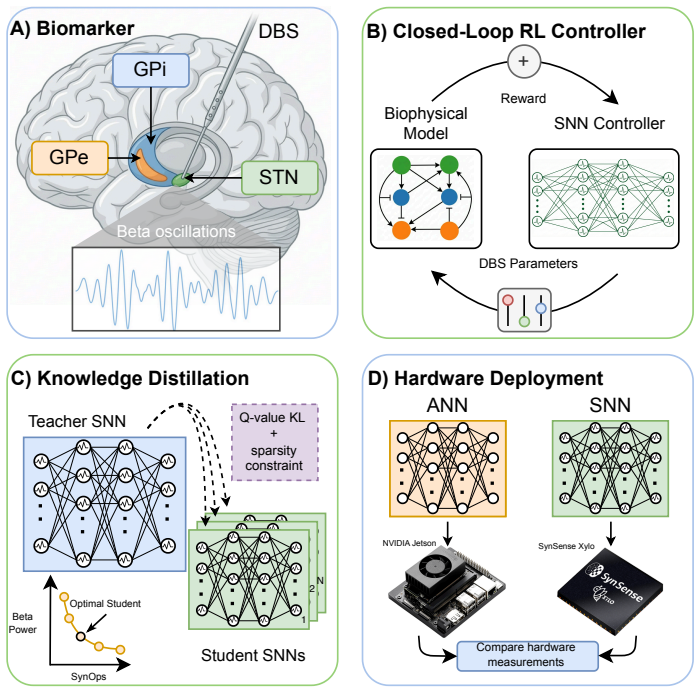
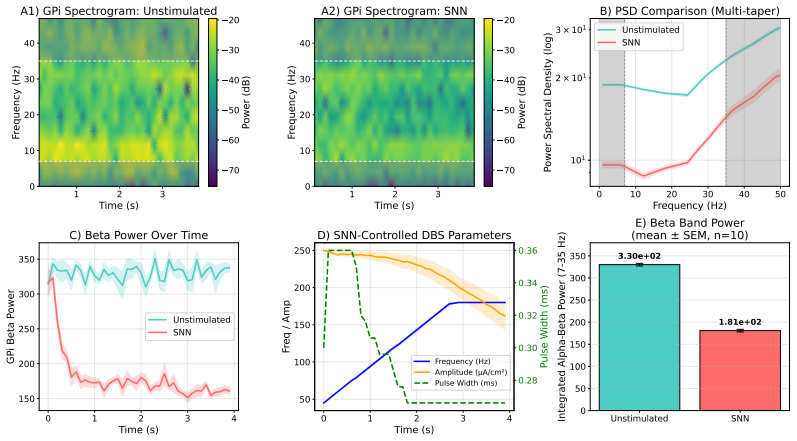
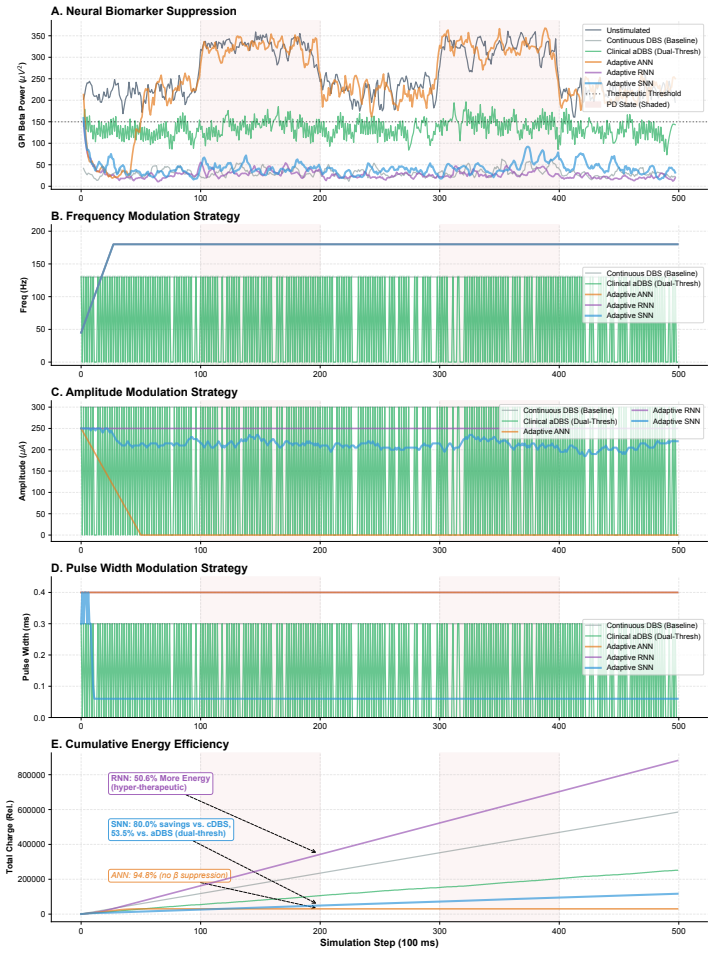
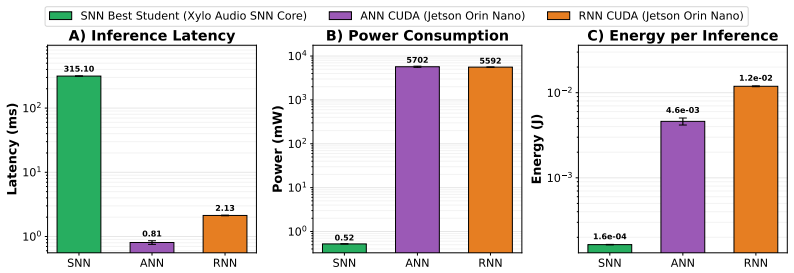
Incorporating actuator energy into the reward of a reinforcement learning agent allows a deep spiking Q-network, trained inside a cortico-basal ganglia-thalamic circuit model, to learn an adaptive deep brain stimulation policy that reduces pathological alpha-beta oscillations by 45.2% while cutting stimulation charge by 80.0% relative to continuous DBS; the policy can then be compressed onto the SynSense XyloAudio 3 neuromorphic processor at 0.52 mW inference power, yielding 28.1 times lower energy per inference than an equivalent artificial neural network on conventional hardware.
What carries the argument
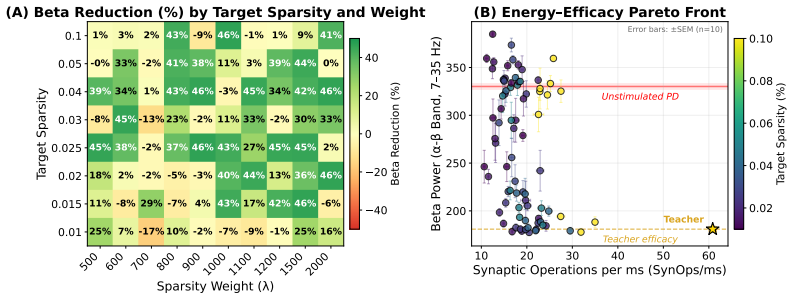
Energy-aware reinforcement learning reward that penalizes stimulation charge, implemented inside a deep spiking Q-network and followed by sparsity-constrained knowledge distillation to a neuromorphic processor.
If this is right
- Adaptive DBS policies can achieve substantial oscillation suppression at far lower stimulation energy than continuous delivery.
- Neuromorphic hardware can host the resulting policies at sub-milliwatt inference power.
- Co-optimization of controller and actuator energy addresses both dominant power demands in implantable neuromodulation devices.
Where Pith is reading between the lines
- The same reward-augmentation approach could be tested in other closed-loop neuromodulation settings such as epilepsy or pain management.
- Real deployment would require checking whether the learned policy remains effective when the underlying circuit model is replaced by patient-specific data.
- The method may generalize to any physical system in which actuator energy dominates total consumption once inference is already efficient.
Load-bearing premise
The biophysical cortico-basal ganglia-thalamic circuit model accurately represents the dynamics of pathological oscillations and the effects of stimulation in actual human patients.
What would settle it
Application of the learned stimulation policy to human patients or a higher-fidelity model, with direct measurement of both oscillation suppression and total delivered charge compared against continuous DBS.
Figures

read the original abstract
Neuromorphic and edge computing research has focused on reducing the inference cost of neural network controllers, yet in physical closed-loop systems the actuator can rival or exceed an efficient controller in energy. An efficient controller is therefore necessary but not sufficient, because the actuator becomes the cost worth reducing once inference no longer dominates it. Here, we introduce energy-aware learning, an approach that incorporates actuator energy directly into the reinforcement learning reward, and demonstrate it in closed-loop deep brain stimulation (DBS) for Parkinson's disease. A deep spiking Q-network, trained in a biophysical cortico-basal ganglia-thalamic circuit model, learns to suppress pathological alpha-beta oscillations by 45.2% while reducing stimulation charge by 80.0% relative to continuous DBS. Sparsity-constrained knowledge distillation compresses the policy onto the SynSense XyloAudio 3 neuromorphic processor at 0.52 mW inference power, yielding 28.1x lower energy per inference than an equivalent artificial neural network on conventional edge hardware. By co-optimizing stimulation energy and inference efficiency, the framework addresses both major power demands in implantable neuromodulation.
Editorial analysis
A structured set of objections, weighed in public.
Referee Report
Summary. The manuscript introduces energy-aware learning for adaptive deep brain stimulation (DBS) in Parkinson's disease. A deep spiking Q-network is trained via reinforcement learning inside a biophysical cortico-basal ganglia-thalamic circuit model; the reward explicitly penalizes stimulation charge. The resulting policy is reported to suppress pathological alpha-beta oscillations by 45.2% while cutting stimulation charge by 80.0% relative to continuous DBS. A sparsity-constrained knowledge-distillation step then deploys the policy on the SynSense XyloAudio 3 neuromorphic processor at 0.52 mW, achieving 28.1× lower energy per inference than an equivalent ANN on conventional edge hardware.
Significance. If the underlying biophysical model is shown to reproduce human LFP spectra and DBS responses, the work would be significant for implantable neuromodulation: it jointly optimizes actuator energy (via the RL reward) and inference energy (via spiking networks and neuromorphic deployment). The explicit inclusion of actuator cost in the learning objective and the end-to-end hardware mapping are concrete strengths that address both dominant power sinks in closed-loop DBS.
major comments (2)
- [Abstract] Abstract: all quantitative claims (45.2% oscillation suppression, 80.0% charge reduction, 28.1× energy reduction) are generated exclusively inside the cortico-basal ganglia-thalamic model. No cross-validation against human LFP spectra, patient-specific parameters, or alternative models is described, rendering the reported percentages clinically uninterpretable without that match.
- [Abstract] Abstract: the central performance numbers are presented without any description of the training procedure, choice of baselines, statistical tests, number of runs, or error bars. This absence prevents assessment of robustness and is load-bearing for the claim that the policy outperforms continuous DBS.
Simulated Author's Rebuttal
We thank the referee for the constructive comments on the abstract. We agree that the abstract should better contextualize the simulation-based nature of the results and include key methodological details for assessing robustness. We will revise the abstract and add supporting text in the manuscript.
read point-by-point responses
-
Referee: [Abstract] Abstract: all quantitative claims (45.2% oscillation suppression, 80.0% charge reduction, 28.1× energy reduction) are generated exclusively inside the cortico-basal ganglia-thalamic model. No cross-validation against human LFP spectra, patient-specific parameters, or alternative models is described, rendering the reported percentages clinically uninterpretable without that match.
Authors: We acknowledge that all reported metrics are obtained within the computational model and that the abstract does not explicitly reference external validation. The cortico-basal ganglia-thalamic model employed is a standard biophysical model previously shown in the literature to reproduce human LFP spectra and DBS response characteristics; we will add citations to these validation studies in the revised abstract and expand the discussion section to clarify the model's established fidelity. Direct cross-validation on new human datasets or patient-specific tuning lies outside the scope of this in silico study, but the framework is intended to support such extensions. revision: partial
-
Referee: [Abstract] Abstract: the central performance numbers are presented without any description of the training procedure, choice of baselines, statistical tests, number of runs, or error bars. This absence prevents assessment of robustness and is load-bearing for the claim that the policy outperforms continuous DBS.
Authors: The abstract is constrained by length, but the full manuscript details the RL training procedure (including the spiking Q-network architecture, reward formulation, and optimization), the continuous DBS baseline, statistical comparisons, and results aggregated over multiple independent runs with error bars (see Methods and Results sections). We will revise the abstract to concisely note that performance is averaged over N independent training runs with statistical testing against the baseline. revision: yes
Circularity Check
No circularity: results are simulation outcomes, not reductions by construction
full rationale
The paper reports quantitative results (45.2% oscillation suppression, 80% charge reduction) as direct outputs of reinforcement learning training inside the cortico-basal ganglia-thalamic model using an energy-aware reward. No equations, fitted parameters renamed as predictions, or self-citation chains are shown that would make these percentages equivalent to the model inputs by definition. The framework is presented as a demonstration of co-optimization within the specified biophysical simulator; the model's fidelity to human data is an external validity assumption rather than a circularity in the derivation itself.
Axiom & Free-Parameter Ledger
free parameters (1)
- energy weighting factor in reward
axioms (1)
- domain assumption The cortico-basal ganglia-thalamic circuit model accurately captures Parkinson's pathological oscillations and stimulation effects
Reference graph
Works this paper leans on
-
[1]
The Journal of Physiology , volume =
A Quantitative Description of Membrane Current and Its Application to Conduction and Excitation in Nerve , author =. The Journal of Physiology , volume =. doi:10.1113/jphysiol.1952.sp004764 , urldate =
-
[2]
IEEE Transactions on Neural Networks , volume =
Simple Model of Spiking Neurons , author =. IEEE Transactions on Neural Networks , volume =. doi:10.1109/TNN.2003.820440 , urldate =
-
[3]
Advances in Neural Information Processing Systems 32 , pages =
PyTorch: An Imperative Style, High-Performance Deep Learning Library , author =. Advances in Neural Information Processing Systems 32 , pages =. 2019 , publisher =
2019
-
[4]
and Ward, Max and Neftci, Emre O
Eshraghian, Jason K. and Ward, Max and Neftci, Emre O. and Wang, Xinxin and Lenz, Gregor and Dwivedi, Girish and Bennamoun, Mohammed and Jeong, Doo Seok and Lu, Wei D. , year = 2023, month = sep, journal =. Training. doi:10.1109/JPROC.2023.3308088 , urldate =
-
[5]
, year = 2020, month = jan, journal =
Lu, Meili and Wei, Xile and Che, Yanqiu and Wang, Jiang and Loparo, Kenneth A. , year = 2020, month = jan, journal =. Application of. doi:10.1109/TNSRE.2019.2952637 , langid =
-
[6]
Deep Brain Stimulation of the Subthalamic Nucleus for the Treatment of
Benabid, Alim Louis and Chabardes, Stephan and Mitrofanis, John and Pollak, Pierre , year = 2009, month = jan, journal =. Deep Brain Stimulation of the Subthalamic Nucleus for the Treatment of. doi:10.1016/S1474-4422(08)70291-6 , langid =
-
[7]
What Brain Signals Are Suitable for Feedback Control of Deep Brain Stimulation in
Little, Simon and Brown, Peter , year = 2012, journal =. What Brain Signals Are Suitable for Feedback Control of Deep Brain Stimulation in. doi:10.1111/j.1749-6632.2012.06650.x , urldate =
-
[8]
Little, Simon and Pogosyan, Alex and Neal, Spencer and Zavala, Baltazar and Zrinzo, Ludvic and Hariz, Marwan and Foltynie, Thomas and Limousin, Patricia and Ashkan, Keyoumars and FitzGerald, James and Green, Alexander L. and Aziz, Tipu Z. and Brown, Peter , year = 2013, month = sep, journal =. Adaptive Deep Brain Stimulation in Advanced. doi:10.1002/ana.2...
-
[9]
and Heijmans, Margot and Kuijf, Mark L
Habets, Jeroen G.V. and Heijmans, Margot and Kuijf, Mark L. and Janssen, Marcus L.F. and Temel, Yasin and Kubben, Pieter L. , year =. An Update on Adaptive Deep Brain Stimulation in. Movement Disorders , volume =. doi:10.1002/mds.115 , url =
-
[10]
Arlotti, Mattia and Marceglia, Sara and Foffani, Guglielmo and Volkmann, Jens and Lozano, Andres M. and Moro, Elena and Cogiamanian, Filippo and Prenassi, Marco and Bocci, Tommaso and Cortese, Francesca and Rampini, Paolo and Barbieri, Sergio and Priori, Alberto , year = 2018, month = mar, journal =. Eight-Hours Adaptive Deep Brain Stimulation in Patients...
-
[11]
Pathological Synchronization in
Hammond, Constance and Bergman, Hagai and Brown, Peter , year = 2007, month = jul, journal =. Pathological Synchronization in. doi:10.1016/j.tins.2007.05.004 , urldate =
-
[12]
Journal of NeuroEngineering and Rehabilitation , volume =
Advances in Closed-Loop Deep Brain Stimulation Devices , author =. Journal of NeuroEngineering and Rehabilitation , volume =. doi:10.1186/s12984-017-0295-1 , urldate =
-
[13]
Thakur, Chetan Singh and Molin, Jamal Lottier and Cauwenberghs, Gert and Indiveri, Giacomo and Kumar, Kundan and Qiao, Ning and Schemmel, Johannes and Wang, Runchun and Chicca, Elisabetta and Olson Hasler, Jennifer and Seo, Jae-sun and Yu, Shimeng and Cao, Yu and. Large-. Frontiers in Neuroscience , volume =. doi:10.3389/fnins.2018.00891 , urldate =
-
[14]
Journal of Computational Neuroscience , volume =
High Frequency Stimulation of the Subthalamic Nucleus Eliminates Pathological Thalamic Rhythmicity in a Computational Model , author =. Journal of Computational Neuroscience , volume =
-
[15]
Kumaravelu, Karthik and Brocker, David T. and Grill, Warren M. , year = 2016, month = apr, journal =. A Biophysical Model of the Cortex-Basal Ganglia-Thalamus Network in the 6-. doi:10.1007/s10827-016-0593-9 , langid =
-
[16]
IEEE Neural Engineering Conference (NER) , year =
Accelerating Neuromorphic Deep Brain Stimulation Optimization through Knowledge Distillation and Enforced Sparsity , author =. IEEE Neural Engineering Conference (NER) , year =
-
[17]
Nguyen, Binh and Mighetto, Edward and Louie, Dylan and Yu, Chunxiu and Eshraghian, Jason , year = 2025, month = may, pages =. Closed-. 2025. doi:10.1109/ISCAS56072.2025.11043472 , urldate =
-
[18]
Nature Communications , volume =
Efficient Event-Based Delay Learning in Spiking Neural Networks , author =. Nature Communications , volume =. doi:10.1038/s41467-025-65394-8 , urldate =
-
[19]
Neural Computing and Applications , volume =
Energy Efficient and Low-Latency Spiking Neural Networks on Embedded Microcontrollers through Spiking Activity Tuning , author =. Neural Computing and Applications , volume =. doi:10.1007/s00521-024-10191-5 , urldate =
-
[20]
Nature Communications , volume =
Neuromorphic Hardware for Somatosensory Neuroprostheses , author =. Nature Communications , volume =. doi:10.1038/s41467-024-44723-3 , urldate =
-
[21]
and Gurram, Sandeep and Kamble, Nitish and Yadav, Ravi and Srinivas, Dwarakanath and Pal, Pramod K
Sharma, Praveen and Holla, Vikram V. and Gurram, Sandeep and Kamble, Nitish and Yadav, Ravi and Srinivas, Dwarakanath and Pal, Pramod K. , year = 2023, journal =. A. doi:10.4103/aian.aian_62_23 , urldate =
-
[22]
and Bauer, Felix and Weidel, Philipp , title =
Muir, Dylan R. and Bauer, Felix and Weidel, Philipp , title =. doi:10.5281/zenodo.3773845 , url =
-
[23]
Bos, Hannah and Muir, Dylan , year = 2022, month = sep, number =. Sub-. doi:10.48550/arXiv.2208.12991 , urldate =. arXiv , keywords =:2208.12991 , primaryclass =
-
[24]
2019 , organization =
Jetson. 2019 , organization =
2019
-
[25]
Pedersen, Jens E. and Abreu, Steven and Jobst, Matthias and Lenz, Gregor and Fra, Vittorio and Bauer, Felix Christian and Muir, Dylan Richard and Zhou, Peng and Vogginger, Bernhard and Heckel, Kade and Urgese, Gianvito and Shankar, Sadasivan and Stewart, Terrence C. and Sheik, Sadique and Eshraghian, Jason K. , year = 2024, month = sep, journal =. Neuromo...
-
[26]
Pierro, Alessandro and Abreu, Steven and Timcheck, Jonathan and Stratmann, Philipp and Wild, Andreas and Shrestha, Sumit Bam , year = 2025, month = aug, number =. Accelerating. doi:10.48550/arXiv.2502.01330 , urldate =. arXiv , keywords =:2502.01330 , primaryclass =
-
[27]
Kuzmina, Ekaterina and Kriukov, Dmitrii and Lebedev, Mikhail and Dylov, Dmitry V. , year =. Neurophysiologically. doi:10.48550/arXiv.2505.09624 , url =. 2505.09624 , archiveprefix =
-
[28]
Selection of Stimulus Parameters for Deep Brain Stimulation , author =. 2004 , month = nov, journal =. doi:10.1016/j.clinph.2004.05.031 , url =
-
[29]
Technology of Deep Brain Stimulation: Current Status and Future Directions , author =. 2021 , month = feb, journal =. doi:10.1038/s41582-020-00426-z , url =
-
[30]
Gao, Qitong and Naumann, Michael and Jovanov, Ilija and Lesi, Vuk and Kamaravelu, Karthik and Grill, Warren M. and Pajic, Miroslav , year =. Model-. 2020. doi:10.1109/ICCPS48487.2020.00018 , url =
-
[31]
, year = 2019, month = sep, journal =
Su, Fei and Kumaravelu, Karthik and Wang, Jiang and Grill, Warren M. , year = 2019, month = sep, journal =. Model-. doi:10.3389/fnins.2019.00956 , urldate =
-
[32]
Proceedings of the National Academy of Sciences , volume =
Temporal Evolution of Beta Bursts in the Parkinsonian Cortical and Basal Ganglia Network , author =. Proceedings of the National Academy of Sciences , volume =. doi:10.1073/pnas.1819975116 , urldate =
-
[33]
Stanslaski, Scott and Summers, Rebekah L. S. and Tonder, Lisa and Tan, Ye and Case, Michelle and Raike, Robert S. and Morelli, Nathan and Herrington, Todd M. and Beudel, Martijn and Ostrem, Jill L. and Little, Simon and Almeida, Leonardo and. Sensing Data and Methodology from the. npj Parkinson's Disease , volume =. doi:10.1038/s41531-024-00772-5 , urldate =
-
[34]
Long-. JAMA Neurology , volume =. doi:10.1001/jamaneurol.2025.2781 , urldate =
-
[35]
Gilron, Ro'ee and Little, Simon and Perrone, Randy and Wilt, Robert and. Long-Term Wireless Streaming of Neural Recordings for Circuit Discovery and Adaptive Stimulation in Individuals with. Nature Biotechnology , volume =. doi:10.1038/s41587-021-00897-5 , urldate =
-
[36]
Li, Zongyi and Kovachki, Nikola and Azizzadenesheli, Kamyar and Liu, Burigede and Bhattacharya, Kaushik and Stuart, Andrew and Anandkumar, Anima , year = 2021, month = may, number =. Fourier. doi:10.48550/arXiv.2010.08895 , urldate =. arXiv , keywords =:2010.08895 , primaryclass =
work page internal anchor Pith review Pith/arXiv arXiv doi:10.48550/arxiv.2010.08895 2021
-
[37]
Lu, Lu and Jin, Pengzhan and Karniadakis, George Em , year = 2021, month = mar, journal =. doi:10.1038/s42256-021-00302-5 , urldate =. arXiv , keywords =:1910.03193 , primaryclass =
work page internal anchor Pith review Pith/arXiv arXiv doi:10.1038/s42256-021-00302-5 2021
-
[38]
, year = 2020, journal =
Liu, Chen and Zhao, Ge and Wang, Jiang and Wu, Hao and Li, Huiyan and Fietkiewicz, Chris and Loparo, Kenneth A. , year = 2020, journal =. Neural
2020
-
[39]
Cho, Chia-Hung and Huang, Pin-Jui and Chen, Meng-Chao and Lin, Chii-Wann , year = 2024, journal =. Closed-. doi:10.1109/TNSRE.2024.3465243 , urldate =
-
[40]
, year = 2014, month = nov, journal =
Ebert, Martin and Hauptmann, Christian and Tass, Peter A. , year = 2014, month = nov, journal =. Coordinated Reset Stimulation in a Large-Scale Model of the. doi:10.3389/fncom.2014.00154 , urldate =
-
[41]
Jarvis, M. R. and Mitra, P. P. , year = 2001, month = apr, journal =. Sampling. doi:10.1162/089976601300014312 , urldate =
-
[42]
Annals of Neurology , volume =
Calculating Total Electrical Energy Delivered by Deep Brain Stimulation Systems , author =. Annals of Neurology , volume =. doi:10.1002/ana.20525 , urldate =
-
[43]
Cho, Kyunghyun and. On the. Proceedings of. doi:10.3115/v1/W14-4012 , urldate =
-
[44]
Velisar, A. and. Dual Threshold Neural Closed Loop Deep Brain Stimulation in. Brain Stimulation , volume =. doi:10.1016/j.brs.2019.02.020 , urldate =
-
[45]
Sensors (Basel, Switzerland) , volume =
A. Sensors (Basel, Switzerland) , volume =. doi:10.3390/s22176429 , urldate =
-
[46]
Helmers, Ann-Kristin and L. Comparison of the. Neuromodulation: Journal of the International Neuromodulation Society , volume =. doi:10.1111/ner.12720 , langid =
-
[47]
Sarica, Can and. Implantable. Frontiers in Human Neuroscience , volume =. doi:10.3389/fnhum.2021.708481 , urldate =
-
[48]
Science Translational Medicine , volume =
Optimized Temporal Pattern of Brain Stimulation Designed by Computational Evolution , author =. Science Translational Medicine , volume =. doi:10.1126/scitranslmed.aah3532 , langid =
-
[49]
Nine-Year Prospective Efficacy and Safety of Brain-Responsive Neurostimulation for Focal Epilepsy , author =. Neurology , volume =. doi:10.1212/WNL.0000000000010154 , urldate =
-
[50]
Mekhail, Nagy and Levy, Robert M. and Deer, Timothy R. and Kapural, Leonardo and Li, Sean and Amirdelfan, Kasra and Hunter, Corey W. and Rosen, Steven M. and Costandi, Shrif J. and Falowski, Steven M. and Burgher, Abram H. and Pope, Jason E. and Gilmore, Christopher A. and Qureshi, Farooq A. and Staats, Peter S. and Scowcroft, James and Carlson, Jonathan ...
discussion (0)
Sign in with ORCID, Apple, or X to comment. Anyone can read and Pith papers without signing in.