The Long-Period Radio Transient and Cataclysmic Variable ASKAP J1745-5051: Evidence for a 15,000 K White Dwarf and a Sub-Stellar Donor
Pith reviewed 2026-06-30 08:24 UTC · model grok-4.3
The pith
The radio transient ASKAP J1745-5051 contains a 15,000 K white dwarf and a sub-stellar donor.
A machine-rendered reading of the paper's core claim, the machinery that carries it, and where it could break.
Core claim
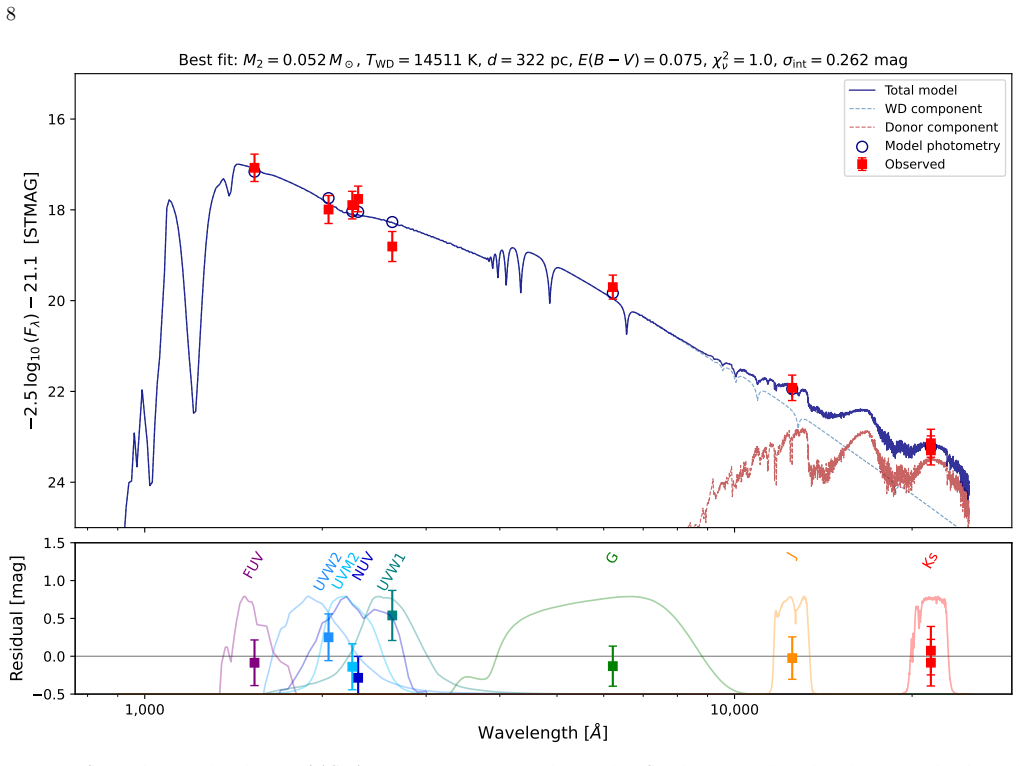
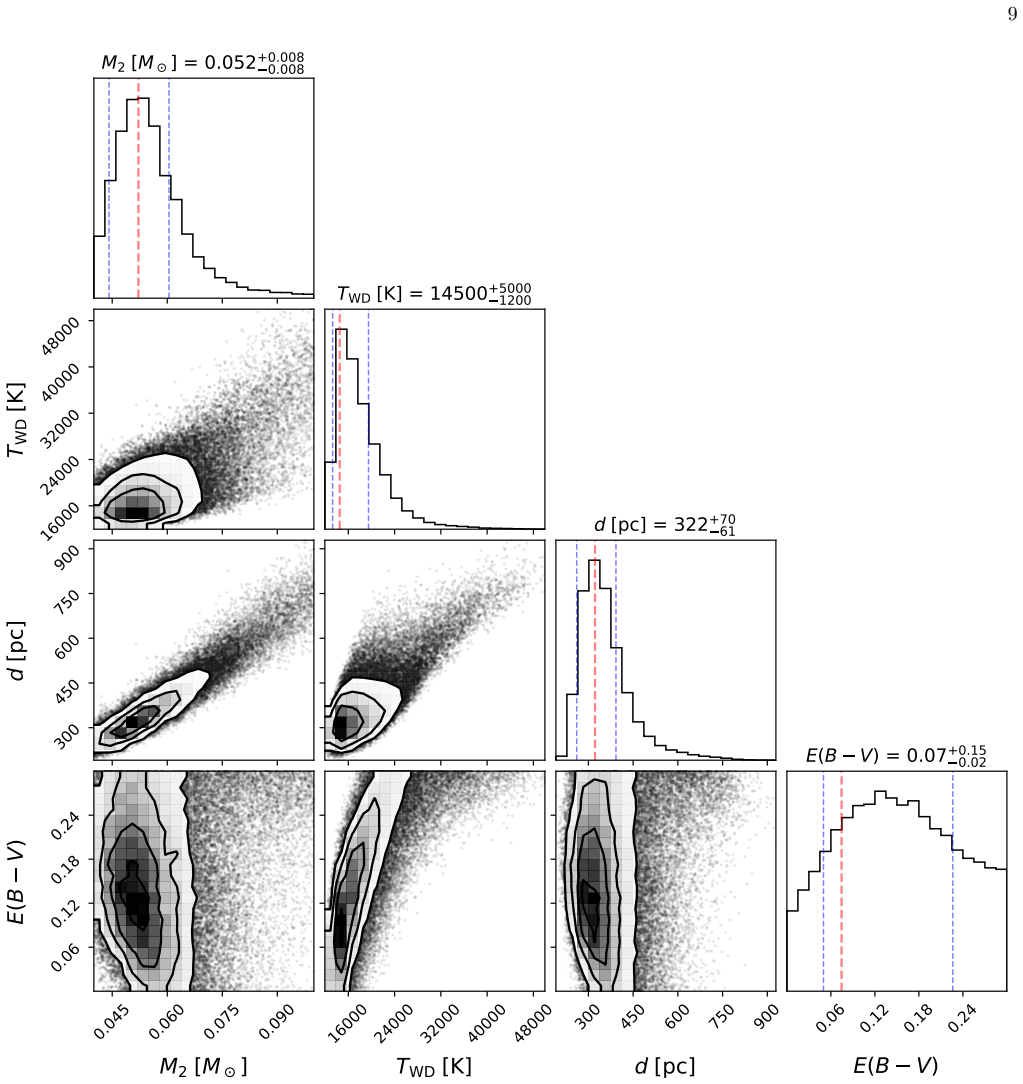
The broad-band SED is well described by a 15,000 K white dwarf dominating far-UV through optical and a sub-stellar donor (M2 ~ 0.05 Msun, Teff ~ 1800 K) dominating in the Ks band, indicating the system is a period bouncer. The SED fit also yields a distance of d ~ 320 pc, only ~4x larger than that to the nearest confirmed mCV. Since the fraction of the sky swept out by the radio beam is likely to be small, systems like ASKAP J1745-5051 could make up a large percentage of mCVs.
What carries the argument
Broad-band spectral energy distribution fitting with synthetic spectra from model atmospheres for the white dwarf and the donor star, after correcting for reddening and removing contaminated photometry.
If this is right
- The inferred white dwarf temperature is reasonable for an accretion-heated primary in a short-period magnetic cataclysmic variable.
- The sub-stellar nature of the donor indicates that the system has evolved past the cataclysmic variable period minimum.
- Systems like ASKAP J1745-5051 could make up a large percentage of magnetic cataclysmic variables if their radio beams cover only a small fraction of the sky.
- This points towards a connection between long-period radio transients and the missing population of period bouncers among cataclysmic variables.
Where Pith is reading between the lines
- If the radio emission is beamed narrowly, then many more such period-bouncer systems may exist but remain undetected in radio surveys.
- The relatively close distance of 320 pc implies that similar systems could be found in existing multi-wavelength surveys with targeted follow-up.
- Confirming more such objects would help resolve the discrepancy between predicted and observed numbers of evolved cataclysmic variables.
Load-bearing premise
The near-infrared flux is entirely from the donor star with negligible contribution from an accretion disk or other components.
What would settle it
A parallax measurement from Gaia or another astrometric mission that yields a distance significantly different from 320 pc, or infrared spectroscopy that shows spectral features inconsistent with a 1800 K sub-stellar object.
Figures
read the original abstract
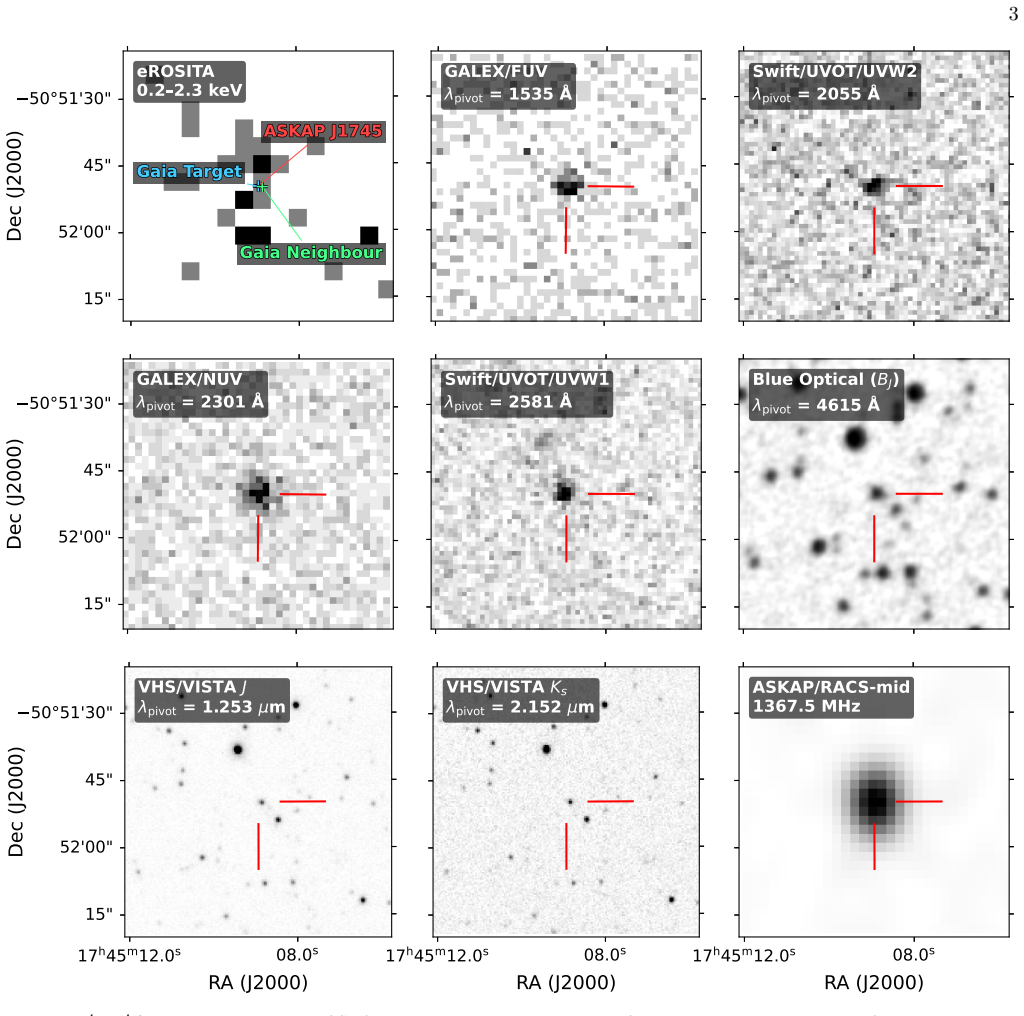
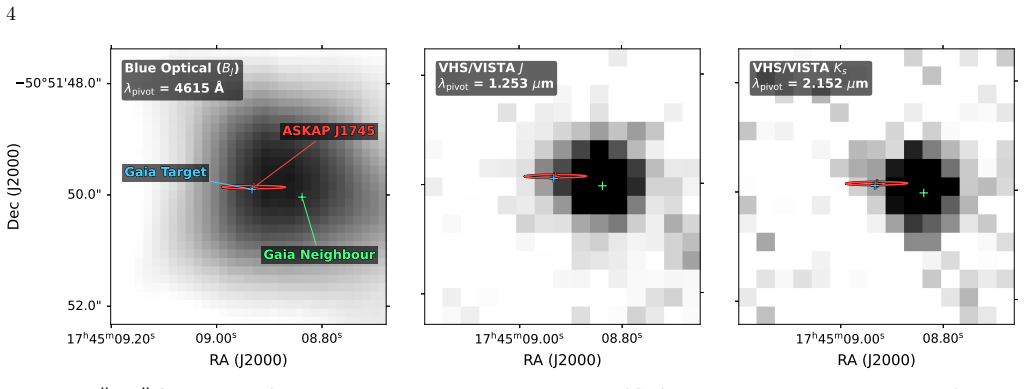
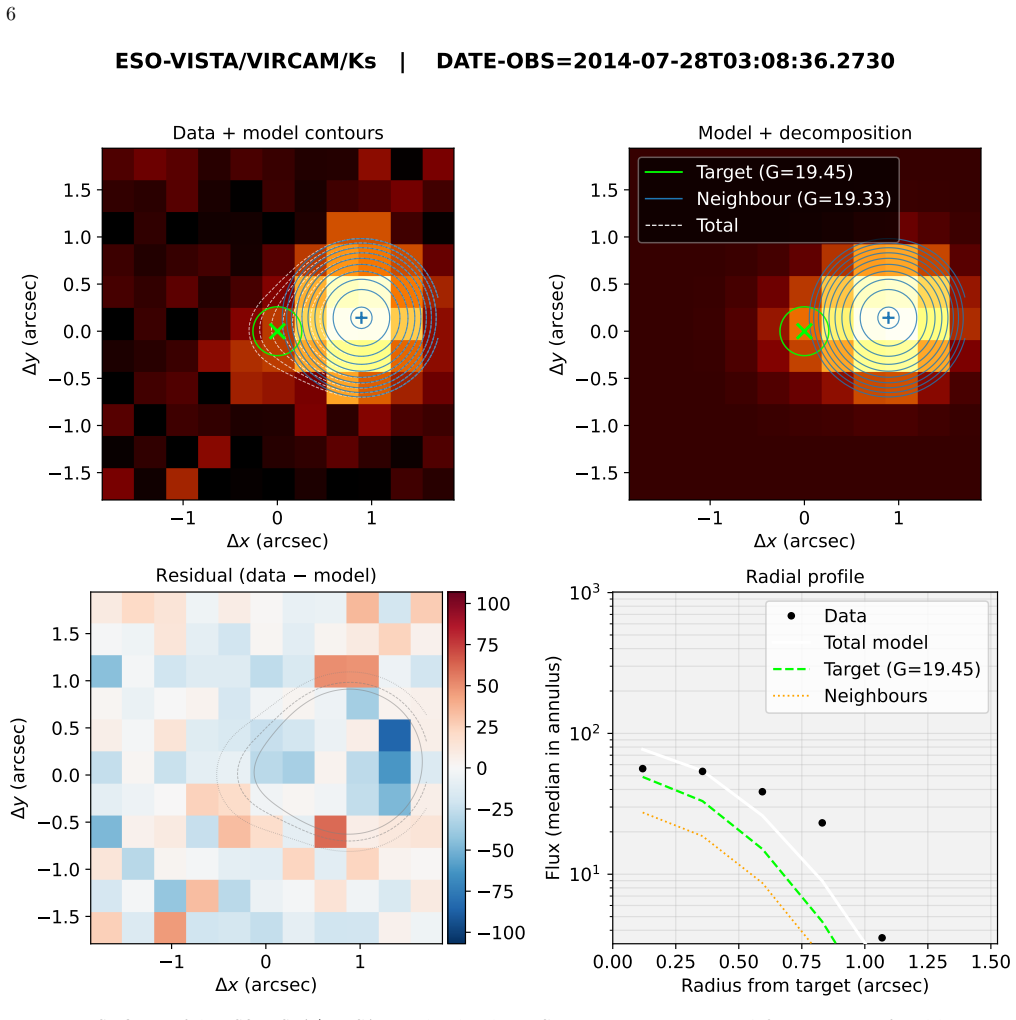
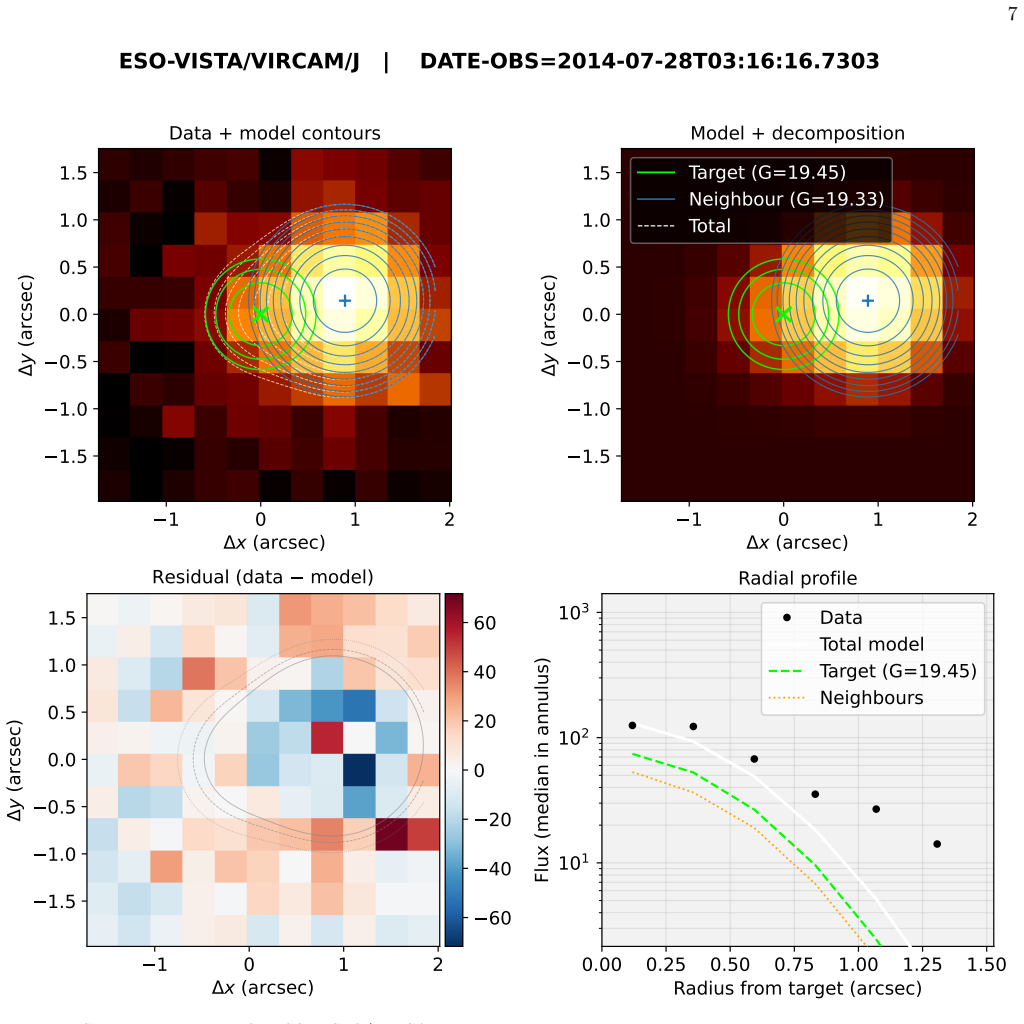
Long-period transients (LPTs) are radio sources that exhibit polarized periodic radio bursts on time-scales of minutes to hours. At least some LPTs are associated with white dwarfs (WDs) in close binary systems. However, the evolutionary connection between LPTs and accreting WDs (aka ``cataclysmic variables'' [CVs]) has been unclear. The recent discovery of ASKAP J1745-5051 has been a breakthrough: this system is a bona-fide LPT that is also an X-ray emitting magnetic CV (mCV) with P_orb ~ 1.3 hrs. Here, we construct the broad-band far-UV through near-IR SED for the system and show that it is well described by two components: a 15,000 K WD (which dominates the far-UV through optical bands) and a sub-stellar (M_2 ~ 0.05~M_sun, T_eff ~ 1800 K) donor star (which dominates in the K_s band). Our SED-fitting results differ from those in the discovery paper for four reasons: (i) we fix an issue with the treatment of reddening/extinction; (ii) we discard photometric measurements that are irreparably contaminated by an unrelated star located just 0.9" from the target; (iii) we add near-infrared brightness measurements obtained from PSF-fitting photometry on archival VISTA/VHS observations; (iv) we fit the data with synthetic spectra based on model atmospheres (rather than with blackbodies). The inferred WD temperature is reasonable for an accretion-heated primary in a short-period mCV. The sub-stellar nature of the donor suggests that the system is a "period bouncer" that has already evolved past the CV period minimum. The SED fit also yields a distance of d ~ 320 pc, only ~4x larger than that to the nearest confirmed mCV. Since the fraction of the sky swept out by the radio beam is likely to be small, systems like ASKAP J1745-5051 could make up a large percentage of mCVs. This may point towards a connection between LPTs and the ``missing'' population of period bouncers among CVs.
Editorial analysis
A structured set of objections, weighed in public.
Referee Report
Summary. The manuscript analyzes the broadband far-UV to near-IR SED of the long-period radio transient and magnetic CV ASKAP J1745-5051. After correcting the reddening treatment, discarding photometry contaminated by a 0.9 arcsec neighbor, adding VISTA/VHS PSF photometry, and fitting with model-atmosphere spectra rather than blackbodies, the authors find a two-component solution: a 15,000 K white dwarf dominating UV-optical and a sub-stellar donor (M2 ≈ 0.05 M⊙, Teff ≈ 1800 K) dominating the Ks band. They conclude the system is a period bouncer at d ≈ 320 pc and discuss implications for the LPT–CV connection.
Significance. If the Ks-band attribution holds, the result supplies direct evidence that at least one LPT is a period-bouncing mCV and suggests such systems may be common enough to account for a substantial fraction of the mCV population. The use of atmosphere grids and explicit photometric decontamination improves on the discovery paper.
major comments (1)
- [Abstract (SED model)] Abstract (two-component SED model): The period-bouncer classification rests on the Ks flux being produced almost entirely by the 1800 K, 0.05 M⊙ donor. In mCVs the accretion column produces cyclotron radiation whose spectrum for B ~ 10–100 MG commonly peaks in the near-IR. The fit does not include or marginalize over a cyclotron term, nor does it report an upper limit on its contribution. A 20–40 % cyclotron fraction would lower the required donor luminosity and could push the mass above the hydrogen-burning limit, undermining the sub-stellar claim.
minor comments (2)
- [Abstract] The abstract states that VISTA PSF photometry was added but does not list the resulting magnitudes, uncertainties, or the exact filter transmission used in the fit.
- A table of all photometric points (with references, which points were discarded, and the impact on the fit) would aid reproducibility and allow readers to assess the neighbor decontamination.
Simulated Author's Rebuttal
We thank the referee for their constructive comments on our manuscript. We address the single major comment below and have revised the manuscript to incorporate additional discussion and limits as appropriate.
read point-by-point responses
-
Referee: Abstract (two-component SED model): The period-bouncer classification rests on the Ks flux being produced almost entirely by the 1800 K, 0.05 M⊙ donor. In mCVs the accretion column produces cyclotron radiation whose spectrum for B ~ 10–100 MG commonly peaks in the near-IR. The fit does not include or marginalize over a cyclotron term, nor does it report an upper limit on its contribution. A 20–40 % cyclotron fraction would lower the required donor luminosity and could push the mass above the hydrogen-burning limit, undermining the sub-stellar claim.
Authors: We agree that cyclotron emission from the accretion column is a relevant consideration for magnetic CVs and could in principle contribute to the near-IR. Our two-component (WD + donor) atmosphere fit reproduces the observed SED to within the photometric uncertainties across FUV to Ks with no systematic residuals in the Ks band. Nevertheless, to strengthen the analysis we have added a new subsection discussing possible cyclotron contributions. Using the fit residuals and the expected cyclotron spectral shape for B ~ 10–50 MG, we derive a conservative 3σ upper limit of ~15% on any non-stellar contribution to the Ks flux. Even allowing this maximum fraction, the required donor luminosity remains consistent with a sub-stellar object (M2 ≲ 0.07 M⊙). We have also updated the abstract to note this limit explicitly. A full cyclotron model marginalization would require additional assumptions about the magnetic field geometry and accretion rate; we therefore treat the current limit as sufficient for the present data while flagging the need for phase-resolved NIR spectroscopy in future work. revision: partial
Circularity Check
No circularity: SED parameters obtained by direct fitting to photometry using external model grids
full rationale
The derivation consists of correcting archival photometry for reddening and neighbor contamination, then fitting two-component synthetic spectra (white-dwarf atmosphere grid plus donor atmosphere grid) to the resulting SED points. The sub-stellar donor mass and temperature are outputs of this least-squares fit; the period-bouncer classification follows directly from the fitted mass lying below the hydrogen-burning limit. No equation, normalization, or self-citation is invoked to force the result to equal any input quantity. Citations to the discovery paper supply only the orbital period and radio/X-ray context and do not enter the SED model or the mass inference. The procedure is therefore self-contained against external atmosphere models and observed fluxes.
Axiom & Free-Parameter Ledger
free parameters (4)
- White dwarf temperature =
15000 K
- Donor mass =
0.05 Msun
- Donor effective temperature =
1800 K
- Distance =
320 pc
axioms (3)
- domain assumption White dwarf and brown-dwarf model atmospheres from standard grids accurately predict the observed fluxes at the fitted temperatures and gravities
- domain assumption The orbital period and magnetic CV classification reported in the discovery paper are correct
- domain assumption The 0.9 arcsec neighbor is unrelated and its flux can be fully removed from the target photometry
Reference graph
Works this paper leans on
-
[1]
Anumarlapudi, A., Kaplan, D. L., Rea, N., et al. 2025, MNRAS, 542, 1208, doi: 10.1093/mnras/staf1227
-
[2]
Archibald, A. M., Stairs, I. H., Ransom, S. M., et al. 2009, Science, 324, 1411, doi: 10.1126/science.1172740
-
[3]
2023, A&A, 674, A32, doi: 10.1051/0004-6361/202243790
Babusiaux, C., Fabricius, C., Khanna, S., et al. 2023, A&A, 674, A32, doi: 10.1051/0004-6361/202243790
-
[4]
Barrett, P., Dieck, C., Beasley, A. J., Mason, P. A., & Singh, K. P. 2020, Advances in Space Research, 66, 1226, doi: 10.1016/j.asr.2020.04.007
-
[5]
Barrett, P. E., & Gurwell, M. A. 2025, arXiv e-prints, arXiv:2505.06468, doi: 10.48550/arXiv.2505.06468
-
[6]
Bergeron, P., Leggett, S. K., & Ruiz, M. T. 2001, ApJS, 133, 413, doi: 10.1086/320356
-
[7]
1995, PASP, 107, 1047, doi: 10.1086/133661
Bergeron, P., Wesemael, F., & Beauchamp, A. 1995, PASP, 107, 1047, doi: 10.1086/133661
-
[8]
Bloot, S., Vedantham, H. K., Bassa, C. G., et al. 2025, A&A, 699, A341, doi: 10.1051/0004-6361/202555131
-
[9]
Buckley, D. A. H., Meintjes, P. J., Potter, S. B., Marsh, T. R., & G¨ ansicke, B. T. 2017, Nature Astronomy, 1, 0029, doi: 10.1038/s41550-016-0029
-
[10]
Camisassa, M., Fuentes, J. R., Schreiber, M. R., et al. 2024, A&A, 691, L21, doi: 10.1051/0004-6361/202452539
-
[11]
Campbell, R., & Harrison, T. E. 2007, in American Astronomical Society Meeting Abstracts, Vol. 211, American Astronomical Society Meeting Abstracts, 15.14 Castro Segura, N., Pelisoli, I., G¨ ansicke, B. T., et al. 2025, MNRAS, 543, 2116, doi: 10.1093/mnras/staf1511
-
[12]
2024, ApJ, 975, 63, doi: 10.3847/1538-4357/ad7a6a
Castro-Tapia, M., Zhang, S., & Cumming, A. 2024, ApJ, 975, 63, doi: 10.3847/1538-4357/ad7a6a
-
[13]
Cropper, M. 1990, Space Sci. Rev., 54, 195, doi: 10.1007/BF00177799 de Ruiter, I., Rajwade, K. M., Bassa, C. G., et al. 2025, Nature Astronomy, doi: 10.1038/s41550-025-02491-0 du Plessis, L., Venter, C., Wadiasingh, Z., et al. 2022, MNRAS, 510, 2998, doi: 10.1093/mnras/stab3595
-
[14]
Ferrario, L., de Martino, D., & G¨ ansicke, B. T. 2015, Space Sci. Rev., 191, 111, doi: 10.1007/s11214-015-0152-0
-
[15]
Fitzpatrick, E. L. 1999, PASP, 111, 63, doi: 10.1086/316293 Gaia Collaboration, Vallenari, A., Brown, A. G. A., et al. 2023, A&A, 674, A1, doi: 10.1051/0004-6361/202243940 G¨ ansicke, B. T., Beuermann, K., & de Martino, D. 1995, A&A, 303, 127 G¨ ansicke, B. T., Schmidt, G. D., Jordan, S., & Szkody, P. 2001, ApJ, 555, 380, doi: 10.1086/321464 G¨ ansicke, B...
-
[16]
2019, ApJ, 872, 67, doi: 10.3847/1538-4357/aafb2c
Garnavich, P., Littlefield, C., Kafka, S., et al. 2019, ApJ, 872, 67, doi: 10.3847/1538-4357/aafb2c
-
[17]
2021, ApJ, 908, 195, doi: 10.3847/1538-4357/abd4db
Garnavich, P., Littlefield, C., Lyutikov, M., & Barkov, M. 2021, ApJ, 908, 195, doi: 10.3847/1538-4357/abd4db
-
[18]
2016, ApJ, 831, L10, doi: 10.3847/2041-8205/831/1/L10 Hern´ andez Santisteban, J
Geng, J.-J., Zhang, B., & Huang, Y.-F. 2016, ApJ, 831, L10, doi: 10.3847/2041-8205/831/1/L10 Hern´ andez Santisteban, J. V., Knigge, C., Littlefair, S. P., et al. 2016, Nature, 533, 366, doi: 10.1038/nature17952
-
[19]
Hurley-Walker, N., McSweeney, S. J., Bahramian, A., et al. 2024, ApJ, 976, L21, doi: 10.3847/2041-8213/ad890e I lkiewicz, K., Scaringi, S., Littlefield, C., & Mason, P. A. 2022, MNRAS, 516, 5209, doi: 10.1093/mnras/stac2597
-
[20]
Imbrogno, M., Veresvarska, M., Wang, Y. L., et al. 2026, arXiv e-prints, arXiv:2606.05842, doi: 10.48550/arXiv.2606.05842
work page internal anchor Pith review Pith/arXiv arXiv doi:10.48550/arxiv.2606.05842 2026
-
[21]
Katz, J. I. 2017, ApJ, 835, 150, doi: 10.3847/1538-4357/835/2/150
-
[22]
Knigge, C. 2006, MNRAS, 373, 484, doi: 10.1111/j.1365-2966.2006.11096.x
-
[23]
2011, ApJS, 194, 28, doi: 10.1088/0067-0049/194/2/28
Knigge, C., Baraffe, I., & Patterson, J. 2011, ApJS, 194, 28, doi: 10.1088/0067-0049/194/2/28
-
[24]
2008, ApJ, 683, 1006, doi: 10.1086/589987
Knigge, C., Dieball, A., Ma´ ız Apell´ aniz, J., et al. 2008, ApJ, 683, 1006, doi: 10.1086/589987
-
[25]
2010, Mem
Koester, D. 2010, Mem. Soc. Astron. Italiana, 81, 921
2010
-
[26]
2008, MNRAS, 387, 1669, doi: 10.1111/j.1365-2966.2008.13360.x
Littlefair, S. P., Dhillon, V. S., Marsh, T. R., et al. 2008, MNRAS, 388, 1582, doi: 10.1111/j.1365-2966.2008.13539.x
-
[27]
R., & Kramer, M
Lorimer, D. R., & Kramer, M. 2004, Handbook of Pulsar
2004
-
[28]
Marsh, T. R., G¨ ansicke, B. T., H¨ ummerich, S., et al. 2016, Nature, 537, 374, doi: 10.1038/nature18620
-
[29]
G., Banerji, M., Gonzalez, E., et al
McMahon, R. G., Banerji, M., Gonzalez, E., et al. 2013, The Messenger, 154, 35
2013
-
[30]
Onken, C. A., Wolf, C., Bessell, M. S., et al. 2019, PASA, 36, e033, doi: 10.1017/pasa.2019.27
-
[31]
Pala, A. F., G¨ ansicke, B. T., Breedt, E., et al. 2020, MNRAS, 494, 3799, doi: 10.1093/mnras/staa764
-
[32]
2022, in Astrophysics and Space Science Library, Vol
Papitto, A., & de Martino, D. 2022, in Astrophysics and Space Science Library, Vol. 465, Astrophysics and Space Science Library, ed. S. Bhattacharyya, A. Papitto, & D. Bhattacharya, 157–200, doi: 10.1007/978-3-030-85198-9 6
-
[33]
Pelisoli, I., Marsh, T. R., Parsons, S. G., et al. 2022, MNRAS, 516, 5052, doi: 10.1093/mnras/stac2391
-
[34]
Pelisoli, I., Marsh, T. R., Buckley, D. A. H., et al. 2023, Nature Astronomy, 7, 931, doi: 10.1038/s41550-023-01995-x
-
[35]
2024, MNRAS, 527, 3826, doi: 10.1093/mnras/stad3442
Pelisoli, I., Sahu, S., Lyutikov, M., et al. 2024, MNRAS, 527, 3826, doi: 10.1093/mnras/stad3442
-
[36]
Pelisoli, I., Brown, A. J., Castro Segura, N., et al. 2025, MNRAS, 544, L76, doi: 10.1093/mnrasl/slaf101
-
[37]
Potter, S. B., & Buckley, D. A. H. 2018, MNRAS, 481, 2384, doi: 10.1093/mnras/sty2407
-
[38]
2026, Journal of High Energy Astrophysics, 52, 100566, doi: 10.1016/j.jheap.2026.100566
Rea, N., Hurley-Walker, N., & Caleb, M. 2026, Journal of High Energy Astrophysics, 52, 100566, doi: 10.1016/j.jheap.2026.100566
-
[39]
Rodriguez, A. C. 2025, A&A, 695, L8, doi: 10.1051/0004-6361/202553684
-
[40]
2026, Nature Astronomy, doi: 10.1038/s41550-026-02882-x
Rose, K., Pritchard, J., Murphy, T., et al. 2026, Nature Astronomy, doi: 10.1038/s41550-026-02882-x
-
[41]
Savoury, C. D. J., Littlefair, S. P., Dhillon, V. S., et al. 2011, MNRAS, 415, 2025, doi: 10.1111/j.1365-2966.2011.18707.x
-
[42]
2014, MNRAS, 438, 1233, doi: 10.1093/mnras/stt2270
Scaringi, S. 2014, MNRAS, 438, 1233, doi: 10.1093/mnras/stt2270
-
[43]
Schlafly, E. F., & Finkbeiner, D. P. 2011, ApJ, 737, 103, doi: 10.1088/0004-637X/737/2/103
work page internal anchor Pith review doi:10.1088/0004-637x/737/2/103 2011
-
[44]
2021, Nature Astronomy, 5, 648, doi: 10.1038/s41550-021-01346-8
Zorotovic, M. 2021, Nature Astronomy, 5, 648, doi: 10.1038/s41550-021-01346-8
-
[45]
Speagle, J. S. 2020, MNRAS, 493, 3132, doi: 10.1093/mnras/staa278
-
[46]
Takata, J., Hu, C. P., Lin, L. C. C., et al. 2018, ApJ, 853, 106, doi: 10.3847/1538-4357/aaa23d
-
[47]
Townsley, D. M., & Bildsten, L. 2003, ApJ, 596, L227, doi: 10.1086/379535
-
[48]
Townsley, D. M., & G¨ ansicke, B. T. 2009, ApJ, 693, 1007, doi: 10.1088/0004-637X/693/1/1007
-
[49]
1995, Cataclysmic variable stars, Vol
Warner, B. 1995, Cataclysmic variable stars, Vol. 28 (Cambridge University Press)
1995
-
[50]
Yang, Y.-P. 2026, ApJ, 997, 124, doi: 10.3847/1538-4357/ae2864 This paper was built using the Open Journal of As- trophysics LATEX template. The OJA is a journal which provides fast and easy peer review for new papers in the astro-ph section of the arXiv, making the reviewing pro- cess simpler for authors and referees alike. Learn more at http://astro.theoj.org
discussion (0)
Sign in with ORCID, Apple, or X to comment. Anyone can read and Pith papers without signing in.