When LLMs Read Tables Carelessly: Measuring and Reducing Data Referencing Errors
Pith reviewed 2026-07-01 05:24 UTC · model grok-4.3
The pith
LLMs make data referencing errors on tables across all sizes, but a trained critic detects them and improves accuracy up to 12%.
A machine-rendered reading of the paper's core claim, the machinery that carries it, and where it could break.
Core claim
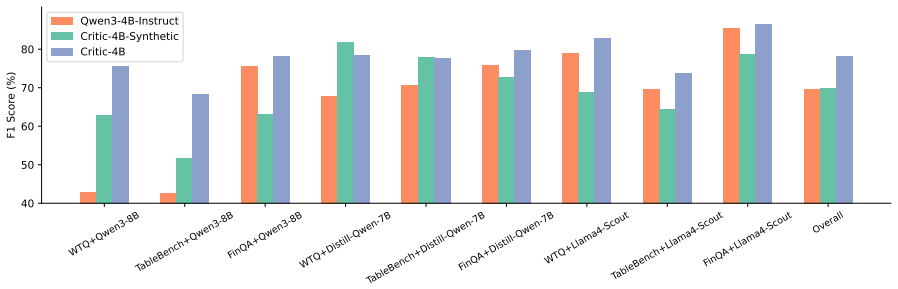
Data referencing errors occur in every tested LLM from 1.7B to 20B parameters; training a critic to spot incorrect table value citations or omissions allows critic-based filtering and rejection sampling to raise answer accuracy by up to 12 percent, and a 4B-parameter critic reaches 78.2 percent average F1 on in- and out-of-distribution cases while aiding larger models at inference time.
What carries the argument
The data referencing critic, a model that evaluates whether reasoning steps correctly cite or omit table values.
If this is right
- DREs appear in all models tested, independent of parameter count.
- Critic-based filtering and rejection sampling raise accuracy by as much as 12%.
- A 4B critic achieves 78.2% F1 on both in-distribution and out-of-distribution DREs.
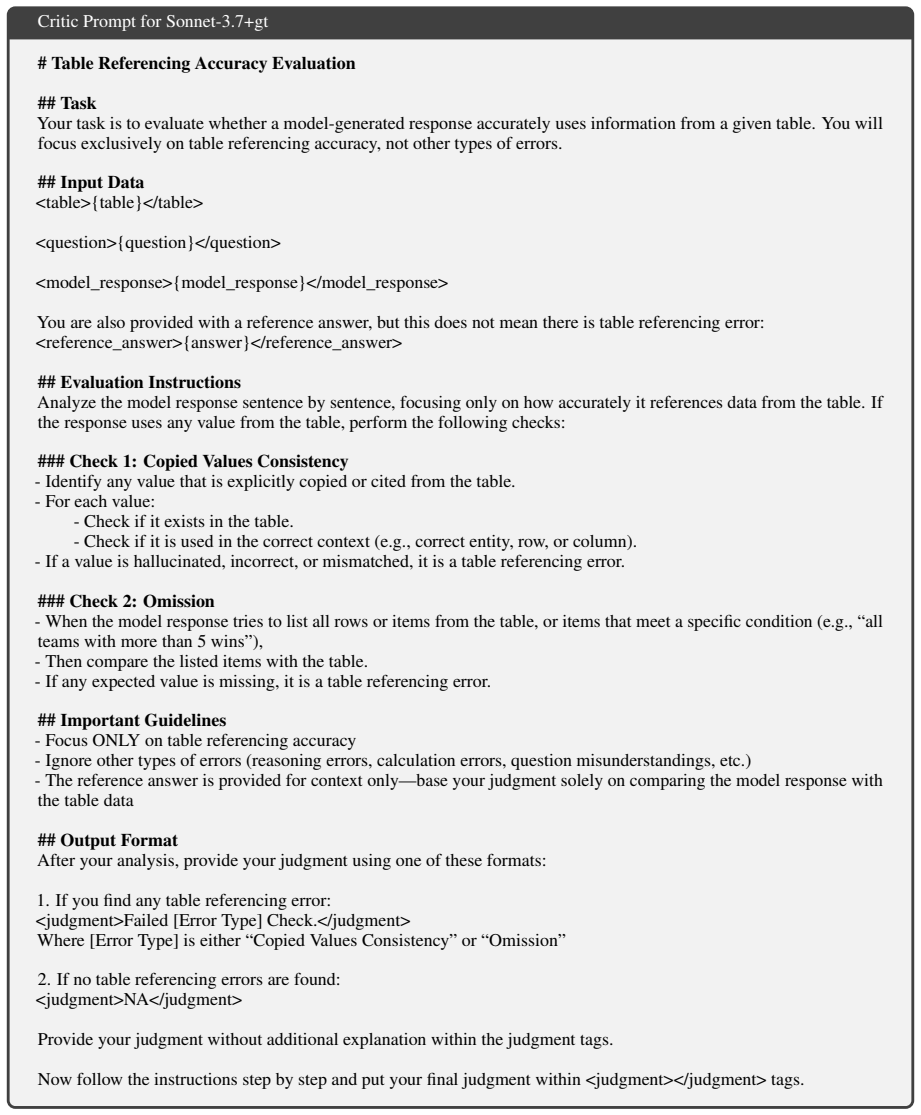
- The critic assists inference for larger models.
- The approach works through detection of specific referencing mistakes rather than general reasoning critique.
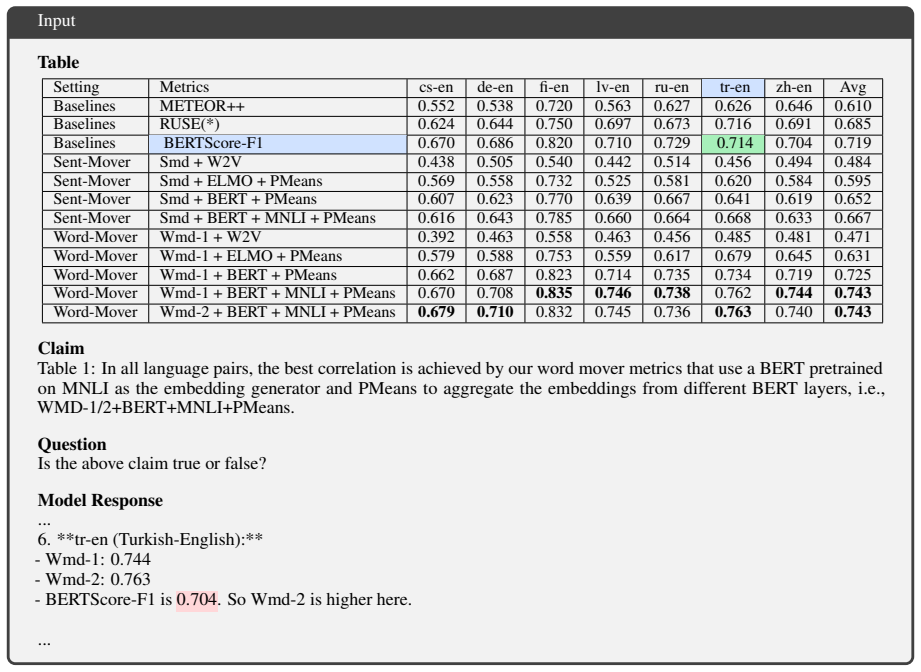
Where Pith is reading between the lines
- Similar critics could be trained for other structured inputs such as code or knowledge graphs.
- Lightweight critics might enable cheaper auditing of large model outputs in production.
- Error-specific critics could be combined to cover multiple failure modes in LLM reasoning.
- Future work might test whether the same critic training data works across different base models without retraining.
Load-bearing premise
The defined data referencing errors can be isolated and measured independently from other reasoning mistakes in the evaluation tasks.
What would settle it
A controlled test where models are forced to use only correct table references and accuracy does not improve beyond the critic method, or where the critic fails to improve accuracy on a new table task with different error patterns.
Figures



read the original abstract
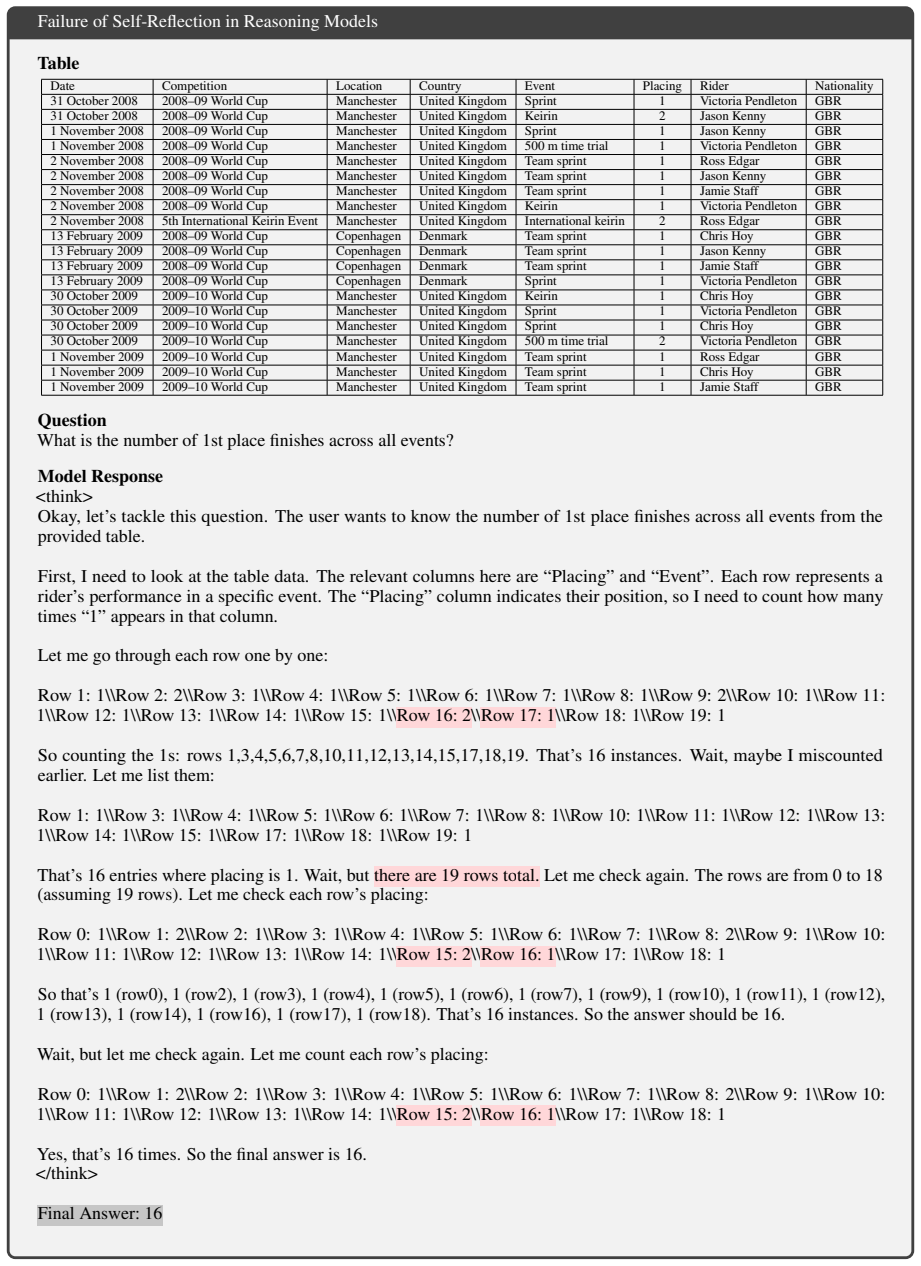
While large language models (LLMs) perform well on table tasks, they still make data referencing errors (DREs), i.e., incorrectly citing or omitting table values, despite understanding the table structure. Beyond final-answer accuracy, DREs directly compromise the correctness and reliability of intermediate reasoning steps. Yet prior studies have only offered limited, small-scale analyses. In this work, we present the first systematic evaluation of tabular data referencing errors across different models and tasks. Our results show that DREs occur across all tested models (1.7B to 20B parameters). Furthermore, we demonstrate that incorporating data referencing as a critic significantly improves answer accuracy up to 12.0%, through critic-based filtering and rejection sampling. Finally, we trained a lightweight 4B-parameter critic model that achieves an average F1 score of 78.2% in detecting both in-distribution and out-of-distribution DREs, and effectively assists inference for larger models.
Editorial analysis
A structured set of objections, weighed in public.
Referee Report
Summary. The paper introduces data referencing errors (DREs) as a distinct failure mode in LLMs on table tasks, where models incorrectly cite or omit specific table values despite grasping structure. It reports the first systematic evaluation showing DREs occur across models from 1.7B to 20B parameters, demonstrates that a data-referencing critic improves final answer accuracy by up to 12% via filtering and rejection sampling, and presents a trained 4B-parameter critic achieving 78.2% average F1 on both in-distribution and out-of-distribution DRE detection while aiding inference on larger models.
Significance. If the isolation of DREs as a measurable category and the critic's effectiveness hold under rigorous evaluation, the work provides a targeted, practical approach to improving LLM reliability on structured data beyond aggregate accuracy metrics. The scale of the evaluation across model sizes and the lightweight critic are useful contributions for deployment. The empirical focus on a specific error type complements broader reasoning studies.
minor comments (3)
- The abstract and introduction would benefit from an explicit definition and annotation protocol for DREs (including examples of what counts as a referencing error versus other reasoning failures) to allow readers to assess the claimed separation from general errors.
- Provide details on the datasets, task formulations, and statistical significance tests used for the 12.0% accuracy improvement and the 78.2% F1 scores, including baseline comparisons and inter-annotator agreement if human labels are involved.
- Clarify how out-of-distribution DREs are constructed and whether the critic training data distribution matches the error patterns observed in the main evaluation.
Simulated Author's Rebuttal
We thank the referee for the positive summary, recognition of the practical value of isolating DREs, and the recommendation for minor revision. No major comments requiring point-by-point rebuttal were provided in the report.
Circularity Check
No significant circularity; empirical measurement study
full rationale
This is an empirical evaluation and model-training paper with no mathematical derivation chain, equations, or first-principles predictions. Claims rest on direct measurements of DREs across models, critic-based filtering experiments, and separate training/evaluation of a 4B critic model on in- and out-of-distribution cases. No steps reduce by construction to fitted inputs, self-definitions, or self-citation chains; results are externally falsifiable via the described annotation and accuracy metrics.
Axiom & Free-Parameter Ledger
invented entities (1)
-
Data Referencing Errors (DREs)
no independent evidence
Reference graph
Works this paper leans on
-
[1]
DeepSeek-AI, Daya Guo, Dejian Yang, Haowei Zhang, Junxiao Song, Ruoyu Zhang, Runxin Xu, Qihao Zhu, Shirong Ma, Peiyi Wang, Xiao Bi, Xiaokang Zhang, Xingkai Yu, Yu Wu, Z
OpenReview.net. DeepSeek-AI, Daya Guo, Dejian Yang, Haowei Zhang, Junxiao Song, Ruoyu Zhang, Runxin Xu, Qihao Zhu, Shirong Ma, Peiyi Wang, Xiao Bi, Xiaokang Zhang, Xingkai Yu, Yu Wu, Z. F. Wu, Zhibin Gou, Zhi- hong Shao, Zhuoshu Li, Ziyi Gao, and 81 others
-
[2]
DeepSeek-R1: Incentivizing Reasoning Capability in LLMs via Reinforcement Learning
Deepseek-r1: Incentivizing reasoning capa- bility in llms via reinforcement learning. CoRR, abs/2501.12948. Jonathan Herzig, Pawel Krzysztof Nowak, Thomas Müller, Francesco Piccinno, and Julian Martin Eisenschlos. 2020. Tapas: Weakly supervised ta- ble parsing via pre-training. In Proceedings of the 58th Annual Meeting of the Association for Computational...
work page internal anchor Pith review Pith/arXiv arXiv 2020
-
[3]
Understanding R1-Zero-Like Training: A Critical Perspective
Understanding r1-zero-like training: A critical perspective. CoRR, abs/2503.20783. Xinyuan Lu, Liangming Pan, Qian Liu, Preslav Nakov, and Min-Yen Kan. 2023. SCITAB: A challenging benchmark for compositional reasoning and claim verification on scientific tables. InProceedings of the 2023 Conference on Empirical Methods in Natural Language Processing, EMNL...
work page internal anchor Pith review Pith/arXiv arXiv 2023
-
[4]
Gsm-symbolic: Understanding the limitations of mathematical reasoning in large language mod- els. In The Thirteenth International Conference on Learning Representations, ICLR 2025, Singapore, April 24-28, 2025. OpenReview.net. Nafise Sadat Moosavi, Andreas Rücklé, Dan Roth, and Iryna Gurevych. 2021. Scigen: a dataset for reasoning-aware text generation fr...
work page internal anchor Pith review Pith/arXiv arXiv 2025
-
[5]
Solving math word problems with process- and outcome-based feedback
Solving math word problems with process- and outcome-based feedback. CoRR, abs/2211.14275. Zengzhi Wang, Fan Zhou, Xuefeng Li, and Pengfei Liu
work page internal anchor Pith review Pith/arXiv arXiv
-
[6]
arXiv preprint arXiv:2506.20512 , year=
Octothinker: Mid-training incentivizes rein- forcement learning scaling. CoRR, abs/2506.20512. Cornelius Wolff and Madelon Hulsebos. 2025. How well do llms reason over tabular data, really? CoRR, abs/2505.07453. Xianjie Wu, Jian Yang, Linzheng Chai, Ge Zhang, Jia- heng Liu, Xeron Du, Di Liang, Daixin Shu, Xianfu Cheng, Tianzhen Sun, Tongliang Li, Zhoujun ...
-
[7]
Table-R1: Region-based Reinforcement Learning for Table Understanding
Fine-grained human feedback gives bet- ter rewards for language model training. In Advances in Neural Information Processing Systems 36: Annual Conference on Neural Information Processing Systems 2023, NeurIPS 2023, New Orleans, LA, USA, December 10 - 16, 2023. Zhenhe Wu, Jian Yang, Jiaheng Liu, Xianjie Wu, Changzai Pan, Jie Zhang, Yu Zhao, Shuangyong Son...
work page internal anchor Pith review Pith/arXiv arXiv 2023
-
[8]
Tablellama: Towards open large general- ist models for tables. In Proceedings of the 2024 Conference of the North American Chapter of the Association for Computational Linguistics: Human Language Technologies (V olume1: Long Papers), NAACL 2024, Mexico City, Mexico, June 16-21, 2024, pages 6024–6044. Association for Computa- tional Linguistics. Xiaokang Z...
-
[9]
Mix up rows:Swap the identified value with a value from the same column but a different row
-
[10]
Mix up columns:Swap the value with another value from the same row but a different column
-
[11]
Remove row:Delete the entire row that contains the used value
-
[12]
all teams with more than 5 wins
Remove a listed row:Keep the table unchanged, but if the response enumerates all rows, randomly remove one row from the response and re-index. We then use Qwen3-8B to perform inference for three times again to see whether the answer changes, and only save the cases where the final an- swer differs. For each saved case, this indicates that the modified tab...
2024
-
[13]
Copied Values Consistency
If you find any table referencing error: <judgment>Failed [Error Type] Check.</judgment> Where [Error Type] is either “Copied Values Consistency” or “Omission”
-
[14]
Failed Copied Values Consistency Check
If no table referencing errors are found: <judgment>NA</judgment> Provide your judgment without additional explanation within the judgment tags. Now follow the instructions step by step and put your final judgment within <judgment></judgment> tags. Figure 3: Judge prompt for Sonnet-3.7+gt. Both “Failed Copied Values Consistency Check” and “Failed Omission...
-
[15]
So Wmd-2 is higher here
**tr-en (Turkish-English):** - Wmd-1: 0.744 - Wmd-2: 0.763 - BERTScore-F1 is 0.704. So Wmd-2 is higher here. ... Figure 5: This is an example of Qwen3-8B on the SciTab test set. Qwen3-8B misquoted 0.714 as 0.704, but this does not affect the subsequent conclusion that Wmd-2 (0.763) is higher. Therefore, final-answer accuracy cannot fully reflect the prese...
-
[16]
Review the inputs: <table>{table}</table> <question>{question}</question> <model_response>{model_response}</model_response>
-
[17]
all teams with more than 5 wins
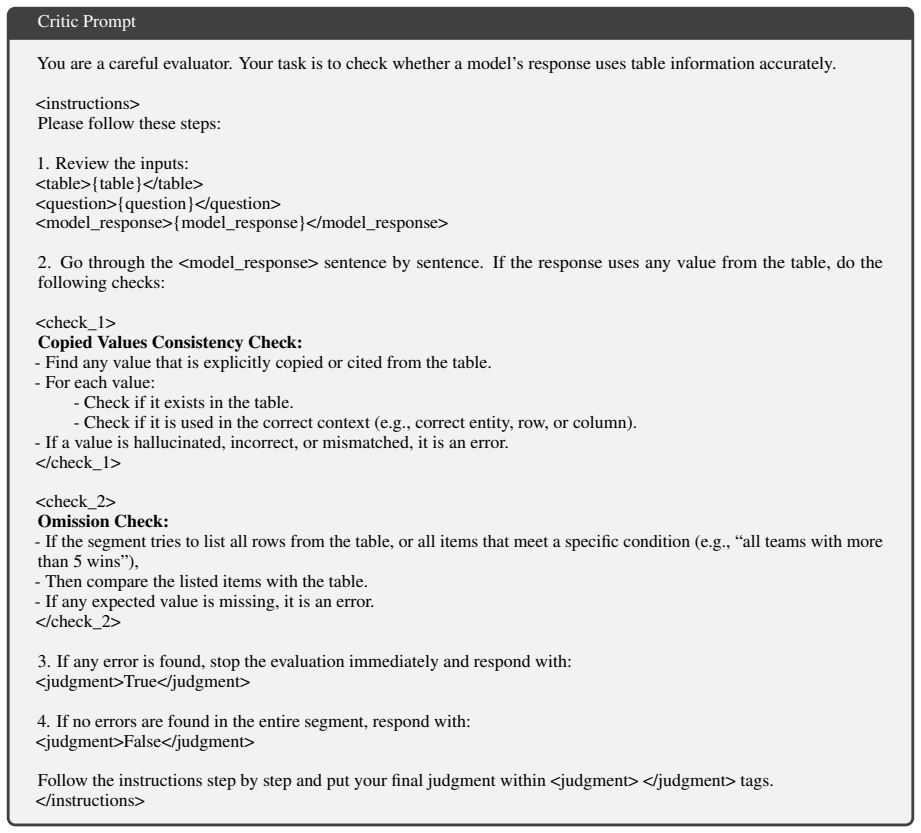
Go through the <model_response> sentence by sentence. If the response uses any value from the table, do the following checks: <check_1> Copied Values Consistency Check: - Find any value that is explicitly copied or cited from the table. - For each value: - Check if it exists in the table. - Check if it is used in the correct context (e.g., correct entity,...
-
[18]
If any error is found, stop the evaluation immediately and respond with: <judgment>True</judgment>
-
[19]
Silver” value, except for the first row, “Soviet Union
If no errors are found in the entire segment, respond with: <judgment>False</judgment> Follow the instructions step by step and put your final judgment within <judgment> </judgment> tags. </instructions> Figure 6: Critic Prompt for small-scale LLMs. We do not provide ground-truth answers in this prompt. Judge Prompt Input Table Rank Nation Gold Silver Bro...
discussion (0)
Sign in with ORCID, Apple, or X to comment. Anyone can read and Pith papers without signing in.