Safe and Adaptive Cloud Healing: Verifying LLM-Generated Recovery Plans with a Neural-Symbolic World Model
Pith reviewed 2026-07-03 14:55 UTC · model grok-4.3
The pith
PASE turns cloud fault recovery into neuro-symbolic program synthesis by having an LLM generate plans that a world model then verifies through simulation.
A machine-rendered reading of the paper's core claim, the machinery that carries it, and where it could break.
Core claim
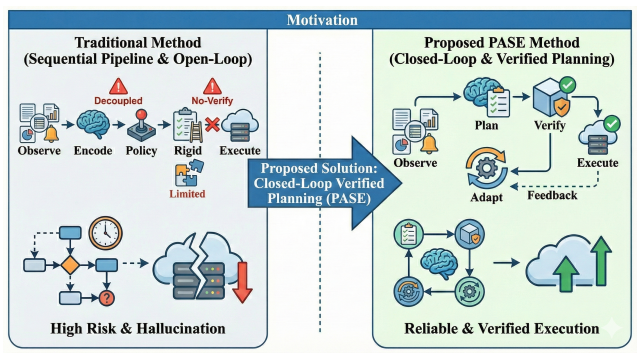
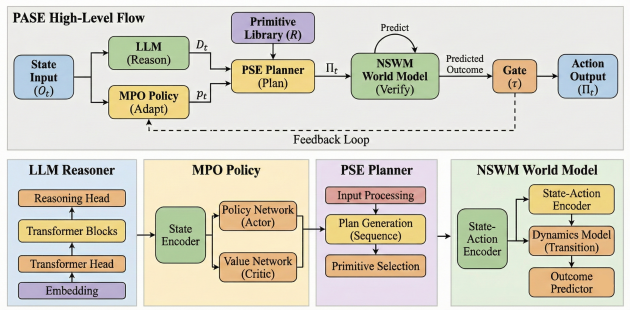
PASE reconceptualizes recovery as a neuro-symbolic program synthesis task. It employs an LLM as a core Plan Synthesis Engine to generate structured recovery plans from a library of semantic primitives. A Neural-Symbolic World Model verifies plan feasibility through simulation, while a Meta-Prompt Optimizer, trained via DRL, learns to generate optimal prompts that guide the LLM's planning process. This tight reason-plan-verify-adapt loop enables dynamic, context-aware recovery strategy generation beyond predefined action spaces.
What carries the argument
The Planning-Aware Semantic self-healing engine (PASE) that uses an LLM for plan synthesis from semantic primitives, a neural-symbolic world model for simulation-based verification, and a DRL meta-prompt optimizer to adapt the LLM's prompts.
If this is right
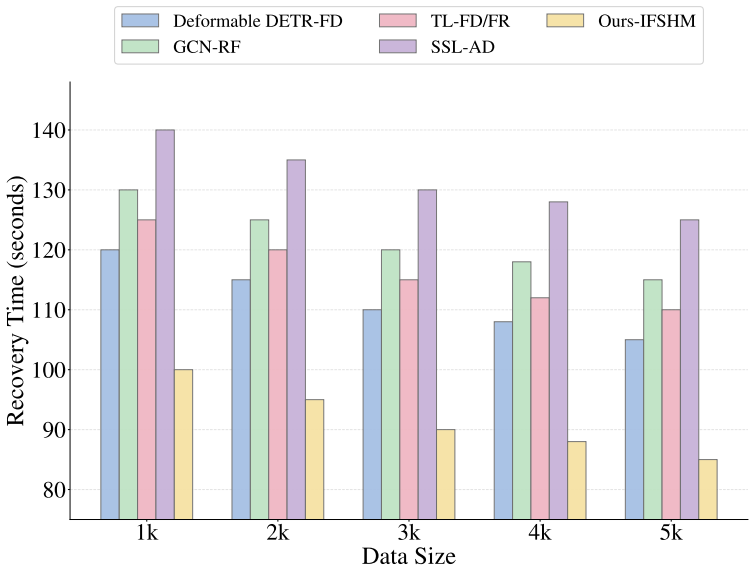
- Average system recovery time falls by more than 40 percent compared with prior methods on the same fault-injection dataset.
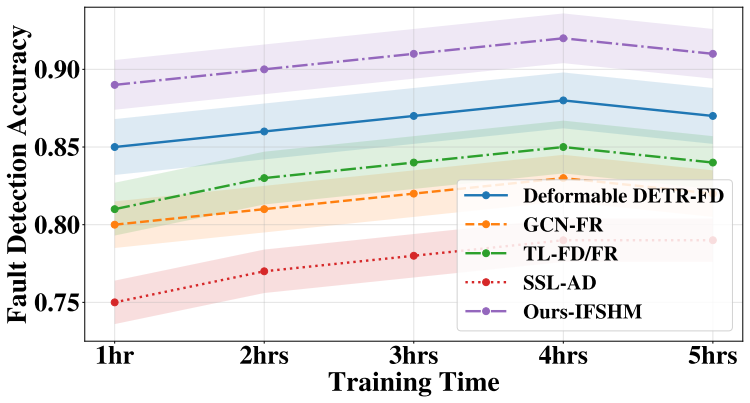
- Fault detection accuracy rises in scenarios involving previously unseen faults.
- Recovery actions can be synthesized outside any fixed action library because the LLM generates plans from semantic primitives.
- The closed reason-plan-verify-adapt cycle replaces loosely coupled LLM-plus-DRL pipelines.
Where Pith is reading between the lines
- The same verify-before-execute pattern could be applied to other domains that require safe LLM-generated action sequences, such as robotic task planning.
- If the world model simulation is cheap and accurate, the framework reduces the cost of exploring unsafe plans in real systems.
- Success would depend on the library of semantic primitives being expressive enough to cover the faults that actually occur.
Load-bearing premise
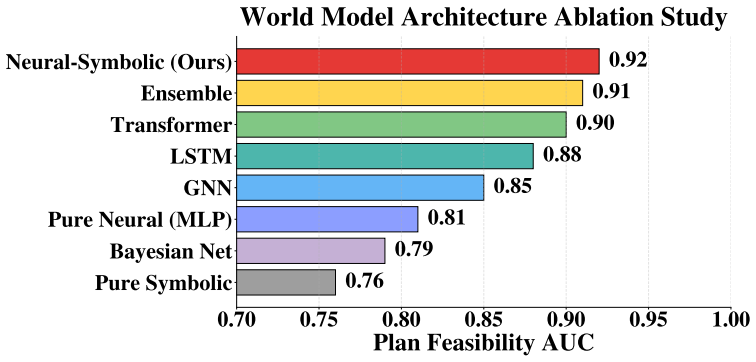
The LLM will reliably output structured recovery plans whose feasibility the neural-symbolic world model can accurately determine by simulation.
What would settle it
An experiment in which a plan the world model labels feasible is executed on the live cloud system and produces a longer outage or new failure.
Figures

read the original abstract
As the scale and complexity of cloud-based AI systems continue to escalate, ensuring service reliability through rapid fault detection and adaptive recovery has become a critical challenge. While existing approaches integrate Large Language Models (LLMs) for semantic understanding and Deep Reinforcement Learning (DRL) for policy optimization, they often rely on sequential, loosely coupled architectures that underutilize the generative and reasoning capabilities of LLMs. In this paper, we propose a paradigm shift with PASE, a Planning-Aware Semantic self-healing engine, a novel fault self-healing framework that reconceptualizes recovery as a neuro-symbolic program synthesis task. PASE employs an LLM as a core Plan Synthesis Engine to generate structured recovery plans from a library of semantic primitives. A Neural-Symbolic World Model verifies plan feasibility through simulation, while a Meta-Prompt Optimizer, trained via DRL, learns to generate optimal prompts that guide the LLM's planning process. This tight reason-plan-verify-adapt loop enables dynamic, context-aware recovery strategy generation beyond predefined action spaces. Experiments on a real-world cloud fault injection dataset demonstrate that PASE significantly outperforms state-of-the-art methods, reducing average system recovery time by over 40% and improving fault detection accuracy in unknown fault scenarios. Our framework advances autonomous system management by unifying LLM-based reasoning with model-assisted verification and meta-learned guidance.
Editorial analysis
A structured set of objections, weighed in public.
Referee Report
Summary. The paper proposes PASE, a Planning-Aware Semantic self-healing engine for cloud AI systems. It reconceptualizes recovery as neuro-symbolic program synthesis: an LLM generates structured recovery plans from a library of semantic primitives; a Neural-Symbolic World Model verifies feasibility via simulation; and a DRL-trained Meta-Prompt Optimizer learns optimal prompts to guide the LLM. The framework forms a reason-plan-verify-adapt loop. Experiments on a real-world cloud fault injection dataset are reported to show >40% reduction in average recovery time and improved fault detection accuracy in unknown scenarios compared to state-of-the-art methods.
Significance. If the central claims hold, the work would be significant for autonomous cloud management by demonstrating a tight integration of LLM generative capabilities with model-based verification, moving beyond loosely coupled LLM+DRL pipelines. The neuro-symbolic verification step directly targets safety concerns in LLM-generated actions, which is a timely contribution to reliable AI-driven systems.
major comments (2)
- [Abstract] Abstract and experimental description: the headline claims of >40% reduction in recovery time and improved unknown-fault accuracy rest on the Neural-Symbolic World Model correctly classifying LLM-synthesized plans as feasible. No architecture, training procedure, simulation error rate against real executions, or false-positive analysis is supplied, rendering the performance numbers uninterpretable.
- [Abstract] Abstract: the experimental protocol, dataset description, baseline methods, number of trials, and statistical measures (error bars, significance tests) are absent, so it is impossible to determine whether the reported gains are supported by the data or methods.
minor comments (1)
- [Abstract] The abstract uses several compound terms ("Planning-Aware Semantic self-healing engine", "neuro-symbolic program synthesis task") without a concise one-sentence definition on first use.
Simulated Author's Rebuttal
We thank the referee for the constructive comments on the abstract. We agree that additional details would improve clarity and will revise the abstract to incorporate summaries of the key components and experimental setup.
read point-by-point responses
-
Referee: [Abstract] Abstract and experimental description: the headline claims of >40% reduction in recovery time and improved unknown-fault accuracy rest on the Neural-Symbolic World Model correctly classifying LLM-synthesized plans as feasible. No architecture, training procedure, simulation error rate against real executions, or false-positive analysis is supplied, rendering the performance numbers uninterpretable.
Authors: The architecture, training procedure, and validation of the Neural-Symbolic World Model, including simulation fidelity and false-positive rates, are detailed in the body of the paper (Sections 3 and 4). To address the referee's concern about the abstract, we will revise the abstract to include a concise description of the world model and its verification capabilities. This will make the performance claims more interpretable without altering the manuscript's core content. revision: yes
-
Referee: [Abstract] Abstract: the experimental protocol, dataset description, baseline methods, number of trials, and statistical measures (error bars, significance tests) are absent, so it is impossible to determine whether the reported gains are supported by the data or methods.
Authors: The experimental protocol, including the dataset, baselines, number of trials, and statistical analysis, is described in Section 5 of the manuscript. We will revise the abstract to briefly mention the evaluation setup, such as the use of a real-world cloud fault injection dataset and comparison against state-of-the-art methods with multiple trials. This revision will help readers assess the reported results. revision: yes
Circularity Check
No circularity; framework description contains no derivations or self-referential reductions
full rationale
The paper text (abstract and described components) presents PASE as an architectural integration of LLM plan synthesis, neural-symbolic simulation, and DRL-based meta-prompt optimization, with performance claims tied to external experiments on a cloud fault dataset. No equations, derivation chains, fitted parameters renamed as predictions, or load-bearing self-citations appear. The central claims rest on empirical results rather than any step that reduces by construction to its own inputs. This matches the expected non-finding for papers without mathematical self-reference.
Axiom & Free-Parameter Ledger
Reference graph
Works this paper leans on
-
[1]
Optimization and prediction techniques for self-healing and self-learning applications in a trustworthy cloud continuum.Information, 12(8):308, 2021
Juncal Alonso, Leire Orue-Echevarria, Eneko Osaba, Jesús López Lobo, Iñigo Martinez, Josu Diaz de Arcaya, and Iñaki Etxaniz. Optimization and prediction techniques for self-healing and self-learning applications in a trustworthy cloud continuum.Information, 12(8):308, 2021
2021
-
[2]
ChatEval: Towards Better LLM-based Evaluators through Multi-Agent Debate
Chi-Min Chan, Weize Chen, Yusheng Su, Jianxuan Yu, Wei Xue, Shanghang Zhang, Jie Fu, and Zhiyuan Liu. Chateval: Towards better llm-based evaluators through multi-agent debate. arXiv preprint arXiv:2308.07201, 2023
work page internal anchor Pith review Pith/arXiv arXiv 2023
-
[3]
Mvi-bench: A comprehensive benchmark for evaluating robustness to misleading 10 visual inputs in lvlms
Huiyi Chen, Jiawei Peng, Dehai Min, Changchang Sun, Kaijie Chen, Yan Yan, Xu Yang, and Lu Cheng. Mvi-bench: A comprehensive benchmark for evaluating robustness to misleading 10 visual inputs in lvlms. InProceedings of the 43rd International Conference on Machine Learning (ICML 2026), 2025
2026
-
[4]
R2i-bench: Benchmarking reasoning-driven text-to-image generation
Kaijie Chen, Zihao Lin, Zhiyang Xu, Ying Shen, Yuguang Yao, Joy Rimchala, Jiaxin Zhang, and Lifu Huang. R2i-bench: Benchmarking reasoning-driven text-to-image generation. In Proceedings of the 2025 Conference on Empirical Methods in Natural Language Processing, pages 12606–12641, 2025
2025
-
[5]
Composerx: Multi-agent symbolic music composition with llms.arXiv preprint arXiv:2404.18081, 2024
Qixin Deng, Qikai Yang, Ruibin Yuan, Yipeng Huang, Yi Wang, Xubo Liu, Zeyue Tian, Jiahao Pan, Ge Zhang, Hanfeng Lin, et al. Composerx: Multi-agent symbolic music composition with llms.arXiv preprint arXiv:2404.18081, 2024
-
[6]
Confidence trigger detection: Accelerating real-time tracking-by-detection systems
Zhicheng Ding, Zhixin Lai, Siyang Li, Panfeng Li, Qikai Yang, and Edward Wong. Confidence trigger detection: Accelerating real-time tracking-by-detection systems. In2024 5th Interna- tional Conference on Electronic Communication and Artificial Intelligence (ICECAI), pages 587–592. IEEE, 2024
2024
-
[7]
Jianbing Feng, Tao Yu, Kuozhen Zhang, and Lefeng Cheng. Integration of multi-agent systems and artificial intelligence in self-healing subway power supply systems: Advancements in fault diagnosis, isolation, and recovery.Processes, 13(4):1144, 2025
2025
-
[8]
Kanatsoulis, and Alejandro Ribeiro
Jiashu He, Charilaos I. Kanatsoulis, and Alejandro Ribeiro. T-GAE: Transferable Graph Autoencoder for Network Alignment.arXiv e-prints, art. arXiv:2310.03272, October 2023. doi: 10.48550/arXiv.2310.03272
-
[9]
Jiashu He, Mingyu Derek Ma, Jinxuan Fan, Dan Roth, Wei Wang, and Alejandro Ribeiro. Give: Structured reasoning of large language models with knowledge graph inspired veracity extrapolation, 2025. URLhttps://arxiv.org/abs/2410.08475
-
[10]
GUI Agents for Continual Game Generation
Yixu Huang, Bo Li, Na Li, Zhe Wang, Kaijie Chen, Haonan Ge, Qingyi Si, Yuanzhe Shen, Ruihan Yang, Guangjing Wang, and Hongcheng Guo. Gui agents for continual game generation. arXiv preprint arXiv:2605.28258, 2026. doi: 10.48550/arXiv.2605.28258
work page internal anchor Pith review Pith/arXiv arXiv doi:10.48550/arxiv.2605.28258 2026
-
[11]
Cheng Ji and Huaiying Luo. Cloud-based ai systems: Leveraging large language models for intelligent fault detection and autonomous self-healing.arXiv preprint arXiv:2505.11743, 2025
-
[12]
Assertion detection in clinical natural language processing using large language models
Yuelyu Ji, Zeshui Yu, and Yanshan Wang. Assertion detection in clinical natural language processing using large language models. In2024 IEEE 12th International Conference on Healthcare Informatics (ICHI), pages 242–247, 2024. doi: 10.1109/ICHI61247.2024.00039
-
[13]
Metamorphictestingoflarge languagemodelsfornaturallanguageprocessing.doi:10.48550/arXiv
Yuelyu Ji, Hang Zhang, and Yanshan Wang. Evaluating bias in retrieval-augmented medical question-answering systems.arXiv preprint arXiv:2503.15454, 2025. doi: 10.48550/arXiv. 2503.15454
work page internal anchor Pith review doi:10.48550/arxiv 2025
-
[14]
Yihong Jin, Ze Yang, Xinhe Xu, Yihan Zhang, and Shuyang Ji. Adaptive fault tolerance mechanisms of large language models in cloud computing environments.arXiv preprint arXiv:2503.12228, 2025
-
[15]
Musarath Jahan Karamthulla, Jesu Narkarunai Arasu Malaiyappan, and Sanjeev Prakash. Ai- powered self-healing systems for fault tolerant platform engineering: Case studies and chal- lenges.Journal of Knowledge Learning and Science Technology ISSN: 2959-6386 (online), 2 (2):327–338, 2023
2023
-
[16]
Deception detection from linguistic and physiological data streams using bimodal convolutional neural networks
Panfeng Li, Mohamed Abouelenien, Rada Mihalcea, Zhicheng Ding, Qikai Yang, and Yiming Zhou. Deception detection from linguistic and physiological data streams using bimodal convolutional neural networks. In2024 5th International Conference on Information Science, Parallel and Distributed Systems (ISPDS), pages 263–267. IEEE, 2024
2024
-
[17]
Automated intelligent healing in cloud-scale data centers
Rui Li, Zhinan Cheng, Patrick PC Lee, Pinghui Wang, Yi Qiang, Lin Lan, Cheng He, Jinlong Lu, Mian Wang, and Xinquan Ding. Automated intelligent healing in cloud-scale data centers. In2021 40th International Symposium on Reliable Distributed Systems (SRDS), pages 244–253. IEEE, 2021. 11
2021
-
[18]
Zilinghan Li, Shilan He, Ze Yang, Minseok Ryu, Kibaek Kim, and Ravi Madduri. Advances in appfl: A comprehensive and extensible federated learning framework.arXiv preprint arXiv:2409.11585, 2024
-
[19]
GraphSnapShot: Caching local structure for fast graph learning.arXiv preprint arXiv:2406.17918, 2024
Dong Liu, Roger Waleffe, Meng Jiang, and Shivaram Venkataraman. GraphSnapShot: Caching local structure for fast graph learning.arXiv preprint arXiv:2406.17918, 2024. doi: 10.48550/ arXiv.2406.17918
-
[20]
Dong Liu, Yanxuan Yu, Yite Wang, Jing Wu, Zhongwei Wan, Sina Alinejad, Benjamin Lengerich, and Ying Nian Wu. Designing large foundation models for efficient training and inference: A survey.arXiv preprint arXiv:2409.01990, 2024. doi: 10.48550/arXiv.2409.01990
-
[21]
Huaiying Luo and Cheng Ji. Cross-cloud data privacy protection: Optimizing collabora- tive mechanisms of ai systems by integrating federated learning and llms.arXiv preprint arXiv:2505.13292, 2025
-
[22]
Faithfulpersona: Balancing faithfulness and personalization in code explanations through self-critique
Zhuang Luo, Yichuan Li, Zexing Xu, Kyumin Lee, and S Rasoul Etesami. Faithfulpersona: Balancing faithfulness and personalization in code explanations through self-critique. In Findings of the Association for Computational Linguistics: NAACL 2025, pages 930–944, 2025
2025
-
[23]
Artificial intelligence for self-healing automation testing frameworks: Real-time fault prediction and recovery.CINE- FORUM, 64(3S):111–140, 2024
Prathyusha Nama, Purushotham Reddy, and Suprit Kumar Pattanayak. Artificial intelligence for self-healing automation testing frameworks: Real-time fault prediction and recovery.CINE- FORUM, 64(3S):111–140, 2024. URL https://revistadecineforum.com/index.php/ cf/article/view/177
2024
-
[24]
Artificial intelligence for fault detection in cloud-optimized data engineering systems.International Journal of Social Trends, 2(4):8–44, 2024
Dillep Kumar Pentyala. Artificial intelligence for fault detection in cloud-optimized data engineering systems.International Journal of Social Trends, 2(4):8–44, 2024
2024
-
[25]
Sohel Rana. Ai-driven fault detection and predictive maintenance in electrical power systems: A systematic review of data-driven approaches, digital twins, and self-healing grids.American Journal of Advanced Technology and Engineering Solutions, 1(01):258–289, 2025
2025
- [26]
-
[27]
Multi-Agent Collaboration: Harnessing the Power of Intelligent LLM Agents
Yashar Talebirad and Amirhossein Nadiri. Multi-agent collaboration: Harnessing the power of intelligent llm agents.arXiv preprint arXiv:2306.03314, 2023
work page internal anchor Pith review Pith/arXiv arXiv 2023
-
[28]
Ai-enhanced self-healing cloud architectures for data integrity, privacy, and sustainable learning
Vamshidhar Reddy Vemula. Ai-enhanced self-healing cloud architectures for data integrity, privacy, and sustainable learning. InSmart Education and Sustainable Learning Environments in Smart Cities, pages 93–106. IGI Global Scientific Publishing, 2025
2025
-
[29]
A Stochastic GDA Method With Backtracking For Solving Nonconvex Concave Minimax Problems
Qiushui Xu, Xuan Zhang, Necdet Serhat Aybat, and Mert Gürbüzbalaban. A stochastic gda method with backtracking for solving nonconvex (strongly) concave minimax problems.arXiv preprint arXiv:2403.07806, 2024
work page internal anchor Pith review Pith/arXiv arXiv 2024
-
[30]
Zexing Xu, Zhuang Luo, Yichuan Li, Kyumin Lee, and S Rasoul Etesami. From critique to clarity: A pathway to faithful and personalized code explanations with large language models. arXiv preprint arXiv:2501.14731, 2024
-
[31]
Ze Yang, Yihong Jin, and Xinhe Xu. Hades: Hardware accelerated decoding for efficient speculation in large language models.arXiv preprint arXiv:2412.19925, 2024
-
[32]
Ze Yang, Yihong Jin, Yihan Zhang, Juntian Liu, and Xinhe Xu. Research on large language model cross-cloud privacy protection and collaborative training based on federated learning. arXiv preprint arXiv:2503.12226, 2025
-
[33]
Drdgrl: Dual-relational dynamic graph repre- sentation learning for delay-sensitive stock trend prediction
Mingjie You, Kaijie Chen, and Dawei Cheng. Drdgrl: Dual-relational dynamic graph repre- sentation learning for delay-sensitive stock trend prediction. InInternational Conference on Database Systems for Advanced Applications, pages 35–50. Springer, 2026
2026
-
[34]
Ai for science: A comprehensive review on innovations, challenges, and future directions.International Journal of Artificial Intelligence for Science (IJAI4S), 1(1), 2025
Zhenyu Yu. Ai for science: A comprehensive review on innovations, challenges, and future directions.International Journal of Artificial Intelligence for Science (IJAI4S), 1(1), 2025. 12
2025
-
[35]
Physics-constrained symbolic regression from imagery
Zhenyu Yu, Mohd Yamani Idna Idris, and Pei Wang. Physics-constrained symbolic regression from imagery. In2nd AI for Math Workshop@ ICML 2025, 2025
2025
-
[36]
Cotextor: Training-free modular multilingual text editing via layered disentanglement and depth-aware fusion
Zhenyu Yu, Mohd Yamani Idna Idris, Pei Wang, and Rizwan Qureshi. Cotextor: Training-free modular multilingual text editing via layered disentanglement and depth-aware fusion. InThe Thirty-ninth Annual Conference on Neural Information Processing Systems Creative AI Track: Humanity, 2025
2025
-
[37]
MemMark: State-Evolution Attribution Watermarking for Agent Long-Term Memory Systems
Haobo Zhang, Xutao Mao, Guangyuan Dong, Ziwei Li, Xuanbo Su, Kaijie Chen, Jing Yang, and Zheng Lin. Memmark: State-evolution attribution watermarking for agent long-term memory systems.arXiv preprint arXiv:2605.25002, 2026
work page internal anchor Pith review Pith/arXiv arXiv 2026
-
[38]
Xuan Zhang, Qiushui Xu, and Necdet Serhat Aybat. Agda+: Proximal alternating gradient descent ascent method with a nonmonotone adaptive step-size search for nonconvex minimax problems.arXiv preprint arXiv:2406.14371, 2024
-
[39]
Qinjian Zhao, Zhihao Dou, Dinggen Zhang, Xiangyu Li, Chaoda Song, Zhongwei Wan, Xinpeng Li, Yanyan Zhang, Kaijie Chen, Qingtao Pan, et al. Stride: Strategic trajectory reasoning via dis- criminative estimation for verifiable reinforcement learning.arXiv preprint arXiv:2606.15866, 2026
-
[40]
Yunfan Zhao, Niclas Boehmer, Aparna Taneja, and Milind Tambe. Towards foundation-model- based multiagent system to accelerate ai for social impact.arXiv preprint arXiv:2412.07880, 2024. 13
discussion (0)
Sign in with ORCID, Apple, or X to comment. Anyone can read and Pith papers without signing in.