Unconventional Mixed-Parity Magnetism in Rare-Earth Tetraborides
Pith reviewed 2026-07-03 05:54 UTC · model grok-4.3
The pith
TbB4's non-coplanar magnetic order creates mixed-parity spin textures in momentum space through scalar spin chirality rather than spin-orbit coupling.
A machine-rendered reading of the paper's core claim, the machinery that carries it, and where it could break.
Core claim
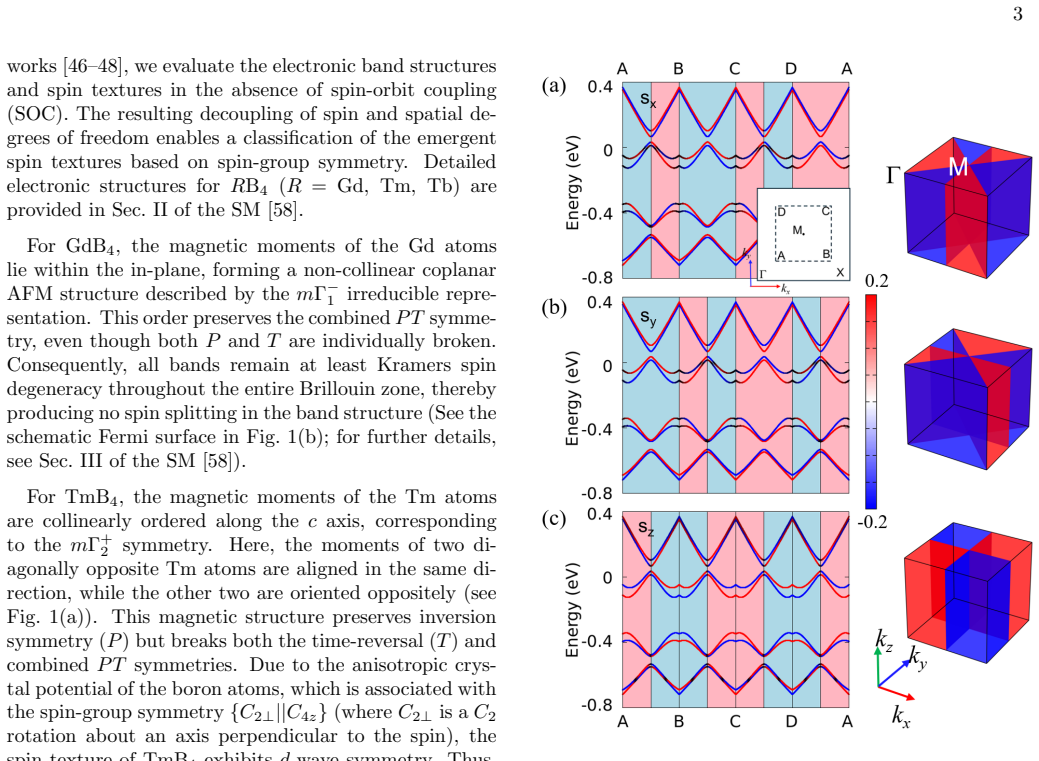
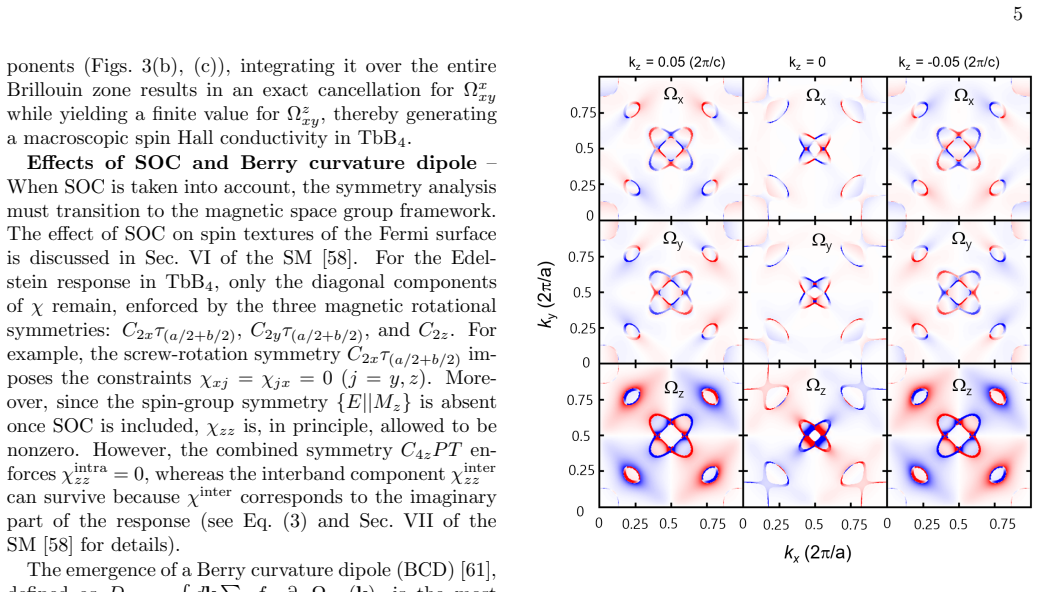
The non-coplanar ground state of TbB4 enforces a unique momentum-space spin texture. The in-plane spin components exhibit odd-parity p- and f-wave-like textures, whereas the out-of-plane component retains an even-parity d-wave altermagnetic character. The coexistence of the in-plane odd-parity textures is driven by a staggered Berry phase arising from the inherent scalar spin chirality, not by relativistic spin-orbit coupling. This mixed-parity structure dictates distinct transport fingerprints, including bulk non-relativistic Edelstein and spin Hall responses, as well as a symmetry-allowed Berry curvature dipole.
What carries the argument
The staggered Berry phase generated by scalar spin chirality in the non-coplanar state, which produces the mixed-parity momentum-space spin textures.
If this is right
- The mixed-parity spin splitting produces a bulk non-relativistic Edelstein response.
- It also produces spin Hall responses.
- A symmetry-allowed Berry curvature dipole appears in the material.
- Rare-earth tetraborides become a platform for engineering complex spin-charge conversion phenomena.
Where Pith is reading between the lines
- The same chirality-driven mechanism could be tested in other non-coplanar compensated magnets to look for similar mixed-parity textures.
- Transport experiments on TbB4 that isolate the Edelstein and spin Hall signals would provide a direct check independent of the first-principles band-structure details.
- Materials with tunable scalar spin chirality might allow external control over the relative strength of odd- and even-parity components.
Load-bearing premise
The first-principles calculations and symmetry analysis correctly identify the non-coplanar ground state and show that scalar spin chirality, rather than spin-orbit coupling, is responsible for the odd-parity in-plane textures.
What would settle it
Measurement of the spin textures or transport responses in TbB4 that match the predictions of dominant spin-orbit coupling instead of scalar spin chirality would falsify the central claim.
Figures


read the original abstract
Altermagnetism has advanced the study of compensated magnets by revealing non-relativistic spin splitting, traditionally classified into strictly even- or odd-parity spin textures. Here, we unveil a fundamentally different regime: component-resolved mixed-parity spin splitting in a fully three-dimensional compensated magnet. Using first-principles calculations, tight-binding and $\mathbf{k} \cdot \mathbf{p}$ models, along with spin-group symmetry analysis, we demonstrate that the non-coplanar ground state of $\mathrm{TbB}_4$ enforces a unique momentum-space spin texture. The in-plane spin components exhibit odd-parity $p$- and $f$-wave-like textures, whereas the out-of-plane component retains an even-parity $d$-wave altermagnetic character. Crucially, the coexistence of the in-plane odd-parity textures is driven not by relativistic spin-orbit coupling, but by a staggered Berry phase arising from the inherent scalar spin chirality. This mixed-parity structure dictates distinct transport fingerprints, including bulk non-relativistic Edelstein and spin Hall responses, as well as a symmetry-allowed Berry curvature dipole. These results establish the rare-earth tetraborides as a robust platform for engineering complex spin-charge conversion phenomena.
Editorial analysis
A structured set of objections, weighed in public.
Referee Report
Summary. The manuscript uses first-principles DFT calculations, tight-binding and k·p models, and spin-group symmetry analysis to argue that the non-coplanar magnetic ground state of TbB4 produces a mixed-parity momentum-space spin texture in this compensated magnet: odd-parity p- and f-wave-like textures for the in-plane spin components and even-parity d-wave altermagnetic character for the out-of-plane component. The key claim is that the in-plane odd-parity components arise from a staggered Berry phase generated by the scalar spin chirality of the non-coplanar order, rather than from relativistic spin-orbit coupling, and that this texture enables distinct bulk transport responses including non-relativistic Edelstein and spin Hall effects plus a Berry curvature dipole.
Significance. If the central attribution to scalar spin chirality holds, the work identifies a new regime of component-resolved mixed-parity spin splitting in altermagnets that is independent of SOC. This would position rare-earth tetraborides as a platform for engineering complex spin-charge conversion phenomena and would extend the classification of compensated magnets beyond strictly even- or odd-parity textures.
major comments (2)
- [Abstract and results section on first-principles and model calculations] Abstract and results section on first-principles and model calculations: The load-bearing claim that the odd-parity in-plane textures are driven by staggered Berry phase from scalar spin chirality and not by SOC requires a controlled demonstration. Because the DFT calculations necessarily include SOC for the heavy Tb f-electrons, the manuscript must show either (i) that the same odd-parity textures survive when SOC is switched off while the non-coplanar order is preserved, or (ii) an explicit non-relativistic symmetry analysis of the spin texture. Without this isolation, SOC-induced parity mixing cannot be ruled out.
- [k·p model and Berry-phase discussion] k·p model and Berry-phase discussion: The explicit mapping from the scalar spin chirality of the non-coplanar order to the staggered Berry phase that produces the odd-parity components is not shown in sufficient detail to confirm that the parity mixing is SOC-independent. A step-by-step derivation linking the real-space chirality to the momentum-space spin texture in the non-relativistic limit would be required.
minor comments (2)
- Figure captions for the spin-texture plots should explicitly state whether the plotted components are obtained with SOC included or excluded.
- A short table summarizing the spin-group symmetries and the allowed spin-texture parities under each would improve readability of the symmetry analysis.
Simulated Author's Rebuttal
We thank the referee for the constructive and insightful comments. We agree that the SOC-independent origin of the odd-parity textures requires a more explicit demonstration and will revise the manuscript to address both points.
read point-by-point responses
-
Referee: The load-bearing claim that the odd-parity in-plane textures are driven by staggered Berry phase from scalar spin chirality and not by SOC requires a controlled demonstration. Because the DFT calculations necessarily include SOC for the heavy Tb f-electrons, the manuscript must show either (i) that the same odd-parity textures survive when SOC is switched off while the non-coplanar order is preserved, or (ii) an explicit non-relativistic symmetry analysis of the spin texture. Without this isolation, SOC-induced parity mixing cannot be ruled out.
Authors: We agree that a direct isolation is needed. In the revised manuscript we will add DFT calculations performed with SOC switched off while preserving the non-coplanar magnetic order; these will show that the odd-parity in-plane textures remain. We will also expand the spin-group symmetry analysis to explicitly demonstrate the non-relativistic character of the spin texture. revision: yes
-
Referee: The explicit mapping from the scalar spin chirality of the non-coplanar order to the staggered Berry phase that produces the odd-parity components is not shown in sufficient detail to confirm that the parity mixing is SOC-independent. A step-by-step derivation linking the real-space chirality to the momentum-space spin texture in the non-relativistic limit would be required.
Authors: We will add a detailed step-by-step derivation, based on the tight-binding model in the non-relativistic limit, that explicitly connects the real-space scalar spin chirality to the staggered Berry phase and the resulting odd-parity momentum-space spin texture. This derivation will be placed in the main text or supplementary material of the revised version. revision: yes
Circularity Check
No circularity; derivation grounded in independent calculations and symmetry analysis
full rationale
The paper derives mixed-parity spin textures from the non-coplanar magnetic order of TbB4 via first-principles DFT, tight-binding/k·p models, and spin-group symmetry analysis. The central attribution to scalar spin chirality (rather than SOC) is presented as a result of these external methods applied to the identified ground state, with no reduction of predictions to fitted inputs, self-definitional loops, or load-bearing self-citations. The derivation chain remains self-contained against external benchmarks and does not exhibit any of the enumerated circular patterns.
Axiom & Free-Parameter Ledger
Reference graph
Works this paper leans on
-
[1]
L. ˇSmejkal, R. Gonz´ alez-Hern´ andez, T. Jungwirth, and J. Sinova, Crystal time-reversal symmetry breaking and spontaneous hall effect in collinear antiferromagnets, Sci- ence Advances6, eaaz8809 (2020)
work page 2020
-
[2]
L. ˇSmejkal, J. Sinova, and T. Jungwirth, Emerging re- search landscape of altermagnetism, Phys. Rev. X12, 040501 (2022)
work page 2022
-
[3]
L. ˇSmejkal, J. Sinova, and T. Jungwirth, Beyond conven- tional ferromagnetism and antiferromagnetism: A phase with nonrelativistic spin and crystal rotation symmetry, Phys. Rev. X12, 031042 (2022)
work page 2022
-
[4]
L. ˇSmejkal, A. H. MacDonald, J. Sinova, S. Nakatsuji, and T. Jungwirth, Anomalous hall antiferromagnets, Na- ture Reviews Materials7, 482 (2022)
work page 2022
-
[5]
T. Jungwirth, R. Fernandes, E. Fradkin, A. MacDon- ald, J. Sinova, and L. ˇSmejkal, Altermagnetism: An un- conventional spin-ordered phase of matter, Newton1, 10.1016/j.newton.2025.100162 (2025)
-
[6]
Mazin, Editorial: Altermagnetism—a new punch line of fundamental magnetism, Phys
I. Mazin, Editorial: Altermagnetism—a new punch line of fundamental magnetism, Phys. Rev. X12, 040002 (2022)
work page 2022
-
[7]
Z. Zhou, X. Cheng, M. Hu, R. Chu, H. Bai, L. Han, J. Liu, F. Pan, and C. Song, Manipulation of the al- termagnetic order in CrSb via crystal symmetry, Nature 638, 645 (2025)
work page 2025
- [8]
- [9]
-
[10]
C.-T. Liao, Y.-C. Wang, Y.-C. Tien, S.-Y. Huang, and D. Qu, Separation of inverse altermagnetic spin-splitting effect from inverse spin hall effect in RuO 2, Phys. Rev. Lett.133, 056701 (2024)
work page 2024
-
[11]
Z. Feng, X. Zhou, L. ˇSmejkal, L. Wu, Z. Zhu, H. Guo, R. Gonz´ alez-Hern´ andez, X. Wang, H. Yan, P. Qin, X. Zhang, H. Wu, H. Chen, Z. Meng, L. Liu, Z. Xia, J. Sinova, T. Jungwirth, and Z. Liu, An anomalous hall effect in altermagnetic ruthenium dioxide, Nature Elec- tronics5, 735 (2022)
work page 2022
-
[12]
O. Fedchenko, J. Min´ ar, A. Akashdeep, S. W. D’Souza, D. Vasilyev, O. Tkach, L. Odenbreit, Q. Nguyen, D. Kut- nyakhov, N. Wind, L. Wenthaus, M. Scholz, K. Ross- nagel, M. Hoesch, M. Aeschlimann, B. Stadtm¨ uller, M. Kl¨ aui, G. Sch¨ onhense, T. Jungwirth, A. B. Hellenes, G. Jakob, L. ˇSmejkal, J. Sinova, and H.-J. Elmers, Ob- servation of time-reversal s...
work page 2024
-
[13]
Gonz´ alez-Hern´ andez, L.ˇSmejkal, K
R. Gonz´ alez-Hern´ andez, L.ˇSmejkal, K. V´ yborn´ y, Y. Ya- hagi, J. Sinova, T. c. v. Jungwirth, and J. ˇZelezn´ y, Efficient electrical spin splitter based on nonrelativis- tic collinear antiferromagnetism, Phys. Rev. Lett.126, 127701 (2021)
work page 2021
-
[14]
D.-F. Shao, S.-H. Zhang, M. Li, C.-B. Eom, and E. Y. Tsymbal, Spin-neutral currents for spintronics, Nature Communications12, 7061 (2021)
work page 2021
-
[15]
L. ˇSmejkal, A. B. Hellenes, R. Gonz´ alez-Hern´ andez, J. Sinova, and T. Jungwirth, Giant and tunneling mag- netoresistance in unconventional collinear antiferromag- nets with nonrelativistic spin-momentum coupling, Phys. Rev. X12, 011028 (2022)
work page 2022
-
[16]
S. Lee, S. Lee, S. Jung, J. Jung, D. Kim, Y. Lee, B. Seok, J. Kim, B. G. Park, L. ˇSmejkal, C.-J. Kang, and C. Kim, Broken kramers degeneracy in altermagnetic MnTe, Phys. Rev. Lett.132, 036702 (2024)
work page 2024
-
[17]
O. J. Amin, A. Dal Din, E. Golias, Y. Niu, A. Za- kharov, S. C. Fromage, C. J. B. Fields, S. L. Heywood, R. B. Cousins, F. Maccherozzi, J. Krempask´ y, J. H. Dil, D. Kriegner, B. Kiraly, R. P. Campion, A. W. Rushforth, K. W. Edmonds, S. S. Dhesi, L. ˇSmejkal, T. Jungwirth, and P. Wadley, Nanoscale imaging and control of alter- 7 magnetism in MnTe, Nature6...
work page 2024
-
[18]
J. Krempask´ y, L. ˇSmejkal, S. W. D’Souza, M. Ha- jlaoui, G. Springholz, K. Uhl´ ıˇ rov´ a, F. Alarab, P. C. Constantinou, V. Strocov, D. Usanov, W. R. Pudelko, R. Gonz´ alez-Hern´ andez, A. Birk Hellenes, Z. Jansa, H. Reichlov´ a, Z. ˇSob´ aˇ n, R. D. Gonzalez Betancourt, P. Wadley, J. Sinova, D. Kriegner, J. Min´ ar, J. H. Dil, and T. Jungwirth, Alterm...
work page 2024
- [19]
-
[20]
A. Hariki, A. Dal Din, O. J. Amin, T. Yamaguchi, A. Badura, D. Kriegner, K. W. Edmonds, R. P. Cam- pion, P. Wadley, D. Backes, L. S. I. Veiga, S. S. Dhesi, G. Springholz, L. ˇSmejkal, K. V´ yborn´ y, T. Jungwirth, and J. Kuneˇ s, X-ray magnetic circular dichroism in alter- magneticα-MnTe, Phys. Rev. Lett.132, 176701 (2024)
work page 2024
-
[21]
D. Takegami, T. Aoyama, T. Okauchi, T. Yamaguchi, S. Tippireddy, S. Agrestini, M. Garc´ ıa-Fern´ andez, T. Mi- zokawa, K. Ohgushi, K.-J. Zhou, J. Chaloupka, J. Kuneˇ s, A. Hariki, and H. Suzuki, Circular dichroism in reso- nant inelastic x-ray scattering: Probing altermagnetic domains in MnTe, Phys. Rev. Lett.135, 196502 (2025)
work page 2025
-
[22]
J. Ding, Z. Jiang, X. Chen, Z. Tao, Z. Liu, T. Li, J. Liu, J. Sun, J. Cheng, J. Liu, Y. Yang, R. Zhang, L. Deng, W. Jing, Y. Huang, Y. Shi, M. Ye, S. Qiao, Y. Wang, Y. Guo, D. Feng, and D. Shen, Large band splitting in g-wave altermagnet CrSb, Phys. Rev. Lett.133, 206401 (2024)
work page 2024
-
[23]
S. Reimers, L. Odenbreit, L. ˇSmejkal, V. N. Strocov, P. Constantinou, A. B. Hellenes, R. Jaeschke Ubiergo, W. H. Campos, V. K. Bharadwaj, A. Chakraborty, T. Denneulin, W. Shi, R. E. Dunin-Borkowski, S. Das, M. Kl¨ aui, J. Sinova, and M. Jourdan, Direct observation of altermagnetic band splitting in CrSb thin films, Nature Communications15, 2116 (2024)
work page 2024
-
[24]
G. Yang, Z. Li, S. Yang, J. Li, H. Zheng, W. Zhu, Z. Pan, Y. Xu, S. Cao, W. Zhao, A. Jana, J. Zhang, M. Ye, Y. Song, L.-H. Hu, L. Yang, J. Fujii, I. Vobornik, M. Shi, H. Yuan, Y. Zhang, Y. Xu, and Y. Liu, Three- dimensional mapping of the altermagnetic spin splitting in CrSb, Nature Communications16, 1442 (2025)
work page 2025
-
[25]
N. Biniskos, M. dos Santos Dias, S. Agrestini, D. Svit´ ak, K.-J. Zhou, J. Posp´ ıˇ sil, and P.ˇCerm´ ak, Systematic map- ping of altermagnetic magnons by resonant inelastic x- ray circular dichroism, Nature Communications16, 9311 (2025)
work page 2025
-
[26]
C. Li, M. Hu, Z. Li, Y. Wang, W. Chen, B. Thiagara- jan, M. Leandersson, C. Polley, T. Kim, H. Liu, C. Fulga, M. G. Vergniory, O. Janson, O. Tjernberg, and J. van den Brink, Topological weyl altermagnetism in CrSb, Com- munications Physics8, 311 (2025)
work page 2025
-
[27]
Y.-P. Zhu, X. Chen, X.-R. Liu, Y. Liu, P. Liu, H. Zha, G. Qu, C. Hong, J. Li, Z. Jiang, X.-M. Ma, Y.-J. Hao, M.-Y. Zhu, W. Liu, M. Zeng, S. Jayaram, M. Lenger, J. Ding, S. Mo, K. Tanaka, M. Arita, Z. Liu, M. Ye, D. Shen, J. Wrachtrup, Y. Huang, R.-H. He, S. Qiao, Q. Liu, and C. Liu, Observation of plaid-like spin split- ting in a noncoplanar antiferromagn...
work page 2024
-
[28]
A. B. Hellenes, T. Jungwirth, R. Jaeschke-Ubiergo, A. Chakraborty, J. Sinova, and L. ˇSmejkal,p-wave mag- nets (2024), arXiv:2309.01607 [cond-mat.mes-hall]
work page internal anchor Pith review Pith/arXiv arXiv 2024
- [29]
-
[30]
Q. Song, S. Stavri´ c, P. Barone, A. Droghetti, D. S. An- tonenko, J. W. F. Venderbos, C. A. Occhialini, B. Ilyas, E. Erge¸ cen, N. Gedik, S.-W. Cheong, R. M. Fernandes, S. Picozzi, and R. Comin, Electrical switching of ap-wave magnet, Nature642, 64 (2025)
work page 2025
-
[31]
Odd-Parity Altermagnetism Originated from Orbital Orders
Z.-Y. Zhuang, D. Zhu, D. Liu, Z. Wu, and Z. Yan, Odd-parity altermagnetism originated from orbital or- ders (2025), arXiv:2508.18361 [cond-mat.mes-hall]
work page internal anchor Pith review Pith/arXiv arXiv 2025
-
[32]
R. Yamada, M. T. Birch, P. R. Baral, S. Okumura, R. Nakano, S. Gao, M. Ezawa, T. Nomoto, J. Masell, Y. Ishihara, K. K. Kolincio, I. Belopolski, H. Sagayama, H. Nakao, K. Ohishi, T. Ohhara, R. Kiyanagi, T. Naka- jima, Y. Tokura, T.-h. Arima, Y. Motome, M. M. Hirschmann, and M. Hirschberger, A metallicp-wave magnet with commensurate spin helix, Nature646, 8...
work page 2025
-
[33]
McNally,p-wave magnetism in a metal, Nature Mate- rials25, 16 (2026)
D. McNally,p-wave magnetism in a metal, Nature Mate- rials25, 16 (2026)
work page 2026
-
[34]
Q. N. Meier, A. Carta, C. Ederer, and A. Cano, Net and compensated altermagnetism from staggered orbital order: Layer-dependent spin splitting in sr n+1crno3n+1, Phys. Rev. Lett.136, 116705 (2026)
work page 2026
-
[35]
Y. Yu, M. B. Lyngby, T. Shishidou, M. Roig, A. Kreisel, M. Weinert, B. M. Andersen, and D. F. Agterberg, Odd- parity magnetism driven by antiferromagnetic exchange, Phys. Rev. Lett.135, 046701 (2025)
work page 2025
-
[36]
P. Liu, J. Li, J. Han, X. Wan, and Q. Liu, Spin-group symmetry in magnetic materials with negligible spin- orbit coupling, Phys. Rev. X12, 021016 (2022)
work page 2022
-
[37]
Z. Xiao, J. Zhao, Y. Li, R. Shindou, and Z.-D. Song, Spin space groups: Full classification and applications, Phys. Rev. X14, 031037 (2024)
work page 2024
-
[38]
X. Chen, J. Ren, Y. Zhu, Y. Yu, A. Zhang, P. Liu, J. Li, Y. Liu, C. Li, and Q. Liu, Enumeration and representa- tion theory of spin space groups, Phys. Rev. X14, 031038 (2024)
work page 2024
- [39]
-
[40]
N. A. A. Pari, R. Jaeschke-Ubiergo, A. Chakraborty, L. ˇSmejkal, and J. Sinova, Nonrelativistic linear edel- stein effect in helical EuIn2As2, Phys. Rev. B112, 024404 (2025)
work page 2025
-
[41]
R. Gonz´ alez-Hern´ andez, P. Ritzinger, K. V´ yborn´ y, J. ˇZelezn´ y, and A. Manchon, Non-relativistic torque and edelstein effect in non-collinear magnets, Nature Com- munications15, 7663 (2024)
work page 2024
-
[42]
M. Hu, O. Janson, C. Felser, P. McClarty, J. van den Brink, and M. G. Vergniory, Spin hall and edelstein ef- fects in chiral non-collinear altermagnets, Nature Com- munications16, 8529 (2025)
work page 2025
-
[43]
A. Chakraborty, A. Birk Hellenes, R. Jaeschke-Ubiergo, T. Jungwirth, L. ˇSmejkal, and J. Sinova, Highly efficient non-relativistic edelstein effect in nodalp-wave magnets, Nature Communications16, 7270 (2025)
work page 2025
- [44]
-
[45]
J. Lai, T. Yu, P. Liu, L. Liu, G. Xing, X.-Q. Chen, and Y. Sun,d-wave flat fermi surface in altermagnets enables maximum charge-to-spin conversion, Phys. Rev. Lett.135, 256702 (2025)
work page 2025
-
[46]
J. A. Blanco, P. J. Brown, A. Stunault, K. Katsumata, F. Iga, and S. Michimura, Magnetic structure of Gdb 4 from spherical neutron polarimetry, Phys. Rev. B73, 212411 (2006)
work page 2006
-
[47]
L. Ye, T. Suzuki, and J. G. Checkelsky, Electronic trans- port on the shastry-sutherland lattice in ising-type rare- earth tetraborides, Phys. Rev. B95, 174405 (2017)
work page 2017
-
[48]
R. D. Johnson and S. W. Lovesey, Magnetic symmetries of terbium tetraboride (Tbb4) revealed by resonant x-ray bragg diffraction, Phys. Rev. B110, 104405 (2024)
work page 2024
-
[49]
H. Sim, S. Lee, K.-P. Hong, J. Jeong, J. R. Zhang, T. Kamiyama, D. T. Adroja, C. A. Murray, S. P. Thomp- son, F. Iga, S. Ji, D. Khomskii, and J.-G. Park, Spon- taneous structural distortion of the metallic shastry- sutherland system Dyb 4 by quadrupole-spin-lattice cou- pling, Phys. Rev. B94, 195128 (2016)
work page 2016
-
[50]
J. Etourneau, J. Mercurio, A. Berrada, P. Hagenmuller, R. Georges, R. Bourezg, and J. Gianduzzo, The magnetic and electrical properties of some rare earth tetraborides, Journal of the Less Common Metals67, 531 (1979)
work page 1979
-
[51]
K. H. J. Buschow and J. H. N. Creyghton, Magnetic prop- erties of rare earth tetraborides, The Journal of Chemical Physics57, 3910 (1972)
work page 1972
-
[52]
H. C. Choi, A. Laref, J. H. Shim, S. K. Kwon, and B. I. Min, Electronic structures and magnetic properties of rb4 (r=yb,pr,gd,tb,dy), Journal of Applied Physics105, 07E107 (2009)
work page 2009
-
[53]
G. A. Wigger, E. Felder, R. Monnier, H. R. Ott, L. Pham, and Z. Fisk, Low-temperature phase transitions in the induced-moment system Prb 4, Phys. Rev. B72, 014419 (2005)
work page 2005
- [54]
-
[55]
G. Kresse and J. Furthm¨ uller, Efficient iterative schemes for ab initio total-energy calculations using a plane-wave basis set, Phys. Rev. B54, 11169 (1996)
work page 1996
-
[57]
G. Kresse and D. Joubert, From ultrasoft pseudopoten- tials to the projector augmented-wave method, Phys. Rev. B59, 1758 (1999)
work page 1999
-
[58]
The Supplemental Material includes Refs
See Supplemental Material for further computational de- tails, the electronic structures ofRB 4, spin textures on the Fermi surfaces, tight-binding andk·pmodels, the ef- fect of spin-orbit coupling on the spin textures and Edel- stein response, as well as the Berry curvature and Berry curvature dipole in the absence of spin-orbit coupling. The Supplementa...
-
[59]
H. Li, H. Gao, L. P. Zˆ arbo, K. V´ yborn´ y, X. Wang, I. Garate, F. Doˇ gan, A. ˇCejchan, J. Sinova, T. Jung- wirth, and A. Manchon, Intraband and interband spin- orbit torques in noncentrosymmetric ferromagnets, Phys. Rev. B91, 134402 (2015)
work page 2015
-
[60]
The spin-only inversionI s is forced to become anti- unitary (incorporating the complex conjugation operator K) in order to preserve the spin commutation relations when evaluated as a quantum operator in the Kubo for- mula. Hence, the symmetry operation{I sC −1 4z ||C4z}be- comes{I sC −1 4z ||KC4z} ≡T{C −1 4z ||C4z}, whereTis the time-reversal operation
-
[61]
I. Sodemann and L. Fu, Quantum nonlinear hall effect induced by berry curvature dipole in time-reversal in- variant materials, Phys. Rev. Lett.115, 216806 (2015)
work page 2015
-
[62]
Mixed-Parity Altermagnetism in Collinear Spin-Orbital Magnets
Z.-Y. Zhuang, J.-X. Hu, S.-B. Zhang, L.-H. Hu, and Z. Yan, Mixed-parity altermagnetism in collinear spin- orbital magnets (2026), arXiv:2605.05205
work page internal anchor Pith review Pith/arXiv arXiv 2026
-
[63]
Tunable Odd-Parity Spin Splittings in Altermagnets
Y. Yu, Tunable odd-parity spin splittings in altermagnets (2026), arXiv:2605.03026
work page internal anchor Pith review Pith/arXiv arXiv 2026
-
[64]
Unconventional Mixed-Parity Magnetism in Rare-Earth Tetraborides
G. Y. Guo, S. Murakami, T.-W. Chen, and N. Nagaosa, Intrinsic spin hall effect in platinum: First-principles cal- culations, Phys. Rev. Lett.100, 096401 (2008). END MA TTER Appendix A: Spin-Space Group Symmetry Elements in TbB4— Based on the spin-space group (SSG) analysis, the non-coplanar magnetic ground state of TbB 4 com- prises 16 symmetry operations...
work page 2008
-
[65]
Standard Kinetic Hamiltonian Hkin(k) The 8×8 standard kinetic Hamiltonian is given by: Hkin(k) =hkin(k)⊗σ0 where hkin(k) is the 4×4 spin-independent kinetic matrix and σ0 is the 2×2 identity matrix. To accurately capture the energy band dispersion and the topological crossing features near the Fermi level—particularly around the M-point— hkin(k) incorpora...
-
[66]
Complex Kinetic Hamiltonian HB(k) Even in the absence of spin-orbit coupling (SOC), the non-coplanar magnetic ordering of the Tb ions yields a non-zero scalar spin chirality, Si·(Sj×Sk)̸= 0. For itinerant electrons, this chiral spin texture acts as an emergent fictitious gauge field (Berry phase). Due to the specific non-coplanar magnetic structure of TbB...
-
[67]
Exchange Interaction Hex The conduction electrons interact with the localized, non-coplanar magnetic moments of the Tb ions via the s−f exchange coupling. The interaction Hamiltonian at site i is−Jsf si·Si, where si is the conduction electron spin operator (represented by Pauli matrices) and Si is the normalized local spin moment of the Tb ion. The exchan...
-
[68]
Model Parameters The tight-binding parameters used to reproduce the key features of the DFT calculations (e.g., the crossing at the M-point and the spin texture on the Fermi surface) are: E0 =−0.4 eV (On-site energy) t =−0.5 eV (Nearest-neighbor hopping) t′=−0.3 eV (Dimer hopping) t3 = 0.05 eV (Next-nearest-neighbor hopping) Jsf =−0.15 eV (s−f e...
-
[69]
We expand the elements of the total kinetic Hamiltonian in Eq
T A YLOR EXP ANSION OF THE KINETIC MA TRIX A T THE M-POINT We define the momentum near the M-point as k = M + q = (π/a+qx,π/a+qy), where|q|≪1. We expand the elements of the total kinetic Hamiltonian in Eq. (1) up to the cubic order,O(q3), to capture the dominant symmetries. 1.1 Nearest-Neighbor Hopping ( t) and Staggered Berry Phase ( λ) Substituting kx =...
-
[70]
L ¨OWDIN DOWNFOLDING AND THE EFFECTIVE SPIN HAMIL TONIAN To extract the effective physics at the Fermi level, we project the 8×8 HamiltonianH(M + q) onto the low-energy degenerate subspace utilizing L¨ owdin partitioning. The resulting 2×2 effective Hamiltonian for the conduction electrons in the pseudo-spin subspace takes the generic form: Heff (q) =ε0(q...
-
[71]
However, the staggered Berry phase ( λ̸= 0) breaks this cancellation
COEXISTENCE OF p-W A VE,d-W A VE, ANDf -W A VE SPIN SYMMETRIES 3.1 The Inner Pocket (In-Plane): p-wave Symmetry During downfolding, the pure real-hopping linear terms (±itqxa and±itqya) destructively interfere and cancel out due to the staggered s−f exchange potential. However, the staggered Berry phase ( λ̸= 0) breaks this cancellation. The symmetric rea...
- [72]
-
[73]
G. Kresse and D. Joubert, From ultrasoft pseudopotentials to the projector augmented-wave method, Phys. Rev. B 59, 1758 (1999)
work page 1999
-
[74]
G. Kresse and J. Furthm¨ uller, Efficient iterative schemes for ab initio total-energy calculations using a plane-wave basis set, Phys. Rev. B 54, 11169 (1996)
work page 1996
-
[75]
J. P. Perdew, K. Burke, and M. Ernzerhof, Generalized gradient approximation made simple, Phys. Rev. Lett. 77, 3865 (1996)
work page 1996
-
[76]
R. D. Johnson and S. W. Lovesey, Magnetic symmetries of terbium tetraboride (Tbb 4) revealed by resonant x-ray bragg diffraction, Phys. Rev. B 110, 104405 (2024)
work page 2024
discussion (0)
Sign in with ORCID, Apple, or X to comment. Anyone can read and Pith papers without signing in.