The Direct Wave is Not a Meaningful Test of Horizon Properties
Pith reviewed 2026-07-03 08:15 UTC · model grok-4.3
The pith
The direct wave frequency does not track the horizon frequency or surface gravity in black hole mergers.
A machine-rendered reading of the paper's core claim, the machinery that carries it, and where it could break.
Core claim
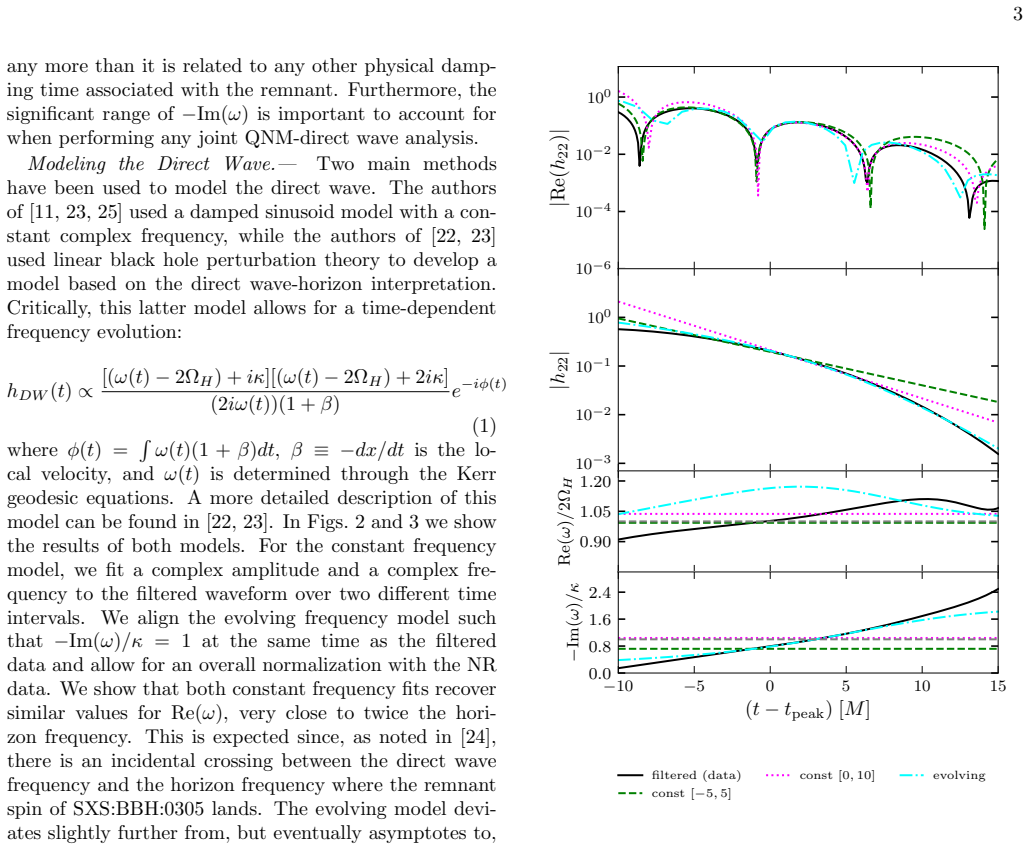
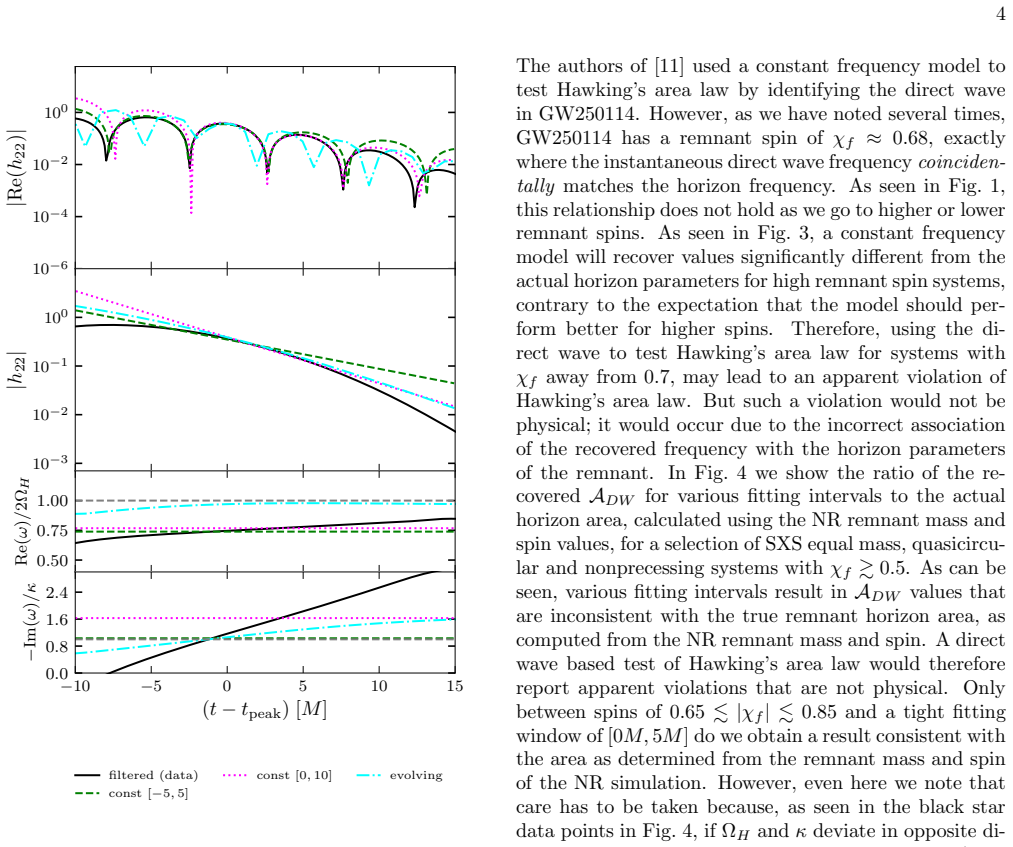
The direct wave frequency is not correlated with the horizon frequency or surface gravity, other than an incidental crossing around χ_f ≈ 0.7. The damping time shows significant evolution, so a single damped sinusoid model is not appropriate. An evolving frequency model based on horizon properties does not model the direct wave for large remnant spins. Testing Hawking's area law with a horizon frequency based on the direct wave will lead to apparent violations when no violation actually occurs.
What carries the argument
The direct wave, a distinct non-quasinormal mode component of black hole binary merger radiation whose frequency and damping time are compared to horizon quantities.
If this is right
- The direct wave cannot serve as a meaningful test of remnant horizon properties.
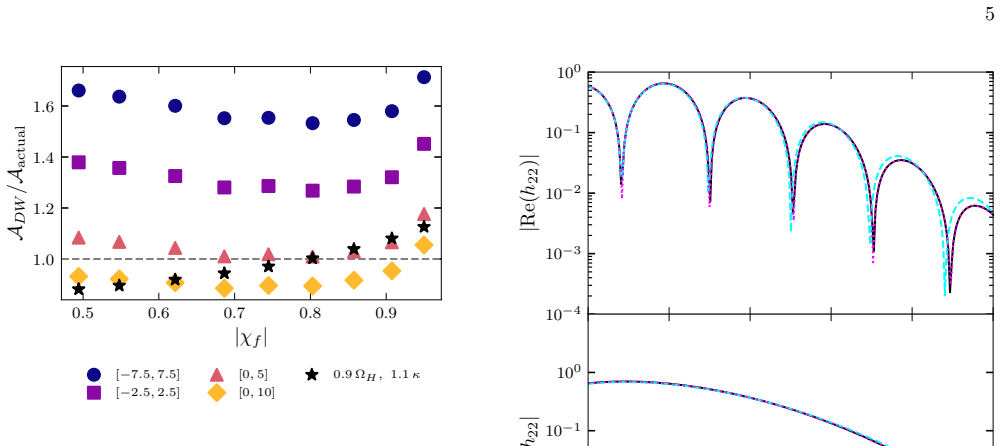
- Using the direct wave for Hawking area law tests produces false apparent violations.
- The quasi-stable frequency but evolving damping time means fixed-parameter models fail to describe the direct wave.
- Horizon-based evolving frequency models do not fit the direct wave at high spins.
Where Pith is reading between the lines
- Other gravitational wave components, such as quasinormal modes, may still be viable for horizon tests if they show better correlation.
- The origin of the direct wave might lie in the strong-field dynamics of the merger rather than the final horizon.
- Additional simulations with varied spins could confirm the lack of correlation across the parameter space.
Load-bearing premise
The reliable identification and isolation of a distinct direct wave component in the strain data, allowing extraction of its properties for comparison to the horizon.
What would settle it
A demonstration of consistent correlation between direct wave frequency and horizon frequency across multiple remnant spins in numerical simulations would contradict the paper's findings.
Figures

read the original abstract
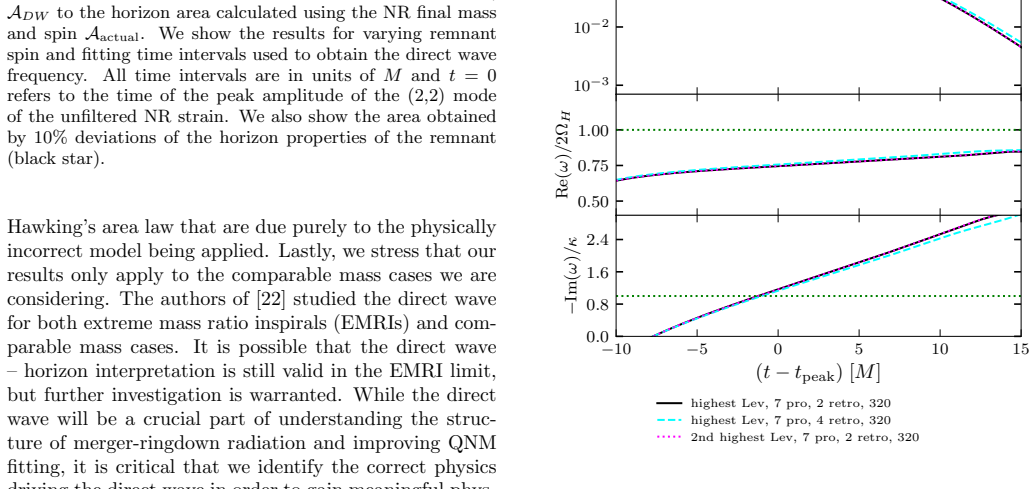
Recently, a distinct non--quasinormal mode component of black hole binary merger radiation, named the direct wave, has been identified. The frequency and damping time of the direct wave have been associated with properties of the remnant horizon. This has led to direct-wave based analysis of GW250114, including a test of Hawking's area law. However, as we demonstrate here using numerical relativity strain data, the direct wave frequency is not correlated with the horizon frequency or surface gravity, other than an incidental crossing around $\chi_f \approx 0.7$ corresponding closely to the remnant spin of GW250114. We show that while the instantaneous frequency of the direct wave is quasi-stable, the damping time shows significant evolution and therefore a single damped sinusoid model, containing a fixed damping time, is not appropriate. We further show that an evolving frequency model based on horizon properties also does not model the direct wave component for systems with large remnant spins. We demonstrate that testing Hawking's area law with a horizon frequency based on the direct wave interpretation will lead to apparent violations of Hawking's area law when no violation actually occurs. Our results therefore indicate that the direct wave is not a reliable probe of the remnant horizon's properties.
Editorial analysis
A structured set of objections, weighed in public.
Referee Report
Summary. The manuscript uses numerical relativity strain data to argue that the recently identified 'direct wave' component in black hole binary merger waveforms is not correlated with remnant horizon frequency or surface gravity, except for an incidental crossing at χ_f ≈ 0.7 that matches the spin of GW250114. It shows that the direct wave's instantaneous frequency is quasi-stable but its damping time evolves significantly, rendering a single damped-sinusoid model inappropriate, and that horizon-property-based frequency models fail to describe the direct wave at high remnant spins. The paper further demonstrates that adopting a direct-wave interpretation for tests of Hawking's area law produces apparent violations even when none occur, concluding that the direct wave is not a reliable probe of horizon properties.
Significance. If the central numerical comparisons hold, the result supplies a concrete counter-example to recent associations between the direct wave and remnant horizon quantities, thereby cautioning against direct-wave-based analyses of events such as GW250114. The use of independent NR simulations to exhibit both the lack of correlation and the spurious area-law violations is a clear strength; the work supplies falsifiable predictions about waveform modeling that can be checked with additional simulations or alternative decompositions.
major comments (2)
- [Abstract and methods on direct-wave extraction] Abstract and the section describing the direct-wave isolation procedure: the central claim of no correlation (except at χ_f ≈ 0.7) rests on the reliability of extracting instantaneous frequency and damping time from a distinct non-QNM component. The manuscript does not demonstrate robustness of this isolation against alternative waveform decompositions; if the procedure inadvertently suppresses components that would correlate with horizon quantities, the reported lack of correlation could be procedural rather than physical. This is load-bearing for the claim that the direct wave is 'not a meaningful test of horizon properties.'
- [Section on horizon-based models] The paragraph demonstrating that horizon-based evolving-frequency models fail for large remnant spins: the paper states that such models 'do not model the direct wave component,' but does not report quantitative fit residuals, χ² values, or comparison against a null model. Without these metrics it is difficult to judge whether the failure is decisive or merely indicates that a more flexible parametrization is needed.
minor comments (2)
- [Figures] Figure captions should explicitly state the remnant spin values used for each waveform and whether error bands on the extracted direct-wave frequency and damping time are shown.
- [Abstract] The phrase 'incidental crossing around χ_f ≈ 0.7' would benefit from a quantitative statement of how close the crossing is to the GW250114 remnant spin and the width of the crossing region.
Simulated Author's Rebuttal
We thank the referee for their thorough review and constructive feedback on our manuscript. We address each major comment below and have revised the manuscript accordingly to strengthen the presentation of our results.
read point-by-point responses
-
Referee: [Abstract and methods on direct-wave extraction] Abstract and the section describing the direct-wave isolation procedure: the central claim of no correlation (except at χ_f ≈ 0.7) rests on the reliability of extracting instantaneous frequency and damping time from a distinct non-QNM component. The manuscript does not demonstrate robustness of this isolation against alternative waveform decompositions; if the procedure inadvertently suppresses components that would correlate with horizon quantities, the reported lack of correlation could be procedural rather than physical. This is load-bearing for the claim that the direct wave is 'not a meaningful test of horizon properties.'
Authors: We agree that explicit robustness checks against alternative decompositions would strengthen the central claim. The isolation procedure in the manuscript follows the method of the original direct-wave identification paper and was applied uniformly to multiple independent NR datasets. In the revised version we have added a new subsection that repeats the extraction using a second, independent decomposition technique (based on a different time-frequency filtering approach) and shows that the reported lack of correlation with horizon quantities persists. We have also added a short discussion of the assumptions underlying the isolation and their potential impact. revision: yes
-
Referee: [Section on horizon-based models] The paragraph demonstrating that horizon-based evolving-frequency models fail for large remnant spins: the paper states that such models 'do not model the direct wave component,' but does not report quantitative fit residuals, χ² values, or comparison against a null model. Without these metrics it is difficult to judge whether the failure is decisive or merely indicates that a more flexible parametrization is needed.
Authors: We accept that quantitative goodness-of-fit metrics are needed to make the comparison decisive. The revised manuscript now includes a table of reduced-χ² values for the horizon-based evolving-frequency models versus both the direct-wave data and a simple null model (constant frequency and damping time) across the spin range. The table shows that the horizon-based models yield χ² values several times larger than the null model at high remnant spins, confirming that they do not provide an adequate description. revision: yes
Circularity Check
No significant circularity; claims rest on independent NR simulations
full rationale
The paper derives its central result—that direct-wave frequency shows no correlation with horizon frequency or surface gravity except at an incidental point—directly from extraction and comparison performed on numerical relativity strain data. No load-bearing step reduces by construction to a fitted parameter, self-definition, or self-citation chain; the isolation of the direct-wave component and the subsequent frequency/damping-time measurements are presented as empirical outputs from external simulations rather than internal consistency requirements. The demonstration that a single damped sinusoid or horizon-based model fails for high spins likewise follows from the same data comparison without circular reduction. This is the normal case of a self-contained analysis against external benchmarks.
Axiom & Free-Parameter Ledger
axioms (1)
- domain assumption Numerical relativity simulations of binary black hole mergers accurately capture the gravitational wave strain and allow unambiguous identification of a distinct direct-wave component separate from quasinormal modes.
Reference graph
Works this paper leans on
-
[1]
Furthermore, they argue that the damping rate is only characterized by the surface grav- ity,−Im(ω)∼ O(κ)
only state that the direct wave should oscillate near the horizon frequency. Furthermore, they argue that the damping rate is only characterized by the surface grav- ity,−Im(ω)∼ O(κ). However, as we show in this work, the direct wave is not correlated with the horizon fre- quency and Im(ω) significantly varies over a short inter- val of time. Since the di...
-
[2]
A. Abac, I. Abouelfettouh, F. Acernese, K. Ackley, S. Ad- hicary, D. Adhikari, N. Adhikari, R. Adhikari, V. Adkins, S. Afroz,et al., Gwtc-4.0: An introduction to version 4.0 of the gravitational-wave transient catalog, The Astro- physical Journal Letters995, L18 (2025)
2025
-
[3]
A. Abac, I. Abouelfettouh, F. Acernese, K. Ackley, S. Ad- hicary, D. Adhikari, N. Adhikari, R. Adhikari, V. Ad- 6 SXS IDχ f SXS:BBH:2089 0.4942 SXS:BBH:2088 0.5478 SXS:BBH:3919 0.6215 SXS:BBH:4434 0.6864 SXS:BBH:0305 0.6921 SXS:BBH:2095 0.7447 SXS:BBH:3927 0.8029 SXS:BBH:2099 0.8574 SXS:BBH:3897 0.9075 SXS:BBH:0178 0.9499 TABLE I. Remnant dimensionless sp...
work page internal anchor Pith review Pith/arXiv arXiv 2089
-
[4]
Laser Interferometer Space Antenna
P. Amaro-Seoane, H. Audley, S. Babak, J. Baker, E. Ba- rausse, P. Bender, E. Berti, P. Binetruy, M. Born, D. Bor- toluzzi,et al., Laser interferometer space antenna (2017), arXiv:1702.00786 [astro-ph.IM]
work page internal anchor Pith review Pith/arXiv arXiv 2017
-
[5]
Cosmic Explorer: The U.S. Contribution to Gravitational-Wave Astronomy beyond LIGO
D. Reitze, R. X. Adhikari, S. Ballmer, B. Barish, L. Bar- sotti, G. Billingsley, D. A. Brown, Y. Chen, D. Coyne, R. Eisenstein,et al., Cosmic explorer: the us contribu- tion to gravitational-wave astronomy beyond ligo, arXiv preprint arXiv:1907.04833 (2019)
work page internal anchor Pith review Pith/arXiv arXiv 1907
-
[6]
A. Abac, R. Abramo, S. Albanesi, A. Albertini, A. Agapito, M. Agathos, C. Albertus, N. Andersson, T. Andrade, I. Andreoni,et al., The science of the ein- stein telescope (2025)
2025
-
[7]
A. Abac, I. Abouelfettouh, F. Acernese, K. Ackley, C. Adamcewicz, S. Adhicary, D. Adhikari, N. Adhikari, R. Adhikari, V. Adkins,et al., Black hole spectroscopy and tests of general relativity with gw250114, Physical review letters136, 041403 (2026)
2026
-
[9]
Berti, V
E. Berti, V. Cardoso, G. Carullo, S. Albanesi, V. Baib- hav, S. Bhagwat, B. Bucciotti, P. A. Cano, M. H.-Y. Che- ung, K.-W. Chung,et al., Black hole spectroscopy: from theory to experiment, Classical and Quantum Gravity (2025)
2025
- [10]
-
[11]
Maenaut, G
S. Maenaut, G. Carullo, P. A. Cano, A. Liu, V. Cardoso, T. Hertog, and T. G. Li, Ringdown analysis of rotating black holes in effective field theory extensions of general relativity, Physical Review D113, 044039 (2026)
2026
-
[12]
A. K.-W. Chung, K. K.-H. Lam, A. Liu, and N. Yunes, Measuring a black hole’s area immediately after merger: A direct-wave test of hawking’s area law (2026), arXiv:2606.06592 [gr-qc]
work page internal anchor Pith review Pith/arXiv arXiv 2026
-
[13]
Black hole spectroscopy: from theory to experiment
E. Berti, V. Cardoso, G. Carullo, J. Abedi, N. Afshordi, S. Albanesi, V. Baibhav, S. Bhagwat, J. L. Bl´ azquez- Salcedo, B. Bonga,et al., Black hole spectroscopy: from theory to experiment, arXiv preprint arXiv:2505.23895 (2025)
work page internal anchor Pith review Pith/arXiv arXiv 2025
-
[14]
Berti, V
E. Berti, V. Cardoso, and A. O. Starinets, Quasinor- mal modes of black holes and black branes, Classical and Quantum Gravity26, 163001 (2009)
2009
-
[15]
Giesler, M
M. Giesler, M. Isi, M. A. Scheel, and S. A. Teukolsky, Black hole ringdown: the importance of overtones, Phys- ical Review X9, 041060 (2019)
2019
-
[16]
M. H.-Y. Cheung, E. Berti, V. Baibhav, and R. Cotesta, Extracting linear and nonlinear quasinormal modes from black hole merger simulations, Physical Review D109, 044069 (2024)
2024
-
[17]
Pacilio, S
C. Pacilio, S. Bhagwat, F. Nobili, and D. Gerosa, Flexible mapping of ringdown amplitudes for nonprecessing bi- nary black holes, Physical Review D110, 103037 (2024)
2024
-
[18]
Baibhav, M
V. Baibhav, M. H.-Y. Cheung, E. Berti, V. Cardoso, G. Carullo, R. Cotesta, W. Del Pozzo, and F. Duque, Agnostic black hole spectroscopy: Quasinormal mode content of numerical relativity waveforms and limits of validity of linear perturbation theory, Physical Review D 108, 104020 (2023)
2023
-
[19]
Maga˜ na Zertuche, L
L. Maga˜ na Zertuche, L. C. Stein, K. Mitman, S. E. Field, V. Varma, M. Boyle, N. Deppe, L. E. Kidder, J. Moxon, H. P. Pfeiffer,et al., High-precision ringdown surrogate model for nonprecessing binary black holes, Physical Re- view D112, 024077 (2025)
2025
-
[20]
S. Ma, K. Mitman, L. Sun, N. Deppe, F. H´ ebert, L. E. Kidder, J. Moxon, W. Throwe, N. L. Vu, and Y. Chen, Quasinormal-mode filters: A new approach to analyze the gravitational-wave ringdown of binary black-hole mergers, Physical Review D106, 084036 (2022)
2022
-
[21]
S. Ma, L. Sun, and Y. Chen, Using rational filters to un- cover the first ringdown overtone in gw150914, Physical Review D107, 084010 (2023)
2023
-
[22]
N. Lu, S. Ma, O. J. Piccinni, L. Sun, and E. Finch, Sta- tistical identification of ringdown modes with rational fil- ters, Physical Review D112, 064047 (2025)
2025
- [23]
-
[24]
N. Lu, S. Ma, O. J. Piccinni, Y. Chen, and L. Sun, Gw250114 reveals black hole horizon signatures, arXiv preprint arXiv:2510.01001 (2025)
work page internal anchor Pith review Pith/arXiv arXiv 2025
-
[25]
A. Kankani and S. T. McWilliams, Direct waves in black- hole binary mergers: Insights from the backwards one body model, arXiv preprint arXiv:2603.15474 (2026)
-
[26]
R. Dyer, A. K.-W. Chung, and C. J. Moore, Model- ing direct waves in binary black hole ringdowns (2026), arXiv:2606.25021
work page internal anchor Pith review Pith/arXiv arXiv 2026
-
[27]
SXS Collaboration, Binary black-hole simulation SXS:BBH:0305 (2025)
2025
-
[28]
SXS Collaboration, The sxs catalog of simulations v3.0.0 (2025)
2025
-
[29]
Boyle, K
M. Boyle, K. Mitman, M. Scheel, and L. Stein, The sxs package (2026)
2026
-
[30]
M. A. Scheel, M. Boyle, K. Mitman, N. Deppe, L. C. Stein, C. Armaza, M. S. Bonilla, L. T. Buchman, A. Ceja, H. Chaudhary,et al., The sxs collaboration’s third cata- log of binary black hole simulations, Classical and Quan- tum Gravity42, 195017 (2025)
2025
-
[31]
B. P. Abbott, R. Abbott, T. D. Abbott, M. R. Aber- nathy, F. Acernese, K. Ackley, C. Adams, T. Adams, P. Addesso, R. X. Adhikari,et al., Observation of gravi- tational waves from a binary black hole merger, Physical review letters116, 061102 (2016). 7
2016
-
[32]
A. Abac, I. Abouelfettouh, F. Acernese, K. Ackley, C. Adamcewicz, S. Adhicary, D. Adhikari, N. Adhikari, R. Adhikari, V. Adkins,et al., Gw250114: Testing hawk- ing’s area law and the kerr nature of black holes, Physical review letters135, 111403 (2025)
2025
-
[33]
S. T. McWilliams, Analytical black-hole binary merger waveforms, Physical review letters122, 191102 (2019)
2019
-
[34]
A. Kankani and S. T. McWilliams, Bob the (waveform) builder: Optimizing analytical black-hole binary merger waveforms, arXiv preprint arXiv:2510.25012 (2025)
-
[35]
Kankani and S
A. Kankani and S. T. McWilliams, Modeling relative peak times of gravitational wave harmonics, Phys. Rev. D112, 124051 (2025)
2025
-
[36]
Mahesh, S
S. Mahesh, S. T. McWilliams, and Z. Etienne, Combin- ing effective one-body inspirals and backwards one-body merger-ringdowns for aligned spin black hole binaries, Physical Review D112, 124065 (2025)
2025
-
[37]
Boyle, D
M. Boyle, D. Hemberger, D. A. Iozzo, G. Lovelace, S. Os- sokine, H. P. Pfeiffer, M. A. Scheel, L. C. Stein, C. J. Woodford, A. B. Zimmerman,et al., The sxs collabora- tion catalog of binary black hole simulations, Classical and Quantum Gravity36, 195006 (2019)
2019
-
[38]
A. H. Mroue, M. A. Scheel, B. Szilagyi, H. P. Pfeiffer, M. Boyle, D. A. Hemberger, L. E. Kidder, G. Lovelace, S. Ossokine, N. W. Taylor,et al., Catalog of 174 binary black hole simulations for gravitational wave astronomy, Physical Review Letters111, 241104 (2013)
2013
-
[39]
M. A. Scheel, M. Giesler, D. A. Hemberger, G. Lovelace, K. Kuper, M. Boyle, B. Szil´ agyi, and L. E. Kidder, Im- proved methods for simulating nearly extremal binary black holes, Classical and Quantum Gravity32, 105009 (2015)
2015
-
[40]
SXS Collaboration, Binary black-hole simulation SXS:BBH:0178 (2025)
2025
discussion (0)
Sign in with ORCID, Apple, or X to comment. Anyone can read and Pith papers without signing in.