REVIEW 2 major objections 6 minor 61 references
Do All Visual Tokens Matter Equally? Object-Evidence Preserving Token Merging for Vision-Language Retrieval
T0 review · 2 major / 6 minor · reviewed 2026-07-14 · grok-4.5
Pith's one-line read Multi-vector image search gets cheaper and more accurate when image tokens are merged so object-level evidence stays selectable by future queries.
desk verdict Solid systems paper: object-prior soft merging of post-projector tokens at K=64 cuts ColPali storage ~16× and lifts R@1 over full multi-vector and matched adapted compressors, with grounding support; main caveat is single-domain adaptation isolation, not a broken claim. read the letter →
The pith
A machine-rendered reading of the paper's core claim, the machinery that carries it, and where it could break.
The reading
What carries the argument
SaMer (semantic-aware merging): feature-spatial soft assignment of post-projector tokens into K normalized weighted centroids, with a training-only object-instance penalty that discourages cross-instance mixing; inference uses the same late-interaction interface without boxes or detectors.
What would settle it
Under identical K=64 projection-only adaptation on the same backbone, if feature-spatial merging without the object-instance prior matches or beats full SaMer on R@1 and BoxMass on held-out Flickr30K and MSCOCO, the claim that the object prior is what preserves selectable evidence would fail.
Extended reading notes
Core claim
The paper claims that object-aware merging of post-projector visual tokens into K representative centroids preserves query-selectable object and region evidence under MaxSim late interaction, so aggressive compression can improve rather than degrade retrieval. With K=64, using training-only object annotations as a merge prior, no boxes at inference, and projection-only adaptation of frozen backbones, SaMer removes more than 93 percent of image-side tokens, reduces ColPali storage by 16.09 times, lifts R@1 on Flickr30K and MSCOCO, and strengthens phrase-level grounding relative to pruning and pooling at the same budget.
Load-bearing premise
A training-time object-instance merge prior from one annotated set, absorbed only into an adapted shared projection, still yields object-consistent centroids at inference with no boxes, and a budget of 64 tokens is enough to keep the evidence queries need.
Editorial analysis
A structured set of objections, weighed in public.
Referee Report
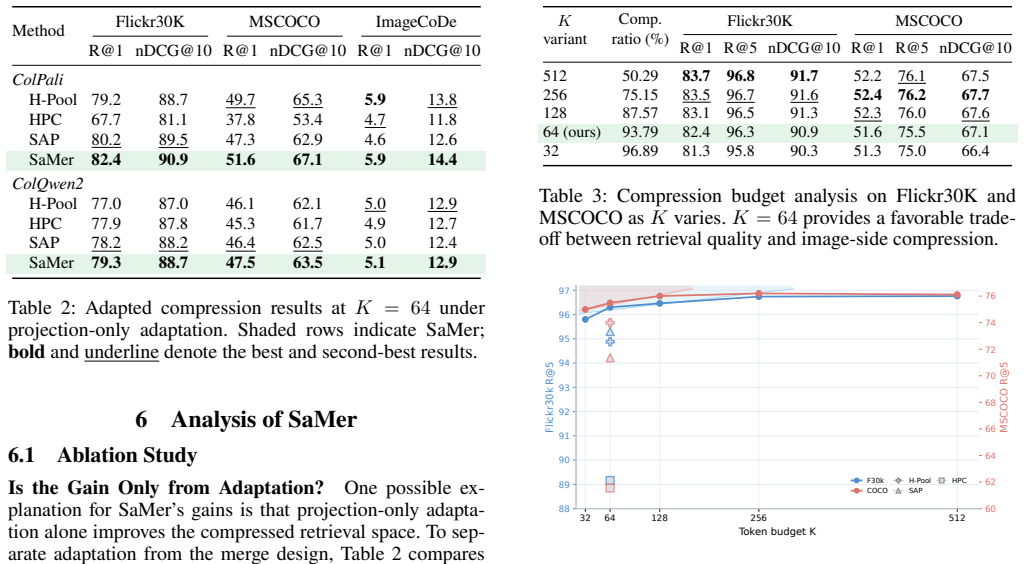
Summary. The paper proposes SaMer, an object-aware post-projector token merging method for multi-vector vision-language retrieval (ColPali/ColQwen2-style MaxSim). Image tokens are compressed to K feature-spatial soft centroids (Eqs. 2–4) while preserving the late-interaction interface. During training only, bounding-box instance labels define an instance-inconsistency penalty P_inst that reshapes soft assignment (Eqs. 5–6); inference is bbox- and detector-free. Only the shared projection is adapted under a multi-positive InfoNCE loss on compressed scores (Eq. 7), with frozen vision/language backbones. At K=64 the method removes >93% of image-side tokens, reports 16.09× ColPali storage reduction, improves R@1 on Flickr30K (77.0→82.4) and MSCOCO (47.4→51.6), outperforms matched-budget adapted compressors (H-Pool, HPC, SAP; Table 2), and improves phrase-level grounding (BoxMass/RegionHit/CoverageIoU). Ablations attribute the main lift to the object prior (Table 4); DocVQA is treated as a non-object-centric boundary case.
Significance. Late-interaction multi-vector VL retrieval is storage- and scoring-bound by dense image tokens; framing compression as query-selectable evidence preservation rather than pure redundancy reduction is a useful and timely contribution for IR and multimodal retrieval. The design is practically attractive: training-only object prior, annotation-free inference, projection-only adaptation, and an unchanged MaxSim interface. Strengths include matched-budget adapted baselines (Table 2), merge-component and budget sweeps (Tables 3–4), merging-vs-pruning controls, explicit grounding metrics tied to the evidence claim, efficiency measurements (storage, MaxSim ops, QPS), and released code. If the reported gains hold under broader adaptation sources and seed variance, SaMer is a strong, deployable recipe for index-side multi-vector compression.
major comments (2)
- [§6.1, Table 2, Table 4] §6.1 and Table 2 are the load-bearing isolation of “object-aware merging, not adaptation alone”: all compressors share the same frozen backbones, projection-only FT, and K=64. That control is appropriate, but every adapted run uses a single adaptation source (Flickr30K-Entities, §5.2) with no multi-seed variance. The headline lifts (e.g., ColPali Flickr30K R@1 80.4→82.4 when adding the object prior in Table 4; SaMer vs H-Pool/SAP in Table 2) could partly reflect fitting the shared projection to Flickr-style object density under any soft merge. Please report mean±std over ≥3 seeds for Table 2/Table 4 key rows, and ideally one alternative adaptation source (or a leave-domain control) so the claimed transfer of the training-time prior into bbox-free inference centroids is quantified rather than assumed.
- [§4.2, Eqs. 2–6; Fig. 3] §4.2 states that at inference the object-aware prior is “reflected in the adapted projection space” while assignment uses only feature-spatial soft centroids (Eqs. 2–3). Retrieval and grounding (Fig. 3, BoxMass/RegionHit/CoverageIoU) support better phrase evidence, but they do not directly measure the mechanism the paper names as central—reduced cross-instance collapse of merged representatives. A simple diagnostic on held-out images with boxes (e.g., fraction of soft mass mixing distinct instance labels per centroid, or purity of hard assignment under the same d(i,k) used at inference) would test whether inference centroids are actually more object-consistent than feature/spatial-only merging after the same projection FT. Without that, the causal story “object-aware merge prior → object-consistent selectable evidence” remains one step more indirect than the abstract claims.
minor comments (6)
- [Abstract, §1] Abstract and §1 claim improvement “while improving R@1 on Flickr30K and MSCOCO” without stating that adaptation is Flickr-only and MSCOCO is zero-shot transfer; one clause would prevent over-reading domain generality.
- [Table 1, §5.3, §7] DocVQA results in Table 1 show SaMer below full ColPali/ColQwen2; §5.3 correctly calls it a boundary case, but the conclusion (§7) should restate that object-centric merging is not claimed for sparse OCR/layout retrieval.
- [Appendix B, Eq. (2)] γ, τs, and τ are fixed in Appendix B without sensitivity; a short note or one-row sensitivity for γ would help readers who reimplement feature-spatial merging.
- [Figure 2] Figure 2 dual-axis R@5 trade-off is useful; ensure baseline markers (H-Pool/SAP/HPC at K=64) are labeled in the legend as well as the caption for greyscale readability.
- [§4.1, Appendix A/E] Table 6 (centroid variants) and Table 7 (merging vs pruning) strengthen the design choices; consider a one-sentence pointer in §4.1/§6.1 so main-text readers know soft assignment and merging-over-pruning were ablated.
- [§4.2, Eq. (5)] Minor notation: N vs K and soft vs hard assignment (ci vs ai,k) are clear in §4, but P_inst(i,k)=1−Pk(bi) for background tokens could be stated explicitly (all background share one label?).
Circularity Check
No significant circularity: empirical compression method evaluated on external benchmarks with independent retrieval loss and matched-budget ablations.
full rationale
SaMer is an empirical multi-vector retrieval compression method, not a first-principles derivation. The load-bearing claims (K=64 storage reduction, R@1 gains on Flickr30K/MSCOCO, better grounding vs H-Pool/SAP/HPC) are measured outcomes under standard InfoNCE over compressed MaxSim (Eq. 7), not quantities forced by construction from fitted inputs. Object annotations enter only as a training-time soft-assignment prior (Eq. 5–6), not as an auxiliary grounding loss that defines the reported metrics; inference is bbox-free feature-spatial merging (Eq. 2–3). Table 2 holds adaptation fixed across compressors, and Table 4 ablates the object prior, so the claimed mechanism is tested rather than assumed. Grounding metrics (BoxMass, RegionHit, CoverageIoU) use external phrase boxes as independent probes of evidence concentration; they are not the training objective. Evaluation uses public external benchmarks and external baselines under matched K. No self-definitional loop, no fitted parameter renamed as prediction, no load-bearing self-citation uniqueness theorem, and no renaming of a known result as a derivation. Mild experimental caveats (single adaptation source, K chosen at a favorable operating point) are design/generalization issues, not circularity.
Assumptions & free parameters
free parameters (4)
- K (merged token budget)
- spatial weight γ
- soft-assignment temperature τs and retrieval temperature τ
- projection-only adaptation schedule
assumptions (4)
- domain assumption MaxSim late interaction over token embeddings is the correct scoring interface to preserve for fine-grained VL retrieval.
- ad hoc to paper Object-instance labels from training boxes are a useful merge prior that reduces harmful cross-instance collapse under feature similarity.
- domain assumption Soft weighted ℓ2-normalized centroids of post-projector tokens preserve selectable evidence better than hard pruning of tokens.
- ad hoc to paper Adapting only the shared projection with frozen backbones is sufficient to align compressed centroids with query tokens.
invented entities (1)
-
SaMer object-aware merge prior (instance-inconsistency penalty P_inst on soft assignment)
Cite this review
Pith. "Pith review of Do All Visual Tokens Matter Equally? Object-Evidence Preserving Token Merging for Vision-Language Retrieval." pith.science (2026). https://pith.science/paper/OZHUOGCX
@misc{pith2026260704605,
  author       = {Pith},
  title        = {Pith review of: Do All Visual Tokens Matter Equally? Object-Evidence Preserving Token Merging for Vision-Language Retrieval},
  year         = {2026},
  howpublished = {\url{https://pith.science/paper/OZHUOGCX}},
  note         = {Machine review of arXiv:2607.04605}
}
abstract
Multi-vector vision-language retrieval preserves fine-grained visual evidence through maximum-similarity late interaction, but dense image-side tokens make storage and scoring expensive. Existing token compression methods reduce this cost, yet they can remove or collapse object- and region-level evidence that future query tokens may need to select. We propose SaMer, an object-aware token merging framework that compresses image-side post-projector tokens into $K$ representative centroids while preserving the original late-interaction interface. SaMer uses object annotations only during training as a merge prior to discourage cross-instance mixing, requires no ground-truth bounding boxes or detectors at inference time, and adapts only the shared projection layer with frozen vision and language backbones. With $K=64$, SaMer removes more than 93% of image-side tokens and reduces ColPali storage by $16.09\times$, while improving R@1 on Flickr30K and MSCOCO. These gains arise because object-aware merging preserves query-selectable object evidence that pruning or feature-only pooling can remove or collapse. SaMer also outperforms compression baselines and shows stronger phrase-level grounding, suggesting that efficient multi-vector retrieval depends not only on reducing token count, but on preserving the evidence future query tokens need to select.
Figures


Figures from the paper (1 more)

Reference graph
Works this paper leans on
-
[1]
Proceedings of the 43rd International ACM SIGIR Conference on Research and Development in Information Retrieval , pages=
ColBERT: Efficient and Effective Passage Search via Contextualized Late Interaction over BERT , author=. Proceedings of the 43rd International ACM SIGIR Conference on Research and Development in Information Retrieval , pages=
-
[2]
Proceedings of the 2022 Conference of the North American Chapter of the Association for Computational Linguistics: Human Language Technologies , pages=
ColBERTv2: Effective and Efficient Retrieval via Lightweight Late Interaction , author=. Proceedings of the 2022 Conference of the North American Chapter of the Association for Computational Linguistics: Human Language Technologies , pages=
2022
-
[3]
arXiv preprint arXiv:2407.01449 , year=
ColPali: Efficient Document Retrieval with Vision Language Models , author=. arXiv preprint arXiv:2407.01449 , year=
-
[4]
arXiv preprint arXiv:2409.12191 , year=
Qwen2-VL: Enhancing Vision-Language Model's Perception of the World at Any Resolution , author=. arXiv preprint arXiv:2409.12191 , year=
-
[5]
International Conference on Learning Representations , year=
An Image is Worth 16x16 Words: Transformers for Image Recognition at Scale , author=. International Conference on Learning Representations , year=
-
[6]
arXiv preprint arXiv:2506.04997 , year=
Towards Storage-Efficient Visual Document Retrieval: An Empirical Study on Reducing Patch-Level Embeddings , author=. arXiv preprint arXiv:2506.04997 , year=
-
[7]
International conference on machine learning , pages=
Scaling up visual and vision-language representation learning with noisy text supervision , author=. International conference on machine learning , pages=. 2021 , organization=
2021
-
[8]
Advances in neural information processing systems , volume=
Align before fuse: Vision and language representation learning with momentum distillation , author=. Advances in neural information processing systems , volume=
Show all 61 references
-
[9]
International conference on machine learning , pages=
Blip: Bootstrapping language-image pre-training for unified vision-language understanding and generation , author=. International conference on machine learning , pages=. 2022 , organization=
2022
-
[10]
International conference on machine learning , pages=
Blip-2: Bootstrapping language-image pre-training with frozen image encoders and large language models , author=. International conference on machine learning , pages=. 2023 , organization=
2023
-
[11]
Proceedings of the 2021 Conference of the North American Chapter of the Association for Computational Linguistics: Human Language Technologies , pages=
COIL: Revisit exact lexical match in information retrieval with contextualized inverted list , author=. Proceedings of the 2021 Conference of the North American Chapter of the Association for Computational Linguistics: Human Language Technologies , pages=
2021
-
[12]
Proceedings of the 44th International ACM SIGIR Conference on Research and Development in Information Retrieval , pages=
Splade: Sparse lexical and expansion model for first stage ranking , author=. Proceedings of the 44th International ACM SIGIR Conference on Research and Development in Information Retrieval , pages=
-
[13]
arXiv preprint arXiv:2109.10086 , year=
SPLADE v2: Sparse lexical and expansion model for information retrieval , author=. arXiv preprint arXiv:2109.10086 , year=
-
[14]
Proceedings of the 31st ACM International Conference on Information & Knowledge Management , pages=
PLAID: an efficient engine for late interaction retrieval , author=. Proceedings of the 31st ACM International Conference on Information & Knowledge Management , pages=
-
[15]
Proceedings of the 48th international ACM SIGIR conference on research and development in information retrieval , pages=
WARP: An efficient engine for multi-vector retrieval , author=. Proceedings of the 48th international ACM SIGIR conference on research and development in information retrieval , pages=
-
[16]
Proceedings of the IEEE/CVF International Conference on Computer Vision , pages=
Llava-prumerge: Adaptive token reduction for efficient large multimodal models , author=. Proceedings of the IEEE/CVF International Conference on Computer Vision , pages=
-
[17]
Findings of the Association for Computational Linguistics: NAACL 2025 , pages=
Lvpruning: An effective yet simple language-guided vision token pruning approach for multi-modal large language models , author=. Findings of the Association for Computational Linguistics: NAACL 2025 , pages=
2025
-
[18]
Proceedings of the IEEE/CVF Conference on Computer Vision and Pattern Recognition , pages=
Visionzip: Longer is better but not necessary in vision language models , author=. Proceedings of the IEEE/CVF Conference on Computer Vision and Pattern Recognition , pages=
-
[19]
arXiv preprint arXiv:2410.08584 , year=
Zipvl: Efficient large vision-language models with dynamic token sparsification , author=. arXiv preprint arXiv:2410.08584 , year=
-
[20]
arXiv preprint arXiv:2605.13178 , year=
CLIP Tricks You: Training-free Token Pruning for Efficient Pixel Grounding in Large VIsion-Language Models , author=. arXiv preprint arXiv:2605.13178 , year=
-
[21]
The Eleventh International Conference on Learning Representations , year=
Token Merging: Your ViT But Faster , author=. The Eleventh International Conference on Learning Representations , year=
-
[22]
arXiv preprint arXiv:2511.21631 , year=
Qwen3-vl technical report , author=. arXiv preprint arXiv:2511.21631 , year=
-
[23]
Transactions of the Association for Computational Linguistics , volume=
From image descriptions to visual denotations: New similarity metrics for semantic inference over event descriptions , author=. Transactions of the Association for Computational Linguistics , volume=. 2014 , publisher=
2014
-
[24]
arXiv preprint arXiv:1505.04870 , year =
Flickr30k Entities: Collecting Region-to-Phrase Correspondences for Richer Image-to-Sentence Models , author =. arXiv preprint arXiv:1505.04870 , year =
-
[25]
European Conference on Computer Vision , year =
Microsoft COCO: Common Objects in Context , author =. European Conference on Computer Vision , year =
-
[26]
Proceedings of the IEEE/CVF Winter Conference on Applications of Computer Vision , year =
DocVQA: A Dataset for VQA on Document Images , author =. Proceedings of the IEEE/CVF Winter Conference on Applications of Computer Vision , year =
-
[27]
arXiv preprint arXiv:2203.15867 , year =
Image Retrieval from Contextual Descriptions , author =. arXiv preprint arXiv:2203.15867 , year =
-
[28]
Proceedings of the IEEE/CVF Conference on Computer Vision and Pattern Recognition , year =
GQA: A New Dataset for Real-World Visual Reasoning and Compositional Question Answering , author =. Proceedings of the IEEE/CVF Conference on Computer Vision and Pattern Recognition , year =
-
[29]
European Conference on Computer Vision , year =
A-OKVQA: A Benchmark for Visual Question Answering using World Knowledge , author =. European Conference on Computer Vision , year =
-
[30]
International conference on machine learning , pages=
Learning transferable visual models from natural language supervision , author=. International conference on machine learning , pages=. 2021 , organization=
2021
-
[31]
Proceedings of the IEEE/CVF Conference on Computer Vision and Pattern Recognition (CVPR) , month =
Cherti, Mehdi and Beaumont, Romain and Wightman, Ross and Wortsman, Mitchell and Ilharco, Gabriel and Gordon, Cade and Schuhmann, Christoph and Schmidt, Ludwig and Jitsev, Jenia , title =. Proceedings of the IEEE/CVF Conference on Computer Vision and Pattern Recognition (CVPR)...
2023
-
[32]
Demystifying
Hu Xu and Saining Xie and Xiaoqing Tan and Po-Yao Huang and Russell Howes and Vasu Sharma and Shang-Wen Li and Gargi Ghosh and Luke Zettlemoyer and Christoph Feichtenhofer , booktitle=. Demystifying. 2024 , url=
2024
-
[33]
arXiv preprint arXiv:2303.15389 , year =
EVA-CLIP: Improved Training Techniques for CLIP at Scale , author =. arXiv preprint arXiv:2303.15389 , year =
-
[34]
arXiv preprint arXiv:2309.17425 , year =
Data Filtering Networks , author =. arXiv preprint arXiv:2309.17425 , year =
-
[35]
arXiv preprint arXiv:2502.14786 , year =
SigLIP 2: Multilingual Vision-Language Encoders with Improved Semantic Understanding, Localization, and Dense Features , author =. arXiv preprint arXiv:2502.14786 , year =
-
[36]
2026 , url=
Rui Meng and Ziyan Jiang and Ye Liu and Mingyi Su and Xinyi Yang and Yuepeng Fu and Can Qin and Raghuveer Thirukovalluru and Xuan Zhang and Zeyuan Chen and Ran Xu and Caiming Xiong and Yingbo Zhou and Wenhu Chen and Semih Yavuz , journal=. 2026 , url=
2026
-
[37]
arXiv preprint arXiv:2412.16855 , year =
GME: Improving Universal Multimodal Retrieval by Multimodal LLMs , author =. arXiv preprint arXiv:2412.16855 , year =
-
[38]
Shi Yu and Chaoyue Tang and Bokai Xu and Junbo Cui and Junhao Ran and Yukun Yan and Zhenghao Liu and Shuo Wang and Xu Han and Zhiyuan Liu and Maosong Sun , booktitle=. Vis. 2025 , url=
2025
-
[39]
Proceedings of the AAAI conference on artificial intelligence , volume=
Attention correctness in neural image captioning , author=. Proceedings of the AAAI conference on artificial intelligence , volume=
-
[40]
arXiv preprint arXiv:2404.19128 , year=
Q-GroundCAM: Quantifying Grounding in Vision Language Models via GradCAM , author=. arXiv preprint arXiv:2404.19128 , year=
-
[41]
International Journal of Computer Vision , volume=
Top-down neural attention by excitation backprop , author=. International Journal of Computer Vision , volume=. 2018 , publisher=
2018
-
[42]
European Conference on Computer Vision , pages=
Grounding of textual phrases in images by reconstruction , author=. European Conference on Computer Vision , pages=. 2016 , organization=
2016
-
[43]
Proceedings of the IEEE conference on computer vision and pattern recognition , pages=
Learning deep features for discriminative localization , author=. Proceedings of the IEEE conference on computer vision and pattern recognition , pages=
-
[44]
International journal of computer vision , volume=
Grad-CAM: visual explanations from deep networks via gradient-based localization , author=. International journal of computer vision , volume=. 2020 , publisher=
2020
-
[45]
Proceedings of the 61st Annual Meeting of the Association for Computational Linguistics , pages=
PuMer: Pruning and Merging Tokens for Efficient Vision Language Models , author=. Proceedings of the 61st Annual Meeting of the Association for Computational Linguistics , pages=
-
[46]
Advances in Neural Information Processing Systems , year=
TokenLearner: What Can 8 Learned Tokens Do for Images and Videos? , author=. Advances in Neural Information Processing Systems , year=
-
[47]
Advances in Neural Information Processing Systems , volume=
DynamicViT: Efficient Vision Transformers with Dynamic Token Sparsification , author=. Advances in Neural Information Processing Systems , volume=
-
[48]
International Conference on Learning Representations , year=
Not All Patches are What You Need: Expediting Vision Transformers via Token Reorganizations , author=. International Conference on Learning Representations , year=
-
[49]
European Conference on Computer Vision , year=
Adaptive Token Sampling For Efficient Vision Transformers , author=. European Conference on Computer Vision , year=
-
[50]
Proceedings of the IEEE/CVF Winter Conference on Applications of Computer Vision , year=
Token Pooling in Vision Transformers for Image Classification , author=. Proceedings of the IEEE/CVF Winter Conference on Applications of Computer Vision , year=
-
[51]
Proceedings of the IEEE/CVF Conference on Computer Vision and Pattern Recognition , pages=
Patch Slimming for Efficient Vision Transformers , author=. Proceedings of the IEEE/CVF Conference on Computer Vision and Pattern Recognition , pages=
-
[52]
European Conference on Computer Vision , pages=
Stacked Cross Attention for Image-Text Matching , author=. European Conference on Computer Vision , pages=
-
[53]
Proceedings of the IEEE/CVF International Conference on Computer Vision , pages=
Visual Semantic Reasoning for Image-Text Matching , author=. Proceedings of the IEEE/CVF International Conference on Computer Vision , pages=
-
[54]
Proceedings of the AAAI Conference on Artificial Intelligence , volume=
Similarity Reasoning and Filtration for Image-Text Matching , author=. Proceedings of the AAAI Conference on Artificial Intelligence , volume=
-
[55]
Towards Storage-Efficient Visual Document Retrieval: An Empirical Study on Reducing Patch-Level Embeddings
Ma, Yubo and Li, Jinsong and Zang, Yuhang and Wu, Xiaobao and Dong, Xiaoyi and Zhang, Pan and Cao, Yuhang and Duan, Haodong and Wang, Jiaqi and Cao, Yixin and Sun, Aixin. Towards Storage-Efficient Visual Document Retrieval: An Empirical Study on Reducing Patch-Level Embeddings...
2025 doi
-
[56]
arXiv preprint arXiv:2506.21601 , year=
Hierarchical Patch Compression for ColPali: Efficient Multi-Vector Document Retrieval with Dynamic Pruning and Quantization , author=. arXiv preprint arXiv:2506.21601 , year=
-
[57]
2026 , eprint=
Structural Anchor Pruning: Training-Free Multi-Vector Compression for Visual Document Retrieval , author=. 2026 , eprint=
2026
-
[58]
arXiv preprint arXiv:2602.21202 , year=
Multi-Vector Index Compression in Any Modality , author=. arXiv preprint arXiv:2602.21202 , year=
-
[59]
arXiv preprint arXiv:1807.03748 , year=
Representation learning with contrastive predictive coding , author=. arXiv preprint arXiv:1807.03748 , year=
-
[60]
Advances in Neural Information Processing Systems , volume=
Learning to merge tokens via decoupled embedding for efficient vision transformers , author=. Advances in Neural Information Processing Systems , volume=
-
[61]
2025 IEEE/RSJ International Conference on Intelligent Robots and Systems (IROS) , pages=
Tosa: Token merging with spatial awareness , author=. 2025 IEEE/RSJ International Conference on Intelligent Robots and Systems (IROS) , pages=. 2025 , organization=
2025
Reviewed July 14, 2026 · model on record in the stance chip above.
Discussion (0). Sign in to comment.