REVIEW 5 major objections 5 minor 74 references
DeLIVeR claims that fact-checking improves when a language model learns to plan a small, diverse set of questions for querying a knowledge graph, lifting F1 by 10–15 percent over static retrieval.
Reviewed by Pith at T0; open to challenge. T0 means a machine referee read the full paper against a public rubric. the ladder, T0–T4 →
T0 review · deepseek-v4-flash
2026-08-01 16:34 UTC pith:W7QVAK7E
load-bearing objection Plausible new integration of GRPO question planning and KG retrieval, but the headline F1 gains are unauditable because the evidence protocol is underspecified and LIAR appears to leak claims into the KG. the 5 major comments →
DeLIVeR: Decomposed Learning for Information-grounded Veracity Recognition via Reinforced Knowledge Graph Exploration
The pith
A machine-rendered reading of the paper's core claim, the machinery that carries it, and where it could break.
Core claim
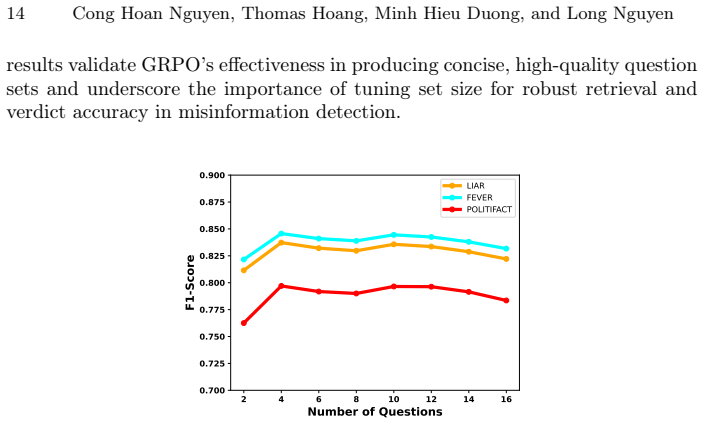
The paper claims that a reinforced question-planning policy over a knowledge graph substantially outperforms static retrieval for claim verification. Given a claim, a secondary LLM generates a small, diverse set of questions; each question is embedded and matched to nodes and edges of a knowledge graph built from ground-truth evidence; the combined evidence is passed to a frozen verifier. A GRPO loop with a reward weighted toward structural diversity (0.60 weight) refines the question set to cover different semantic facets of the claim. The empirical claim is peak F1 of about 83.7, 84.6, and 79.7 on LIAR, FEVER, and PolitiFact, respectively, which the authors attribute to better evidence cov
What carries the argument
The central object is the question-generation 'planner': a language model that maps a claim to a set of 4–8 questions, optimized by GRPO. The carrying mechanism is the structure reward, which classifies each question into semantic categories (who, what, when, where, how, contradiction) and rewards coverage of the ideal category set; it carries the most weight (0.60), meaning the policy is trained primarily to ask questions that span distinct subgraphs of the knowledge graph. Retrieval uses cosine similarity between question embeddings and graph element embeddings, and every graph element keeps provenance back to a source document so the verifier can audit paths.
Load-bearing premise
The load-bearing premise is that each dataset has a trustworthy, claim-free evidence corpus from which a knowledge graph can be built without label leakage, and that the reinforced planner is trained and evaluated on clean, non-overlapping splits; for two of the three benchmarks no such corpus is explicitly identified.
What would settle it
An independent replication that builds the knowledge graph only from the official evidence documents, splits the planner's training, validation, and test sets before any training, and then reproduces the 10–15 percent F1 margin over the same static baselines would confirm the claim; a large drop or a reversal would falsify it.
If this is right
- If correct, standard retrieval-augmented pipelines should be re-thought: replacing a single fixed query with a learned, diverse question set can yield large gains in evidence quality and verdict accuracy, independent of scaling the verifier.
- The approach makes fact-checking decisions auditable end-to-end: each verdict is backed by the generated questions, the retrieved knowledge-graph paths, and their source documents–useful for high-stakes deployment.
- The four-question optimum suggests a practical design rule: small, non-redundant question sets beat larger ones, because extra questions add retrieval noise.
- The error analysis indicates that document mismatch and insufficient coverage together account for most failures, so the next incremental gain lies in aligning questions to evidence documents rather than in adding more questions.
Where Pith is reading between the lines
- The same reinforced question-planning recipe could extend to other knowledge-intensive verification tasks, such as medical claims, product safety, or financial statements, wherever a clean evidence corpus can be turned into a knowledge graph; the paper does not test that transfer.
- The paper's dependence on a ground-truth evidence corpus per dataset is the biggest open question: a testable extension is to build the knowledge graph from a generic encyclopedic corpus and measure how much the F1 margin shrinks.
- The reward design could be strengthened by penalizing document mismatch directly, since the error analysis identifies it as the dominant failure mode; a version of the reward based on retrieved-document overlap with gold evidence would test that.
Editorial analysis
A structured set of objections, weighed in public.
Referee Report
Summary. The paper proposes DeLIVeR, a fact-verification framework in which a GRPO-optimized 'Planner' LLM decomposes a claim into 4–8 questions that retrieve evidence from a knowledge graph; a frozen Verifier LLM then outputs True/False/NEI with an explanation. The central empirical claim is that, using Qwen2.5-7B, DeLIVeR achieves peak F1-scores of 83.73 on LIAR, 84.57 on FEVER, and 79.70 on PolitiFact, a 10–15% improvement over HippoRAG2. The paper also reports ablations on question-set size, a qualitative evaluation, and an error analysis of 200 PolitiFact failures.
Significance. If the reported numbers are genuine, the contribution is a useful and modular architecture: reinforced question planning over structured knowledge graphs for fact-checking, with auditable evidence chains and a stable GRPO training objective. The paper gives clear motivation, detailed hyperparameters, and an ablation of the central design choice (number of questions). However, the empirical claim is not currently supported: the evidence corpora used to build the knowledge graphs are not identifiable for two of the three datasets, the train/validation/test protocol is unspecified, and the reward used for GRPO training is not connected to gold labels. These are load-bearing gaps in an otherwise well-scoped system paper. No code or data is released, so the results cannot be independently checked.
major comments (5)
- [§3.3, Table 4] The KG-construction protocol cannot be satisfied for LIAR and PolitiFact. LIAR has no ground-truth evidence corpus, and PolitiFact fact-check articles typically restate the claim and the verdict rationale. Table 4 describes the LIAR KG as 'Political claims and entities,' which directly contradicts §3.3's claim that claim text and veracity labels are excluded from graph construction. If the KG contains claim statements or verdict-bearing text, retrieval can surface gold-label information directly, making the reported F1 gains an artifact of leakage rather than of the GRPO planner. The authors must identify the exact source documents for each KG, demonstrate that no claim text or labels enter the graph, and report leakage checks (e.g., overlap between retrieved triples and gold evidence/verdict text).
- [§4.1, Table 3; §4.2, Table 5] No train/validation/test split is specified for the GRPO-trained planner or the final evaluation. Table 3 only reports total dataset counts, and Table 5 gives no confidence intervals, standard errors, or the macro/micro averaging scheme for precision/recall/F1 over the three verdict classes. Because Table 4 states that early stopping is done on validation F1, the absence of an explicit split means the reported test numbers cannot be audited; overlap between training and test claims is a second, independent route to inflated scores. Provide exact splits, per-class metrics, and a statement of how the three-class F1 is averaged.
- [§3.6, Eq. (8)] The accuracy reward R_Accuracy is defined as a binary 'information is correct' signal from an LLM judge or fine-tuned classifier, but no mapping from the judge's SUPPORTS/REFUTES/NEI output to the 0/1 reward is given, and the judge's agreement with gold labels is not reported. If the reward is not calibrated to the gold veracity labels, GRPO may optimize a proxy that is unrelated to the F1 numbers in Table 5. Specify the reward computation, report judge accuracy, or change the reward to use the gold labels directly.
- [§4.2, Table 5] The paper claims 'high-precision evidence' retrieval, yet no retrieval-quality metric (evidence precision, recall, hit rate against gold evidence, or path accuracy) is reported anywhere. The only reported quantities are final verdict F1 and accuracy. Since the contribution is explicitly about improving evidence retrieval, the absence of retrieval-side metrics means the mechanism responsible for any F1 gain cannot be identified—the gain could come from the verifier's prompt, the KG size, or label leakage rather than from the question-planning policy. At minimum, report retrieval precision/recall on FEVER, which has gold evidence annotations.
- [§4.3, Table 6] The error-analysis percentages sum to 112% (48 + 34 + 16 + 14), and the text says that Irrelevant Questions (16%) and Redundant Questions (14%) 'together account for only 30%,' which is internally inconsistent with both the sum and the claim that these two categories are a minor component. The four error categories are evidently not mutually exclusive; the overlap must be defined and the percentages corrected. As reported, the error analysis does not support the conclusion that GRPO effectively reduces irrelevant/redundant questions.
minor comments (5)
- [Abstract] The acronym in the abstract is rendered inconsistently ('DeLIVeR' vs. 'VeacityRecognition'), which interferes with readability.
- [§4.2, Table 5] The table caption says 'MultiReQA Datasets,' but the experiments are on LIAR, FEVER, and PolitiFact. MultiReQA is not mentioned anywhere else and the caption should be corrected.
- [§4.3] The qualitative evaluation text lists five scores for six categories: '83.2 (Knowledge-ability, Relevance), 75.12 (Comprehensiveness), 82.45 (Factuality), 68.4 (Logical Coherence), and 75.25 (Correctness)'—83.2 is assigned to two categories. Clarify whether these are separate or joint scores.
- [§3.6, Figure 3] The GRPO advantage in Eq. (5) uses a normalization function F_norm (e.g., standard deviation), but the worked example in Figure 3 computes advantages using only the group mean without normalization. Align the figure with the equation.
- [§3.4] The sentence 'The performance of the set of questions is refined iteratively using GRPO, detailed in Section 3.4' is a self-reference; GRPO is described in Section 3.6.
Circularity Check
No definitional circularity found; F1 claims are empirical and externally benchmarked. KG-provenance and split-reporting gaps are correctness risks, not circularity.
full rationale
I walked the derivation chain: P(y|c) is decomposed as max_Q P(y|c,Retrieve(Q,G))P(Q|c;θQ) (Eq. 1), which is a generic decision-theoretic decomposition, not a tautology. The GRPO objective (Eq. 5) optimizes a reward combining format, structure, and a judge-based accuracy term; the reported F1 is computed against gold labels through a frozen verifier, so the central claim is not obtained by construction from the fitted planner. No self-citation is load-bearing: GRPO is cited to DeepSeekMath (external), retriever embeddings to bge-large-en-v1.5 (external), and no internal 'uniqueness theorem' is invoked. The closest candidates to circularity are (a) the structural reward's ideal category distribution C* 'derived from claim type or oracle analysis' (§3.6, Eq. 7), and (b) the KG-construction statement in §3.3 vs. Table 4, which lists the LIAR KG as 'Political claims and entities' even though §3.3 claims claim text and labels are excluded. Neither is a definitional reduction: C* is a training-time target whose derivation split is unspecified, and the LIAR/PolitiFact KG provenance contradiction is an evidence-leakage/evaluation-protocol risk rather than an equation-level equivalence. Because the paper never specifies train/validation/test splits for GRPO, the empirical numbers cannot be fully audited, but absence of a described split is not itself circularity. Under the hard rule requiring a quoted equation-level reduction, I find no circular step.
Axiom & Free-Parameter Ledger
free parameters (5)
- Reward weights w1, w2, w3 =
0.15, 0.60, 0.25
- Ideal category distribution C* =
unspecified (derived from 'oracle analysis')
- GRPO group size N =
8
- Number of questions per claim =
4 (optimal; tested 2-16)
- KL penalty beta, clipping epsilon, learning rate =
0.04, 0.20, 5e-6
axioms (4)
- domain assumption Each dataset has a ground-truth evidence corpus from which valid KG triples can be extracted by GPT-4 OpenIE.
- domain assumption Cosine similarity between Sentence-BERT embeddings reliably maps questions to relevant KG nodes/edges.
- domain assumption The frozen primary LLM produces correct verdicts when given retrieved KG evidence.
- ad hoc to paper The 'accuracy' reward can be judged by an LLM judge or fine-tuned classifier independently of gold labels.
read the original abstract
Automated fact-checking remains a challenge for Large Language Models (LLMs) due to "query brittleness" in traditional retrieval systems. We propose DeLIVeR (Decomposed Learning for Information-grounded Veracity Recognition), a framework that treats evidence retrieval as a reinforced strategic exploration task. DeLIVeR utilizes a Planner LLM to decompose complex claims into targeted question sets, which are used to traverse structured Knowledge Graphs (KGs) for high-precision evidence. We optimize the Planner's policy using Group Relative Policy Optimization (GRPO) with a reward system prioritizing structural diversity and verdict accuracy. Our evaluation on LIAR, FEVER, and PolitiFact shows that DeLIVeR significantly outperforms state-of-the-art baselines. Using Qwen2.5-7B, our framework achieved peak F1-scores of 83.73, 84.57, and 79.70 respectively, representing a 10-15% improvement over HippoRAG2. By shifting to a reinforced question-planning strategy, DeLIVeR effectively bridges multi-hop reasoning gaps and provides an auditable, transparent path for verifiable misinformation detection.
Figures



Reference graph
Works this paper leans on
-
[1]
& Fung, P
Ji,Z.,Lee,N.,Frieske,R.,Yu,T.,Su,D.,Xu,Y.,Ishii,E.,Bang,Y.,Madotto, A. & Fung, P. Survey of hallucination in natural language generation.ACM Computing Surveys.55, 1-38 (2023)
2023
-
[2]
& Shearer, E
Mitchell, A., Jurkowitz, M., Oliphant, J. & Shearer, E. Americans who mainly get their news on social media are less engaged, less knowledgeable. Pew Research Center.30(2020)
2020
-
[3]
& Others Siren’s Song in the AI Ocean: A Survey on Hallucination in Large Language Models.Computational Linguistics.51, 1373-1418 (2025)
Zhang, Y., Li, Y., Cui, L., Cai, D., Liu, L., Fu, T., Huang, X., Zhao, E., Zhang, Y., Chen, Y. & Others Siren’s Song in the AI Ocean: A Survey on Hallucination in Large Language Models.Computational Linguistics.51, 1373-1418 (2025)
2025
-
[4]
Potthast,M.,Kiesel,J.,Reinartz,K.,Bevendorff,J.&Stein,B.Astylometric inquiry into hyperpartisan and fake news.Proceedings Of The 56th Annual Meeting Of The Association For Computational Linguistics (volume 1: Long Papers). pp. 231-240 (2018)
2018
-
[5]
& Liu, Y
Qian, F., Gong, C., Sharma, K. & Liu, Y. Neural user response generator: Fake news detection with collective user intelligence..IJCAI.18pp. 3834- 3840 (2018)
2018
-
[6]
& Liu, H
Mosallanezhad, A., Karami, M., Shu, K., Mancenido, M. & Liu, H. Domain adaptive fake news detection via reinforcement learning.Proceedings Of The ACM Web Conference 2022. pp. 3632-3640 (2022)
2022
-
[7]
Khattab, O., Santhanam, K., Li, X., Hall, D., Liang, P., Potts, C. & Zaharia, M. Demonstrate-search-predict: Composing retrieval and language models for knowledge-intensive nlp.ArXiv Preprint ArXiv:2212.14024. (2022)
Pith/arXiv arXiv 2022
-
[8]
& Lewis, M
Press, O., Zhang, M., Min, S., Schmidt, L., Smith, N. & Lewis, M. Measuring and narrowing the compositionality gap in language models.Findings Of The Association For Computational Linguistics: EMNLP 2023. pp. 5687-5711 (2023)
2023
-
[9]
& Durrett, G
Chen, J., Sriram, A., Choi, E. & Durrett, G. Generating literal and implied subquestions to fact-check complex claims.Proceedings Of The 2022 Confer- ence On Empirical Methods In Natural Language Processing. pp. 3495-3516 (2022)
2022
-
[10]
& Vlachos, A
Ousidhoum, N., Yuan, Z. & Vlachos, A. Varifocal question generation for fact-checking.Proceedings Of The 2022 Conference On Empirical Methods In Natural Language Processing. pp. 2532-2544 (2022)
2022
-
[11]
& Leskovec, J
Yasunaga, M., Ren, H., Bosselut, A., Liang, P. & Leskovec, J. QA-GNN: Reasoning with language models and knowledge graphs for question answer- ing.Proceedings Of The 2021 Conference Of The North American Chapter Of The Association For Computational Linguistics: Human Language Tech- nologies. pp. 535-546 (2021)
2021
-
[12]
& Yih, W
Shi, W., Min, S., Yasunaga, M., Seo, M., James, R., Lewis, M., Zettlemoyer, L. & Yih, W. Replug: Retrieval-augmented black-box language models.Pro- ceedings Of The 2024 Conference Of The North American Chapter Of The 18 Cong Hoan Nguyen, Thomas Hoang, Minh Hieu Duong, and Long Nguyen Association For Computational Linguistics: Human Language Technologies (...
2024
-
[13]
& Liang, P
Shi, T., Karpathy, A., Fan, L., Hernandez, J. & Liang, P. World of bits: An open-domain platform for web-based agents.International Conference On Machine Learning. pp. 3135-3144 (2017)
2017
-
[14]
Gur, I., Rueckert, U., Faust, A. & Hakkani-Tur, D. Learning to navigate the web.ArXiv Preprint ArXiv:1812.09195. (2018)
Pith/arXiv arXiv 2018
-
[15]
& Neubig, G
Jiang,Z.,Xu,F.,Gao,L.,Sun,Z.,Liu,Q.,Dwivedi-Yu,J.,Yang,Y.,Callan, J. & Neubig, G. Active retrieval augmented generation.Proceedings Of The 2023 Conference On Empirical Methods In Natural Language Processing. pp. 7969-7992 (2023)
2023
-
[16]
& Toutanova, K
Devlin, J., Chang, M., Lee, K. & Toutanova, K. Bert: Pre-training of deep bidirectional transformers for language understanding.Proceedings Of The 2019 Conference Of The North American Chapter Of The Association For Computational Linguistics: Human Language Technologies, Volume 1 (long And Short Papers). pp. 4171-4186 (2019)
2019
-
[17]
Liu, Y., Ott, M., Goyal, N., Du, J., Joshi, M., Chen, D., Levy, O., Lewis, M., Zettlemoyer, L. & Stoyanov, V. Roberta: A robustly optimized bert pre- training approach.ArXiv Preprint ArXiv:1907.11692. (2019)
Pith/arXiv arXiv 1907
-
[18]
& Gao, W
Zhang, X. & Gao, W. Towards llm-based fact verification on news claims with a hierarchical step-by-step prompting method.Proceedings Of The 13th International Joint Conference On Natural Language Processing And The 3rd Conference Of The Asia-pacific Chapter Of The Association For Com- putational Linguistics (volume 1: Long Papers). pp. 996-1011 (2023)
2023
-
[19]
& Others Boosting search engines with interactive agents.ArXiv Preprint ArXiv:2109.00527
Adolphs, L., Boerschinger, B., Buck, C., Huebscher, M., Ciaramita, M., Es- peholt, L., Hofmann, T., Kilcher, Y., Rothe, S., Sessa, P. & Others Boosting search engines with interactive agents.ArXiv Preprint ArXiv:2109.00527. (2021)
Pith/arXiv arXiv 2021
-
[20]
& Trischler, A
Yuan, X., Fu, J., Cote, M., Tay, Y., Pal, C. & Trischler, A. Interactive machine comprehension with information seeking agents.Proceedings Of The 58th Annual Meeting Of The Association For Computational Linguistics. pp. 2325-2338 (2020)
2020
-
[21]
Ziegler, D., Stiennon, N., Wu, J., Brown, T., Radford, A., Amodei, D., Christiano, P. & Irving, G. Fine-tuning language models from human pref- erences.ArXiv Preprint ArXiv:1909.08593. (2019)
Pith/arXiv arXiv 1909
-
[22]
& Amodei, D
Ibarz, B., Leike, J., Pohlen, T., Irving, G., Legg, S. & Amodei, D. Reward learning from human preferences and demonstrations in atari.Advances In Neural Information Processing Systems.31(2018)
2018
-
[23]
& Amodei, D
Christiano, P., Leike, J., Brown, T., Martic, M., Legg, S. & Amodei, D. Deep reinforcement learning from human preferences.Advances In Neural Information Processing Systems.30(2017)
2017
-
[24]
Lin, Y., Han, X., Xie, R., Liu, Z. & Sun, M. Knowledge representation learning: A quantitative review.ArXiv Preprint ArXiv:1812.10901. (2018)
Pith/arXiv arXiv 2018
-
[25]
& Guo, L
Wang, Q., Mao, Z., Wang, B. & Guo, L. Knowledge graph embedding: A survey of approaches and applications.IEEE Transactions On Knowledge And Data Engineering.29, 2724-2743 (2017) Decomposed Learning for Information-grounded Veracity Recognition 19
2017
-
[26]
112948 (2020)
Chen,X.,Jia,S.&Xiang,Y.Areview:Knowledgereasoningoverknowledge graph.Expert Systems With Applications.141pp. 112948 (2020)
2020
-
[27]
& Wang, M
Wu, T., Qi, G., Li, C. & Wang, M. A survey of techniques for constructing Chinese knowledge graphs and their applications.Sustainability.10, 3245 (2018)
2018
-
[28]
Knowledge graph refinement: A survey of approaches and evaluation methods.Semantic Web.8, 489-508 (2016)
Paulheim, H. Knowledge graph refinement: A survey of approaches and evaluation methods.Semantic Web.8, 489-508 (2016)
2016
-
[29]
& Gabrilovich, E
Nickel, M., Murphy, K., Tresp, V. & Gabrilovich, E. A review of relational machinelearningforknowledgegraphs.Proceedings Of The IEEE.104,11-33 (2015)
2015
-
[30]
& Wöß, W
Ehrlinger, L. & Wöß, W. Towards a definition of knowledge graphs..SE- MANTiCS (Posters, Demos, SuCCESS).48, 2 (2016)
2016
-
[31]
& Presutti, V
Bonatti, P., Decker, S., Polleres, A. & Presutti, V. Knowledge graphs: New directions for knowledge representation on the semantic web (dagstuhl sem- inar 18371).Dagstuhl Reports.8, 29-111 (2019)
2019
-
[32]
A COMMON SENSE VIEW OF KNOWLEDGE GRAPHS
Bergman, M. A COMMON SENSE VIEW OF KNOWLEDGE GRAPHS. (2019), https://api.semanticscholar.org/CorpusID:204957313
2019
-
[33]
19, 22-36 (2017)
Shu,K.,Sliva,A.,Wang,S.,Tang,J.&Liu,H.Fakenewsdetectiononsocial media: A data mining perspective.ACM SIGKDD Explorations Newsletter. 19, 22-36 (2017)
2017
-
[34]
& Federico, M
Turchi, M., Negri, M. & Federico, M. MT Quality Estimation for Computer- assisted Translation: Does it Really Help?.Proceedings Of The 53rd Annual Meeting Of The Association For Computational Linguistics And The 7th International Joint Conference On Natural Language Processing (Volume 2: Short Papers). pp. 530-535 (2015)
2015
-
[35]
Wang, W. " liar, liar pants on fire": A new benchmark dataset for fake news detection.ArXiv Preprint ArXiv:1705.00648. (2017)
Pith/arXiv arXiv 2017
-
[36]
Thorne, J., Vlachos, A., Christodoulopoulos, C. & Mittal, A. FEVER: a large-scale dataset for fact extraction and VERification.ArXiv Preprint ArXiv:1803.05355. (2018)
Pith/arXiv arXiv 2018
-
[37]
& Zafarani, R
Zhou, X. & Zafarani, R. A survey of fake news: Fundamental theories, de- tection methods, and opportunities.ACM Computing Surveys (CSUR).53, 1-40 (2020)
2020
-
[38]
& Others Retrieval-augmented generation for knowledge-intensive nlp tasks.Advances In Neural Informa- tion Processing Systems.33pp
Lewis, P., Perez, E., Piktus, A., Petroni, F., Karpukhin, V., Goyal, N., Küt- tler, H., Lewis, M., Yih, W., Rocktäschel, T. & Others Retrieval-augmented generation for knowledge-intensive nlp tasks.Advances In Neural Informa- tion Processing Systems.33pp. 9459-9474 (2020)
2020
-
[39]
& Chang, M
Guu, K., Lee, K., Tung, Z., Pasupat, P. & Chang, M. Retrieval augmented language model pre-training.International Conference On Machine Learn- ing. pp. 3929-3938 (2020)
2020
-
[40]
& Zamani, H
Salemi, A. & Zamani, H. Evaluating retrieval quality in retrieval-augmented generation.Proceedings Of The 47th International ACM SIGIR Confer- ence On Research And Development In Information Retrieval. pp. 2395-2400 (2024)
2024
-
[41]
& Hajishirzi, H
Asai, A., Wu, Z., Wang, Y., Sil, A. & Hajishirzi, H. Self-rag: Learning to retrieve, generate, and critique through self-reflection. (ICLR,2024) 20 Cong Hoan Nguyen, Thomas Hoang, Minh Hieu Duong, and Long Nguyen
2024
-
[42]
Nakano, R., Hilton, J., Balaji, S., Wu, J., Ouyang, L., Kim, C., Hesse, C., Jain, S., Kosaraju, V., Saunders, W. & Others Webgpt: Browser-assisted question-answering with human feedback.ArXiv Preprint ArXiv:2112.09332. (2021)
Pith/arXiv arXiv 2021
-
[43]
& Others Knowledge graphs.ACM Computing Surveys (Csur).54, 1-37 (2021)
Hogan, A., Blomqvist, E., Cochez, M., D’Amato, C., Melo, G., Gutierrez, C., Kirrane, S., Gayo, J., Navigli, R., Neumaier, S. & Others Knowledge graphs.ACM Computing Surveys (Csur).54, 1-37 (2021)
2021
-
[44]
Ji, S., Pan, S., Cambria, E., Marttinen, P. & Yu, P. A survey on knowledge graphs: Representation, acquisition, and applications.IEEE Transactions On Neural Networks And Learning Systems.33, 494-514 (2021)
2021
-
[45]
& Zhou, M
Hu, L., Yang, T., Zhang, L., Zhong, W., Tang, D., Shi, C., Duan, N. & Zhou, M. Compare to the knowledge: Graph neural fake news detection with external knowledge.Proceedings Of The 59th Annual Meeting Of The As- sociation For Computational Linguistics And The 11th International Joint Conference On Natural Language Processing (volume 1: Long Papers). pp. 7...
2021
-
[46]
Rajpurkar, P., Zhang, J., Lopyrev, K. & Liang, P. Squad: 100,000+ ques- tions for machine comprehension of text.ArXiv Preprint ArXiv:1606.05250. (2016)
Pith/arXiv arXiv 2016
-
[47]
Lewis, M., Liu, Y., Goyal, N., Ghazvininejad, M., Mohamed, A., Levy, O., Stoyanov, V. & Zettlemoyer, L. BART: Denoising sequence-to-sequence pre- training for natural language generation, translation, and comprehension. ArXiv Preprint ArXiv:1910.13461. (2019)
Pith/arXiv arXiv 1910
-
[48]
& Liu, P
Raffel, C., Shazeer, N., Roberts, A., Lee, K., Narang, S., Matena, M., Zhou, Y., Li, W. & Liu, P. Exploring the limits of transfer learning with a unified text-to-text transformer.Journal Of Machine Learning Research.21, 1-67 (2020)
2020
-
[49]
& Others Training language models to follow instructions with human feedback.Advances In Neural In- formation Processing Systems.35pp
Ouyang, L., Wu, J., Jiang, X., Almeida, D., Wainwright, C., Mishkin, P., Zhang, C., Agarwal, S., Slama, K., Ray, A. & Others Training language models to follow instructions with human feedback.Advances In Neural In- formation Processing Systems.35pp. 27730-27744 (2022)
2022
-
[50]
Schulman, J., Wolski, F., Dhariwal, P., Radford, A. & Klimov, O. Proximal policy optimization algorithms.ArXiv Preprint ArXiv:1707.06347. (2017)
Pith/arXiv arXiv 2017
-
[51]
Edge, D., Trinh, H., Cheng, N., Bradley, J., Chao, A., Mody, A., Tru- itt, S., Metropolitansky, D., Ness, R. & Larson, J. From local to global: A graph rag approach to query-focused summarization.ArXiv Preprint ArXiv:2404.16130. (2024)
Pith/arXiv arXiv 2024
-
[52]
Reimers, N. & Gurevych, I. Sentence-bert: Sentence embeddings using siamese bert-networks.ArXiv Preprint ArXiv:1908.10084. (2019)
Pith/arXiv arXiv 1908
-
[53]
Yang, Z., Qi, P., Zhang, S., Bengio, Y., Cohen, W., Salakhutdinov, R. & Manning, C. HotpotQA: A dataset for diverse, explainable multi-hop ques- tion answering.ArXiv Preprint ArXiv:1809.09600. (2018)
Pith/arXiv arXiv 2018
-
[54]
& Liu, H
Shu, K., Mahudeswaran, D., Wang, S., Lee, D. & Liu, H. Fakenewsnet: A data repository with news content, social context, and spatiotemporal information for studying fake news on social media.Big Data.8, 171-188 (2020) Decomposed Learning for Information-grounded Veracity Recognition 21
2020
-
[55]
Guo, Z., Xia, L., Yu, Y., Ao, T. & Huang, C. Lightrag: Simple and fast retrieval-augmented generation.ArXiv Preprint ArXiv:2410.05779. (2024)
Pith/arXiv arXiv 2024
-
[56]
& Cao, Y
Yao, S., Zhao, J., Yu, D., Du, N., Shafran, I., Narasimhan, K. & Cao, Y. React: Synergizing reasoning and acting in language models.International Conference On Learning Representations (ICLR). (2023)
2023
-
[57]
Jimenez Gutierrez, B., Shu, Y., Gu, Y., Yasunaga, M. & Su, Y. Hipporag: Neurobiologically inspired long-term memory for large language models.Ad- vances In Neural Information Processing Systems.37pp. 59532-59569 (2024)
2024
-
[58]
& Others Qwen2 technical report.ArXiv Preprint ArXiv:2407.10671.2pp
Team, Q. & Others Qwen2 technical report.ArXiv Preprint ArXiv:2407.10671.2pp. 3 (2024)
Pith/arXiv arXiv 2024
-
[59]
Chen, J., Xiao, S., Zhang, P., Luo, K., Lian, D. & Liu, Z. Bge m3- embedding: Multi-lingual, multi-functionality, multi-granularity text embed- dings through self-knowledge distillation.ArXiv Preprint ArXiv:2402.03216. (2024)
Pith/arXiv arXiv 2024
-
[60]
& Others Gpt-4 technical report.ArXiv Preprint ArXiv:2303.08774
Achiam, J., Adler, S., Agarwal, S., Ahmad, L., Akkaya, I., Aleman, F., Almeida, D., Altenschmidt, J., Altman, S., Anadkat, S. & Others Gpt-4 technical report.ArXiv Preprint ArXiv:2303.08774. (2023)
Pith/arXiv arXiv 2023
-
[61]
& Gentzkow, M
Allcott, H. & Gentzkow, M. Social media and fake news in the 2016 election. Journal Of Economic Perspectives.31, 211-236 (2017)
2016
-
[62]
Evaluating large language models trained on code.ArXiv Preprint ArXiv:2107.03374
Chen, M. Evaluating large language models trained on code.ArXiv Preprint ArXiv:2107.03374. (2021)
Pith/arXiv arXiv 2021
-
[63]
& Choi,Y.Defendingagainstneuralfakenews.Advances In Neural Information Processing Systems.32(2019)
Zellers, R., Holtzman, A., Rashkin, H., Bisk, Y., Farhadi, A., Roesner, F. & Choi,Y.Defendingagainstneuralfakenews.Advances In Neural Information Processing Systems.32(2019)
2019
-
[64]
Bang, Y., Cahyawijaya, S., Lee, N., Dai, W., Su, D., Wilie, B., Lovenia, H., Ji, Z., Yu, T., Chung, W. & Others A multitask, multilingual, multimodal evaluation of chatgpt on reasoning, hallucination, and interactivity.ArXiv Preprint ArXiv:2302.04023. (2023)
Pith/arXiv arXiv 2023
-
[65]
& Krötzsch, M
Vrandečić, D. & Krötzsch, M. Wikidata: a free collaborative knowledgebase. Communications Of The ACM.57, 78-85 (2014)
2014
-
[66]
Shao, Z., Wang, P., Zhu, Q., Xu, R., Song, J., Bi, X., Zhang, H., Zhang, M., Li, Y., Wu, Y. & Others Deepseekmath: Pushing the limits of mathemati- cal reasoning in open language models.ArXiv Preprint ArXiv:2402.03300. (2024)
Pith/arXiv arXiv 2024
-
[67]
& Yao, L
Ngai, C., Singh, R. & Yao, L. Impact of COVID-19 vaccine misinformation on social media virality: content analysis of message themes and writing strategies.Journal Of Medical Internet Research.24, e37806 (2022)
2022
-
[68]
& Others Misinformation about climate change and related environmental events on social media: Protocol for a scoping review.JMIR Research Pro- tocols.13, e59345 (2024)
Vivion, M., Trottier, V., Bouhêlier, È., Goupil-Sormany, I., Diallo, T. & Others Misinformation about climate change and related environmental events on social media: Protocol for a scoping review.JMIR Research Pro- tocols.13, e59345 (2024)
2024
-
[69]
& Gopalan, S
Govindankutty, S. & Gopalan, S. Epidemic modeling for misinformation spread in digital networks through a social intelligence approach.Scientific Reports.14, 19100 (2024)
2024
-
[70]
& Brassard, G
Aïmeur, E., Amri, S. & Brassard, G. Fake news, disinformation and mis- information in social media: a review.Social Network Analysis And Mining. 13, 30 (2023) 22 Cong Hoan Nguyen, Thomas Hoang, Minh Hieu Duong, and Long Nguyen
2023
-
[71]
& Aral, S
Vosoughi, S., Roy, D. & Aral, S. The spread of true and false news online. Science.359, 1146-1151 (2018)
2018
-
[72]
FGRA: Toward flexible logic mining with ensemble multi-attribute selection and Discrete Hopfield Neural Network.Journal Of Computational Design And Engineering.13, 88-107 (2026)
Gao,Y.,Jiang,X.,Kasihmuddin,M.,Zheng,C.,Chen,J.,Liu,X.&Guo,Y. FGRA: Toward flexible logic mining with ensemble multi-attribute selection and Discrete Hopfield Neural Network.Journal Of Computational Design And Engineering.13, 88-107 (2026)
2026
-
[73]
& Chen, J
Chang, Y., Kasihmuddin, M., Ruzai, W., Guo, Y. & Chen, J. Weighted C- type random 2 satisfiability in discrete hopfield neural network.Engineering Applications Of Artificial Intelligence.160pp. 111760 (2025)
2025
-
[74]
& Zamri, N
Romli, N., Zulkepli, N., Kasihmuddin, M., Karim, S., Jamaludin, S., Rusdi, N., Manoharam, G., Mansor, M. & Zamri, N. An optimized logic mining method for data processing through higher-order satisfiability representation in discrete Hopfield neural network.Applied Soft Computing. pp. 113759 (2025)
2025
discussion (0)
Sign in with ORCID, Apple, or X to comment. Anyone can read and Pith papers without signing in.