REVIEW 1 major objections 4 minor 45 references
Bond thickenings of the simplicial boundary of Outer space
T0 review · 1 major / 4 minor · reviewed 2026-08-15 · deepseek-v4-flash
Pith's one-line read Adding all non-3-edge-connected stable graphs to the boundary of Outer space does not change its homotopy groups through dimension $2n-4$; only theta-graph fibres add spheres.
desk verdict The 2-bond thickening theorem is genuinely interesting, but Lemma 7.15 has a real gap that leaves the main theorem unproven as written. read the letter →
The pith
A machine-rendered reading of the paper's core claim, the machinery that carries it, and where it could break.
The reading
What carries the argument
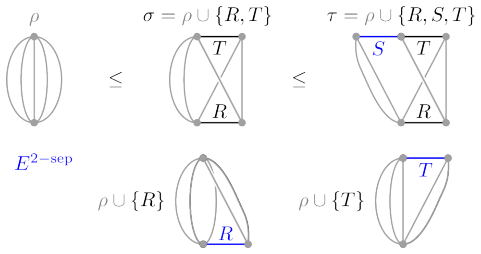
The argument is organised by two graph-theoretic filtrations. A $k$-bond is a set of $k$ edges whose removal disconnects the graph; the paper filters the 1-bond thickening by the number of separating edges and the 2-bond thickening by the size of $E_{2-\mathrm{sep}}(\sigma)$, the set of edges that can become part of a 2-bond after expanding the dual graph. Each filtration inclusion is analysed through a fibre theorem for poset maps, which converts the connectivity of the inclusion into the connectivity of joins of lower and upper fibre posets. The lower fibres are handled by cone points and minimal elements; the upper intervals are replaced up to homotopy by a flag complex of pairwise-compatible two-element edge partitions. When the base graph is a $\theta$-graph, that flag complex is a known partition complex whose homotopy type is a wedge of $(n-1)!$ spheres of dimension $n-3$, and joining it with the boundary of an $n$-simplex yields the wedges of $(2n-3)$-spheres that set the threshold in Theorem 1.1.
What would settle it
Compute the reduced homology of the upper interval over a rank-$4$ $\theta$-graph (two vertices joined by five parallel edges) inside the 2-bond thickening: the paper predicts $\mathbb{Z}^6$ in degree $1$ and zero in all other degrees, and the join with the lower fibre would then be a wedge of six spheres of dimension $5$. Any other homology would disprove the fibre description and with it the proof of Theorem 1.1.
Extended reading notes
Core claim
The central claim is that the simplicial boundary $\partial\mathcal{FS}$ of Outer space admits a controlled 'bond thickening' inside the free splitting complex $\mathcal{FS}$. Let $C'$ be the smallest subcomplex of $\mathcal{FS}$ that contains $\partial\mathcal{FS}$ together with every stable graph that is not $3$-edge connected; Theorem 1.1 states that the inclusion $\partial\mathcal{FS}\hookrightarrow C'$ is $(2n-3)$-connected, meaning it induces an isomorphism on homotopy groups in degrees $\le 2n-4$ and a surjection in degree $2n-3$. The refinement is sharper: the intermediate 1-bond thickening, obtained by adjoining exactly the graphs with a cut vertex, is a homotopy equivalence, and the remaining 2-bond thickening $C\hookrightarrow C'$ has the stated connectivity, with the only non-contractible fibres occurring over rank-$n$ $\theta$-graphs, where the fibre is a wedge of $(n-1)!$ spheres of dimension $2n-3$. This is offered as evidence that $\partial\mathcal{FS}$ may itself be $(2n-3)$-spherical, mirroring a known connectivity conjecture for the common basis complex.
Load-bearing premise
The load-bearing premise is the cited computation that, over a rank-$n$ $\theta$-graph, the upper-interval complex is a wedge of $(n-1)!$ spheres of dimension $n-3$; if that computation were wrong or misapplied, the description of the non-contractible fibres and the $(2n-3)$-connectivity of the second thickening would both fail.
Editorial extensions
If this is right
- Because the inclusion $\partial\mathcal{FS}\hookrightarrow C'$ is $(2n-3)$-connected, the two spaces have isomorphic homotopy groups up to degree $2n-4$ and a surjection in degree $2n-3$, so any spherical obstruction to understanding $\partial\mathcal{FS}$ must live in dimension $2n-3$ or higher.
- Adding graphs with cut vertices to the boundary is a homotopy equivalence, so the 1-bond thickening carries no new topology; the $\theta$-graph fibres are the only place where non-contractible behaviour enters the 2-bond thickening.
- If the remaining inclusion $C'\hookrightarrow\mathcal{FS}$ were also $(2n-3)$-connected, then $\partial\mathcal{FS}$ would be $(2n-3)$-spherical, giving the free-group analogue of the common-basis-complex connectivity conjecture.
- In low degrees, the relative pair $(\mathcal{FS},C')$ can stand in for $(\mathcal{FS},\partial\mathcal{FS})$ in graph-complex homology, providing a topological explanation of the known reductions to 3-vertex-connected graphs without directly implying them.
- The explicit fibre description identifies the first potentially nontrivial relative homology $H_{2n-2}(C',\partial\mathcal{FS})$ as a module assembled from the $\theta$-graph fibres, giving a concrete target for spectral-sequence computations.
Reading between the lines
- A natural test is to push the same filtration to $k$-edge-connectivity for $k\ge 4$; the paper's own observation that a degree-three vertex can never be 4-edge connected suggests such a thickening would need to be defined by vertex cuts instead, with a different fibre analysis.
- Since the paper notes the 1-bond argument adapts to graphs with marked points, the same filtration should give equivariant homotopy equivalences for that setting, possibly reproving or refining the known $(2n-3)$-sphericity of the automorphism-group version of the boundary.
- The theta-graph fibre description is likely the permutation representation of $\mathrm{Out}(F_n)$ on the $(n-1)!$ spheres; computing that representation explicitly would determine the top homology module of $(C',\partial\mathcal{FS})$ and could feed the graph-complex spectral sequence, though the paper leaves this open.
- A testable bridge to the graph-complex results would be to check whether the non-equivariant relative homology $H_q(C',\partial\mathcal{FS})$ vanishes in every degree; if it did, the spectral sequence in Section 9.2 would close the gap between the topological theorem and the known algebraic reductions, but the paper does not establish this vanishing.
Signed reviews
Editorial analysis
A structured set of objections, weighed in public.
Referee Report
Summary. The paper studies the simplicial boundary ∂FS of Culler–Vogtmann Outer space through two intermediate subcomplexes C and C′ of the free splitting complex. The main theorem states that the inclusion ∂FS ↪ C′ is (2n−3)-connected. The proof splits the inclusion into a 1-bond thickening ∂FS ↪ C, shown to be a homotopy equivalence by a filtration and Quillen’s fibre theorem, and a 2-bond thickening C ↪ C′, treated by a more delicate filtration in which all but one intermediate inclusion are homotopy equivalences. The exceptional step adds exactly the graphs whose dual graph is a θ-graph, and the corresponding fibre join is identified, via Vogtmann’s computation of a partition complex, with a wedge of (n−1)! spheres of dimension 2n−3. The paper also discusses equivariance with respect to Out(Fn) and offers a conceptual link to known reductions of the commutative graph complex.
Significance. If the main theorem is correct, it is a substantial step toward the conjectured (2n−3)-sphericity of ∂FS and it provides a unified topological viewpoint on several graph-complex reductions. The paper is unusually explicit about the structure of the proof: the filtration levels, the fibre models, and the dependence on external results are all clearly stated. In particular, the reliance on Brück–Gupta for the dimension of ∂FS and on Vogtmann for the partition complex is transparent and appropriate. The proposed explicit description of the non-contractible fibres over θ-graphs is a valuable and falsifiable strengthening. However, the proof as written contains a genuine gap in Lemma 7.15 that is load-bearing for the contractibility of upper intervals, and therefore for Theorem 4.1 and Theorem 1.1. The paper’s framework is promising and the gap appears local, but it must be repaired before the main claim can be considered established.
major comments (1)
- [§7.3, Lemma 7.15] The verification that the cone point S of P_vw is a cone point of all of C′^{only-2}_{⊃ρ} is incomplete. In the case T ∉ P_v, the proof says that if T ∉ P_wv, then Lemma 7.10 gives {S,T} ∈ C′^{only-2}_{⊃ρ}. Lemma 7.10, however, has the hypothesis T ∈ P_w \ P_wv. No argument is given that T lies in P_w. If T ∈ P_u for a vertex u distinct from both v and w, the cited lemma does not apply. This includes the potentially delicate case T ∈ P_uv, where the witness for T is v itself; adding S, which splits v, can change the graph in exactly the way that the argument of Lemma 7.10 is not designed to handle. Since Lemma 7.15 is the step that proves contractibility of all non-θ upper intervals, it is essential for Proposition 6.4, Proposition 8.1, and ultimately Theorem 4.1 and Theorem 1.1. A complete proof must supply an argument covering T ∈ P_u for all u ∉ {v,w}, or else restrict the cone-point construction to a vertex cut that is shown to be the only relevant one; neither is currently present.
minor comments (4)
- [§2.1] The sentence beginning “Note that a graph that is 3-vertex connected is nec” is visibly corrupted and breaks off; it should be completed or deleted. The surrounding definitions of 2- and 3-vertex connectivity should be restated cleanly.
- [§1.2] There is a typo in “rouhgly speaking”; it should read “roughly speaking”.
- [§6.2, Lemma 6.2] In the proof of Item 2 for p = 0, the phrase “if σ has n edges and does not lie in C, then σ must be a rose” would benefit from a one-sentence justification, since the term “rose” is not defined earlier in this section.
- [§9.1, Theorem 9.1] The equivariance proof is summarized by reference to Table 1 rather than carried out. This is acceptable for a closing remark, but the table mixes results whose proofs rely on the gap in Lemma 7.15; the status of equivariance should be revisited once the gap is fixed.
Circularity Check
No circularity found: the main theorem is proved by an internal Quillen-fibre argument, and the self-citations are not load-bearing.
full rationale
The paper's central claim is Theorem 1.1, that ∂FS → C' is (2n−3)-connected. The proof route is: Theorem 3.1 makes ∂FS → C a homotopy equivalence via a filtration Cp,q and Quillen's fibre theorem; Theorem 4.1 treats C → C' via the filtration C'_{p,q}; Proposition 6.3 gives contractible lower fibres; Lemma 6.13 identifies the upper interval up to homotopy with C'^{only-2}_{⊃ρ}; Lemmas 7.15 and 7.16 determine that model, with the θ-graph case depending on Vogtmann's external computation [38] that P_vw is a wedge of (n−1)! spheres of dimension n−3. No step defines its object in terms of the target connectivity, and no fitted parameter is renamed as a prediction. The paper's self-citations ([9], [13], [14]) are used for motivation, context, or dimension bounds in the discussion section; they do not supply the connectivity conclusion, and they are independent published results. The external Vogtmann theorem is used as a black box but is not equivalent to the theorem being proved. A referee note identifies a possible gap in Lemma 7.15 for vertices T in P_u with u outside {v,w}; if correct, that is a proof-gap/correctness issue, not a circularity, and it does not change this finding. The derivation chain is therefore self-contained with respect to the main claim, and no circularity is present.
Assumptions & free parameters
assumptions (4)
- standard math Quillen's fibre theorem (Theorem 2.1) is valid and applicable to the poset maps in the filtration.
- domain assumption Sphere systems and dual graphs in the free splitting complex behave as described; in particular the link of a sphere system decomposes as a join over the vertices of its dual graph (Section 2.3.2).
- domain assumption ∂FS is homotopy equivalent to the complex of free factor systems of dimension 2n-3, and the bounds |σ| <= 3n-3 and |V(Γ(σ))| <= 2n-2 hold for stable graphs.
- domain assumption The partition complex P_vw is homotopy equivalent to a wedge of (n-1)! spheres of dimension n-3, as computed by Vogtmann [38] and Robinson-Whitehouse [34].
Cite this review
Pith. "Pith review of Bond thickenings of the simplicial boundary of Outer space." pith.science (2026). https://pith.science/paper/RLEWM5XL
@misc{pith2026260804456,
  author       = {Pith},
  title        = {Pith review of: Bond thickenings of the simplicial boundary of Outer space},
  year         = {2026},
  howpublished = {\url{https://pith.science/paper/RLEWM5XL}},
  note         = {Machine review of arXiv:2608.04456}
}
abstract
We study the simplicial boundary $\partial\mathcal{FS}$ of Culler-Vogtmann Outer space via thickenings defined by graph-theoretic connectivity. Let $C'$ be the subcomplex of the free splitting complex obtained from $\partial\mathcal{FS}$ by adding all stable graphs that are not $3$-edge connected, together with their faces. We prove that the inclusion $\partial\mathcal{FS}\hookrightarrow C'$ is $(2n-3)$-connected. The proof shows, more precisely, that adding graphs with cut vertices is a homotopy equivalence, while the only non-contractible fibres in the $2$-bond thickening occur over $\theta$-graphs. The result gives further evidence that $\partial\mathcal{FS}$ may be $(2n-3)$-spherical, an $\operatorname{Out}(F_n)$-analogue of Rognes's connectivity conjecture for the common basis complex. It also gives a topological, universal-cover perspective that unifies several existing results about the commutative graph complex.
Figures


Figures from the paper (8 more)




Reference graph
Works this paper leans on
-
[1]
Avner Ash, Jeremy Miller, and Peter Patzt.Hopf algebras, Steinberg modules, and the unstable cohomology ofSLn(Z) and GLn(Z). 2024. doi: 10.48550/ARXIV.2404.13776
-
[2]
The topology at infinity ofOut(Fn)
Mladen Bestvina and Mark Feighn. “The topology at infinity ofOut(Fn)”. In: Inven- tiones Mathematicae140.3 (2000), pp. 651–692.doi: 10.1007/s002220000068
-
[3]
Geometry of the space of phylogenetic trees
Louis J. Billera, Susan P. Holmes, and Karen Vogtmann. “Geometry of the space of phylogenetic trees”. In:Adv. in Appl. Math.27.4 (2001), 733?767.doi: 10.1006/aama. 2001.0759
arXiv 2001
-
[4]
A. Borel and J.-P. Serre. “Corners and arithmetic groups”. In: Commentarii Mathe- matici Helvetici48 (1973). Avec un appendice: Arrondissement des variétés à coins, par A. Douady et L. Hérault, pp. 436–491.doi: 10.1007/BF02566134. 36
-
[5]
Francis Brown. “Bordifications of the moduli spaces of tropical curves and abelian vari- eties, and unstable cohomology ofGLg(Z) and SLg(Z)”. In:Inventiones mathematicae 241 (2025), pp. 35–152.doi: 10.1007/s00222-025-01335-y
-
[6]
Hopf algebras in the cohomology ofAg, GLn(Z), and SLn(Z)
Francis Brown, Melody Chan, Søren Galatius, and Sam Payne. Hopf algebras in the cohomology ofAg, GLn(Z), and SLn(Z). 2024. doi: 10.48550/arXiv.2405.11528
-
[7]
Kenneth S. Brown. Cohomology of groups. Vol. 87. Graduate Texts in Mathematics. Corrected reprint of the 1982 original. Springer-Verlag, New York, 1994, pp. x+306. doi: 10.1007/978-1-4684-9327-6
-
[8]
Between buildings and free factor complexes
Benjamin Brück. “Between buildings and free factor complexes”. PhD thesis. Bielefeld University, 2020. url: https://pub.uni-bielefeld.de/record/2940020
Show all 45 references
-
[9]
Homotopy type of the complex of free factors of a free group
Benjamin Brück and Radhika Gupta. “Homotopy type of the complex of free factors of a free group”. In:Proceedings of the London Mathematical Society. Third Series121.6 (2020), pp. 1737–1765.doi: 10.1112/plms.12381
2020 doi
- [10]
-
[11]
Model theory and groups
Benjamin Brück. (Non-)Vanishing of high-dimensional group cohomology. To appear in the EMS proceedings of the conference “Model theory and groups”. 2024.doi: 10. 48550/arXiv.2404.15026
2024 doi
-
[12]
Non-vanishing uni- tary cohomology of low-rank integral special linear groups
Benjamin Brück, Sam Hughes, Dawid Kielak, and Piotr Mizerka. “Non-vanishing uni- tary cohomology of low-rank integral special linear groups”. In:International Mathe- matics Research Notices. IMRN15 (2025). doi: 10.1093/imrn/rnaf230
2025 doi
-
[13]
An analogue of Rognes’ connectivity conjecture for free groups
Benjamin Brück, Jeremy Miller, and Kevin Ivan Piterman. An analogue of Rognes’ connectivity conjecture for free groups. 2025. doi: 10.48550/arxiv.2512.19128
2025 doi
-
[14]
Connectivity of partial basis complexes of freely decomposable groups
Benjamin Brück and Kevin I. Piterman. “Connectivity of partial basis complexes of freely decomposable groups”. In: Bulletin of the London Mathematical Society57.12 (2025), pp. 3919–3933.doi: 10.1112/blms.70197
2025 doi
-
[15]
The common basis complex and the partial decomposition poset
Benjamin Brück, Kevin I. Piterman, and Volkmar Welker. “The common basis complex and the partial decomposition poset”. In:International Mathematics Research Notices. IMRN 18 (2024), pp. 12746–12760.doi: 10.1093/imrn/rnae177
2024 doi
-
[16]
Onthebordificationofouterspace
Kai-UweBux,PeterSmillie,andKarenVogtmann.“Onthebordificationofouterspace”. In: Journal of the London Mathematical Society. Second Series98.1 (2018), pp. 12–34. doi: 10.1112/jlms.12124
2018 doi
-
[17]
A stability conjecture for the un- stable cohomology ofSLnZ, mapping class groups, andAut(Fn)
Thomas Church, Benson Farb, and Andrew Putman. “A stability conjecture for the un- stable cohomology ofSLnZ, mapping class groups, andAut(Fn)”. In:Algebraic topology: applications and new directions. Vol. 620. Contemp. Math. Amer. Math. Soc., Provi- dence, RI, 2014, pp. 55–70....
2014 doi
-
[18]
Cut vertices in commutative graphs
James Conant, Ferenc Gerlits, and Karen Vogtmann. “Cut vertices in commutative graphs”. In:The Quarterly Journal of Mathematics56.3 (2005), pp. 321–336.doi: 10. 1093/qmath/hah040
2005
-
[19]
On a theorem of Kontsevich
James Conant and Karen Vogtmann. “On a theorem of Kontsevich”. In:Algebraic & Geometric Topology3 (2003), pp. 1167–1224.doi: 10.2140/agt.2003.3.1167
2003 doi
-
[20]
Infinitesimal operations on complexes of graphs
Jim Conant and Karen Vogtmann. “Infinitesimal operations on complexes of graphs”. In: Mathematische Annalen327.3 (2003), pp. 545–573.doi: 10.1007/s00208-003-0465-2
2003 doi
-
[21]
Moduliofgraphsandautomorphismsoffreegroups
MarcCullerandKarenVogtmann.“Moduliofgraphsandautomorphismsoffreegroups”. In: Inventiones Mathematicae84.1 (1986), pp. 91–119.doi: 10.1007/BF01388734
1986 doi
-
[22]
Graph theory
Reinhard Diestel. Graph theory. 2nd ed. Vol. 173. Grad. Texts Math. Berlin: Springer, 2000
2000
-
[23]
Voronoi complexes in higher dimensions, cohomology ofGLN(Z) forN≥ 8 and the triviality ofK8(Z)
Mathieu Dutour Sikirić, Philippe Elbaz-Vincent, Alexander Kupers, and Jacques Mar- tinet. “Voronoi complexes in higher dimensions, cohomology ofGLN(Z) forN≥ 8 and the triviality ofK8(Z)”. In: Journal of the Institute of Mathematics of Jussieu25.1 (2026), pp. 565–590.doi: 10.10...
2026 doi
-
[24]
Perfect forms, K-theory and the cohomology of modular groups
Philippe Elbaz-Vincent, Herbert Gangl, and Christophe Soulé. “Perfect forms, K-theory and the cohomology of modular groups”. In: Advances in Mathematics 245 (2013), pp. 587–624. doi: 10.1016/j.aim.2013.06.014. 37
2013 doi
- [25]
-
[26]
AGLn(q) analogue of the partition lattices
Phil Hanlon, Patricia Hersh, and John Shareshian. “AGLn(q) analogue of the partition lattices”
-
[27]
Homologicalstabilityforautomorphismgroupsoffreegroups
AllenHatcher. “Homologicalstabilityforautomorphismgroupsoffreegroups”. In: Com- mentarii Mathematici Helvetici70.1 (1995), pp. 39–62.doi: 10.1007/BF02565999
1995 doi
-
[28]
On the torsion inK4(Z) andK5(Z)
Ronnie Lee and R. H. Szczarba. “On the torsion inK4(Z) andK5(Z)”. In:Duke Math- ematical Journal45 (1978), pp. 101–129.doi: 10.1215/S0012-7094-78-04508-8
1978 doi
-
[29]
On rank filtrations of algebraic K-theory and Steinberg modules
Jeremy Miller, Peter Patzt, and Jennifer C. H. Wilson. “On rank filtrations of algebraic K-theory and Steinberg modules”. In:Journal of the European Mathematical Society (2025). doi: 10.4171/jems/1628
2025 doi
-
[30]
The handlebody group is a virtual duality group
Dan Petersen and Richard D. Wade. “The handlebody group is a virtual duality group”. In: Journal de l’École polytechnique — Mathématique13 (2026), pp. 1007–1028.doi: 10.5802/jep.341
2026 doi
-
[31]
Kevin Ivan Piterman, John Shareshian, and Volkmar Welker.Posets of decompositions in spherical buildings. 2025. doi: 10.48550/ARXIV.2511.22531
2025 doi
-
[32]
Some results on Quillen’s conjecture via equivalent-poset techniques
Kevin Ivan Piterman and Stephen D. Smith. “Some results on Quillen’s conjecture via equivalent-poset techniques”. In:J. Comb. Algebra9.3-4 (2025), 265?387.doi: 10.4171/ jca/95
2025
-
[33]
Posets arising from decompositions of objects in a monoidal category
Kevin Ivan Piterman and Volkmar Welker. “Posets arising from decompositions of objects in a monoidal category”. In: Forum of Mathematics, Sigma 13 (2025). doi: 10.1017/fms.2025.10060
2025
-
[34]
The tree representation ofΣn+1
Alan Robinson and Sarah Whitehouse. “The tree representation ofΣn+1”. In:J. Pure Appl. Algebra111.1-3 (1996), 245?253.doi: 10.1016/0022-4049(95)00116-6
1996 doi
-
[35]
A spectrum level rank filtration in algebraicK-theory
John Rognes. “A spectrum level rank filtration in algebraicK-theory”. In:Topology. An International Journal of Mathematics31.4 (1992), pp. 813–845.doi: 10.1016/0040- 9383(92)90012-7
1992 doi
-
[36]
Homotopy equivalence of posets with a group action
J. Thévenaz and P. J. Webb. “Homotopy equivalence of posets with a group action”. In: J. Combin. Theory Ser. A56.2 (1991), 173?181.doi: 10.1016/0097-3165(91)90030-K
1991 doi
-
[37]
Shellability of complexes of trees
Henryk Trappmann and Günter M. Ziegler. “Shellability of complexes of trees”. In:J. Combin. Theory Ser. A82.2 (1998), 168?178.doi: 10.1006/jcta.1997.2844
1998
-
[38]
Local structure of someOut(Fn)-complexes
Karen Vogtmann. “Local structure of someOut(Fn)-complexes”. In:Proceedings of the Edinburgh Mathematical Society. Series II33.3 (1990), pp. 367–379. doi: 10 . 1017 / S0013091500004818
1990
-
[39]
The boundary of bordified Outer space
Karen Vogtmann. The boundary of bordified Outer space. to appear in proceedings of TIFR International Colloquium on Proceedings of TIFR International Colloquium on Randomness, Geometry and Dynamics, 1-12 January 2024. Apr. 2024.doi: 10.48550/ ARXIV.2404.11371
-
[40]
Cohen–Macaulay Complexes, Duality Groups, and the dualizing module ofOut(FN)
Richard D. Wade and Thomas A. Wasserman. “Cohen–Macaulay Complexes, Duality Groups, and the dualizing module ofOut(FN)”. In:International Mathematics Research Notices. IMRN 6 (2025). doi: 10.1093/imrn/rnaf059
2025 doi
-
[41]
On Certain Sets of Elements in a Free Group
J. H. C. Whitehead. “On Certain Sets of Elements in a Free Group”. In:Proceedings of the London Mathematical Society. Second Series41.1 (1936), pp. 48–56.doi: 10.1112/ plms/s2-41.1.48
1936
-
[42]
On equivalent sets of elements in a free group
J. H. C. Whitehead. “On equivalent sets of elements in a free group”. In: Annals of Mathematics. Second Series37 (1936), pp. 782–800.doi: 10.2307/1968618
1936 doi
-
[43]
M.Kontsevich’sgraphcomplexandtheGrothendieck-Teichmüller Lie algebra
ThomasWillwacher.“M.Kontsevich’sgraphcomplexandtheGrothendieck-Teichmüller Lie algebra”. In:Invent. Math.200.3 (2015), 671?760.doi: 10.1007/s00222-014-0528- x
2015 doi
- [44]
-
[45]
Multiple edges in M. Kontsevich’s graph complexes and computations of the dimensions and Euler characteristics
Thomas Willwacher and Marko Živković. “Multiple edges in M. Kontsevich’s graph complexes and computations of the dimensions and Euler characteristics”. In:Advances in Mathematics 272 (2015), pp. 553–578.doi: 10.1016/j.aim.2014.12.010. 38 Benjamin Brück Institut für mathematisc...
2015 doi
Reviewed August 15, 2026 · model on record in the stance chip above.
Discussion (0). Continue with ORCID to comment.