Are PTA measurements sensitive to gravitational wave non-Gaussianities?
Pith reviewed 2026-06-30 23:13 UTC · model grok-4.3
The pith
PTA measurements cannot distinguish Gaussian from non-Gaussian gravitational wave backgrounds in a model-agnostic way even after ideal decorrelation.
A machine-rendered reading of the paper's core claim, the machinery that carries it, and where it could break.
Core claim
Even in an idealized signal-dominated setup, after decorrelating the data to avoid spurious detections, statistical tests applied to PTA data cannot distinguish between a Gaussian and a non-Gaussian amplitude distribution of the GWB in a model-agnostic way. In particular, without making strong assumptions on the GW spectrum or the properties of the population, the sensitivity to any distinctive non-Gaussian feature is washed out.
What carries the argument
Decorrelation of PTA timing residuals before applying statistical tests to the amplitude distribution of the gravitational wave background.
If this is right
- Non-Gaussian features cannot be used as a model-agnostic discriminator between astrophysical and cosmological origins of the GWB.
- Sensitivity to any non-Gaussian signature is lost once the data have been decorrelated.
- Strong assumptions on the GW spectrum shape or source population properties are required to recover distinguishability.
- PTA analyses must incorporate specific modeling choices rather than remaining fully agnostic to extract non-Gaussian information.
Where Pith is reading between the lines
- Alternative analysis techniques that avoid full decorrelation or combine spectrum and statistics inference may be needed to access non-Gaussian information.
- The result underscores limits on using higher-order statistics from correlated PTA datasets without additional priors.
- Future work could test whether partial decorrelation or multi-messenger constraints restore some sensitivity to amplitude distribution shape.
Load-bearing premise
The decorrelation procedure removes spurious correlations while leaving intact the information needed to distinguish whether the underlying amplitude distribution is Gaussian or non-Gaussian.
What would settle it
A calculation or simulation in which a chosen non-Gaussian amplitude distribution produces a statistically significant difference in the distribution of decorrelated PTA timing residuals compared with the Gaussian case, under the same idealized signal-dominated conditions.
Figures

read the original abstract
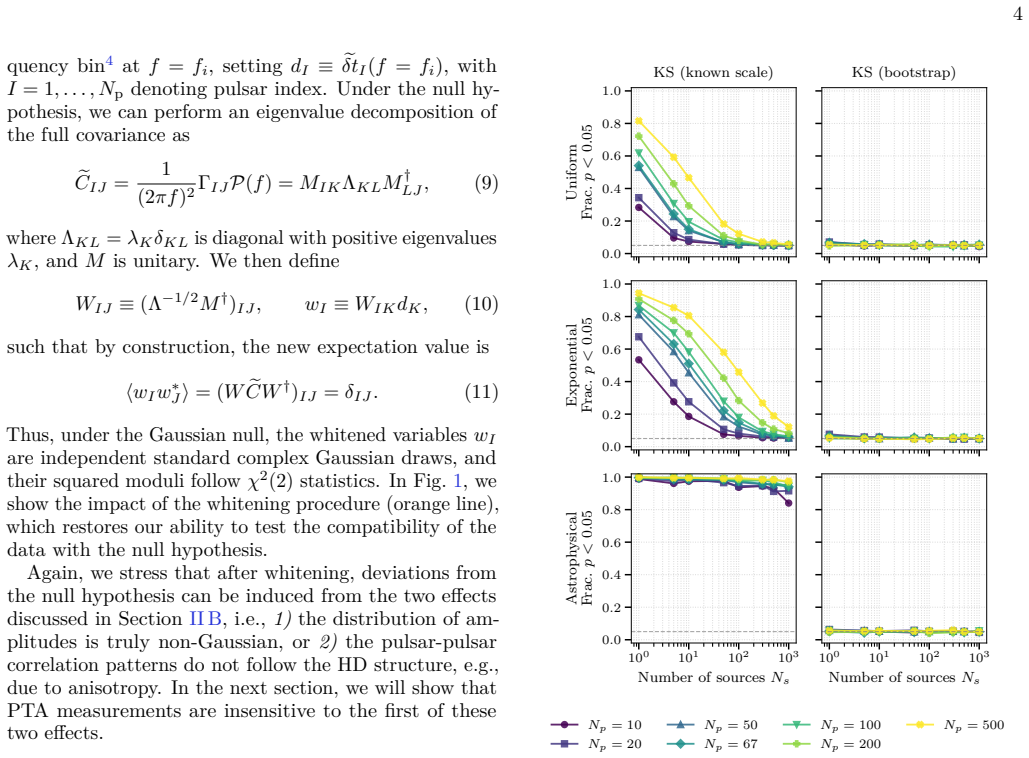
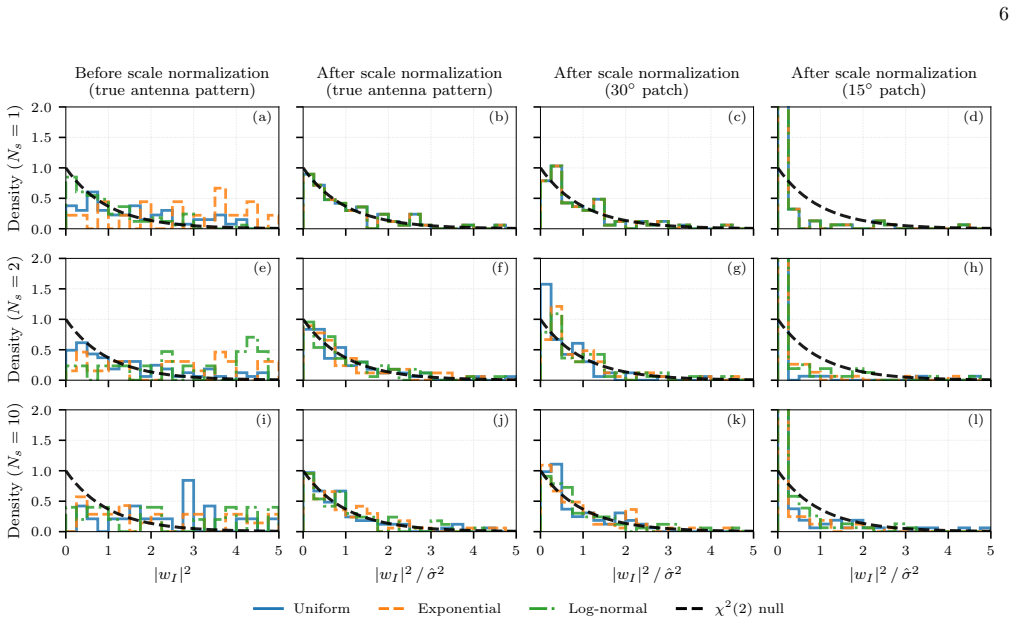
Observing non-Gaussianities in the timing residuals of Pulsar Timing Arrays (PTAs) has recently attracted attention as a potential discriminator between astrophysical and cosmological origins of the observed Gravitational Wave (GW) signal. In this work, we show that even in an idealized signal-dominated setup, after decorrelating the data to avoid spurious detections, statistical tests applied to PTA data cannot distinguish between a Gaussian and a non-Gaussian amplitude distribution of the GWB in a model-agnostic way. In particular, without making strong assumptions on the GW spectrum or the properties of the population, the sensitivity to any distinctive non-Gaussian feature is washed out.
Editorial analysis
A structured set of objections, weighed in public.
Referee Report
Summary. The paper claims that even in an idealized signal-dominated setup, after decorrelating PTA timing residuals to avoid spurious detections, statistical tests cannot distinguish Gaussian from non-Gaussian amplitude distributions of the GWB in a model-agnostic manner; without strong assumptions on the spectrum or source population, any distinctive non-Gaussian features are washed out.
Significance. If the central claim holds, the result would indicate that non-Gaussianity searches in current PTA analyses are not viable as model-agnostic discriminants between astrophysical and cosmological GWB origins, shifting emphasis toward spectrum shape or other higher-order statistics that survive decorrelation.
major comments (2)
- [Abstract] The abstract invokes a decorrelation step 'to avoid spurious detections' but supplies no description of the algorithm (e.g., whether it is a linear covariance-based whitening or a more general operation), the precise statistical tests applied, or quantitative measures of sensitivity loss; without these, it is impossible to verify whether the procedure preserves higher-order moments that encode non-Gaussian amplitude information.
- [Abstract] The central claim requires that the decorrelation leaves the marginal amplitude distribution intact for non-Gaussian cases. If the procedure is constructed from second-moment quantities (standard cross-power spectra or covariance matrices), it is a linear operation whose effect on kurtosis or tail features for non-Gaussian amplitudes is not shown to be negligible; this is load-bearing for the 'washed out' conclusion.
Simulated Author's Rebuttal
We thank the referee for their thoughtful comments on our manuscript. The two major comments both concern the level of detail in the abstract regarding the decorrelation procedure and its impact on higher-order statistics. We address each point below and propose targeted revisions where appropriate.
read point-by-point responses
-
Referee: [Abstract] The abstract invokes a decorrelation step 'to avoid spurious detections' but supplies no description of the algorithm (e.g., whether it is a linear covariance-based whitening or a more general operation), the precise statistical tests applied, or quantitative measures of sensitivity loss; without these, it is impossible to verify whether the procedure preserves higher-order moments that encode non-Gaussian amplitude information.
Authors: We agree that the abstract is too terse on these points. The decorrelation is a linear whitening operation constructed from the estimated covariance matrix of the timing residuals (detailed in Section 2.2). The statistical tests are the Kolmogorov-Smirnov and Anderson-Darling tests on the marginal distributions of the decorrelated amplitudes, with sensitivity quantified via Monte Carlo ensembles in Section 4. We will revise the abstract to state that the decorrelation is linear and covariance-based and to direct readers to the methods and results sections for the algorithm, tests, and sensitivity analysis. revision: yes
-
Referee: [Abstract] The central claim requires that the decorrelation leaves the marginal amplitude distribution intact for non-Gaussian cases. If the procedure is constructed from second-moment quantities (standard cross-power spectra or covariance matrices), it is a linear operation whose effect on kurtosis or tail features for non-Gaussian amplitudes is not shown to be negligible; this is load-bearing for the 'washed out' conclusion.
Authors: The manuscript explicitly addresses this point. Although the decorrelation is linear and based on second moments, Sections 3.1–3.2 derive how it mixes higher-order moments across the pulsar array, and Section 4 presents Monte Carlo results showing that, for the non-Gaussian amplitude distributions relevant to both astrophysical and cosmological sources, the post-decorrelation marginal distributions are statistically indistinguishable from Gaussian by the chosen tests. The dilution of kurtosis and tail features is quantified in Figures 4 and 5. We do not provide a model-independent proof that holds for every conceivable non-Gaussian distribution, but the result is demonstrated for the classes of distributions that appear in the literature on PTA signals. revision: no
Circularity Check
No circularity: result follows from analysis of idealized setup
full rationale
The paper presents its central claim—that statistical tests on decorrelated PTA data cannot distinguish Gaussian from non-Gaussian GWB amplitude distributions in a model-agnostic way—as the outcome of an analysis performed on an idealized signal-dominated setup. No quoted equations or steps reduce the claimed insensitivity to a self-definition, a fitted input renamed as prediction, or a load-bearing self-citation chain. The decorrelation step is invoked as a standard preprocessing choice to avoid spurious detections, not as a construction that forces the result by definition. The derivation remains self-contained against external PTA analysis benchmarks.
Axiom & Free-Parameter Ledger
Reference graph
Works this paper leans on
-
[1]
R. w. Hellings and G. s. Downs, Astrophys. J. Lett.265, L39 (1983)
1983
-
[2]
The NANOGrav 15-year Data Set: Evidence for a Gravitational-Wave Background
G. Agazieet al.(NANOGrav), Astrophys. J. Lett.951, L8 (2023), arXiv:2306.16213 [astro-ph.HE]
work page internal anchor Pith review Pith/arXiv arXiv 2023
-
[3]
J. Antoniadiset al.(EPTA, InPTA:), Astron. Astrophys. 678, A50 (2023), arXiv:2306.16214 [astro-ph.HE]
work page internal anchor Pith review Pith/arXiv arXiv 2023
-
[4]
D. J. Reardonet al., Astrophys. J. Lett.951, L6 (2023), arXiv:2306.16215 [astro-ph.HE]
work page internal anchor Pith review Pith/arXiv arXiv 2023
-
[5]
H. Xuet al., Res. Astron. Astrophys.23, 075024 (2023), arXiv:2306.16216 [astro-ph.HE]
work page internal anchor Pith review Pith/arXiv arXiv 2023
- [6]
-
[7]
The NANOGrav 15-year Data Set: Search for Signals from New Physics
A. Afzalet al.(NANOGrav), Astrophys. J. Lett.951, L11 (2023), [Erratum: Astrophys.J.Lett. 971, L27 (2024), Erratum: Astrophys.J. 971, L27 (2024)], arXiv:2306.16219 [astro-ph.HE]
work page internal anchor Pith review Pith/arXiv arXiv 2023
-
[8]
Antoniadiset al.(EPTA, InPTA), Astron
J. Antoniadiset al.(EPTA, InPTA), Astron. Astrophys. 685, A94 (2024), arXiv:2306.16227 [astro-ph.CO]
- [9]
- [10]
-
[11]
Caprini, Nature Rev
C. Caprini, Nature Rev. Phys.6, 291 (2024)
2024
- [12]
-
[13]
C. M. F. Mingarelli, T. Sidery, I. Mandel, and A. Vecchio, Phys. Rev. D88, 062005 (2013), arXiv:1306.5394 [astro- ph.HE]
work page internal anchor Pith review Pith/arXiv arXiv 2013
-
[14]
C. M. F. Mingarelli, T. J. W. Lazio, A. Sesana, J. E. Greene, J. A. Ellis, C.-P. Ma, S. Croft, S. Burke- Spolaor, and S. R. Taylor, Nature Astron.1, 886 (2017), arXiv:1708.03491 [astro-ph.GA]
work page internal anchor Pith review Pith/arXiv arXiv 2017
- [15]
-
[16]
S. R. Taylor and J. R. Gair, Phys. Rev. D88, 084001 (2013), arXiv:1309.3611 [gr-qc]
work page internal anchor Pith review Pith/arXiv arXiv 2013
-
[17]
G. Agazieet al., Astrophys. J. Lett.956, L3 (2023), arXiv:2306.16222 [astro-ph.HE]
-
[18]
Y. Ali-Haïmoud, T. L. Smith, and C. M. F. Mingarelli, Phys. Rev. D103, 042009 (2021), arXiv:2010.13958 [gr- qc]
- [19]
- [20]
- [21]
-
[22]
T. Konstandin, A.-M. Lemke, A. Mitridate, and E. Per- boni, JCAP04, 059 (2025), arXiv:2408.07741 [astro- ph.CO]
- [23]
- [24]
- [25]
-
[26]
B. Bécsyet al., Astrophys. J.959, 9 (2023), arXiv:2309.04443 [gr-qc]
-
[27]
D. J. Schwarz, Mod. Phys. Lett. A13, 2771 (1998), arXiv:gr-qc/9709027
work page internal anchor Pith review Pith/arXiv arXiv 1998
-
[28]
Cosmological Backgrounds of Gravitational Waves
C. Caprini and D. G. Figueroa, Class. Quant. Grav.35, 163001 (2018), arXiv:1801.04268 [astro-ph.CO]
work page internal anchor Pith review Pith/arXiv arXiv 2018
-
[29]
G. Franciolini, D. Racco, and F. Rompineve, Phys. Rev. Lett.132, 081001 (2024), [Erratum: Phys.Rev.Lett. 133, 189901 (2024)], arXiv:2306.17136 [astro-ph.CO]
-
[30]
The stochastic gravity-wave background: sources and detection
B. Allen, inLes Houches School of Physics: Astrophysical Sources of Gravitational Radiation(1996) pp. 373–417, arXiv:gr-qc/9604033
work page internal anchor Pith review Pith/arXiv arXiv 1996
-
[31]
N. Bartolo, V. De Luca, G. Franciolini, M. Peloso, D. Racco, and A. Riotto, Phys. Rev. D99, 103521 (2019), arXiv:1810.12224 [astro-ph.CO]
- [32]
-
[33]
M. Falxa and A. Sesana, Phys. Rev. D113, 043047 (2026), arXiv:2508.08365 [astro-ph.IM]
-
[34]
W. G. Lamb, J. M. Wachter, A. Mitridate, S. C. Sardesai, B. Bécsy, E. L. Hagen, S. R. Taylor, and L. Z. Kelley, (2025), arXiv:2511.09659 [gr-qc]
work page internal anchor Pith review Pith/arXiv arXiv 2025
- [35]
-
[36]
M. Ciprini, M. L. Marcelli, and G. Tasinato, (2026), arXiv:2603.15514 [astro-ph.CO]
-
[37]
The Heavy Tailed Non-Gaussianity of the Supermassive Black Hole Gravitational Wave Background
J. Raidal, J. Urrutia, V. Vaskonen, and H. Veermäe, (2026), arXiv:2604.08506 [astro-ph.CO]
work page internal anchor Pith review Pith/arXiv arXiv 2026
-
[38]
J. D. Romano and N. J. Cornish, Living Rev. Rel.20, 2 (2017), arXiv:1608.06889 [gr-qc]
work page internal anchor Pith review Pith/arXiv arXiv 2017
-
[39]
The Astrophysics of Nanohertz Gravitational Waves
S. Burke-Spolaor, S. R. Taylor, M. Charisi, T. Dolch, J. S. Hazboun, A. M. Holgado, L. Z. Kelley, T. J. W. Lazio, D. R. Madison, N. McMann, C. M. F. Mingarelli, A. Rasskazov, X. Siemens, J. J. Simon, and T. L. Smith, Astron. Astrophys. Rev.27, 5 (2019), arXiv:1811.08826 [astro-ph.HE]. 8
work page internal anchor Pith review Pith/arXiv arXiv 2019
-
[40]
S. R. Taylor, CRC Press (2022), 10.1201/9781003240648, arXiv:2105.13270 [astro-ph.HE]
-
[41]
J. M. Maldacena and G. L. Pimentel, JHEP09, 045 (2011), arXiv:1104.2846 [hep-th]
work page internal anchor Pith review Pith/arXiv arXiv 2011
-
[42]
R.Namba, M.Peloso, M.Shiraishi, L.Sorbo, andC.Unal, JCAP01, 041 (2016), arXiv:1509.07521 [astro-ph.CO]
work page internal anchor Pith review Pith/arXiv arXiv 2016
-
[43]
Unal,Imprints of Primordial Non-Gaussianity on Gravitational Wave Spectrum,Phys
C. Unal, Phys. Rev. D99, 041301 (2019), arXiv:1811.09151 [astro-ph.CO]
-
[44]
R.-g. Cai, S. Pi, and M. Sasaki, Phys. Rev. Lett.122, 201101 (2019), arXiv:1810.11000 [astro-ph.CO]
work page internal anchor Pith review Pith/arXiv arXiv 2019
-
[45]
Cosmological Shapes of Higher-Spin Gravity
D. Anninos, V. De Luca, G. Franciolini, A. Kehagias, and A. Riotto, JCAP04, 045 (2019), arXiv:1902.01251 [hep-th]
work page internal anchor Pith review Pith/arXiv arXiv 2019
-
[46]
P. Adshead, K. D. Lozanov, and Z. J. Weiner, JCAP10, 080 (2021), arXiv:2105.01659 [astro-ph.CO]
-
[47]
C. Yuan, D.-S. Meng, and Q.-G. Huang, JCAP12, 036 (2023), arXiv:2308.07155 [astro-ph.CO]
-
[48]
N. Bartolo, D. Bertacca, S. Matarrese, M. Peloso, A. Ric- ciardone, A. Riotto, and G. Tasinato, Phys. Rev. D100, 121501 (2019), arXiv:1908.00527 [astro-ph.CO]
-
[49]
N. Bartolo, D. Bertacca, S. Matarrese, M. Peloso, A. Ric- ciardone, A. Riotto, and G. Tasinato, Phys. Rev. D102, 023527 (2020), arXiv:1912.09433 [astro-ph.CO]
- [50]
- [51]
- [52]
-
[53]
N. Bartolo, V. Domcke, D. G. Figueroa, J. García-Bellido, M. Peloso, M. Pieroni, A. Ricciardone, M. Sakellari- adou, L. Sorbo, and G. Tasinato, JCAP11, 034 (2018), arXiv:1806.02819 [astro-ph.CO]
-
[54]
The Primordial Black Hole Dark Matter - LISA Serendipity
N. Bartolo, V. De Luca, G. Franciolini, A. Lewis, M. Peloso, and A. Riotto, Phys. Rev. Lett.122, 211301 (2019), arXiv:1810.12218 [astro-ph.CO]
work page internal anchor Pith review Pith/arXiv arXiv 2019
-
[55]
A. Margalit, C. R. Contaldi, and M. Pieroni, Phys. Rev. D102, 083506 (2020), arXiv:2004.01727 [astro-ph.CO]
-
[56]
E. Dimastrogiovanni, M. Fasiello, and G. Tasinato, Phys. Rev. Lett.124, 061302 (2020), arXiv:1906.07204 [astro- ph.CO]
-
[57]
C. R. Contaldi, Phys. Lett. B771, 9 (2017), arXiv:1609.08168 [astro-ph.CO]
work page internal anchor Pith review Pith/arXiv arXiv 2017
-
[58]
A. C. Jenkins and M. Sakellariadou, Phys. Rev. D98, 063509 (2018), arXiv:1802.06046 [astro-ph.CO]
work page internal anchor Pith review Pith/arXiv arXiv 2018
-
[59]
G. Cusin and G. Tasinato, JCAP08, 036 (2022), arXiv:2201.10464 [astro-ph.CO]
-
[60]
G. Tasinato, Phys. Rev. D108, 103521 (2023), arXiv:2309.00403 [gr-qc]
-
[61]
G. F. Smoot, M. V. Gorenstein, and R. A. Muller, Phys. Rev. Lett.39, 898 (1977)
1977
-
[62]
J. Gair, J. D. Romano, S. Taylor, and C. M. F. Mingarelli, Phys. Rev. D90, 082001 (2014), arXiv:1406.4664 [gr-qc]
work page internal anchor Pith review Pith/arXiv arXiv 2014
-
[63]
E. S. Phinney, (2001), arXiv:astro-ph/0108028
work page internal anchor Pith review Pith/arXiv arXiv 2001
-
[64]
A.Sesana, A.Vecchio, andC.N.Colacino,Mon.Not.Roy. Astron. Soc.390, 192 (2008), arXiv:0804.4476 [astro-ph]
work page internal anchor Pith review Pith/arXiv arXiv 2008
-
[65]
M. Enoki and M. Nagashima, Prog. Theor. Phys.117, 241 (2007), arXiv:astro-ph/0609377
work page internal anchor Pith review Pith/arXiv arXiv 2007
-
[66]
Gas driven massive black hole binaries: signatures in the nHz gravitational wave background
B. Kocsis and A. Sesana, Mon. Not. Roy. Astron. Soc. 411, 1467–1479 (2011), arXiv:1002.0584 [astro-ph.CO]
work page internal anchor Pith review Pith/arXiv arXiv 2011
-
[67]
S. Chen, A. Sesana, and W. Del Pozzo, Mon. Not. Roy. Astron. Soc.470, 1738 (2017), arXiv:1612.00455 [astro- ph.CO]
work page internal anchor Pith review Pith/arXiv arXiv 2017
-
[68]
L. Z. Kelley, L. Blecha, and L. Hernquist, Mon. Not. Roy. Astron. Soc.464, 3131 (2017), arXiv:1606.01900 [astro-ph.HE]
work page internal anchor Pith review Pith/arXiv arXiv 2017
-
[69]
E. A. Huerta, S. T. McWilliams, J. R. Gair, and S. R. Taylor, Phys. Rev. D92, 063010 (2015), arXiv:1504.00928 [gr-qc]
work page internal anchor Pith review Pith/arXiv arXiv 2015
-
[70]
S. R. Taylor, E. A. Huerta, J. R. Gair, and S. T. McWilliams, Astrophys. J.817, 70 (2016), arXiv:1505.06208 [gr-qc]
work page internal anchor Pith review Pith/arXiv arXiv 2016
-
[71]
P. A. Rosado, A. Sesana, and J. Gair, Mon. Not. Roy. Astron. Soc.451, 2417 (2015), arXiv:1503.04803 [astro- ph.HE]
work page internal anchor Pith review Pith/arXiv arXiv 2015
-
[72]
G. Agazieet al., Astrophys. J.978, 31 (2025), arXiv:2404.07020 [astro-ph.HE]
- [73]
-
[74]
A. Sesana, F. Haardt, P. Madau, and M. Volonteri, Astrophys. J.611, 623 (2004), arXiv:astro-ph/0401543
work page internal anchor Pith review Pith/arXiv arXiv 2004
-
[75]
A. Sesana, Mon. Not. Roy. Astron. Soc.433, L1 (2013), arXiv:1211.5375 [astro-ph.CO]
work page internal anchor Pith review Pith/arXiv arXiv 2013
- [76]
- [77]
-
[78]
The Kolmogorov-Smirnov test for the CMB
M. Frommert, R. Durrer, and J. Michaud, JCAP01, 009 (2012), arXiv:1108.5354 [astro-ph.CO]
work page internal anchor Pith review Pith/arXiv arXiv 2012
-
[79]
M. Crisostomi, R. van Haasteren, P. M. Meyers, and M. Vallisneri, (2025), arXiv:2506.13866 [astro-ph.IM]
-
[80]
A practical theorem on gravitational-wave background statistics
Y. Ali-Haïmoud, (2026), arXiv:2604.19701 [astro-ph.CO]
work page internal anchor Pith review Pith/arXiv arXiv 2026
discussion (0)
Sign in with ORCID, Apple, or X to comment. Anyone can read and Pith papers without signing in.