Credibility Trilemma in Polymatroidal Service Markets
Pith reviewed 2026-07-01 16:09 UTC · model grok-4.3
The pith
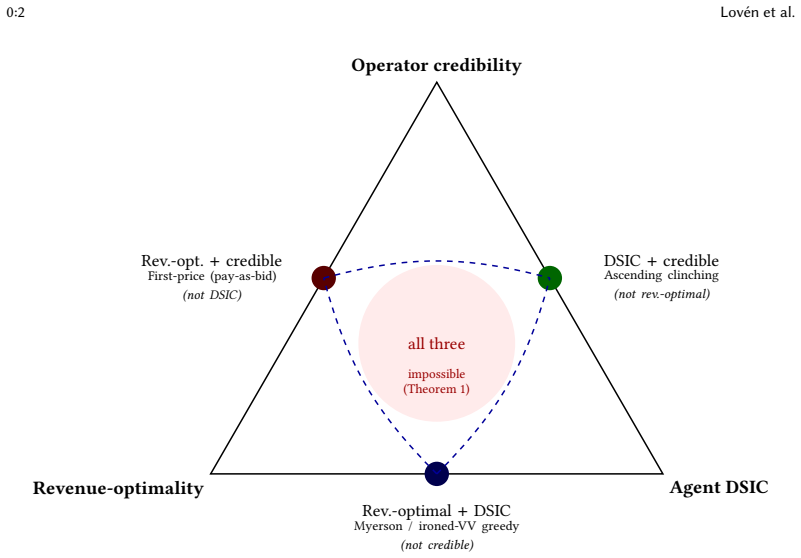
No static sealed-bid mechanism can be revenue-optimal, DSIC for agents, and credible for the operator on non-modular polymatroids.
A machine-rendered reading of the paper's core claim, the machinery that carries it, and where it could break.
Core claim
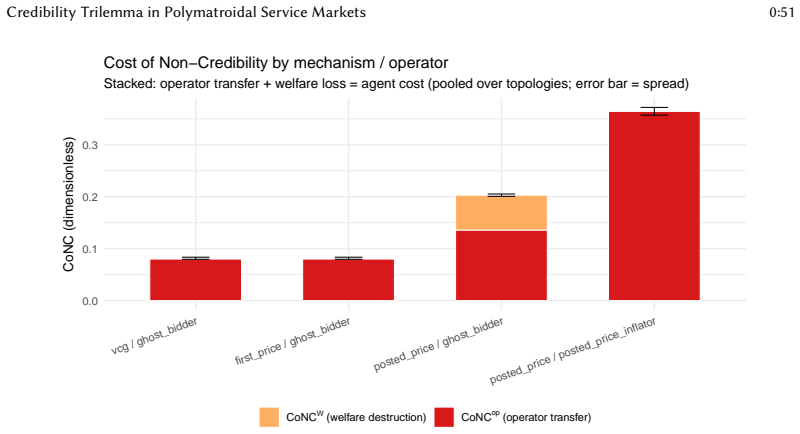
Modelling the operator as a strategic player, we establish a credibility trilemma: for single-parameter agents on a non-modular polymatroid, no static sealed-bid mechanism is simultaneously revenue-optimal, DSIC for agents, and credible for the operator. We introduce the Cost of Non-Credibility (CoNC) as a price-of-anarchy-style welfare-loss measure and obtain tight Θ-bounds across five topology classes, plus a matching upper bound O(|S|) on general DAGs realised by an Ω(|S|) witness on the SP-augmented sub-family.
What carries the argument
The credibility trilemma for non-modular polymatroids, which prevents any static sealed-bid mechanism from satisfying revenue optimality, agent DSIC, and operator credibility at the same time.
If this is right
- The Cost of Non-Credibility admits tight Θ-bounds across single-edge, series, parallel, tree, and series-parallel topologies.
- A matching O(|S|) upper bound and Ω(|S|) lower bound hold on general DAGs and the SP-augmented subfamily respectively.
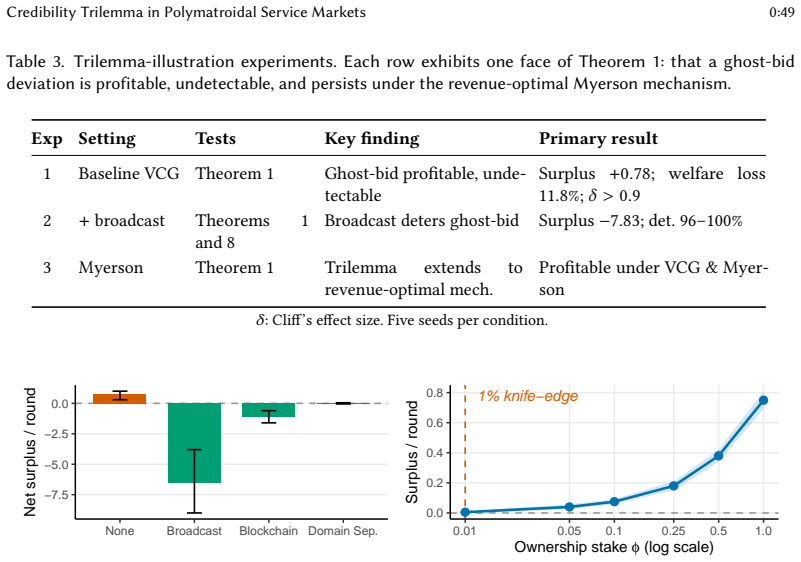
- Three structurally distinct resolutions are available: public broadcast or deferred-revelation commitment, administrative domain separation under settlement separation and four side conditions, and integrator competition orthogonal to mechanism execution.
- An instance-level grounding confirms the trilemma holds on the edge-pricing market from external prior work.
Where Pith is reading between the lines
- Market designers facing strategic operators may have to sacrifice revenue or incentive compatibility to maintain credibility in polymatroid settings.
- The topology-dependent bounds imply that the cost of credibility depends on the specific structure of the feasibility constraint, suggesting structure-aware mechanism design.
- Introducing competition among integrators could resolve the trilemma by separating the roles of execution and settlement without changing the underlying allocation rule.
Load-bearing premise
The marketplace operator acts as a strategic player who may deviate from truthful execution or reporting.
What would settle it
Discovery of a static sealed-bid mechanism on a non-modular polymatroid that is revenue-optimal, DSIC, and credible, or calculation of a Cost of Non-Credibility value outside the stated Θ-bounds for one of the five topology classes.
Figures
read the original abstract
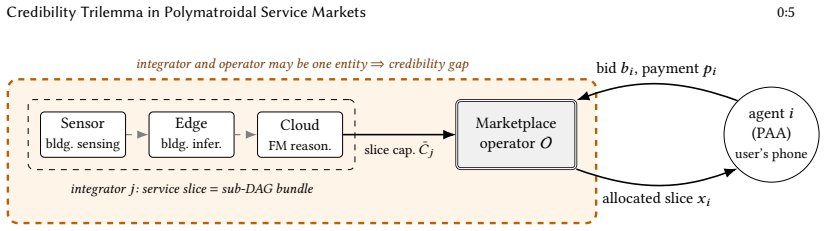
Mechanism-mediated service markets with polymatroidal feasibility admit efficient, dominant-strategy incentive-compatible (DSIC) allocation, but these guarantees implicitly assume truthful execution by the marketplace operator. Modelling the operator as a strategic player, we establish a credibility trilemma: for single-parameter agents on a non-modular polymatroid, no static sealed-bid mechanism is simultaneously revenue-optimal, DSIC for agents, and credible for the operator. We introduce the Cost of Non-Credibility (CoNC) as a price-of-anarchy-style welfare-loss measure and obtain tight $\Theta$-bounds across five topology classes (single-edge, series, parallel, tree, series-parallel), plus a matching upper bound $O(|\mathcal{S}|)$ on general DAGs realised by an $\Omega(|\mathcal{S}|)$ witness on the SP-augmented sub-family, turning the trilemma into a structural quantity. Three structurally distinct resolutions follow: public broadcast or deferred-revelation commitment, administrative domain separation under settlement separation and four side conditions, and integrator competition orthogonal to mechanism execution under disjoint actors. An instance-level grounding over the edge-pricing market of Amin et al. confirms the trilemma's robustness on a refereed external setting. The result establishes marketplace neutrality as a first-order design constraint on polymatroidal service markets rather than an implementation detail: where the operator is a strategic player, credibility trades off against revenue optimality and agent incentive compatibility along structurally characterised lines.
Editorial analysis
A structured set of objections, weighed in public.
Referee Report
Summary. The manuscript claims that in mechanism-mediated service markets with polymatroidal feasibility, modeling the operator as a strategic player yields a credibility trilemma: for single-parameter agents on a non-modular polymatroid, no static sealed-bid mechanism is simultaneously revenue-optimal, DSIC for agents, and credible for the operator. It introduces the Cost of Non-Credibility (CoNC) as a price-of-anarchy-style welfare-loss measure, derives tight Θ-bounds across five topology classes (single-edge, series, parallel, tree, series-parallel) plus an O(|S|) upper bound on general DAGs with a matching Ω(|S|) witness on the SP-augmented subfamily, and proposes three resolutions (public broadcast/deferred-revelation commitment, administrative domain separation under four side conditions, and integrator competition). The trilemma is further grounded via an instance-level analysis on the edge-pricing market of Amin et al.
Significance. If the central negative result and the accompanying structural bounds hold, the work is significant in reframing marketplace neutrality as a first-order design constraint rather than an implementation detail for polymatroidal service markets. The explicit topology-class bounds, the matching DAG bounds, the introduction of CoNC, and the grounding on an external refereed setting (Amin et al.) are concrete strengths that could influence subsequent mechanism-design research in service markets.
minor comments (1)
- The abstract is information-dense; consider splitting the description of the trilemma, the CoNC bounds, and the resolutions into separate sentences or short paragraphs for improved readability.
Simulated Author's Rebuttal
We thank the referee for their positive assessment of the manuscript and the recommendation to accept. We are pleased that the credibility trilemma, the introduction of the Cost of Non-Credibility, the tight topology-class bounds, the matching DAG bounds, and the grounding on the Amin et al. setting are viewed as concrete strengths.
Circularity Check
No significant circularity; derivation is self-contained theoretical impossibility result
full rationale
The paper establishes a negative result (impossibility of a static sealed-bid mechanism satisfying revenue optimality, DSIC, and operator credibility on non-modular polymatroids) under the explicit modeling choice that the operator may act strategically. This premise is definitional to the trilemma rather than derived from or reducing to prior fitted parameters, self-citations, or ansatzes within the paper. No equations or steps in the provided abstract reduce a claimed prediction to an input by construction, nor does the result rely on load-bearing self-citation chains or uniqueness theorems imported from the authors' prior work. The CoNC bounds and resolution mechanisms are presented as derived structural quantities, with the overall claim remaining independent of its own outputs. The paper is self-contained as a proof against external benchmarks in mechanism design.
Axiom & Free-Parameter Ledger
Reference graph
Works this paper leans on
-
[1]
Ibrahim Afolabi, Tarik Taleb, Konstantinos Samdanis, et al. 2018. Network Slicing and Softwarization: A Survey on Principles, Enabling Technologies, and Solutions.IEEE Communications Surveys & Tutorials20, 3 (2018), 2429–2453. doi:10.1109/COMST.2018.2815638
-
[2]
Aiyer, Lorenzo Alvisi, Allen Clement, Mike Dahlin, Jean-Philippe Martin, and Carl Porth
Amitanand S. Aiyer, Lorenzo Alvisi, Allen Clement, Mike Dahlin, Jean-Philippe Martin, and Carl Porth. 2005. BAR Fault Tolerance for Cooperative Services. InProc. 20th ACM Symposium on Operating Systems Principles (SOSP). 45–58. doi:10.1145/1095810.1095816
-
[3]
Mohammad Akbarpour and Shengwu Li. 2020. Credible Auctions: A Trilemma.Econometrica88, 2 (2020), 425–467. doi:10.3982/ECTA15925
-
[4]
AMD. 2024. AMD Secure Encrypted Virtualization-Secure Nested Paging (SEV-SNP). White paper
2024
-
[5]
Saurabh Amin, Patrick Jaillet, Haripriya Pulyassary, and Manxi Wu. 2026. Market Design for Capacity Sharing in Networks.ACM Transactions on Economics and Computation14, 1, Article 2 (Feb. 2026), 47 pages. doi:10.1145/3777901
-
[6]
Anderson, André de Palma, and Jacques-François Thisse
Simon P. Anderson, André de Palma, and Jacques-François Thisse. 1992.Discrete Choice Theory of Product Differentiation. MIT Press, Cambridge, MA
1992
-
[7]
Aaron Archer and Éva Tardos. 2001. Truthful Mechanisms for One-Parameter Agents. InProc. 42nd IEEE Symp. Foundations of Computer Science (FOCS). 482–491. doi:10.1109/SFCS.2001.959924
-
[8]
Mark Armstrong. 2006. Competition in Two-Sided Markets.RAND Journal of Economics37, 3 (2006), 668–691. doi:10.1111/j.1756-2171.2006.tb00037.x
-
[9]
Lawrence M. Ausubel. 2004. An Efficient Ascending-Bid Auction for Multiple Objects.American Economic Review94, 5 (December 2004), 1452–1475. doi:10.1257/0002828043052330
-
[10]
Lawrence M. Ausubel and Paul Milgrom. 2006. The Lovely but Lonely Vickrey Auction. InCombinatorial Auctions, Peter Cramton, Yoav Shoham, and Richard Steinberg (Eds.). MIT Press, 17–40. https://doi.org/10.7551/mitpress/ 9780262033428.003.0002
-
[11]
2015.Industrial Organization: Markets and Strategies(2nd ed.)
Paul Belleflamme and Martin Peitz. 2015.Industrial Organization: Markets and Strategies(2nd ed.). Cambridge University Press
2015
-
[12]
Dirk Bergemann and Stephen Morris. 2005. Robust Mechanism Design.Econometrica73, 6 (2005), 1771–1813. doi:10.1111/j.1468-0262.2005.00638.x
-
[13]
Sushil Bikhchandani, Shurojit Chatterji, Ron Lavi, Ahuva Mu’alem, Noam Nisan, and Arunava Sen. 2006. Weak Monotonicity Characterizes Deterministic Dominant-Strategy Implementation.Econometrica74, 4 (2006), 1109–1132. doi:10.1111/j.1468-0262.2006.00697.x
-
[14]
Shyam Bikhchandani and John W. Mamer. 1997. Competitive Equilibrium in an Exchange Economy with Indivisibilities. Journal of Economic Theory74, 2 (1997), 385–413. doi:10.1006/jeth.1996.2269
-
[15]
Eric Budish, Peter Cramton, and John Shim. 2015. The High-Frequency Trading Arms Race: Frequent Batch Auctions as a Market Design Response.Quarterly Journal of Economics130, 4 (2015), 1547–1621. doi:10.1093/qje/qjv027
-
[16]
Yang Cai, Constantinos Daskalakis, and S. Matthew Weinberg. 2017. A Duality-Based Unified Approach to Bayesian Mechanism Design.J. ACM64, 6 (2017), Article 39. doi:10.1145/3140772
-
[17]
Bernard Caillaud and Philippe Jehiel. 1998. Collusion in Auctions with Externalities.RAND Journal of Economics29, 4 (1998), 680–702. doi:10.2307/2556095
-
[18]
Bernard Caillaud and Bruno Jullien. 2003. Chicken and Egg: Competition Among Intermediation Service Providers. RAND Journal of Economics34, 2 (2003), 309–328. doi:10.2307/1593720
-
[19]
Jorge Cardoso, Amit Sheth, John Miller, Jonathan Arnold, and Krys Kochut. 2004. Quality of Service for Workflows and Web Service Processes.Web Semantics1, 3 (2004), 281–308. doi:10.1016/j.websem.2004.03.001
-
[20]
Fabio Casati and Ming-Chien Shan. 2001. Models and Languages for Describing and Discovering E-Services.SIGMOD Record30, 1 (2001), 83–92. doi:10.1145/373626.373738
-
[21]
Raymond Cheng, Fan Zhang, Jernej Kos, Warren He, Nicholas Hynes, Noah Johnson, Ari Juels, Andrew Miller, and Dawn Song. 2019. Ekiden: A Platform for Confidentiality-Preserving, Trustworthy, and Performant Smart Contracts. InProc. IEEE European Symposium on Security and Privacy (EuroS&P). 185–200. doi:10.1109/EuroSP.2019.00023
-
[22]
Tarun Chitra, Matheus V. X. Ferreira, and Kshitij Kulkarni. 2024. Credible, Optimal Auctions via Public Broadcast. In 6th Conf. Advances in Financial Technologies (AFT) (LIPIcs, Vol. 316). 19:1–19:16. doi:10.4230/LIPIcs.AFT.2024.19
-
[23]
Edward H. Clarke. 1971. Multipart Pricing of Public Goods.Public Choice11 (1971), 17–33. doi:10.1007/BF01726210
-
[24]
Victor Costan and Srinivas Devadas. 2016. Intel SGX Explained. InIACR Cryptology ePrint Archive. Report 2016/086. 0:60 Lovén et al
2016
-
[25]
Francisco Curbera, Rania Khalaf, Nirmal Mukhi, Stefan Tai, and Sanjiva Weerawarana. 2003. The Next Step in Web Services. InCommunications of the ACM, Vol. 46. 29–34. doi:10.1145/944217.944234
- [26]
- [27]
-
[28]
R. J. Duffin. 1965. Topology of Series-Parallel Networks.J. Math. Anal. Appl.10, 2 (1965), 303–318. doi:10.1016/0022- 247X(65)90125-3
-
[29]
Jack Edmonds. 2003. Submodular Functions, Matroids, and Certain Polyhedra. InCombinatorial Optimization - Eureka, You Shrink!Springer-Verlag, Berlin, Heidelberg, 11–26. doi:10.1007/3-540-36478-1_2
-
[30]
Matheus V. X. Ferreira and S. Matthew Weinberg. 2020. Credible, Truthful, and Two-Round (Optimal) Auctions via Cryptographic Commitments. InProc. 21st ACM Conf. Economics and Computation (EC). 683–712. doi:10.1145/3391403. 3399495
-
[31]
Eric J. Friedman and Paul Resnick. 2001. The Social Cost of Cheap Pseudonyms.Journal of Economics & Management Strategy10, 2 (2001), 173–199. doi:10.1111/j.1430-9134.2001.00173.x
-
[32]
2005.Submodular Functions and Optimization(2nd ed.)
Satoru Fujishige. 2005.Submodular Functions and Optimization(2nd ed.). Vol. 58. Elsevier
2005
-
[33]
Williamson, and Oana Ciobotaru
Ariel Gabizon, Zachary J. Williamson, and Oana Ciobotaru. 2019. PLONK: Permutations over Lagrange-bases for Oecumenical Noninteractive arguments of Knowledge. Cryptology ePrint Archive, Report 2019/953. https: //eprint.iacr.org/2019/953
2019
-
[34]
Keke Gai, Jinnan Guo, Liehuang Zhu, and Shui Yu. 2020. Blockchain Meets Cloud Computing: A Survey.IEEE Communications Surveys & Tutorials22, 3 (2020), 2009–2030. doi:10.1109/COMST.2020.2989392
-
[35]
Aadityan Ganesh and Qianfan Zhang. 2025. Truthful, Credible, and Optimal Auctions for Matroids via Blockchains and Commitments. InProc. 26th ACM Conf. Economics and Computation (EC). doi:10.1145/3736252.3742652
-
[36]
Gagan Goel, Vahab Mirrokni, and Renato Paes Leme. 2015. Polyhedral Clinching Auctions and the AdWords Polytope. J. ACM62, 3, Article 18 (2015). doi:10.1145/2738038
-
[37]
Google Cloud. 2025. Announcing the Agent2Agent Protocol (A2A). Google Developers Blog. https://developers. googleblog.com/en/a2a-a-new-era-of-agent-interoperability/ Accessed: 2026-02-23
2025
-
[38]
Jens Groth. 2016. On the Size of Pairing-Based Non-Interactive Arguments. InAdvances in Cryptology – EUROCRYPT 2016 (LNCS, Vol. 9666). Springer, 305–326. doi:10.1007/978-3-662-49896-5_11
-
[39]
Theodore Groves. 1973. Incentives in Teams.Econometrica41, 4 (1973), 617–631. doi:10.2307/1914085
-
[40]
Faruk Gul and Ennio Stacchetti. 1999. Walrasian Equilibrium with Gross Substitutes.Journal of Economic Theory87, 1 (1999), 95–124. doi:10.1006/jeth.1999.2531
-
[41]
Andrei Hagiu, Tat-How Teh, and Julian Wright. 2022. Should Platforms Be Allowed to Sell on Their Own Marketplaces? RAND Journal of Economics53, 2 (2022), 297–327. doi:10.1111/1756-2171.12408
-
[42]
John William Hatfield and Paul R. Milgrom. 2005. Matching with Contracts.American Economic Review95, 4 (2005), 913–935. doi:10.1257/0002828054825466
-
[43]
Thomas W. Hazlett. 2017. The Political Spectrum: The Tumultuous Liberation of Wireless Technology, from Herbert Hoover to the Smartphone.Yale University Press(2017)
2017
-
[44]
Independent Assignment
Masao Iri and Nobuaki Tomizawa. 1968. An Algorithm for Finding an Optimal “Independent Assignment”.Journal of the Operations Research Society of Japan11, 4 (1968), 201–217
1968
-
[45]
Philippe Jehiel and Benny Moldovanu. 2001. Efficient Design with Interdependent Valuations.Econometrica69, 5 (2001), 1237–1259. doi:10.1111/1468-0262.00240
-
[46]
Xiaolin Jiang, Hossein Shokri-Ghadikolaei, Gabor Fodor, et al. 2019. Low-Latency Networking: Where Latency Lurks and How to Tame It.Proc. IEEE107, 2 (2019), 280–306. doi:10.1109/JPROC.2018.2863960
-
[47]
Bruno Jullien, Alessandro Pavan, and Marc Rysman. 2021. Two-Sided Markets, Pricing, and Network Effects. In Handbook of Industrial Organization. Vol. 4. Elsevier, 485–592. doi:10.1016/bs.hesind.2021.11.007
-
[48]
Alexander S. Kelso and Vincent P. Crawford. 1982. Job Matching, Coalition Formation, and Gross Substitutes. Econometrica50, 6 (1982), 1483–1504. doi:10.2307/1913392
-
[49]
Lina M. Khan. 2017. Amazon’s Antitrust Paradox.Yale Law Journal126, 3 (2017), 710–805
2017
-
[50]
Elias Koutsoupias and Christos Papadimitriou. 2009. Worst-case equilibria.Computer Science Review3, 2 (2009), 65–69. doi:10.1016/j.cosrev.2009.04.003
-
[51]
1993.A Theory of Incentives in Procurement and Regulation
Jean-Jacques Laffont and Jean Tirole. 1993.A Theory of Incentives in Procurement and Regulation. MIT Press, Cambridge, MA
1993
-
[52]
Huaizhi Li and Mukesh Singhal. 2007. Trust Management in Distributed Systems .Computer40, 02 (Feb. 2007), 45–53. doi:10.1109/MC.2007.76
-
[53]
Lauri Lovén, Reza Farahani, Ilir Murturi, et al. 2026. Agentic Edge Intelligence: A Research Agenda. InProceedings of the 18th IEEE/ACM International Conference on Utility and Cloud Computing (UCC ’25). Association for Computing Credibility Trilemma in Polymatroidal Service Markets 0:61 Machinery, New York, NY, USA, Article 66, 5 pages. doi:10.1145/377327...
- [54]
-
[55]
R. Preston McAfee. 1992. A Dominant Strategy Double Auction.Journal of Economic Theory56, 2 (1992), 434–450. doi:10.1016/0022-0531(92)90091-U
-
[56]
Paul Milgrom and Chris Shannon. 1994. Monotone Comparative Statics.Econometrica62, 1 (1994), 157–180. doi:10. 2307/2951479
1994
-
[57]
Kazuo Murota. 2003.Discrete Convex Analysis. SIAM. doi:10.1137/1.9780898718508
-
[58]
Roger B. Myerson. 1981. Optimal Auction Design.Mathematics of Operations Research6, 1 (1981), 58–73. doi:10.1287/ moor.6.1.58
1981
-
[59]
Roger B. Myerson and Mark A. Satterthwaite. 1983. Efficient Mechanisms for Bilateral Trading.Journal of Economic Theory29, 2 (1983), 265–281. doi:10.1016/0022-0531(83)90048-0
-
[60]
OASIS WSBPEL TC. 2007. Web Services Business Process Execution Language Version 2.0. OASIS Standard. http: //docs.oasis-open.org/wsbpel/2.0/OS/wsbpel-v2.0-OS.html
2007
-
[61]
James B. Orlin. 2013. Max Flows in O(nm) Time, or Better. InProc. 45th Annual ACM Symposium on Theory of Computing (STOC). 765–774. doi:10.1145/2488608.2488705
-
[62]
James G. Oxley. 2011.Matroid Theory(2nd ed.). Oxford Graduate Texts in Mathematics, Vol. 21. Oxford University Press
2011
-
[63]
Papazoglou, Paolo Traverso, Schahram Dustdar, and Frank Leymann
Mike P. Papazoglou, Paolo Traverso, Schahram Dustdar, and Frank Leymann. 2007. Service-Oriented Computing: State of the Art and Research Challenges.Computer40, 11 (2007), 38–45. doi:10.1109/MC.2007.400
-
[64]
Alessandro Pavan, Ilya Segal, and Juuso Toikka. 2014. Dynamic Mechanism Design: A Myersonian Approach. Econometrica82, 2 (2014), 601–653. doi:10.3982/ECTA10269
-
[65]
Jean-Charles Rochet and Jean Tirole. 2003. Platform Competition in Two-Sided Markets.Journal of the European Economic Association1, 4 (2003), 990–1029. doi:10.1162/154247603322493212
-
[66]
Roth and Marilda A
Alvin E. Roth and Marilda A. O. Sotomayor. 1990.Two-Sided Matching: A Study in Game-Theoretic Modeling and Analysis. Cambridge University Press
1990
-
[67]
Tim Roughgarden. 2015. Intrinsic Robustness of the Price of Anarchy.J. ACM62, 5 (2015), Article 32, 42 pages. doi:10.1145/2806883
-
[68]
Tim Roughgarden and Éva Tardos. 2002. How Bad is Selfish Routing?J. ACM49, 2, 236–259. doi:10.1145/506147.506153
-
[69]
Alaa Saleh et al. 2025. Follow-Me AI: Energy-Efficient User Interaction With Smart Environments.IEEE Pervasive Computing24, 1 (2025), 32–42. doi:10.1109/MPRV.2025.3539421
-
[70]
Steven C. Salop. 1979. Monopolistic Competition with Outside Goods.Bell Journal of Economics10, 1 (1979), 141–156. doi:10.2307/3003323
-
[71]
Mahadev Satyanarayanan. 2017. The Emergence of Edge Computing.Computer50, 1 (2017), 30–39. doi:10.1109/MC. 2017.9
work page doi:10.1109/mc 2017
-
[72]
2003.Combinatorial Optimization: Polyhedra and Efficiency
Alexander Schrijver. 2003.Combinatorial Optimization: Polyhedra and Efficiency. Algorithms and Combinatorics, Vol. 24. Springer. Three volumes (A, B, C)
2003
-
[73]
Vincenzo Sciancalepore, Xavier Costa-Perez, and Albert Banchs. 2019. RL-NSB: Reinforcement Learning-Based 5G Network Slice Broker.IEEE/ACM Transactions on Networking27, 4 (2019), 1543–1557. doi:10.1109/TNET.2019.2924471
-
[74]
George J. Stigler. 1971. The Theory of Economic Regulation.Bell Journal of Economics and Management Science2, 1 (1971), 3–21. doi:10.2307/3003160
-
[75]
Steven Tadelis. 2016. Reputation and Feedback Systems in Online Platform Markets.Annual Review of Economics8 (2016), 321–340. doi:10.1146/annurev-economics-080315-015325
-
[76]
Hongru Tan and Julian Wright. 2018. A Price Theory of Multi-Sided Platforms: Comment.American Economic Review 108, 9 (2018), 2758–2760. doi:10.1257/aer.20171048
-
[77]
Donald M. Topkis. 1998.Supermodularity and Complementarity. Princeton University Press, Princeton, NJ
1998
-
[78]
Jacobo Valdes, Robert E. Tarjan, and Eugene L. Lawler. 1982. The Recognition of Series Parallel Digraphs.SIAM J. Comput.11, 2 (1982), 298–313. doi:10.1137/0211023
-
[79]
William Vickrey. 1961. Counterspeculation, Auctions, and Competitive Sealed Tenders.Journal of Finance16, 1 (1961), 8–37. doi:10.1111/j.1540-6261.1961.tb02789.x
-
[80]
Christof Weinhardt, Arun Anandasivam, Benjamin Blau, et al. 2009. Cloud Computing – A Classification, Business Models, and Research Directions.Business & Information Systems Engineering1, 5 (2009), 391–399. doi:10.1007/s12599- 009-0071-2
discussion (0)
Sign in with ORCID, Apple, or X to comment. Anyone can read and Pith papers without signing in.