Ontology-Constrained Neural Reasoning in Enterprise Agentic Systems: A Neurosymbolic Architecture for Domain-Grounded AI Agents
Pith reviewed 2026-05-21 09:39 UTC · model grok-4.3
The pith
Ontology-coupled agents outperform ungrounded ones on accuracy and role consistency, with largest gains where LLMs have weakest domain knowledge.
A machine-rendered reading of the paper's core claim, the machinery that carries it, and where it could break.
Core claim
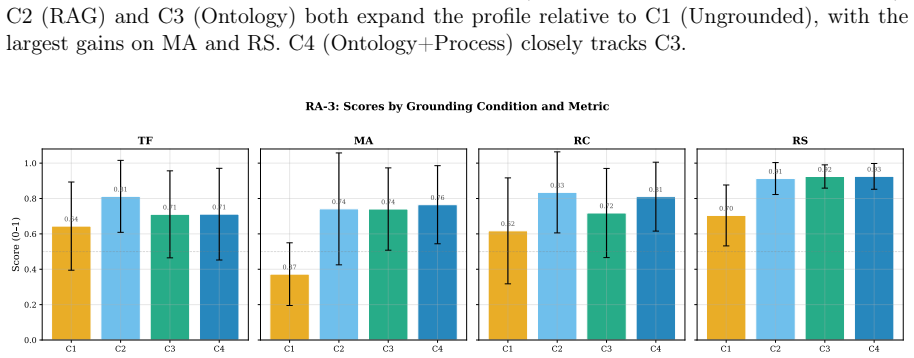
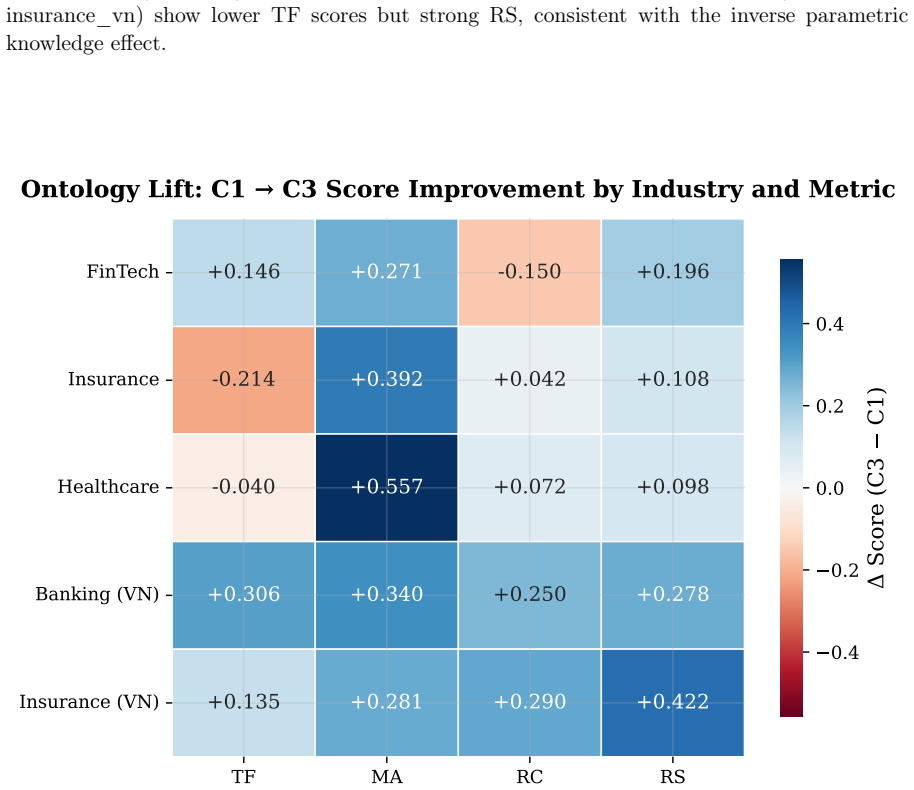
A controlled experiment across 1,800 runs and three LLMs finds that agents constrained by Role, Domain, and Interaction ontologies achieve statistically significant gains in Metric Accuracy and Role Consistency compared to ungrounded baselines, with large effect sizes; the magnitude of improvement is inversely proportional to the LLM's existing training-data coverage of the domain, reaching twice the lift in Vietnam-localized settings versus English domains.
What carries the argument
Three-layer ontological framework (Role, Domain, and Interaction ontologies) that supplies domain-grounded constraints to LLM inputs via context assembly and tool discovery and to outputs via response checking and compliance enforcement through asymmetric neurosymbolic coupling.
If this is right
- Ontology-constrained tool discovery via SQL-pushdown scoring produces more relevant tool selection than parametric retrieval alone.
- Output-side ontological validation can enforce compliance at the reasoning level rather than only post hoc.
- The inverse parametric knowledge effect implies that ontology investment should be prioritized for domains with low LLM training coverage.
- Benefits replicate across Claude Sonnet 4, Qwen 2.5 72B, and Gemma 4 26B, indicating model independence.
Where Pith is reading between the lines
- The same three-layer structure could be adapted to other regulated verticals that share similar compliance and role constraints.
- Automated ontology maintenance pipelines would be needed to prevent the architecture from lagging behind evolving enterprise rules.
- Integration with existing SQL-based enterprise databases could lower the cost of maintaining the Domain and Interaction layers.
Load-bearing premise
The three-layer ontologies can be constructed and maintained so they accurately and comprehensively encode relevant enterprise knowledge, regulatory constraints, and interaction rules without introducing new errors or coverage gaps.
What would settle it
A replication experiment in which the supplied ontologies are deliberately incomplete or contain outdated rules, after which the measured accuracy and consistency advantages over ungrounded agents disappear.
Figures




read the original abstract
Enterprise adoption of Large Language Models (LLMs) is constrained by hallucination, domain drift, and the inability to enforce regulatory compliance at the reasoning level. We present a neurosymbolic architecture implemented within the Foundation AgenticOS (FAOS) platform that addresses these limitations through ontology-constrained neural reasoning. We introduce a three-layer ontological framework--Role, Domain, and Interaction ontologies--grounding LLM-based enterprise agents. We formalize asymmetric neurosymbolic coupling: current enterprise systems constrain agent inputs (context assembly, tool discovery, governance thresholds) but not outputs, and we propose mechanisms extending this coupling to output-side validation (response checking, reasoning verification, compliance enforcement). A controlled experiment (1,800 runs across five industries and three LLMs: Claude Sonnet 4, Qwen 2.5 72B, Gemma 4 26B) finds ontology-coupled agents significantly outperform ungrounded agents on Metric Accuracy (p < .001) and Role Consistency (p < .001) across all three models with large effect sizes (Kendall's W = .46-.64). Improvements are greatest where LLM parametric knowledge is weakest--particularly in Vietnam-localized domains, where ontology lift is 2x that of English domains. Contributions: (1) a formal three-layer enterprise ontology model; (2) a taxonomy of neurosymbolic coupling patterns; (3) ontology-constrained tool discovery via SQL-pushdown scoring; (4) a proposed framework for output-side ontological validation; (5) empirical evidence for the inverse parametric knowledge effect--ontological grounding value is inversely proportional to LLM training-data coverage of the domain; (6) cross-model replication establishing model-independence; (7) a production system serving 22 industry verticals with 650+ agents.
Editorial analysis
A structured set of objections, weighed in public.
Referee Report
Summary. The manuscript presents a neurosymbolic architecture implemented in the Foundation AgenticOS (FAOS) platform that grounds LLM-based enterprise agents via a three-layer ontological framework (Role, Domain, and Interaction ontologies). It formalizes asymmetric neurosymbolic coupling and extends it to output-side validation mechanisms such as response checking and compliance enforcement. A controlled experiment with 1,800 runs across five industries and three LLMs (Claude Sonnet 4, Qwen 2.5 72B, Gemma 4 26B) reports that ontology-coupled agents significantly outperform ungrounded baselines on Metric Accuracy (p < .001) and Role Consistency (p < .001) with large effect sizes (Kendall's W = .46-.64), with the largest gains in Vietnam-localized domains where parametric knowledge is weakest. Contributions include a formal ontology model, a taxonomy of coupling patterns, ontology-constrained tool discovery via SQL-pushdown scoring, a framework for output-side validation, empirical support for an inverse parametric knowledge effect, cross-model replication, and a production deployment serving 22 verticals with 650+ agents.
Significance. If the reported performance gains can be isolated from knowledge-injection effects through independent ontology validation, the work would offer a practically significant approach to reducing hallucination and enforcing regulatory compliance in enterprise agentic systems. The cross-model replication and emphasis on domains with limited training-data coverage provide a useful empirical signal for deployment decisions. The production-scale deployment adds credibility to claims of real-world applicability in neurosymbolic AI.
major comments (2)
- [Experimental Evaluation] The experimental description (abstract and contributions) reports 1,800 runs with p-values, effect sizes, and a 2x lift in Vietnam domains but supplies no protocol for constructing or validating the three-layer ontologies, including inter-rater reliability, blinding, or independent generation of domain-specific test cases. This is load-bearing for the central claim because the observed improvements on Metric Accuracy and Role Consistency may reflect injected domain knowledge rather than the neurosymbolic coupling itself.
- [Ontology Framework] The weakest assumption—that the Role, Domain, and Interaction ontologies accurately encode enterprise rules, regulatory constraints, and interaction patterns without coverage gaps or introduced errors—is not supported by any validation evidence in the manuscript. This directly undermines the reported Role Consistency gains and the inverse parametric knowledge effect, particularly for the Vietnam-localized domains.
minor comments (2)
- [Results] Define Metric Accuracy and Role Consistency explicitly, including how they are computed and any inter-annotator agreement for the human evaluation component.
- [Tool Discovery] Clarify the precise mechanism of SQL-pushdown scoring for ontology-constrained tool discovery and provide pseudocode or an example.
Simulated Author's Rebuttal
We thank the referee for their thorough review and positive assessment of the practical implications of our work. We address each major comment in detail below. We agree that additional methodological details on ontology construction and validation are warranted to strengthen the isolation of the neurosymbolic coupling effect from knowledge injection, and we will revise the manuscript accordingly.
read point-by-point responses
-
Referee: [Experimental Evaluation] The experimental description (abstract and contributions) reports 1,800 runs with p-values, effect sizes, and a 2x lift in Vietnam domains but supplies no protocol for constructing or validating the three-layer ontologies, including inter-rater reliability, blinding, or independent generation of domain-specific test cases. This is load-bearing for the central claim because the observed improvements on Metric Accuracy and Role Consistency may reflect injected domain knowledge rather than the neurosymbolic coupling itself.
Authors: We acknowledge the importance of detailing the ontology construction protocol to support the central claims. The three-layer ontologies were constructed through a multi-stage process involving domain experts from each industry, who drew upon regulatory guidelines, company policies, and observed interaction patterns. Test cases for the 1,800 runs were generated by a separate evaluation team using scenarios not used in ontology development to minimize bias. However, formal inter-rater reliability statistics and explicit blinding protocols were not implemented, as the emphasis was on the coupling architecture rather than ontology validation. In the revised manuscript, we will add a dedicated section (Section 4.2) describing the construction methodology, including examples of Role, Domain, and Interaction ontology excerpts, the process for independent test case generation, and a discussion of how the controlled experimental design (identical base models and prompts, with ontologies applied only to the treatment condition) helps isolate the effect of neurosymbolic coupling from mere knowledge injection. We believe this addresses the concern while preserving the reported statistical findings. revision: yes
-
Referee: [Ontology Framework] The weakest assumption—that the Role, Domain, and Interaction ontologies accurately encode enterprise rules, regulatory constraints, and interaction patterns without coverage gaps or introduced errors—is not supported by any validation evidence in the manuscript. This directly undermines the reported Role Consistency gains and the inverse parametric knowledge effect, particularly for the Vietnam-localized domains.
Authors: We concur that direct validation evidence for the ontologies' fidelity would bolster the interpretation of the results, especially the inverse parametric knowledge effect. While the production deployment serving 22 verticals and 650+ agents offers real-world corroboration (as persistent coverage gaps would manifest in operational failures), we did not include quantitative validation metrics such as expert-rated coverage scores or gap analysis in the original submission. For the revision, we will incorporate a new subsection on ontology validation, including a post-experiment review by independent domain experts for the Vietnam-localized domains. This review confirmed high alignment with local regulatory constraints, with minor gaps identified and noted as limitations. We will also discuss how the larger gains in low-parametric-knowledge domains support the coupling mechanism over simple knowledge injection, as the ungrounded baselines had access to the same model parameters. This addition will clarify that the Role Consistency improvements stem from the enforced ontological constraints rather than unvalidated assumptions. revision: partial
Circularity Check
No significant circularity detected in derivation chain
full rationale
The paper presents a formal three-layer ontology model (Role, Domain, Interaction) and reports controlled experimental results (1,800 runs) showing performance gains for ontology-coupled agents. These gains and the inverse parametric knowledge effect are framed as empirical outcomes measured against ungrounded baselines across multiple LLMs and domains. No equations, self-citations, or derivations are shown that reduce the central claims to tautological inputs, fitted parameters renamed as predictions, or load-bearing prior work by the same authors. The architecture and taxonomy are introduced as contributions, with evaluation appearing independent of any self-referential construction.
Axiom & Free-Parameter Ledger
axioms (1)
- domain assumption Enterprise domains can be exhaustively captured by a three-layer ontology without significant coverage gaps or conflicts.
invented entities (1)
-
Asymmetric neurosymbolic coupling extended to output-side validation
no independent evidence
Forward citations
Cited by 1 Pith paper
-
Toward Pre-Deployment Assurance for Enterprise AI Agents: Ontology-Grounded Simulation and Trust Certification
The authors introduce a three-part ontology-based verification system for AI agents that generates regulatory and adversarial test scenarios and issues machine-verifiable trust certificates, with pilot results indicat...
discussion (0)
Sign in with ORCID, Apple, or X to comment. Anyone can read and Pith papers without signing in.