Spider-Webb: enhanced star formation in low-mass galaxies within the Spiderweb protocluster revealed by JWST Paβ narrow-band imaging
Pith reviewed 2026-05-21 04:36 UTC · model grok-4.3
The pith
Low-mass galaxies in the Spiderweb protocluster form stars more actively than field galaxies of the same mass.
A machine-rendered reading of the paper's core claim, the machinery that carries it, and where it could break.
Core claim
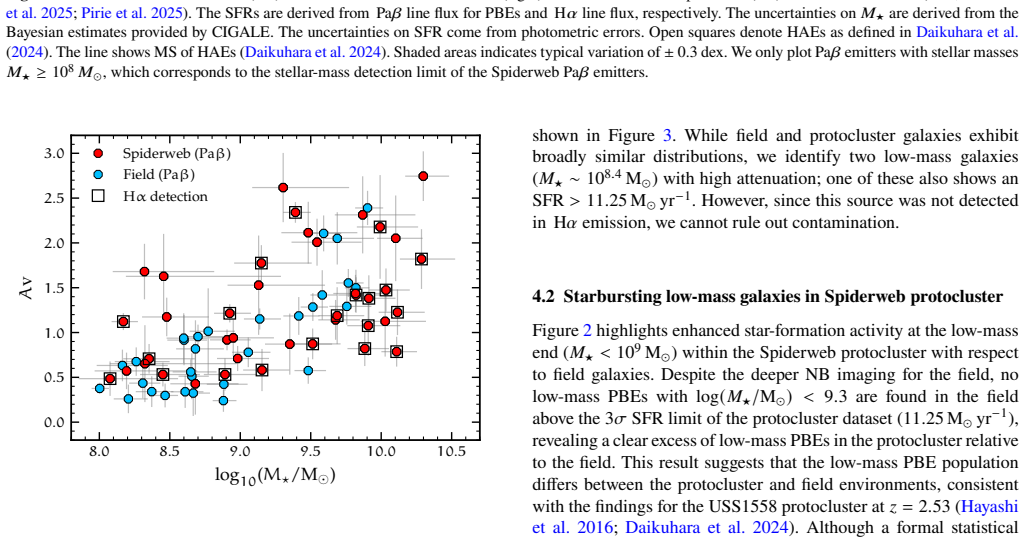
Low-mass Paβ emitters (M⋆ < 10^9 M⊙) in the Spiderweb protocluster exhibit an enhancement in star formation compared to their field counterparts. This excess persists even without applying dust-attenuation corrections. Intermediate- and high-mass Paβ emitters (M⋆ > 10^9 M⊙) show no significant deviation from the field, revealing a strong mass dependence in the environmental effects on star formation. No clear spatial concentration toward the cluster core is seen for the starbursting low-mass galaxies.
What carries the argument
Paβ emission measured through JWST/NIRCam narrow-band imaging, used to derive dust-robust star formation rates for direct comparison between protocluster and field samples.
Load-bearing premise
The chosen field galaxies accurately represent the average population at the same redshift and stellar mass without any special environmental influence.
What would settle it
A new set of Paβ observations in a larger, mass-matched field sample at z=2.16 that shows no star-formation excess relative to the protocluster low-mass galaxies.
Figures


read the original abstract
Understanding the role of the environment in galaxy evolution is key to revealing the physical processes that regulate galaxy growth. We study the star formation activity of \pab\ emitters (PBEs) in the Spiderweb protocluster at $z=2.16$ using \textit{James Webb Space Telescope}/NIRCam narrow-band imaging. To investigate the environmental dependence of star formation, we derive star formation rates (SFRs) from the \pab\ emission line and compare SFRs in the Spiderweb protocluster with those in the field. Our main finding is that low-mass PBEs ($M_\star < 10^9\,M_\odot$) in the Spiderweb protocluster exhibit an enhancement in star formation compared to their field counterparts. This excess persists even without applying dust-attenuation corrections, indicating that enhanced star formation in the protocluster is robust regardless of whether a dust correction is applied. In contrast, intermediate- and high-mass PBEs ($M_\star > 10^9\,M_\odot$) show no significant deviation from the field, revealing a strong mass dependence in the environmental effects on star formation. No clear spatial concentration toward the cluster core of starbursting low-mass galaxies within the protocluster is seen, suggesting that their enhancement is not restricted to the cluster core. We suggest that starbursts in low-mass galaxies are facilitated by environmental processes such as galaxy mergers/interactions, and/or efficient gas supply. While the enhancement at the low-mass end is consistent with trends reported for other protoclusters at similar redshifts, the behaviour of star formation at intermediate masses ($10^{9} < M_\star/M_\odot < 10^{10}$) is not uniform across protoclusters. Our \pab-based results in the Spiderweb protocluster indicate that star-formation enhancement at cosmic noon depends on both mass and the dynamical state of the protocluster.
Editorial analysis
A structured set of objections, weighed in public.
Referee Report
Summary. The manuscript reports JWST/NIRCam narrow-band Paβ imaging of emitters in the Spiderweb protocluster at z=2.16. SFRs are derived from the Paβ line and compared to a field sample. The central claim is that low-mass PBEs (M⋆ < 10^9 M⊙) exhibit enhanced star formation relative to field counterparts, with the excess persisting even in the absence of dust-attenuation corrections; intermediate- and high-mass PBEs show no significant deviation. The authors interpret this mass dependence as evidence for environmental facilitation of starbursts via mergers or gas supply, and note consistency with other z~2 protoclusters at the low-mass end but differences at intermediate masses.
Significance. If the field comparison proves robust, the result would be a useful contribution to studies of environmental effects on galaxy evolution at cosmic noon. The choice of Paβ as a relatively dust-insensitive SFR tracer and the explicit check that the enhancement survives without dust correction are strengths that increase the credibility of the mass-dependent signal. The absence of spatial concentration toward the core further suggests the effect is not confined to the densest regions.
major comments (2)
- [Abstract and main-results paragraph] Abstract and main-results paragraph: the claim of a low-mass SFR enhancement is stated without accompanying sample sizes, statistical significance, error budgets on the SFRs, or completeness limits. These quantitative elements are required to assess whether the reported offset at M⋆ < 10^9 M⊙ is statistically meaningful or could be driven by small-number statistics.
- [Field-sample construction (methods and comparison sections)] Field-sample construction (methods and comparison sections): the manuscript does not specify that the field Paβ-emitter sample was assembled with identical narrow-band selection criteria, depth, redshift distribution, and stellar-mass completeness as the protocluster sample. Without such matching, differential detection thresholds at the low-mass end could produce an apparent excess that is not environmental in origin, directly undermining the central environmental-dependence claim.
minor comments (2)
- [Abstract] The acronym 'PBE' is introduced without an immediate parenthetical expansion; spelling out 'Paβ emitters' on first use would aid readability.
- [Throughout] Notation for stellar mass alternates between M⋆ and M_⋆; consistent use throughout would improve clarity.
Simulated Author's Rebuttal
We thank the referee for their constructive feedback on our manuscript. We address each of the major comments below and have made revisions to the manuscript where necessary to improve clarity and address the concerns raised.
read point-by-point responses
-
Referee: [Abstract and main-results paragraph] Abstract and main-results paragraph: the claim of a low-mass SFR enhancement is stated without accompanying sample sizes, statistical significance, error budgets on the SFRs, or completeness limits. These quantitative elements are required to assess whether the reported offset at M⋆ < 10^9 M⊙ is statistically meaningful or could be driven by small-number statistics.
Authors: We agree that providing these quantitative details is important for assessing the robustness of our findings. In the revised version of the manuscript, we have updated the abstract and the main results paragraph to include the sample sizes for the low-mass Paβ emitters in both the protocluster and field samples. We have also added the statistical significance of the observed SFR enhancement, along with error budgets on the derived SFRs and a discussion of the completeness limits at the low-mass end. These additions allow readers to better evaluate the statistical meaningfulness of the reported offset. revision: yes
-
Referee: [Field-sample construction (methods and comparison sections)] Field-sample construction (methods and comparison sections): the manuscript does not specify that the field Paβ-emitter sample was assembled with identical narrow-band selection criteria, depth, redshift distribution, and stellar-mass completeness as the protocluster sample. Without such matching, differential detection thresholds at the low-mass end could produce an apparent excess that is not environmental in origin, directly undermining the central environmental-dependence claim.
Authors: This is a valid concern regarding potential selection biases. We have revised the methods and comparison sections to explicitly describe the construction of the field sample. The field Paβ-emitter sample was assembled using the same narrow-band selection criteria and depth as the protocluster observations. We have also ensured and now explicitly state that the redshift distribution and stellar-mass completeness are matched between the two samples. This matching was performed to minimize differential detection thresholds, particularly at the low-mass end, thereby supporting that the observed enhancement is environmental in origin rather than a selection artifact. revision: yes
Circularity Check
No circularity: direct observational SFR comparison with no self-referential derivations
full rationale
The paper reports empirical measurements of Paβ-derived SFRs for PBEs in the Spiderweb protocluster at z=2.16 and compares them directly to a field sample. No equations, fitted parameters, or derivations are presented that reduce the reported low-mass enhancement to a self-definition, a renamed fit, or a self-citation chain. The central claim rests on observational data selection and line-flux measurements rather than any internal construction that forces the result. Field-sample representativeness is an external validity concern, not a circularity issue within the derivation chain.
Axiom & Free-Parameter Ledger
axioms (1)
- domain assumption Paβ emission line flux traces instantaneous star formation rate
Lean theorems connected to this paper
-
IndisputableMonolith/Cost/FunctionalEquation.leanwashburn_uniqueness_aczel unclear?
unclearRelation between the paper passage and the cited Recognition theorem.
We derive star formation rates (SFRs) from the Paβ emission line and compare SFRs in the Spiderweb protocluster with those in the field (abstract, §3.3)
What do these tags mean?
- matches
- The paper's claim is directly supported by a theorem in the formal canon.
- supports
- The theorem supports part of the paper's argument, but the paper may add assumptions or extra steps.
- extends
- The paper goes beyond the formal theorem; the theorem is a base layer rather than the whole result.
- uses
- The paper appears to rely on the theorem as machinery.
- contradicts
- The paper's claim conflicts with a theorem or certificate in the canon.
- unclear
- Pith found a possible connection, but the passage is too broad, indirect, or ambiguous to say the theorem truly supports the claim.
Reference graph
Works this paper leans on
-
[1]
The Intriguing Life of Massive Galaxies , year = 2013, editor =
Mahalo-Subaru: Mapping Star Formation at the Peak Epoch of Massive Galaxy Formation. The Intriguing Life of Massive Galaxies , year = 2013, editor =. doi:10.1017/S1743921313004353 , adsurl =
-
[2]
The Star Formation Main Sequence in the Hubble Space Telescope Frontier Fields
The Star Formation Main Sequence in the Hubble Space Telescope Frontier Fields. , keywords =. doi:10.3847/1538-4357/aa8874 , archivePrefix =. 1706.07059 , primaryClass =
work page internal anchor Pith review Pith/arXiv arXiv doi:10.3847/1538-4357/aa8874
-
[3]
Identification of the progenitors of rich clusters and member galaxies in rapid formation at z>2
Identification of the progenitors of rich clusters and member galaxies in rapid formation at z > 2. , keywords =. doi:10.1093/mnrasl/slu029 , archivePrefix =. 1402.3568 , primaryClass =
work page internal anchor Pith review Pith/arXiv arXiv doi:10.1093/mnrasl/slu029
-
[4]
Enhanced Star Formation of Less Massive Galaxies in a Proto-Cluster at z=2.5
Enhanced Star Formation of Less Massive Galaxies in a Protocluster at z = 2.5. , keywords =. doi:10.3847/2041-8205/826/2/L28 , archivePrefix =. 1607.04040 , primaryClass =
work page internal anchor Pith review Pith/arXiv arXiv doi:10.3847/2041-8205/826/2/l28 2041
-
[5]
MAHALO Deep Cluster Survey II. Characterizing massive forming galaxies in the Spiderweb protocluster at z = 2.2. , keywords =. doi:10.1093/mnras/sty2618 , archivePrefix =. 1809.08755 , primaryClass =
work page internal anchor Pith review Pith/arXiv arXiv doi:10.1093/mnras/sty2618
-
[6]
The Dust Content and Opacity of Actively Star-Forming Galaxies
The Dust Content and Opacity of Actively Star-forming Galaxies. , keywords =. doi:10.1086/308692 , archivePrefix =. astro-ph/9911459 , primaryClass =
work page internal anchor Pith review Pith/arXiv arXiv doi:10.1086/308692
-
[7]
Galactic Stellar and Substellar Initial Mass Function
Galactic Stellar and Substellar Initial Mass Function. , keywords =. doi:10.1086/376392 , archivePrefix =. astro-ph/0304382 , primaryClass =
work page internal anchor Pith review Pith/arXiv arXiv doi:10.1086/376392
-
[8]
SExtractor: Software for source extraction. , keywords =. doi:10.1051/aas:1996164 , adsurl =
-
[9]
doi:10.1046/j.1365-8711.2003.06637.x , eprint =
Stellar population synthesis at the resolution of 2003. , keywords =. doi:10.1046/j.1365-8711.2003.06897.x , archivePrefix =. astro-ph/0309134 , primaryClass =
-
[10]
The Environmental Impacts on the Star Formation Main Sequence: An H Study of the Newly Discovered Rich Cluster at z = 1.52. , keywords =. doi:10.1088/0004-637X/789/1/18 , archivePrefix =. 1405.4165 , primaryClass =
work page internal anchor Pith review Pith/arXiv arXiv doi:10.1088/0004-637x/789/1/18
-
[11]
The realm of the galaxy protoclusters
The realm of the galaxy protoclusters. A review. , keywords =. doi:10.1007/s00159-016-0100-3 , archivePrefix =. 1610.05201 , primaryClass =
work page internal anchor Pith review Pith/arXiv arXiv doi:10.1007/s00159-016-0100-3
-
[12]
Massive starburst galaxies in a z=2.16 proto-cluster unveiled by panoramic H-alpha mapping
Massive starburst galaxies in a z = 2.16 proto-cluster unveiled by panoramic H mapping. , keywords =. doi:10.1093/mnras/sts133 , archivePrefix =. 1210.0972 , primaryClass =
work page internal anchor Pith review Pith/arXiv arXiv doi:10.1093/mnras/sts133
-
[13]
The Spiderweb galaxy: a forming massive cluster galaxy at z~2
The Spiderweb Galaxy: A Forming Massive Cluster Galaxy at z -0.5ex 2. , keywords =. doi:10.1086/508534 , archivePrefix =. astro-ph/0610909 , primaryClass =
work page internal anchor Pith review Pith/arXiv arXiv doi:10.1086/508534
-
[14]
The Massive Hosts of Radio Galaxies Across Cosmic Time
The Massive Hosts of Radio Galaxies across Cosmic Time. , keywords =. doi:10.1086/517887 , archivePrefix =. astro-ph/0703224 , primaryClass =
work page internal anchor Pith review Pith/arXiv arXiv doi:10.1086/517887
-
[15]
The GOGREEN Survey: A deep stellar mass function of cluster galaxies at 1.0 < z < 1.4 and the complex nature of satellite quenching. , keywords =. doi:10.1051/0004-6361/202037754 , archivePrefix =. 2004.10757 , primaryClass =
-
[16]
Cosmic Star-Formation History. , keywords =. doi:10.1146/annurev-astro-081811-125615 , archivePrefix =. 1403.0007 , primaryClass =
work page internal anchor Pith review Pith/arXiv arXiv doi:10.1146/annurev-astro-081811-125615
-
[17]
The MOSDEF Survey: Dissecting the Star Formation Rate versus Stellar Mass Relation Using H and H Emission Lines at z 2. , keywords =. doi:10.1088/0004-637X/815/2/98 , archivePrefix =. 1507.03017 , primaryClass =
work page internal anchor Pith review Pith/arXiv arXiv doi:10.1088/0004-637x/815/2/98
-
[18]
The Herschel view of the dominant mode of galaxy growth from z=4 to the present day
The Herschel view of the dominant mode of galaxy growth from z = 4 to the present day. , keywords =. doi:10.1051/0004-6361/201425017 , archivePrefix =. 1409.5433 , primaryClass =
work page internal anchor Pith review Pith/arXiv arXiv doi:10.1051/0004-6361/201425017
-
[19]
The Star-formation Mass Sequence out to z=2.5
The Star Formation Mass Sequence Out to z = 2.5. , keywords =. doi:10.1088/2041-8205/754/2/L29 , archivePrefix =. 1205.0547 , primaryClass =
work page internal anchor Pith review Pith/arXiv arXiv doi:10.1088/2041-8205/754/2/l29 2041
-
[20]
doi:10.1111/j.1365-2966.2005.09107.x , eprint =
Kereš, Dušan and Katz, Neal and Weinberg, David H. and Davé, Romeel , title = ". Monthly Notices of the Royal Astronomical Society , volume =. 2005 , month =. doi:10.1111/j.1365-2966.2005.09451.x , url =
-
[21]
Star Formation in AEGIS Field Galaxies since z=1.1: The Dominance of Gradually Declining Star Formation, and the Main Sequence of Star-forming Galaxies. , keywords =. doi:10.1086/517926 , archivePrefix =. astro-ph/0701924 , primaryClass =
work page internal anchor Pith review Pith/arXiv arXiv doi:10.1086/517926
-
[22]
The physical properties of star-forming galaxies in the low-redshift Universe. , keywords =. doi:10.1111/j.1365-2966.2004.07881.x , archivePrefix =. astro-ph/0311060 , primaryClass =
-
[23]
Multiwavelength Study of Massive Galaxies at z -0.5ex 2. I. Star Formation and Galaxy Growth. , keywords =. doi:10.1086/521818 , archivePrefix =. 0705.2831 , primaryClass =
work page internal anchor Pith review Pith/arXiv arXiv doi:10.1086/521818
-
[24]
The reversal of the star formation-density relation in the distant universe
The reversal of the star formation-density relation in the distant universe. , keywords =. doi:10.1051/0004-6361:20077525 , archivePrefix =. astro-ph/0703653 , primaryClass =
work page internal anchor Pith review Pith/arXiv arXiv doi:10.1051/0004-6361:20077525
-
[25]
UV Star Formation Rates in the Local Universe
UV Star Formation Rates in the Local Universe. , keywords =. doi:10.1086/519218 , archivePrefix =. 0704.3611 , primaryClass =
work page internal anchor Pith review Pith/arXiv arXiv doi:10.1086/519218
-
[26]
A Multi-wavelength View of the Star Formation Activity at z~3
A Multi-wavelength View of the Star Formation Activity at z -0.5ex 3. , keywords =. doi:10.1088/0004-637X/714/2/1740 , archivePrefix =. 1003.5773 , primaryClass =
work page internal anchor Pith review Pith/arXiv arXiv doi:10.1088/0004-637x/714/2/1740
-
[27]
The lesser role of starbursts for star formation at z=2
The Lesser Role of Starbursts in Star Formation at z = 2. , keywords =. doi:10.1088/2041-8205/739/2/L40 , archivePrefix =. 1108.0933 , primaryClass =
work page internal anchor Pith review Pith/arXiv arXiv doi:10.1088/2041-8205/739/2/l40 2041
-
[28]
Constraining the Low-Mass Slope of the Star Formation Sequence at 0.5<z<2.5
Constraining the Low-mass Slope of the Star Formation Sequence at 0.5 < z < 2.5. , keywords =. doi:10.1088/0004-637X/795/2/104 , archivePrefix =. 1407.1843 , primaryClass =
work page internal anchor Pith review Pith/arXiv arXiv doi:10.1088/0004-637x/795/2/104
-
[29]
HerMES: dust attenuation and star formation activity in UV-selected samples from z~4 to z~1.5
HerMES: dust attenuation and star formation activity in ultraviolet-selected samples from z 4 to 1.5. , keywords =. doi:10.1093/mnras/stt1960 , archivePrefix =. 1310.3227 , primaryClass =
work page internal anchor Pith review Pith/arXiv arXiv doi:10.1093/mnras/stt1960
-
[30]
The SFR-M* Relation and Empirical Star-Formation Histories from ZFOURGE at 0.5 < z < 4
The SFR-M* Relation and Empirical Star-Formation Histories from ZFOURGE* at 0.5 < z < 4. , keywords =. doi:10.3847/0004-637X/817/2/118 , archivePrefix =. 1510.06072 , primaryClass =
work page internal anchor Pith review Pith/arXiv arXiv doi:10.3847/0004-637x/817/2/118
-
[31]
The VLA-COSMOS 3 GHz Large Project: Evolution of Specific Star Formation Rates out to z 5. , keywords =. doi:10.3847/1538-4357/aba044 , archivePrefix =. 2006.13937 , primaryClass =
-
[32]
A New Census of the 0.2 < z < 3.0 Universe. II. The Star-forming Sequence. , keywords =. doi:10.3847/1538-4357/ac887d , archivePrefix =. 2110.04314 , primaryClass =
-
[33]
Galaxy Structure and Mode of Star Formation in the SFR-Mass Plane from z ~ 2.5 to z ~ 0.1
Galaxy Structure and Mode of Star Formation in the SFR-Mass Plane from z -0.5ex 2.5 to z -0.5ex 0.1. , keywords =. doi:10.1088/0004-637X/742/2/96 , archivePrefix =. 1107.0317 , primaryClass =
work page internal anchor Pith review Pith/arXiv arXiv doi:10.1088/0004-637x/742/2/96
-
[34]
The SFR-M$_*$ Correlation Extends to Low Mass at High Redshift
The SFR-M _ * Correlation Extends to Low Mass at High Redshift. , keywords =. doi:10.3847/1538-4357/aae0fa , archivePrefix =. 1809.04099 , primaryClass =
work page internal anchor Pith review Pith/arXiv arXiv doi:10.3847/1538-4357/aae0fa
-
[35]
Secondary standard stars for absolute spectrophotometry. , keywords =. doi:10.1086/160817 , adsurl =
-
[36]
Mass and Environment as Drivers of Galaxy Evolution in SDSS and zCOSMOS and the Origin of the Schechter Function. , keywords =. doi:10.1088/0004-637X/721/1/193 , archivePrefix =. 1003.4747 , primaryClass =
work page internal anchor Pith review Pith/arXiv arXiv doi:10.1088/0004-637x/721/1/193
-
[37]
CIGALE: a python Code Investigating GALaxy Emission
CIGALE: a python Code Investigating GALaxy Emission. , keywords =. doi:10.1051/0004-6361/201834156 , archivePrefix =. 1811.03094 , primaryClass =
work page internal anchor Pith review Pith/arXiv arXiv doi:10.1051/0004-6361/201834156
-
[38]
Analysis of galaxy SEDs from far-UV to far-IR with CIGALE: Studying a SINGS test sample
Analysis of galaxy spectral energy distributions from far-UV to far-IR with CIGALE: studying a SINGS test sample. , keywords =. doi:10.1051/0004-6361/200912497 , archivePrefix =. 0909.5439 , primaryClass =
work page internal anchor Pith review Pith/arXiv arXiv doi:10.1051/0004-6361/200912497
-
[39]
doi:10.1111/j.1365-2966.2005.09107.x , eprint =
Star formation and dust attenuation properties in galaxies from a statistical ultraviolet-to-far-infrared analysis. , keywords =. doi:10.1111/j.1365-2966.2005.09131.x , archivePrefix =. astro-ph/0504434 , primaryClass =
-
[40]
Correlation between star formation activity and electron density of ionized gas at z=2.5
Correlation between star formation activity and electron density of ionized gas at z = 2.5. , keywords =. doi:10.1093/mnras/stv915 , archivePrefix =. 1411.1408 , primaryClass =
work page internal anchor Pith review Pith/arXiv arXiv doi:10.1093/mnras/stv915
-
[41]
Astropy: A Community Python Package for Astronomy
doi:10.1051/0004-6361/201322068 , Eid =. arXiv , Author =:1307.6212 , Journal =
work page internal anchor Pith review Pith/arXiv arXiv doi:10.1051/0004-6361/201322068
-
[42]
The Astropy Project: Building an inclusive, open-science project and status of the v2.0 core package
The Astropy Project: Building an Open-science Project and Status of the v2.0 Core Package. , keywords =. doi:10.3847/1538-3881/aabc4f , archivePrefix =. 1801.02634 , primaryClass =
work page internal anchor Pith review Pith/arXiv arXiv doi:10.3847/1538-3881/aabc4f
-
[43]
The Astropy Project: Sustaining and Growing a Community-oriented Open-source Project and the Latest Major Release (v5.0) of the Core Package. apj , keywords =. doi:10.3847/1538-4357/ac7c74 , archivePrefix =. 2206.14220 , primaryClass =
work page internal anchor Pith review Pith/arXiv arXiv doi:10.3847/1538-4357/ac7c74
-
[44]
COSMOS2020: A Panchromatic View of the Universe to z 10 from Two Complementary Catalogs. , keywords =. doi:10.3847/1538-4365/ac3078 , archivePrefix =. 2110.13923 , primaryClass =
-
[45]
Forming intracluster gas in a galaxy protocluster at a redshift of 2.16. , keywords =. doi:10.1038/s41586-023-05761-x , archivePrefix =. 2303.16226 , primaryClass =
-
[46]
New Insight on Galaxy Formation and Evolution from Keck Spectroscopy of the Hawaii Deep Fields
New Insight on Galaxy Formation and Evolution From Keck Spectroscopy of the Hawaii Deep Fields. , keywords =. doi:10.1086/118058 , archivePrefix =. astro-ph/9606079 , primaryClass =
work page internal anchor Pith review Pith/arXiv arXiv doi:10.1086/118058
-
[47]
Down-sizing in galaxy formation at z -0.5ex 1 in the Subaru/XMM-Newton Deep Survey (SXDS). , keywords =. doi:10.1111/j.1365-2966.2004.07711.x , archivePrefix =. astro-ph/0402276 , primaryClass =
-
[48]
A large H survey at z = 2.23, 1.47, 0.84 and 0.40: the 11 Gyr evolution of star-forming galaxies from HiZELS★. , keywords =. doi:10.1093/mnras/sts096 , archivePrefix =. 1202.3436 , primaryClass =
work page internal anchor Pith review Pith/arXiv arXiv doi:10.1093/mnras/sts096
-
[49]
Enhancement of AGN in a protocluster at z=1.6
Enhancement of AGN in a protocluster at z = 1.6. , keywords =. doi:10.1093/mnras/stx1315 , archivePrefix =. 1705.10799 , primaryClass =
work page internal anchor Pith review Pith/arXiv arXiv doi:10.1093/mnras/stx1315
-
[50]
Concurrent Supermassive Black Hole and Galaxy Growth: Linking Environment and Nuclear Activity in z = 2.23 H Emitters. , keywords =. doi:10.1088/0004-637X/765/2/87 , archivePrefix =. 1301.3922 , primaryClass =
work page internal anchor Pith review Pith/arXiv arXiv doi:10.1088/0004-637x/765/2/87
-
[51]
Excess AGN activity in the z = 2.30 Protocluster in HS 1700+64. , keywords =. doi:10.1111/j.1365-2966.2010.16977.x , archivePrefix =. 1005.1833 , primaryClass =
-
[52]
Starbursts from the Strong Compression of Galactic Molecular Clouds due to the High Pressure of the Intracluster Medium. , keywords =. doi:10.1086/379054 , archivePrefix =. astro-ph/0308264 , primaryClass =
work page internal anchor Pith review Pith/arXiv arXiv doi:10.1086/379054
-
[53]
Charles R. Harris and K. Jarrod Millman and St. Array programming with. 2020 , month = sep, journal =. doi:10.1038/s41586-020-2649-2 , publisher =
-
[54]
astropy/photutils: 1.8.0 , month = may, year = 2023, publisher =
Larry Bradley and Brigitta Sip. astropy/photutils: 1.8.0 , month = may, year = 2023, publisher =. doi:10.5281/zenodo.7946442 , url =
-
[55]
Virtanen, Pauli and Gommers, Ralf and Oliphant, Travis E. and Haberland, Matt and Reddy, Tyler and Cournapeau, David and Burovski, Evgeni and Peterson, Pearu and Weckesser, Warren and Bright, Jonathan and. Nature Methods , year =
-
[56]
Spectroscopic observations of PHz G237.01+42.50: A galaxy protocluster at z = 2.16 in the Cosmos field. , keywords =. doi:10.1051/0004-6361/202140612 , archivePrefix =. 2109.04396 , primaryClass =
-
[57]
Signs of environmental effects on star-forming galaxies in the Spiderweb protocluster at z = 2.16. , keywords =. doi:10.1093/mnras/stac2784 , archivePrefix =. 2209.13069 , primaryClass =
-
[58]
Accelerated Galaxy Growth and Environmental Quenching in a Protocluster at z = 3.24. , keywords =. doi:10.3847/1538-4357/abe62e , archivePrefix =. 2102.06499 , primaryClass =
-
[59]
Evidence for Gas-phase Metal Deficiency in Massive Protocluster Galaxies at z 2.2. , keywords =. doi:10.3847/1538-4357/abe5a3 , archivePrefix =. 2102.05637 , primaryClass =
-
[60]
The VIMOS Ultra Deep Survey: The reversal of the star-formation rate - density relation at 2 < z < 5. , keywords =. doi:10.1051/0004-6361/202039346 , archivePrefix =. 2009.03324 , primaryClass =
-
[61]
On the Nature of AGN and Star Formation Enhancement in the z = 3.1 SSA22 Protocluster: The HST WFC3 IR View. , keywords =. doi:10.3847/1538-4357/ac0f84 , archivePrefix =. 2106.13846 , primaryClass =
-
[62]
The evolution of dust-obscured star formation activity in galaxy clusters relative to the field over the last 9 billion years. , keywords =. doi:10.1093/mnras/stt1897 , archivePrefix =. 1310.6040 , primaryClass =
work page internal anchor Pith review Pith/arXiv arXiv doi:10.1093/mnras/stt1897
-
[63]
The 700 ks Chandra Spiderweb Field. II. Evidence for inverse-Compton and thermal diffuse emission in the Spiderweb galaxy. , keywords =. doi:10.1051/0004-6361/202244337 , archivePrefix =. 2209.15467 , primaryClass =
-
[64]
On Near-Infrared H-Alpha Searches for High-Redshift Galaxies
On near-infrared H&alpha searches for high-redshift galaxies. , keywords =. doi:10.1093/mnras/273.2.513 , archivePrefix =. astro-ph/9501026 , primaryClass =
work page internal anchor Pith review Pith/arXiv arXiv doi:10.1093/mnras/273.2.513
-
[65]
An excess of dusty starbursts related to the Spiderweb galaxy
An excess of dusty starbursts related to the Spiderweb galaxy. , keywords =. doi:10.1051/0004-6361/201423771 , archivePrefix =. 1410.3730 , primaryClass =
work page internal anchor Pith review Pith/arXiv arXiv doi:10.1051/0004-6361/201423771
-
[66]
Galaxy Merger Fractions in Two Clusters at $z\sim2$ Using the Hubble Space Telescope
Galaxy Merger Fractions in Two Clusters at z 2 Using the Hubble Space Telescope. , keywords =. doi:10.3847/1538-4357/ab06ef , archivePrefix =. 1902.07225 , primaryClass =
work page internal anchor Pith review Pith/arXiv arXiv doi:10.3847/1538-4357/ab06ef 1902
-
[67]
Caught in the Act: The Assembly of Massive Cluster Galaxies at z = 1.62. , keywords =. doi:10.1088/0004-637X/773/2/154 , adsurl =
-
[68]
Merger driven star-formation activity in Cl J1449+0856 at z=1.99 as seen by ALMA and JVLA
Merger-driven star formation activity in Cl J1449+0856 at z = 1.99 as seen by ALMA and JVLA. , keywords =. doi:10.1093/mnras/sty1446 , archivePrefix =. 1805.09789 , primaryClass =
work page internal anchor Pith review Pith/arXiv arXiv doi:10.1093/mnras/sty1446
-
[69]
An enhanced merger fraction within the galaxy population of the SSA22 protocluster at z ~ 3.1
An enhanced merger fraction within the galaxy population of the SSA22 protocluster at z = 3.1. , keywords =. doi:10.1093/mnras/stv2448 , archivePrefix =. 1506.05115 , primaryClass =
work page internal anchor Pith review Pith/arXiv arXiv doi:10.1093/mnras/stv2448
-
[70]
What boost galaxy mergers in two massive galaxy protoclusters at z = 2.24?. , keywords =. doi:10.1093/mnras/stad1543 , archivePrefix =. 2305.10932 , primaryClass =
-
[71]
Galaxy Merger Candidates in High-Redshift Cluster Environments
Galaxy Merger Candidates in High-redshift Cluster Environments. , keywords =. doi:10.3847/1538-4357/aa756a , archivePrefix =. 1705.10849 , primaryClass =
work page internal anchor Pith review Pith/arXiv arXiv doi:10.3847/1538-4357/aa756a
-
[72]
JWST catches the assembly of a z 5 ultra-low-mass galaxy. , keywords =. doi:10.1093/mnrasl/slad054 , archivePrefix =. 2212.07540 , primaryClass =
-
[73]
The COSMOS2015 galaxy stellar mass function . Thirteen billion years of stellar mass assembly in ten snapshots. , keywords =. doi:10.1051/0004-6361/201730419 , archivePrefix =. 1701.02734 , primaryClass =
work page internal anchor Pith review Pith/arXiv arXiv doi:10.1051/0004-6361/201730419
-
[74]
Mass assembly in quiescent and star-forming galaxies since z=4 from UltraVISTA
Mass assembly in quiescent and star-forming galaxies since z ≃ 4 from UltraVISTA. , keywords =. doi:10.1051/0004-6361/201321100 , archivePrefix =. 1301.3157 , primaryClass =
work page internal anchor Pith review Pith/arXiv arXiv doi:10.1051/0004-6361/201321100
-
[75]
Spitzer Bright, UltraVISTA Faint Sources in COSMOS: The Contribution to the Overall Population of Massive Galaxies at z = 3-7. , keywords =. doi:10.1088/0004-637X/810/1/73 , archivePrefix =. 1505.05721 , primaryClass =
work page internal anchor Pith review Pith/arXiv arXiv doi:10.1088/0004-637x/810/1/73
-
[76]
The galaxy stellar mass function at 3.5<z<7.5 in the CANDELS/UDS, GOODS-South, and HUDF fields
The galaxy stellar mass function at 3.5 z 7.5 in the CANDELS/UDS, GOODS-South, and HUDF fields. , keywords =. doi:10.1051/0004-6361/201424750 , archivePrefix =. 1412.0532 , primaryClass =
work page internal anchor Pith review Pith/arXiv arXiv doi:10.1051/0004-6361/201424750
-
[77]
Environmental impacts on the rest-frame UV size and morphology ofstar-forming galaxies at z 2. arXiv e-prints , keywords =. doi:10.48550/arXiv.2309.15450 , archivePrefix =. 2309.15450 , primaryClass =
-
[78]
Enhanced star formation and metallicity deficit in the USS 1558-003 forming protocluster at z = 2.53. , keywords =. doi:10.1093/mnras/stad3805 , archivePrefix =. 2312.03574 , primaryClass =
-
[79]
A Survey of Star-Forming Galaxies in the z=1.4-2.5 `Redshift Desert': Overview
A Survey of Star-forming Galaxies in the 1.4< -0.5ex < -0.5ex 2.5 Redshift Desert: Overview. , keywords =. doi:10.1086/381960 , archivePrefix =. astro-ph/0401439 , primaryClass =
work page internal anchor Pith review Pith/arXiv arXiv doi:10.1086/381960
-
[80]
Spectroscopic Identification of a Protocluster at z=2.300: Environmental Dependence of Galaxy Properties at High Redshift. , keywords =. doi:10.1086/429989 , archivePrefix =. astro-ph/0502432 , primaryClass =
work page internal anchor Pith review Pith/arXiv arXiv doi:10.1086/429989
discussion (0)
Sign in with ORCID, Apple, or X to comment. Anyone can read and Pith papers without signing in.