Efficient Transferable Optimal Transport via Min-Sliced Transport Plans
Pith reviewed 2026-05-21 17:55 UTC · model grok-4.3
The pith
A slicer optimized for one distribution pair stays effective for nearby pairs under small perturbations.
A machine-rendered reading of the paper's core claim, the machinery that carries it, and where it could break.
Core claim
The central claim is that optimized slicers in the min-STP framework remain close under slight perturbations of the data distributions. This closeness lets a slicer trained on one pair produce effective conditional transport plans for new but related pairs. The paper further introduces a minibatch formulation of min-STP together with statistical guarantees on its accuracy and demonstrates strong empirical performance on point-cloud alignment and flow-based generative modeling.
What carries the argument
The min-Sliced Transport Plan (min-STP), which selects a single one-dimensional projection that minimizes the full-dimensional transport cost via closed-form 1D solutions.
If this is right
- Optimized slicers transfer across related tasks without retraining.
- Minibatch min-STP retains statistical accuracy guarantees.
- One-shot matching becomes practical for point-cloud and multimodal alignment.
- Amortized training is enabled for flow-based generative models.
Where Pith is reading between the lines
- In streaming or sequential settings, infrequent slicer updates could replace per-step full optimization.
- The same transfer argument may apply to other projection-based methods outside optimal transport.
- For larger shifts a hybrid schedule of occasional full retraining plus transfer could be tested directly.
Load-bearing premise
New distribution pairs are only slightly perturbed versions of the original training pair.
What would settle it
Compare the transport cost or matching accuracy of a transferred slicer versus a freshly optimized slicer on pairs whose Wasserstein distance from the training pair is gradually increased; a rapid deterioration would falsify the transfer guarantee.
Figures




read the original abstract
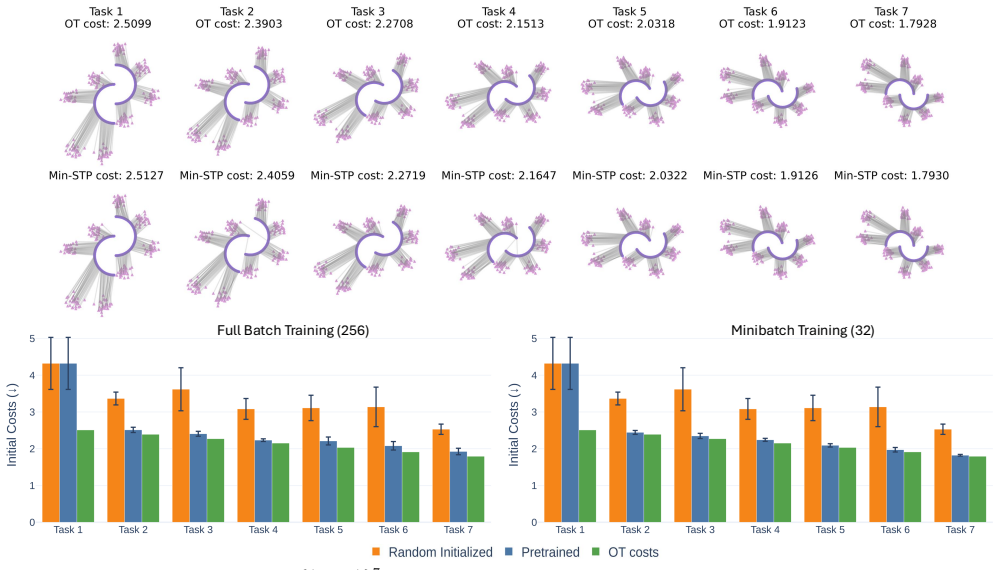
Optimal Transport (OT) offers a powerful framework for finding correspondences between distributions and addressing matching and alignment problems in various areas of computer vision, including shape analysis, image generation, and multimodal tasks. The computation cost of OT, however, hinders its scalability. Slice-based transport plans have recently shown promise for reducing the computational cost by leveraging the closed-form solutions of 1D OT problems. These methods optimize a one-dimensional projection (slice) to obtain a conditional transport plan that minimizes the transport cost in the ambient space. While efficient, these methods leave open the question of whether learned optimal slicers can transfer to new distribution pairs under distributional shift. Understanding this transferability is crucial in settings with evolving data or repeated OT computations across closely related distributions. In this paper, we study the min-Sliced Transport Plan (min-STP) framework and investigate the transferability of optimized slicers: can a slicer trained on one distribution pair yield effective transport plans for new, unseen pairs? Theoretically, we show that optimized slicers remain close under slight perturbations of the data distributions, enabling efficient transfer across related tasks. To further improve scalability, we introduce a minibatch formulation of min-STP and provide statistical guarantees on its accuracy. Empirically, we demonstrate that the transferable min-STP achieves strong one-shot matching performance and facilitates amortized training for point cloud alignment and flow-based generative modeling.
Editorial analysis
A structured set of objections, weighed in public.
Referee Report
Summary. The paper studies the min-Sliced Transport Plan (min-STP) framework for scalable optimal transport. It claims that slicers optimized on one distribution pair remain close under small perturbations of the input distributions, thereby enabling transfer of the resulting conditional transport plans to new, related pairs without re-optimization. A minibatch formulation is introduced together with statistical accuracy guarantees, and experiments demonstrate competitive one-shot matching performance on point-cloud alignment and amortized flow-based generative modeling tasks.
Significance. If the transferability result holds with a quantitative link to excess transport cost, the work would provide a practical route to amortized OT computation in computer vision pipelines that repeatedly solve related matching problems. The combination of a perturbation-based continuity argument with a minibatch implementation directly targets the scalability bottleneck of classical OT.
major comments (1)
- [Theoretical analysis] Theoretical section on slicer transferability: the manuscript establishes closeness of optimized slicers under distributional perturbations but does not supply a quantitative bound relating slicer perturbation size to the excess cost of the induced min-STP relative to the true OT optimum on the perturbed pair. Without this link, the claim that transferred slicers yield effective (near-optimal) transport plans remains incomplete even for small shifts.
minor comments (2)
- [Preliminaries] Notation for the conditional transport plan and its cost should be introduced once and used consistently; the current presentation occasionally redefines symbols across sections.
- [Minibatch formulation] The minibatch statistical guarantee would benefit from an explicit statement of the dependence on batch size and number of slices in the main theorem statement rather than only in the appendix.
Simulated Author's Rebuttal
We thank the referee for the constructive feedback on our work. We address the single major comment below and indicate the planned revisions.
read point-by-point responses
-
Referee: [Theoretical analysis] Theoretical section on slicer transferability: the manuscript establishes closeness of optimized slicers under distributional perturbations but does not supply a quantitative bound relating slicer perturbation size to the excess cost of the induced min-STP relative to the true OT optimum on the perturbed pair. Without this link, the claim that transferred slicers yield effective (near-optimal) transport plans remains incomplete even for small shifts.
Authors: We appreciate the referee pointing out this gap in the theoretical development. The manuscript proves that the slicers minimizing the min-STP objective remain close (in a suitable metric on the space of projections) when the underlying distribution pair is perturbed by a small amount in Wasserstein distance; this is stated as a continuity result for the argmin of the sliced objective. While this closeness is used to argue that the induced conditional transport plans can be transferred, we indeed stop short of supplying an explicit quantitative inequality that bounds the excess transport cost of the transferred min-STP relative to the true OT optimum on the perturbed pair. Such a bound would make the effectiveness claim fully rigorous even for small shifts. We agree that the current argument is therefore incomplete on this point. In the revised version we will add a new corollary that relates the slicer perturbation size to the excess cost via the Lipschitz continuity of the 1D transport cost and the definition of the min-STP objective, thereby closing the link the referee requests. revision: yes
Circularity Check
Theoretical perturbation analysis is self-contained and independent of fitted inputs
full rationale
The paper derives a theoretical result showing that optimized slicers remain close under slight perturbations of the data distributions, which is presented as a perturbation analysis enabling transfer. No equations or claims in the provided abstract reduce this result to a self-definition, a fitted parameter renamed as a prediction, or a load-bearing self-citation whose validity depends on the current work. The minibatch formulation is accompanied by separate statistical guarantees, and empirical results on point cloud alignment and generative modeling provide external checks. The derivation chain therefore stands on independent mathematical content rather than collapsing to its own inputs by construction.
Axiom & Free-Parameter Ledger
axioms (1)
- standard math Standard assumptions of optimal transport theory including existence of transport plans and finite costs
Lean theorems connected to this paper
-
IndisputableMonolith/Foundation/BranchSelection.leanbranch_selection unclear?
unclearRelation between the paper passage and the cited Recognition theorem.
min-STP p(μ, ν) = min f∈F STP p(μ, ν; f)
What do these tags mean?
- matches
- The paper's claim is directly supported by a theorem in the formal canon.
- supports
- The theorem supports part of the paper's argument, but the paper may add assumptions or extra steps.
- extends
- The paper goes beyond the formal theorem; the theorem is a base layer rather than the whole result.
- uses
- The paper appears to rely on the theorem as machinery.
- contradicts
- The paper's claim conflicts with a theorem or certificate in the canon.
- unclear
- Pith found a possible connection, but the passage is too broad, indirect, or ambiguous to say the theorem truly supports the claim.
Forward citations
Cited by 3 Pith papers
-
ASAP: Amortized Doubly-Stochastic Attention via Sliced Dual Projection
ASAP amortizes Sinkhorn-based doubly-stochastic attention by learning a parametric map from 1D potentials to the Sinkhorn dual and reconstructing the plan via two-sided entropic c-transform, delivering 5.3x faster inf...
-
Generative Transfer for Entropic Optimal Transport with Unknown Costs
A generative transfer framework using iterative path-wise tilting integrated with conditional flow matching recovers target entropic optimal transport couplings from reference samples, achieving O(δ) convergence in Wa...
-
Sliced Inner Product Gromov-Wasserstein Distances
A sliced IGW distance is introduced with closed-form 1D expressions, rotational invariance, and studied structural and computational properties for efficient data alignment.
discussion (0)
Sign in with ORCID, Apple, or X to comment. Anyone can read and Pith papers without signing in.