Forward-modelling the Tolman and distance-duality tests with IllustrisTNG
Pith reviewed 2026-06-26 03:48 UTC · model grok-4.3
The pith
The IllustrisTNG simulation shows that standard galaxy evolution explains the signals from the Tolman and distance-duality tests.
A machine-rendered reading of the paper's core claim, the machinery that carries it, and where it could break.
Core claim
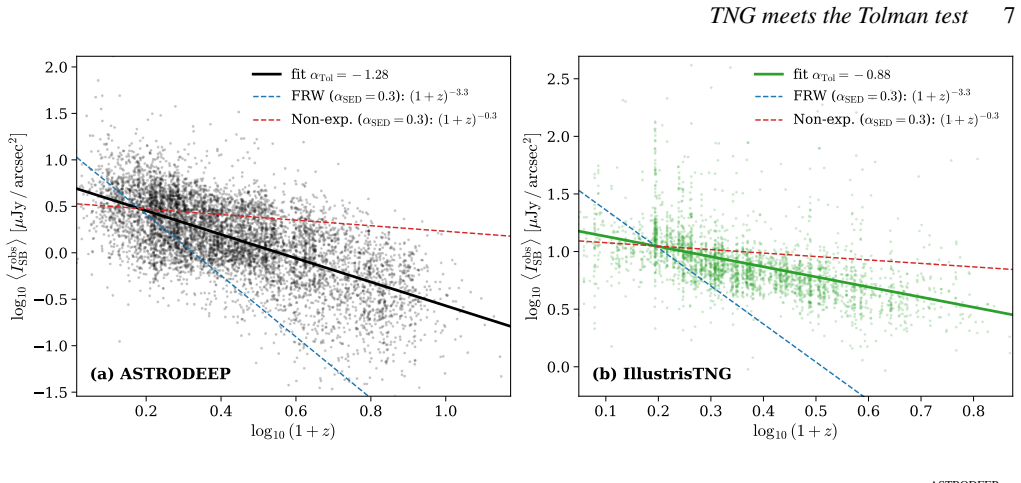
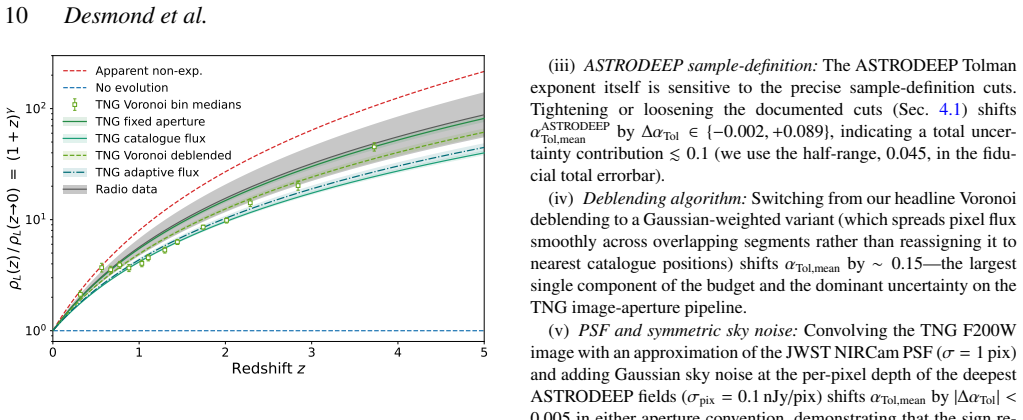
The astrophysical evolution relevant for both tests may be effectively parametrised as a single power-law exponent for the luminosity density as a function of redshift, for which the simulation gives γ=2.23±0.20 across realistic aperture conventions. This value is approximately sufficient to explain both the Tolman and distance-duality signals within standard cosmology and galaxy formation physics, with a small discrepancy for the latter suggesting that radio AGN evolve slightly more strongly than bright galaxies.
What carries the argument
The single power-law exponent γ for luminosity density evolution versus redshift, obtained by forward-modelling surface-brightness and angular-size measurements inside IllustrisTNG with an empirical mock selection.
If this is right
- The Tolman surface-brightness signal is reproduced by the simulated evolution without extra physics.
- The distance-duality relation is reproduced to within a small offset attributable to stronger evolution of radio AGN.
- Neither test requires departures from metric gravity or photon-number conservation.
- Galaxy-formation physics already encoded in hydrodynamical simulations is sufficient to account for these particular distance probes.
Where Pith is reading between the lines
- A dedicated simulation run focused on radio AGN populations could test whether their evolution alone removes the residual distance-duality offset.
- Repeating the forward model on other hydrodynamical simulations would show how sensitive the recovered γ is to sub-grid physics choices.
- The same luminosity-density parametrization could be applied to other surface-brightness or angular-size cosmological tests to check consistency.
Load-bearing premise
The IllustrisTNG simulation and the empirical mock selection accurately capture the luminosity density evolution that affects surface-brightness and angular-size measurements in the specific observed samples.
What would settle it
A direct measurement of the luminosity-density power-law index in the exact galaxy populations used for the Tolman and radio-source samples that differs substantially from 2.23 would falsify the explanation.
Figures


read the original abstract
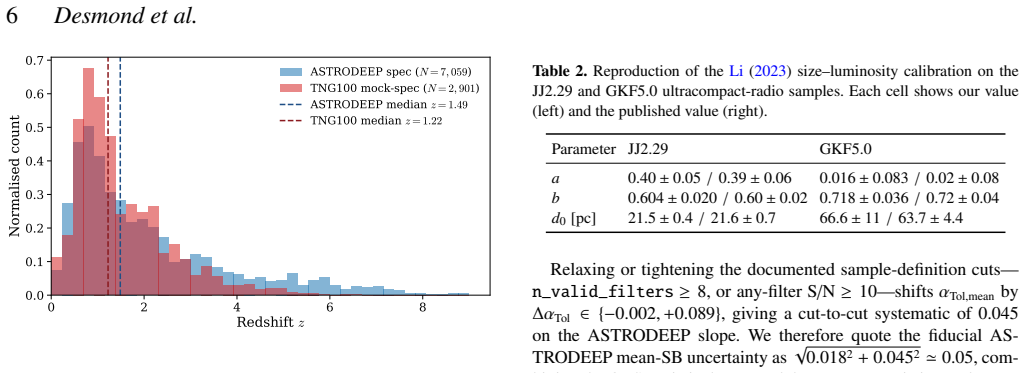
The Tolman surface-brightness test and the angular-size distance-duality test are two complementary probes of the same underlying relation between luminosity and angular-diameter distance, $D_L = (1+z)^2 D_A$, as holds in any metric theory of gravity where photon number is conserved. Both tests have recently delivered a priori surprising signals: JWST/ASTRODEEP measurements yield a surface brightness scaling with redshift much flatter than the expected value, and ultracompact radio sources also appear to follow a flatter $D_L/D_A$ scaling with redshift. These results have been suggested to support non-expanding cosmologies, however they are also sensitive to astrophysical and instrumental effects. We test whether these results indicate genuine departures from standard cosmology by forward-modelling observed surface-brightness evolution in the IllustrisTNG cosmological hydrodynamical simulation, with an empirical mock-spectroscopic selection trained on ASTRODEEP. We show that the astrophysical evolution relevant for both tests may be effectively parametrised as a single power-law exponent for the luminosity density as a function of redshift, for which the simulation gives $\gamma=2.23\pm0.20$ across realistic aperture conventions. This value is approximately sufficient to explain both the Tolman and distance-duality signals within standard cosmology and galaxy formation physics, with a small discrepancy for the latter suggesting that radio AGN evolve slightly more strongly than bright galaxies.
Editorial analysis
A structured set of objections, weighed in public.
Referee Report
Summary. The paper forward-models the Tolman surface-brightness test and angular-size distance-duality test using the IllustrisTNG hydrodynamical simulation combined with an empirical mock selection trained on ASTRODEEP data. It extracts a single power-law exponent γ = 2.23 ± 0.20 for luminosity-density evolution as a function of redshift, valid across realistic apertures, and claims this value is approximately sufficient to reproduce the observed signals within standard cosmology and galaxy formation, with a small residual discrepancy for the radio AGN sample.
Significance. If the central result holds, the work demonstrates that apparent anomalies in two independent cosmological tests can be accounted for by astrophysical evolution of luminosity density in a standard ΛCDM framework, reducing the need to invoke non-metric gravity or photon non-conservation. The forward-modeling approach with a hydrodynamical simulation provides a concrete, falsifiable link between galaxy-formation physics and the observed scalings.
major comments (3)
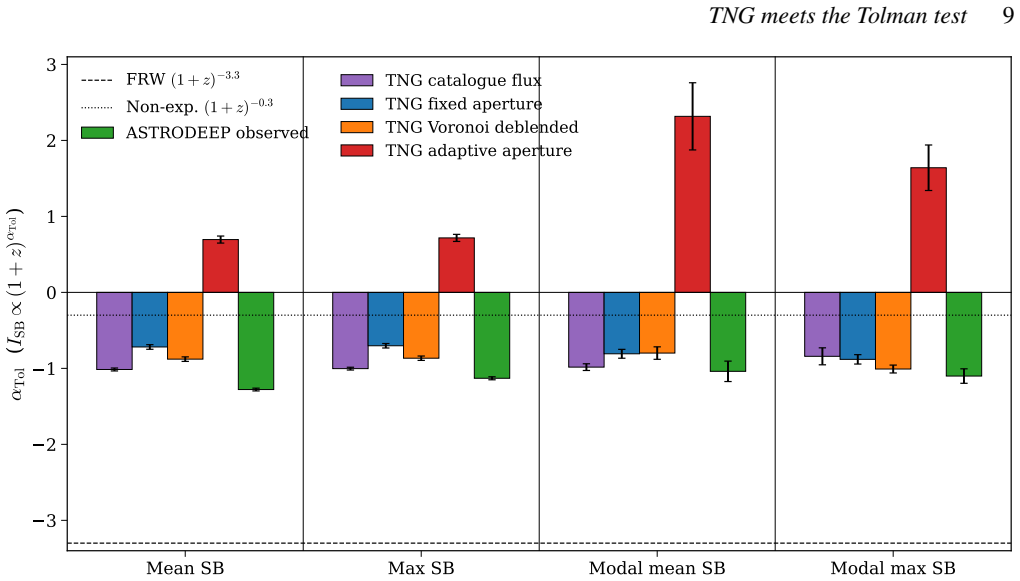
- [Abstract and methods] The abstract states that γ = 2.23 ± 0.20 is obtained 'across realistic aperture conventions,' but the manuscript provides no explicit definition or table of the aperture radii, surface-brightness measurement procedures, or robustness tests against aperture choice; this directly affects whether the extracted γ can be compared to the JWST/ASTRODEEP and radio-source data.
- [Methods] The training and validation of the ASTRODEEP-trained mock-spectroscopic selection function are not described with quantitative metrics (e.g., completeness, redshift-dependent selection efficiency, or comparison of simulated vs. observed luminosity functions); without these, it is impossible to assess whether the weakest assumption—that the simulation plus selection accurately captures the relevant luminosity-density evolution—is satisfied.
- [Results] The claim that γ is 'approximately sufficient' to explain both signals is stated without a direct quantitative comparison (predicted vs. observed surface-brightness or D_L/D_A scaling, including error propagation or goodness-of-fit statistic) in the results; the small discrepancy noted for the radio sample therefore cannot be evaluated for statistical significance.
minor comments (2)
- [Introduction] Notation for the luminosity-density power-law exponent should be introduced with an explicit equation (e.g., ρ_L(z) ∝ (1+z)^γ) at first use rather than only in the abstract.
- [Figures] Figure captions should explicitly state the aperture convention and selection cuts applied to each panel to allow readers to connect the plotted quantities to the γ value.
Simulated Author's Rebuttal
We thank the referee for the constructive comments, which highlight areas where additional detail will strengthen the manuscript. We address each major comment below and will incorporate revisions as indicated.
read point-by-point responses
-
Referee: [Abstract and methods] The abstract states that γ = 2.23 ± 0.20 is obtained 'across realistic aperture conventions,' but the manuscript provides no explicit definition or table of the aperture radii, surface-brightness measurement procedures, or robustness tests against aperture choice; this directly affects whether the extracted γ can be compared to the JWST/ASTRODEEP and radio-source data.
Authors: We agree that explicit documentation of aperture conventions is required for reproducibility. The methods section describes the use of multiple realistic apertures drawn from the simulation outputs and ASTRODEEP training, but does not tabulate the exact radii or include dedicated robustness tests. In revision we will add a table of aperture radii, a step-by-step description of the surface-brightness measurement procedure, and a short subsection demonstrating that the recovered γ remains consistent (within the quoted ±0.20) across the tested apertures. revision: yes
-
Referee: [Methods] The training and validation of the ASTRODEEP-trained mock-spectroscopic selection function are not described with quantitative metrics (e.g., completeness, redshift-dependent selection efficiency, or comparison of simulated vs. observed luminosity functions); without these, it is impossible to assess whether the weakest assumption—that the simulation plus selection accurately captures the relevant luminosity-density evolution—is satisfied.
Authors: The manuscript outlines the empirical training procedure on ASTRODEEP but omits quantitative validation statistics. We will revise the methods section to include completeness as a function of redshift and magnitude, redshift-dependent selection efficiency curves, and direct comparisons of the simulated versus observed luminosity functions in the relevant bands. These additions will allow readers to evaluate the fidelity of the mock selection. revision: yes
-
Referee: [Results] The claim that γ is 'approximately sufficient' to explain both signals is stated without a direct quantitative comparison (predicted vs. observed surface-brightness or D_L/D_A scaling, including error propagation or goodness-of-fit statistic) in the results; the small discrepancy noted for the radio sample therefore cannot be evaluated for statistical significance.
Authors: The forward-modeling results are used to derive γ and the abstract states that this value is approximately sufficient, but the results section does not present a side-by-side predicted-versus-observed comparison with propagated uncertainties or a goodness-of-fit metric. We will add this quantitative comparison (including χ² or equivalent statistic) for both the Tolman and distance-duality signals, allowing the residual discrepancy for the radio AGN sample to be assessed for statistical significance. revision: yes
Circularity Check
No significant circularity; derivation is self-contained
full rationale
The paper extracts the single power-law exponent γ = 2.23 ± 0.20 for luminosity-density evolution directly from the IllustrisTNG simulation under an empirical mock selection trained on ASTRODEEP. This γ is then used to forward-model the expected Tolman surface-brightness and distance-duality signals, which are compared to external observations. The central result does not reduce to a fit of the test data itself, nor does any step rely on self-definition, renaming of known results, or load-bearing self-citations whose content is unverified. The modelling targets the astrophysical evolution as an independent input from the simulation, making the comparison falsifiable against the observed signals.
Axiom & Free-Parameter Ledger
free parameters (1)
- luminosity density power-law exponent γ =
2.23 ± 0.20
axioms (1)
- domain assumption IllustrisTNG hydrodynamical simulation accurately models the evolution of galaxy luminosity density, surface brightness, and angular sizes relevant to the Tolman and distance-duality tests.
Reference graph
Works this paper leans on
-
[1]
Bassett B. A., Kunz M., 2004, @doi [ ] 10.1103/PhysRevD.69.101305 , https://ui.adsabs.harvard.edu/abs/2004PhRvD..69j1305B 69, 101305
-
[2]
Bertin E., Arnouts S., 1996, @doi [ ] 10.1051/aas:1996164 , https://ui.adsabs.harvard.edu/abs/1996A&AS..117..393B 117, 393
-
[3]
Cao S., Biesiada M., Jackson J., Zheng X., Zhao Y., Zhu Z.-H., 2017, @doi [ ] 10.1088/1475-7516/2017/02/012 , https://ui.adsabs.harvard.edu/abs/2017JCAP...02..012C 2017, 012
-
[4]
Conselice C. J., Copeland E. J., Sevillano Mu \ n oz S., 2026, @doi [arXiv e-prints] 10.48550/arXiv.2603.17842 , https://ui.adsabs.harvard.edu/abs/2026arXiv260317842C p. arXiv:2603.17842
-
[5]
Donnari M., et al., 2019, @doi [ ] 10.1093/mnras/stz712 , https://ui.adsabs.harvard.edu/abs/2019MNRAS.485.4817D 485, 4817
-
[6]
Ellis G. F. R., 2007, @doi [General Relativity and Gravitation] 10.1007/s10714-006-0355-5 , https://ui.adsabs.harvard.edu/abs/2007GReGr..39.1047E 39, 1047
-
[7]
Etherington I. M. H., 1933, Philosophical Magazine, https://ui.adsabs.harvard.edu/abs/1933PMag...15..761E 15, 761
1933
-
[8]
Fagioli M., et al., 2018, @doi [ ] 10.1088/1475-7516/2018/11/015 , https://ui.adsabs.harvard.edu/abs/2018JCAP...11..015F 2018, 015
-
[9]
Fagioli M., Tortorelli L., Herbel J., Z \"u rcher D., Refregier A., Amara A., 2020, @doi [ ] 10.1088/1475-7516/2020/06/050 , https://ui.adsabs.harvard.edu/abs/2020JCAP...06..050F 2020, 050
-
[10]
Genel S., et al., 2018, @doi [ ] 10.1093/mnras/stx3078 , https://ui.adsabs.harvard.edu/abs/2018MNRAS.474.3976G 474, 3976
-
[11]
I., 1994, @doi [ ] 10.1086/173999 , https://ui.adsabs.harvard.edu/abs/1994ApJ...425..442G 425, 442
Gurvits L. I., 1994, @doi [ ] 10.1086/173999 , https://ui.adsabs.harvard.edu/abs/1994ApJ...425..442G 425, 442
-
[12]
The ``angular size - redshift'' relation for compact radio structures in quasars and radio galaxies
Gurvits L. I., Kellermann K. I., Frey S., 1999, @doi [ ] 10.48550/arXiv.astro-ph/9812018 , https://ui.adsabs.harvard.edu/abs/1999A&A...342..378G 342, 378
work page internal anchor Pith review Pith/arXiv arXiv doi:10.48550/arxiv.astro-ph/9812018 1999
-
[13]
Holanda R. F. L., Lima J. A. S., Ribeiro M. B., 2010, @doi [ ] 10.1088/2041-8205/722/2/L233 , https://ui.adsabs.harvard.edu/abs/2010ApJ...722L.233H 722, L233
-
[14]
Jackson J. C., Jannetta A. L., 2006, @doi [ ] 10.1088/1475-7516/2006/11/002 , https://ui.adsabs.harvard.edu/abs/2006JCAP...11..002J 2006, 002
-
[15]
K., 1987, in Hewitt A., Burbidge G., Fang L
Kapahi V. K., 1987, in Hewitt A., Burbidge G., Fang L. Z., eds, IAU Symposium Vol. 124, Observational Cosmology. pp 251--265
1987
-
[16]
Khedekar S., Chakraborti S., 2011, @doi [ ] 10.1103/PhysRevLett.106.221301 , https://ui.adsabs.harvard.edu/abs/2011PhRvL.106v1301K 106, 221301
-
[17]
Lerner E. J., 2018, @doi [ ] 10.1093/mnras/sty728 , https://ui.adsabs.harvard.edu/abs/2018MNRAS.477.3185L 477, 3185
-
[18]
Li P., 2023, @doi [ ] 10.3847/2041-8213/acdb49 , https://ui.adsabs.harvard.edu/abs/2023ApJ...950L..14L 950, L14
-
[19]
Liao K., Li Z., Cao S., Biesiada M., Zheng X., Zhu Z.-H., 2016, @doi [ ] 10.3847/0004-637X/822/2/74 , https://ui.adsabs.harvard.edu/abs/2016ApJ...822...74L 822, 74
-
[20]
Lopez-Corredoira M., 2014, in Frontiers of Fundamental Physics 14 (FFP14). p. 85 ( @eprint arXiv 1501.01487 ), @doi 10.22323/1.224.0085
work page internal anchor Pith review Pith/arXiv arXiv doi:10.22323/1.224.0085 2014
-
[21]
Lovell C. C., Harrison I., Harikane Y., Tacchella S., Wilkins S. M., 2023, @doi [ ] 10.1093/mnras/stac3224 , https://ui.adsabs.harvard.edu/abs/2023MNRAS.518.2511L 518, 2511
-
[22]
Lu S., Frenk C. S., Bose S., Lacey C. G., Cole S., Baugh C. M., Helly J. C., 2025, @doi [ ] 10.1093/mnras/stae2646 , https://ui.adsabs.harvard.edu/abs/2025MNRAS.536.1018L 536, 1018
-
[23]
Lubin L. M., Sandage A., 2001a, @doi [ ] 10.1086/320401 , https://ui.adsabs.harvard.edu/abs/2001AJ....121.2289L 121, 2289
-
[24]
Lubin L. M., Sandage A., 2001b, @doi [ ] 10.1086/322133 , https://ui.adsabs.harvard.edu/abs/2001AJ....122.1071L 122, 1071
-
[25]
Lubin L. M., Sandage A., 2001c, @doi [ ] 10.1086/322134 , https://ui.adsabs.harvard.edu/abs/2001AJ....122.1084L 122, 1084
-
[26]
Marinacci F., et al., 2018, @doi [ ] 10.1093/mnras/sty2206 , https://ui.adsabs.harvard.edu/abs/2018MNRAS.480.5113M 480, 5113
work page internal anchor Pith review doi:10.1093/mnras/sty2206 2018
-
[27]
Marshall M. A., et al., 2022, @doi [ ] 10.1093/mnras/stac2111 , https://ui.adsabs.harvard.edu/abs/2022MNRAS.516.1047M 516, 1047
-
[28]
Merlin E., et al., 2024, @doi [ ] 10.1051/0004-6361/202451409 , https://ui.adsabs.harvard.edu/abs/2024A&A...691A.240M 691, A240
-
[29]
Naiman J. P., et al., 2018, @doi [ ] 10.1093/mnras/sty618 , https://ui.adsabs.harvard.edu/abs/2018MNRAS.477.1206N 477, 1206
work page internal anchor Pith review doi:10.1093/mnras/sty618 2018
-
[30]
Nelson D., et al., 2018, @doi [ ] 10.1093/mnras/stx3040 , https://ui.adsabs.harvard.edu/abs/2018MNRAS.475..624N 475, 624
work page internal anchor Pith review doi:10.1093/mnras/stx3040 2018
-
[31]
Nelson D., et al., 2019, @doi [Computational Astrophysics and Cosmology] 10.1186/s40668-019-0028-x , https://ui.adsabs.harvard.edu/abs/2019ComAC...6....2N 6, 2
-
[32]
Pahre M. A., Djorgovski S. G., de Carvalho R. R., 1996, @doi [ ] 10.1086/309872 , https://ui.adsabs.harvard.edu/abs/1996ApJ...456L..79P 456, L79
-
[33]
Pedregosa F., et al., 2011, @doi [Journal of Machine Learning Research] 10.48550/arXiv.1201.0490 , https://ui.adsabs.harvard.edu/abs/2011JMLR...12.2825P 12, 2825
work page internal anchor Pith review Pith/arXiv arXiv doi:10.48550/arxiv.1201.0490 2011
-
[34]
Pillepich A., et al., 2018a, @doi [ ] 10.1093/mnras/stx2656 , https://ui.adsabs.harvard.edu/abs/2018MNRAS.473.4077P 473, 4077
work page internal anchor Pith review doi:10.1093/mnras/stx2656
-
[35]
Pillepich A., et al., 2018b, @doi [ ] 10.1093/mnras/stx3112 , https://ui.adsabs.harvard.edu/abs/2018MNRAS.475..648P 475, 648
work page internal anchor Pith review doi:10.1093/mnras/stx3112
-
[36]
Pillepich A., et al., 2019, @doi [ ] 10.1093/mnras/stz2338 , https://ui.adsabs.harvard.edu/abs/2019MNRAS.490.3196P 490, 3196
-
[37]
Planck Collaboration et al., 2016, @doi [ ] 10.1051/0004-6361/201525830 , https://ui.adsabs.harvard.edu/abs/2016A&A...594A..13P 594, A13
-
[38]
M., 2001, @doi [ ] 10.1086/320394 , https://ui.adsabs.harvard.edu/abs/2001AJ....121.2271S 121, 2271
Sandage A., Lubin L. M., 2001, @doi [ ] 10.1086/320394 , https://ui.adsabs.harvard.edu/abs/2001AJ....121.2271S 121, 2271
-
[39]
Snyder G. F., Pe \ n a T., Yung L. Y. A., Rose C., Kartaltepe J., Ferguson H., 2023, @doi [ ] 10.1093/mnras/stac3397 , https://ui.adsabs.harvard.edu/abs/2023MNRAS.518.6318S 518, 6318
-
[40]
Springel V., 2010, @doi [ ] 10.1111/j.1365-2966.2009.15715.x , https://ui.adsabs.harvard.edu/abs/2010MNRAS.401..791S 401, 791
-
[41]
Springel V., et al., 2018, @doi [ ] 10.1093/mnras/stx3304 , https://ui.adsabs.harvard.edu/abs/2018MNRAS.475..676S 475, 676
-
[42]
Tolman R. C., 1930, @doi [Proceedings of the National Academy of Science] 10.1073/pnas.16.7.511 , https://ui.adsabs.harvard.edu/abs/1930PNAS...16..511T 16, 511
-
[43]
C., 1934, Relativity, Thermodynamics, and Cosmology
Tolman R. C., 1934, Relativity, Thermodynamics, and Cosmology
1934
-
[44]
Cosmological Observational Tests in the JWST Era. II: The Tolman Test
Tsymbal V. V., Raikov A. A., Lovyagin N. Y., 2026, @doi [arXiv e-prints] 10.48550/arXiv.2604.27867 , https://ui.adsabs.harvard.edu/abs/2026arXiv260427867T p. arXiv:2604.27867
work page internal anchor Pith review Pith/arXiv arXiv doi:10.48550/arxiv.2604.27867 2026
-
[45]
Uzan J.-P., Aghanim N., Mellier Y., 2004, @doi [ ] 10.1103/PhysRevD.70.083533 , https://ui.adsabs.harvard.edu/abs/2004PhRvD..70h3533U 70, 083533
-
[46]
Vogelsberger M., et al., 2020, @doi [ ] 10.1093/mnras/staa137 , https://ui.adsabs.harvard.edu/abs/2020MNRAS.492.5167V 492, 5167
-
[47]
Weinberger R., et al., 2017, @doi [ ] 10.1093/mnras/stw2944 , https://ui.adsabs.harvard.edu/abs/2017MNRAS.465.3291W 465, 3291
work page internal anchor Pith review doi:10.1093/mnras/stw2944 2017
-
[48]
Whitney A., Conselice C. J., Bhatawdekar R., Duncan K., 2019, @doi [ ] 10.3847/1538-4357/ab53d4 , https://ui.adsabs.harvard.edu/abs/2019ApJ...887..113W 887, 113
-
[49]
Wilkins S. M., et al., 2023, @doi [ ] 10.1093/mnras/stac3280 , https://ui.adsabs.harvard.edu/abs/2023MNRAS.519.3118W 519, 3118
-
[50]
Yung L. Y. A., et al., 2022, @doi [ ] 10.1093/mnras/stac2139 , https://ui.adsabs.harvard.edu/abs/2022MNRAS.515.5416Y 515, 5416
-
[51]
Yung L. Y. A., Somerville R. S., Finkelstein S. L., Wilkins S. M., Gardner J. P., 2024, @doi [ ] 10.1093/mnras/stad3484 , https://ui.adsabs.harvard.edu/abs/2024MNRAS.527.5929Y 527, 5929
discussion (0)
Sign in with ORCID, Apple, or X to comment. Anyone can read and Pith papers without signing in.