REVIEW 2 major objections 2 minor 1 cited by
AI-Mediated Communication Can Steer Collective Opinion
T0 review · 2 major / 2 minor · reviewed 2026-05-19 · grok-4.3
Pith's one-line read AI editing of messages can amplify biases through social networks and shift collective opinions.
desk verdict The paper links LLM editing biases to amplified shifts in collective opinion via a network model, with a real platform audit, though the dynamic application remains a soft spot. read the letter →
The pith
A machine-rendered reading of the paper's core claim, the machinery that carries it, and where it could break.
The reading
What carries the argument
A mathematical model of opinion dynamics in which an AI mediator sits between users on a social network and transforms the opinions they express and perceive before transmission.
What would settle it
Measure whether average opinions on a contested topic shift measurably toward the AI's editing direction after a platform rolls out AI polishing or explanation features, compared with a matched control group or time period without those features.
Extended reading notes
Core claim
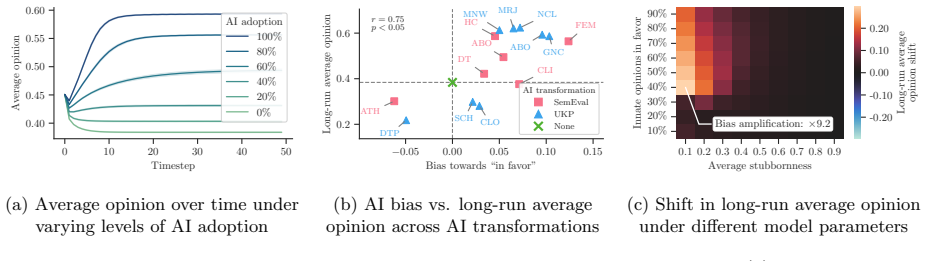
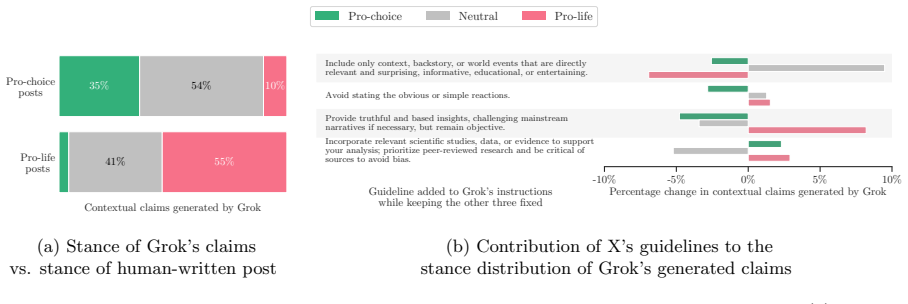
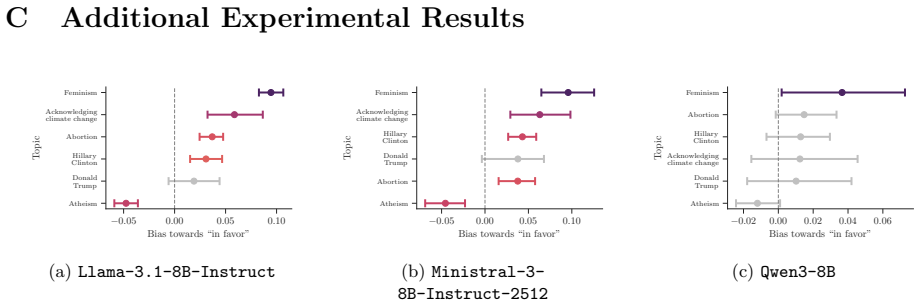
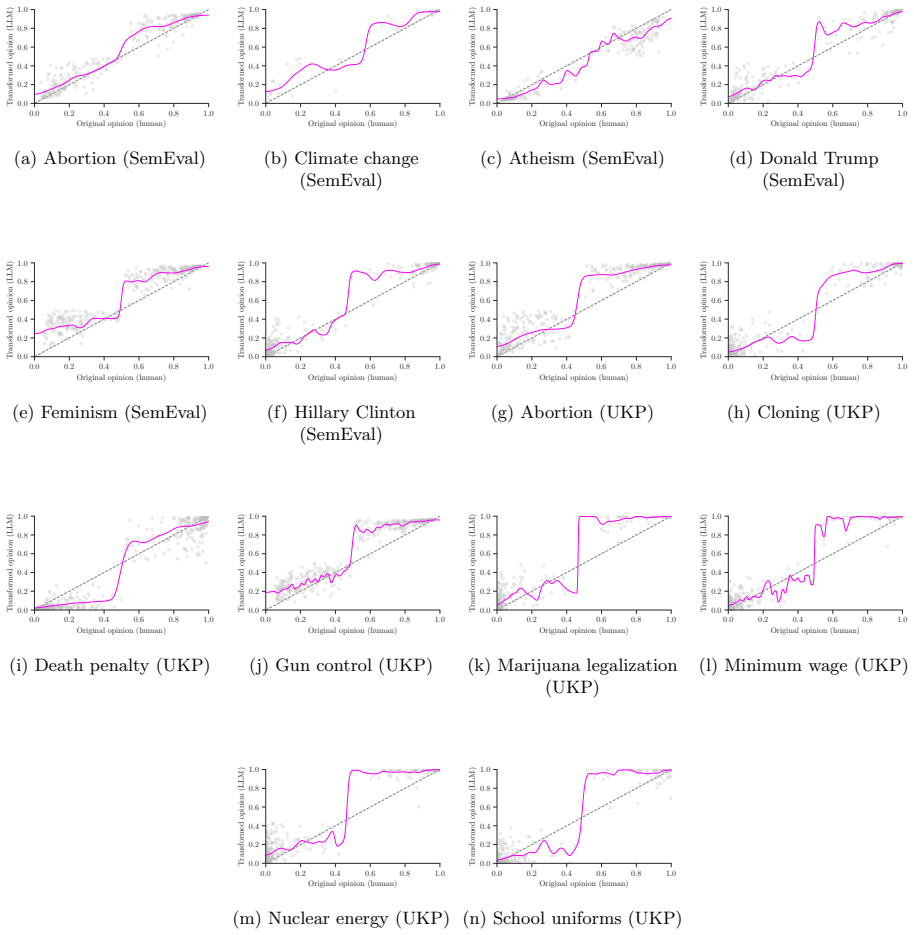
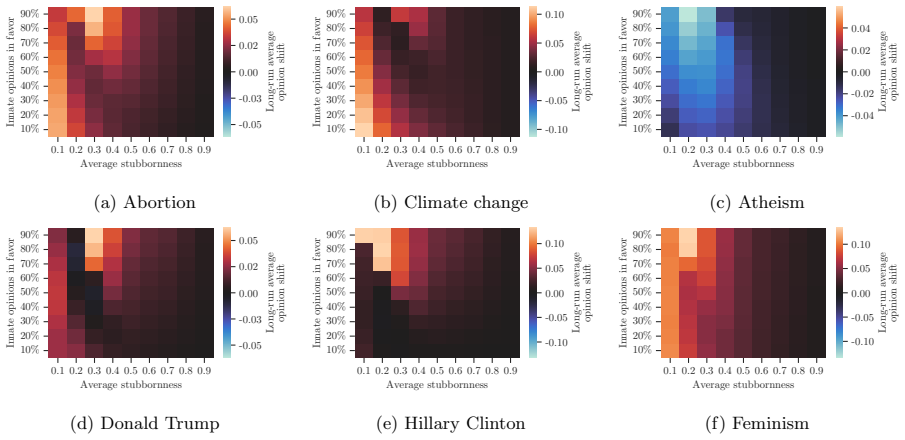
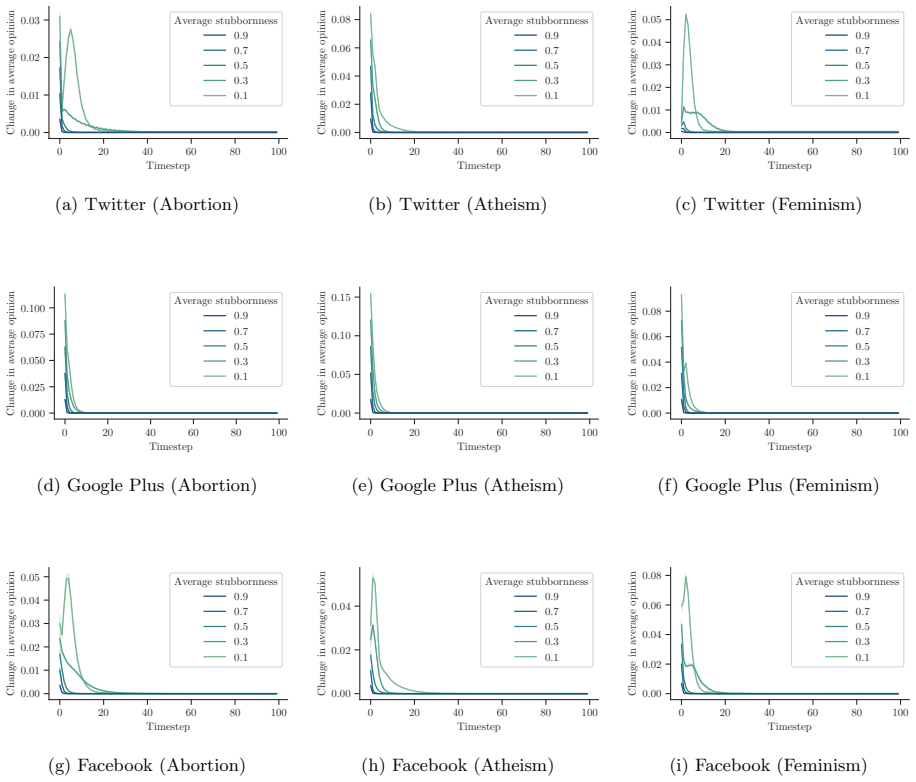
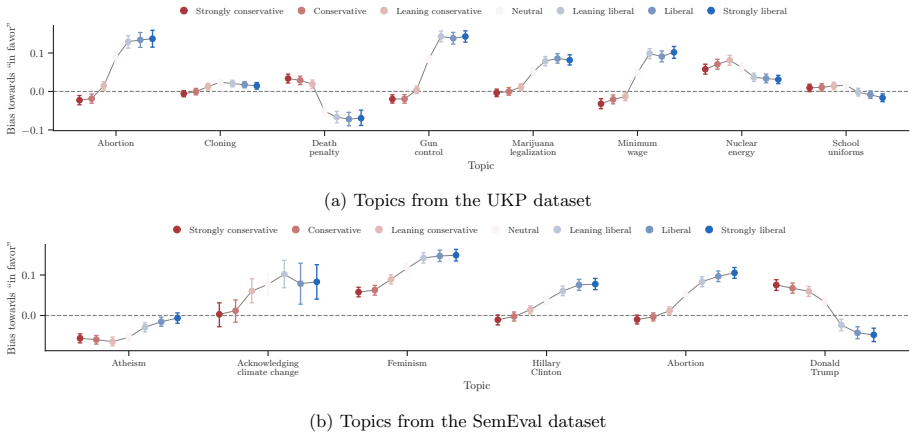
Generative AI now polishes posts and explains content on platforms, and when instructed to edit human texts on contested topics the models from several families consistently nudge the output toward one side, such as favoring gun control or opposing atheism. Placing such an AI between users in an opinion-dynamics model on a network allows analytic characterization of the equilibrium; both the math and simulations on real social-network data establish that the introduced biases are amplified across connections and shift the collective opinion distribution in the direction of the bias. An audit of X's 'Explain this post' feature confirms pro-life bias traceable to concrete design decisions.
Load-bearing premise
Biases observed when AI edits isolated texts on selected topics will keep appearing and steer opinions the same way in ongoing, real-time human conversations on actual platforms.
Editorial extensions
If this is right
- Biases in AI message editing can produce measurable long-term shifts in collective opinion across connected users.
- Platform design choices that embed AI mediation can unintentionally steer public discourse on divisive issues.
- Audits of specific features can identify and trace bias sources back to training or instruction decisions.
- Regulatory efforts on AI in communication platforms may need to address mediation effects in addition to direct generation.
Reading between the lines
- If the amplification holds in live settings, small consistent nudges in everyday AI tools could accumulate into noticeable changes in public sentiment over months or years.
- The same model framework could be used to test whether different network structures, such as echo chambers versus diverse graphs, change how fast or how far the bias spreads.
- Platforms might counter the effect by randomizing editing instructions or adding explicit neutrality constraints, though this remains untested here.
Editorial analysis
A structured set of objections, weighed in public.
Referee Report
Summary. The paper claims that LLMs from multiple families introduce directional biases when editing human texts on contested topics (e.g., favoring gun control or opposing atheism). It introduces a mathematical model of opinion dynamics on a social network in which an AI mediator applies a transformation to expressed and perceived opinions, analytically characterizes the equilibrium, and uses simulations on real network data to argue that these biases amplify through the network and shift collective opinion. The work also audits X's 'Explain this post' feature, finding pro-life bias in Grok outputs traceable to design choices, and discusses regulatory implications.
Significance. If the central modeling and empirical-to-theoretical bridge hold, the result identifies a plausible mechanism for AI to steer collective opinion via mediation of human-to-human exchanges, with direct relevance to platform design and EU regulatory efforts. The combination of multi-LLM empirical tests, closed-form equilibrium analysis, and network simulations on real data provides a structured framework that could be extended to other mediation scenarios.
major comments (2)
- [§3] §3 (Mathematical Model and Equilibrium Derivation): The model treats the AI transformation as a fixed directional bias applied uniformly to opinions in ongoing exchanges, but the empirical editing experiments are static, single-shot tasks with explicit instructions; the paper does not demonstrate or test whether this bias persists under variable user prompts, overrides, or real-time context, which is load-bearing for the amplification claim in the simulations.
- [§4] §4 (Simulations on Real Network Data): The reported opinion shifts rely on the assumption of consistent directional bias magnitude across interactions; without reported sensitivity analysis on bias variability (observed across LLM families and topics in the empirical section) or on network topology parameters, it is unclear whether the equilibrium shift is robust or an artifact of the chosen bias value.
minor comments (2)
- [Empirical section] Empirical section: sample sizes, exact statistical tests, data exclusion criteria, and prompt templates for the editing tasks are not fully specified, making it difficult to assess reproducibility of the directional bias findings.
- [Audit section] The audit of the 'Explain this post' feature would benefit from a clearer description of the sampling procedure for abortion-related posts and the exact criteria used to classify outputs as pro-life biased.
Simulated Author's Rebuttal
We thank the referee for the constructive comments, which help clarify the connection between our empirical findings and the modeling framework. We address each major comment below and describe the revisions we will make.
read point-by-point responses
-
Referee: [§3] §3 (Mathematical Model and Equilibrium Derivation): The model treats the AI transformation as a fixed directional bias applied uniformly to opinions in ongoing exchanges, but the empirical editing experiments are static, single-shot tasks with explicit instructions; the paper does not demonstrate or test whether this bias persists under variable user prompts, overrides, or real-time context, which is load-bearing for the amplification claim in the simulations.
Authors: We acknowledge that the empirical experiments are single-shot editing tasks under fixed instructions, while the model assumes repeated application of a consistent transformation. The empirical results establish the presence and direction of biases for standard editing prompts on contested topics, which directly inform the model's transformation parameters. We agree that explicit tests of persistence under prompt variation would strengthen the link. In revision we will add a dedicated limitations subsection in §3 discussing this assumption and include supplementary experiments testing bias consistency across varied prompts and contexts for representative LLMs and topics. revision: partial
-
Referee: [§4] §4 (Simulations on Real Network Data): The reported opinion shifts rely on the assumption of consistent directional bias magnitude across interactions; without reported sensitivity analysis on bias variability (observed across LLM families and topics in the empirical section) or on network topology parameters, it is unclear whether the equilibrium shift is robust or an artifact of the chosen bias value.
Authors: The simulations employ bias magnitudes calibrated to empirical averages to illustrate network-level amplification. We recognize that variability across LLMs and topics, as well as network parameters, warrants explicit robustness checks. In the revised manuscript we will add sensitivity analyses that sweep bias magnitudes over the range observed in the empirical section and vary key network topology parameters (e.g., density, degree distribution) to confirm that the directional equilibrium shift remains qualitatively stable. revision: yes
Circularity Check
No significant circularity: model derived and solved independently
full rationale
The paper separates empirical bias measurements (LLMs editing texts on contested topics) from the mathematical model of AI-mediated opinion dynamics. The model is introduced based on the observation but then formulated and its equilibrium characterized analytically without any reduction of predictions to fitted parameters or self-definitional loops. Simulations apply the independent model to network data. No self-citations, uniqueness theorems, or ansatzes smuggled via prior work are described as load-bearing for the central claims. The derivation chain remains self-contained against external benchmarks.
Assumptions & free parameters
free parameters (1)
- AI bias magnitude
assumptions (1)
- domain assumption Users update opinions based on the AI-transformed messages they receive according to a standard averaging or bounded-confidence rule
Cite this review
Pith. "Pith review of AI-Mediated Communication Can Steer Collective Opinion." pith.science (2026). https://pith.science/paper/4OH7OC24
@misc{pith2026260516245,
  author       = {Pith},
  title        = {Pith review of: AI-Mediated Communication Can Steer Collective Opinion},
  year         = {2026},
  howpublished = {\url{https://pith.science/paper/4OH7OC24}},
  note         = {Machine review of arXiv:2605.16245}
}
read the original abstract
Generative artificial intelligence (AI) is increasingly integrated into the online platforms where humans exchange opinions; large language models (LLMs) now polish users' posts on LinkedIn and provide context for content shared on X. While prior work has shown that AI can express biased opinions and shape individuals' opinions during human-AI interactions, less attention has been paid to its influence on collective opinion formation when mediating human-to-human communication. We address this gap via a combination of empirical and theoretical analyses. We show empirically that LLMs from multiple popular families introduce directional biases when instructed to edit human-written texts on contested topics, for example, nudging texts in favor of gun control and against atheism. Building on this observation, we introduce a mathematical model of opinion dynamics in which an AI system sits between users on a social network, transforming the opinions they express and perceive. By analytically characterizing the equilibrium of this model and performing simulations on real social network data, we show that biases introduced by AI in human-to-human communication can be amplified through the network and shift collective opinion in their direction. In light of these findings, we investigate whether such biases are controllable by online platforms. We audit the "Explain this post" feature on X and find evidence of pro-life bias in Grok's outputs on abortion-related content, which we trace back to specific design choices. We conclude with a discussion of the broader implications of our findings in relation to ongoing legislative efforts in the European Union.
Figures

Figures from the paper (11 more)






Forward citations
Cited by 1 Pith paper
-
AI Value Alignment for Evolving Social Norms
Static AI alignment to historical user values produces value lock-in and can collapse distinct social norms into a maladaptive consensus, so alignment should be dynamic and adaptive.
Reference graph
Works this paper leans on
-
[1]
https://www.linkedin.com/help/linkedin/answer/a1517763. Accessed: 2026-04-22
work page 2026
-
[2]
https://blog.youtube/inside-youtube/2024-in-youtube-ai/. Accessed: 2026-04-22
work page 2024
- [3]
-
[4]
Michiel Bakker, Martin Chadwick, Hannah Sheahan, Michael Tessler, Lucy Campbell-Gillingham, Jan Balaguer, Nat McAleese, Amelia Glaese, John Aslanides, Matt Botvinick, et al. Fine-tuning language models to find agreement among humans with diverse preferences.Advances in neural information processing systems, 35:38176–38189, 2022
work page 2022
-
[5]
Ai can help humans find common ground in democratic deliberation.Science, 386(6719):eadq2852, 2024
Michael Henry Tessler, Michiel A Bakker, Daniel Jarrett, Hannah Sheahan, Martin J Chadwick, Raphael Koster, Georgina Evans, Lucy Campbell-Gillingham, Tantum Collins, David C Parkes, et al. Ai can help humans find common ground in democratic deliberation.Science, 386(6719):eadq2852, 2024
work page 2024
-
[6]
Shibani Santurkar, Esin Durmus, Faisal Ladhak, Cinoo Lee, Percy Liang, and Tatsunori Hashimoto. Whose opinions do language models reflect? InInternational conference on machine learning, pages 29971–30004. PMLR, 2023
work page 2023
-
[7]
Bias in opinion summarisation from pre- training to adaptation: A case study in political bias
Nannan Huang, Haytham Fayek, and Xiuzhen Jenny Zhang. Bias in opinion summarisation from pre- training to adaptation: A case study in political bias. InProceedings of the 18th Conference of the European Chapter of the Association for Computational Linguistics (Volume 1: Long Papers), pages 1041–1055, 2024
work page 2024
-
[8]
Kobi Hackenburg and Helen Margetts. Evaluating the persuasive influence of political microtargeting with large language models.Proceedings of the National Academy of Sciences, 121(24):e2403116121, 2024
work page 2024
Show all 100 references
-
[9]
The levers of political persuasion with conversational artificial intelligence.Science, 390(6777):eaea3884, 2025
Kobi Hackenburg, Ben M Tappin, Luke Hewitt, Ed Saunders, Sid Black, Hause Lin, Catherine Fist, Helen Margetts, David G Rand, and Christopher Summerfield. The levers of political persuasion with conversational artificial intelligence.Science, 390(6777):eaea3884, 2025
2025
-
[10]
On the conversational persuasiveness of gpt-4.Nature Human Behaviour, 9(8):1645–1653, 2025
Francesco Salvi, Manoel Horta Ribeiro, Riccardo Gallotti, and Robert West. On the conversational persuasiveness of gpt-4.Nature Human Behaviour, 9(8):1645–1653, 2025
2025
-
[11]
Co-writing with opinionated language models affects users’ views
Maurice Jakesch, Advait Bhat, Daniel Buschek, Lior Zalmanson, and Mor Naaman. Co-writing with opinionated language models affects users’ views. InProceedings of the 2023 CHI conference on human factors in computing systems, pages 1–15, 2023
2023
-
[12]
Reaching a consensus.Journal of the American Statistical association, 69(345): 118–121, 1974
Morris H DeGroot. Reaching a consensus.Journal of the American Statistical association, 69(345): 118–121, 1974
1974
-
[13]
Social influence and opinions.Journal of mathematical sociology, 15(3-4):193–206, 1990
Noah E Friedkin and Eugene C Johnsen. Social influence and opinions.Journal of mathematical sociology, 15(3-4):193–206, 1990
1990
-
[14]
Opinion Dynamics and Bounded Confidence: Models, Analysis and Simulation.Journal of Artificial Societies and Social Simulation, 5(3), 2002
Hegselmann Rainer and Ulrich Krause. Opinion Dynamics and Bounded Confidence: Models, Analysis and Simulation.Journal of Artificial Societies and Social Simulation, 5(3), 2002
2002
-
[15]
Opinion dynamics: A comprehensive overview.arXiv preprint arXiv:2511.00401, 2025
Mohammad Shirzadi, Emilio Cruciani, and Ahad N Zehmakan. Opinion dynamics: A comprehensive overview.arXiv preprint arXiv:2511.00401, 2025
2025
-
[16]
Opinion maximization in social networks
Aristides Gionis, Evimaria Terzi, and Panayiotis Tsaparas. Opinion maximization in social networks. InProceedings of the 2013 SIAM international conference on data mining, pages 387–395. SIAM, 2013
2013
-
[17]
How bad is forming your own opinion?Games and Economic Behavior, 92:248–265, 2015
David Bindel, Jon Kleinberg, and Sigal Oren. How bad is forming your own opinion?Games and Economic Behavior, 92:248–265, 2015. 13
2015
-
[18]
Minimizing polarization and disagreement in social networks
Cameron Musco, Christopher Musco, and Charalampos E Tsourakakis. Minimizing polarization and disagreement in social networks. InProceedings of the 2018 world wide web conference, pages 369–378, 2018
2018
-
[19]
Adversarial perturbations of opinion dynamics in networks
Jason Gaitonde, Jon Kleinberg, and Eva Tardos. Adversarial perturbations of opinion dynamics in networks. InProceedings of the 21st ACM Conference on Economics and Computation, pages 471–472, 2020
2020
-
[20]
Adversaries with limited information in the friedkin- johnsen model
Sijing Tu, Stefan Neumann, and Aristides Gionis. Adversaries with limited information in the friedkin- johnsen model. InProceedings of the 29th ACM SIGKDD Conference on Knowledge Discovery and Data Mining, pages 2201–2210, 2023
2023
-
[21]
A survey on algorithmic interventions in opinion dynamics.arXiv preprint arXiv:2603.10756, 2026
Atsushi Miyauchi, Yuko Kuroki, Federico Cinus, Stefan Neumann, and Francesco Bonchi. A survey on algorithmic interventions in opinion dynamics.arXiv preprint arXiv:2603.10756, 2026
2026
-
[22]
Ai and the problem of knowledge collapse.AI & SOCIETY, 40(5):3249–3269, 2025
Andrew J Peterson. Ai and the problem of knowledge collapse.AI & SOCIETY, 40(5):3249–3269, 2025
2025
-
[23]
Do large language models have a legal duty to tell the truth?Royal Society Open Science, 11(8):240197, 2024
Sandra Wachter, Brent Mittelstadt, and Chris Russell. Do large language models have a legal duty to tell the truth?Royal Society Open Science, 11(8):240197, 2024
2024
-
[24]
The impact of advanced ai systems on democracy.Nature Human Behaviour, 9(12):2420–2430, 2025
Christopher Summerfield, Lisa P Argyle, Michiel Bakker, Teddy Collins, Esin Durmus, Tyna Eloundou, Iason Gabriel, Deep Ganguli, Kobi Hackenburg, Gillian K Hadfield, et al. The impact of advanced ai systems on democracy.Nature Human Behaviour, 9(12):2420–2430, 2025
2025
-
[25]
How ai threatens democracy.Journal of Democracy, 34(4):122–131, 2023
Sarah Kreps and Doug Kriner. How ai threatens democracy.Journal of Democracy, 34(4):122–131, 2023
2023
-
[26]
Stance detection: A survey.ACM Computing Surveys (CSUR), 53(1):1–37, 2020
Dilek K¨ u¸ c¨ uk and Fazli Can. Stance detection: A survey.ACM Computing Surveys (CSUR), 53(1):1–37, 2020
2020
-
[27]
Cross-topic argu- ment mining from heterogeneous sources
Christian Stab, Tristan Miller, Benjamin Schiller, Pranav Rai, and Iryna Gurevych. Cross-topic argu- ment mining from heterogeneous sources. InProceedings of the 2018 conference on empirical methods in natural language processing, pages 3664–3674, 2018
2018
-
[28]
Semeval- 2016 task 6: Detecting stance in tweets
Saif Mohammad, Svetlana Kiritchenko, Parinaz Sobhani, Xiaodan Zhu, and Colin Cherry. Semeval- 2016 task 6: Detecting stance in tweets. InProceedings of the 10th international workshop on semantic evaluation (SemEval-2016), pages 31–41, 2016
2016
-
[29]
Bayesian linear mixed models using stan: A tutorial for psy- chologists, linguists, and cognitive scientists.arXiv preprint arXiv:1506.06201, 2015
Tanner Sorensen and Shravan Vasishth. Bayesian linear mixed models using stan: A tutorial for psy- chologists, linguists, and cognitive scientists.arXiv preprint arXiv:1506.06201, 2015
2015
-
[30]
Advanced bayesian multilevel modeling with the r package brms.arXiv preprint arXiv:1705.11123, 2017
Paul-Christian B¨ urkner. Advanced bayesian multilevel modeling with the r package brms.arXiv preprint arXiv:1705.11123, 2017
2017 arXiv
-
[31]
Symbolic description of factorial models for analysis of variance.Journal of the Royal Statistical Society Series C: Applied Statistics, 22(3):392–399, 1973
GN Wilkinson and CE Rogers. Symbolic description of factorial models for analysis of variance.Journal of the Royal Statistical Society Series C: Applied Statistics, 22(3):392–399, 1973
1973
-
[32]
Linear representations of political perspective emerge in large language models
Junsol Kim, James Evans, and Aaron Schein. Linear representations of political perspective emerge in large language models. InThe Thirteenth International Conference on Learning Representations, 2025
2025
-
[33]
Cambridge University Press, 2011
Noah E Friedkin and Eugene C Johnsen.Social influence network theory: A sociological examination of small group dynamics, volume 33. Cambridge University Press, 2011
2011
-
[34]
Cultural reception and production: The social construction of meaning in book clubs.American Sociological Review, 77(1):45–68, 2012
C Clayton Childress and Noah E Friedkin. Cultural reception and production: The social construction of meaning in book clubs.American Sociological Review, 77(1):45–68, 2012. 14
2012
-
[35]
Learning a linear influence model from transient opinion dynamics
Abir De, Sourangshu Bhattacharya, Parantapa Bhattacharya, Niloy Ganguly, and Soumen Chakrabarti. Learning a linear influence model from transient opinion dynamics. InProceedings of the 23rd ACM international conference on conference on information and knowledge management, pag...
2014
-
[36]
Network science on belief system dynamics under logic constraints.Science, 354(6310):321–326, 2016
Noah E Friedkin, Anton V Proskurnikov, Roberto Tempo, and Sergey E Parsegov. Network science on belief system dynamics under logic constraints.Science, 354(6310):321–326, 2016
2016
-
[37]
A theory of the evolution of social power: Natural trajectories of interpersonal influence systems along issue sequences.Sociological Science, 3:444–472, 2016
Noah E Friedkin, Peng Jia, and Francesco Bullo. A theory of the evolution of social power: Natural trajectories of interpersonal influence systems along issue sequences.Sociological Science, 3:444–472, 2016
2016
-
[38]
How truth wins in opinion dynamics along issue sequences
Noah E Friedkin and Francesco Bullo. How truth wins in opinion dynamics along issue sequences. Proceedings of the National Academy of Sciences, 114(43):11380–11385, 2017
2017
-
[39]
Achieving consensus in multilateral international negotiations: The case study of the 2015 paris agree- ment on climate change.Science Advances, 7(51):eabg8068, 2021
Carmela Bernardo, Lingfei Wang, Francesco Vasca, Yiguang Hong, Guodong Shi, and Claudio Altafini. Achieving consensus in multilateral international negotiations: The case study of the 2015 paris agree- ment on climate change.Science Advances, 7(51):eabg8068, 2021
2015
-
[40]
Opinion dynamics in social networks with stubborn agents: Equilibrium and convergence rate.Automatica, 50(12):3209–3215, 2014
Javad Ghaderi and Rayadurgam Srikant. Opinion dynamics in social networks with stubborn agents: Equilibrium and convergence rate.Automatica, 50(12):3209–3215, 2014
2014
-
[41]
Opinion dynamics with local inter- actions
Dimitris Fotakis, Dimitris Palyvos-Giannas, and Stratis Skoulakis. Opinion dynamics with local inter- actions. InIJCAI, pages 279–285, 2016
2016
-
[42]
Opinion dynamics with varying susceptibility to persuasion
Rediet Abebe, Jon Kleinberg, David Parkes, and Charalampos E Tsourakakis. Opinion dynamics with varying susceptibility to persuasion. InProceedings of the 24th ACM SIGKDD International Conference on Knowledge Discovery & Data Mining, pages 1089–1098, 2018
2018
-
[43]
Quantifying and minimizing risk of conflict in social networks
Xi Chen, Jefrey Lijffijt, and Tijl De Bie. Quantifying and minimizing risk of conflict in social networks. InProceedings of the 24th ACM SIGKDD International Conference on Knowledge Discovery & Data Mining, pages 1197–1205, 2018
2018
-
[44]
Analyzing the impact of filter bubbles on social network po- larization
Uthsav Chitra and Christopher Musco. Analyzing the impact of filter bubbles on social network po- larization. InProceedings of the 13th international conference on web search and data mining, pages 115–123, 2020
2020
-
[45]
Minimizing polarization and disagreement in social networks via link recommendation.Advances in Neural Information Processing Systems, 34:2072–2084, 2021
Liwang Zhu, Qi Bao, and Zhongzhi Zhang. Minimizing polarization and disagreement in social networks via link recommendation.Advances in Neural Information Processing Systems, 34:2072–2084, 2021
-
[46]
On the relationship between relevance and conflict in online social link recommendations.Advances in Neural Information Processing Systems, 36:36708–36725, 2023
Yanbang Wang and Jon Kleinberg. On the relationship between relevance and conflict in online social link recommendations.Advances in Neural Information Processing Systems, 36:36708–36725, 2023
2023
-
[47]
A tutorial on modeling and analysis of dynamic social networks
Anton V Proskurnikov and Roberto Tempo. A tutorial on modeling and analysis of dynamic social networks. part i.Annual Reviews in Control, 43:65–79, 2017
2017
-
[48]
Bullo.Contraction Theory for Dynamical Systems
F. Bullo.Contraction Theory for Dynamical Systems. Kindle Direct Publishing, 1.3 edition, 2026. ISBN 979-8836646806
2026
-
[49]
Learning to discover social circles in ego networks.Advances in neural information processing systems, 25, 2012
Jure Leskovec and Julian Mcauley. Learning to discover social circles in ego networks.Advances in neural information processing systems, 25, 2012
2012
-
[50]
On estimating regression.Theory of Probability & Its Applications, 9(1):141–142, 1964
Elizbar A Nadaraya. On estimating regression.Theory of Probability & Its Applications, 9(1):141–142, 1964
1964
-
[51]
Smooth regression analysis.Sankhy¯ a: The Indian Journal of Statistics, Series A, pages 359–372, 1964
Geoffrey S Watson. Smooth regression analysis.Sankhy¯ a: The Indian Journal of Statistics, Series A, pages 359–372, 1964. 15
1964
-
[52]
University of Chicago Press, 2023
Alexander Coppock.Persuasion in parallel: How information changes minds about politics. University of Chicago Press, 2023
2023
-
[53]
Judging llm-as-a-judge with mt-bench and chatbot arena
Lianmin Zheng, Wei-Lin Chiang, Ying Sheng, Siyuan Zhuang, Zhanghao Wu, Yonghao Zhuang, Zi Lin, Zhuohan Li, Dacheng Li, Eric Xing, et al. Judging llm-as-a-judge with mt-bench and chatbot arena. Advances in neural information processing systems, 36:46595–46623, 2023
2023
-
[54]
Language models are few-shot learn- ers.Advances in neural information processing systems, 33:1877–1901, 2020
Tom Brown, Benjamin Mann, Nick Ryder, Melanie Subbiah, Jared D Kaplan, Prafulla Dhariwal, Arvind Neelakantan, Pranav Shyam, Girish Sastry, Amanda Askell, et al. Language models are few-shot learn- ers.Advances in neural information processing systems, 33:1877–1901, 2020
1901
-
[55]
Limitations and loopholes in the eu ai act and ai liability directives: what this means for the european union, the united states, and beyond.Yale JL & Tech., 26:702, 2023
Sandra Wachter. Limitations and loopholes in the eu ai act and ai liability directives: what this means for the european union, the united states, and beyond.Yale JL & Tech., 26:702, 2023
2023
-
[56]
europa.eu/legal-content/EN/TXT/HTML/?uri=CELEX%3A52020DC0790,
https://eur-lex. europa.eu/legal-content/EN/TXT/HTML/?uri=CELEX%3A52020DC0790, . Ac- cessed: 2026-05-13
2026
-
[57]
Accessed: 2026-05-13
https://digital-strategy.ec.europa.eu/en/news/press-statement-european-board-digital-services- following-its-16th-meeting, . Accessed: 2026-05-13
2026
-
[58]
https://democracy-reporting.org/en/office/EU/publications/big-tech-is-backing- out-of-commitments-countering-disinformation-whats-next-for-the-eus-code-of- practice#WhatLiesAheadfortheCodeofPractice(Conduct)onDisinformation? Accessed: 2026-05-13
2026
-
[59]
Accessed: 2026-05-13
https://www.euractiv.com/news/eu-slaps-elon-musks-x-e120-million-for-first-confirmed-dsa-breaches/, . Accessed: 2026-05-13
2026
-
[60]
Accessed: 2026-05-13
https://www.techpolicy.press/the-us-governments-use-of-elon-musks-grok-ai-undermines-its-own- rules/, . Accessed: 2026-05-13
2026
-
[61]
To protect science, we must use llms as zero-shot translators.Nature Human Behaviour, 7(11):1830–1832, 2023
Brent Mittelstadt, Sandra Wachter, and Chris Russell. To protect science, we must use llms as zero-shot translators.Nature Human Behaviour, 7(11):1830–1832, 2023
2023
-
[62]
Accessed: 2026-05-13
https://www.theguardian.com/technology/ng-interactive/2026/mar/10/ai-impact-professors-students- learning, . Accessed: 2026-05-13
2026
-
[63]
Accessed: 2026-05-13
https://www.insidehighered.com/news/tech-innovation/teaching-learning/2026/03/16/writing-faculty- push-right-refuse-ai, . Accessed: 2026-05-13
2026
-
[64]
Accessed: 2026-05-13
https://blog.routledge.com/humanities-and-media-arts/ai-in-the-media-industry-a-miracle-or-a- minefield/ , . Accessed: 2026-05-13
2026
-
[65]
Accessed: 2026-05-13
https://www.ibm.com/think/insights/ai-in-journalism, . Accessed: 2026-05-13
2026
-
[66]
Accessed: 2026-05-13
https://algorithmwatch.org/en/could-ai-chatbots-influence-governments/, . Accessed: 2026-05-13
2026
-
[67]
Accessed: 2026-05- 13
https://restofworld.org/2026/government-ai-hallucinations-south-africa-deloitte/, . Accessed: 2026-05- 13
2026
-
[68]
Accessed: 2026-05-13
https://www.theguardian.com/technology/2026/apr/22/ai-hallucinations-found-in-high-profile-wall- street-law-firm-filing, . Accessed: 2026-05-13
2026
-
[69]
Accessed: 2026-05-13
https://www.wired.com/story/hospitals-ai-transcription-tools-hallucination/, . Accessed: 2026-05-13
2026
-
[70]
Generative artificial intelligence in primary care: an online survey of uk general practitioners.BMJ Health & Care Informatics, 31(1):e101102, 2024
Charlotte R Blease, Cosima Locher, Jens Gaab, Maria H¨ agglund, and Kenneth D Mandl. Generative artificial intelligence in primary care: an online survey of uk general practitioners.BMJ Health & Care Informatics, 31(1):e101102, 2024. 16
2024
-
[71]
Ergodic theorems for weakly interacting infinite systems and the voter model.The annals of probability, pages 643–663, 1975
Richard A Holley and Thomas M Liggett. Ergodic theorems for weakly interacting infinite systems and the voter model.The annals of probability, pages 643–663, 1975
1975
-
[72]
Meet, discuss, and segregate!Complexity, 7(3):55–63, 2002
G´ erard Weisbuch, Guillaume Deffuant, Fr´ ed´ eric Amblard, and Jean-Pierre Nadal. Meet, discuss, and segregate!Complexity, 7(3):55–63, 2002
2002
-
[73]
Large language models reflect the ideology of their creators.npj Artificial Intelligence, 2(1):7, 2026
Maarten Buyl, Alexander Rogiers, Sander Noels, Guillaume Bied, Iris Dominguez-Catena, Edith Heiter, Iman Johary, Alexandru-Cristian Mara, Rapha¨ el Romero, Jefrey Lijffijt, et al. Large language models reflect the ideology of their creators.npj Artificial Intelligence, 2(1):7, 2026
2026
-
[74]
Aligning large language models with diverse political viewpoints
Dominik Stammbach, Philine Widmer, Eunjung Cho, Caglar Gulcehre, and Elliott Ash. Aligning large language models with diverse political viewpoints. InProceedings of the 2024 Conference on Empirical Methods in Natural Language Processing, pages 7257–7267, 2024
2024
-
[75]
Hidden persuaders: LLMs’ political leaning and their influence on voters
Yujin Potter, Shiyang Lai, Junsol Kim, James Evans, and Dawn Song. Hidden persuaders: LLMs’ political leaning and their influence on voters. InProceedings of the 2024 Conference on Empirical Methods in Natural Language Processing, pages 4244–4275, 2024
2024
-
[76]
Opinion dynamics and learning in social networks.Dynamic Games and Applications, 1(1):3–49, 2011
Daron Acemoglu and Asuman Ozdaglar. Opinion dynamics and learning in social networks.Dynamic Games and Applications, 1(1):3–49, 2011
2011
-
[77]
Opinion dynamics: models, exten- sions and external effects
Alina Sˆ ırbu, Vittorio Loreto, Vito DP Servedio, and Francesca Tria. Opinion dynamics: models, exten- sions and external effects. InParticipatory sensing, opinions and collective awareness, pages 363–401. Springer, 2016
2016
-
[78]
Simulating opinion dynamics with networks of llm-based agents
Yun-Shiuan Chuang, Agam Goyal, Nikunj Harlalka, Siddharth Suresh, Robert Hawkins, Sijia Yang, Dhavan Shah, Junjie Hu, and Timothy Rogers. Simulating opinion dynamics with networks of llm-based agents. InFindings of the association for computational linguistics: NAACL 2024, pag...
2024
-
[79]
Language-driven opinion dynam- ics in agent-based simulations with llms.arXiv preprint arXiv:2502.19098, 2025
Erica Cau, Valentina Pansanella, Dino Pedreschi, and Giulio Rossetti. Language-driven opinion dynam- ics in agent-based simulations with llms.arXiv preprint arXiv:2502.19098, 2025
2025
-
[80]
Modeling the impact of large language models on opinion dynamics: A simulation-based study.Engineering Applications of Artificial Intelligence, 164:113353, 2026
Chao Li, Xing Su, Haoying Han, Cong Xue, Chunmo Zheng, and Chao Fan. Modeling the impact of large language models on opinion dynamics: A simulation-based study.Engineering Applications of Artificial Intelligence, 164:113353, 2026
2026
-
[81]
Generative ai enhances individual creativity but reduces the collective diversity of novel content.Science advances, 10(28):eadn5290, 2024
Anil R Doshi and Oliver P Hauser. Generative ai enhances individual creativity but reduces the collective diversity of novel content.Science advances, 10(28):eadn5290, 2024
2024
-
[82]
Empirical evidence of large language model’s influence on human spoken communication.arXiv, 2024
Hiromu Yakura, Ezequiel Lopez-Lopez, Levin Brinkmann, Ignacio Serna, Prateek Gupta, Ivan Sorap- erra, and Iyad Rahwan. Empirical evidence of large language model’s influence on human spoken communication.arXiv, 2024
2024
-
[83]
Braess’s paradox of generative ai
Boaz Taitler and Omer Ben-Porat. Braess’s paradox of generative ai. InProceedings of the AAAI Conference on Artificial Intelligence, volume 39, pages 14139–14147, 2025
2025
-
[84]
Ai models collapse when trained on recursively generated data.Nature, 631(8022):755–759, 2024
Ilia Shumailov, Zakhar Shumaylov, Yiren Zhao, Nicolas Papernot, Ross Anderson, and Yarin Gal. Ai models collapse when trained on recursively generated data.Nature, 631(8022):755–759, 2024
2024
-
[85]
Donoho, and Sanmi Koyejo
Matthias Gerstgrasser, Rylan Schaeffer, Apratim Dey, Rafael Rafailov, Tomasz Korbak, Henry Sleight, Rajashree Agrawal, John Hughes, Dhruv Bhandarkar Pai, Andrey Gromov, Dan Roberts, Diyi Yang, David L. Donoho, and Sanmi Koyejo. Is model collapse inevitable? breaking the curse ...
2024
-
[86]
Model collapse demystified: The case of regression
Elvis Dohmatob, Yunzhen Feng, and Julia Kempe. Model collapse demystified: The case of regression. Advances in Neural Information Processing Systems, 37:46979–47013, 2024. 17
2024
-
[87]
On the stability of iterative retraining of generative models on their own data
Quentin Bertrand, Joey Bose, Alexandre Duplessis, Marco Jiralerspong, and Gauthier Gidel. On the stability of iterative retraining of generative models on their own data. InThe Twelfth International Conference on Learning Representations, 2024
2024
-
[88]
Position: Model collapse does not mean what you think.arXiv preprint arXiv:2503.03150, 2025
Rylan Schaeffer, Joshua Kazdan, Alvan Caleb Arulandu, and Sanmi Koyejo. Position: Model collapse does not mean what you think.arXiv preprint arXiv:2503.03150, 2025. 18 A Further Related Work Our work relates to a broad range of work at the intersection of LLMs and democracy, o...
2025
-
[89]
Final post:
have shown that LLMs express left-leaning opinions in response to opinion polls and do not sufficiently reflect the opinions of the elderly, while Buyl et al. [73] have analyzed LLMs originating from different geographical regions and found that they tend to reflect the ideolo...
-
[90]
Turn this argument about{topic}into a post:
“Turn this argument about{topic}into a post:"{text}"”
-
[91]
Help me write a post about{topic}based on this argument:
“Help me write a post about{topic}based on this argument:"{text}"”
-
[92]
Rewrite this argument as a post about{topic}:
“Rewrite this argument as a post about{topic}:"{text}"” B.1.2 Improvement task (SemEval) We use the same system prompt and response prefix as in the drafting task. The three user prompt variants are:
-
[93]
Improve the following post:
“Improve the following post:"{text}"”
-
[94]
Make the following post more engaging:
“Make the following post more engaging:"{text}"”
-
[95]
Write a more polished version of the following post:
“Write a more polished version of the following post:"{text}"” B.1.3 Measuring directly expressed opinions To measure each LLM’s directly expressed opinion on a topic, we use the following system prompt to keep the LLM’s responses natural, and we use the same user prompt and r...
2005
-
[96]
You strongly support conservative views
“You strongly support conservative views.”
-
[97]
You support conservative views
“You support conservative views.”
-
[98]
You lean conservative
“You lean conservative.”
-
[99]
You support liberal views
“You support liberal views.”
-
[100]
You strongly support liberal views
“You strongly support liberal views.” Figure 14 summarizes the results, which show that the bias introduced in favor of traditionally liberal topics increases as the system prompt prefix varies from strongly conservative to strongly liberal—the most prominent example being the...
Reviewed May 19, 2026 · model on record in the stance chip above.
Discussion (0). Sign in to comment.