Unsupervised Deformable Image Registration Using Cycle-Consistent CNN
Pith reviewed 2026-05-25 11:02 UTC · model grok-4.3
The pith
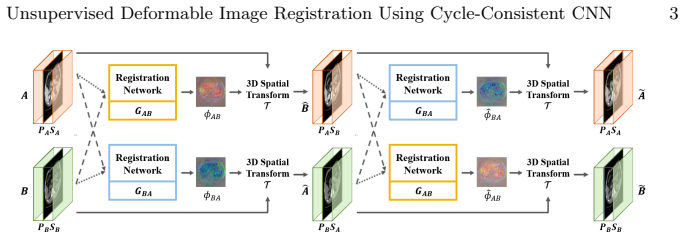
Cycle consistency lets a CNN learn unsupervised deformable registration of severely deformed 3D medical images.
A machine-rendered reading of the paper's core claim, the machinery that carries it, and where it could break.
Core claim
The authors claim that a cycle-consistency loss applied to a CNN allows unsupervised training for accurate 3D deformable registration, enabling the network to process diverse image pairs that exhibit severe deformations and to deliver precise results within seconds on multiphase liver CT data.
What carries the argument
Cycle-consistency loss that forces the composition of forward and backward registrations to recover the original image, supplying the only training signal.
If this is right
- The method registers multiphase liver CT volumes that contain severe deformations without requiring ground truth.
- Computation completes in a few seconds per 3D volume.
- Registered images yield more accurate cancer size estimates than unregistered ones.
- The same training procedure applies to many different pairs of medical images.
Where Pith is reading between the lines
- Cycle-consistency training could transfer to other medical imaging tasks such as segmentation or synthesis that also lack dense labels.
- The speed advantage may support real-time use cases such as intra-operative guidance once integrated into clinical workflows.
- Combining the cycle loss with lightweight anatomical priors could further stabilize results on organs that deform non-rigidly.
Load-bearing premise
Cycle consistency by itself is enough to produce accurate deformation fields without ground-truth labels or extra supervision.
What would settle it
On a held-out set of image pairs supplied with known ground-truth deformation fields, the network's predicted fields produce registration errors that exceed the errors of a supervised baseline by a clinically meaningful margin.
Figures


read the original abstract
Medical image registration is one of the key processing steps for biomedical image analysis such as cancer diagnosis. Recently, deep learning based supervised and unsupervised image registration methods have been extensively studied due to its excellent performance in spite of ultra-fast computational time compared to the classical approaches. In this paper, we present a novel unsupervised medical image registration method that trains deep neural network for deformable registration of 3D volumes using a cycle-consistency. Thanks to the cycle consistency, the proposed deep neural networks can take diverse pair of image data with severe deformation for accurate registration. Experimental results using multiphase liver CT images demonstrate that our method provides very precise 3D image registration within a few seconds, resulting in more accurate cancer size estimation.
Editorial analysis
A structured set of objections, weighed in public.
Referee Report
Summary. The paper proposes an unsupervised deformable registration method for 3D medical volumes that trains CNNs via a cycle-consistency loss, enabling registration of image pairs with severe deformations without ground-truth fields. Experiments on multiphase liver CT are said to yield precise registrations in seconds that improve cancer size estimation.
Significance. An unsupervised method that reliably produces anatomically accurate alignments from cycle consistency alone would be valuable for medical registration tasks where supervised deformation labels are unavailable. The approach builds on cycle-consistency ideas from other domains, but its success hinges on whether the loss plus any implicit regularizers actually converge to the correct deformation rather than any of the many inverse pairs that satisfy the cycle condition.
major comments (1)
- [Abstract] Abstract: the central claim that 'cycle consistency' alone permits 'accurate registration' of 'diverse pair[s] ... with severe deformation' is load-bearing yet unsupported by any argument or experiment showing that the loss disambiguates among the many inverse map pairs that satisfy A→B→A identity; the skeptic concern therefore directly questions whether the reported precision on liver CT follows from the stated training signal.
Simulated Author's Rebuttal
We thank the referee for the careful reading and the opportunity to clarify the central claim in the abstract. We respond to the major comment below.
read point-by-point responses
-
Referee: [Abstract] Abstract: the central claim that 'cycle consistency' alone permits 'accurate registration' of 'diverse pair[s] ... with severe deformation' is load-bearing yet unsupported by any argument or experiment showing that the loss disambiguates among the many inverse map pairs that satisfy A→B→A identity; the skeptic concern therefore directly questions whether the reported precision on liver CT follows from the stated training signal.
Authors: We agree that cycle consistency by itself does not uniquely identify a deformation field, since multiple (including non-invertible) mappings can satisfy the A→B→A identity. In the method, the cycle-consistency loss is combined with the inductive bias of the CNN (limited receptive fields and shared weights across the forward and backward networks) and an explicit smoothness regularizer on the deformation field (detailed in Section 3.2). These elements together constrain the solution space. The liver CT experiments provide empirical support: registrations obtained from diverse pairs with large deformations improve a downstream clinical metric (cancer size estimation) that would not improve under arbitrary cycle-consistent but anatomically incorrect mappings. We will revise the abstract to state that accurate registration is achieved by cycle consistency together with the CNN architecture and regularization, rather than by cycle consistency alone. revision: partial
Circularity Check
No significant circularity; derivation is self-contained
full rationale
The paper introduces an unsupervised deformable registration network trained with cycle-consistency loss as an external supervisory signal. No equations or claims in the provided abstract reduce a prediction or result to a quantity defined by the output itself, nor do they rely on load-bearing self-citations whose supporting results are unverified within the paper. The cycle-consistency principle is imported from prior literature as a standard training objective rather than constructed from the registration outputs, and experimental claims rest on empirical validation against multiphase liver CT data rather than tautological re-derivation of inputs.
Axiom & Free-Parameter Ledger
Forward citations
Cited by 1 Pith paper
-
MorphSeek: Fine-grained Latent Representation-Level Policy Optimization for Deformable Image Registration
MorphSeek advances a latent representation-level policy optimization approach for deformable image registration that reports Dice gains on brain MRI, liver CT, and MR-CT benchmarks with high label efficiency.
Reference graph
Works this paper leans on
-
[1]
Medical image analysis 12(1), 26–41 (2008)
Avants, B.B., Epstein, C.L., Grossman, M., Gee, J.C.: Symmetric diffeomorphic image registration with cross-correlation: evaluating automated labeling of elderly and neurodegenerative brain. Medical image analysis 12(1), 26–41 (2008)
work page 2008
-
[2]
In: Proceedings of the IEEE Conference on Computer Vision and Pattern Recognition
Balakrishnan, G., Zhao, A., Sabuncu, M.R., Guttag, J., Dalca, A.V.: An unsuper- vised learning model for deformable medical image registration. In: Proceedings of the IEEE Conference on Computer Vision and Pattern Recognition. pp. 9252–9260 (2018)
work page 2018
-
[3]
International journal of computer vision 61(2), 139–157 (2005)
Beg, M.F., Miller, M.I., Trouv´ e, A., Younes, L.: Computing large deformation metric mappings via geodesic flows of diffeomorphisms. International journal of computer vision 61(2), 139–157 (2005)
work page 2005
-
[4]
IEEE transactions on medical imaging 20(7), 568–582 (2001)
Christensen, G.E., Johnson, H.J.: Consistent image registration. IEEE transactions on medical imaging 20(7), 568–582 (2001)
work page 2001
-
[5]
In: International Conference on Medical Image Computing and Computer-Assisted Intervention
Dalca, A.V., Balakrishnan, G., Guttag, J., Sabuncu, M.R.: Unsupervised learn- ing for fast probabilistic diffeomorphic registration. In: International Conference on Medical Image Computing and Computer-Assisted Intervention. pp. 729–738. Springer (2018)
work page 2018
-
[6]
In: Advances in neural information processing systems
Jaderberg, M., Simonyan, K., Zisserman, A., et al.: Spatial transformer networks. In: Advances in neural information processing systems. pp. 2017–2025 (2015)
work page 2017
-
[7]
Abdominal imaging 36(3), 300–314 (2011)
Kim, K.W., Lee, J.M., Choi, B.I.: Assessment of the treatment response of hcc. Abdominal imaging 36(3), 300–314 (2011)
work page 2011
-
[8]
IEEE transactions on medical imaging 29(1), 196–205 (2010)
Klein, S., Staring, M., Murphy, K., Viergever, M.A., Pluim, J.P.: Elastix: a tool- box for intensity-based medical image registration. IEEE transactions on medical imaging 29(1), 196–205 (2010)
work page 2010
-
[9]
In: Biomedical Imaging (ISBI 2018), 2018 IEEE 15th International Symposium on
Mahapatra, D., Antony, B., Sedai, S., Garnavi, R.: Deformable medical image registration using generative adversarial networks. In: Biomedical Imaging (ISBI 2018), 2018 IEEE 15th International Symposium on. pp. 1449–1453. IEEE (2018)
work page 2018
-
[10]
In: International Conference on Medical image computing and computer-assisted intervention
Ronneberger, O., Fischer, P., Brox, T.: U-net: Convolutional networks for biomedi- cal image segmentation. In: International Conference on Medical image computing and computer-assisted intervention. pp. 234–241. Springer (2015)
work page 2015
-
[11]
Medical image analysis 2(3), 243–260 (1998)
Thirion, J.P.: Image matching as a diffusion process: an analogy with maxwell’s demons. Medical image analysis 2(3), 243–260 (1998)
work page 1998
-
[12]
NeuroImage 158, 378–396 (2017)
Yang, X., Kwitt, R., Styner, M., Niethammer, M.: Quicksilver: Fast predictive image registration–a deep learning approach. NeuroImage 158, 378–396 (2017)
work page 2017
-
[13]
Inverse-Consistent Deep Networks for Unsupervised Deformable Image Registration
Zhang, J.: Inverse-consistent deep networks for unsupervised deformable image registration. arXiv preprint arXiv:1809.03443 (2018)
work page internal anchor Pith review Pith/arXiv arXiv 2018
-
[14]
In: Proceedings of the IEEE interna- tional conference on computer vision
Zhu, J.Y., Park, T., Isola, P., Efros, A.A.: Unpaired image-to-image translation using cycle-consistent adversarial networks. In: Proceedings of the IEEE interna- tional conference on computer vision. pp. 2223–2232 (2017)
work page 2017
discussion (0)
Sign in with ORCID, Apple, or X to comment. Anyone can read and Pith papers without signing in.