Probing Baryonic Feedback Effect with CSST Weak Lensing and Future FRB Measurements
Pith reviewed 2026-06-25 23:53 UTC · model grok-4.3
The pith
Joint CSST weak lensing and FRB dispersion measures constrain the AGN feedback parameter to 0.4 percent accuracy.
A machine-rendered reading of the paper's core claim, the machinery that carries it, and where it could break.
Core claim
The joint analysis of CSST weak lensing and future FRB DM measurements, modeled with the baryonic halo model, improves the constraint on the baryonic feedback parameter log10 T_AGN from 3.1 percent to 0.4 percent and yields a tighter upper limit on the neutrino mass sum.
What carries the argument
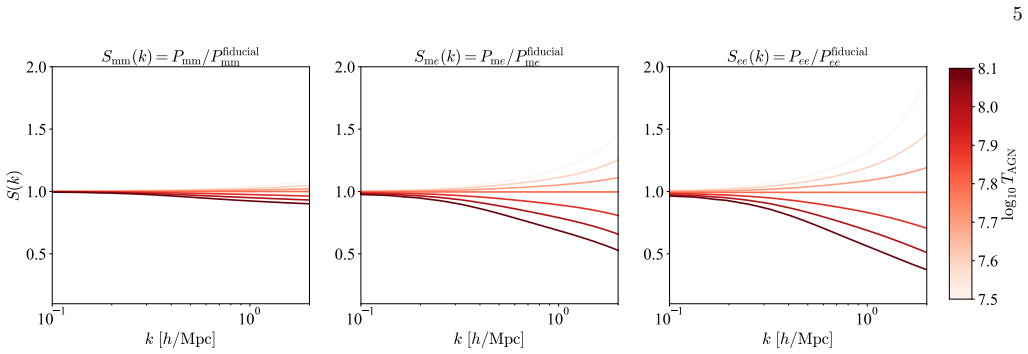
The baryonic halo model, used to compute the matter, electron, and matter-electron power spectra that encode AGN feedback effects on the distributions.
If this is right
- The joint probe supplies tighter bounds on the sum of neutrino masses by reducing uncertainty from baryonic feedback.
- The 3x2pt analysis incorporating FRB data breaks the degeneracy between feedback strength and neutrino mass that appears in lensing alone.
- Similar joint constraints become feasible for other cosmological parameters once the feedback effect is better controlled.
Where Pith is reading between the lines
- Electron density information from FRBs supplies an independent handle on feedback that lensing shear alone cannot isolate.
- Survey planners could prioritize overlapping sky coverage between CSST and next-generation radio arrays to maximize the gain shown in the mocks.
- If the improvement holds in real data, the same combination might be applied to other large-scale structure observables sensitive to baryon distribution.
Load-bearing premise
The baryonic halo model used both to generate the mock power spectra and to fit the simulated data accurately captures the real effects of AGN feedback on matter and electron distributions.
What would settle it
Real CSST and SKA observations that produce a matter-electron power spectrum inconsistent with the baryonic halo model predictions at the relevant scales and redshifts would falsify the claimed improvement in parameter constraints.
Figures



read the original abstract
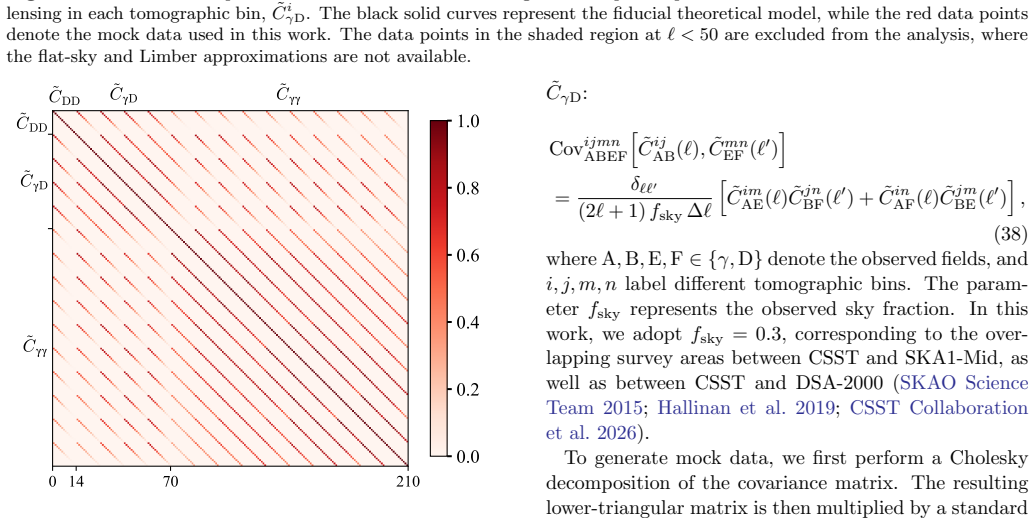
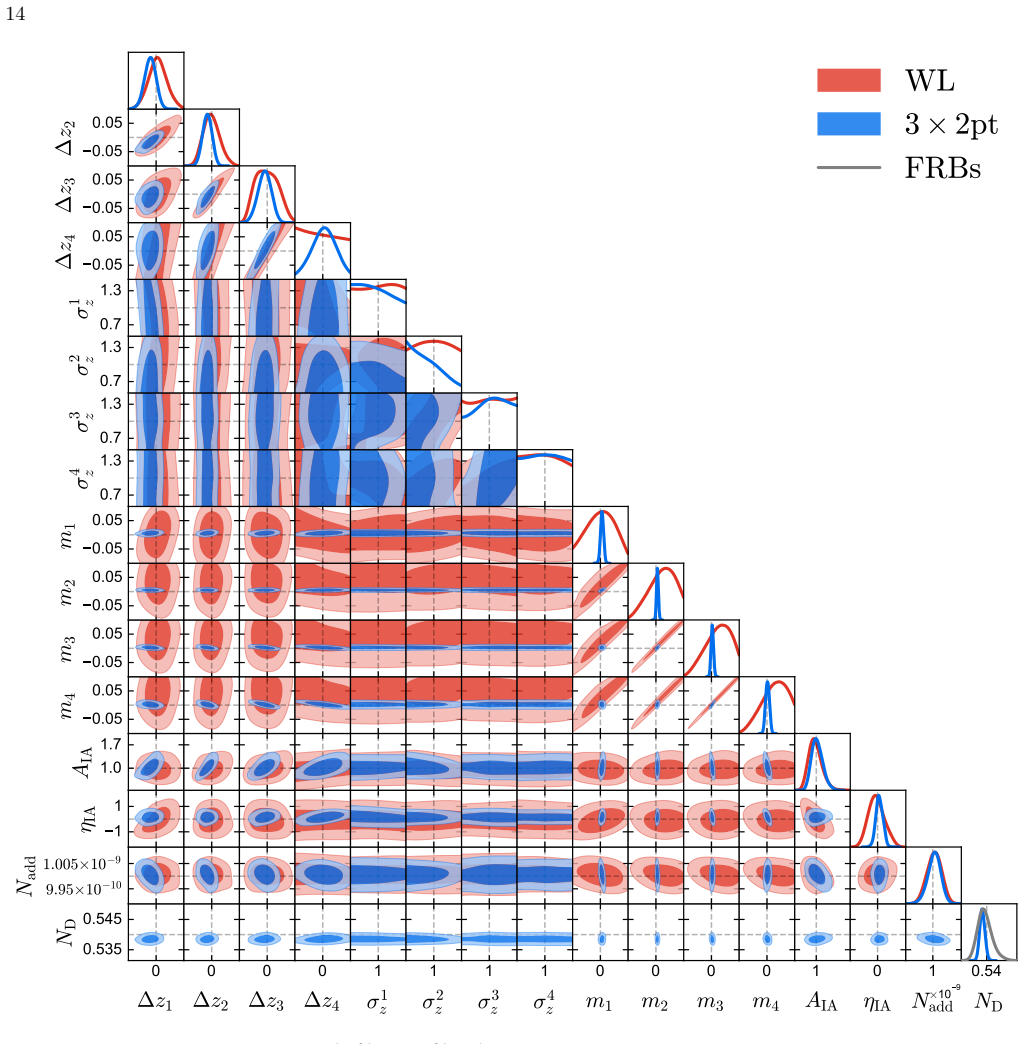
We explore the joint probe on the baryonic feedback effect using the weak lensing measurement from the upcoming Chinese Space-station Survey Telescope (CSST) photometric survey and the dispersion measure (DM) statistics of the fast radio bursts (FRBs) from next-generation radio telescopes, i.e., the Square Kilometre Array (SKA) and the Deep Synoptic Array (DSA-2000). By employing the baryonic halo model, we compute the matter, electron, and matter-electron power spectra, and generate mock data considering realistic noise and systematic effects based on the designs of the telescopes. These mock data are then analyzed using the Markov Chain Monte Carlo (MCMC) method to investigate the parameter constraints. We find that CSST weak lensing alone can constrain the baryonic feedback parameter $\log_{10} T_{\text{AGN}}$ to an accuracy of $3.1\%$, with the sum of neutrino mass bound $\sum m_{\nu} < 0.53\,\mathrm{eV}$. When performing the $3\times2$pt analysis, the inclusion of FRB DM measurements can significantly improve the precision of $\log_{10} T_{\text{AGN}}$ to $0.4\%$, and will lead to a better constraint on $\sum m_{\nu}$ with an upper limit $< 0.47\,\mathrm{eV}$ by effectively breaking the degeneracy. Our results demonstrate that the joint observation of future FRB DM and weak lensing surveys is a powerful tool for probing the baryonic feedback effect, which is helpful in obtaining robust constraints on the neutrino mass and other important cosmological parameters.
Editorial analysis
A structured set of objections, weighed in public.
Referee Report
Summary. The paper forecasts cosmological constraints from joint CSST weak-lensing (WL) and future FRB dispersion-measure (DM) data. Using a baryonic halo model, it computes matter, electron, and matter-electron power spectra, generates mock 3×2pt data with realistic noise, and runs MCMC to constrain log10 T_AGN and Σmν. CSST WL alone yields 3.1% precision on log10 T_AGN and Σmν < 0.53 eV; adding FRB DM tightens these to 0.4% and Σmν < 0.47 eV by breaking degeneracies. The central claim is that the joint probe is a powerful tool for baryonic feedback and yields robust neutrino-mass constraints.
Significance. If the baryonic halo model is an adequate description of AGN feedback on both matter and electron fields, the work demonstrates that FRB DM statistics can meaningfully tighten WL constraints on feedback and neutrino mass. The quantitative improvement (factor ~8 in log10 T_AGN precision) is a concrete illustration of the value of cross-correlating lensing with electron-tracing observables. The manuscript does not, however, provide evidence that the quoted precisions survive model misspecification.
major comments (1)
- [Abstract] Abstract: the headline claim that the joint analysis yields 'robust constraints on the neutrino mass' rests on the assumption that the baryonic halo model used to generate the mock power spectra is also the correct model for inference. Because the same parametric form is employed for both forward modeling and fitting, the reported gains (3.1% → 0.4% on log10 T_AGN; 0.53 eV → 0.47 eV on Σmν) demonstrate internal consistency within that model family but do not address bias or loss of constraining power if the true feedback deviates from the halo-model parametrization (different heating profiles, scale-dependent suppression, or non-parametric effects seen in hydrodynamical simulations). This single shared assumption is load-bearing for the robustness statement.
minor comments (1)
- [Abstract] The abstract and methods description should explicitly state that all forecasts are conditional on the baryonic halo model being correct, rather than presenting the results as model-independent robustness tests.
Simulated Author's Rebuttal
We thank the referee for the detailed and constructive comment. We agree that the language in the abstract regarding 'robust constraints' requires clarification to accurately reflect the scope of our forecast analysis.
read point-by-point responses
-
Referee: [Abstract] Abstract: the headline claim that the joint analysis yields 'robust constraints on the neutrino mass' rests on the assumption that the baryonic halo model used to generate the mock power spectra is also the correct model for inference. Because the same parametric form is employed for both forward modeling and fitting, the reported gains (3.1% → 0.4% on log10 T_AGN; 0.53 eV → 0.47 eV on Σmν) demonstrate internal consistency within that model family but do not address bias or loss of constraining power if the true feedback deviates from the halo-model parametrization (different heating profiles, scale-dependent suppression, or non-parametric effects seen in hydrodynamical simulations). This single shared assumption is load-bearing for the robustness statement.
Authors: We appreciate the referee's observation. Our analysis is a forecast performed entirely within the baryonic halo model: the same parametrization generates the mock power spectra and is used for MCMC inference. The quoted improvements therefore illustrate the gain from adding FRB DM data under consistent model assumptions, specifically the breaking of degeneracies between log10 T_AGN and Σmν. We acknowledge that this does not constitute a test of robustness against model misspecification (e.g., different heating profiles or hydrodynamical effects). We will revise the abstract to replace the phrase 'robust constraints on the neutrino mass' with 'improved constraints on the neutrino mass' and insert a brief clarifying sentence noting that results are obtained within the adopted halo-model framework. This change will be implemented in the revised manuscript. revision: yes
Circularity Check
Baryonic halo model generates mocks and performs the fit; constraints are internal to the model
specific steps
-
fitted input called prediction
[Abstract]
"By employing the baryonic halo model, we compute the matter, electron, and matter-electron power spectra, and generate mock data considering realistic noise and systematic effects based on the designs of the telescopes. These mock data are then analyzed using the Markov Chain Monte Carlo (MCMC) method to investigate the parameter constraints."
The same baryonic halo model (with parameters such as log10 T_AGN) is used to forward-model the mock CSST WL and FRB DM data and is subsequently fitted to those mocks. The reported improvements (log10 T_AGN precision from 3.1% to 0.4%, neutrino mass limit from 0.53 eV to 0.47 eV) are therefore statistically forced by the shared parametric form rather than arising from independent data.
full rationale
The paper's forecast uses the baryonic halo model both to compute the power spectra and generate mock data, then fits the identical parametric model via MCMC to those mocks. This produces the quoted precision gains on log10 T_AGN and neutrino mass as internal consistency within the shared assumption, matching the fitted_input_called_prediction pattern. No alternative hydrodynamical simulations or different feedback parametrizations are used for robustness, so the central claim reduces to the input model by construction. The derivation remains self-contained only within that model family, warranting a moderate circularity score.
Axiom & Free-Parameter Ledger
free parameters (1)
- log10 T_AGN
axioms (2)
- domain assumption The baryonic halo model correctly captures AGN feedback effects on matter and electron power spectra.
- domain assumption Noise and systematic models for CSST and SKA/DSA-2000 match the assumed levels in the mocks.
Reference graph
Works this paper leans on
-
[1]
Amara, A., & R´ efr´ egier, A. 2008, MNRAS, 391, 228, doi: 10.1111/j.1365-2966.2008.13880.x
-
[2]
Berghaus, K. V., Du, Y., Lee, V. S. H., et al. 2025, JCAP, 2025, 035, doi: 10.1088/1475-7516/2025/12/035
-
[3]
Carilli, C. L., & Rawlings, S. 2004, NewAR, 48, 979, doi: 10.1016/j.newar.2004.09.001
-
[4]
Cheng, A. Q., Andrew, S. E., Wang, H., & Masui, K. W. 2026, ApJ, 998, 252, doi: 10.3847/1538-4357/ae369f
-
[5]
Modelling baryonic feedback for survey cosmology
Chisari, N. E., Mead, A. J., Joudaki, S., et al. 2019a, The Open Journal of Astrophysics, 2, 4, doi: 10.21105/astro.1905.06082
work page internal anchor Pith review Pith/arXiv arXiv doi:10.21105/astro.1905.06082 1905
-
[6]
Chisari, N. E., Alonso, D., Krause, E., et al. 2019b, ApJS, 242, 2, doi: 10.3847/1538-4365/ab1658
-
[7]
Connor, L., Ravi, V., Sharma, K., et al. 2025, Nature Astronomy, 9, 1226, doi: 10.1038/s41550-025-02566-y
-
[8]
NE2001.I. A New Model for the Galactic Distribution of Free Electrons and its Fluctuations
Cordes, J. M., & Lazio, T. J. W. 2002, arXiv e-prints, astro, doi: 10.48550/arXiv.astro-ph/0207156 CSST Collaboration, Gong, Y., Miao, H., et al. 2026, Science China Physics, Mechanics, and Astronomy, 69, 239501, doi: 10.1007/s11433-025-2809-0
work page internal anchor Pith review Pith/arXiv arXiv doi:10.48550/arxiv.astro-ph/0207156 2002
-
[9]
Debackere, S. N. B., Schaye, J., & Hoekstra, H. 2020, MNRAS, 492, 2285, doi: 10.1093/mnras/stz3446 DES Collaboration, Abbott, T. M. C., Aguena, M., et al. 2026, arXiv e-prints, arXiv:2602.10065, doi: 10.48550/arXiv.2602.10065 Euclid Collaboration, Mellier, Y., Abdurro’uf, et al. 2025, A&A, 697, A1, doi: 10.1051/0004-6361/202450810
-
[10]
2014, JCAP, 2014, 028, doi: 10.1088/1475-7516/2014/04/028
Fedeli, C. 2014, JCAP, 2014, 028, doi: 10.1088/1475-7516/2014/04/028
-
[11]
Fender, R., Stewart, A., Macquart, J. P., et al. 2015, in Advancing Astrophysics with the Square Kilometre Array (AASKA14), 51, doi: 10.22323/1.215.0051
-
[12]
Foreman-Mackey, D., Hogg, D. W., Lang, D., & Goodman, J. 2013, PASP, 125, 306, doi: 10.1086/670067
-
[13]
Gong, Y., Liu, X., Cao, Y., et al. 2019, ApJ, 883, 203, doi: 10.3847/1538-4357/ab391e
-
[14]
2025, Science China
Gong, Y., Miao, H., Zhou, X., et al. 2025, Science China
2025
-
[15]
Physics, Mechanics, and Astronomy, 68, 280402, doi: 10.1007/s11433-025-2646-2
-
[16]
The DSA-2000 -- A Radio Survey Camera
Hallinan, G., Ravi, V., Weinreb, S., et al. 2019, in Bulletin of the American Astronomical Society, Vol. 51, 255, doi: 10.48550/arXiv.1907.07648 Harnois-D´ eraps, J., van Waerbeke, L., Viola, M., &
work page internal anchor Pith review Pith/arXiv arXiv doi:10.48550/arxiv.1907.07648 2019
-
[17]
2015, MNRAS, 450, 1212, doi: 10.1093/mnras/stv646
Heymans, C. 2015, MNRAS, 450, 1212, doi: 10.1093/mnras/stv646
-
[18]
2017, MNRAS, 465, 1454, doi: 10.1093/mnras/stw2805
Hildebrandt, H., Viola, M., Heymans, C., et al. 2017, MNRAS, 465, 1454, doi: 10.1093/mnras/stw2805
-
[19]
Forecasting Constraint on Primordial Black Hole Properties with the CSST $3\times2$pt Analysis
Hu, D., Gong, Y., Su, P., et al. 2025, arXiv e-prints, arXiv:2511.22575, doi: 10.48550/arXiv.2511.22575
work page internal anchor Pith review Pith/arXiv arXiv doi:10.48550/arxiv.2511.22575 2025
-
[20]
Hussaini, M., Connor, L., Konietzka, R. M., et al. 2025, ApJL, 993, L27, doi: 10.3847/2041-8213/ae0a49
-
[21]
Huterer, D., Takada, M., Bernstein, G., & Jain, B. 2006, MNRAS, 366, 101, doi: 10.1111/j.1365-2966.2005.09782.x Ivezi´ c,ˇZ., Kahn, S. M., Tyson, J. A., et al. 2019, ApJ, 873, 111, doi: 10.3847/1538-4357/ab042c
-
[22]
James, C. W., Ghosh, E. M., Prochaska, J. X., et al. 2022, MNRAS, 516, 4862, doi: 10.1093/mnras/stac2524
-
[23]
Joachimi, B., Cacciato, M., Kitching, T. D., et al. 2015, SSRv, 193, 1, doi: 10.1007/s11214-015-0177-4
-
[24]
, volume = 474, number = 4, pages =
Joudaki, S., Blake, C., Johnson, A., et al. 2018, MNRAS, 474, 4894, doi: 10.1093/mnras/stx2820
-
[25]
Kaiser, N. 1992, ApJ, 388, 272, doi: 10.1086/171151 14 0 ∆z1 0.535 0.545 ND 9.95×10⁻¹⁰ 1.005×10⁻⁹ Nadd 1 1 ηIA 1.0 1.7 AIA 0.05 0.05 m4 0.05 0.05 m3 0.05 0.05 m2 0.05 0.05 m1 0.7 1.3 σ4 z 0.7 1.3 σ3 z 0.7 1.3 σ2 z 0.7 1.3 σ1 z 0.05 0.05 ∆z4 0.05 0.05 ∆z3 0.05 0.05 ∆z2 0 ∆z2 0 ∆z3 0 ∆z4 1 σ1 z 1 σ2 z 1 σ3 z 1 σ4 z 0 m1 0 m2 0 m3 0 m4 1 AIA 0 ηIA 1 Nadd ×10...
-
[26]
Khrykin, I. S., Ata, M., Lee, K.-G., et al. 2024, ApJ, 973, 151, doi: 10.3847/1538-4357/ad6567
-
[27]
Leung, C., Borrow, J., Masui, K. W., et al. 2025, arXiv e-prints, arXiv:2509.19514, doi: 10.48550/arXiv.2509.19514
-
[28]
2022, MNRAS, 515, 5743, doi: 10.1093/mnras/stac2126
Lin, H., Gong, Y., Chen, X., et al. 2022, MNRAS, 515, 5743, doi: 10.1093/mnras/stac2126
-
[29]
A Bright Millisecond Radio Burst of Extragalactic Origin.Science2007,318, 777
Lorimer, D. R., Bailes, M., McLaughlin, M. A., Narkevic, D. J., & Crawford, F. 2007, Science, 318, 777, doi: 10.1126/science.1147532
-
[30]
Lu, W., Piro, A. L., & Waxman, E. 2020, MNRAS, 498, 1973, doi: 10.1093/mnras/staa2397
-
[31]
Luo, R., Men, Y., Lee, K., et al. 2020, MNRAS, 494, 665, doi: 10.1093/mnras/staa704 15
-
[32]
Macquart, J.-P., & Ekers, R. 2018, MNRAS, 480, 4211, doi: 10.1093/mnras/sty2083
-
[33]
Macquart, J.-P., Bailes, M., Bhat, N. D. R., et al. 2010, PASA, 27, 272, doi: 10.1071/AS09082
-
[34]
Macquart, J.-P., Prochaska, J. X., McQuinn, M., et al. 2020, Nature, 581, 391, doi: 10.1038/s41586-020-2300-2
-
[35]
2013, MNRAS, 432, 1947, doi: 10.1093/mnras/stt297
Martizzi, D., Teyssier, R., & Moore, B. 2013, MNRAS, 432, 1947, doi: 10.1093/mnras/stt297
-
[36]
and Schaye, Joop and Bird, Simeon and Le Brun, Amandine M
McCarthy, I. G., Schaye, J., Bird, S., & Le Brun, A. M. C. 2017, MNRAS, 465, 2936, doi: 10.1093/mnras/stw2792
-
[37]
McQuinn, M. 2014, ApJL, 780, L33, doi: 10.1088/2041-8205/780/2/L33
work page internal anchor Pith review doi:10.1088/2041-8205/780/2/l33 2014
-
[38]
J., Tr¨ oster, T., Heymans, C., Van Waerbeke, L., & McCarthy, I
Mead, A. J., Tr¨ oster, T., Heymans, C., Van Waerbeke, L., & McCarthy, I. G. 2020, A&A, 641, A130, doi: 10.1051/0004-6361/202038308
-
[39]
2023, PhRvD, 108, 123517, doi: 10.1103/PhysRevD.108.123517
Miyatake, H., Sugiyama, S., Takada, M., et al. 2023, PhRvD, 108, 123517, doi: 10.1103/PhysRevD.108.123517
-
[40]
Navarro, J. F., Frenk, C. S., & White, S. D. M. 1997, ApJ, 490, 493, doi: 10.1086/304888
-
[41]
NE2025: An Updated Electron Density Model for the Galactic Interstellar Medium
Ocker, S. K., & Cordes, J. M. 2026, arXiv e-prints, arXiv:2602.11838, doi: 10.48550/arXiv.2602.11838
work page internal anchor Pith review Pith/arXiv arXiv doi:10.48550/arxiv.2602.11838 2026
-
[42]
Pakmor, R., Springel, V., Coles, J. P., et al. 2023, MNRAS, 524, 2539, doi: 10.1093/mnras/stac3620
-
[43]
Rafiei-Ravandi, M., Smith, K. M., & Masui, K. W. 2020, PhRvD, 102, 023528, doi: 10.1103/PhysRevD.102.023528
-
[44]
Rafiei-Ravandi, M., Smith, K. M., Li, D., et al. 2021, ApJ, 922, 42, doi: 10.3847/1538-4357/ac1dab
-
[45]
2025, arXiv e-prints, arXiv:2507.17742, doi: 10.48550/arXiv.2507.17742
Reischke, R., & Hagstotz, S. 2025, arXiv e-prints, arXiv:2507.17742, doi: 10.48550/arXiv.2507.17742
-
[46]
Calibrating baryonic feedback with weak lensing and fast radio bursts
Reischke, R., Neumann, D., Bertmann, K. A., Hagstotz, S., & Hildebrandt, H. 2023, arXiv e-prints, arXiv:2309.09766, doi: 10.48550/arXiv.2309.09766
work page internal anchor Pith review Pith/arXiv arXiv doi:10.48550/arxiv.2309.09766 2023
-
[47]
Schaye, J., Kugel, R., Schaller, M., et al. 2023, MNRAS, 526, 4978, doi: 10.1093/mnras/stad2419
-
[48]
2015, JCAP, 2015, 049, doi: 10.1088/1475-7516/2015/12/049
Schneider, A., & Teyssier, R. 2015, JCAP, 2015, 049, doi: 10.1088/1475-7516/2015/12/049
-
[49]
Sharma, K., Krause, E., Ravi, V., et al. 2026a, ApJ, 998, 109, doi: 10.3847/1538-4357/ae2ff9 —. 2025, ApJ, 989, 81, doi: 10.3847/1538-4357/adeca4 —. 2026b, arXiv e-prints, arXiv:2604.22105, doi: 10.48550/arXiv.2604.22105
work page internal anchor Pith review Pith/arXiv arXiv doi:10.3847/1538-4357/ae2ff9 2025
-
[50]
2017, PhRvD, 95, 083012, doi: 10.1103/PhysRevD.95.083012
Shirasaki, M., Kashiyama, K., & Yoshida, N. 2017, PhRvD, 95, 083012, doi: 10.1103/PhysRevD.95.083012
-
[51]
Shirasaki, M., Takahashi, R., Osato, K., & Ioka, K. 2022, MNRAS, 512, 1730, doi: 10.1093/mnras/stac490 —. 2026, arXiv e-prints, arXiv:2601.21336, doi: 10.48550/arXiv.2601.21336 SKAO Science Team. 2015, SKA1 Level 0 Science
work page internal anchor Pith review Pith/arXiv arXiv doi:10.1093/mnras/stac490 2022
-
[52]
2026, ApJ, 1000, 143, doi: 10.3847/1538-4357/ae4a1e
Su, P., Gong, Y., Xiong, Q., et al. 2026, ApJ, 1000, 143, doi: 10.3847/1538-4357/ae4a1e
-
[53]
Takahashi, R., Ioka, K., Shirasaki, M., & Osato, K. 2025, arXiv e-prints, arXiv:2511.02155, doi: 10.48550/arXiv.2511.02155
work page internal anchor Pith review Pith/arXiv arXiv doi:10.48550/arxiv.2511.02155 2025
-
[54]
2024, arXiv e-prints, arXiv:2403.08611, doi: 10.48550/arXiv.2403.08611 Tr¨ oster, T., Mead, A
Theis, A., Hagstotz, S., Reischke, R., & Weller, J. 2024, arXiv e-prints, arXiv:2403.08611, doi: 10.48550/arXiv.2403.08611 Tr¨ oster, T., Mead, A. J., Heymans, C., et al. 2022, A&A, 660, A27, doi: 10.1051/0004-6361/202142197 van Daalen, M. P., Schaye, J., Booth, C. M., & Dalla
-
[55]
Vecchia, C. 2011, MNRAS, 415, 3649, doi: 10.1111/j.1365-2966.2011.18981.x Van Waerbeke, L., Mellier, Y., Erben, T., et al. 2000, A&A, 358, 30, doi: 10.48550/arXiv.astro-ph/0002500
-
[56]
2015, MNRAS, 448, 3026, doi: 10.1093/mnras/stv123
Wanderman, D., & Piran, T. 2015, MNRAS, 448, 3026, doi: 10.1093/mnras/stv123
-
[57]
Wang, H., Masui, K., Andrew, S., et al. 2025, arXiv e-prints, arXiv:2506.08932, doi: 10.48550/arXiv.2506.08932
-
[58]
2026, MNRAS, doi: 10.1093/mnras/stag557
Wayland, A., Alonso, D., & Reischke, R. 2026, MNRAS, doi: 10.1093/mnras/stag557
-
[59]
2024, ApJ, 975, 184, doi: 10.3847/1538-4357/ad82e4
Wei, J.-J., & Gao, C.-Y. 2024, ApJ, 975, 184, doi: 10.3847/1538-4357/ad82e4
-
[60]
H., St¨ olzner, B., Asgari, M., et al
Wright, A. H., St¨ olzner, B., Asgari, M., et al. 2025, A&A, 703, A158, doi: 10.1051/0004-6361/202554908
-
[61]
2026, ApJ, 998, 320, doi: 10.3847/1538-4357/ae3a8d
Xiong, Q., Gong, Y., Yan, J., et al. 2026, ApJ, 998, 320, doi: 10.3847/1538-4357/ae3a8d
-
[62]
2026, ApJ, 997, 357, doi: 10.3847/1538-4357/ae2d09
Yan, J.-h., Gong, Y., Xiong, Q., et al. 2026, ApJ, 997, 357, doi: 10.3847/1538-4357/ae2d09
-
[63]
Yao, J. M., Manchester, R. N., & Wang, N. 2017, ApJ, 835, 29, doi: 10.3847/1538-4357/835/1/29 Y¨ uksel, H., Kistler, M. D., Beacom, J. F., & Hopkins, A. M. 2008, ApJL, 683, L5, doi: 10.1086/591449
-
[64]
Scientia Sinica Physica, Mechanica & Astronomica , year = 2011, month = jan, volume =
Zhan, H. 2011, Scientia Sinica Physica, Mechanica & Astronomica, 41, 1441, doi: 10.1360/132011-961
-
[65]
2021, Chinese Science Bulletin
Zhan, H. 2021, Chinese Science Bulletin. https://api.semanticscholar.org/CorpusID:234805827
2021
-
[66]
The physics of fast radio bursts.Rev
Zhang, B. 2023, Reviews of Modern Physics, 95, 035005, doi: 10.1103/RevModPhys.95.035005
-
[67]
2023, Science China Physics, Mechanics, and Astronomy, 66, 120412, doi: 10.1007/s11433-023-2212-9
Zhang, J.-G., Zhao, Z.-W., Li, Y., et al. 2023, Science China Physics, Mechanics, and Astronomy, 66, 120412, doi: 10.1007/s11433-023-2212-9
-
[68]
C., Zhang, B., Li, Y., & Lorimer, D
Zhang, R. C., Zhang, B., Li, Y., & Lorimer, D. R. 2021, MNRAS, 501, 157, doi: 10.1093/mnras/staa3537
discussion (0)
Sign in with ORCID, Apple, or X to comment. Anyone can read and Pith papers without signing in.