Adversarial Creation and Detection of AI-Generated Social Bot Content
Pith reviewed 2026-06-27 21:41 UTC · model grok-4.3
The pith
An adversarial methodology for creating paired human and AI-generated social media messages enables accurate detection of AI bot content in real-world data.
A machine-rendered reading of the paper's core claim, the machinery that carries it, and where it could break.
Core claim
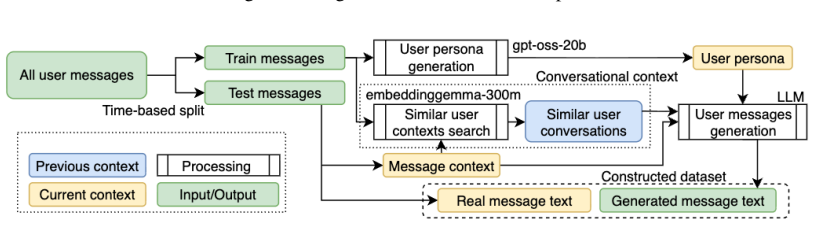
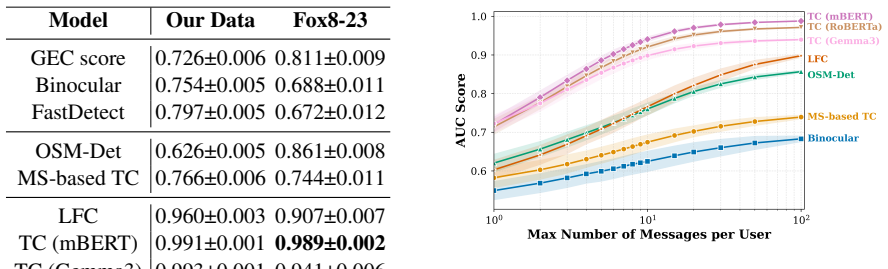
Using an adversarial methodology that models the impersonation of real social media users by malicious actors, we curate a multilingual, cross-platform dataset of paired human and AI-generated messages. Training on such adversarial data yields accurate detection of AI-generated text, significantly outperforming existing models for content-based bot detection in real-world, out-of-distribution data.
What carries the argument
The adversarial methodology that models malicious impersonation of real users to generate paired human-AI message datasets for training detectors.
If this is right
- Detectors trained this way accurately identify AI-generated text.
- Performance holds on real-world out-of-distribution data.
- The approach outperforms existing content-based bot detection models.
- The method applies across languages and platforms.
Where Pith is reading between the lines
- Similar adversarial pairing could improve detection in other text domains like reviews or news.
- As language models advance, the methodology may need periodic updates to maintain effectiveness.
- Combining this content-based detection with network or behavioral signals could yield stronger bot identification systems.
Load-bearing premise
The way the adversarial methodology generates AI content accurately reflects how real malicious actors would use AI to impersonate users on social platforms.
What would settle it
Running the trained detector on a collection of messages known to be generated by actual AI-using social bots and observing low detection accuracy would falsify the claim that the approach works in real-world conditions.
Figures


read the original abstract
The convergence of large language models and social bots allows malicious actors to manipulate the information ecosystem by generating human-like content at scale. Existing models for detecting AI-generated content often fail in the wild, primarily due to the lack of ground-truth data. We address this gap through an adversarial methodology that models the impersonation of real social media users by malicious actors. Using this methodology, we curate a multilingual, cross-platform dataset of paired human and AI-generated messages. Training on such adversarial data yields accurate detection of AI-generated text. Our approach significantly outperforms existing models for content-based bot detection in real-world, out-of-distribution data.
Editorial analysis
A structured set of objections, weighed in public.
Referee Report
Summary. The paper introduces an adversarial methodology to model malicious impersonation of real social media users, using it to curate a multilingual cross-platform dataset of paired human and AI-generated messages. It claims that detectors trained on this adversarial data achieve accurate detection of AI-generated text and significantly outperform existing models on real-world out-of-distribution data.
Significance. If the empirical claims hold, the work would be significant for addressing the lack of ground-truth paired data in AI-generated content detection for social bots, a pressing issue in combating information manipulation. The dataset and methodology could provide a reusable resource for training more robust detectors.
major comments (2)
- [Abstract] Abstract: the central claim that the approach 'significantly outperforms existing models for content-based bot detection in real-world, out-of-distribution data' is asserted without any quantitative results, dataset sizes, baselines, or statistical details, preventing evaluation of the data-to-claim link.
- [Methodology] The load-bearing assumption that the adversarial methodology accurately models real malicious impersonation strategies (as stated in the abstract) is not supported by evidence that the generation procedure incorporates platform constraints, user-specific history, iterative evasion, or cross-message consistency; without this, OOD generalization may not transfer beyond the synthetic pairing process.
Simulated Author's Rebuttal
We thank the referee for their thoughtful review and constructive suggestions. We address each major comment below and outline the revisions we will make to strengthen the manuscript.
read point-by-point responses
-
Referee: [Abstract] Abstract: the central claim that the approach 'significantly outperforms existing models for content-based bot detection in real-world, out-of-distribution data' is asserted without any quantitative results, dataset sizes, baselines, or statistical details, preventing evaluation of the data-to-claim link.
Authors: We agree that the abstract would benefit from including quantitative highlights to better support the central claim. In the revised manuscript, we will update the abstract to incorporate key metrics (e.g., accuracy improvements and F1 scores on OOD test sets), dataset sizes, and a brief mention of the primary baselines used. revision: yes
-
Referee: [Methodology] The load-bearing assumption that the adversarial methodology accurately models real malicious impersonation strategies (as stated in the abstract) is not supported by evidence that the generation procedure incorporates platform constraints, user-specific history, iterative evasion, or cross-message consistency; without this, OOD generalization may not transfer beyond the synthetic pairing process.
Authors: The methodology conditions AI generation on real user message histories to capture user-specific stylistic patterns, which forms the core of the impersonation simulation. However, we acknowledge that the current description does not explicitly detail iterative evasion loops or platform-specific formatting constraints. We will expand the methodology section to clarify these design choices, discuss their relation to real-world impersonation, and note limitations regarding cross-message consistency. revision: partial
Circularity Check
No significant circularity; empirical dataset curation and OOD testing are self-contained.
full rationale
The paper's core contribution is an empirical pipeline: an adversarial methodology is used to curate a paired human/AI message dataset, models are trained on it, and performance is measured on real-world out-of-distribution data. No equations, predictions, or first-principles derivations are presented that reduce to their own inputs by construction. The approach contains no self-definitional steps, fitted-input-as-prediction artifacts, or load-bearing self-citation chains; the claims rest on experimental results rather than analytic equivalence to the inputs.
Axiom & Free-Parameter Ledger
axioms (1)
- domain assumption Adversarial impersonation of real users produces AI content sufficiently similar to real malicious bot activity for training purposes
Reference graph
Works this paper leans on
-
[1]
The spread of low-credibility content by social bots , url =
Shao, Chengcheng and Ciampaglia, Giovanni Luca and Varol, Onur and Yang, Kaicheng and Flammini, Alessandro and Menczer, Filippo , doi =. The spread of low-credibility content by social bots , url =. Nature Communications , pages =
-
[2]
Characteristics and prevalence of fake social media profiles with AI-generated faces , url =
Kai-Cheng Yang and Danishjeet Singh and Filippo Menczer , doi =. Characteristics and prevalence of fake social media profiles with AI-generated faces , url =. Journal of Online Trust and Safety , number =
-
[3]
Science , number =
Schroeder, Daniel Thilo and Meeyoung Cha and Andrea Baronchelli and Nick Bostrom and Nicholas Christakis and David Garcia and Amit Goldenberg and Yara Kyrychenko and Kevin Leyton-Brown and Nina Lutz and Gary Marcus and Filippo Menczer and Gordon Pennycook and David Rand and Frank Schweitzer and Christopher Summerfield and Audrey Tang and Van Bavel, Jay J ...
-
[4]
Aho and Jeffrey D
Alfred V. Aho and Jeffrey D. Ullman , title =. 1972
1972
-
[5]
Publications Manual , year = "1983", publisher =
1983
-
[6]
Ashok K. Chandra and Dexter C. Kozen and Larry J. Stockmeyer , year = "1981", title =. doi:10.1145/322234.322243
-
[7]
Scalable training of
Andrew, Galen and Gao, Jianfeng , booktitle=. Scalable training of
-
[8]
Dan Gusfield , title =. 1997
1997
-
[9]
A Framework for Learning Predictive Structures from Multiple Tasks and Unlabeled Data , Volume =
Ando, Rie Kubota and Zhang, Tong , Issn =. A Framework for Learning Predictive Structures from Multiple Tasks and Unlabeled Data , Volume =. Journal of Machine Learning Research , Month = dec, Numpages =
-
[10]
Chang, Jonathan P. and Chiam, Caleb and Fu, Liye and Wang, Andrew and Zhang, Justine and Danescu-Niculescu-Mizil, Cristian. C onvo K it: A Toolkit for the Analysis of Conversations. Proceedings of the 21th Annual Meeting of the Special Interest Group on Discourse and Dialogue. 2020. doi:10.18653/v1/2020.sigdial-1.8
-
[11]
Koncar, Philipp and Walk, Simon and Helic, Denis , title =. 2021 , isbn =. doi:10.1145/3447535.3462481 , booktitle =
-
[12]
Ukrainians Increasingly Rely on Telegram Channels for News and Information During Wartime , year =
-
[13]
La Morgia, Massimo and Mei, Alessandro and Mongardini, Alberto Maria , title =. 2025 , isbn =. doi:10.1145/3690624.3709397 , booktitle =
-
[14]
Proceedings of the 2024 Conference on Empirical Methods in Natural Language Processing: Industry Track , pages=
mGTE: Generalized Long-Context Text Representation and Reranking Models for Multilingual Text Retrieval , author=. Proceedings of the 2024 Conference on Empirical Methods in Natural Language Processing: Industry Track , pages=
2024
-
[15]
Bag of Tricks for Efficient Text Classification
Joulin, Armand and Grave, Edouard and Bojanowski, Piotr and Mikolov, Tomas. Bag of Tricks for Efficient Text Classification. Proceedings of the 15th Conference of the E uropean Chapter of the Association for Computational Linguistics: Volume 2, Short Papers. 2017
2017
-
[16]
Proceedings of the International AAAI Conference on Web and Social Media , author=
The Pushshift Reddit Dataset , volume=. Proceedings of the International AAAI Conference on Web and Social Media , author=. 2020 , month=. doi:10.1609/icwsm.v14i1.7347 , number=
-
[17]
2024 , eprint=
How Well Can LLMs Echo Us? Evaluating AI Chatbots' Role-Play Ability with ECHO , author=. 2024 , eprint=
2024
-
[18]
2024 , eprint=
Under the Surface: Tracking the Artifactuality of LLM-Generated Data , author=. 2024 , eprint=
2024
-
[19]
A Survey on LLM -Generated Text Detection: Necessity, Methods, and Future Directions
Wu, Junchao and Yang, Shu and Zhan, Runzhe and Yuan, Yulin and Chao, Lidia Sam and Wong, Derek Fai , title =. Computational Linguistics , volume =. 2025 , month =. doi:10.1162/coli_a_00549 , url =
-
[20]
Proceedings of the 41st ICML , articleno =
Hans, Abhimanyu and Schwarzschild, Avi and Cherepanova, Valeriia and Kazemi, Hamid and Saha, Aniruddha and Goldblum, Micah and Geiping, Jonas and Goldstein, Tom , title =. Proceedings of the 41st ICML , articleno =. 2024 , publisher =
2024
-
[21]
The Twelfth International Conference on Learning Representations , year=
Fast-DetectGPT: Efficient Zero-Shot Detection of Machine-Generated Text via Conditional Probability Curvature , author=. The Twelfth International Conference on Learning Representations , year=
-
[22]
A Survey on Detection of LLM s-Generated Content
Yang, Xianjun and Pan, Liangming and Zhao, Xuandong and Chen, Haifeng and Petzold, Linda Ruth and Wang, William Yang and Cheng, Wei. A Survey on Detection of LLM s-Generated Content. Findings of the Association for Computational Linguistics: EMNLP 2024. 2024. doi:10.18653/v1/2024.findings-emnlp.572
-
[23]
and Yang, Shu and Liu, Xuebo and Chao, Lidia S
Wu, Junchao and Zhan, Runzhe and Wong, Derek F. and Yang, Shu and Liu, Xuebo and Chao, Lidia S. and Zhang, Min. Who Wrote This? The Key to Zero-Shot LLM -Generated Text Detection Is GECS core. Proceedings of the 31st International Conference on Computational Linguistics. 2025
2025
-
[24]
Learning to Rewrite: Generalized LLM -Generated Text Detection
Hao, Wei and Li, Ran and Zhao, Weiliang and Yang, Junfeng and Mao, Chengzhi. Learning to Rewrite: Generalized LLM -Generated Text Detection. Proceedings of the 63rd Annual Meeting of the Association for Computational Linguistics (Volume 1: Long Papers). 2025. doi:10.18653/v1/2025.acl-long.322
-
[25]
Youden, W. J. , title =. Cancer , volume =. doi:https://doi.org/10.1002/1097-0142(1950)3:1<32::AID-CNCR2820030106>3.0.CO;2-3 , url =. https://acsjournals.onlinelibrary.wiley.com/doi/pdf/10.1002/1097-0142 year =
-
[26]
WETB ench: A Benchmark for Detecting Task-Specific Machine-Generated Text on W ikipedia
Quaremba, Gerrit and Black, Elizabeth and Vrandecic, Denny and Simperl, Elena. WETB ench: A Benchmark for Detecting Task-Specific Machine-Generated Text on W ikipedia. Proceedings of the 2nd Workshop on Advancing Natural Language Processing for Wikipedia (WikiNLP 2025). 2025. doi:10.18653/v1/2025.wikinlp-1.6
-
[27]
M ulti S ocial: Multilingual Benchmark of Machine-Generated Text Detection of Social-Media Texts
Macko, Dominik and Kop \'a l, Jakub and Moro, Robert and Srba, Ivan. M ulti S ocial: Multilingual Benchmark of Machine-Generated Text Detection of Social-Media Texts. Proceedings of the 63rd Annual Meeting of the Association for Computational Linguistics (Volume 1: Long Papers). 2025. doi:10.18653/v1/2025.acl-long.36
-
[28]
Lee, Bruce W. and Lee, Jason. LFTK : Handcrafted Features in Computational Linguistics. Proceedings of the 18th Workshop on Innovative Use of NLP for Building Educational Applications (BEA 2023). 2023. doi:10.18653/v1/2023.bea-1.1
-
[29]
Anna Veronika Dorogush and Andrey Gulin and Gleb Gusev and Nikita Kazeev and Liudmila Ostroumova Prokhorenkova and Aleksandr Vorobev , title =. CoRR , volume =. 2017 , url =. 1706.09516 , timestamp =
Pith/arXiv arXiv 2017
-
[30]
An Open Multilingual System for Scoring Readability of W ikipedia
Trokhymovych, Mykola and Sen, Indira and Gerlach, Martin. An Open Multilingual System for Scoring Readability of W ikipedia. Proceedings of the 62nd Annual Meeting of the Association for Computational Linguistics (Volume 1: Long Papers). 2024. doi:10.18653/v1/2024.acl-long.342
-
[31]
Signature verification using a
Bromley, Jane and Guyon, Isabelle and LeCun, Yann and S\". Signature verification using a "Siamese" time delay neural network , year =. Proceedings of the 7th International Conference on Neural Information Processing Systems , pages =
-
[32]
Proceedings of the 58th Annual Meeting of the Association for Computational Linguistics , pages =
Conneau, Alexis and Khandelwal, Kartikay and Goyal, Naman and Chaudhary, Vishrav and Wenzek, Guillaume and Guzm \'a n, Francisco and Grave, Edouard and Ott, Myle and Zettlemoyer, Luke and Stoyanov, Veselin. Unsupervised Cross-lingual Representation Learning at Scale. Proceedings of the 58th Annual Meeting of the Association for Computational Linguistics. ...
-
[33]
BERT : Pre-training of Deep Bidirectional Transformers for Language Understanding
Devlin, Jacob and Chang, Ming-Wei and Lee, Kenton and Toutanova, Kristina. BERT : Pre-training of Deep Bidirectional Transformers for Language Understanding. Proceedings of the 2019 Conference of the North A merican Chapter of the Association for Computational Linguistics: Human Language Technologies, Volume 1 (Long and Short Papers). 2019. doi:10.18653/v...
-
[34]
Tibshirani.An Introduction to the Bootstrap
An Introduction to the Bootstrap , author =. 1994 , publisher =. doi:10.1201/9780429246593 , isbn =
-
[35]
Kai-Cheng Yang and Onur Varol and Alexander C. Nwala and Mohsen Sayyadiharikandeh and Emilio Ferrara and Alessandro Flammini and Filippo Menczer , booktitle =. Social Bots: Detection and Challenges , url =. doi:10.4337/9781802207309.00049 , editor =
-
[36]
The rise of social bots , url =
Emilio Ferrara and Onur Varol and Clayton Davis and Filippo Menczer and Alessandro Flammini , doi =. The rise of social bots , url =. Comm. ACM , number =
-
[37]
Scientific Reports , year=
A global comparison of social media bot and human characteristics , author=. Scientific Reports , year=
-
[38]
Proceedings of the International AAAI Conference on Web and Social Media , author=
Online Human-Bot Interactions: Detection, Estimation, and Characterization , volume=. Proceedings of the International AAAI Conference on Web and Social Media , author=. 2017 , month=. doi:10.1609/icwsm.v11i1.14871 , number=
-
[39]
Detecting Automation of Twitter Accounts: Are You a Human, Bot, or Cyborg? , year=
Chu, Zi and Gianvecchio, Steven and Wang, Haining and Jajodia, Sushil , journal=. Detecting Automation of Twitter Accounts: Are You a Human, Bot, or Cyborg? , year=
-
[40]
Davis, Clayton Allen and Varol, Onur and Ferrara, Emilio and Flammini, Alessandro and Menczer, Filippo , title =. 2016 , isbn =. doi:10.1145/2872518.2889302 , booktitle =
-
[41]
Botometer 101: Social bot practicum for computational social scientists , url =
Yang, Kai-Cheng and Ferrara, Emilio and Menczer, Filippo , doi =. Botometer 101: Social bot practicum for computational social scientists , url =. Journal of Computational Social Science , pages =
-
[42]
and Ferrara, Emilio and Flammini, Alessandro and Menczer, Filippo , title =
Yang, Kai-Cheng and Varol, Onur and Davis, Clayton A. and Ferrara, Emilio and Flammini, Alessandro and Menczer, Filippo , title =. Human Behavior and Emerging Technologies , volume =. doi:https://doi.org/10.1002/hbe2.115 , url =. https://onlinelibrary.wiley.com/doi/pdf/10.1002/hbe2.115 , year =
-
[43]
Anatomy of an AI-powered malicious social botnet , volume=
Yang, Kai-Cheng and Menczer, Filippo , year=. Anatomy of an AI-powered malicious social botnet , volume=. doi:10.51685/jqd.2024.icwsm.7 , journal=
-
[44]
Ferrara, Emilio , year=. GenAI against humanity: nefarious applications of generative artificial intelligence and large language models , volume=. Journal of Computational Social Science , publisher=. doi:10.1007/s42001-024-00250-1 , number=
-
[45]
Tang, Ruixiang and Chuang, Yu-Neng and Hu, Xia , title =. Commun. ACM , month = mar, pages =. 2024 , issue_date =. doi:10.1145/3624725 , abstract =
-
[46]
Brown, Tom B. and Mann, Benjamin and Ryder, Nick and Subbiah, Melanie and Kaplan, Jared and Dhariwal, Prafulla and Neelakantan, Arvind and Shyam, Pranav and Sastry, Girish and Askell, Amanda and Agarwal, Sandhini and Herbert-Voss, Ariel and Krueger, Gretchen and Henighan, Tom and Child, Rewon and Ramesh, Aditya and Ziegler, Daniel M. and Wu, Jeffrey and W...
2020
-
[47]
Transformers: State-of-the-Art Natural Language Processing
Wolf, Thomas and Debut, Lysandre and Sanh, Victor and Chaumond, Julien and Delangue, Clement and Moi, Anthony and Cistac, Pierric and Rault, Tim and Louf, Remi and Funtowicz, Morgan and Davison, Joe and Shleifer, Sam and von Platen, Patrick and Ma, Clara and Jernite, Yacine and Plu, Julien and Xu, Canwen and Le Scao, Teven and Gugger, Sylvain and Drame, M...
-
[48]
An Empirical Analysis of the Writing Styles of Persona-Assigned LLM s
Malik, Manuj and Jiang, Jing and Chai, Kian Ming A. An Empirical Analysis of the Writing Styles of Persona-Assigned LLM s. Proceedings of the 2024 Conference on Empirical Methods in Natural Language Processing. 2024. doi:10.18653/v1/2024.emnlp-main.1079
-
[49]
2024 , eprint=
Towards Realistic Synthetic User-Generated Content: A Scaffolding Approach to Generating Online Discussions , author=. 2024 , eprint=
2024
-
[50]
Are We in the AI -Generated Text World Already? Quantifying and Monitoring AIGT on Social Media
Sun, Zhen and Zhang, Zongmin and Shen, Xinyue and Zhang, Ziyi and Liu, Yule and Backes, Michael and Zhang, Yang and He, Xinlei. Are We in the AI -Generated Text World Already? Quantifying and Monitoring AIGT on Social Media. Proceedings of the 63rd Annual Meeting of the Association for Computational Linguistics (Volume 1: Long Papers). 2025. doi:10.18653/...
-
[51]
Xinlei He and Xinyue Shen and Zeyuan Chen and Michael Backes and Yang Zhang , title =
-
[52]
M 4 GT -Bench: Evaluation Benchmark for Black-Box Machine-Generated Text Detection
Wang, Yuxia and Mansurov, Jonibek and Ivanov, Petar and Su, Jinyan and Shelmanov, Artem and Tsvigun, Akim and Mohammed Afzal, Osama and Mahmoud, Tarek and Puccetti, Giovanni and Arnold, Thomas and Aji, Alham and Habash, Nizar and Gurevych, Iryna and Nakov, Preslav. M 4 GT -Bench: Evaluation Benchmark for Black-Box Machine-Generated Text Detection. Proceed...
-
[53]
MULTITuDE: Large-Scale Multilingual Machine-Generated Text Detection Benchmark , url=
Macko, Dominik and Moro, Robert and Uchendu, Adaku and Lucas, Jason and Yamashita, Michiharu and Pikuliak, Matúš and Srba, Ivan and Le, Thai and Lee, Dongwon and Simko, Jakub and Bielikova, Maria , year=. MULTITuDE: Large-Scale Multilingual Machine-Generated Text Detection Benchmark , url=. doi:10.18653/v1/2023.emnlp-main.616 , booktitle=
-
[54]
MA i DE -up: Multilingual Deception Detection of AI -generated Hotel Reviews
Ignat, Oana and Xu, Xiaomeng and Mihalcea, Rada. MA i DE -up: Multilingual Deception Detection of AI -generated Hotel Reviews. Findings of the Association for Computational Linguistics: NAACL 2025. 2025. doi:10.18653/v1/2025.findings-naacl.88
-
[55]
2024 , eprint=
Can AI-Generated Text be Reliably Detected? , author=. 2024 , eprint=
2024
-
[56]
Proceedings of the 40th ICML , pages =
A Watermark for Large Language Models , author =. Proceedings of the 40th ICML , pages =. 2023 , editor =
2023
-
[57]
DNA-GPT: Divergent N-Gram Analysis for Training-Free Detection of GPT-Generated Text , url =
Yang, Xianjun and Cheng, Wei and Wu, Yue and Petzold, Linda and Wang, William and Chen, Haifeng , booktitle =. DNA-GPT: Divergent N-Gram Analysis for Training-Free Detection of GPT-Generated Text , url =
-
[58]
2023 , eprint=
Use of LLMs for Illicit Purposes: Threats, Prevention Measures, and Vulnerabilities , author=. 2023 , eprint=
2023
-
[59]
Position: On the Possibilities of
Chakraborty, Souradip and Bedi, Amrit and Zhu, Sicheng and An, Bang and Manocha, Dinesh and Huang, Furong , booktitle =. Position: On the Possibilities of. 2024 , editor =
2024
-
[60]
2025 , url=
Quan Shi and Carlos E Jimenez and Stephen Dong and Brian Seo and Caden Yao and Adam Kelch and Karthik R Narasimhan , booktitle=. 2025 , url=
2025
-
[61]
Proceedings of the 7th Annual Collaboration, Electronic Messaging, Anti-Abuse and Spam Conference (CEAS) , year =
Detecting Spammers on Twitter , author =. Proceedings of the 7th Annual Collaboration, Electronic Messaging, Anti-Abuse and Spam Conference (CEAS) , year =
-
[62]
Do humans identify AI-generated text better than machines? Evidence based on excerpts from German theses , journal =. 2025 , issn =. doi:https://doi.org/10.1016/j.iree.2025.100321 , url =
-
[63]
M4: Multi-generator, Multi-domain, and Multi-lingual Black-Box Machine-Generated Text Detection
Wang, Yuxia and Mansurov, Jonibek and Ivanov, Petar and Su, Jinyan and Shelmanov, Artem and Tsvigun, Akim and Whitehouse, Chenxi and Mohammed Afzal, Osama and Mahmoud, Tarek and Sasaki, Toru and Arnold, Thomas and Aji, Alham Fikri and Habash, Nizar and Gurevych, Iryna and Nakov, Preslav. M4: Multi-generator, Multi-domain, and Multi-lingual Black-Box Machi...
-
[64]
and Japkowicz, Nathalie and Viktor, Herna L
Crothers, Evan N. and Japkowicz, Nathalie and Viktor, Herna L. , journal=. Machine-Generated Text: A Comprehensive Survey of Threat Models and Detection Methods , year=
-
[65]
Proceedings of the 2022 ACM Conference on Fairness, Accountability, and Transparency , pages =
Weidinger, Laura and Uesato, Jonathan and Rauh, Maribeth and Griffin, Conor and Huang, Po-Sen and Mellor, John and Glaese, Amelia and Cheng, Myra and Balle, Borja and Kasirzadeh, Atoosa and Biles, Courtney and Brown, Sasha and Kenton, Zac and Hawkins, Will and Stepleton, Tom and Birhane, Abeba and Hendricks, Lisa Anne and Rimell, Laura and Isaac, William ...
-
[66]
Edward J Hu and yelong shen and Phillip Wallis and Zeyuan Allen-Zhu and Yuanzhi Li and Shean Wang and Lu Wang and Weizhu Chen , booktitle=. Lo. 2022 , url=
2022
discussion (0)
Sign in with ORCID, Apple, or X to comment. Anyone can read and Pith papers without signing in.