Infinite-Level Hierarchy of Solvable Quantum Circuits
Pith reviewed 2026-06-26 07:56 UTC · model grok-4.3
The pith
An infinite hierarchy of solvability conditions extends dual-unitary circuits so that correlations and entanglement can be computed exactly across all spacetime.
A machine-rendered reading of the paper's core claim, the machinery that carries it, and where it could break.
Core claim
We present an infinite hierarchy of solvability conditions remedying this problem. These new conditions can be combined with the generalized dual-unitary hierarchy to obtain circuits for which correlation functions and entanglement dynamics can be analyzed exactly in the whole spacetime. We show that this novel hierarchy possesses non-trivial solutions at every level.
What carries the argument
the infinite hierarchy of solvability conditions that can be imposed together with generalized dual-unitary conditions while preserving exact solvability throughout spacetime
If this is right
- Correlation functions become exactly computable everywhere in space and time.
- Entanglement dynamics become exactly computable everywhere in space and time.
- Non-trivial solutions exist at every level of the new hierarchy.
- The construction yields exactly solvable non-integrable circuits with more general properties than before.
Where Pith is reading between the lines
- The hierarchy could be used to generate families of circuits with controllable degrees of solvability for testing numerical methods.
- Similar hierarchies might be constructible for other circuit architectures or for open-system dynamics.
- The existence of solutions at all levels suggests that the set of exactly solvable circuits is larger than previously known.
Load-bearing premise
The new solvability conditions can be imposed simultaneously with the generalized dual-unitary conditions while retaining exact solvability throughout spacetime and admitting non-trivial solutions at arbitrarily high levels.
What would settle it
A concrete circuit satisfying the combined conditions up to some level for which a two-point correlation function cannot be computed exactly in the full spacetime would falsify the claim.
Figures

read the original abstract
Dual-unitary circuits have emerged as a paradigm of exactly solvable yet non-integrable quantum dynamics. Recently, a generalization of dual unitarity attempting to extend the phenomenology of exactly solvable circuits has been introduced through a hierarchy of conditions, with dual unitarity as the first level. However, beyond the second level the proposed generalized dual-unitary hierarchy ceases to be solvable in the whole spacetime. We present an infinite hierarchy of solvability conditions remedying this problem. These new conditions can be combined with the generalized dual-unitary hierarchy to obtain circuits for which correlation functions and entanglement dynamics can be analyzed exactly in the whole spacetime. We show that this novel hierarchy possesses non-trivial solutions at every level. Our results demonstrate that dual unitarity can be systematically extended while preserving solvability, opening up investigations of exactly solvable non-integrable systems with more general properties.
Editorial analysis
A structured set of objections, weighed in public.
Referee Report
Summary. The manuscript introduces an infinite hierarchy of solvability conditions for quantum circuits that remedies the limitation of the generalized dual-unitary hierarchy (which loses whole-spacetime solvability beyond level 2). These new conditions can be imposed simultaneously with the generalized dual-unitary hierarchy to produce circuits in which all spacetime correlation functions and entanglement dynamics remain exactly computable; the authors further claim and demonstrate that this combined hierarchy admits non-trivial solutions at every level.
Significance. If the central claims hold, the work provides a systematic extension of the dual-unitary paradigm while preserving exact solvability throughout spacetime. This would enlarge the set of exactly solvable non-integrable circuits and enable controlled studies of entanglement and correlation dynamics under more general local gates than previously accessible.
major comments (2)
- [§4] §4 (Construction of solutions): The explicit parametrization used to obtain non-trivial solutions at arbitrary hierarchy levels must be checked against the simultaneous imposition of the generalized dual-unitary conditions; it is not immediately clear from the derivation whether the resulting gates remain non-Clifford and non-product for levels >3 while still satisfying the full set of spacetime-solvability constraints.
- [§3.2] §3.2, Eq. (17)–(19): The proof that the new solvability conditions commute with the generalized dual-unitary constraints and preserve whole-spacetime exactness relies on an inductive argument; however, the base case and inductive step do not explicitly verify that the light-cone structure remains intact when both hierarchies are truncated at finite but arbitrary depth.
minor comments (2)
- Notation for the new hierarchy levels (e.g., S_k versus the existing D_k) should be introduced with a clear comparison table to avoid confusion with the generalized dual-unitary notation.
- Figure 2 caption should state the bond dimension and the precise truncation level at which the plotted correlation functions are computed.
Simulated Author's Rebuttal
We thank the referee for their careful reading of the manuscript and for the constructive comments. We address each major comment below, providing clarifications and indicating revisions that will be incorporated to improve the presentation.
read point-by-point responses
-
Referee: [§4] §4 (Construction of solutions): The explicit parametrization used to obtain non-trivial solutions at arbitrary hierarchy levels must be checked against the simultaneous imposition of the generalized dual-unitary conditions; it is not immediately clear from the derivation whether the resulting gates remain non-Clifford and non-product for levels >3 while still satisfying the full set of spacetime-solvability constraints.
Authors: The parametrization in §4 is obtained by successively solving the new solvability conditions while enforcing the generalized dual-unitary constraints at each step; the resulting two-qubit gates are constructed from a family of local unitaries whose parameters are chosen to avoid both the product and Clifford limits. Explicit verification for levels 3 and 4 confirms that the gates remain non-product and non-Clifford while satisfying the combined constraints, and the algebraic structure of the hierarchy ensures this pattern persists at higher levels. To make the verification fully transparent we will add a short appendix containing the explicit matrix forms and a brief argument for the general case. revision: yes
-
Referee: [§3.2] §3.2, Eq. (17)–(19): The proof that the new solvability conditions commute with the generalized dual-unitary constraints and preserve whole-spacetime exactness relies on an inductive argument; however, the base case and inductive step do not explicitly verify that the light-cone structure remains intact when both hierarchies are truncated at finite but arbitrary depth.
Authors: The base case (level 1) is ordinary dual unitarity, which manifestly preserves the light-cone structure. Each inductive step augments the gate with additional local constraints that act only inside the already-established light cone; because the new conditions are imposed on the same two-qubit blocks that define the causal structure, the light-cone boundaries remain unchanged at every finite truncation. Nevertheless, we agree that an explicit sentence confirming this invariance for arbitrary finite depth would remove any ambiguity. We will revise the inductive argument in §3.2 to include this statement. revision: yes
Circularity Check
No circularity detected in the hierarchy construction
full rationale
The paper defines a new infinite hierarchy of solvability conditions explicitly to remedy limitations in the generalized dual-unitary hierarchy, then states that these can be combined while preserving whole-spacetime solvability and demonstrates non-trivial solutions at each level. No quoted step reduces a claimed prediction or uniqueness result to a fitted parameter, self-referential definition, or load-bearing self-citation whose content is itself unverified within the paper. The central claims rest on explicit construction and verification rather than renaming or smuggling prior ansatzes, making the derivation self-contained against external benchmarks.
Axiom & Free-Parameter Ledger
Forward citations
Cited by 1 Pith paper
-
Exact subsystem dynamics in the deterministic Floquet-PXP model
Rule 201 in the deterministic Floquet-PXP model admits exact finite-dimensional MPO influence matrices for subsystem dynamics that solve algebraic conditions.
Reference graph
Works this paper leans on
-
[1]
Now, any path that connects the initial and final operator and contains only steps of heightℎ=1and𝑤≤ 𝑘−1corresponds to a possible reduced form of the diagram Eq
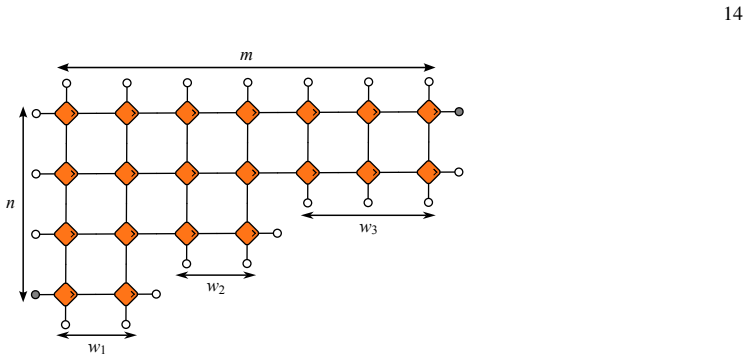
In a FDU𝑘circuit, the maximum possible step width is given by𝑘−1. Now, any path that connects the initial and final operator and contains only steps of heightℎ=1and𝑤≤ 𝑘−1corresponds to a possible reduced form of the diagram Eq. (10). Let us call𝑎 𝑗 the number of steps of width𝑗. The total height and width of the diagram yield the consistency conditions 𝑛=...
-
[2]
Thin path domain Let us first analyze the correlator in the thin path domain
Dynamical correlation functions a. Thin path domain Let us first analyze the correlator in the thin path domain. The crucial insight is the following: when reducing the diagram using the DU∗𝑘condition or any of the DU ∗ℓconditions with𝑘 < ℓ, the boundaries of the diagram acquires a particular shape. For concreteness, we start the reduction from the bottom...
-
[3]
These maximize the number of steps of width𝑘−1
Entanglement line tension In the computation of𝑍 𝛼 for FDU𝑘circuits, the𝑎 𝑗 satisfy the consistency conditions 𝑚= 𝑘−1∑︁ 𝑗=1 𝑗 𝑎𝑗 , 𝑛= 𝑘−1∑︁ 𝑗=1 𝑎 𝑗 .(B4) To obtain a particularly simple expression where the diagram is disconnected as much as possible we are interested in finding extremal paths. These maximize the number of steps of width𝑘−1. As we only wa...
-
[4]
Two-qubit Clifford gates map the two-qubit Pauli group, P2 := {𝐼, 𝑋, 𝑌 , 𝑍 }⊗2, to itself under conjugation, where𝑋, 𝑌 ,and𝑍are the2×2Pauli matrices [43]
No-go for FDU3 Clifford gates in prime dimensions We first establish the absence of FDU3 gates for qubit gates. Two-qubit Clifford gates map the two-qubit Pauli group, P2 := {𝐼, 𝑋, 𝑌 , 𝑍 }⊗2, to itself under conjugation, where𝑋, 𝑌 ,and𝑍are the2×2Pauli matrices [43]. There are 11520 two-qubit Clifford gates and numerically we found that the number of gates...
-
[5]
For the two-ququart case (C4 ⊗C 4) using the isomorphismC 4 ⊗C 4 ≡C 2 ⊗C 2 ⊗C 2 ⊗C 2, we sample the Clifford gates from the four-qubit Clifford group
FDU3 Clifford gates in nonprime dimensions For prime-power dimensions such as𝑞=4, the Clifford group can be defined in different ways. For the two-ququart case (C4 ⊗C 4) using the isomorphismC 4 ⊗C 4 ≡C 2 ⊗C 2 ⊗C 2 ⊗C 2, we sample the Clifford gates from the four-qubit Clifford group. Unlike the smaller dimensions discussed above, for𝑞=4we are able to obt...
-
[6]
1. . . . .−𝑖 . . .−𝑖 . . . 𝑖 . . . 𝑖 .−1. . .−1. . . 𝑖 . . . 𝑖 . . . . .−1. . .−1. . .1. . .1.−𝑖 . . .−𝑖 . . . . .−𝑖 . . . 𝑖 .1. . .−1. . . −1. . .1. . . . . 𝑖 . . .−𝑖 . . .−1. . .1. 𝑖 . . .−𝑖 . . . −𝑖 . . . 𝑖 . . . . .1. . .−1. ª®®®®®®®®®®®®®®®®®®®®®®®®®® ¬ ,(E1) where the non-zero entries are determined by the fourth roots of unity, {±1,±𝑖 }, and “.” re...
-
[7]
is given by 𝐶2 = 1 2 √ 2 © « .−1. 𝑖1. 𝑖 . 𝑖 .1. . 𝑖 .−1 1.−𝑖 . .−1.−𝑖 . 𝑖 .1𝑖 .−1. 𝑖 .1. .−𝑖 .1.1.−𝑖1. 𝑖 . . 𝑖 .1−𝑖 .1.−1. 𝑖 . .−1.−𝑖 .−1.−𝑖1.−𝑖 .−𝑖 .1. .−𝑖 .−1 −1.−𝑖 . .1.−𝑖 . 𝑖 .−1𝑖 .1. −𝑖 .1. . 𝑖 .1.1. 𝑖1.−𝑖 . . 𝑖 .−1−𝑖 .−1.1. 𝑖 . .1.−𝑖 1.−𝑖 . .1. 𝑖 . 𝑖 .1−𝑖 .1. .1.−𝑖1. 𝑖 .−𝑖 .−1. . 𝑖 .−1 . 𝑖 .1𝑖 .−1.−1. 𝑖 . .1. 𝑖 −𝑖 .−1. .−𝑖 ...
-
[8]
1.−𝑖 .−𝑖 .1𝑖 .1
𝑖 . .1.−𝑖 .−𝑖 .1𝑖 .1. .−1.−𝑖−1. 𝑖 .−𝑖 .1. . 𝑖 .1 .−𝑖 .1−𝑖 .−1.−1.−𝑖 . .1.−𝑖 −𝑖 .1. .−𝑖 .−1.1. 𝑖−1. 𝑖 . ª®®®®®®®®®®®®®®®®®®®®®®®®®® ¬ ,(E2) where again the non-zero entries are determined by the fourth roots of unity and “.” represents vanishing matrix entries. The action of the Clifford unitary𝐶 2 on the generators of the four-qubit Pauli group is shown i...
-
[9]
Akila, D
M. Akila, D. Waltner, B. Gutkin, and T. Guhr, Particle-time du- ality in the kicked Ising spin chain, J. Phys. Math. Theor.49, 375101 (2016)
2016
-
[10]
Bertini, P
B. Bertini, P. Kos, and T. Prosen, Exact spectral form factor in a minimal model of many-body quantum chaos, Phys. Rev. Lett. 121, 264101 (2018)
2018
-
[11]
Gopalakrishnan and A
S. Gopalakrishnan and A. Lamacraft, Unitary circuits of finite depth and infinite width from quantum channels, Phys. Rev. B 100, 064309 (2019)
2019
-
[12]
Bertini, P
B. Bertini, P. Kos, and T. Prosen, Exact correlation functions for dual-unitary lattice models in1+1dimensions, Phys. Rev. Lett.123, 210601 (2019)
2019
-
[13]
Bertini, P
B. Bertini, P. Kos, and T. Prosen, Entanglement spreading in a minimal model of maximal many-body quantum chaos, Phys. Rev. X9, 021033 (2019)
2019
-
[14]
P. W. Claeys and A. Lamacraft, Maximum velocity quantum circuits, Phys. Rev. Research2, 033032 (2020)
2020
-
[15]
P. W. Claeys and A. Lamacraft, Ergodic and nonergodic dual- unitary quantum circuits with arbitrary local Hilbert space di- mension, Phys. Rev. Lett.126, 100603 (2021). 24
2021
-
[16]
Bertini, P
B. Bertini, P. W. Claeys, and T. Prosen, Exactly solvable quan- tum many-body dynamics from space-time duality, Rev. Mod. Phys.98, 025001 (2026)
2026
-
[17]
Jonay, V
C. Jonay, V . Khemani, and M. Ippoliti, Triunitary quantum cir- cuits, Phys. Rev. Research3, 043046 (2021)
2021
-
[18]
R. M. Milbradt, L. Scheller, C. Aßmus, and C. B. Mendl, Ternary unitary quantum lattice models and circuits in 2+1 di- mensions, Phys. Rev. Lett.130, 090601 (2023)
2023
-
[19]
G. M. Sommers, D. A. Huse, and M. J. Gullans, Crystalline quantum circuits, PRX Quantum4, 030313 (2023)
2023
-
[20]
Mesty ´an, B
M. Mesty ´an, B. Pozsgay, and I. M. Wanless, Multi-directional unitarity and maximal entanglement in spatially symmetric quantum states, SciPost Phys.16, 010 (2024)
2024
-
[21]
X.-H. Yu, Z. Wang, and P. Kos, Hierarchical generalization of dual unitarity, Quantum8, 1260 (2024)
2024
-
[22]
M. A. Rampp, S. A. Rather, and P. W. Claeys, Geometric con- structions of generalized dual-unitary circuits from biunitarity, SciPost Phys.18, 182 (2025)
2025
-
[23]
Breach, B
O. Breach, B. Placke, P. W. Claeys, and S. Parameswaran, Solv- able quantum circuits inTree+1dimensions, PRX Quantum6, 040316 (2025)
2025
-
[24]
M. A. Rampp, S. A. Rather, and P. W. Claeys, Solvable quantum circuits from spacetime lattices, arXiv:2512.15871 (2025)
arXiv 2025
-
[25]
S. H. Pickering and B. Bertini, Asymptotically solvable quan- tum circuits, arXiv:2602.24276 (2026)
arXiv 2026
-
[26]
M. A. Rampp, S. A. Rather, and P. W. Claeys, Entanglement membrane in exactly solvable lattice models, Phys. Rev. Re- search6, 033271 (2024)
2024
-
[27]
Foligno, P
A. Foligno, P. Kos, and B. Bertini, Quantum information spreading in generalized dual-unitary circuits, Phys. Rev. Lett. 132, 250402 (2024)
2024
-
[28]
G. M. Sommers, S. Gopalakrishnan, M. J. Gullans, and D. A. Huse, Zero-temperature entanglement membranes in quantum circuits, Phys. Rev. B110, 064311 (2024)
2024
-
[29]
Liu and W
C. Liu and W. W. Ho, Solvable entanglement dynamics in quan- tum circuits with generalized space-time duality, Phys. Rev. Re- search7, l012011 (2025)
2025
-
[30]
Bertini, C
B. Bertini, C. De Fazio, J. P. Garrahan, and K. Klobas, Exact quench dynamics of the floquet quantum east model at the de- terministic point, Phys. Rev. Lett.132, 120402 (2024)
2024
-
[31]
M. P. Fisher, V . Khemani, A. Nahum, and S. Vijay, Random quantum circuits, Annu. Rev. Condens. Matter Phys.14, 335 (2023)
2023
-
[32]
C. Jonay, D. A. Huse, and A. Nahum, Coarse-grained dynamics of operator and state entanglement, arXiv:1803.00089 (2018)
Pith/arXiv arXiv 2018
-
[33]
Zhou and A
T. Zhou and A. Nahum, Emergent statistical mechanics of en- tanglement in random unitary circuits, Phys. Rev. B99, 174205 (2019)
2019
-
[34]
D. J. Reutter and J. Vicary, Biunitary constructions in quantum information, Higher Structures3, 109 (2019)
2019
-
[35]
P. W. Claeys, A. Lamacraft, and J. Vicary, From dual-unitary to biunitary: a 2-categorical model for exactly-solvable many- body quantum dynamics, Journal of Physics A: Mathematical and Theoretical57, 335301 (2024)
2024
-
[36]
Tadej and K
W. Tadej and K. ˙Zyczkowski, A concise guide to complex hadamard matrices, Open Systems & Information Dynamics 13, 133 (2006)
2006
-
[37]
R. F. Werner, All teleportation and dense coding schemes, Jour- nal of Physics A: Mathematical and General34, 7081 (2001)
2001
-
[38]
Englert and Y
B.-G. Englert and Y . Aharonov, The mean king’s problem: prime degrees of freedom, Physics Letters A284, 1 (2001)
2001
-
[39]
A. Wojcik, A. Grudka, and R. W. Chhajlany, Generation of in- equivalent generalized bell bases, Quantum Information Pro- cessing 2, 201 (2003), arXiv:quant-ph/0305034 [quant-ph]
Pith/arXiv arXiv 2003
-
[40]
Klappenecker and M
A. Klappenecker and M. R ¨otteler, Constructions of mutually unbiased bases, inFinite Fields and Applications(Springer Berlin Heidelberg, 2004) pp. 137–144
2004
-
[41]
Gutkin, P
B. Gutkin, P. Braun, M. Akila, D. Waltner, and T. Guhr, Exact local correlations in kicked chains, Phys. Rev. B102, 174307 (2020)
2020
-
[42]
P. W. Claeys and A. Lamacraft, Emergent quantum state de- signs and biunitarity in dual-unitary circuit dynamics, Quantum 6, 738 (2022)
2022
-
[43]
Prosen, Many-body quantum chaos and dual-unitarity round- a-face, Chaos: An Interdisciplinary Journal of Nonlinear Sci- ence31, 093101 (2021)
T. Prosen, Many-body quantum chaos and dual-unitarity round- a-face, Chaos: An Interdisciplinary Journal of Nonlinear Sci- ence31, 093101 (2021)
2021
-
[44]
Piroli, B
L. Piroli, B. Bertini, J. I. Cirac, and T. Prosen, Exact dynam- ics in dual-unitary quantum circuits, Phys. Rev. B101, 094304 (2020)
2020
-
[45]
Haake, S
F. Haake, S. Gnutzmann, and M. Ku ´s,Quantum Signatures of Chaos(Springer International Publishing, 2018)
2018
-
[46]
D. J. Thouless, Maximum metallic resistance in thin wires, Phys. Rev. Lett.39, 1167 (1977)
1977
-
[47]
B. L. Altshuler and B. I. Shklovskii, Repulsion of energy levels and conductivity of small metal samples, Zh. Eksp. Teor. Fiz 91, 220 (1986)
1986
-
[48]
W. W. Ho and S. Choi, Exact emergent quantum state designs from quantum chaotic dynamics, Phys. Rev. Lett.128, 060601 (2022)
2022
-
[49]
J. S. Cotler, D. K. Mark, H.-Y . Huang, F. Hern ´andez, J. Choi, A. L. Shaw, M. Endres, and S. Choi, Emergent quantum state designs from individual many-body wave functions, PRX Quantum4, 010311 (2023)
2023
-
[50]
M. A. Nielsen, C. M. Dawson, J. L. Dodd, A. Gilchrist, D. Mortimer, T. J. Osborne, M. J. Bremner, A. W. Harrow, and A. Hines, Quantum dynamics as a physical resource, Phys. Rev. A67, 052301 (2003)
2003
-
[51]
Gottesman, Stabilizer codes and quantum error correction (1997), arXiv:quant-ph/9705052 [quant-ph]
D. Gottesman, Stabilizer codes and quantum error correction (1997), arXiv:quant-ph/9705052 [quant-ph]
Pith/arXiv arXiv 1997
-
[52]
Koenig and J
R. Koenig and J. A. Smolin, How to efficiently select an arbi- trary clifford group element, Journal of Mathematical Physics 55, 122202 (2014)
2014
discussion (0)
Sign in with ORCID, Apple, or X to comment. Anyone can read and Pith papers without signing in.