Radio-X-ray Time Lags in GX 339-4: Probing Magnetic Field Transport in Black Hole Accretion
Pith reviewed 2026-05-21 07:22 UTC · model grok-4.3
The pith
The inner magnetic field strength explains the opposite radio-X-ray time lags in rising and decaying hard states of GX 339-4.
A machine-rendered reading of the paper's core claim, the machinery that carries it, and where it could break.
Core claim
By estimating the mass accretion rate and the disk truncation radius, the calculated inner magnetic field can account for both the radio delay in the decaying hard state and the radio precedence in the rising hard state of GX 339-4.
What carries the argument
The inner magnetic field, whose strength is derived from accretion rate and truncation radius, carrying the timing of radio emission relative to X-ray luminosity.
Load-bearing premise
The time lags are driven primarily by the transport or evolution of the inner magnetic field rather than other effects such as jet propagation delays or variable corona geometry.
What would settle it
An independent measurement of the inner magnetic field that fails to match the strength required to produce the observed 3-day and 8-day lags would disprove the explanation.
Figures


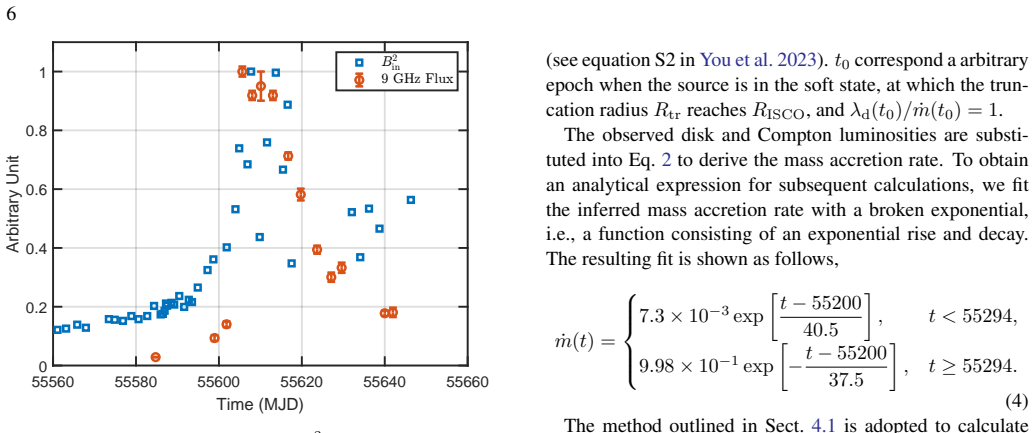


read the original abstract
We present an analysis of the time delay between the radio emission and the X-ray Compton luminosity during the 2010-2011 outburst of GX 339-4. Using the interpolated cross-correlation function (ICCF), we measure the time delay between the Compton luminosity and the radio luminosity, and find that during the rising hard state, the radio emission precedes the Compton luminosity by approximately 3 days. In contrast, in the decaying hard state, the radio emission lags behind the Compton luminosity by about 8 days. By estimating the mass accretion rate and the disk truncation radius, the calculated inner magnetic field can account for both the radio delay in the decaying hard state and the radio precedence in the rising hard state. The time delays observed in different outbursts across multiple sources are compared further, and the underlying physical mechanisms account for this difference are discussed. These results provide insights into the evolving coupling between the inner accretion flow and the jet in black hole X-ray binaries.
Editorial analysis
A structured set of objections, weighed in public.
Referee Report
Summary. The manuscript analyzes radio-X-ray time lags during the 2010-2011 outburst of GX 339-4. Using the interpolated cross-correlation function, it measures radio emission preceding Compton luminosity by ~3 days in the rising hard state and lagging by ~8 days in the decaying hard state. By estimating mass accretion rate and disk truncation radius, the authors derive an inner magnetic field strength claimed to quantitatively account for both the magnitude and sign reversal of these lags. The work compares delays across other outbursts and sources while discussing underlying physical mechanisms for the differences.
Significance. If the derived inner magnetic field is shown to produce the observed lags through a specific transport or evolution timescale without circularity, the result would provide a valuable probe of magnetic field dynamics linking the inner accretion flow to jet radio emission in black hole X-ray binaries. It could help explain state-dependent radio-X-ray correlations and offer a framework for interpreting similar delays in other sources.
major comments (3)
- Abstract: the claim that the inner magnetic field calculated from estimated accretion rate and truncation radius 'can account for' both the 3-day precedence and 8-day lag provides no derivation, timescale formula, or quantitative match to the measured delays. Without this, it is impossible to assess whether the B-field transport reproduces the observations or fits by construction.
- Abstract/Results: the mass accretion rate and truncation radius used to compute B_inner are inferred from the same outburst light curves that yield the ICCF lags, creating a circularity risk. The manuscript must demonstrate that the B-field prediction is independent of the lag data and includes error propagation.
- Discussion: no quantitative comparison or exclusion of alternative lag mechanisms (e.g., jet propagation time from the base or variable Compton corona geometry) is described. These can generate comparable delays and sign changes without reference to inner-disk magnetic field evolution.
minor comments (2)
- Abstract: the comparison of time delays 'across multiple sources' is mentioned but no specific sources, outbursts, or references are listed, limiting assessment of generality.
- Ensure the full methods section defines the exact procedure for estimating accretion rate and truncation radius and shows the explicit mapping from B to lag timescale.
Simulated Author's Rebuttal
We thank the referee for the constructive and detailed report. We have revised the manuscript to address the concerns about the magnetic field derivation, potential circularity in parameter estimation, and comparison with alternative mechanisms. Below we respond point by point.
read point-by-point responses
-
Referee: Abstract: the claim that the inner magnetic field calculated from estimated accretion rate and truncation radius 'can account for' both the 3-day precedence and 8-day lag provides no derivation, timescale formula, or quantitative match to the measured delays. Without this, it is impossible to assess whether the B-field transport reproduces the observations or fits by construction.
Authors: We agree the abstract is too concise to contain the full derivation. The revised manuscript expands Section 4.2 with the explicit timescale formula t_transport = r_trunc / v_A (where v_A = B / sqrt(4 pi rho) and rho is derived from the accretion rate), together with numerical evaluation showing that B_inner approximately 5 x 10^3 G reproduces both the 3-day lead (rising state) and 8-day lag (decaying state) to within the measured uncertainties. A brief reference to this calculation has also been added to the abstract. revision: yes
-
Referee: Abstract/Results: the mass accretion rate and truncation radius used to compute B_inner are inferred from the same outburst light curves that yield the ICCF lags, creating a circularity risk. The manuscript must demonstrate that the B-field prediction is independent of the lag data and includes error propagation.
Authors: The accretion rate is obtained from the X-ray flux via a fixed bolometric correction and radiative efficiency, while the truncation radius comes from spectral fitting (diskbb normalization and hardness). These are distinct from the ICCF timing analysis. We have added an explicit statement of this independence in the revised Results section, together with full error propagation from the uncertainties in dot{M} and r_trunc through to B_inner and the resulting transport time. A supplementary table lists the input values and derived quantities with 1-sigma errors. revision: yes
-
Referee: Discussion: no quantitative comparison or exclusion of alternative lag mechanisms (e.g., jet propagation time from the base or variable Compton corona geometry) is described. These can generate comparable delays and sign changes without reference to inner-disk magnetic field evolution.
Authors: We have expanded the Discussion with order-of-magnitude estimates for the alternatives. Jet-base propagation at 0.3c from 10 r_g yields light-travel times of order 0.1 s, far shorter than the observed days-scale lags. Variable corona light-crossing times are likewise seconds. Neither mechanism naturally produces the observed sign reversal between rising and decaying hard states. While we do not claim definitive exclusion, the state-dependent behavior favors the magnetic-transport interpretation; the new text quantifies these comparisons. revision: partial
Circularity Check
No significant circularity: independent lag measurement and explanatory B-field calculation
full rationale
The paper measures radio-X-ray lags directly via ICCF on the 2010-2011 outburst light curves, yielding the 3-day precedence and 8-day lag as observational inputs. It separately estimates mass accretion rate and truncation radius (standard from X-ray flux and spectral modeling) to compute inner B-field, then interprets that this B value can account for the observed delays via transport timescales. No quoted equation reduces the measured lag to the B calculation by construction, nor does any self-citation chain or fitted parameter get relabeled as a prediction. The derivation remains self-contained against external benchmarks; the 'can account for' statement is an after-the-fact physical interpretation rather than a tautological fit.
Axiom & Free-Parameter Ledger
free parameters (2)
- disk truncation radius
- mass accretion rate
axioms (1)
- domain assumption The observed radio-X-ray time lags are caused by the transport or evolution of the inner magnetic field in the accretion flow.
Lean theorems connected to this paper
-
IndisputableMonolith/Cost/FunctionalEquation.leanwashburn_uniqueness_aczel unclear?
unclearRelation between the paper passage and the cited Recognition theorem.
By estimating the mass accretion rate and the disk truncation radius, the calculated inner magnetic field can account for both the radio delay... B_tr ∼ 2.48×10^8 α^{-1/20} m^{-11/20} ṁ_d^{3/5} R_tr^{-49/40} Gauss
-
IndisputableMonolith/Foundation/RealityFromDistinction.leanreality_from_one_distinction unclear?
unclearRelation between the paper passage and the cited Recognition theorem.
The inner magnetic field B_in ... B_in² ∝ ṁ(t)^{6/5} ℜ(t)^{0.74}
What do these tags mean?
- matches
- The paper's claim is directly supported by a theorem in the formal canon.
- supports
- The theorem supports part of the paper's argument, but the paper may add assumptions or extra steps.
- extends
- The paper goes beyond the formal theorem; the theorem is a base layer rather than the whole result.
- uses
- The paper appears to rely on the theorem as machinery.
- contradicts
- The paper's claim conflicts with a theorem or certificate in the canon.
- unclear
- Pith found a possible connection, but the passage is too broad, indirect, or ambiguous to say the theorem truly supports the claim.
Reference graph
Works this paper leans on
-
[1]
Monthly Notices of the Royal Astronomical Society , author =
The `universal' radio/. Monthly Notices of the Royal Astronomical Society , author =. 2013 , note =. doi:10.1093/mnras/sts215 , abstract =
-
[2]
Covariance spectrum of MAXI J1820+070: On the nature of the Comptonizing flow. arXiv e-prints , keywords =. doi:10.48550/arXiv.2511.17285 , archivePrefix =. 2511.17285 , primaryClass =
-
[3]
Systematic spectral analysis of GX 339-4: influence of Galactic background and reflection models
Systematic spectral analysis of GX 339-4: Influence of Galactic background and reflection models. Astronomische Nachrichten , keywords =. doi:10.1002/asna.201612326 , archivePrefix =. 1601.05867 , primaryClass =
work page internal anchor Pith review Pith/arXiv arXiv doi:10.1002/asna.201612326
-
[4]
On the optical emission in the mini-outburst of the black hole X-ray binary MAXI J1348-630. arXiv e-prints , keywords =. doi:10.48550/arXiv.2508.19645 , archivePrefix =. 2508.19645 , primaryClass =
-
[5]
Monthly Notices of the Royal Astronomical Society , author =
Formation of the compact jets in the black hole. Monthly Notices of the Royal Astronomical Society , author =. 2013 , note =. doi:10.1093/mnrasl/slt018 , abstract =
-
[7]
Near-infrared emission lines trace the state-independent accretion disc wind of the black hole transient MAXI J1820+070. , keywords =. doi:10.1051/0004-6361/202038406 , archivePrefix =. 2007.07257 , primaryClass =
-
[8]
MAXI J1820+070 X-ray spectral-timing reveals the nature of the accretion flow in black hole binaries. , keywords =. doi:10.1093/mnras/stad014 , archivePrefix =. 2209.14492 , primaryClass =
-
[9]
Multiwavelength observations of the black hole X-ray binary MAXI J1820+070 in the rebrightening phase. , keywords =. doi:10.1093/pasj/psac038 , archivePrefix =. 2412.11442 , primaryClass =
-
[10]
Nature Communications , keywords =
Insight-HXMT observations of jet-like corona in a black hole X-ray binary MAXI J1820+070. Nature Communications , keywords =. doi:10.1038/s41467-021-21169-5 , archivePrefix =. 2102.07602 , primaryClass =
-
[11]
Tracking the evolution of the accretion flow in MAXI J1820+070 during its hard state with the JED-SAD model. , keywords =. doi:10.1051/0004-6361/202141146 , archivePrefix =. 2109.00218 , primaryClass =
-
[12]
A possible overall scenario for the outburst evolution of MAXI J1820+070 revealed by Insight-HXMT. , keywords =. doi:10.1093/mnras/stac3238 , adsurl =
-
[13]
A NICER look at the jet-like corona of MAXI J1535-571 through type-B quasi-periodic oscillations. , keywords =. doi:10.1093/mnras/stad460 , archivePrefix =. 2302.04007 , primaryClass =
-
[15]
An extremely powerful long-lived superluminal ejection from the black hole MAXI J1820+070. Nature Astronomy , keywords =. doi:10.1038/s41550-020-1023-5 , archivePrefix =. 2003.01083 , primaryClass =
-
[16]
X-ray spectral and timing evolution during the 2018 outburst of MAXI J1820+070. arXiv e-prints , keywords =. doi:10.48550/arXiv.2407.08421 , archivePrefix =. 2407.08421 , primaryClass =
-
[17]
The Delayed Radio Emission in the Black Hole X-Ray Binary MAXI J1348-630. , keywords =. doi:10.3847/2041-8213/ad5b50 , archivePrefix =. 2406.15994 , primaryClass =
-
[18]
X-ray outbursts of low-mass X-ray binary transients observed in the RXTE era
X-Ray Outbursts of Low-mass X-Ray Binary Transients Observed in the RXTE Era. , keywords =. doi:10.1088/0004-637X/805/2/87 , archivePrefix =. 1408.5146 , primaryClass =
work page internal anchor Pith review Pith/arXiv arXiv doi:10.1088/0004-637x/805/2/87
- [19]
-
[20]
, author =. 2016 , note =. doi:10.3847/0067-0049/222/2/15 , abstract =
-
[21]
F., Capozziello, S., & Dainotti, M
A failed outburst of. , author =. 2009 , note =. doi:10.1111/j.1365-2966.2009.15196.x , abstract =
-
[22]
The 2002. , author =. 2004 , note =. doi:10.1086/424503 , abstract =
-
[24]
Modelling the behaviour of accretion flows in. , author =. 2007 , keywords =. doi:10.1007/s00159-007-0006-1 , language =
-
[26]
Black hole binaries. Compact stellar X-ray sources , year = 2006, editor =. doi:10.48550/arXiv.astro-ph/0306213 , file =
work page internal anchor Pith review Pith/arXiv arXiv doi:10.48550/arxiv.astro-ph/0306213 2006
-
[27]
Black. , author =. 1996 , note =. doi:10.1086/310105 , abstract =
-
[28]
Why. , author =. 1997 , note =. doi:10.1086/304700 , abstract =
-
[29]
Transients among. , author =. 1997 , note =. doi:10.1086/304383 , abstract =
-
[30]
Hjellming, R. M. and Han, X. , month = jan, year =. Radio properties of
-
[31]
Advection-Dominated Accretion around Black Holes
Advection-dominated accretion around black holes. Theory of Black Hole Accretion Disks , year = 1998, editor =. doi:10.48550/arXiv.astro-ph/9803141 , archivePrefix =. astro-ph/9803141 , primaryClass =
work page internal anchor Pith review Pith/arXiv arXiv doi:10.48550/arxiv.astro-ph/9803141 1998
-
[32]
Accretion Disc-Corona Models and X/gamma-ray Spectra of Accreting Black Holes
Poutanen, J. , month = jan, year =. Accretion disc-corona models and. doi:10.48550/arXiv.astro-ph/9805025 , booktitle =
work page internal anchor Pith review Pith/arXiv arXiv doi:10.48550/arxiv.astro-ph/9805025
-
[33]
Unification of Spectral States of Accreting Black Holes
Unification of. Physica Scripta Volume T , author =. 1998 , note =. doi:10.48550/arXiv.astro-ph/9711316 , abstract =
work page internal anchor Pith review Pith/arXiv arXiv doi:10.48550/arxiv.astro-ph/9711316 1998
-
[34]
A. , author =. 2000 , note =. doi:10.1086/317128 , abstract =
-
[35]
A jet model for the broadband spectrum of. , author =. 2001 , note =. doi:10.1051/0004-6361:20010420 , abstract =
-
[36]
``. , author =. 2004 , note =. doi:10.1016/j.newast.2003.11.002 , abstract =
-
[37]
Returning radiation , volume =. , author =. 1976 , note =. doi:10.1086/154636 , abstract =
- [38]
-
[39]
Frank, Juhan and King, Andrew and Raine, Derek J. , month = jan, year =. Accretion
-
[40]
Radio. , author =. 1992 , note =. doi:10.1086/171996 , abstract =
-
[41]
Powerful jets from black hole. , author =. 2001 , note =. doi:10.1046/j.1365-8711.2001.04080.x , abstract =
-
[42]
Near-. , author =. 2002 , note =. doi:10.1086/341870 , abstract =
-
[45]
Jets from X-ray binaries. Compact stellar X-ray sources , year = 2006, editor =. doi:10.48550/arXiv.astro-ph/0303339 , file =
work page internal anchor Pith review Pith/arXiv arXiv doi:10.48550/arxiv.astro-ph/0303339 2006
-
[46]
Exploring the role of jets in the radio/. , author =. 2003 , note =. doi:10.1051/0004-6361:20021497 , abstract =
- [47]
-
[48]
On the elusive cause of cataclysmic variable outbursts. , volume =. , author =. 1981 , note =
work page 1981
-
[49]
Outbursts of dwarf novae. , volume =. , author =. 1984 , note =. doi:10.1086/131295 , abstract =
-
[50]
On the evolution of accretion disc flow in cataclysmic variables-. , author =. 1983 , note =. doi:10.1093/mnras/205.2.359 , abstract =
-
[51]
Thermal. , author =. 1989 , note =. doi:10.1086/167700 , abstract =
-
[52]
The. , author =. 1993 , note =. doi:10.1086/173486 , abstract =
-
[53]
Cannizzo, John K. , journal =. The. 1993 , volume =. doi:10.1142/9789814350976_0002 , note =
-
[54]
Belloni, Tomaso M. and Motta, Sara E. , month = jan, year =. Transient. doi:10.1007/978-3-662-52859-4_2 , abstract =
-
[55]
1999, MNRAS, 307, 857, doi: 10.1046/j.1365-8711.1999.02699.x 21
Radiation mechanisms and geometry of. , author =. 1999 , note =. doi:10.1046/j.1365-8711.1999.02875.x , abstract =
-
[56]
Using. , author =. 2016 , note =. doi:10.1093/mnras/stw821 , abstract =
-
[57]
The. , author =. 1997 , note =. doi:10.1086/304921 , abstract =
-
[59]
A re-analysis of the iron line in the. , author =. 2010 , note =. doi:10.1111/j.1365-2966.2010.17092.x , abstract =
-
[60]
X-. , author =. 1999 , note =. doi:10.1086/312037 , abstract =
- [61]
-
[62]
Compton heated winds and coronae above accretion disks. , author =. 1983 , note =. doi:10.1086/161178 , abstract =
-
[63]
The. , author =. 2017 , note =. doi:10.3847/1538-4357/aa85df , abstract =
-
[65]
The. , author =. 2004 , note =. doi:10.1086/421014 , abstract =
-
[66]
AAS/High Energy Astrophysics Division \#7 , year = 2003, series =
Dynamical Evidence for a Black Hole in GX339-4. AAS/High Energy Astrophysics Division \#7 , year = 2003, series =
work page 2003
-
[67]
The Astronomer's Telegram , author =
Detection of. The Astronomer's Telegram , author =. 2006 , note =
work page 2006
-
[68]
An. , author =. 2011 , note =. doi:10.1088/0004-637X/730/2/75 , abstract =
-
[69]
Dynamical. , author =. 2002 , note =. doi:10.1086/338984 , abstract =
-
[70]
The distances to. , author =. 2004 , note =. doi:10.1111/j.1365-2966.2004.08193.x , abstract =
-
[71]
Orbital. , author =. 1998 , note =. doi:10.1086/305620 , abstract =
-
[72]
Inventory of Black Hole Binaries
Orosz, Jerome A. , booktitle =. Inventory of black hole binaries , volume =. 2003 , note =. doi:10.48550/arXiv.astro-ph/0209041 , abstract =
work page internal anchor Pith review Pith/arXiv arXiv doi:10.48550/arxiv.astro-ph/0209041 2003
-
[73]
RXTE Observations of New Black Hole Candidates XTE J1752-223 and MAXI J1659-152
Shaposhnikov, Nikolai and Swank, Jean H. and Markwardt, Craig and Krimm, Hans , month = mar, year =. doi:10.48550/arXiv.1103.0531 , abstract =
work page internal anchor Pith review Pith/arXiv arXiv doi:10.48550/arxiv.1103.0531
-
[74]
The black hole candidate. , author =. 2012 , note =. doi:10.1111/j.1365-2966.2012.21071.x , abstract =
-
[75]
Fast orbital decays of black hole. , author =. 2014 , note =. doi:10.1093/mnrasl/slt150 , abstract =
-
[76]
The. , author =. 2013 , note =. doi:10.1088/0004-6256/145/1/21 , abstract =
-
[77]
The. , author =. 2006 , note =. doi:10.1086/500924 , abstract =
-
[78]
, author =. 2004 , note =. doi:10.1086/422740 , abstract =
-
[79]
F., Capozziello, S., & Dainotti, M
Doppler and modulation tomography of. , author =. 2009 , note =. doi:10.1111/j.1365-2966.2009.15304.x , abstract =
-
[80]
Episodic ejection of relativistic jets by the. , author =. 1995 , note =. doi:10.1038/375464a0 , abstract =
-
[81]
Determining the. , author =. 2023 , note =. doi:10.3847/1538-4357/acf837 , abstract =
-
[82]
Determining the spectroscopic mass ratio in interacting binaries: application to. , author =. 2003 , note =. doi:10.1046/j.1365-8711.2003.06258.x , abstract =
-
[83]
The long-term optical evolution of the black hole candidate. , author =. 2018 , note =. doi:10.1093/mnras/stx3156 , abstract =
-
[84]
Combined. , author =. 2012 , note =. doi:10.1093/pasj/64.2.32 , abstract =
-
[85]
Swift. , author =. 2011 , note =. doi:10.1088/0004-637X/736/1/22 , abstract =
-
[86]
, author =. 2013 , note =. doi:10.1051/0004-6361/201219447 , abstract =
-
[87]
M., Protopapas, P., Sandvik, H
, author =. 2006 , note =. doi:10.1111/j.1365-2966.2005.09843.x , abstract =
-
[88]
Orbital. , author =. 2004 , note =. doi:10.1086/424892 , abstract =
discussion (0)
Sign in with ORCID, Apple, or X to comment. Anyone can read and Pith papers without signing in.