A Model Selection Criterion for Multidimensional Gaussian Processes: Application to Radial Velocities
Pith reviewed 2026-06-28 04:05 UTC · model grok-4.3
The pith
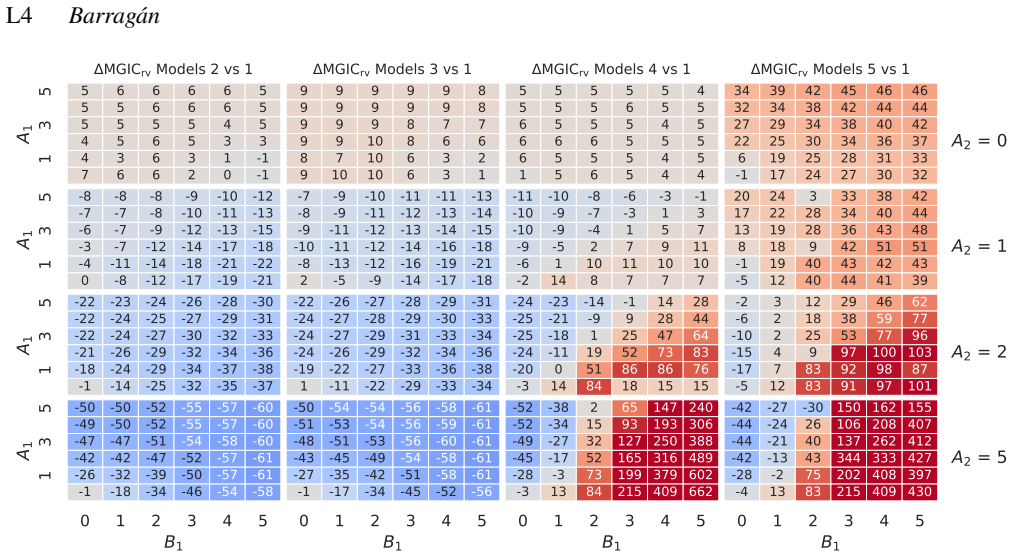
MGIC_rv compares multi-GP models by how well they explain radial velocity data alone.
A machine-rendered reading of the paper's core claim, the machinery that carries it, and where it could break.
Core claim
MGIC_rv combines the conditional RV likelihood with an effective parameter count that accounts for the regularization imposed by the multi-GP model on the RV component, thereby providing a quantitative and robust framework for comparing multi-GP models based on their ability to explain the RV signal. This enables identification of the activity indicators that most effectively constrain the RV component, and the criterion extends to other multi-GP settings focused on a particular observable.
What carries the argument
MGIC_rv, which evaluates model quality via conditional RV likelihood plus an effective parameter count that encodes multi-GP regularization on the RV component, allowing direct comparison across models that use different ancillary time series.
If this is right
- Combinations of activity indicators can be ranked quantitatively by how well their multi-GP models explain the RV data.
- The activity indicators that most effectively constrain the stellar contribution to RVs can be identified systematically.
- The same selection approach applies to any multi-GP problem where inference targets one specific observable.
- Classical model comparison methods that do not handle varying time series combinations are no longer required for this task.
Where Pith is reading between the lines
- Wider adoption could reduce the rate of activity-induced false positives in exoplanet catalogs by standardizing indicator selection.
- The effective parameter count might be compared against other regularization penalties used in Gaussian process literature.
- Application to synthetic datasets with controlled activity levels would test whether MGIC_rv recovers the true underlying indicator set.
- Similar conditional criteria could be developed for multi-output GPs in fields outside astronomy such as climate time series or sensor networks.
Load-bearing premise
The assumption that the conditional RV likelihood combined with an effective parameter count that accounts for multi-GP regularization on the RV component yields a fair and unbiased comparison across models that use different ancillary time series.
What would settle it
On simulated radial velocity datasets with known injected planetary signals, check whether models selected by lowest MGIC_rv recover the injected planet parameters more accurately than models selected by other criteria.
Figures
read the original abstract
Multidimensional Gaussian Process (multi-GP) regression is widely used to disentangle stellar and planetary signals in radial velocities (RVs) by jointly modelling ancillary activity indicators. However, identifying the combination of indicators that best constrains the stellar signal in the RVs is non-trivial, as classical model comparison methods are not directly applicable when multi-GPs involve different time series combinations. In this work, we present an information criterion to compare multi-GP models based on their ability to explain the RV component, $\mathrm{MGIC}_{\rm rv}$. This metric combines the conditional RV likelihood with an effective parameter count that accounts for the regularisation imposed by the multi-GP model on the RV component. We demonstrate that $\mathrm{MGIC}_{\rm rv}$ provides a quantitative and robust framework for multi-GP model comparison, identifying the activity indicators that most effectively constrain the RV signal. Although developed in the context of RV analysis, the proposed criterion is general and applicable to multi-GP problems in which the inference focuses on a specific observable.
Editorial analysis
A structured set of objections, weighed in public.
Referee Report
Summary. The paper presents MGIC_rv, an information criterion for comparing multi-GP models in the context of radial velocity analysis. It combines the conditional RV likelihood with an effective parameter count accounting for the regularization imposed by the multi-GP on the RV component, claiming to provide a quantitative and robust framework for identifying the activity indicators that best constrain the RV signal. The criterion is also presented as general for multi-GP problems focusing on a specific observable.
Significance. If the proposed metric is rigorously derived and validated to ensure fair comparisons across models with varying ancillary time series, it could offer a practical solution to model selection challenges in multi-dimensional GP regression for exoplanet detection, where choosing appropriate activity indicators is critical.
major comments (2)
- [Abstract] The abstract states the form of the metric but supplies no derivation steps, no explicit formula, no validation on simulated or real data, and no comparison against existing methods, so it is impossible to judge whether the math supports the robustness claim.
- [Effective parameter count definition] The effective parameter count is intended to capture multi-GP regularization on the RV component, but its construction implicitly depends on the joint covariance structure between RV and each ancillary series. When models use different numbers or qualities of indicators, the regularization strength (and thus the effective count) can change in a non-comparable way; nothing shows this quantity is invariant or properly normalized across such choices. If the penalty term under- or over-penalizes models with stronger cross-covariances, the ranking is biased even if the conditional likelihood is correctly computed.
minor comments (1)
- The manuscript would benefit from explicit mathematical expressions for MGIC_rv and the effective parameter count in the main text.
Simulated Author's Rebuttal
We thank the referee for their thorough review and valuable comments on our manuscript. We provide point-by-point responses to the major comments below.
read point-by-point responses
-
Referee: [Abstract] The abstract states the form of the metric but supplies no derivation steps, no explicit formula, no validation on simulated or real data, and no comparison against existing methods, so it is impossible to judge whether the math supports the robustness claim.
Authors: The abstract provides a high-level overview as is standard. The explicit formula, derivation steps, validation on simulated and real data, and comparisons to existing methods are all detailed in the body of the paper (see Sections 3, 4, and 5). We will revise the abstract to include a short statement highlighting the validation results to better support the robustness claim. revision: yes
-
Referee: [Effective parameter count definition] The effective parameter count is intended to capture multi-GP regularization on the RV component, but its construction implicitly depends on the joint covariance structure between RV and each ancillary series. When models use different numbers or qualities of indicators, the regularization strength (and thus the effective count) can change in a non-comparable way; nothing shows this quantity is invariant or properly normalized across such choices. If the penalty term under- or over-penalizes models with stronger cross-covariances, the ranking is biased even if the conditional likelihood is correctly computed.
Authors: We appreciate this insightful observation. The effective parameter count is constructed from the conditional distribution of the RV given the ancillary data, which explicitly depends on the joint covariance to reflect the regularization. This dependence is intentional, as it ensures the penalty term scales with the strength of the constraints provided by the indicators. We will add explicit discussion and numerical tests in the revised manuscript to demonstrate that this leads to fair comparisons without bias in the model ranking. revision: yes
Circularity Check
No circularity: MGIC_rv defined as independent combination of conditional likelihood and regularization penalty
full rationale
The paper introduces MGIC_rv explicitly as a new metric that combines the conditional RV likelihood with a separate effective parameter count intended to capture multi-GP regularization on the RV component. No equations, derivations, or self-citations are quoted in the abstract or description that would reduce this combination to a fitted input, a renamed known result, or a load-bearing self-citation chain. The criterion is presented as a general tool for model comparison, with the effective count described as an accounting device rather than a quantity forced by the likelihood itself. The derivation chain therefore remains self-contained against external benchmarks and does not exhibit any of the enumerated circularity patterns.
Axiom & Free-Parameter Ledger
Reference graph
Works this paper leans on
-
[1]
Planets and Stellar Activity: Hide and Seek in the CoRoT-7 system
Planets and stellar activity: hide and seek in the CoRoT-7 system. , keywords =. 2014. doi:10.1093/mnras/stu1320 , archivePrefix =. 1407.1044 , primaryClass =
work page internal anchor Pith review Pith/arXiv arXiv doi:10.1093/mnras/stu1320 2014
-
[2]
On Measuring and Correcting the Effects of Data Mining and Model Selection , urldate =
Jianming Ye , journal =. On Measuring and Correcting the Effects of Data Mining and Model Selection , urldate =
-
[3]
, journal=
Akaike, H. , journal=. A new look at the statistical model identification , year=
-
[4]
Mass estimates of the young TOI-451 transiting planets: multidimensional Gaussian Process on stellar spectroscopic and photometric signals. , keywords =. doi:10.1093/mnras/stag087 , archivePrefix =. 2601.09438 , primaryClass =
-
[5]
, title =
Kolmogorov, A. , title =. G. Ist. Ital. Attuari , volume =
-
[6]
Mathematical Theory of Probability and Statistics , publisher =
Richard. Mathematical Theory of Probability and Statistics , publisher =. 1964 , isbn =. doi:https://doi.org/10.1016/B978-1-4832-3213-3.50011-7 , url =
-
[7]
1984 , edition =
An Introduction to Multivariate Statistical Analysis , author =. 1984 , edition =
1984
-
[8]
Styan, George P. H. , title =. Proceedings of the First International Tampere Seminar on Linear Statistical Models and their Applications , editor =. 1985 , pages =
1985
-
[9]
Smirnov , title =
N. Smirnov , title =. The Annals of Mathematical Statistics , number =. 1948 , doi =
1948
-
[10]
TOI-837 b: characterisation, formation and evolutionary history of an infant warm Saturn-mass planet. arXiv e-prints , keywords =. doi:10.48550/arXiv.2406.08949 , archivePrefix =. 2406.08949 , primaryClass =
-
[11]
Characterization of LOPS2, the first long-pointing field
The PLATO field selection process: II. Characterization of LOPS2, the first long-pointing field. , keywords =. doi:10.1051/0004-6361/202452325 , archivePrefix =. 2501.07687 , primaryClass =
-
[12]
The all-sky PLATO input catalogue. , keywords =. doi:10.1051/0004-6361/202140717 , archivePrefix =. 2108.13712 , primaryClass =
-
[13]
A link between rocky planet composition and stellar age. , keywords =. doi:10.1093/mnras/staf474 , archivePrefix =. 2411.17358 , primaryClass =
-
[14]
On the time dependence of differential rotation in young late-type stars. , keywords =. doi:10.1111/j.1365-2966.2006.11085.x , adsurl =
-
[15]
Activity-Related Radial Velocity Variation in Cool Stars. , keywords =. doi:10.1086/304392 , adsurl =
-
[16]
Star Spot Induced Radial Velocity Variability in LkCa 19
Starspot-Induced Radial Velocity Variability in LkCa 19. , keywords =. doi:10.1086/526415 , archivePrefix =. 0711.2505 , primaryClass =
work page internal anchor Pith review Pith/arXiv arXiv doi:10.1086/526415
-
[17]
Stellar activity as noise in exoplanet detection - I. Methods and application to solar-like stars and activity cycles. , keywords =. doi:10.1093/mnras/stu2730 , archivePrefix =. 1501.00981 , primaryClass =
work page internal anchor Pith review Pith/arXiv arXiv doi:10.1093/mnras/stu2730
-
[18]
Estimating Stellar Radial Velocity Variability from Kepler and GALEX: Implications for the Radial Velocity Confirmation of Exoplanets. , keywords =. doi:10.1088/0004-637X/780/1/104 , archivePrefix =. 1311.3344 , primaryClass =
work page internal anchor Pith review Pith/arXiv arXiv doi:10.1088/0004-637x/780/1/104
-
[19]
On the road to the radius valley: distinguishing between gas dwarfs and water worlds with young transiting exoplanets. , keywords =. doi:10.1093/mnras/staf628 , archivePrefix =. 2503.17364 , primaryClass =
-
[20]
Model Selection and Multimodel Inference: A Practical Information-Theoretic Approach , author=. 2002 , publisher=. doi:10.1007/b97636 , url=
-
[21]
A Relationship between Stellar Age and Spot Coverage. , keywords =. doi:10.3847/1538-4357/ab79a0 , archivePrefix =. 2002.09135 , primaryClass =
-
[22]
Magnetic activity and differential rotation in the young Sun-like stars KIC 7985370 and KIC 7765135
Magnetic activity and differential rotation in the young Sun-like stars KIC 7985370 and KIC 7765135. , keywords =. doi:10.1051/0004-6361/201219167 , archivePrefix =. 1205.5721 , primaryClass =
work page internal anchor Pith review Pith/arXiv arXiv doi:10.1051/0004-6361/201219167
-
[23]
Magnetic activity and differential rotation in the very young star KIC 8429280
Magnetic activity and differential rotation in the very young star KIC 8429280. , keywords =. doi:10.1051/0004-6361/201116980 , archivePrefix =. 1106.4928 , primaryClass =
work page internal anchor Pith review Pith/arXiv arXiv doi:10.1051/0004-6361/201116980
-
[24]
Investigating stellar activity through eight years of Sun-as-a-star observations. , keywords =. doi:10.1093/mnras/stae1313 , archivePrefix =. 2405.12065 , primaryClass =
-
[25]
Planets around young active solar-type stars: assessing detection capabilities from a non-stabilized spectrograph. , keywords =. doi:10.1093/mnras/stab1586 , adsurl =
-
[26]
Stellar Companions to TESS Objects of Interest: A Test of Planet-Companion Alignment. , keywords =. doi:10.3847/1538-3881/ac53a7 , archivePrefix =. 2202.01798 , primaryClass =
-
[27]
The magnetic field and multiple planets of the young dwarf AU Mic. , keywords =. doi:10.1093/mnras/stad1193 , archivePrefix =. 2304.09642 , primaryClass =
-
[28]
Monitoring the young planet host V1298 Tau with SPIRou: planetary system and evolving large-scale magnetic field. , keywords =. doi:10.1093/mnras/stad3012 , archivePrefix =. 2310.02613 , primaryClass =
-
[29]
V., Launhardt, R., Trifonov, T., et al
Radial velocity survey for planets around young stars (RVSPY). A transiting warm super-Jovian planet around HD 114082, a young star with a debris disk. , keywords =. doi:10.1051/0004-6361/202244747 , archivePrefix =. 2211.08294 , primaryClass =
-
[30]
The generalised Lomb-Scargle periodogram. A new formalism for the floating-mean and Keplerian periodograms. , keywords =. doi:10.1051/0004-6361:200811296 , archivePrefix =. 0901.2573 , primaryClass =
work page internal anchor Pith review Pith/arXiv arXiv doi:10.1051/0004-6361:200811296
-
[31]
Measuring the masses of the two transiting planets
One year of AU Mic with HARPS - I. Measuring the masses of the two transiting planets. , keywords =. doi:10.1093/mnras/stac614 , archivePrefix =. 2203.01750 , primaryClass =
-
[32]
Radial Velocity Data Analysis with Compressed Sensing Techniques
Radial velocity data analysis with compressed sensing techniques. , keywords =. doi:10.1093/mnras/stw2261 , archivePrefix =. 1609.01519 , primaryClass =
work page internal anchor Pith review Pith/arXiv arXiv doi:10.1093/mnras/stw2261
-
[33]
Determining the Mass of Kepler-78b With Nonparametric Gaussian Process Estimation
Determining the Mass of Kepler-78b with Nonparametric Gaussian Process Estimation. , keywords =. 2015. doi:10.1088/0004-637X/808/2/127 , archivePrefix =. 1501.00369 , primaryClass =
work page internal anchor Pith review Pith/arXiv arXiv doi:10.1088/0004-637x/808/2/127 2015
-
[34]
A Neptune-sized transiting planet closely orbiting a 5-10-million-year-old star
A Neptune-sized transiting planet closely orbiting a 5-10-million-year-old star. , keywords =. 2016. doi:10.1038/nature18293 , archivePrefix =. 1606.06729 , primaryClass =
work page internal anchor Pith review Pith/arXiv arXiv doi:10.1038/nature18293 2016
-
[35]
, archivePrefix = "arXiv", eprint =
New Pleiades Eclipsing Binaries and a Hyades Transiting System Identified by K2. , archivePrefix = "arXiv", eprint =. doi:10.3847/0004-6256/151/5/112 , adsurl =
-
[36]
Zodiacal Exoplanets in Time (ZEIT). VI. A Three-planet System in the Hyades Cluster Including an Earth-sized Planet. , keywords =. 2018. doi:10.3847/1538-3881/aa9791 , archivePrefix =. 1709.10328 , primaryClass =
work page internal anchor Pith review Pith/arXiv arXiv doi:10.3847/1538-3881/aa9791 2018
-
[37]
Zodiacal Exoplanets in Time (ZEIT). III. A Short-period Planet Orbiting a Pre-main-sequence Star in the Upper Scorpius OB Association. , keywords =. 2016. doi:10.3847/0004-6256/152/3/61 , archivePrefix =. 1604.06165 , primaryClass =
work page internal anchor Pith review Pith/arXiv arXiv doi:10.3847/0004-6256/152/3/61 2016
-
[38]
Zodiacal Exoplanets in Time (ZEIT). I. A Neptune-sized Planet Orbiting an M4.5 Dwarf in the Hyades Star Cluster. , keywords =. 2016. doi:10.3847/0004-637X/818/1/46 , archivePrefix =. 1512.00483 , primaryClass =
work page internal anchor Pith review Pith/arXiv arXiv doi:10.3847/0004-637x/818/1/46 2016
-
[39]
A Low-Mass Exoplanet Candidate Detected By ${\it K2}$ Transiting the Praesepe M Dwarf JS 183
A Low-mass Exoplanet Candidate Detected by K2 Transiting the Praesepe M Dwarf JS 183. , keywords =. 2017. doi:10.3847/1538-3881/aa62ab , archivePrefix =. 1703.10250 , primaryClass =
work page internal anchor Pith review Pith/arXiv arXiv doi:10.3847/1538-3881/aa62ab 2017
-
[40]
, eprint =
The Hyades: distance, structure, dynamics, and age. , eprint =
-
[41]
The age of the oldest Open Clusters. , eprint =. doi:10.1051/0004-6361:20031578 , adsurl =
-
[42]
, archivePrefix = "arXiv", eprint =
Parallaxes and proper motions for 20 open clusters as based on the new Hipparcos catalogue. , archivePrefix = "arXiv", eprint =. doi:10.1051/0004-6361/200811382 , adsurl =
-
[43]
, archivePrefix = "arXiv", eprint =
The Stellar Populations of Praesepe and Coma Berenices. , archivePrefix = "arXiv", eprint =. doi:10.1086/522831 , adsurl =
-
[44]
Barrag\'an, O. and Gandolfi, D. and Antoniciello, G. , title = ". , keywords =. doi:10.1093/mnras/sty2472 , primaryClass =
-
[45]
Stone, M. , title =. Journal of the Royal Statistical Society: Series B (Methodological) , volume =. 1977 , month =. doi:10.1111/j.2517-6161.1977.tb01603.x , url =
-
[46]
Waskom, Michael L. , title =. 2021 , publisher =. doi:10.21105/joss.03021 , url =
-
[47]
FENRIR: A statistical model of stellar variability: I. A physics-based, fast Gaussian process model to represent stellar activity and perform statistical Doppler imaging. , keywords =. doi:10.1051/0004-6361/202346391 , archivePrefix =. 2304.08489 , primaryClass =
-
[48]
1990 , publisher =
Generalized Additive Models , author =. 1990 , publisher =
1990
-
[49]
Revisiting K2-233 spectroscopic time-series with multidimensional Gaussian processes. , keywords =. doi:10.1093/mnras/stad1139 , archivePrefix =. 2304.06406 , primaryClass =
-
[50]
Overfitting Affects the Reliability of Radial Velocity Mass Estimates of the V1298 Tau Planets. , keywords =. doi:10.3847/1538-3881/acde78 , archivePrefix =. 2306.08145 , primaryClass =
-
[51]
The GAPS programme at TNG XLIX. TOI-5398, the youngest compact multi-planet system composed of an inner sub-Neptune and an outer warm Saturn. arXiv e-prints , keywords =. doi:10.48550/arXiv.2310.16888 , archivePrefix =. 2310.16888 , primaryClass =
-
[52]
Eccentricity evolution during planet-disc interaction. , keywords =. doi:10.1093/mnras/stx3094 , archivePrefix =. 1712.00026 , primaryClass =
-
[53]
The stellar activity-rotation relationship and the evolution of stellar dynamos
The Stellar-activity-Rotation Relationship and the Evolution of Stellar Dynamos. , keywords =. 2011. doi:10.1088/0004-637X/743/1/48 , archivePrefix =. 1109.4634 , primaryClass =
work page internal anchor Pith review Pith/arXiv arXiv doi:10.1088/0004-637x/743/1/48 2011
-
[54]
Improved Age Estimation for Solar-Type Dwarfs Using Activity-Rotation Diagnostics
Improved Age Estimation for Solar-Type Dwarfs Using Activity-Rotation Diagnostics. , keywords =. 2008. doi:10.1086/591785 , archivePrefix =. 0807.1686 , primaryClass =
work page internal anchor Pith review Pith/arXiv arXiv doi:10.1086/591785 2008
-
[55]
Mesa Isochrones and Stellar Tracks (MIST). I. Solar-scaled Models. , keywords =. 2016. doi:10.3847/0004-637X/823/2/102 , archivePrefix =. 1604.08592 , primaryClass =
work page internal anchor Pith review Pith/arXiv arXiv doi:10.3847/0004-637x/823/2/102 2016
-
[56]
Stellar winds on the main-sequence. II. The evolution of rotation and winds. , keywords =. 2015. doi:10.1051/0004-6361/201425301 , archivePrefix =. 1503.07494 , primaryClass =
work page internal anchor Pith review Pith/arXiv arXiv doi:10.1051/0004-6361/201425301 2015
-
[57]
NGTS-4b: A sub-Neptune Transiting in the Desert
NGTS-4b: A sub-Neptune transiting in the desert. , keywords =. 2019. doi:10.1093/mnras/stz1084 , archivePrefix =. 1809.00678 , primaryClass =
work page internal anchor Pith review Pith/arXiv arXiv doi:10.1093/mnras/stz1084 2019
-
[58]
The Evolution of Stellar Rotation and the hydrogen atmospheres of habitable-zone Terrestrial Planets
The Evolution of Stellar Rotation and the Hydrogen Atmospheres of Habitable-zone Terrestrial Planets. , keywords =. 2015. doi:10.1088/2041-8205/815/1/L12 , archivePrefix =. 1511.03647 , primaryClass =
work page internal anchor Pith review Pith/arXiv arXiv doi:10.1088/2041-8205/815/1/l12 2015
-
[59]
Close-in Sub-Neptunes Reveal the Past Rotation History of Their Host Stars: Atmospheric Evolution of Planets in the HD 3167 and K2-32 Planetary Systems. , keywords =. 2019. doi:10.3847/1538-4357/ab1e42 , archivePrefix =. 1906.12153 , primaryClass =
work page internal anchor Pith review Pith/arXiv arXiv doi:10.3847/1538-4357/ab1e42 2019
-
[60]
Grid of upper atmosphere models for 1-40 M _ planets: application to CoRoT-7 b and HD 219134 b,c. , keywords =. 2018. doi:10.1051/0004-6361/201833737 , archivePrefix =. 1809.06645 , primaryClass =
work page internal anchor Pith review Pith/arXiv arXiv doi:10.1051/0004-6361/201833737 2018
-
[61]
A Gaussian process framework for modelling stellar activity signals in radial velocity data
A Gaussian process framework for modelling stellar activity signals in radial velocity data. , keywords =. 2015. doi:10.1093/mnras/stv1428 , archivePrefix =. 1506.07304 , primaryClass =
work page internal anchor Pith review Pith/arXiv arXiv doi:10.1093/mnras/stv1428 2015
-
[62]
Diffuser-assisted Photometric Follow-up Observations of the Neptune-sized Planets K2-28b and K2-100b
Diffuser-assisted Photometric Follow-up Observations of the Neptune-sized Planets K2-28b and K2-100b. , keywords =. 2018. doi:10.3847/1538-3881/aae6ca , archivePrefix =. 1807.04420 , primaryClass =
work page internal anchor Pith review Pith/arXiv arXiv doi:10.3847/1538-3881/aae6ca 2018
-
[63]
60 Validated Planets from K2 Campaigns 5-8
Sixty Validated Planets from K2 Campaigns 5-8. , keywords =. 2018. doi:10.3847/1538-3881/aae778 , archivePrefix =. 1810.04074 , primaryClass =
work page internal anchor Pith review Pith/arXiv arXiv doi:10.3847/1538-3881/aae778 2018
-
[64]
Zodiacal Exoplanets in Time (ZEIT). IV. Seven Transiting Planets in the Praesepe Cluster. , keywords =. 2017. doi:10.1088/1361-6528/aa5276 , archivePrefix =. 1609.00726 , primaryClass =
work page internal anchor Pith review Pith/arXiv arXiv doi:10.1088/1361-6528/aa5276 2017
-
[65]
K2-141 b: A 5-M$_\oplus$ super-Earth transiting a K7 V star every 6.7 hours
K2-141 b. A 5-M _ super-Earth transiting a K7 V star every 6.7 h. , keywords =. 2018. doi:10.1051/0004-6361/201732217 , archivePrefix =. 1711.02097 , primaryClass =
work page internal anchor Pith review Pith/arXiv arXiv doi:10.1051/0004-6361/201732217 2018
-
[66]
An Ultra-short Period Rocky Super-Earth with a Secondary Eclipse and a Neptune-like Companion around K2-141. , keywords =. 2018. doi:10.3847/1538-3881/aaa5b5 , archivePrefix =. 1801.03502 , primaryClass =
work page internal anchor Pith review Pith/arXiv arXiv doi:10.3847/1538-3881/aaa5b5 2018
-
[67]
K2-139 b: a low-mass warm Jupiter on a 29-day orbit transiting an active K0 V star
K2-139 b: a low-mass warm Jupiter on a 29-d orbit transiting an active K0 V star. , keywords =. 2018. doi:10.1093/mnras/stx3207 , archivePrefix =. 1702.00691 , primaryClass =
work page internal anchor Pith review Pith/arXiv arXiv doi:10.1093/mnras/stx3207 2018
-
[68]
K2-264: A transiting multi-planet system in the Praesepe open cluster
K2-264: a transiting multiplanet system in the Praesepe open cluster. , keywords =. 2019. doi:10.1093/mnras/sty3464 , archivePrefix =. 1809.01968 , primaryClass =
work page internal anchor Pith review Pith/arXiv arXiv doi:10.1093/mnras/sty3464 2019
-
[69]
Three Small Planets Transiting a Hyades Star
Three Small Planets Transiting a Hyades Star. , keywords =. 2018. doi:10.3847/1538-3881/aaa841 , archivePrefix =. 1710.07203 , primaryClass =
work page internal anchor Pith review Pith/arXiv arXiv doi:10.3847/1538-3881/aaa841 2018
-
[70]
, archivePrefix = "arXiv", eprint =
The Age and Age Spread of the Praesepe and Hyades Clusters: a Consistent, \ 800 Myr Picture from Rotating Stellar Models. , archivePrefix = "arXiv", eprint =. doi:10.1088/0004-637X/807/1/24 , adsurl =
-
[71]
Hot super-Earths stripped by their host stars
Hot super-Earths stripped by their host stars. Nature Communications , keywords =. 2016. doi:10.1038/ncomms11201 , archivePrefix =. 1604.05220 , primaryClass =
work page internal anchor Pith review Pith/arXiv arXiv doi:10.1038/ncomms11201 2016
-
[72]
, archivePrefix = "arXiv", eprint =
An Earth-sized planet with an Earth-like density. , archivePrefix = "arXiv", eprint =. doi:10.1038/nature12768 , adsurl =
-
[73]
, archivePrefix = "arXiv", eprint =
Transiting exoplanet candidates from K2 Campaigns 5 and 6. , archivePrefix = "arXiv", eprint =. doi:10.1093/mnras/stw1373 , adsurl =
-
[74]
Long Term Evolution of Close Planets Including the Effects of Secular Interactions
Long-Term Evolution of Close Planets Including the Effects of Secular Interactions. , keywords =. 2006. doi:10.1086/506145 , archivePrefix =. astro-ph/0606349 , primaryClass =
work page internal anchor Pith review Pith/arXiv arXiv doi:10.1086/506145 2006
-
[75]
Planet-planet scattering leads to tightly packed planetary systems
Planet-Planet Scattering Leads to Tightly Packed Planetary Systems. , keywords =. 2009. doi:10.1088/0004-637X/696/1/L98 , archivePrefix =. 0903.4700 , primaryClass =
work page internal anchor Pith review Pith/arXiv arXiv doi:10.1088/0004-637x/696/1/l98 2009
-
[76]
The Mass of CoRoT-7b. , keywords =. 2011. doi:10.1088/0004-637X/743/1/75 , archivePrefix =. 1105.3372 , primaryClass =
work page internal anchor Pith review Pith/arXiv arXiv doi:10.1088/0004-637x/743/1/75 2011
-
[77]
arXiv e-prints , keywords =
Transits and Occultations. arXiv e-prints , keywords =. 2010
2010
-
[78]
Magnetohydrodynamics on an Unstructured Moving Grid:
Homogeneous studies of transiting extrasolar planets - IV. Thirty systems with space-based light curves. , keywords =. 2011. doi:10.1111/j.1365-2966.2011.19399.x , archivePrefix =. 1107.1235 , primaryClass =
-
[79]
Mass-Radius Relation for Rocky Planets based on PREM
Mass-Radius Relation for Rocky Planets Based on PREM. , keywords =. 2016. doi:10.3847/0004-637X/819/2/127 , archivePrefix =. 1512.08827 , primaryClass =
work page internal anchor Pith review Pith/arXiv arXiv doi:10.3847/0004-637x/819/2/127 2016
-
[80]
ascl:1706.001 , adsurl =
Exotrending. ascl:1706.001 , adsurl =
discussion (0)
Sign in with ORCID, Apple, or X to comment. Anyone can read and Pith papers without signing in.