Protection Is (Nearly) All You Need: Structural Protection Dominates Scoring in Globally Capped KV Eviction
Pith reviewed 2026-05-20 12:08 UTC · model grok-4.3
The pith
Structural protection at prompt boundaries dominates scoring policies in KV cache eviction for long-context LLMs.
A machine-rendered reading of the paper's core claim, the machinery that carries it, and where it could break.
Core claim
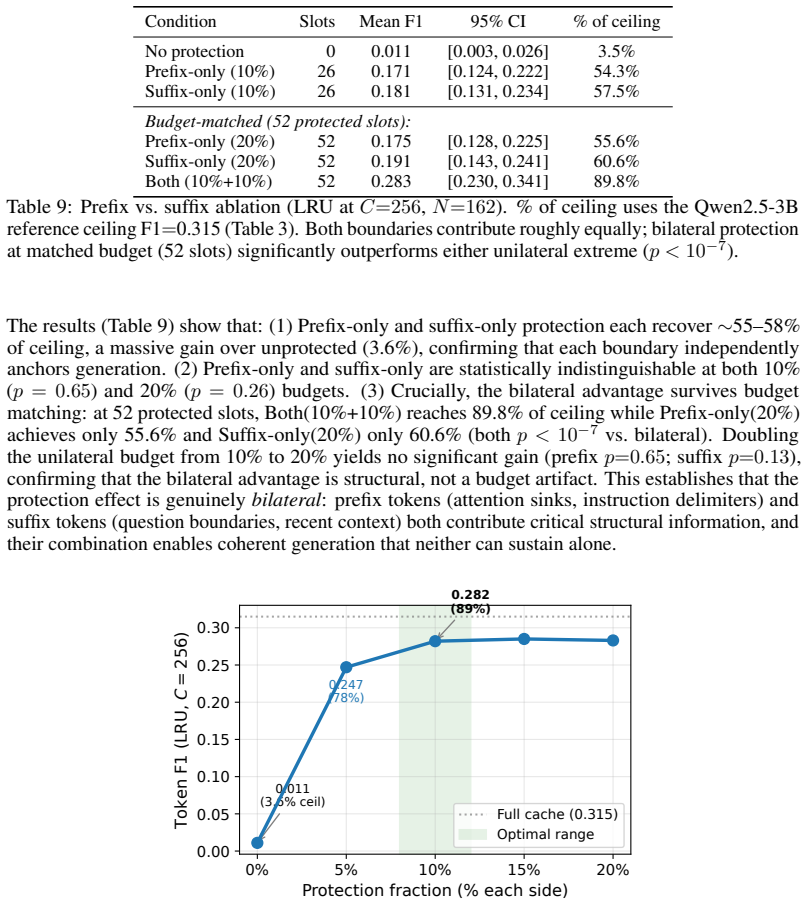
Under a shared globally capped decode-time harness, seven eviction policies share a prompt-boundary vulnerability that causes them to collapse without structural protection. Reserving 10% of cache at each boundary recovers 69-90% of the C=2048 reference-ceiling quality on seven LongBench models at C=256 (13% retention); a ten-model panel spans 68-98%. An attention-mass pilot shows the position-0 sink holds about 75% of prefix mass while other boundary tokens sit near 0.41 times uniform expectation. With protection, simplified score-isolation variants are TOST-equivalent to LRU at K=32, attention policies converge yet beat LRU at K=8, and faithful per-head scoring adds modest further gains. A
What carries the argument
Structural protection mechanism that reserves a fixed fraction of cache slots at prompt boundaries to safeguard the high-mass sink token and other boundary positions.
If this is right
- Simplified attention variants become statistically equivalent to LRU once protection is added at K=32.
- Attention policies still outperform LRU by 0.011-0.021 F1 at K=8 across C=256 and C=512.
- Faithful per-head versions of Ada-KV and QUEST add an extra 0.03-0.04 F1 on models such as Mistral-7B.
- Protection lifts transfer with ratio 0.99-1.00 between decode and prefill regimes in the NIAH-32K pilot.
- Per-head allocation supplies a further modest gain on top of boundary protection.
Where Pith is reading between the lines
- Designers of future eviction systems should treat boundary reservation as the default first step rather than an optional add-on.
- The same protection ratio may need adjustment when moving to contexts much longer than 64K where recovery becomes modest.
- Combining boundary protection with dynamic per-layer or per-head budgets could be tested to see if gains compound beyond the reported modest improvements.
Load-bearing premise
The six pure-transformer models and LongBench tasks used are representative of broader LLM usage patterns and the observed attention-mass distribution generalizes.
What would settle it
A new model or task where quality stays near zero at 13% retention even after applying the 10% boundary reservation would show the protection effect does not hold.
Figures




read the original abstract
We study KV cache eviction under a shared globally capped decode-time harness. Seven policies (LRU, H2O, SnapKV, StreamingLLM, Ada-KV, QUEST, Random) share a prompt-boundary vulnerability: without structural protection, they collapse to near-zero quality on six pure-transformer models (F1$\leq$0.064). Reserving 10\% of cache at each boundary recovers 69--90\% of the $C{=}2{,}048$ reference-ceiling quality on seven LongBench models at $C{=}256$ (13\% retention); a ten-model panel spans 68--98\%. An attention-mass pilot (Qwen2.5-3B, $N{=}30$) suggests why: the position-0 sink holds ${\sim}75\%$ of prefix mass, while other boundary tokens sit near ${\sim}0.41{\times}$ uniform expectation, so attention scorers retain the sink but still drop structurally critical tokens. With protection, simplified score-isolation variants are TOST-equivalent to LRU at $K{=}32$ ($\Delta{=}0.02$); at $K{=}8$, attention policies pairwise converge yet beat LRU by 0.011--0.021 F1 across $C{=}256$ and $C{=}512$. Faithful Ada-KV/QUEST add ${\sim}0.03$--$0.04$ F1 on Mistral-7B and Phi-3.5 beyond simplified variants. A NIAH-32K regime-transfer pilot on Qwen3-4B (decode vs.\ prefill, $C{\in}\{512,2048\}$) shows near-identical protection lifts (ratio 0.99--1.00). At 64K, protection helps but recovery is modest; faithful per-head scoring matches full-cache ceiling on Gemma-3-4B at 6.3\% retention only when the model already supports strong 64K retrieval without eviction. Overall: protection dominates; scoring differences are secondary once boundaries are guarded; per-head allocation gives a further modest gain.
Editorial analysis
A structured set of objections, weighed in public.
Referee Report
Summary. The paper examines KV cache eviction under a globally capped decode-time harness across seven policies (LRU, H2O, SnapKV, StreamingLLM, Ada-KV, QUEST, Random). It reports that without structural protection these policies collapse to near-zero quality (F1 ≤ 0.064) on six pure-transformer models. Reserving 10% of cache at each boundary recovers 69–90% of the C=2048 reference quality at C=256 (13% retention) on seven LongBench models and 68–98% on a ten-model panel. An attention-mass pilot on Qwen2.5-3B (N=30) is used to explain the boundary vulnerability: the position-0 sink holds ~75% of prefix mass while other boundary tokens receive ~0.41× uniform attention, so scorers keep the sink but drop other critical tokens. With protection, simplified score-isolation variants become TOST-equivalent to LRU at K=32 and attention policies converge yet outperform LRU at K=8; faithful variants add modest gains. A NIAH-32K transfer pilot shows near-identical protection lifts.
Significance. If the empirical recovery percentages hold, the result is significant for efficient long-context inference: it shows that a lightweight structural safeguard can recover most performance lost to aggressive eviction, rendering many scoring refinements secondary once boundaries are protected. This offers a practical, low-overhead lever for memory-constrained deployment and shifts emphasis from per-token attention heuristics toward position-aware cache allocation.
major comments (1)
- [Abstract / attention-mass pilot] The mechanistic explanation that attention scorers 'retain the sink but still drop structurally critical tokens' rests on the attention-mass pilot (position-0 ~75% prefix mass, other boundaries ~0.41× uniform) reported only for Qwen2.5-3B (N=30). The main results and dominance claim span seven LongBench models (including Mistral-7B, Phi-3.5, Gemma-3-4B) and a ten-model panel, yet no equivalent mass distributions are provided for these models. If sink mass or boundary under-attention differs materially, the account of why protection recovers 69–90% while scoring differences remain secondary would not generalize uniformly. This is load-bearing for the paper's interpretation of the results.
minor comments (2)
- [Results and experimental protocol] Reported F1 scores, recovery percentages, and TOST equivalence claims lack error bars, standard deviations, or confidence intervals, and the abstract omits exact data-exclusion rules and full experimental protocol details needed for reproducibility.
- [Method / protection mechanism] The precise definition and implementation of '10% of cache at each boundary' (e.g., which tokens count as boundaries, whether reservation is global or per-head, and how it scales with C=256 vs. C=512) should be stated explicitly, ideally with pseudocode or a small diagram.
Simulated Author's Rebuttal
We thank the referee for the constructive feedback and for recognizing the practical significance of the structural protection result. We address the single major comment below and clarify the role of the attention-mass pilot relative to the empirical claims.
read point-by-point responses
-
Referee: [Abstract / attention-mass pilot] The mechanistic explanation that attention scorers 'retain the sink but still drop structurally critical tokens' rests on the attention-mass pilot (position-0 ~75% prefix mass, other boundaries ~0.41× uniform) reported only for Qwen2.5-3B (N=30). The main results and dominance claim span seven LongBench models (including Mistral-7B, Phi-3.5, Gemma-3-4B) and a ten-model panel, yet no equivalent mass distributions are provided for these models. If sink mass or boundary under-attention differs materially, the account of why protection recovers 69–90% while scoring differences remain secondary would not generalize uniformly. This is load-bearing for the paper's interpretation of the results.
Authors: We agree that the attention-mass pilot is reported only for Qwen2.5-3B and that extending the distributional analysis would strengthen the mechanistic narrative. However, the core claims of the paper are empirical rather than mechanistic: across all seven LongBench models and the ten-model panel, removing structural protection causes every scoring policy to collapse to near-zero quality (F1 ≤ 0.064), while reserving 10 % of the cache at each boundary recovers 69–98 % of the C=2048 reference quality at 13 % retention. These recovery percentages and the secondary role of scoring differences are observed directly and do not depend on the exact mass numbers from the pilot. The pilot serves only to supply intuition for why boundary tokens are vulnerable on the model where it was measured. We will add attention-mass distributions for at least two additional models (Mistral-7B and Phi-3.5) in the revised manuscript to test consistency of the sink and boundary-attention pattern. revision: yes
Circularity Check
No circularity: purely empirical comparisons with no derivations or self-referential fits
full rationale
The manuscript contains no equations, derivations, or parameter-fitting steps that could reduce to self-definition or fitted-input-called-prediction. All reported results (F1 recoveries, TOST equivalence, attention-mass observations) are direct experimental measurements across fixed policies, models, and cache sizes. The Qwen2.5-3B pilot is presented as an explanatory observation rather than an input that is then redefined as an output; no quantity is constructed from itself. No self-citations are invoked to justify uniqueness or ansatzes. The work is therefore self-contained against external benchmarks and receives the default non-circularity finding.
Axiom & Free-Parameter Ledger
free parameters (1)
- boundary reservation ratio
axioms (1)
- domain assumption The six tested transformer models and LongBench tasks are representative of typical long-context usage.
Lean theorems connected to this paper
-
IndisputableMonolith/Foundation/RealityFromDistinction.leanreality_from_one_distinction echoes?
echoesECHOES: this paper passage has the same mathematical shape or conceptual pattern as the Recognition theorem, but is not a direct formal dependency.
every τ=8 decode steps, the policy is re-invoked to maintain capacity as new tokens are generated
What do these tags mean?
- matches
- The paper's claim is directly supported by a theorem in the formal canon.
- supports
- The theorem supports part of the paper's argument, but the paper may add assumptions or extra steps.
- extends
- The paper goes beyond the formal theorem; the theorem is a base layer rather than the whole result.
- uses
- The paper appears to rely on the theorem as machinery.
- contradicts
- The paper's claim conflicts with a theorem or certificate in the canon.
- unclear
- Pith found a possible connection, but the passage is too broad, indirect, or ambiguous to say the theorem truly supports the claim.
Reference graph
Works this paper leans on
-
[1]
Ashish Vaswani, Noam Shazeer, Niki Parmar, Jakob Uszkoreit, Llion Jones, Aidan N Gomez, Łukasz Kaiser, and Illia Polosukhin. Attention is all you need. InAdvances in neural information processing systems, pages 5998–6008, 2017
work page 2017
-
[2]
Efficiently scaling transformer inference.Proceedings of Machine Learning and Systems, 2023
Reiner Pope, Sholto Li, Adam Mohamed, Matej Baji´c, Thomas Paine, Kevin Leyton-Brown, Milad Alizadeh, Devin Kreuzer, et al. Efficiently scaling transformer inference.Proceedings of Machine Learning and Systems, 2023
work page 2023
-
[3]
H$_2$O: Heavy-Hitter Oracle for Efficient Generative Inference of Large Language Models
Zhenyu Zhang, Jie Ren, Yujie Liu, Tianyi Zhu, Tianle Zhang, Ji Liu, Jiang Bian, Shizhe Diao, Boxin Zhang, Wenhao Wang, et al. H2o: Heavy-hitter oracle for efficient generative inference of large language models.arXiv preprint arXiv:2306.14048, 2023
work page internal anchor Pith review Pith/arXiv arXiv 2023
-
[4]
SnapKV: LLM Knows What You are Looking for Before Generation
Suyu Ge, Yisen Zhang, Yifei Wang, Huan Zheng, Yuxuan Zhou, et al. Snapkv: Llm knows what you are looking for before generation.arXiv preprint arXiv:2404.14469, 2024
work page internal anchor Pith review Pith/arXiv arXiv 2024
-
[5]
Efficient Streaming Language Models with Attention Sinks
Guangxuan Xiao, Yuandong Tian, Beidi Chen, Song Han, and Mike Lewis. Efficient streaming language models with attention sinks.arXiv preprint arXiv:2309.17453, 2023
work page internal anchor Pith review Pith/arXiv arXiv 2023
-
[6]
Zhenyu Liu, Aditya Desai, Feng Luo, Weiran Zhu, Yikang Shen, et al. Scissorhands: Exploiting the persistence of importance hypothesis for llm kv cache compression at test time.arXiv preprint arXiv:2305.17118, 2023
-
[7]
Ada-KV: Optimizing KV Cache Eviction by Adaptive Budget Allocation for Efficient LLM Inference
Yuan Feng, Junlin Lv, Yukun Cao, Xike Xie, and S. Kevin Zhou. Ada-kv: Optimizing kv cache eviction by adaptive budget allocation for efficient llm inference.arXiv preprint arXiv:2407.11550, 2024. 29
work page internal anchor Pith review Pith/arXiv arXiv 2024
-
[8]
Yehui Tang, Xin Chen, Ming Li, et al. Quest: Query-aware sparsity for efficient long-context llm inference.arXiv preprint arXiv:2402.05074, 2024
-
[9]
arXiv preprint arXiv:2512.03324
Yuhan Li et al. Cache what lasts: Token retention for memory-bounded KV cache in LLMs. arXiv preprint arXiv:2512.03324, 2025. ICLR 2026
-
[10]
Yuming Zhang et al. ForesightKV: Optimizing KV cache eviction for reasoning models by learning long-term contribution.arXiv preprint arXiv:2602.03203, 2026
-
[11]
Dongjie Yang, Xiaodong Han, Yan Gao, Yao Hu, Shilin Zhang, and Hai Zhao. Pyramid- Infer: Pyramid kv cache compression for high-throughput llm inference.arXiv preprint arXiv:2405.12532, 2024
-
[12]
Chaojun Xiao, Pengle Zhang, Xu Han, Guangxuan Xiao, Yankai Lin, Zhengyan Zhang, Zhiyuan Liu, and Maosong Sun. InfLLM: Unveiling the intrinsic capacity of LLMs for understanding extremely long sequences with training-free memory.arXiv preprint arXiv:2402.04617, 2024
-
[13]
Nair, Ilya Soloveychik, and Purushotham Kamath
Muhammad Adnan, Akhil Arunkumar, Gaurav Jain, Prashant J. Nair, Ilya Soloveychik, and Purushotham Kamath. Keyformer: KV cache reduction through key tokens selection for efficient generative inference. InProceedings of Machine Learning and Systems (MLSys), 2024
work page 2024
-
[14]
Hanlin Tang, Yang Lin, Jing Lin, Qingsen Han, Shikuan Hong, Yiwu Yao, and Gongyi Wang. RazorAttention: Efficient KV cache compression through retrieval heads.arXiv preprint arXiv:2407.15891, 2024
-
[15]
KIVI: A Tuning-Free Asymmetric 2bit Quantization for KV Cache
Zirui Liu et al. Kivi: A tuning-free asymmetric 2bit quantization for kv cache.arXiv preprint arXiv:2402.02750, 2024
work page internal anchor Pith review Pith/arXiv arXiv 2024
-
[16]
Coleman Hooper, Sehoon Kim, Michael W Mahoney, Yakun Sophia Shao, Kurt Keutzer, and Amir Gholami. KVQuant: Towards 10 million context length llm inference with kv cache quantization.arXiv preprint arXiv:2401.18079, 2024
-
[17]
Mikv: An adaptive kv cache compression via mixed-precision quantization
Zirui Liu et al. Mikv: An adaptive kv cache compression via mixed-precision quantization. arXiv preprint, 2024. ICLR 2025
work page 2024
-
[18]
Efficient Memory Management for Large Language Model Serving with PagedAttention
Woosuk Kwon, Zhuohan Li, Siyuan Zhuang, Yingsheng Yu, Minsoo Hui, Sungjun Hwang, Youngjin Jin, Jimin Lee, et al. Efficient memory management for large language model serving with pagedattention.arXiv preprint arXiv:2309.06180, 2023
work page internal anchor Pith review Pith/arXiv arXiv 2023
-
[19]
Tri Dao, Daniel Y Fu, Stefano Ermon, Atri Rudra, and Christopher R´e. Flashattention: Fast and memory-efficient exact attention with io-awareness.Advances in Neural Information Processing Systems, 2022
work page 2022
-
[20]
FlashAttention-2: Faster Attention with Better Parallelism and Work Partitioning
Tri Dao. Flashattention-2: Faster attention with better parallelism and work partitioning.arXiv preprint arXiv:2307.08691, 2023
work page internal anchor Pith review Pith/arXiv arXiv 2023
-
[21]
Competitive caching with machine learned advice
Thodoris Lykouris and Sergei Vassilvitskii. Competitive caching with machine learned advice. Journal of the ACM, 68(4):1–25, 2021
work page 2021
-
[22]
Qwen Team. Qwen2.5 technical report.arXiv preprint arXiv:2412.15115, 2024
work page internal anchor Pith review Pith/arXiv arXiv 2024
-
[23]
Qwen3.5: Towards native multimodal agents
Qwen Team. Qwen3.5: Towards native multimodal agents. https://qwen.ai/blog?id=qw en3.5, February 2026. Hugging Face checkpoint:Qwen/Qwen3.5-27B
work page 2026
-
[24]
Qwen Team. Qwen3 Technical Report, 2025. URL https://arxiv.org/abs/2505.09388
work page internal anchor Pith review Pith/arXiv arXiv 2025
-
[25]
Phi-3 Technical Report: A Highly Capable Language Model Locally on Your Phone
Marah Abdin, Sam Ade Jacobs, Ammar Ahmad Awan, Jyoti Aneja, Ahmed Awadalla, Hany Awadallah, Nguyen Bach, Amit Bahree, Arash Bakhtiari, Harkirat Beez, et al. Phi-3 technical re- port: A highly capable language model locally on your phone.arXiv preprint arXiv:2404.14219, 2024
work page internal anchor Pith review Pith/arXiv arXiv 2024
-
[26]
Phi-4-Mini Technical Report: Compact yet Powerful Multimodal Language Models via Mixture-of-LoRAs
Marah Abdin, Sahil Agarwal, Aman Agrawal, Garima Bansal, Harkirat Barcinas, Harsha S. Behl, et al. Phi-4-Mini Technical Report, 2025. URLhttps://arxiv.org/abs/2503.01743. 30
work page internal anchor Pith review Pith/arXiv arXiv 2025
-
[27]
Albert Q. Jiang, Alexandre Sablayrolles, Arthur Mensch, Chris Bamford, Devendra Singh Chaplot, Diego de las Casas, Florian Bressand, Gianna Lengyel, Guillaume Lample, Lucile Saulnier, L´elio Renard Lavaud, Marie-Anne Lachaux, Pierre Stock, Teven Le Scao, Timoth´ee Lavril, Thomas Wang, Timoth´ee Lacroix, and William El Sayed. Mistral 7b.arXiv preprint arXi...
work page internal anchor Pith review Pith/arXiv arXiv 2023
-
[28]
Yi: Open Foundation Models by 01.AI
Alex Young, Bei Chen, Chao Li, Chengen Huang, Ge Zhang, Guanwei Zhang, Heng Li, Jiangcheng Zhu, Jianqun Chen, Jing Chang, et al. Yi: Open foundation models by 01.ai.arXiv preprint arXiv:2403.04652, 2024
work page internal anchor Pith review Pith/arXiv arXiv 2024
-
[29]
Gemma 3 technical report.https://goo.gle/Gemma3Report, 2025
Gemma Team. Gemma 3 technical report.https://goo.gle/Gemma3Report, 2025
work page 2025
-
[30]
LongBench: A Bilingual, Multitask Benchmark for Long Context Understanding
Yushi Bai, Xin Lv, Jiajie Zhang, Hongchang Lyu, Jiankai Tang, Zhidian Huang, Zhengxiao Du, Xiao Liu, Aohan Zeng, Lei Hou, Yuxiao Dong, Jie Tang, and Juanzi Li. Longbench: A bilingual, multitask benchmark for long context understanding.arXiv preprint arXiv:2308.14508, 2023
work page internal anchor Pith review Pith/arXiv arXiv 2023
-
[31]
Sture Holm. A simple sequentially rejective multiple test procedure.Scandinavian Journal of Statistics, 6(2):65–70, 1979
work page 1979
-
[32]
Donald J. Schuirmann. A comparison of the two one-sided tests procedure and the power approach for assessing the equivalence of average bioavailability.Journal of Pharmacokinetics and Biopharmaceutics, 15(6):657–680, 1987
work page 1987
-
[33]
Equivalence tests: A practical primer for t tests, correlations, and meta-analyses
Dani¨el Lakens. Equivalence tests: A practical primer for t tests, correlations, and meta-analyses. Social Psychological and Personality Science, 8(4):355–362, 2017
work page 2017
-
[34]
Liu, Kevin Lin, John Hewitt, Ashwin Paranjape, Michele Bevilacqua, Fabio Petroni, and Percy Liang
Nelson F. Liu, Kevin Lin, John Hewitt, Ashwin Paranjape, Michele Bevilacqua, Fabio Petroni, and Percy Liang. Lost in the middle: How language models use long contexts.Transactions of the Association for Computational Linguistics, 12:157–173, 2024
work page 2024
-
[35]
RULER: What's the Real Context Size of Your Long-Context Language Models?
Cheng-Ping Hsieh, Simeng Sun, Samuel Kriman, Joshua Ainslie, Dhruv Kale, David Yang, et al. RULER: What’s the real context size of your long-context language models?arXiv preprint arXiv:2404.06654, 2024. 31 A JAX decode-step latency (real forward pass) For each autoregressive step after prefill, we time only the JIT-compiled model(...) call that consumes ...
work page internal anchor Pith review Pith/arXiv arXiv 2024
discussion (0)
Sign in with ORCID, Apple, or X to comment. Anyone can read and Pith papers without signing in.