Continual Knowledge Updating in LLM Systems: Learning Through Multi-Timescale Memory Dynamics
Pith reviewed 2026-06-30 23:59 UTC · model grok-4.3
The pith
Coupled fast and slow variables on knowledge-graph edges let external memory self-organize into episodic, consolidated, and forgetful states.
A machine-rendered reading of the paper's core claim, the machinery that carries it, and where it could break.
Core claim
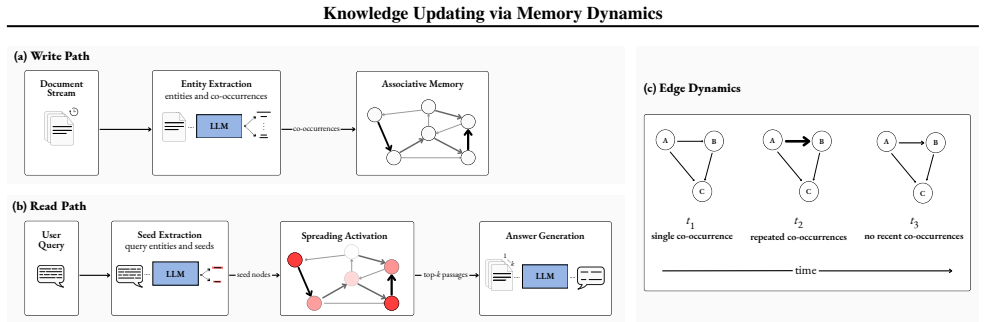
In Memini, knowledge is organized as a directed graph with each edge carrying two coupled internal variables following the Benna-Fusi model of synaptic consolidation. From this coupling, episodic sensitivity, gradual consolidation, and selective forgetting are expected to emerge as facets of a single mechanism, reframing external memory as a learning substrate that reorganizes through its own dynamics.
What carries the argument
Memini associative memory: a directed graph in which each edge carries two coupled internal variables (fast and slow) that follow the Benna-Fusi synaptic-consolidation model.
If this is right
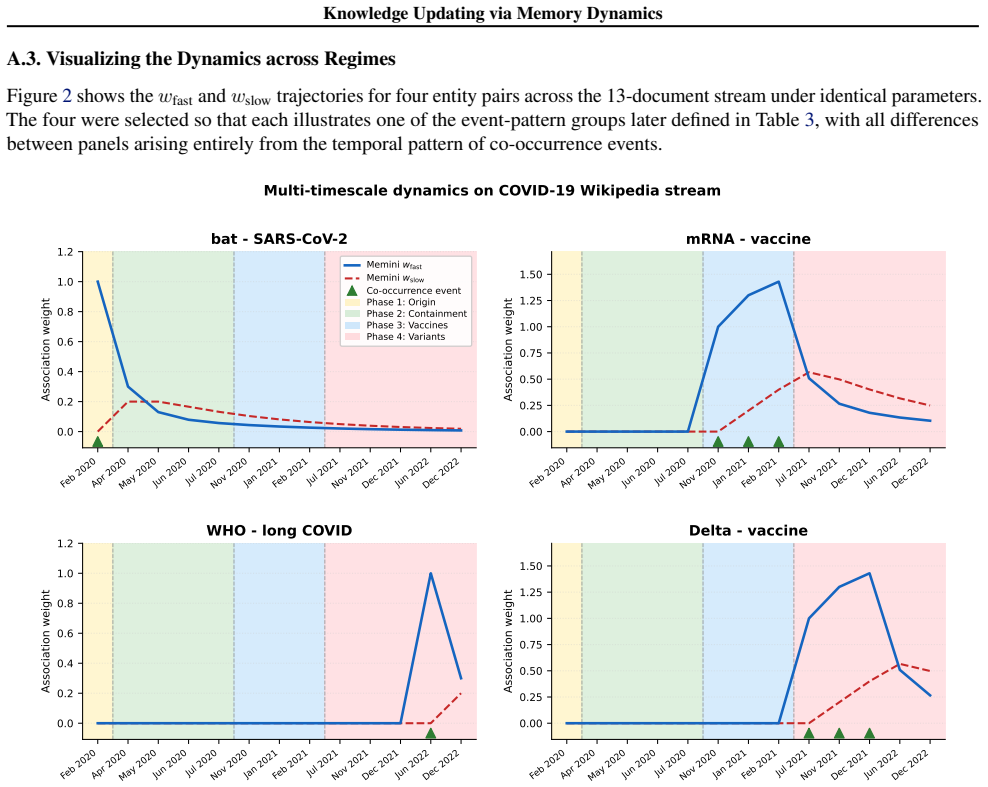
- New associations become immediately usable through the fast variable.
- Repetition strengthens associations via the slow variable.
- Unused knowledge fades through the same coupled dynamics.
- The three memory behaviors arise without separate forgetting or consolidation modules.
- External memory functions as an adaptive substrate rather than a static store.
Where Pith is reading between the lines
- The same edge dynamics might reduce the engineering effort needed for separate memory-management policies in LLM systems.
- A working implementation could be tested by measuring how quickly recall accuracy changes after single versus repeated exposures to new facts.
- The approach invites comparison with other multi-timescale models already used in continual-learning research.
- If the mapping works, it suggests that biological consolidation principles can be ported to graph-based memory without domain-specific adjustments.
Load-bearing premise
The Benna-Fusi model of synaptic consolidation can be mapped directly onto edge variables in a knowledge graph so that episodic sensitivity, gradual consolidation, and selective forgetting appear without any added mechanisms or tuning.
What would settle it
Build a small Memini graph using the Benna-Fusi equations on sample edges, apply a sequence of new and repeated facts, and check whether the three memory behaviors appear automatically from the variable coupling alone.
Figures
read the original abstract
LLMs are trained once, then deployed into a world that never stops changing. External memory compensates for this, but most systems manage it explicitly rather than letting it adapt on its own. Biological memory works differently: coupled multi-timescale dynamics make new associations immediately usable, strengthen what repetition confirms, and let the rest fade. We argue that external memory should follow a similar principle. In Memini, this view takes the form of an associative memory that organizes knowledge as a directed graph. Each edge carries two coupled internal variables, one fast and one slow, following the Benna-Fusi model of synaptic consolidation. From this coupling, episodic sensitivity, gradual consolidation, and selective forgetting are expected to emerge as facets of a single mechanism, reframing external memory as a learning substrate that reorganizes through its own dynamics. This workshop article describes an early-stage conceptual design without experimental evaluation.
Editorial analysis
A structured set of objections, weighed in public.
Referee Report
Summary. The paper proposes Memini, a conceptual design for continual knowledge updating in LLM systems. External memory is represented as a directed graph in which each edge carries two coupled variables (fast and slow) taken from the Benna-Fusi synaptic-consolidation model. The central claim is that this coupling alone will cause episodic sensitivity, gradual consolidation, and selective forgetting to emerge as facets of a single mechanism, thereby turning external memory into an adaptive learning substrate that reorganizes through its own dynamics. The manuscript is explicitly presented as an early-stage workshop article without experimental evaluation or derivations.
Significance. If a rigorous mapping of the Benna-Fusi dynamics onto knowledge-graph edges could be shown to produce the three claimed behaviors without additional mechanisms or parameter tuning, the work would offer a principled alternative to explicit memory-management pipelines in LLM systems. At present the significance is prospective only, because the manuscript supplies no equations, retrieval rules, or analysis that would allow the emergence claim to be evaluated.
major comments (2)
- [Abstract] Abstract: the assertion that 'from this coupling, episodic sensitivity, gradual consolidation, and selective forgetting are expected to emerge as facets of a single mechanism' is load-bearing for the entire proposal, yet the manuscript contains no update equations for the graph edges, no retrieval or query rule that would drive the fast variable, and no derivation or simulation demonstrating that the slow variable produces consolidation or forgetting under those rules.
- [Introduction / Model] The manuscript invokes the Benna-Fusi model (originally derived for neural synaptic plasticity with specific circuit connectivity) but does not address how its assumptions translate to an arbitrary directed knowledge-graph edge set; without this analysis the claimed emergence remains an unexamined change of context.
minor comments (1)
- The term 'Memini associative memory' is introduced without a formal definition or diagram of the graph structure, making it difficult to assess how the edge variables would be queried or updated in an LLM pipeline.
Simulated Author's Rebuttal
We thank the referee for the constructive comments on our conceptual workshop paper. We address each major point below, acknowledging the early-stage nature of the work and outlining planned revisions where appropriate.
read point-by-point responses
-
Referee: [Abstract] Abstract: the assertion that 'from this coupling, episodic sensitivity, gradual consolidation, and selective forgetting are expected to emerge as facets of a single mechanism' is load-bearing for the entire proposal, yet the manuscript contains no update equations for the graph edges, no retrieval or query rule that would drive the fast variable, and no derivation or simulation demonstrating that the slow variable produces consolidation or forgetting under those rules.
Authors: We agree that the emergence claim is central and that the manuscript, explicitly positioned as an early-stage conceptual design without derivations or experiments, does not supply the requested equations, retrieval rules, or analysis. The proposal rests on the expectation that the Benna-Fusi coupling will produce the behaviors when instantiated on graph edges. In revision we will add a dedicated section proposing concrete update equations for the fast and slow variables, a high-level retrieval rule that modulates the fast variable, and a qualitative discussion of how consolidation and forgetting would arise, while retaining the workshop framing that full evaluation remains future work. revision: yes
-
Referee: [Introduction / Model] The manuscript invokes the Benna-Fusi model (originally derived for neural synaptic plasticity with specific circuit connectivity) but does not address how its assumptions translate to an arbitrary directed knowledge-graph edge set; without this analysis the claimed emergence remains an unexamined change of context.
Authors: The comment is correct: the manuscript does not provide an explicit mapping or analysis of how the original synaptic assumptions (e.g., circuit connectivity, local Hebbian updates) carry over to an arbitrary directed knowledge-graph setting. The Benna-Fusi dynamics are invoked primarily as an inspirational mechanism for multi-timescale edge variables rather than a direct transfer. In a revised version we will insert a short subsection discussing the key contextual differences and arguing why the core fast-slow coupling may still be expected to yield the claimed emergent properties, while noting that a rigorous formal mapping is beyond the current conceptual scope. revision: yes
Circularity Check
No circularity; conceptual mapping to external Benna-Fusi model introduces no self-referential reduction or fitted predictions.
full rationale
The paper is an early-stage conceptual proposal without equations, derivations, or experiments. It states that edges in a directed graph carry fast and slow variables 'following the Benna-Fusi model' and that the three behaviors 'are expected to emerge as facets of a single mechanism.' This imports an external neuroscience model rather than defining outcomes in terms of themselves or renaming fitted parameters as predictions. No self-citation chain, ansatz smuggling, or uniqueness theorem from the authors is invoked to force the result. The lack of explicit update rules or analysis is a limitation of scope, not a circular reduction of the claimed emergence to the inputs by construction.
Axiom & Free-Parameter Ledger
axioms (1)
- domain assumption The Benna-Fusi two-variable synaptic consolidation model can be applied without modification to produce episodic sensitivity, consolidation, and selective forgetting in a knowledge graph for LLMs.
invented entities (1)
-
Memini associative memory
no independent evidence
Reference graph
Works this paper leans on
-
[1]
ISSN 0896-6273. doi: 10.1016/j.neuron.2005.02. 001. Guti´errez, B. J., Shu, Y ., Qi, W., Zhou, S., and Su, Y . From RAG to Memory: Non-Parametric Continual Learning for Large Language Models. InProceedings of the 42nd International Conference on Machine Learning, volume 267 ofProceedings of Machine Learning Research, pp. 21497–21515. PMLR, 2025. Honda, Y ...
-
[2]
MemGPT: Towards LLMs as Operating Systems
Curran Associates, Inc., 2020. McClelland, J. L., McNaughton, B. L., and O’Reilly, R. C. Why there are complementary learning systems in the hippocampus and neocortex: Insights from the successes and failures of connectionist models of learning and mem- ory.Psychological Review, 102(3):419–457, 1995. doi: 10.1037/0033-295x.102.3.419. Mialon, G., Dess `ı, ...
work page internal anchor Pith review Pith/arXiv arXiv doi:10.1037/0033-295x.102.3.419 2020
-
[3]
doi: 10.1145/3735633. Sun, T., Shao, Y ., Qian, H., Huang, X., and Qiu, X. Black- Box Tuning for Language-Model-as-a-Service. InPro- ceedings of the 39th International Conference on Ma- chine Learning, volume 162 ofProceedings of Machine Learning Research, pp. 20841–20855. PMLR, June 2022. Tulving, E. Pr ´ecis of Elements of episodic memory.Be- havioral a...
discussion (0)
Sign in with ORCID, Apple, or X to comment. Anyone can read and Pith papers without signing in.