Chiralization of Quiver Varieties
Pith reviewed 2026-06-26 06:14 UTC · model grok-4.3
The pith
A natural vertex superalgebra map exists from the BRST-reduced V(v,w) to the chiral differential operators on the extended quiver variety, and is injective under stronger assumptions.
A machine-rendered reading of the paper's core claim, the machinery that carries it, and where it could break.
Core claim
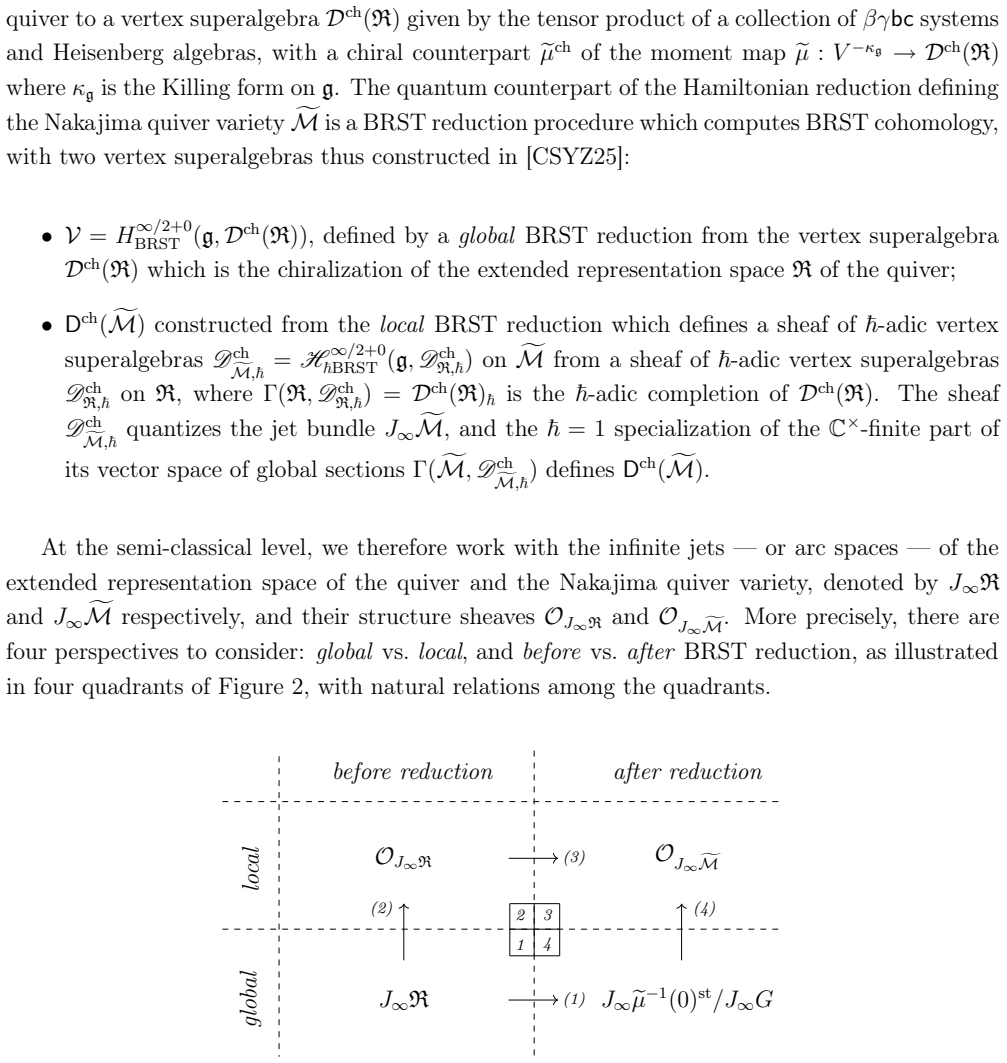
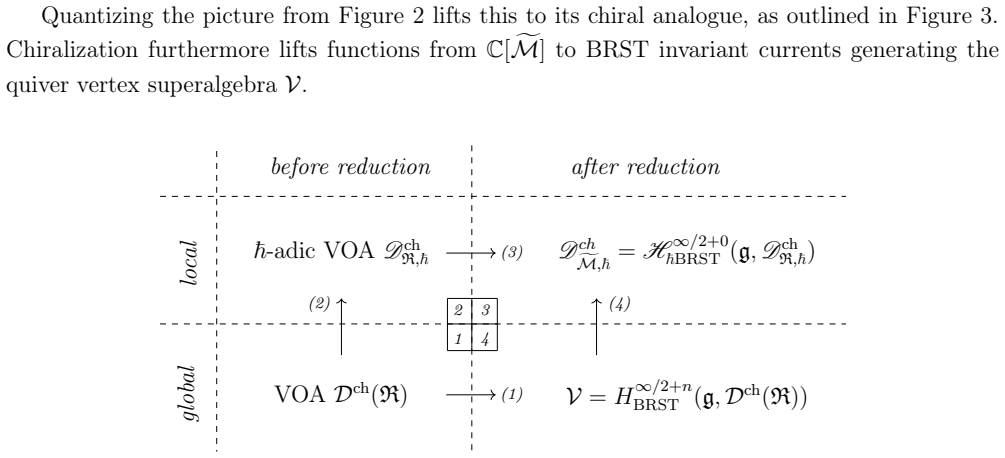
For a quiver Q with gauge dimension v and framing dimension w, the extended quiver variety M~(v,w) admits a sheaf of ħ-adic vertex superalgebras D^ch_{M~,ħ} that quantizes its jet bundle; the ħ=1, C^x-finite global sections give the vertex algebra D^ch(M~(v,w)). The vertex superalgebra V(v,w) is defined by BRST reduction of the associated βγbc-system tensor Heisenberg VOA, and there is a natural map V(v,w) → D^ch(M~(v,w)). Under certain technical assumptions the negative-degree BRST cohomologies of the unreduced tensor product vanish, and under stronger assumptions the map is injective.
What carries the argument
The BRST reduction of the tensor product of βγbc-systems and Heisenberg VOA, which produces V(v,w) and supplies the source of the natural map to D^ch(M~(v,w)).
If this is right
- The geometry of the extended quiver variety is encoded in the vertex superalgebra structure of D^ch(M~(v,w)).
- V(v,w) supplies an algebraic model whose representation theory can be used to study the deformation family M~(v,w).
- When the map is injective, the BRST-reduced algebra embeds as a subalgebra of the global chiral differential operators.
- The construction realizes the boundary vertex superalgebra of the H-twisted 3D N=4 quiver gauge theory associated to Q, v, and w.
Where Pith is reading between the lines
- Low-dimensional explicit calculations for specific quivers could verify or constrain the range of validity of the technical assumptions.
- The same BRST-reduction technique might be applied to other deformation families of quiver varieties or to related moduli spaces.
- The resulting vertex algebras could yield new invariants or categorifications of the cohomology of the extended quiver varieties.
- Connections to other constructions of boundary VOAs in three-dimensional gauge theories may become visible once the assumptions are clarified.
Load-bearing premise
The certain technical assumptions needed for vanishing of negative-degree BRST cohomologies, together with the stronger assumptions needed for injectivity of the map, must hold for the given quiver and dimension vectors.
What would settle it
An explicit computation for a concrete small quiver (for example a single-vertex quiver with small v and w) that exhibits either nonzero negative-degree BRST cohomology or a non-injective map would show the assumptions fail or the claimed vanishing and injectivity do not hold in general.
Figures


read the original abstract
Given a quiver Q with gauge dimension $\bf v$ and framing dimension $\bf w$, one can define the extended quiver variety $\widetilde{\mathcal M}(\mathbf v,\mathbf w)$, which is a smooth family of deformations of the Nakajima quiver variety $\mathcal M(\mathbf v,\mathbf w)$. In this paper we discuss two vertex algebras which chiralize the geometry $\widetilde{\mathcal M}(\mathbf v,\mathbf w)$. We construct a sheaf of $\hbar$-adic vertex superalgebras $\mathscr D^{\mathrm{ch}}_{\widetilde{\mathcal M}(\mathbf v,\mathbf w),\hbar}$ on $\widetilde{\mathcal M}(\mathbf v,\mathbf w)$ which quantizes the jet bundle of $\widetilde{\mathcal M}(\mathbf v,\mathbf w)$, and define a vertex algebra $\mathsf D^{\mathrm{ch}}(\widetilde{\mathcal M}(\mathbf v,\mathbf w))$ to be the $\hbar=1$ specialization of the $\mathbb C^{\times}$-finite part of the vector space of global sections $\Gamma(\widetilde{\mathcal M}(\mathbf v,\mathbf w), \mathscr D^{\mathrm{ch}}_{\widetilde{\mathcal M}(\mathbf v,\mathbf w),\hbar})$. We define another vertex superalgebra $\mathcal V(\mathbf v,\mathbf w)$ by BRST reduction of the tensor product of the $\beta\gamma bc$-system and Heisenberg VOA associated to the quiver Q, and show that there exists a natural vertex superalgebra map from $\mathcal V(\mathbf v,\mathbf w)$ to $\mathsf D^{\mathrm{ch}}(\widetilde{\mathcal M}(\mathbf v,\mathbf w))$. Under certain technical assumptions, we prove that the negative degree BRST cohomologies of the tensor product of $\beta\gamma bc$-systems and Heisenberg VOA associated to the quiver Q are zero, and under stronger assumptions, that the aforementioned vertex superalgebra map is injective. Physically, the vertex superalgebra $\mathcal V(\mathbf v,\mathbf w)$ is closely related to the boundary VOA of the H-twisted 3D $\mathcal N=4$ quiver gauge theory associated to the quiver Q with gauge and framing dimension vectors $\bf v$ and $\bf w$.
Editorial analysis
A structured set of objections, weighed in public.
Referee Report
Summary. The manuscript constructs a sheaf of ħ-adic vertex superalgebras 𝒟^ch on the extended quiver variety ilde M(v,w) quantizing its jet bundle, defines the global sections specialization 𝖣^ch( ilde M(v,w)) at ħ=1, constructs the vertex superalgebra V(v,w) via BRST reduction of the βγbc-system tensor Heisenberg VOA associated to quiver Q, establishes an unconditional natural map V(v,w) → 𝖣^ch( ilde M(v,w)), and proves vanishing of negative-degree BRST cohomologies under certain technical assumptions together with injectivity of the map under stronger assumptions. It also relates V(v,w) to the boundary VOA of the H-twisted 3D 𝒩=4 quiver gauge theory.
Significance. If the technical assumptions can be made explicit, verified for general quivers, and the proofs completed, the unconditional natural map together with the BRST-vanishing result would furnish a direct chiralization linking Nakajima quiver geometry to VOA constructions from gauge theory, with potential applications to boundary chiral algebras in 3d 𝒩=4 theories. The constructions themselves (sheaf quantization and BRST reduction) are presented as direct definitions without fitted parameters.
major comments (2)
- [Abstract] Abstract, final paragraph: the vanishing of negative-degree BRST cohomologies (required to even define the target cohomology in which the map lands) is asserted only under 'certain technical assumptions' that are neither enumerated nor shown to hold for arbitrary Q; this is load-bearing for the central claim.
- [Abstract] Abstract, final paragraph: injectivity of the map V(v,w) → 𝖣^ch is asserted only under 'stronger assumptions' that are likewise unspecified, so the strongest form of the result cannot be assessed for scope or necessity.
minor comments (1)
- Notation: the framing and gauge vectors are sometimes bold v,w and sometimes mathbf v,w; uniform use of one convention would improve readability.
Simulated Author's Rebuttal
We thank the referee for their careful reading and constructive comments on the manuscript. We agree that the abstract requires clarification regarding the technical assumptions and will revise it accordingly to improve transparency. Below we respond point by point to the major comments.
read point-by-point responses
-
Referee: [Abstract] Abstract, final paragraph: the vanishing of negative-degree BRST cohomologies (required to even define the target cohomology in which the map lands) is asserted only under 'certain technical assumptions' that are neither enumerated nor shown to hold for arbitrary Q; this is load-bearing for the central claim.
Authors: The referee is correct that the abstract does not enumerate the assumptions. The assumptions are stated explicitly in the body of the paper in the section on BRST reduction of the βγbc-system and Heisenberg VOA. The manuscript does not claim that the vanishing holds for arbitrary Q; the result is presented as conditional on these assumptions, which are technical and may fail in general. We will revise the abstract to list the key assumptions (or provide a direct reference to their statement in the text) and to emphasize that they are not assumed to hold universally. This will make the conditional nature of the central claim fully transparent. revision: yes
-
Referee: [Abstract] Abstract, final paragraph: injectivity of the map V(v,w) → 𝖣^ch is asserted only under 'stronger assumptions' that are likewise unspecified, so the strongest form of the result cannot be assessed for scope or necessity.
Authors: We agree that the abstract should specify the stronger assumptions under which injectivity holds. These build on the vanishing assumptions and are detailed in the main text. We will revise the abstract to enumerate or explicitly reference the stronger assumptions, allowing readers to evaluate the scope and necessity of the injectivity result. The unconditional natural map is stated separately from the conditional injectivity. revision: yes
Circularity Check
No significant circularity; all constructions are direct definitions followed by a stated map and conditional cohomology results
full rationale
The paper defines the sheaf of ħ-adic vertex superalgebras directly as a quantization of the jet bundle on the extended quiver variety, takes global sections to obtain D^ch, defines V(v,w) explicitly via BRST reduction of the βγbc ⊗ Heisenberg tensor product, asserts a natural map between them, and states vanishing/injectivity results only under separately listed technical assumptions. No equation or step equates a derived object to its input by construction, renames a fit as a prediction, or relies on a self-citation chain for a load-bearing uniqueness claim. The assumptions are external conditions whose verification lies outside the definitional chain itself.
Axiom & Free-Parameter Ledger
axioms (1)
- standard math Standard properties of Nakajima quiver varieties and vertex operator algebras
invented entities (2)
-
Sheaf of ħ-adic vertex superalgebras D^ch
no independent evidence
-
Vertex superalgebra V(v,w) via BRST reduction
no independent evidence
Reference graph
Works this paper leans on
-
[1]
BRST Quantization of the Gauged WZW Action and Coset Conformal Field Theories
Karabali, Dimitra and Schnitzer, Howard J. BRST Quantization of the Gauged WZW Action and Coset Conformal Field Theories. Nucl. Phys. B. 1990. doi:10.1016/0550-3213(90)90075-O
-
[2]
1994 , publisher=
An introduction to homological algebra , author=. 1994 , publisher=
1994
-
[3]
2002 , publisher=
Algebraic geometry and arithmetic curves , author=. 2002 , publisher=
2002
-
[4]
Goddard, P. and Olive, David I. and Waterson, G. Superalgebras, Symplectic Bosons and the Sugawara Construction. Commun. Math. Phys. 1987. doi:10.1007/BF01225374
-
[5]
Infinite Chiral Symmetry in Four Dimensions
Beem, Christopher and Lemos, Madalena and Liendo, Pedro and Peelaers, Wolfger and Rastelli, Leonardo and van Rees, Balt C. Infinite Chiral Symmetry in Four Dimensions. Commun. Math. Phys. 2015. doi:10.1007/s00220-014-2272-x. arXiv:1312.5344
work page internal anchor Pith review Pith/arXiv arXiv doi:10.1007/s00220-014-2272-x 2015
-
[6]
Maffei, Andrea , TITLE =. Comment. Math. Helv. , FJOURNAL =. 2005 , NUMBER =. doi:10.4171/CMH/1 , URL =
-
[7]
Lusztig, G. , TITLE =. Adv. Math. , FJOURNAL =. 1998 , NUMBER =. doi:10.1006/aima.1998.1729 , URL =
-
[8]
Vertex operator algebras, Higgs branches, and modular differential equations
Beem, Christopher and Rastelli, Leonardo. Vertex operator algebras, Higgs branches, and modular differential equations. JHEP. 2018. doi:10.1007/JHEP08(2018)114. arXiv:1707.07679
-
[9]
Creutzig, Thomas and Dimofte, Tudor and Garner, Niklas and Geer, Nathan. A QFT for non-semisimple TQFT. Adv. Theor. Math. Phys. 2024. doi:10.4310/ATMP.2024.v28.n1.a4. arXiv:2112.01559
-
[10]
Lie Groups, Geometry, and Representation Theory: A Tribute to the Life and Work of Bertram Kostant , pages=
Quasi-lisse vertex algebras and modular linear differential equations , author=. Lie Groups, Geometry, and Representation Theory: A Tribute to the Life and Work of Bertram Kostant , pages=. 2018 , publisher=
2018
-
[11]
Arakawa, Tomoyuki and Kuwabara, Toshiro and M. arXiv preprint , eprint = "2309.17308", year=
-
[12]
2003 , publisher=
Kac, Victor and Roan, Shi-Shyr and Wakimoto, Minoru , journal=. 2003 , publisher=
2003
-
[13]
Advances in Mathematics , volume=
Quantum reduction and representation theory of superconformal algebras , author=. Advances in Mathematics , volume=. 2004 , publisher=
2004
-
[14]
2017 , eprint=
Vertex algebras associated with hypertoric varieties , author=. 2017 , eprint=
2017
-
[15]
2017 , publisher=
Arakawa, Tomoyuki , journal=. 2017 , publisher=
2017
-
[16]
2015 , publisher=
Arakawa, Tomoyuki and Kuwabara, Toshiro and Malikov, Fyodor , journal=. 2015 , publisher=
2015
-
[17]
2010 , publisher=
Namikawa, Yoshinori , journal=. 2010 , publisher=
2010
-
[18]
Duke Math
Poisson deformations of affine symplectic varieties , author=. Duke Math. J. , volume=
-
[19]
Inventiones mathematicae , volume=
Kirwan surjectivity for quiver varieties , author=. Inventiones mathematicae , volume=. 2018 , publisher=
2018
-
[20]
Losev, Ivan , journal=
-
[21]
Advances in Mathematics , volume=
Isomorphisms of quantizations via quantization of resolutions , author=. Advances in Mathematics , volume=. 2012 , publisher=
2012
-
[22]
Supersymmetric Boundary Conditions in N=4 Super Yang-Mills Theory
Gaiotto, Davide and Witten, Edward. Supersymmetric Boundary Conditions in N=4 Super Yang-Mills Theory. J. Statist. Phys. 2009. doi:10.1007/s10955-009-9687-3. arXiv:0804.2902
work page internal anchor Pith review Pith/arXiv arXiv doi:10.1007/s10955-009-9687-3 2009
-
[23]
Voronov, Alexander A. , year=. Semi-infinite homological algebra , volume=. Inventiones Mathematicae , publisher=. doi:10.1007/bf01244304 , number=
-
[24]
Feigin, B. L. , year=. Russian Mathematical Surveys , publisher=. doi:10.1070/rm1984v039n02abeh003112 , number=
-
[25]
Frenkel, I. B. and Garland, H. and Zuckerman, G. J. , year=. Semi-infinite cohomology and string theory , volume=. Proceedings of the National Academy of Sciences , publisher=. doi:10.1073/pnas.83.22.8442 , number=
-
[26]
King, A. D. , year=. Moduli of Representations of Finite Dimensional Algebras , volume=. The Quarterly Journal of Mathematics , publisher=. doi:10.1093/qmath/45.4.515 , number=
-
[27]
Mumford, David and Fogarty, John and Kirwan, Frances , year=. Geometric Invariant Theory , ISBN=. doi:10.1007/978-3-642-57916-5 , publisher=
-
[28]
McGerty, Kevin and Nevins, Thomas , journal=
-
[29]
2017 , publisher=
Arakawa, Tomoyuki and Molev, Alexander , journal=. 2017 , publisher=
2017
-
[30]
1990 , publisher=
Feigin, Boris and Frenkel, Edward , journal=. 1990 , publisher=
1990
-
[31]
Quantum Langlands dualities of boundary conditions, D-modules, and conformal blocks
Frenkel, Edward and Gaiotto, Davide. Quantum Langlands dualities of boundary conditions, D-modules, and conformal blocks. Commun. Num. Theor. Phys. 2020. doi:10.4310/CNTP.2020.v14.n2.a1. arXiv:1805.00203
-
[32]
S-Duality of Boundary Conditions In N=4 Super Yang-Mills Theory
Gaiotto, Davide and Witten, Edward. S-Duality of Boundary Conditions In N=4 Super Yang-Mills Theory. Adv. Theor. Math. Phys. 2009. doi:10.4310/ATMP.2009.v13.n3.a5. arXiv:0807.3720
work page internal anchor Pith review Pith/arXiv arXiv doi:10.4310/atmp.2009.v13.n3.a5 2009
-
[33]
Knot Invariants from Four-Dimensional Gauge Theory
Gaiotto, Davide and Witten, Edward. Knot Invariants from Four-Dimensional Gauge Theory. Adv. Theor. Math. Phys. 2012. doi:10.4310/ATMP.2012.v16.n3.a5. arXiv:1106.4789
work page internal anchor Pith review Pith/arXiv arXiv doi:10.4310/atmp.2012.v16.n3.a5 2012
-
[34]
2004 , publisher=
Li, Haisheng , journal=. 2004 , publisher=
2004
-
[35]
Toda Theory From Six Dimensions
Cordova, Clay and Jafferis, Daniel L. Toda Theory From Six Dimensions. JHEP. 2017. doi:10.1007/JHEP12(2017)106. arXiv:1605.03997
work page internal anchor Pith review Pith/arXiv arXiv doi:10.1007/jhep12(2017)106 2017
-
[36]
3d Partition Function as Overlap of Wavefunctions
Nishioka, Tatsuma and Tachikawa, Yuji and Yamazaki, Masahito. 3d Partition Function as Overlap of Wavefunctions. JHEP. 2011. doi:10.1007/JHEP08(2011)003. arXiv:1105.4390
work page internal anchor Pith review Pith/arXiv arXiv doi:10.1007/jhep08(2011)003 2011
-
[37]
Gaiotto, Davide and Rap c \'ak, Miroslav. Vertex Algebras at the Corner. JHEP. 2019. doi:10.1007/JHEP01(2019)160. arXiv:1703.00982
work page internal anchor Pith review Pith/arXiv arXiv doi:10.1007/jhep01(2019)160 2019
-
[38]
1990 , publisher=
Bouwknegt, Peter and McCarthy, Jim and Pilch, Krzysztof , journal=. 1990 , publisher=
1990
-
[39]
Fermionic extensions of W -algebras via 3d N =4 gauge theories with a boundary
Yoshida, Yutaka. Fermionic extensions of W -algebras via 3d N =4 gauge theories with a boundary. 2023. arXiv:2304.03270
Pith/arXiv arXiv 2023
-
[40]
Boundary Chiral Algebras and Holomorphic Twists
Costello, Kevin and Dimofte, Tudor and Gaiotto, Davide. Boundary Chiral Algebras and Holomorphic Twists. Commun. Math. Phys. 2023. doi:10.1007/s00220-022-04599-0. arXiv:2005.00083
-
[41]
Higgs and Coulomb branches from vertex operator algebras
Costello, Kevin and Creutzig, Thomas and Gaiotto, Davide. Higgs and Coulomb branches from vertex operator algebras. JHEP. 2019. doi:10.1007/JHEP03(2019)066. arXiv:1811.03958
work page internal anchor Pith review Pith/arXiv arXiv doi:10.1007/jhep03(2019)066 2019
-
[42]
Vertex Operator Algebras and 3d N=4 gauge theories
Costello, Kevin and Gaiotto, Davide. Vertex Operator Algebras and 3d N = 4 gauge theories. JHEP. 2019. doi:10.1007/JHEP05(2019)018. arXiv:1804.06460
work page internal anchor Pith review Pith/arXiv arXiv doi:10.1007/jhep05(2019)018 2019
-
[43]
Twisted formalism for 3d N =4 theories
Garner, Niklas. Twisted formalism for 3d N =4 theories. Lett. Math. Phys. 2024. doi:10.1007/s11005-023-01758-9. arXiv:2204.02997
-
[44]
Closset, Cyril and Kim, Heeyeon. Three-dimensional N = 2 supersymmetric gauge theories and partition functions on Seifert manifolds: A review. Int. J. Mod. Phys. A. 2019. doi:10.1142/S0217751X19300114. arXiv:1908.08875
-
[45]
Supersymmetric Field Theories on Three-Manifolds
Closset, Cyril and Dumitrescu, Thomas T. and Festuccia, Guido and Komargodski, Zohar. Supersymmetric Field Theories on Three-Manifolds. JHEP. 2013. doi:10.1007/JHEP05(2013)017. arXiv:1212.3388
work page internal anchor Pith review Pith/arXiv arXiv doi:10.1007/jhep05(2013)017 2013
-
[46]
Dual Boundary Conditions in 3d SCFT's
Dimofte, Tudor and Gaiotto, Davide and Paquette, Natalie M. Dual boundary conditions in 3d SCFT s. JHEP. 2018. doi:10.1007/JHEP05(2018)060. arXiv:1712.07654
work page internal anchor Pith review Pith/arXiv arXiv doi:10.1007/jhep05(2018)060 2018
-
[47]
Adv. Theor. Math. Phys. 2019. doi:10.4310/ATMP.2019.v23.n1.a3. arXiv:1604.03625
work page internal anchor Pith review Pith/arXiv arXiv doi:10.4310/atmp.2019.v23.n1.a3 2019
-
[48]
Braverman, Alexander and Finkelberg, Michael and Nakajima, Hiraku. Ring objects in the equivariant derived Satake category arising from Coulomb branches (with an appendix by Gus Lonergan). Physics. 2019. arXiv:1706.02112
arXiv 2019
-
[49]
Boundaries, Vermas, and Factorisation
Bullimore, Mathew and Crew, Samuel and Zhang, Daniel. Boundaries, Vermas, and Factorisation. JHEP. 2021. doi:10.1007/JHEP04(2021)263. arXiv:2010.09741
-
[50]
Topological Chern-Simons/Matter Theories
Aganagic, Mina and Costello, Kevin and McNamara, Jacob and Vafa, Cumrun. Topological Chern-Simons/Matter Theories. 2017. arXiv:1706.09977
Pith/arXiv arXiv 2017
-
[51]
(2,2) and (0,4) Supersymmetric Boundary Conditions in 3d N = 4 Theories and Type IIB Branes
Chung, Hee-Joong and Okazaki, Tadashi. (2,2) and (0,4) supersymmetric boundary conditions in 3d N = 4 theories and type IIB branes. Phys. Rev. D. 2017. doi:10.1103/PhysRevD.96.086005. arXiv:1608.05363
work page internal anchor Pith review Pith/arXiv arXiv doi:10.1103/physrevd.96.086005 2017
-
[52]
2023 , eprint=
An Example of Homomorphisms from the Guay's affine Yangians to non-rectangular W -algebras , author=. 2023 , eprint=
2023
-
[53]
2009 , eprint=
Lectures on Nakajima's Quiver Varieties , author=. 2009 , eprint=
2009
-
[54]
Localization of three-dimensional N =2 supersymmetric theories on S^1 D^2
Yoshida, Yutaka and Sugiyama, Katsuyuki. Localization of three-dimensional N =2 supersymmetric theories on S^1 D^2. PTEP. 2020. doi:10.1093/ptep/ptaa136. arXiv:1409.6713
-
[55]
Comparison of quiver varieties, loop Grassmannians and nilpotent cones in type A. arXiv e-prints , keywords =. doi:10.48550/arXiv.1905.01810 , archivePrefix =. 1905.01810 , primaryClass =
-
[56]
Nakajima, Hiraku , TITLE =. Duke Math. J. , FJOURNAL =. 1994 , NUMBER =. doi:10.1215/S0012-7094-94-07613-8 , URL =
-
[57]
Nakajima, Hiraku , TITLE =. Duke Math. J. , FJOURNAL =. 1998 , NUMBER =. doi:10.1215/S0012-7094-98-09120-7 , URL =
-
[58]
Mirror Symmetry in Three Dimensional Gauge Theories
Intriligator, Kenneth A. and Seiberg, N. Mirror symmetry in three-dimensional gauge theories. Phys. Lett. B. 1996. doi:10.1016/0370-2693(96)01088-X. arXiv:hep-th/9607207
work page internal anchor Pith review Pith/arXiv arXiv doi:10.1016/0370-2693(96)01088-x 1996
-
[59]
Quantum groups and quantum cohomology , author=. Ast. 2019 , publisher=
2019
-
[60]
Nakajima, Hiraku , journal=
-
[61]
Losev, Ivan , note =
-
[62]
On the reducedness of quiver schemes , author=. arXiv:2201.09838 , year=
-
[63]
Symplectic resolutions of quiver varieties , author=. arXiv:1602.00164 , year=
-
[64]
Compositio Mathematica , volume=
Geometry of the moment map for representations of quivers , author=. Compositio Mathematica , volume=. 2001 , publisher=
2001
-
[65]
2002 , publisher=
Crawley-Boevey, William , journal=. 2002 , publisher=
2002
-
[66]
Crawley-Boevey, William , journal=
-
[67]
Luna, Domingo , journal=
-
[68]
Jet schemes of locally complete intersection canonical singularities , author=. Invent. math , volume=
-
[69]
Compositio Mathematica , volume=
Symplectic quotients have symplectic singularities , author=. Compositio Mathematica , volume=. 2020 , publisher=
2020
-
[70]
arXiv preprint arXiv:2108.07306 , year=
When does the zero fiber of the moment map have rational singularities? , author=. arXiv preprint arXiv:2108.07306 , year=
-
[71]
1974 , publisher=
Hochster, Melvin and Roberts, Joel L , journal=. 1974 , publisher=
1974
-
[72]
International Mathematics Research Notices , volume=
Rational singularities, quiver moment maps, and representations of surface groups , author=. International Mathematics Research Notices , volume=. 2021 , publisher=
2021
-
[73]
Rational singularities for moment maps of totally negative quivers. arXiv e-prints , keywords =. doi:10.48550/arXiv.2209.14791 , archivePrefix =. 2209.14791 , primaryClass =
-
[74]
2006 , publisher=
Hartshorne, Robin , volume=. 2006 , publisher=
2006
-
[75]
Moosavian, Seyed Faroogh and Zhou, Yehao , journal=
-
[76]
Journal of the american mathematical society , volume=
Quivers, perverse sheaves, and quantized enveloping algebras , author=. Journal of the american mathematical society , volume=. 1991 , publisher=
1991
-
[77]
Coman, Ioana and Shim, Myungbo and Yamazaki, Masahito and Zhou, Yehao , note=
-
[78]
An Algorithmic approach to operator product expansions, W algebras and W strings
Thielemans, Kris. An Algorithmic approach to operator product expansions, W algebras and W strings. 1994. arXiv:hep-th/9506159
Pith/arXiv arXiv 1994
-
[79]
Arakawa, Tomoyuki , TITLE =. Math. Z. , FJOURNAL =. 2012 , NUMBER =. doi:10.1007/s00209-010-0812-4 , URL =
-
[80]
Three-dimensional gauge theories with supersymmetry enhancement
Gang, Dongmin and Yamazaki, Masahito. Three-dimensional gauge theories with supersymmetry enhancement. Phys. Rev. D. 2018. doi:10.1103/PhysRevD.98.121701. arXiv:1806.07714
work page internal anchor Pith review Pith/arXiv arXiv doi:10.1103/physrevd.98.121701 2018
discussion (0)
Sign in with ORCID, Apple, or X to comment. Anyone can read and Pith papers without signing in.