REVIEW 2 major objections 5 minor 60 references
GADMM: Fast and Communication Efficient Framework for Distributed Machine Learning
T0 review · 2 major / 5 minor · reviewed 2026-08-14 · deepseek-v4-flash
Pith's one-line read GADMM claims distributed convex learning reaches the global optimum with workers split into two groups, each talking only to two chain neighbors and only half transmitting per round; a dynamic variant keeps the guarantee under rewiring.
desk verdict The static GADMM result is a solid two-block ADMM on a chain; the D-GADMM extension is overclaimed because its proof fixes a dual saddle point that the rewired chain does not respect. read the letter →
The pith
A machine-rendered reading of the paper's core claim, the machinery that carries it, and where it could break.
The reading
What carries the argument
The argument is carried by the chain-structured augmented Lagrangian $L_\rho = \sum_n f_n(\theta_n) + \sum_{n=1}^{N-1}\langle\lambda_n, \theta_n - \theta_{n+1}\rangle + \frac{\rho}{2}\sum_{n=1}^{N-1}\|\theta_n - \theta_{n+1}\|^2$, the alternating head/tail update steps in (11)--(15), and two residuals: the primal residual $r^k_{n,n+1} = \theta^k_n - \theta^k_{n+1}$ measuring neighbor disagreement, and the dual residual $s^k_n$ measuring how far a head worker's update lags a full block-coordinate sweep. The proof centers on a Lyapunov function $V_k$ (equation 32) built from dual errors and neighbor-model deviations; showing $V_{k+1} \le V_k$ each iteration makes the residuals summable, which forces them to zero and then forces the objective gap to zero through the upper and lower bounds of Lemma 1. For D-GADMM the same Lyapunov structure is asserted to survive chain rewiring.
What would settle it
With four workers and simple convex losses of known optimum, alternate the chain between two orderings every iteration and compute $V_k$ from equation 125 using the saddle-point dual $\lambda^*$ of a single fixed ordering; if $V_{k+1} > V_k$ across any rewiring while the unwired GADMM converges, the monotone-decrease step of the D-GADMM proof fails, and the algorithm converges, if at all, for reasons the proof does not state.
Extended reading notes
Core claim
GADMM rewrites the distributed learning problem as minimizing $\sum_{n=1}^N f_n(\theta_n)$ subject only to the chain constraints $\theta_n = \theta_{n+1}$ for $n = 1,\dots, N-1$, eliminating the global consensus variable $\Theta$ that parameter-server ADMM must broadcast. The workers at odd indices form the head group and those at even indices the tail group. In each iteration, all head workers minimize their local augmented Lagrangian in parallel using the previous tail values, transmit their new models to their two tail neighbors, all tail workers then update in parallel using the fresh head values, and every worker refreshes its adjacent dual variables locally. Theorem 2 states that when every $f_n$ is closed, proper, and convex and the Lagrangian $L_0$ has a saddle point, the primal residual $r^k_{n,n+1} = \theta^k_n - \theta^k_{n+1}$ and the dual residuals $s^k_n$ of the head workers both converge to zero, and $\sum_n f_n(\theta^k_n) \to \sum_n f_n(\theta^\star)$, the global optimum. The same convergence is claimed for D-GADMM when the logical chain is rewired every $\tau$ iterations.
Load-bearing premise
The dynamic variant's proof holds one set of optimal dual variables fixed across all chain rewirings, yet each rewiring changes which constraints the duals must certify, and the paper does not show its error measure keeps decreasing across a topology change.
Editorial extensions
If this is right
- Per-round bandwidth demand is halved: only $N/2$ workers transmit, each to two neighbors, so each active worker enjoys twice the resources of parameter-server ADMM.
- Convex distributed learning is solved exactly, not approximately: Theorem 2 guarantees residuals and objective gap go to zero.
- Time-varying topologies cost nothing in guarantee: D-GADMM claims identical convergence when workers move and the chain is rebuilt.
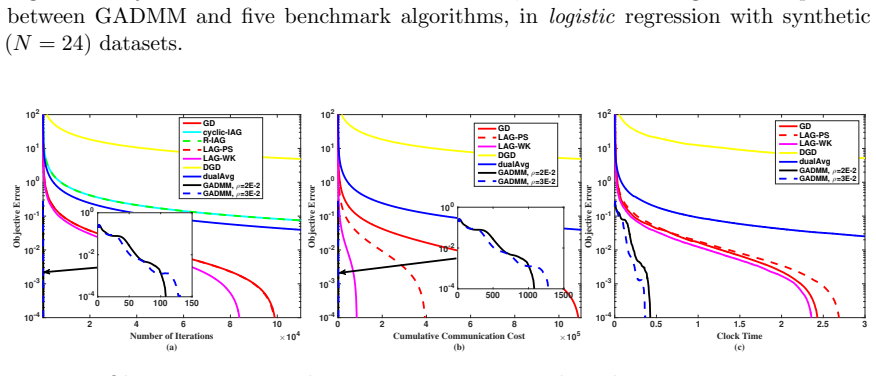
- Frequent rewiring speeds training: the simulations show refresh-rate-1 D-GADMM converging faster than standard ADMM with roughly forty times less communication cost.
- Any chain construction that spans all workers once suffices; the paper shows the optimal construction is TSP-hard, so heuristics are the intended route.
Reading between the lines
- The rewiring speedup suggests D-GADMM's rate is governed by the mixing time of the randomly rewired chain; measuring convergence against the spectral gap of the chain Laplacian across refresh rates would test this.
- The fixed-$\lambda^*$ proof gap points to a simple repair, re-synchronizing dual variables along the new chain at each rewiring; the simulations skip this step and still converge, so the algorithm may be stronger than its proof.
- Because GADMM never forms a global average, the framework carries over to mesh-like settings where no worker has links to all others --- a transfer the paper motivates but does not develop.
- In the authors' own Shannon-link cost model, halving the number of transmitters per round lowers each worker's energy budget for a target rate, a per-device benefit left implicit.
Signed reviews
Editorial analysis
A structured set of objections, weighed in public.
Referee Report
Summary. The paper proposes GADMM, a decentralized ADMM-type algorithm for distributed machine learning. Workers are arranged in a chain and split into head and tail groups; at each iteration one group updates in parallel and exchanges primal variables with its two neighbors, halving the number of contending transmitters per communication round. The authors prove convergence to the global optimum for closed, proper, convex losses under a static chain (Theorem 2), and claim the same convergence for D-GADMM, a variant that rewires the logical chain periodically to handle time-varying topologies. Numerical experiments on linear and logistic regression compare GADMM favorably with LAG, dual averaging, DGD, and other baselines in iterations, communication cost, and runtime, and show that D-GADMM can accelerate convergence by periodic rewiring.
Significance. The static GADMM result is a plausible and useful contribution: the proof in Appendices A and B is a self-contained adaptation of two-block ADMM arguments, including a Lyapunov argument for the parallel group updates, and the communication pattern is a genuine departure from parameter-server ADMM. The empirical study is extensive and directly measures communication cost, which is appropriate for the paper's stated goal. The D-GADMM claim is the main weakness: the convergence proof in Appendix D is not valid as written because it uses a single dual saddle point across all chain rewirings and telescopes a Lyapunov function whose defining index sets change with time. Since the time-varying guarantee is one of the two headline claims in the abstract and Section 6, this gap is load-bearing. If repaired, the paper would be a solid contribution; as it stands, the D-GADMM convergence result is not established.
major comments (2)
- [Appendix D, Eqs. (88) and (108)-(110)] The proof of D-GADMM assumes a fixed dual saddle point λ* that remains valid after every topology change. However, the dual feasibility conditions in Eq. (88) depend on the current left and right neighbors: for interior workers they read 0 ∈ ∂f_n(θ*) − λ*_{n_l,k} + λ*_n, and for the first and last workers the edge duals appear with sign changes. When the chain is reordered, the worker occupying each position changes, so the condition that a given λ* must satisfy changes. For affine functions f_n(θ)=a_n^T θ, the required edge duals are cumulative sums of the a_n in chain order, which are order-dependent. Consequently, a single λ* cannot certify the saddle-point inequality in Eq. (108) for every rewiring, and the lower bound in Eq. (110) is not justified. This invalidates the descent argument for V_k and therefore the claimed convergence of D-GADMM.
- [Appendix D, Eqs. (125)-(130)] The Lyapunov function V_k in Eq. (125) is defined using the current head set N^k_h and the current neighbor labels n_l,k and n_r,k. When the topology changes, N^{k+1}_h is generally different from N^k_h, and the terms ρ‖θ^{k+1}_{n_l,k}−θ*‖² and ρ‖θ^{k+1}_{n_r,k}−θ*‖² that enter V_{k+1} are not the same terms that appeared in V_k. The step from Eq. (124) to Eq. (126) pairs terms as if the index sets were fixed from one iteration to the next, and the telescoping sum leading to Eq. (130) also requires a fixed set. Even if one were to choose a new saddle point after each rewire, the comparison of V_{k+1} and V_k would need to account for the change of index sets explicitly. This is an independent gap in the D-GADMM proof, on top of the fixed-λ* issue in Eqs. (108)-(110).
minor comments (5)
- [Section 6 / Algorithm 2, line 10] The statement 'sends λ^k_n to its right neighbor (worker n_r,k)' is confusing because the preceding paragraph describes each node transmitting its right dual variable to the new right neighbor; please clarify whether the dual variable is indexed by the sending node or by the edge, since the proof reinterprets λ_n after a rewire.
- [Appendix D, Eq. (81)] The augmented Lagrangian in Eq. (81) has a mismatch: the inner product uses ⟨λ_n, θ_n − θ_{n_r,k}⟩, while the quadratic penalty is written as (ρ/2)‖θ_n − θ_{n+1}‖². The second term should use the same neighbor notation n_r,k.
- [Throughout] There are several spelling and terminology slips: 'iterativly' in Section 3, 'Standared ADMM' in the caption of Fig. 8, and 'ACV' versus 'AVC' in Section 7 and Fig. 6(c). These should be corrected in a revision.
- [Theorem 2 statement] The condition that 'the Lagrangian L0 has a saddle point' is used throughout the proof, but L0 is never defined explicitly. Please define L0 as the Lagrangian with ρ=0 and state the saddle-point assumption precisely.
- [Appendix D, Eq. (92)] The notation 0∈∂f_N(θ^{k+1}_N)−λ^{k+1}_{N_l,k} is unclear because N_l,k is not a defined neighbor label; it should be written as N_{l,k} or n_{l,k} with a consistent subscript style.
Circularity Check
No circularity: GADMM's convergence proof is self-contained; the D-GADMM appendix has a proof gap but does not reduce by construction to its inputs.
full rationale
The paper's central claim is Theorem 2, which states that GADMM iterates drive the primal residuals, dual residuals, and objective optimality gap to zero. The proof in Lemma 1 and Appendix B starts from the first-order optimality conditions of the actual GADMM updates in (11)-(15), derives upper and lower bounds on the objective gap in terms of residuals, and constructs a Lyapunov function whose monotone decrease is established from those same optimality conditions. The only external assumption is the standard existence of a saddle point of the Lagrangian L0; this is an assumption, not a fitted parameter, a renamed empirical pattern, or a load-bearing self-citation. No quantity used in the proof is defined in terms of the convergence conclusion, and no benchmark result is relabeled as a prediction. The numerical sections tune the hyperparameters rho and tau, but these are not inputs to the convergence proof, so the empirical comparisons do not force the theorem. Appendix D's D-GADMM proof does contain a load-bearing rigor gap: it uses a fixed dual saddle point lambda* in the lower bound (110) and in the Lyapunov function (125), while the dual feasibility conditions (88) depend on the current chain neighbors, so the saddle-point inequality L0(theta*,lambda*) <= L0(theta^{k+1},lambda*) need not hold after rewiring. That is a correctness or completeness problem, not a circular reduction: the paper does not fit lambda* to the desired convergence claim, and it does not derive the conclusion from a self-citation. The self-citations in the reference list (e.g., Bedi et al. 2019, Park et al. 2019, Jeong et al. 2018, Sriranga et al. 2019) are background and related-work citations and are not load-bearing for Theorem 2 or for the D-GADMM proof. Therefore the circularity score is 0.
Assumptions & free parameters
free parameters (2)
- ρ (penalty parameter) =
Tuned per dataset and task; e.g., 3, 5, 7 for linear regression; 2E-3, 3E-3 for logistic regression
- τ (refresh period) =
Simulation uses 15 iterations; refresh rates 1, 10, 50 in Fig. 8
assumptions (5)
- domain assumption Each local loss function f_n is closed, proper, and convex.
- domain assumption The Lagrangian L0 has a saddle point.
- ad hoc to paper Each worker solves its local subproblem exactly at every iteration.
- ad hoc to paper For D-GADMM, a single dual saddle point λ* remains valid across all chain rewirings.
- domain assumption The number of workers N is even, or can be made even without loss of generality.
Cite this review
Pith. "Pith review of GADMM: Fast and Communication Efficient Framework for Distributed Machine Learning." pith.science (2026). https://pith.science/paper/BGCOWQMF
@misc{pith2026190900047,
  author       = {Pith},
  title        = {Pith review of: GADMM: Fast and Communication Efficient Framework for Distributed Machine Learning},
  year         = {2026},
  howpublished = {\url{https://pith.science/paper/BGCOWQMF}},
  note         = {Machine review of arXiv:1909.00047}
}
read the original abstract
When the data is distributed across multiple servers, lowering the communication cost between the servers (or workers) while solving the distributed learning problem is an important problem and is the focus of this paper. In particular, we propose a fast, and communication-efficient decentralized framework to solve the distributed machine learning (DML) problem. The proposed algorithm, Group Alternating Direction Method of Multipliers (GADMM) is based on the Alternating Direction Method of Multipliers (ADMM) framework. The key novelty in GADMM is that it solves the problem in a decentralized topology where at most half of the workers are competing for the limited communication resources at any given time. Moreover, each worker exchanges the locally trained model only with two neighboring workers, thereby training a global model with a lower amount of communication overhead in each exchange. We prove that GADMM converges to the optimal solution for convex loss functions, and numerically show that it converges faster and more communication-efficient than the state-of-the-art communication-efficient algorithms such as the Lazily Aggregated Gradient (LAG) and dual averaging, in linear and logistic regression tasks on synthetic and real datasets. Furthermore, we propose Dynamic GADMM (D-GADMM), a variant of GADMM, and prove its convergence under the time-varying network topology of the workers.
Figures


Figures from the paper (5 more)



Reference graph
Works this paper leans on
-
[1]
write newline
" write newline "" initialize.prev.this.status FUNCTION begin.bib " write newline preamble empty 'skip preamble write newline if " thebibliography " longest.label * " " * write newline " [1] #1 " write newline " url@samestyle " write newline " " write newline " [2] #2 " write newline " =0pt " write newline " " ALTinterwordstretchfactor * " " * write newli...
-
[2]
4" FUNCTION default.is.dash.repeated.names #1 FUNCTION default.name.format.string
11em plus .33em minus .07em 4000 4000 100 4000 4000 500 `\.=1000 = #1 \@IEEEnotcompsoconly \@IEEEcompsoconly #1 * [1] 0pt [0pt][0pt] #1 * [1] 0pt [0pt][0pt] #1 * \| ** #1 \@IEEEauthorblockNstyle \@IEEEcompsocnotconfonly \@IEEEauthorblockAstyle \@IEEEcompsocnotconfonly \@IEEEcompsocconfonly \@IEEEauthordefaulttextstyle \@IEEEcompsocnotconfonly \@IEEEauthor...
work page 2015
-
[3]
write newline
" write newline "" initialize.prev.this.status FUNCTION begin.bib " write newline preamble empty 'skip preamble write newline if " thebibliography " number.label int.to.str * " " * write newline " [1] #1 " write newline " [1] #1 " write newline " url@samestyle " write newline " " write newline " [2] #2 " write newline " =0pt " write newline " " ALTinterwo...
-
[4]
write newline
" write newline "" initialize.prev.this.status FUNCTION begin.bib " write newline " [1] ^ #1 " write newline preamble empty 'skip preamble write newline if " thebibliography " longest.label * " " * write newline " [1] #1 " write newline " url@samestyle " write newline " " write newline " [2] #2 " write newline " =0pt " write newline " " ALTinterwordstretc...
-
[5]
write newline
" write newline "" initialize.prev.this.status FUNCTION begin.bib " write newline preamble empty 'skip preamble write newline if " thebibliography " longest.label * " " * write newline " [1] #1 " write newline " url@samestyle " write newline " " write newline " [2] #2 " write newline " =0pt " write newline " " ALTinterwordstretchfactor * " " * write newli...
-
[6]
write newline
" write newline "" initialize.prev.this.status FUNCTION begin.bib " write newline preamble empty 'skip preamble write newline if " thebibliography " number.label int.to.str * " " * write newline " [1] #1 " write newline " [1] #1 " write newline " url@samestyle " write newline " " write newline " [2] #2 " write newline " =0pt " write newline " " ALTinterwo...
-
[7]
Distributed large-scale natural graph factorization
Amr Ahmed, Nino Shervashidze, Shravan Narayanamurthy, Vanja Josifovski, and Alexander J Smola. Distributed large-scale natural graph factorization. In Proceedings of World Wide Web, Rio de Janeiro, Brazil, May 2013
work page 2013
-
[8]
Asynchronous saddle point algorithm for stochastic optimization in heterogeneous networks
Amrit Singh Bedi, Alec Koppel, and Rajawat Ketan. Asynchronous saddle point algorithm for stochastic optimization in heterogeneous networks. IEEE Transactions on Signal Processing, 67 0 (7): 0 1742--1757, 2019. ISSN 1053-587X. doi:10.1109/TSP.2019.2894803
arXiv 2019
Show all 60 references
-
[9]
A convergent incremental gradient method with a constant step size
Doron Blatt, Alfred O Hero, and Hillel Gauchman. A convergent incremental gradient method with a constant step size. SIAM Journal on Optimization, 18 0 (1): 0 29--51, 2007
2007
-
[10]
The n-city travelling salesman problem: Statistical mechanics and the metropolis algorithm
Ernesto Bonomi and Jean-Luc Lutton. The n-city travelling salesman problem: Statistical mechanics and the metropolis algorithm. SIAM review, 26 0 (4): 0 551--568, 1984
1984
-
[11]
Distributed optimization and statistical learning via the alternating direction method of multipliers
Stephen Boyd, Neal Parikh, Eric Chu, Borja Peleato, Jonathan Eckstein, et al. Distributed optimization and statistical learning via the alternating direction method of multipliers. Foundations and Trends in Machine learning , 3 0 (1): 0 1--122, 2011
2011
-
[12]
Multi-agent distributed optimization via inexact consensus admm
Tsung-Hui Chang, Mingyi Hong, and Xiangfeng Wang. Multi-agent distributed optimization via inexact consensus admm. IEEE Transactions on Signal Processing, 63 0 (2): 0 482--497, 2014 a
2014
-
[13]
Distributed constrained optimization by consensus-based primal-dual perturbation method
Tsung-Hui Chang, Angelia Nedi \'c , and Anna Scaglione. Distributed constrained optimization by consensus-based primal-dual perturbation method. IEEE Transactions on Automation and Control, 59 0 (6): 0 1524--1538, 2014 b
2014
-
[14]
The direct extension of admm for multi-block convex minimization problems is not necessarily convergent
Caihua Chen, Bingsheng He, Yinyu Ye, and Xiaoming Yuan. The direct extension of admm for multi-block convex minimization problems is not necessarily convergent. Mathematical Programming, 155 0 (1-2): 0 57--79, 2016
2016
-
[15]
Lag: Lazily aggregated gradient for communication-efficient distributed learning
Tianyi Chen, Georgios Giannakis, Tao Sun, and Wotao Yin. Lag: Lazily aggregated gradient for communication-efficient distributed learning. Advances in Neural Information Processing Systems, 31: 0 5055--5065, 2018
2018
-
[16]
Large scale distributed deep networks
Jeffrey Dean, Greg Corrado, Rajat Monga, Kai Chen, Matthieu Devin, Mark Mao, Andrew Senior, Paul Tucker, Ke Yang, Quoc V Le, et al. Large scale distributed deep networks. Advances in Neural Information Processing Systems, 25: 0 1223--1231, 2012
2012
-
[17]
Parallel multi-block admm with o(1/k) convergence
Wei Deng, Ming-Jun Lai, Zhimin Peng, and Wotao Yin. Parallel multi-block admm with o(1/k) convergence. Journal of Scientific Computing, 71 0 (2): 0 712--736, 2017
2017
-
[18]
Ant colonies for the travelling salesman problem
Marco Dorigo and Luca Maria Gambardella. Ant colonies for the travelling salesman problem. biosystems, 43 0 (2): 0 73--81, 1997
1997
-
[19]
UCI machine learning repository, 2017
Dheeru Dua and Casey Graff. UCI machine learning repository, 2017. URL http://archive.ics.uci.edu/ml
2017
-
[20]
Dual averaging for distributed optimization: Convergence analysis and network scaling
John C Duchi, Alekh Agarwal, and Martin J Wainwright. Dual averaging for distributed optimization: Convergence analysis and network scaling. IEEE Transactions on Automatic control, 57 0 (3): 0 592--606, 2011
2011
-
[21]
A dual algorithm for the solution of non linear variational problems via finite element approximation
Daniel Gabay and Bertrand Mercier. A dual algorithm for the solution of non linear variational problems via finite element approximation. Institut de recherche d'informatique et d'automatique, 1975
1975
-
[22]
Sur l'approximation, par \'e l \'e ments finis d'ordre un, et la r \'e solution, par p \'e nalisation-dualit \'e d'une classe de probl \`e mes de dirichlet non lin \'e aires
Roland Glowinski and A Marroco. Sur l'approximation, par \'e l \'e ments finis d'ordre un, et la r \'e solution, par p \'e nalisation-dualit \'e d'une classe de probl \`e mes de dirichlet non lin \'e aires. ESAIM: Mathematical Modelling and Numerical Analysis-Mod \'e lisation ...
1975
-
[23]
On the convergence rate of incremental aggregated gradient algorithms
Mert Gurbuzbalaban, Asuman Ozdaglar, and Pablo A Parrilo. On the convergence rate of incremental aggregated gradient algorithms. SIAM Journal on Optimization, 27 0 (2): 0 1035--1048, 2017
2017
-
[24]
A class of projection and contraction methods for monotone variational inequalities
Bingsheng He. A class of projection and contraction methods for monotone variational inequalities. Applied Mathematics and Optimization, 35 0 (1): 0 69--76, Jan 1997. ISSN 1432-0606. doi:10.1007/BF02683320. URL https://doi.org/10.1007/BF02683320
1997 doi
-
[25]
On the o(1/n) convergence rate of the douglas--rachford alternating direction method
Bingsheng He and Xiaoming Yuan. On the o(1/n) convergence rate of the douglas--rachford alternating direction method. SIAM Journal on Numerical Analysis, 50 0 (2): 0 700--709, 2012
2012
-
[26]
On non-ergodic convergence rate of douglas--rachford alternating direction method of multipliers
Bingsheng He and Xiaoming Yuan. On non-ergodic convergence rate of douglas--rachford alternating direction method of multipliers. Numerische Mathematik, 130 0 (3): 0 567--577, 2015
2015
-
[27]
On full jacobian decomposition of the augmented lagrangian method for separable convex programming
Bingsheng He, Liusheng Hou, and Xiaoming Yuan. On full jacobian decomposition of the augmented lagrangian method for separable convex programming. SIAM Journal on Optimization, 25 0 (4): 0 2274--2312, 2015
2015
-
[28]
Cola: Decentralized linear learning
Lie He, An Bian, and Martin Jaggi. Cola: Decentralized linear learning. In Advances in Neural Information Processing Systems, pages 4536--4546, 2018
2018
-
[29]
Communication-efficient distributed dual coordinate ascent
Martin Jaggi, Virginia Smith, Martin Tak \'a c, Jonathan Terhorst, Sanjay Krishnan, Thomas Hofmann, and Michael I Jordan. Communication-efficient distributed dual coordinate ascent. Advances in Neural Information Processing Systems, 27: 0 3068--3076, 2014
2014
-
[30]
Fast distributed gradient methods
Du s an Jakoveti \'c , Joao Xavier, and Jos \'e MF Moura. Fast distributed gradient methods. IEEE Transactions on Automation and Control Automa. Control, 59 0 (5): 0 1131--1146, 2014
2014
-
[31]
Communication-efficient on-device machine learning: Federated distillation and augmentation under non-iid private data
Eunjeong Jeong, Seungeun Oh, Hyesung Kim, Jihong Park, Mehdi Bennis, and Seong-Lyun Kim. Communication-efficient on-device machine learning: Federated distillation and augmentation under non-iid private data. presented at Neural Information Processing Systems Workshop on Machi...
2018 arXiv
-
[32]
Jordan, Jason D
Michael I. Jordan, Jason D. Lee, and Yun Yang. Communication-efficient distributed statistical inference. Journal of the American Statistical Association, 2018
2018
-
[33]
Proximity without consensus in online multiagent optimization
Alec Koppel, Brian M Sadler, and Alejandro Ribeiro. Proximity without consensus in online multiagent optimization. IEEE Transactions on Signal Processing, 65 0 (12): 0 3062--3077, 2017
2017
-
[34]
Communication-efficient algorithms for decentralized and stochastic optimization
Guanghui Lan, Soomin Lee, and Yi Zhou. Communication-efficient algorithms for decentralized and stochastic optimization. Mathematical Programming, pages 1--48, 2017
2017
-
[35]
Some simple applications of the travelling salesman problem
Jan Karel Lenstra and AHG Rinnooy Kan. Some simple applications of the travelling salesman problem. Journal of the Operational Research Society, 26 0 (4): 0 717--733, 1975
1975
-
[36]
Distributed delayed proximal gradient methods
Mu Li, David G Andersen, and Alexander Smola. Distributed delayed proximal gradient methods. presented at Neural Information Processing Systems Workshop on Optimization for Machine Learning, Lake Tahoe, NV, USA, December 2013
2013
-
[37]
Communication efficient distributed machine learning with the parameter server
Mu Li, David G Andersen, Alexander J Smola, and Kai Yu. Communication efficient distributed machine learning with the parameter server. Advances in Neural Information Processing Systems, 27: 0 19--27, 2014
2014
-
[38]
Splitting algorithms for the sum of two nonlinear operators
Pierre-Louis Lions and Bertrand Mercier. Splitting algorithms for the sum of two nonlinear operators. SIAM Journal on Numerical Analysis, 16 0 (6): 0 964--979, 1979
1979
-
[39]
Communication-censored ADMM for decentralized consensus optimization
Yaohua Liu, Wei Xu, Gang Wu, Zhi Tian, and Qing Ling. Communication-censored ADMM for decentralized consensus optimization. IEEE Transactions on Signal Processing, 67 0 (10): 0 2565--2579, 2019
2019
-
[40]
Distributed optimization with arbitrary local solvers
Chenxin Ma, Jakub Kone c n \`y , Martin Jaggi, Virginia Smith, Michael I Jordan, Peter Richt \'a rik, and Martin Tak \'a c . Distributed optimization with arbitrary local solvers. Optimization Methods and Software, 32 0 (4): 0 813--848, 2017
2017
-
[41]
On the capacity of channels with gaussian and non-gaussian noise
Ian W McKeague. On the capacity of channels with gaussian and non-gaussian noise. Information and Control, 51 0 (2): 0 153--173, 1981
1981
-
[42]
Brendan McMahan, Ramage Daniel Moore, Eider, Seth Hampson, and Blaise Ag\" u era yArcas
H. Brendan McMahan, Ramage Daniel Moore, Eider, Seth Hampson, and Blaise Ag\" u era yArcas. Communication-efficient learning of deep networks from decentralized data. In Proceedings of Artificial Intelligence and Statistics, Fort Lauderdale, FL, USA, April 2017
2017
-
[43]
Distributed optimization over time-varying directed graphs
Angelia Nedi \'c and Alex Olshevsky. Distributed optimization over time-varying directed graphs. IEEE Trans. Automa. Control, 60 0 (3): 0 601--615, 2014
2014
-
[44]
Distributed subgradient methods for multi-agent optimization
Angelia Nedi\' c and Asuman Ozdaglar. Distributed subgradient methods for multi-agent optimization. IEEE Transactions on Automation and Control, 54 0 (1): 0 48--61, 2009
2009
-
[45]
Achieving geometric convergence for distributed optimization over time-varying graphs
Angelia Nedic, Alex Olshevsky, and Wei Shi. Achieving geometric convergence for distributed optimization over time-varying graphs. SIAM Journal on Optimization, 27 0 (4): 0 2597--2633, 2017
2017
-
[46]
Network topology and communication-computation tradeoffs in decentralized optimization
Angelia Nedi \'c , Alex Olshevsky, and Michael G Rabbat. Network topology and communication-computation tradeoffs in decentralized optimization. Proceedings of the IEEE, 106 0 (5): 0 953--976, 2018
2018
-
[47]
Wireless network intelligence at the edge
Jihong Park, Sumudu Samarakoon, Mehdi Bennis, and M \'e rouane Debbah. Wireless network intelligence at the edge. to appear in Proceedings of the IEEE [Online]. Early access is available at: https://ieeexplore.ieee.org/document/8865093, November 2019
2019
-
[48]
Parallel distributed approaches to combinatorial optimization: benchmark studies on traveling salesman problem
Carsten Peterson. Parallel distributed approaches to combinatorial optimization: benchmark studies on traveling salesman problem. Neural computation, 2 0 (3): 0 261--269, 1990
1990
-
[49]
Optimal algorithms for non-smooth distributed optimization in networks
Kevin Scaman, Francis Bach, S \'e bastien Bubeck, Laurent Massouli \'e , and Yin Tat Lee. Optimal algorithms for non-smooth distributed optimization in networks. In Advances in Neural Information Processing Systems, pages 2740--2749, 2018
2018
-
[50]
Minimizing finite sums with the stochastic average gradient
Mark Schmidt, Nicolas Le Roux, and Francis Bach. Minimizing finite sums with the stochastic average gradient. Mathematical Programming, 162 0 (1-2): 0 83--112, 2017
2017
-
[51]
A proximal gradient algorithm for decentralized composite optimization
Wei Shi, Qing Ling, Gang Wu, and Wotao Yin. A proximal gradient algorithm for decentralized composite optimization. IEEE Transactions on Signal Processing, 63 0 (22): 0 6013--6023, 2015
2015
-
[52]
Murthy, and Vaneet Aggarwal
Nandan Sriranga, Chandra R. Murthy, and Vaneet Aggarwal. A method to improve consensus averaging using quantized admm. In 2019 IEEE International Symposium on Information Theory (ISIT). IEEE, 2019
2019
-
[53]
Distributed mean estimation with limited communication
Ananda Theertha Suresh, Felix X Yu, Sanjiv Kumar, and H Brendan McMahan. Distributed mean estimation with limited communication. Proceedings of Machine Learning Research, 70: 0 3329--3337, 2017
2017
-
[54]
Distributed consensus over network with noisy links
Behrouz Touri and Angelia Nedic. Distributed consensus over network with noisy links. In Proceedings of International Conference on Information Fusion, Seattle, WA, USA, July 2009
2009
-
[55]
Tsianos, Sean Lawlor, and Michael G
Konstantinos I. Tsianos, Sean Lawlor, and Michael G. Rabbat. Consensus-based distributed optimization: Practical issues and applications in large-scale machine learning. In Proceedings of Allerton Conference on Communication, Control, and Computing, Monticello, IL, USA, October 2012
2012
-
[56]
Parallel direction method of multipliers
Huahua Wang, Arindam Banerjee, and Zhi-Quan Luo. Parallel direction method of multipliers. Advances in Neural Information Processing Systems, 27: 0 181--189
-
[57]
Group-based alternating direction method of multipliers for distributed linear classification
Huihui Wang, Yang Gao, Yinghuan Shi, and Ruili Wang. Group-based alternating direction method of multipliers for distributed linear classification. IEEE Transactions on Cybernetics, 47 0 (11): 0 3568--3582, 2017
2017
-
[58]
Leung, Christian Makaya, Ting He, and Kevin Chan
Shiqiang Wang, Tiffany Tuor, Theodoros Salonidis, Kin K. Leung, Christian Makaya, Ting He, and Kevin Chan. Adaptive federated learning in resource constrained edge computing systems. ArXiv preprint, abs/1804.05271, 2018
2018 arXiv
-
[59]
Communication-efficient algorithms for statistical optimization
Yuchen Zhang, Martin J Wainwright, and John C Duchi. Communication-efficient algorithms for statistical optimization. Advances in Neural Information Processing Systems, 25: 0 1502--1510, 2012
2012
-
[60]
Quantized consensus ADMM for multi-agent distributed optimization
Shengyu Zhu, Mingyi Hong, and Biao Chen. Quantized consensus ADMM for multi-agent distributed optimization. In Proceedings of International Conference on Acoustics, Speech, and Signal Processing, Shanghai, China, March 2016
2016
Reviewed August 14, 2026 · model on record in the stance chip above.
Discussion (0). Continue with ORCID to comment.