Code Is More Than Text: Uncertainty Estimation for Code Generation
Pith reviewed 2026-06-27 16:08 UTC · model grok-4.3
The pith
Three code-specific uncertainty axes raise average AUROC from 0.696 to 0.776 across five code LLMs.
A machine-rendered reading of the paper's core claim, the machinery that carries it, and where it could break.
Core claim
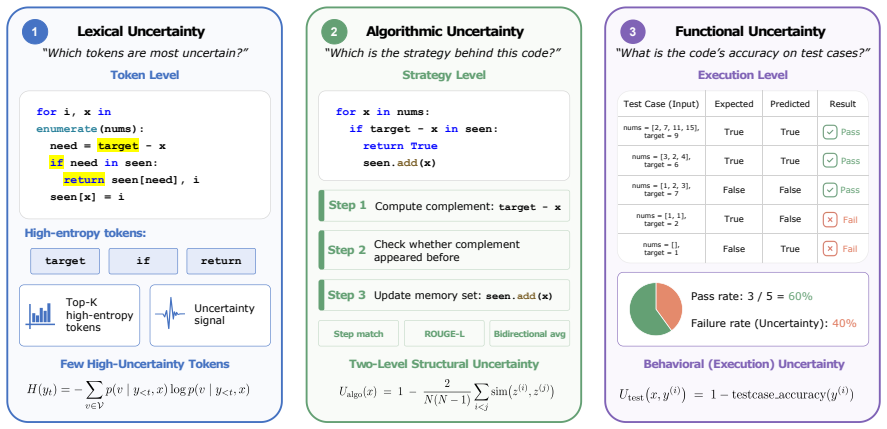
Code differs from NL in three ways: a single wrong token can break an entire program (token fragility); algorithmic intent and concrete implementation can disagree independently (intent-code gap); and programs can be executed (executability). We instantiate these properties as three orthogonal uncertainty axes: lexical (Top-K token entropy), algorithmic (pseudo-code consistency), and functional (behavioral consistency). Across five code LLMs, our three-axis ensemble improves average AUROC from 0.696 for the strongest NL-derived baseline to 0.776 (+8.1 points).
What carries the argument
Three orthogonal uncertainty axes (lexical via Top-K token entropy, algorithmic via pseudo-code consistency, functional via behavioral consistency) that capture token fragility, intent-code gap, and executability.
If this is right
- The three-axis ensemble improves average AUROC by 8.1 points over the strongest NL-derived baseline across five code LLMs.
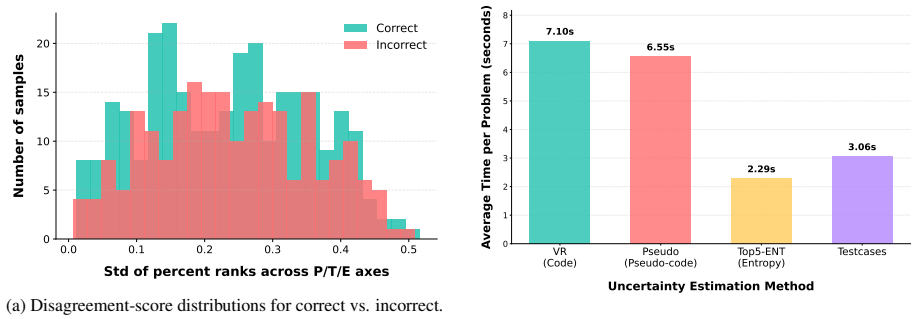
- On Qwen3-14B the single-pass Top-K token entropy alone matches the strongest multi-pass baseline while costing over 3x less.
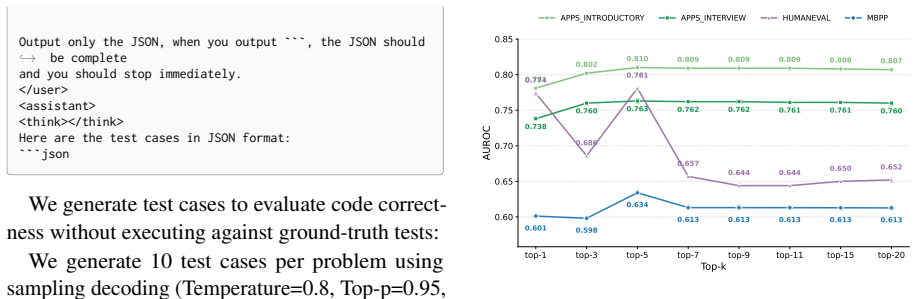
- Top-K token entropy remains a competitive low-cost signal across multiple models.
Where Pith is reading between the lines
- The same three axes could be tested on other structured outputs such as formal proofs or API calls.
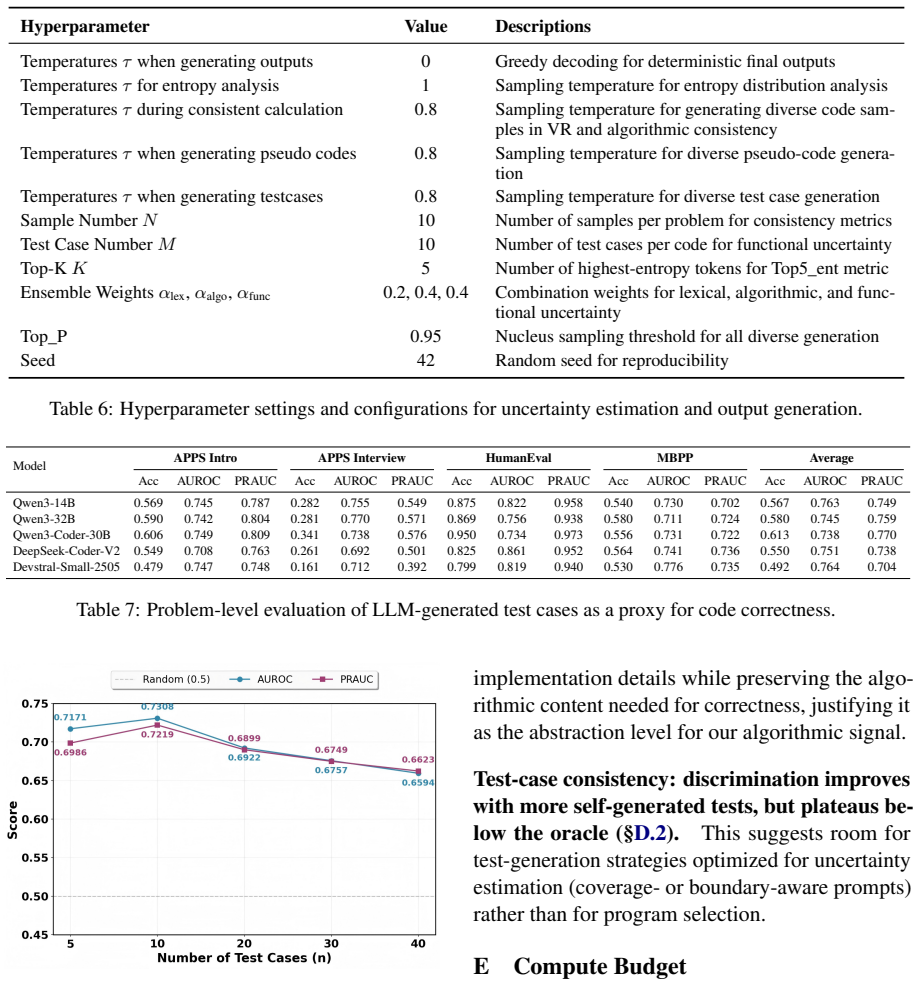
- Functional consistency might be strengthened by running generated code against larger or more diverse test suites.
- The cheap single-pass lexical signal could serve as a first filter before invoking more expensive consistency checks.
Load-bearing premise
The three distinctions between code and natural language can be turned into independent measurable axes whose combination produces additive gains without much overlap.
What would settle it
An experiment in which the three axes show high mutual correlation or in which their ensemble produces no AUROC gain over the best single axis or NL baseline would falsify the claim.
Figures
read the original abstract
Large language models (LLMs) are increasingly deployed as code generators, where silently wrong programs pose real safety and reliability risks. Reliable uncertainty estimation (UE) is essential for selective prediction, human-in-the-loop review, and downstream agentic decisions. Yet most existing code UE methods are inherited from natural language (NL) generation and ignore properties that make code distinct. We argue that code differs from NL in three ways: a single wrong token can break an entire program (token fragility); algorithmic intent and concrete implementation can disagree independently (intent-code gap); and programs can be executed (executability). We instantiate these properties as three orthogonal uncertainty axes: lexical (Top-K token entropy), algorithmic (pseudo-code consistency), and functional (behavioral consistency). Across five code LLMs, our three-axis ensemble improves average AUROC from 0.696 for the strongest NL-derived baseline to 0.776 (+8.1 points). Notably, on Qwen3-14B, our single-pass Top-K token entropy matches the strongest multi-pass baseline while being over 3x cheaper; across models, it remains a competitive low-cost signal. These results suggest that code UE deserves code-specific design rather than direct NL ports.
Editorial analysis
A structured set of objections, weighed in public.
Referee Report
Summary. The paper argues that uncertainty estimation (UE) for code-generating LLMs should exploit three code-specific properties—token fragility, intent-code gap, and executability—rather than porting NL methods. These are instantiated as three axes (lexical: Top-K token entropy; algorithmic: pseudo-code consistency; functional: behavioral consistency) claimed to be orthogonal. Across five code LLMs the three-axis ensemble raises average AUROC from 0.696 (strongest NL baseline) to 0.776; the lexical axis alone matches the best multi-pass baseline on Qwen3-14B while being >3× cheaper.
Significance. If the reported AUROC gains and efficiency results hold under full experimental scrutiny, the work would supply a concrete, code-tailored alternative to NL-derived UE and demonstrate measurable practical benefit for selective prediction in code generation.
minor comments (3)
- Abstract and §3: the claim that the three axes are 'orthogonal' and yield 'additive gains' requires an explicit ablation or correlation table showing pairwise overlap; without it the ensemble improvement cannot be attributed to complementarity rather than simple averaging.
- §4 (experimental setup): the five models, exact datasets, prompt templates, and definition of 'behavioral consistency' (e.g., test-case generation or execution oracle) are not stated in the provided abstract; these details are load-bearing for reproducing the 0.776 AUROC.
- Table 1 or equivalent: report per-model AUROC for each axis individually and for all pairwise combinations so readers can verify that the lexical axis is indeed competitive and that the full ensemble is not dominated by one component.
Simulated Author's Rebuttal
We thank the referee for the positive assessment of our manuscript and the recommendation for minor revision. The summary accurately captures the core argument that code-specific properties warrant tailored uncertainty axes rather than direct ports from natural language methods, along with the reported AUROC gains and efficiency advantages.
Circularity Check
No significant circularity
full rationale
The paper's central chain maps three stated code properties (token fragility, intent-code gap, executability) to three named uncertainty axes (lexical Top-K entropy, pseudo-code consistency, behavioral consistency) and reports an empirical AUROC lift from 0.696 to 0.776 on five models. No equations, fitted parameters, or self-citations are visible that reduce any reported prediction or ensemble gain to a quantity defined by the same data or prior author work. The orthogonality claim is framed as an empirical hypothesis whose support is the observed additive improvement rather than a definitional identity or imported uniqueness theorem. The derivation therefore remains self-contained against external benchmarks.
Axiom & Free-Parameter Ledger
axioms (1)
- domain assumption Code differs from natural language in token fragility, intent-code gap, and executability, which can be measured as orthogonal uncertainty axes.
Reference graph
Works this paper leans on
-
[1]
doi: 10.18653/v1/2023.emnlp-main.330
Katherine Tian and Eric Mitchell and Allan Zhou and Archit Sharma and Rafael Rafailov and Huaxiu Yao and Chelsea Finn and Christopher D. Manning , editor =. Just Ask for Calibration: Strategies for Eliciting Calibrated Confidence Scores from Language Models Fine-Tuned with Human Feedback , booktitle =. 2023 , url =. doi:10.18653/V1/2023.EMNLP-MAIN.330 , t...
-
[2]
2021 , eprint=
Evaluating Large Language Models Trained on Code , author=. 2021 , eprint=
2021
-
[3]
LUQ : Long-text Uncertainty Quantification for LLM s
Zhang, Caiqi and Liu, Fangyu and Basaldella, Marco and Collier, Nigel. LUQ : Long-text Uncertainty Quantification for LLM s. Proceedings of the 2024 Conference on Empirical Methods in Natural Language Processing. 2024. doi:10.18653/v1/2024.emnlp-main.299
-
[4]
CodeT: Code Generation with Generated Tests , booktitle =
Bei Chen and Fengji Zhang and Anh Nguyen and Daoguang Zan and Zeqi Lin and Jian. CodeT: Code Generation with Generated Tests , booktitle =. 2023 , url =
2023
-
[5]
Self-Edit: Fault-Aware Code Editor for Code Generation , booktitle =
Kechi Zhang and Zhuo Li and Jia Li and Ge Li and Zhi Jin , editor =. Self-Edit: Fault-Aware Code Editor for Code Generation , booktitle =. 2023 , url =. doi:10.18653/V1/2023.ACL-LONG.45 , timestamp =
-
[6]
Teaching Large Language Models to Self-Debug , booktitle =
Xinyun Chen and Maxwell Lin and Nathanael Sch. Teaching Large Language Models to Self-Debug , booktitle =. 2024 , url =
2024
-
[7]
Yuheng Huang and Jiayang Song and Zhijie Wang and Shengming Zhao and Huaming Chen and Felix Juefei. Look Before You Leap: An Exploratory Study of Uncertainty Analysis for Large Language Models , journal =. 2025 , url =. doi:10.1109/TSE.2024.3519464 , timestamp =
-
[8]
2025 , eprint=
Devstral: Fine-tuning Language Models for Coding Agent Applications , author=. 2025 , eprint=
2025
-
[9]
2025 , eprint=
Qwen3 Technical Report , author=. 2025 , eprint=
2025
-
[10]
and Li, Yukun and Gao, Huazuo and Ma, Shirong and others , journal =
Zhu, Qihao and Guo, Daya and Shao, Zhihong and Yang, Dejian and Wang, Peiyi and Xu, Runxin and Wu, Y. and Li, Yukun and Gao, Huazuo and Ma, Shirong and others , journal =
-
[11]
Measuring Coding Challenge Competence With
Dan Hendrycks and Steven Basart and Saurav Kadavath and Mantas Mazeika and Akul Arora and Ethan Guo and Collin Burns and Samir Puranik and Horace He and Dawn Song and Jacob Steinhardt , editor =. Measuring Coding Challenge Competence With. Proceedings of the Neural Information Processing Systems Track on Datasets and Benchmarks 1, NeurIPS Datasets and Ben...
2021
-
[12]
2021 , eprint =
Program Synthesis with Large Language Models , author =. 2021 , eprint =
2021
-
[13]
2025 , eprint=
From Code to Correctness: Closing the Last Mile of Code Generation with Hierarchical Debugging , author=. 2025 , eprint=
2025
-
[14]
Yuling Shi and Hongyu Zhang and Chengcheng Wan and Xiaodong Gu , title =. 47th. 2025 , url =. doi:10.1109/ICSE55347.2025.00005 , timestamp =
-
[15]
Enhancing LLM-Based Code Generation with Complexity Metrics:
Melika Sepidband and Hamed Taherkhani and Song Wang and Hadi Hemmati , editor =. Enhancing LLM-Based Code Generation with Complexity Metrics:. 49th. 2025 , url =. doi:10.1109/COMPSAC65507.2025.00178 , timestamp =
-
[16]
Yewei Song and Tiezhu Sun and Xunzhu Tang and Prateek Rajput and Tegawend. Measuring. 40th. 2025 , url =. doi:10.1109/ASE63991.2025.00343 , timestamp =
-
[17]
2025 , eprint=
Assessing Correctness in LLM-Based Code Generation via Uncertainty Estimation , author=. 2025 , eprint=
2025
-
[18]
Atomic Calibration of LLMs in Long-Form Generations , booktitle =
Caiqi Zhang and Ruihan Yang and Zhisong Zhang and Xinting Huang and Sen Yang and Dong Yu and Nigel Collier , editor =. Atomic Calibration of LLMs in Long-Form Generations , booktitle =. 2025 , url =
2025
-
[19]
Weinberger , editor =
Chuan Guo and Geoff Pleiss and Yu Sun and Kilian Q. Weinberger , editor =. On Calibration of Modern Neural Networks , booktitle =. 2017 , url =
2017
-
[20]
A survey of confidence estimation and calibration in large language models
Jiahui Geng and Fengyu Cai and Yuxia Wang and Heinz Koeppl and Preslav Nakov and Iryna Gurevych , editor =. A Survey of Confidence Estimation and Calibration in Large Language Models , booktitle =. 2024 , url =. doi:10.18653/V1/2024.NAACL-LONG.366 , timestamp =
-
[21]
The Twelfth International Conference on Learning Representations,
Miao Xiong and Zhiyuan Hu and Xinyang Lu and Yifei Li and Jie Fu and Junxian He and Bryan Hooi , title =. The Twelfth International Conference on Learning Representations,. 2024 , url =
2024
-
[22]
2022 , eprint=
Language Models (Mostly) Know What They Know , author=. 2022 , eprint=
2022
-
[23]
Zadrozny, Bianca and Elkan, Charles , title =. Proceedings of the Eighth ACM SIGKDD International Conference on Knowledge Discovery and Data Mining , pages =. 2002 , isbn =. doi:10.1145/775047.775151 , abstract =
-
[24]
2024 , eprint=
Perplexed: Understanding When Large Language Models are Confused , author=. 2024 , eprint=
2024
-
[25]
The Eleventh International Conference on Learning Representations,
Lorenz Kuhn and Yarin Gal and Sebastian Farquhar , title =. The Eleventh International Conference on Learning Representations,. 2023 , url =
2023
-
[26]
Andrey Malinin and Mark J. F. Gales , title =. 9th International Conference on Learning Representations,. 2021 , url =
2021
-
[27]
Zhen Lin and Shubhendu Trivedi and Jimeng Sun , title =. Trans. Mach. Learn. Res. , volume =. 2024 , url =
2024
-
[28]
2025 , eprint=
Beyond the 80/20 Rule: High-Entropy Minority Tokens Drive Effective Reinforcement Learning for LLM Reasoning , author=. 2025 , eprint=
2025
-
[29]
Entropy-Gated Branching for Efficient Test-Time Reasoning , booktitle =
Xianzhi Li and Ethan Callanan and Abdellah Ghassel and Xiaodan Zhu , editor =. Entropy-Gated Branching for Efficient Test-Time Reasoning , booktitle =. 2026 , url =
2026
-
[30]
arXiv preprint arXiv:2508.05988 , year=
Pruning the Unsurprising: Efficient Code Reasoning via First-Token Surprisal , author=. arXiv preprint arXiv:2508.05988 , year=
-
[31]
arXiv preprint arXiv:2507.23348 , year=
SWE-Debate: Competitive Multi-Agent Debate for Software Issue Resolution , author=. arXiv preprint arXiv:2507.23348 , year=
-
[32]
arXiv preprint arXiv:2507.23361 , year=
SWE-Exp: Experience-Driven Software Issue Resolution , author=. arXiv preprint arXiv:2507.23361 , year=
-
[33]
arXiv preprint arXiv:2601.16746 , year=
SWE-Pruner: Self-Adaptive Context Pruning for Coding Agents , author=. arXiv preprint arXiv:2601.16746 , year=
-
[34]
arXiv preprint arXiv:2509.14635 , year=
SWE-QA: Can Language Models Answer Repository-level Code Questions? , author=. arXiv preprint arXiv:2509.14635 , year=
-
[35]
arXiv preprint arXiv:2601.00376 , year=
In Line with Context: Repository-Level Code Generation via Context Inlining , author=. arXiv preprint arXiv:2601.00376 , year=
-
[36]
arXiv preprint arXiv:2510.00446 , year=
LongCodeZip: Compress Long Context for Code Language Models , author=. arXiv preprint arXiv:2510.00446 , year=
discussion (0)
Sign in with ORCID, Apple, or X to comment. Anyone can read and Pith papers without signing in.