Binary Neutron Stars from the Moon: Early Warnings and Precision Science for the Artemis Era
Pith reviewed 2026-05-18 08:47 UTC · model grok-4.3
The pith
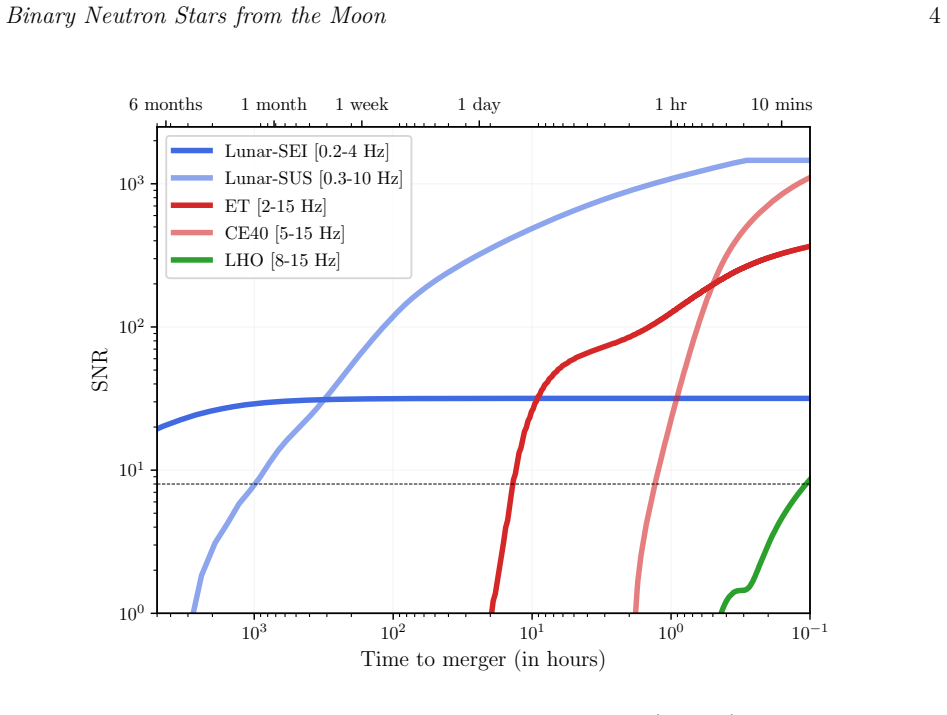
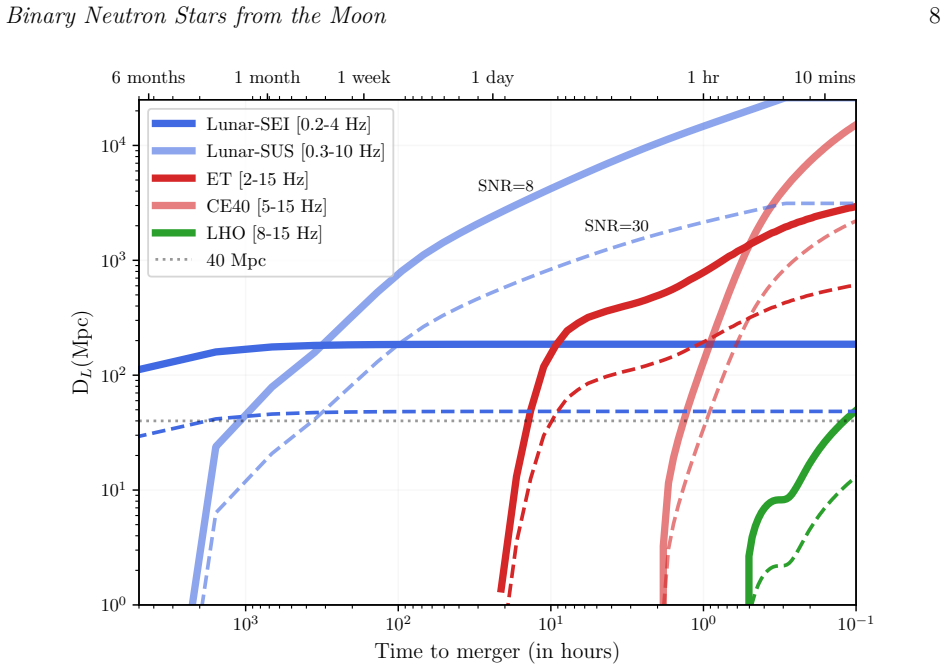
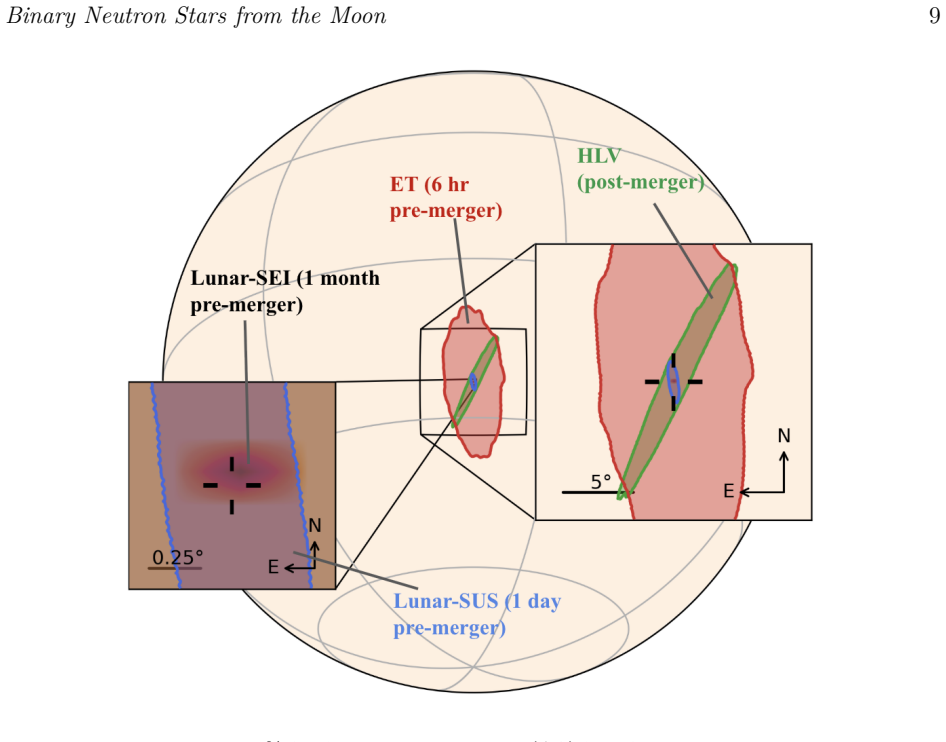
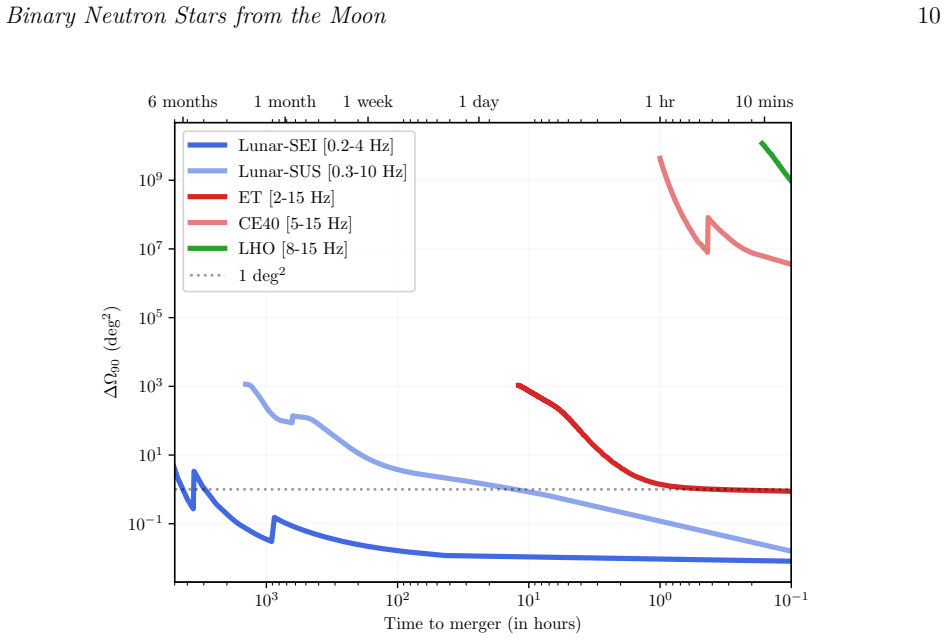
Lunar gravitational-wave detectors would warn of binary neutron star mergers weeks to months ahead and localize them to 0.01 square degrees.
A machine-rendered reading of the paper's core claim, the machinery that carries it, and where it could break.
Core claim
Lunar-based gravitational-wave observatories can forecast binary neutron star mergers weeks to months in advance, localize them to areas as small as 0.01 deg², detect on the order of 100 well-localized mergers annually, and when combined in a multi-band LIGO+Moon network deliver neutron star mass-ratio uncertainties at ~0.1% precision, spin constraints to 0.001%, and luminosity distance errors to 1% level.
What carries the argument
Lunar detectors LILA, LGWA, and GLOC operating in a multi-band network with Earth-based observatories, which lengthens the observable inspiral and tightens sky localization and parameter estimates for binary neutron star signals.
If this is right
- Early warnings would let electromagnetic telescopes point at the merger site days or weeks before the event.
- One hundred well-localized events per year would enable population studies of neutron-star masses and spins.
- Mass-ratio precision of 0.1 percent would sharply limit allowed equations of state for neutron-star matter.
- Luminosity-distance errors at the 1 percent level would provide independent Hubble-constant measurements from each event.
- Sky areas of a few arcseconds squared would match the field of view of high-zoom optical and infrared telescopes.
Where Pith is reading between the lines
- A permanent lunar gravitational-wave station could serve as the anchor for a solar-system-wide detector network that observes the same sources at widely separated frequencies.
- The same long-duration tracking that benefits neutron-star binaries would also improve early-warning times for other long-lived sources such as intermediate-mass black-hole inspirals.
- Artemis infrastructure built for these detectors would simultaneously supply a stable platform for precision timing and ranging experiments that test general relativity in the lunar environment.
Load-bearing premise
The sensitivity curves and noise models used for the proposed lunar detectors match the actual performance that will be achieved once the instruments are built and operated on the Moon.
What would settle it
Deployment of a prototype lunar gravitational-wave sensor and measurement of its actual noise spectrum and sensitivity would show whether the predicted weeks-to-months warning times and sub-square-degree localizations are realistic.
Figures


read the original abstract
Binary neutron star mergers are unique probes of matter at extreme density and standard candles of cosmic expansion. The only such event observed in both gravitational waves and electromagnetic radiation, GW170817, revealed the origin of heavy elements, constrained the neutron star equation of state, and provided an independent measurement of the Hubble constant. Current detectors such as LIGO, Virgo, and KAGRA capture only the final minutes of inspiral, offering limited advance warning and coarse sky localization. In this study, we present a comprehensive analysis of binary neutron star signals for lunar-based gravitational-wave observatories (LILA, LGWA, GLOC) envisioned within NASA's Artemis and Commercial Lunar Payload Services programs, and compare their performance with current and next-generation Earth-based facilities. For GW170817-like sources, we find that lunar detectors can forecast mergers weeks to months in advance and localize them to areas as small as 0.01 deg$^{2}$, far beyond the reach of terrestrial detectors. We further show that lunar observatories would detect on the order of 100 well-localized mergers annually, enabling coordinated multi-messenger follow-up. When combined in a multi-band LIGO+Moon network, sky-localization areas shrink to just a few arcsec$^{2}$, comparable to the field of view of the James Webb Space Telescope at high zoom. Multi-band parameter estimation also delivers dramatic gains: neutron star mass-ratio uncertainties can be measured with $\sim0.1\%$ precision, spin constraints to 0.001$\%$ with luminosity distance errors to 1$\%$ level, enabling precision measurements of the equation of state and the cosmic expansion rate. Our results demonstrate that lunar gravitational-wave observatories would revolutionize multi-messenger astrophysics with binary neutron stars and open a unique discovery landscape in the Artemis era.
Editorial analysis
A structured set of objections, weighed in public.
Referee Report
Summary. The manuscript presents a simulation study of binary neutron star (BNS) gravitational-wave signals for proposed lunar observatories LILA, LGWA, and GLOC under the Artemis program. It claims that, for GW170817-like sources, these detectors enable merger forecasts weeks to months in advance, sky localizations down to 0.01 deg², detection of order 100 well-localized events per year, and, in a multi-band network with LIGO, sky areas of a few arcsec² together with parameter precisions of ~0.1% in mass ratio, 0.001% in spin, and 1% in luminosity distance.
Significance. If the assumed lunar detector sensitivities are realized, the work would demonstrate a substantial advance in multi-messenger astrophysics by extending the observable inspiral phase, tightening constraints on the neutron-star equation of state, and improving standard-siren cosmology. The analysis employs standard general-relativity waveforms and Fisher-matrix methods, providing a reproducible framework for projecting the scientific return of lunar gravitational-wave facilities.
major comments (2)
- [§3 (Detector sensitivity models)] §3 (Detector sensitivity models) and associated figures: All headline quantitative results—early-warning times, localization areas, annual event rates, and multi-band parameter uncertainties—are obtained from SNR and Fisher-matrix calculations that adopt specific extrapolated noise PSDs for LILA, LGWA, and GLOC. The manuscript does not include a sensitivity analysis quantifying how factor-of-two changes in the 0.01–1 Hz band (plausible from unmodeled regolith or tidal effects) propagate into the reported metrics.
- [§4.2 (Event-rate and population assumptions)] §4.2 (Event-rate and population assumptions): The estimate of ~100 well-localized mergers per year rests on a particular BNS population model and the adopted sensitivity curves; without explicit tabulation of the merger-rate density, redshift distribution, and selection criteria used, it is not possible to judge the robustness of this number against reasonable variations in the underlying astrophysical priors.
minor comments (2)
- [Abstract] Abstract: the spin-precision claim is written as '0.001%'; clarify the intended numerical value and units for consistency with the mass-ratio and distance figures.
- [Figure captions] Figure captions: ensure every noise-curve comparison explicitly labels the frequency interval relevant to the long BNS inspiral and states the reference terrestrial detectors used for scaling.
Simulated Author's Rebuttal
We thank the referee for their careful reading and constructive comments on our manuscript. The suggestions identify valuable opportunities to strengthen the robustness and transparency of our projections for lunar gravitational-wave detectors. We address each major comment below and will incorporate revisions to enhance the analysis.
read point-by-point responses
-
Referee: §3 (Detector sensitivity models) and associated figures: All headline quantitative results—early-warning times, localization areas, annual event rates, and multi-band parameter uncertainties—are obtained from SNR and Fisher-matrix calculations that adopt specific extrapolated noise PSDs for LILA, LGWA, and GLOC. The manuscript does not include a sensitivity analysis quantifying how factor-of-two changes in the 0.01–1 Hz band (plausible from unmodeled regolith or tidal effects) propagate into the reported metrics.
Authors: We agree that a sensitivity analysis would better quantify the robustness of our results against uncertainties in the lunar noise models. In the revised manuscript, we will add a new subsection to §3 performing this analysis. We will scale the adopted noise PSDs by factors of 0.5 and 2 across the 0.01–1 Hz band, recompute SNRs, sky localizations, and Fisher-matrix uncertainties for representative GW170817-like sources, and present the variations in an additional table or figure. This will explicitly show how plausible regolith or tidal effects could affect the headline metrics while preserving the core conclusions based on the nominal models. revision: yes
-
Referee: §4.2 (Event-rate and population assumptions): The estimate of ~100 well-localized mergers per year rests on a particular BNS population model and the adopted sensitivity curves; without explicit tabulation of the merger-rate density, redshift distribution, and selection criteria used, it is not possible to judge the robustness of this number against reasonable variations in the underlying astrophysical priors.
Authors: We acknowledge that explicit documentation of the population assumptions will improve transparency and allow readers to evaluate robustness. In the revised manuscript, we will add a table in §4.2 that tabulates the adopted BNS merger-rate density, redshift distribution, selection criteria for well-localized events (including SNR and localization thresholds), and key parameters of the population model. We will also include a brief discussion of how reasonable variations in these priors, drawn from current astrophysical literature, would affect the annual rate estimate. revision: yes
Circularity Check
No significant circularity; forward projections from standard waveforms and assumed detector curves
full rationale
The paper computes early-warning times, localization areas, event rates, and parameter precisions via standard SNR integrals and Fisher-matrix analysis applied to GW170817-like signals. These outputs are generated from explicitly stated input assumptions (lunar noise PSDs for LILA/LGWA/GLOC, standard GR inspiral waveforms, and multi-band network combinations). No equation reduces a claimed performance metric to a quantity fitted from the same data being predicted, nor does any step rely on self-definition, renaming of known results, or load-bearing self-citations whose validity is internal to the present work. The derivation chain is therefore self-contained once the external sensitivity curves are granted; deviations in those curves affect the numerical results but do not render the logic circular.
Axiom & Free-Parameter Ledger
free parameters (1)
- Lunar detector noise curves and sensitivity
axioms (2)
- standard math General-relativity waveform models for BNS inspirals remain accurate at the frequencies accessible to lunar detectors
- domain assumption BNS merger rate and mass distribution are well-represented by GW170817-like events
Forward citations
Cited by 1 Pith paper
-
Gravitational-wave parameter estimation to the Moon and back: massive binaries and the case of GW231123
LGWA could observe more than one third of known binary black hole events, detect ~90 mergers per year, and measure chirp mass better than third-generation detectors for massive systems.
Reference graph
Works this paper leans on
-
[1]
Hulse R A and Taylor J H 1975Astrophys. J. Lett.195L51–L53 REFERENCES16
-
[2]
Abbott B Pet al.(LIGO Scientific, Virgo) 2017Phys. Rev. Lett.119161101 (Preprint 1710.05832)
work page internal anchor Pith review Pith/arXiv arXiv
-
[3]
Abbott B Pet al.(LIGO Scientific, Virgo) 2019Phys. Rev. X9011001 (Preprint 1805.11579)
work page internal anchor Pith review Pith/arXiv arXiv
-
[4]
Abbott B Pet al.(LIGO Scientific, Virgo, Fermi GBM, INTEGRAL, IceCube, AstroSat Cadmium Zinc Telluride Imager Team, IPN, Insight-Hxmt, ANTARES, Swift, AGILE Team, 1M2H Team, Dark Energy Camera GW-EM, DES, DLT40, GRAWITA, Fermi- LAT, ATCA, ASKAP, Las Cumbres Observatory Group, OzGrav, DWF (Deeper Wider Faster Program), AST3, CAASTRO, VINROUGE, MASTER, J-GE...
work page internal anchor Pith review Pith/arXiv arXiv
- [5]
-
[6]
Raaijmakers Get al.2021Astrophys. J.922269 (Preprint2102.11569)
-
[7]
Farrow N, Zhu X J and Thrane E 2019Astrophys. J.87618 (Preprint1902.03300)
-
[8]
Abbott B Pet al.(LIGO Scientific, Virgo) 2017Astrophys. J. Lett.851L16 (Preprint 1710.09320)
work page internal anchor Pith review Pith/arXiv arXiv
- [9]
- [10]
-
[11]
Abbott B Pet al.(LIGO Scientific, Virgo) 2018Phys. Rev. Lett.121161101 (Preprint 1805.11581)
work page internal anchor Pith review Pith/arXiv arXiv
- [12]
-
[13]
Nissanke S, Holz D E, Dalal N, Hughes S A, Sievers J L and Hirata C M 2013 (Preprint 1307.2638)
work page internal anchor Pith review Pith/arXiv arXiv 2013
-
[14]
Abbott B Pet al.(LIGO Scientific, Virgo, 1M2H, Dark Energy Camera GW-E, DES, DLT40, Las Cumbres Observatory, VINROUGE, MASTER) 2017Nature55185–88 (Preprint1710.05835)
work page internal anchor Pith review Pith/arXiv arXiv
- [15]
-
[16]
Feeney S M, Peiris H V, Williamson A R, Nissanke S M, Mortlock D J, Alsing J and Scolnic D 2019Phys. Rev. Lett.122061105 (Preprint1802.03404)
work page internal anchor Pith review Pith/arXiv arXiv
-
[17]
Freedman W L 2021Astrophys. J.91916 (Preprint2106.15656)
-
[18]
Freedman W 2025Nature639858–860 REFERENCES17
- [19]
-
[20]
Abbott B P, Abbott R, Abbott T D, Abernathy M R, Ackley K, Adams C, Addesso P, Adhikari R X, Adya V B, Affeldt C, Aggarwal N, Aguiar O D, Ain A, Ajith P, Allen B, Altin P A, Anderson S B, Anderson W G, Arai K, Araya M C, Arceneaux C C, Areeda J S, Arun K G, Ashton G, Ast M, Aston S M, Aufmuth P, Aulbert C, Babak S, Baker P T, Ballmer S W, Barayoga J C, Ba...
work page internal anchor Pith review Pith/arXiv arXiv
-
[21]
Cosmic Explorer: The U.S. Contribution to Gravitational-Wave Astronomy beyond LIGO
Reitze D, Adhikari R X, Ballmer S, Barish B, Barsotti L, Billingsley G, Brown D A, Chen Y, Coyne D, Eisenstein R, Evans M, Fritschel P, Hall E D, Lazzarini A, Lovelace G, Read J, Sathyaprakash B S, Shoemaker D, Smith J, Torrie C, Vitale S, Weiss R, Wipf C and Zucker M 2019 Cosmic Explorer: The U.S. Contribution to Gravitational- Wave Astronomy beyond LIGO...
work page internal anchor Pith review Pith/arXiv arXiv 2019
-
[22]
Evans M, Adhikari R X, Afle C, Ballmer S W, Biscoveanu S, Borhanian S, Brown D A, Chen Y, Eisenstein R, Gruson A, Gupta A, Hall E D, Huxford R, Kamai B, Kashyap R, Kissel J S, Kuns K, Landry P, Lenon A, Lovelace G, McCuller L, Ng REFERENCES18 K K Y, Nitz A H, Read J, Sathyaprakash B S, Shoemaker D H, Slagmolen B J J, Smith J R, Srivastava V, Sun L, Vitale...
work page internal anchor Pith review Pith/arXiv arXiv
-
[23]
Punturo M, Abernathy M, Acernese F, Allen B, Andersson N, Arun K, Barone F, Barr B, Barsuglia M, Beker M, Beveridge N, Birindelli S, Bose S, Bosi L, Braccini S, Bradaschia C, Bulik T, Calloni E, Cella G, Chassande Mottin E, Chelkowski S, Chincarini A, Clark J, Coccia E, Colacino C, Colas J, Cumming A, Cunningham L, Cuoco E, Danilishin S, Danzmann K, De Lu...
-
[24]
Hild Set al.2011Class. Quant. Grav.28094013 (Preprint1012.0908)
work page internal anchor Pith review Pith/arXiv arXiv
-
[25]
Harms J, Ambrosino F, Angelini L, Braito V, Branchesi M, Brocato E, Cappellaro E, Coccia E, Coughlin M, Della Ceca R, Della Valle M, Dionisio C, Federico C, Formisano M, Frigeri A, Grado A, Izzo L, Marcelli A, Maselli A, Olivieri M, Pernechele C, Possenti A, Ronchini S, Serafinelli R, Severgnini P, Agostini M, Badaracco F, Bertolini A, Betti L, Civitani M...
-
[26]
Ajith P, Amaro Seoane P, Arca Sedda M, Arcodia R, Badaracco F, Banerjee B, Belgacem E, Benetti G, Benetti S, Bobrick A, Bonforte A, Bortolas E, Braito V, Branchesi M, Burrows A, Cappellaro E, Della Ceca R, Chakraborty C, Chalathadka Subrahmanya S, Coughlin M W, Covino S, Derdzinski A, Doshi A, Falanga M, Foffa S, Franchini A, Frigeri A, Futaana Y, Gerberd...
-
[27]
Jani K and Loeb A 2021Journal of Cosmology and Astroparticle Physics2021044 ISSN 1475-7516 URLhttp://dx.doi.org/10.1088/1475-7516/2021/06/044
-
[28]
Jani Ket al.2022 Gravitational-wave astrophysics from the moon: The case for artemis Artemis III Science White Paper URLhttps://www.lpi.usra.edu/announcements/ artemis/whitepapers/2084.pdf
work page 2022
-
[29]
Ballmer S W, Adhikari R, Badurina L, Brown D A, Chattopadhyay S, Evans M, Fritschel P, Hall E, Hogan J M, Jani K, Kovachy T, Kuns K, Schwartzman A, Sigg D, Slagmolen B, Vitale S and Wipf C 2022 Snowmass2021 cosmic frontier white paper: Future gravitational-wave detector facilities (Preprint2203.08228) URLhttps: //arxiv.org/abs/2203.08228
- [30]
- [31]
- [32]
-
[33]
Trippe J M, Jani K, Quetschke V, Reed R A, Sierawski B D, Karsai G and Lognonn´ e P 2024 Laser Interferometer Lunar AntennaLPI Contributions(LPI Contributionsvol
work page 2024
-
[34]
Faber J A and Rasio F A 2012Living Rev. Rel.158 (Preprint1204.3858)
work page internal anchor Pith review Pith/arXiv arXiv
- [35]
-
[36]
Aasi Jet al.(LIGO Scientific) 2015Class. Quant. Grav.32074001 (Preprint1411. 4547)
-
[37]
B Iyer e a 2011 URLhttps://dcc.ligo.org/LIGO-M1100296/public
work page 2011
-
[38]
Finn L S 1992Phys. Rev. D46(12) 5236–5249 URLhttps://link.aps.org/doi/10. 1103/PhysRevD.46.5236
-
[39]
Flanagan E E and Hughes S A 1998Phys. Rev. D57(8) 4535–4565 URLhttps: //link.aps.org/doi/10.1103/PhysRevD.57.4535
- [40]
- [41]
- [42]
-
[43]
Marsat S, Baker J G and Canton T D 2021Phys. Rev. D103(8) 083011 URL https://link.aps.org/doi/10.1103/PhysRevD.103.083011
- [44]
- [45]
-
[46]
Sharma A, Sengupta A S and Mukherjee S 2025Phys. Rev. D111(4) 042009 URL https://link.aps.org/doi/10.1103/PhysRevD.111.042009
- [47]
-
[48]
Chan M L, Messenger C, Heng I S and Hendry M 2018Phys. Rev. D97123014 (Preprint 1803.09680)
work page internal anchor Pith review Pith/arXiv arXiv
-
[49]
Burrows D N, Hill J E, Nousek J A, Wells A A, Short A T, Willingale R, Citterio O, Chincarini G and Tagliaferri G 2000 Swift X-Ray TelescopeX-Ray and Gamma- Ray Instrumentation for Astronomy XIvol 4140 ed Flanagan K A and Siegmund O H W International Society for Optics and Photonics (SPIE) pp 64 – 75 URL https://doi.org/10.1117/12.409158
- [50]
- [51]
-
[52]
Madau P and Dickinson M 2014Ann. Rev. Astron. Astrophys.52415–486 (Preprint 1403.0007)
work page internal anchor Pith review Pith/arXiv arXiv
-
[53]
Vitale S 2016Phys. Rev. Lett.117(5) 051102 URLhttps://link.aps.org/doi/10. 1103/PhysRevLett.117.051102
-
[54]
Sesana A 2017J. Phys. Conf. Ser.840012018 (Preprint1702.04356)
work page internal anchor Pith review Pith/arXiv arXiv
- [55]
- [56]
-
[57]
Ruiz-Rocha K, Holley-Bockelmann K, Jani K, Mapelli M, Dunham S and Gabella W 2025Astrophys. J.98127 (Preprint2407.21161)
discussion (0)
Sign in with ORCID, Apple, or X to comment. Anyone can read and Pith papers without signing in.