Sustainable Intelligence for the Wild: Democratizing Ecological Monitoring via Knowledge-Adaptive Edge Expert Agents
Pith reviewed 2026-05-20 17:47 UTC · model grok-4.3
The pith
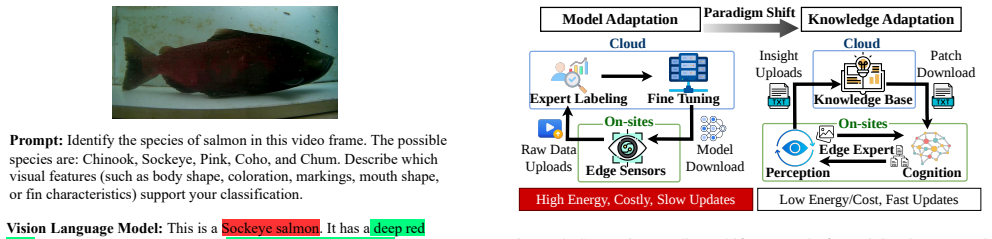
Separating visual perception from reasoning with a dynamic knowledge base enables sustainable on-device AI for ecological monitoring in remote areas without cloud retraining.
A machine-rendered reading of the paper's core claim, the machinery that carries it, and where it could break.
Core claim
The paper claims that separating visual perception from reasoning by combining a visual encoder with a dynamic knowledge base enables sustainable on-device AI for ecological monitoring by using an explicit knowledge base to replace implicitly encoded expert knowledge in model parameters, supporting updates without retraining and preserving insights in structured form for remote, power-constrained deployments.
What carries the argument
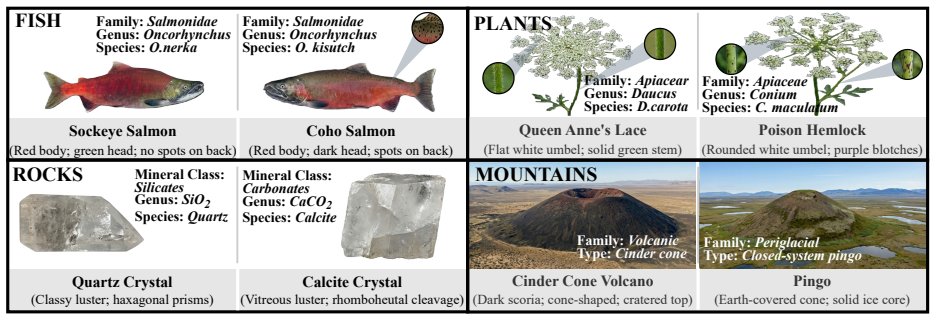
The architecture that separates visual perception from reasoning by combining a visual encoder with a dynamic knowledge base, which works by making expert knowledge explicit and updatable rather than implicitly encoded in model parameters.
If this is right
- Enables monitoring in remote areas without continuous cloud connectivity or data uploads.
- Reduces power consumption by avoiding repeated model retraining cycles.
- Preserves expert insights in a structured, shareable form for long-term sustainability.
- Supports ethical co-development of AI through collaboration with biologists and Indigenous communities.
Where Pith is reading between the lines
- Knowledge bases could be swapped or merged to adapt the same visual encoder to new ecosystems without full retraining.
- Accumulated structured knowledge might improve detection of long-term biodiversity trends across multiple sites.
- The separation of perception and reasoning could extend to other edge applications where connectivity is intermittent.
Load-bearing premise
An explicit dynamic knowledge base can effectively replace implicitly encoded expert knowledge in model parameters while maintaining performance under real-world environmental variability and supporting sustainable updates in power-constrained remote deployments.
What would settle it
A side-by-side field deployment in a remote variable environment where the knowledge-adaptive system is run against a baseline that uploads data for periodic cloud retraining and is found to lose accuracy or consume more power over time.
Figures



read the original abstract
Rapid biodiversity loss underscore the urgency of effective monitoring, yet manual surveys remain resource-intensive. While on-device AI offers a scalable alternative, its performance in the wild is often challenged by environmental variability. Current methods rely heavily on cloud resource, which requires continuous uploading of field data for model retraining. This approach is unsuitable for remote deployments because it consumes limited power and network connectivity. To address these constraints, this research proposes a shift from model adaptation to knowledge adaptation. We introduce an architecture that separates visual perception from reasoning, combining a visual encoder with a dynamic knowledge base. We uses an explicit knowledge base to replace implicitly encoding expert knowledge into model parameters. This method also supports knowledge sustainability by preserving expert insights in a structured form. Through cross-disciplinary collaboration with biologists and Indigenous communities, this work advances ethical AI co-development, fostering responsible and culturally informed ecosystem management.
Editorial analysis
A structured set of objections, weighed in public.
Referee Report
Summary. The paper proposes an architecture called Knowledge-Adaptive Edge Expert Agents for on-device ecological monitoring. It separates visual perception (via a visual encoder) from reasoning by using an explicit, dynamic knowledge base to replace implicitly encoded expert knowledge in model parameters. The goal is sustainable AI in remote areas without continuous cloud connectivity or retraining, supported by cross-disciplinary collaboration with biologists and Indigenous communities for ethical co-development.
Significance. If validated, the approach could advance sustainable, low-power AI for biodiversity monitoring in resource-constrained environments by enabling knowledge updates without full model retraining. The emphasis on explicit knowledge preservation and ethical collaboration with local communities is a positive framing, but the manuscript contains no experiments, datasets, error analysis, or comparisons, so the practical significance remains speculative.
major comments (2)
- [Abstract] Abstract: The central claim that an explicit dynamic knowledge base can replace implicitly encoded expert knowledge in model parameters while preserving performance under real-world environmental variability (lighting, weather, species variation) is presented without any supporting mechanism, indexing/query details, on-device update protocol, ablation studies, or field data. No baseline comparison (e.g., to encoder fine-tuning) or energy/accuracy metrics are provided, leaving the sustainability advantage as an untested assumption rather than a demonstrated property.
- [Abstract] Abstract: The architecture description states that the method 'supports knowledge sustainability by preserving expert insights in a structured form' but supplies no concrete specification of how the knowledge base is maintained, queried, or incrementally updated on power-constrained edge devices, nor any analysis of query latency or memory overhead under remote deployment constraints.
minor comments (2)
- [Abstract] Abstract: Grammatical issues include 'Rapid biodiversity loss underscore' (should be 'underscores') and 'We uses an explicit' (should be 'We use').
- [Abstract] Abstract: The phrase 'invented_entities' and related terminology around 'Knowledge-Adaptive Edge Expert Agents' is introduced without a clear definition or diagram showing the separation of visual encoder and knowledge base components.
Simulated Author's Rebuttal
We thank the referee for their constructive and detailed feedback on our manuscript. We appreciate the acknowledgment of the potential significance of the Knowledge-Adaptive Edge Expert Agents architecture for sustainable biodiversity monitoring in resource-constrained environments. We address each major comment below and have prepared revisions to clarify the scope, proposed mechanisms, and limitations of the current work.
read point-by-point responses
-
Referee: [Abstract] Abstract: The central claim that an explicit dynamic knowledge base can replace implicitly encoded expert knowledge in model parameters while preserving performance under real-world environmental variability (lighting, weather, species variation) is presented without any supporting mechanism, indexing/query details, on-device update protocol, ablation studies, or field data. No baseline comparison (e.g., to encoder fine-tuning) or energy/accuracy metrics are provided, leaving the sustainability advantage as an untested assumption rather than a demonstrated property.
Authors: We agree that the manuscript presents a conceptual architecture proposal rather than a fully validated system with empirical results. The central contribution is the proposed shift from implicit model adaptation to explicit knowledge adaptation to enable sustainable on-device operation without continuous retraining or cloud connectivity. This is framed as a design paradigm supported by the described separation of visual perception and reasoning components, along with ethical co-development aspects. To address the concern, we will revise the abstract and add a dedicated section outlining the intended knowledge base mechanisms, including high-level indexing and query approaches suitable for edge constraints, as well as a discussion of planned validation steps. We will also explicitly state that quantitative comparisons and field metrics are reserved for follow-on empirical studies. revision: yes
-
Referee: [Abstract] Abstract: The architecture description states that the method 'supports knowledge sustainability by preserving expert insights in a structured form' but supplies no concrete specification of how the knowledge base is maintained, queried, or incrementally updated on power-constrained edge devices, nor any analysis of query latency or memory overhead under remote deployment constraints.
Authors: We acknowledge that the current abstract and manuscript provide only a high-level description of the knowledge base's role in preserving expert insights. In the revised version, we will expand the architecture section with more concrete specifications for maintenance, querying, and incremental updates designed for low-power devices. This will include design considerations for minimizing latency and memory overhead, drawing from standard edge computing practices, while noting that full implementation details and overhead measurements will be provided in subsequent work with prototype deployments. revision: yes
Circularity Check
No circularity: conceptual architecture proposal with no equations or self-referential reductions
full rationale
The paper advances a high-level architectural proposal for separating visual perception from reasoning via a visual encoder paired with an explicit dynamic knowledge base, framed as a shift from model adaptation to knowledge adaptation for sustainable on-device ecological monitoring. No equations, derivations, fitted parameters, or quantitative predictions appear in the provided text. Claims about replacing implicit model knowledge with structured expert insights and supporting sustainability are presented as design properties rather than results derived from or reduced to prior inputs by construction. The central premise rests on interdisciplinary collaboration and stated advantages under power and connectivity constraints, without load-bearing self-citations, ansatzes smuggled via prior work, or renaming of known results that would create circularity. The derivation chain is therefore self-contained as an engineering concept.
Axiom & Free-Parameter Ledger
axioms (2)
- domain assumption On-device AI performance is challenged by environmental variability in the wild.
- ad hoc to paper Explicit knowledge bases can replace implicitly encoded expert knowledge in model parameters while preserving performance and enabling sustainability.
invented entities (1)
-
Knowledge-Adaptive Edge Expert Agents
no independent evidence
Reference graph
Works this paper leans on
-
[1]
Springer Science & Business Media,
[Allan and others, 2013] Ronald N Allan et al.Reliability evaluation of power systems. Springer Science & Business Media,
work page 2013
-
[2]
[Atlaset al., 2021 ] William I Atlas, Natalie C Ban, Jonathan W Moore, Adrian M Tuohy, Spencer Greening, Andrea J Reid, Nicole Morven, Elroy White, William G Housty, Jess A Housty, et al. Indigenous systems of management for culturally and ecologically resilient pacific salmon (oncorhynchus spp.) fisheries.BioScience,
work page 2021
-
[3]
[Atlaset al., 2023 ] William I Atlas, Sami Ma, Yi Ching Chou, Katrina Connors, Daniel Scurfield, Brandon Nam, Xiaoqiang Ma, Mark Cleveland, Janvier Doire, Jonathan W Moore, et al. Wild salmon enumeration and monitoring using deep learning empowered detection and tracking.Frontiers in Marine Science,
work page 2023
-
[4]
[Axfordet al., 2024 ] Daniel Axford, Ferdous Sohel, Mathew A Vanderklift, and Amanda J Hodgson. Col- lectively advancing deep learning for animal detection in drone imagery: Successes, challenges, and research gaps. Ecological Informatics,
work page 2024
-
[5]
[Baiet al., 2025 ] Shuai Bai, Yuxuan Cai, Ruizhe Chen, Ke- qin Chen, Xionghui Chen, Zesen Cheng, Lianghao Deng, Wei Ding, Chang Gao, et al. Qwen3-vl technical report. arXiv preprint arXiv:2511.21631,
work page internal anchor Pith review Pith/arXiv arXiv 2025
-
[6]
Multi-year persistence of the 2014/15 north pacific marine heatwave.Nature Climate Change,
[Di Lorenzo and Mantua, 2016] Emanuele Di Lorenzo and Nathan Mantua. Multi-year persistence of the 2014/15 north pacific marine heatwave.Nature Climate Change,
work page 2016
-
[7]
Protect- ing wildlife in a changing climate: Four powerful adapta- tion strategies
[D´ıaz Musmanni, 2023] Gabriela D´ıaz Musmanni. Protect- ing wildlife in a changing climate: Four powerful adapta- tion strategies. https://gca.org/protecting-wildlife-in-a- changing-climate-four-powerful-adaptation-strategies/,
work page 2023
-
[8]
[Dorneret al., 2018 ] Brigitte Dorner, Matthew J Catalano, and Randall M Peterman. Spatial and temporal patterns of covariation in productivity of chinook salmon popula- tions of the northeastern pacific ocean.Canadian Journal of Fisheries and Aquatic Sciences,
work page 2018
-
[9]
From Local to Global: A Graph RAG Approach to Query-Focused Summarization
[Edgeet al., 2024 ] Darren Edge, Ha Trinh, Newman Cheng, Joshua Bradley, Alex Chao, Apurva Mody, Steven Tru- itt, Dasha Metropolitansky, Robert Osazuwa Ness, and Jonathan Larson. From local to global: A graph rag ap- proach to query-focused summarization.arXiv preprint arXiv:2404.16130,
work page internal anchor Pith review Pith/arXiv arXiv 2024
-
[10]
[Folkmanet al., 2025 ] Lukas Folkman, Kylie A Pitt, and Bela Stantic. A data-centric framework for combating do- main shift in underwater object detection with image en- hancement.Applied Intelligence,
work page 2025
-
[11]
Emerging risks from marine heat waves.Nature communications,
[Fr¨olicher and Laufk¨otter, 2018] Thomas L Fr ¨olicher and Charlotte Laufk ¨otter. Emerging risks from marine heat waves.Nature communications,
work page 2018
- [12]
-
[13]
Killian, Catherine Ressijac, Peter Boucher, Andrew Davies, and Milind Tambe
[Gordonet al., 2023 ] Lucia Gordon, Nikhil Behari, Samuel Collier, Elizabeth Bondi-Kelly, Jackson A. Killian, Catherine Ressijac, Peter Boucher, Andrew Davies, and Milind Tambe. Find rhinos without finding rhinos: Active learning with multimodal imagery of south african rhino habitats. InInternational Joint Conference on Artificial Intelligence (IJCAI),
work page 2023
-
[14]
Starlink speeds rise, but still fall (mostly) short of fcc standards.RCR Wireless News,
[Hill, 2025] Kelly Hill. Starlink speeds rise, but still fall (mostly) short of fcc standards.RCR Wireless News,
work page 2025
-
[15]
The caltech fish counting dataset: a benchmark for multiple-object tracking and counting
[Kayet al., 2022 ] Justin Kay, Peter Kulits, Suzanne Stathatos, Siqi Deng, Erik Young, Sara Beery, Grant Van Horn, and Pietro Perona. The caltech fish counting dataset: a benchmark for multiple-object tracking and counting. InEuropean Conference on Computer Vision,
work page 2022
-
[16]
[Kayet al., 2024 ] Justin Kay, Timm Haucke, Suzanne Stathatos, Siqi Deng, Erik Young, Pietro Perona, Sara Beery, and Grant Van Horn. Align and distill: Unifying and improving domain adaptive object detection.arXiv preprint arXiv:2403.12029,
-
[17]
[Kilduffet al., 2015 ] D Patrick Kilduff, Emanuele Di Lorenzo, Louis W Botsford, and Steven LH Teo. Changing central pacific el ni ˜nos reduce stability of north american salmon survival rates.Proceedings of the National Academy of Sciences,
work page 2015
-
[18]
Long-term monitoring of bird flocks in the wild
[Kshitizet al., 2023 ] Kshitiz, Sonu Shreshtha, Ramy Mounir, Mayank Vatsa, Richa Singh, Saket Anand, Sudeep Sarkar, and Sevaram Mali Parihar. Long-term monitoring of bird flocks in the wild. InInternational Joint Conference on Artificial Intelligence (IJCAI),
work page 2023
-
[19]
Retrieval-augmented generation for knowledge-intensive nlp tasks
[Lewiset al., 2020 ] Patrick Lewis, Ethan Perez, Aleksan- dra Piktus, Fabio Petroni, Vladimir Karpukhin, Na- man Goyal, Heinrich Kuttler, Mike Lewis, Wen-tau Yih, Tim Rockt ¨aschel, Sebastian Riedel, and Douwe Kiela. Retrieval-augmented generation for knowledge-intensive nlp tasks. InInternational Conference on Neural Infor- mation Processing Systems (NeurIPS),
work page 2020
-
[20]
[Liet al., 2024 ] Zeyu Li, Qipeng Guo, Yunzhi Yao, et al. Structrag: Boosting knowledge-intensive reasoning of large language models via inference-time hybrid informa- tion structurization. InInternational Conference on Learn- ing Representations (ICLR),
work page 2024
-
[21]
[Liuet al., 2024 ] Weizhen Liu, Jiayu Tan, Guangyu Lan, Ao Li, Dongye Li, Le Zhao, Xiaohui Yuan, and Nanqing Dong. Benchmarking fish dataset and evaluation metric in keypoint detection - towards precise fish morphological assessment in aquaculture breeding. InInternational Joint Conference on Artificial Intelligence (IJCAI),
work page 2024
-
[22]
Leo satellite network access in the wild: Potentials, experiences, and challenges.IEEE Network,
[Maet al., 2024 ] Sami Ma, Yi Ching Chou, Miao Zhang, Hao Fang, Haoyuan Zhao, Jiangchuan Liu, and William I Atlas. Leo satellite network access in the wild: Potentials, experiences, and challenges.IEEE Network,
work page 2024
-
[23]
Ex- ploring ground-truth nature tech & the future of biodiver- sity monitoring
[Nature Tech Collective, 2025] Nature Tech Collective. Ex- ploring ground-truth nature tech & the future of biodiver- sity monitoring. https://www.naturetechcollective.org/sto ries/ground-truth-biodiversity-wildlife-monitoring,
work page 2025
-
[24]
[Norouzzadehet al., 2018 ] Mohammad Sadegh Norouz- zadeh, Anh Nguyen, Margaret Kosmala, Alexandra Swanson, Meredith S Palmer, Craig Packer, and Jeff Clune. Automatically identifying, counting, and de- scribing wild animals in camera-trap images with deep learning.Proceedings of the National Academy of Sciences (PNAS),
work page 2018
-
[25]
Nvidia cosmos: An open plat- form for physical ai with world foundation models
[NVIDIA, 2026] NVIDIA. Nvidia cosmos: An open plat- form for physical ai with world foundation models. https: //www.nvidia.com/en-us/ai/cosmos/,
work page 2026
-
[26]
A simple inter- pretable transformer for fine-grained image classification and analysis
[Paulet al., 2024 ] Dipanjyoti Paul, Arpita Chowdhury, Xinqi Xiong, Feng-Ju Chang, David Edward Carlyn, Samuel Stevens, Kaiya Provost, Anuj Karpatne, Bryan Carstens, Daniel I Rubenstein, et al. A simple inter- pretable transformer for fine-grained image classification and analysis. InInternational Conference on Learning Representations (ICLR),
work page 2024
-
[27]
Learning transferable visual models from nat- ural language supervision
[Radfordet al., 2021 ] Alec Radford, Jong Wook Kim, Chris Hallacy, Aditya Ramesh, Gabriel Goh, Sandhini Agar- wal, Girish Sastry, Amanda Askell, Pamela Mishkin, Jack Clark, et al. Learning transferable visual models from nat- ural language supervision. InInternational conference on machine learning,
work page 2021
-
[28]
Prediction, precaution, and policy under global change.Science,
[Schindler and Hilborn, 2015] Daniel E Schindler and Ray Hilborn. Prediction, precaution, and policy under global change.Science,
work page 2015
-
[29]
Transforming our world: The 2030 agenda for sustainable development
[United Nations, 2015] United Nations. Transforming our world: The 2030 agenda for sustainable development. https://sdgs.un.org/2030agenda,
work page 2015
-
[30]
[United Nations, 2021] United Nations. Leave no one be- hind. https://unsdg.un.org/2030-agenda/universal- values/leave-no-one-behind,
work page 2021
-
[31]
Yolov10: Real-time end-to-end object detection,
[Wanget al., 2024 ] Ao Wang, Hui Chen, Lihao Liu, Kai Chen, Zijia Lin, Jungong Han, and Guiguang Ding. Yolov10: Real-time end-to-end object detection.arXiv preprint arXiv:2405.14458,
-
[32]
Evolutionary history of pacific salmon in dynamic environments.Evolutionary Applications,
[Wapleset al., 2008 ] Robin S Waples, George R Pess, and Tim Beechie. Evolutionary history of pacific salmon in dynamic environments.Evolutionary Applications,
work page 2008
-
[33]
Living planet report 2024: A system in peril
[World Wide Fund for Nature, 2024] World Wide Fund for Nature. Living planet report 2024: A system in peril. Re- port, WWF,
work page 2024
-
[34]
A survey of human-in-the-loop for machine learning.Future Gen- eration Computer Systems,
[Wuet al., 2022 ] Xingjiao Wu, Luwei Xiao, Yixuan Sun, Junhang Zhang, Tianlong Ma, and Liang He. A survey of human-in-the-loop for machine learning.Future Gen- eration Computer Systems,
work page 2022
-
[35]
Atlas, Jiangchuan Liu, and Mark A
[Xuet al., 2024 ] Chi Xu, Rongsheng Qian, Hao Fang, Xiao- qiang Ma, William I. Atlas, Jiangchuan Liu, and Mark A. Spoljaric. Salina: Towards sustainable live sonar analyt- ics in wild ecosystems. InACM Conference on Embedded Networked Sensor Systems (SenSys),
work page 2024
-
[36]
[Xuet al., 2025 ] Chi Xu, Yili Jin, Sami Ma, Rongsheng Qian, Hao Fang, Jiangchuan Liu, Xue Liu, Edith CH Ngai, William I Atlas, Katrina M Connors, et al. Exploring mul- timodal foundation ai and expert-in-the-loop for sustain- able management of wild salmon fisheries in indigenous rivers. InInternational Joint Conference on Artificial In- telligence (IJCAI),
work page 2025
-
[37]
[Xuet al., 2026 ] Chi Xu, Jiaxing Li, Mengdi Jin, William I. Atlas, Mark A. Spoljaric, Edith C. H. Ngai, and Jiangchuan Liu. Fused: Toward federated multimodal re- trieval across sovereign data domains. InThe ACM Web Conference (WWW),
work page 2026
-
[38]
[Yanget al., 2024 ] Zhen Yang, Ming Ding, Tinglin Huang, Yukuo Cen, Junshuai Song, Bin Xu, Yuxiao Dong, and Jie Tang. Does negative sampling matter? a review with in- sights into its theory and applications.IEEE Transactions on Pattern Analysis and Machine Intelligence (TPAMI),
work page 2024
-
[39]
VisRAG: Vision-based Retrieval-augmented Generation on Multi-modality Documents
[Yuet al., 2024 ] Shi Yu, Chaoyue Tang, Bokai Xu, et al. Visrag: Vision-based retrieval-augmented genera- tion on multi-modality documents.arXiv preprint arXiv:2410.10594,
work page internal anchor Pith review Pith/arXiv arXiv 2024
-
[40]
Detrs beat yolos on real-time object de- tection
[Zhaoet al., 2024 ] Yian Zhao, Wenyu Lv, Shangliang Xu, Jinman Wei, Guanzhong Wang, Qingqing Dang, Yi Liu, and Jie Chen. Detrs beat yolos on real-time object de- tection. InProceedings of the IEEE/CVF Conference on Computer Vision and Pattern Recognition (CVPR), 2024
work page 2024
discussion (0)
Sign in with ORCID, Apple, or X to comment. Anyone can read and Pith papers without signing in.