REVIEW 4 major objections 6 minor 1 cited by
Towards AI-Native RAN: An Operator's Perspective of 6G Day 1 Standardization
T0 review · 4 major / 6 minor · reviewed 2026-08-06 · deepseek-v4-flash
Pith's one-line read This paper argues that 6G's Day 1 standards should introduce a dedicated AI Node into the radio access network, and reports a 31-city field trial with more than 5,000 base stations supporting the design.
desk verdict A clear operator position on 6G Day 1 AI-Native RAN, but the field trial claims outrun the evidence—worth engaging as a standards roadmap, not as a validation. read the letter →
The pith
A machine-rendered reading of the paper's core claim, the machinery that carries it, and where it could break.
The reading
What carries the argument
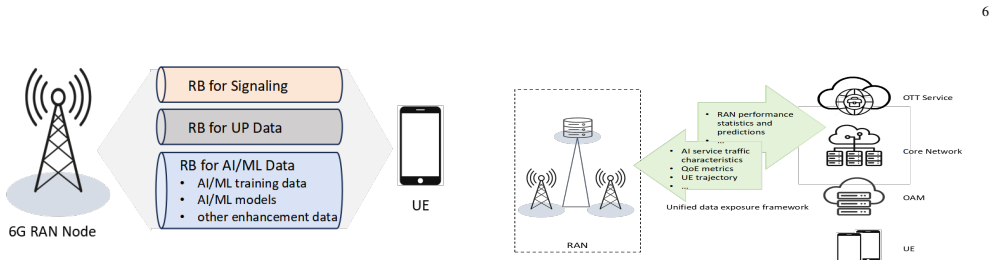
The load-bearing object is the AI Node, defined in one phrase as a locally centralized RAN computing node that hosts data collection, model repository, model training and inference, and RAN capability exposure, and interconnects with many 6gNBs over a new RAN interface. In the field trial this role is played by the CCU, a centralized AI computing unit that performs the heavy inference and cross-base-station coordination. What it does for the argument: it is the architectural device that converts AI from a per-function add-on into a pooled, shareable RAN resource, and it is the component whose field measurements carry the validation of the Day 1 proposal.
What would settle it
Run the same 5,000-plus-station trial with the centralized AI functions toggled off while keeping all other network settings, software versions, and traffic conditions identical; if the reported 25.6% and 21.9% latency reductions, 3–6% traffic growth, 20% root-cause accuracy gain, and 26.6–34.16% energy savings disappear or reverse, the central claim that the AI Node architecture produces these gains is falsified.
Extended reading notes
Core claim
The paper's central claim is that the Day 1 release of 6G should standardize an AI Node as a first-class RAN entity, connected to the 6G base station (6gNB) through a new RAN interface, with one AI Node serving many 6gNBs. The AI Node pools AI/ML compute for data collection, model repository, training, inference, and RAN capability exposure, while the 6gNB keeps real-time L1/L2 inference and basic communication. A field trial deploying a centralized AI computing unit (CCU) reflecting this design, across 31 cities and more than 5,000 5G-Advanced base stations in 2024, produced a 25.6% average air-interface latency reduction for short video and 21.9% for QR-code scanning, 3–6% traffic growth, a 20% improvement in root-cause identification accuracy with 30% higher recall over rule-based methods, and energy savings rising from 26.6% to 34.16% as AI functions were added. The authors conclude that the AI Node is essential and should be realized from Day 1, and that standardization should prioritize interoperable interfaces for it—the trial itself exposed missing standardized interfaces between the centralized unit and multi-vendor base stations as a key gap.
Load-bearing premise
The trial's measured gains in latency, energy, and diagnosis accuracy were actually caused by the centralized AI functions being tested, rather than by other network changes, chosen scenarios, or operator tuning during the same period.
Editorial extensions
If this is right
- If Day 1 standards include the AI Node, the first 6G networks will have a pooled AI-compute layer that can serve base stations, including stations without local AI capabilities, changing per-site hardware requirements.
- The three capabilities—AI-driven RAN processing and automation, reliable AI lifecycle management, and AI-as-a-Service provisioning—become the organizing structure for the 6G RAN work program, with data collection, model management, and collaborative computing specified in the first release.
- The trial's experience-centric service tier, such as premium low-latency assurance for short video and QR-code scanning, becomes a concrete monetization model, with 3–6% traffic growth as an observed revenue-side effect.
- Operators can limit on-site AI computing and centralize intensive training and inference, reducing the cost of AI-native RAN deployment and supporting low-cost rollouts.
- Standards work should focus on the new RAN interface and open APIs for the AI Node, since the trial found that missing standardized interfaces were the main blocker to cross-vendor collaborative inference.
Reading between the lines
- The before-and-after trial design leaves attribution of the reported gains to the AI functions open; a natural next step is a randomized A/B deployment with matched cells and AI coordination enabled or disabled, which would also produce a defensible return-on-investment figure.
- If the AI Node becomes a pooled compute hub, an implicit consequence the paper does not develop is that RAN compute becomes a schedulable resource much like spectrum: idle AI capacity could be sold as low-latency edge inference, which would require standards for fair sharing and isolation.
- The paper's monitoring framework—covering model, network, and resource metrics—points toward a larger unresolved problem: with many models per node and no agreed metric semantics across vendors, the promised reliability of AI lifecycle management will depend on data-provenance and model-versioning standards that are only sketched here.
Editorial analysis
A structured set of objections, weighed in public.
Referee Report
Summary. The paper argues that 6G radio access networks should treat AI as a native component from Day 1 of standardization, rather than as an add-on as in 5G. It proposes three essential capabilities of an AI-Native RAN (AI-driven RAN processing/optimization/automation, reliable AI lifecycle management, and AI-as-a-Service provisioning), defines a functional architecture with a centralized AI Node connected to 6G base stations over a new RAN interface, and recommends specific Day 1 standardization building blocks. To support the proposal, the authors report a nationwide 2024 field trial by China Mobile across 31 cities and more than 5,000 5G-Advanced base stations, claiming reductions in air-interface latency, improved root-cause diagnosis, and network energy savings. The paper concludes that the field trial validates the proposed architecture and three typical use cases.
Significance. The paper is a substantial operator-driven position statement for 6G RAN standardization, with a coherent architectural vision and a systematic taxonomy of use cases and building blocks. The reported trial is unusually large for industrial AI-Native RAN studies, and the explicit acknowledgment in Section V.F of missing standardized interfaces is a candid limitation. If the validation evidence were made rigorous, the paper would be a valuable reference for 3GPP Day 1 discussions. As it stands, however, the central claim that the trial validates the architecture is not supported by the statistical evidence presented, because the comparisons lack controls, defined baselines, and significance tests. The proposal therefore stands as a credible architectural direction, but the empirical validation needs substantial strengthening or careful qualification.
major comments (4)
- [§V.C, Figs. 13–14] The latency reductions for short video and QR code scanning are reported as before/after comparisons with no definition of the measurement periods, traffic conditions, user populations, or statistical variability. No confidence intervals or significance tests are given, so the stated gains (25.6% and 21.9% on average) cannot be attributed to the centralized AI functions. Since the paper's conclusion explicitly states that the trial validates the key architectural features and use cases, this lack of causal evidence is load-bearing and must be addressed.
- [§V.D] The claim that the AI-driven method improves root-cause identification accuracy by 20% and classification recall by 30% relative to 'traditional rule-based methods' is not supported by any definition of the baseline rule set, evaluation dataset, number of users/cells, or per-class performance. Without a precise baseline and a description of the evaluation protocol, the comparison is not reproducible and the improvement could reflect an arbitrarily weak comparator. This is one of the three 'validated' use cases, so the evidence is central to the paper's claim.
- [§V.E, Eq. (energy model) and Fig. 17] The energy-saving evaluation is ambiguous about the baseline. The text says results are benchmarked 'against a baseline scenario without energy-saving mechanisms' but then attributes 'additional 5.32% and 12.88%' gains over 'traditional non-AI energy-saving methods.' The energy model in Section V.E does not include the power consumption of the CCU/AI computing platform, so the net energy saving, after accounting for the AI inference overhead, is not established. The baseline and the overhead must be specified to support the claimed 34.16% saving.
- [§V.F] Section V.F explicitly states that the trial revealed 'the absence of standardized interfaces between the CCU and multi-vendor gNBs' and a 'lack of modular API encapsulation for the AI capabilities.' This concession means that the trial validated a proprietary integration between a single vendor's CCU and a specific set of gNBs, not the Day 1 standardized interfaces and AI Node architecture proposed in Section IV. The conclusion that the trial validates the proposed 6G architecture is therefore overstated, and the manuscript should distinguish between feasibility demonstration and standardization validation.
minor comments (6)
- [§V.D] The sentence 'To enable such high-accuracy prediction, we define a supervised learning model that maps multi-layer network observations to user-level performance labels' appears twice verbatim in the same paragraph; one instance should be removed.
- [§I (Introduction)] The paragraph describing the paper structure says 'The conclusion of this paper is given in Section V,' but the conclusions appear in Section VI. Please correct the cross-reference.
- [§V.C] The optimization formulation for service assurance is presented without an equation number and with the action space A left somewhat informal; consider numbering the equation and defining all symbols in the text.
- [Figures 13–14] The axis labels are partially bilingual (e.g., '极好点/好点/中点/差点' and '轻载/中载/重载' appear alongside English labels); for a journal readership, the figures should be fully in English or fully consistent.
- [§I (Contributions)] There is a grammatical error in 'We investigates the essential capabilities of AI-Native RAN'; it should be 'We investigate.'
- [§V.A] Phase 2 is said to 'extend testing to 475,000 gNBs,' but the paper does not clarify whether this is a completed measurement campaign or a planned deployment target; if it is planned, the wording should be future tense to avoid confusion.
Circularity Check
No circular derivation: the field trial is an empirical validation of the authors' own architecture, with self-citations present but not load-bearing; the main weaknesses concern causal attribution and standardization readiness, not circularity.
full rationale
The paper's central claim—that 6G Day 1 should standardize an AI Node—is an operator-position and design proposal, not a derived quantitative prediction. The supporting evidence is the Phase 1 field trial (Section V), which empirically compares AI-enabled service assurance, root-cause analysis, and energy saving against before-states or non-AI baselines. No equation in the paper fits a parameter to the target outcome and then re-presents it as a prediction; the objective functions in Sections V.C and V.D define the AI controller's decision problem rather than deriving the reported gains. The reported gains come from measurements of a deployed system. The authors' prior work ([13], [14], [28], [31]) is cited for architectural concepts and a simulation result, but none of these citations is invoked as a uniqueness theorem or as the source of the field-trial numbers; the trial data are new and reported in this paper. Section V.F's admission that CCU-gNB interfaces were not standardized undermines generalization to a Day 1 standard, and the before/after design limits causal attribution, but these are validity and correctness concerns, not circularity in the derivation chain. Therefore no step reduces a result to its own inputs by construction; the score of 2 reflects only the mild self-validation flavor of an operator trialing its own proposed architecture.
Assumptions & free parameters
free parameters (3)
- AI model weights for service perception classifier =
Undisclosed
- XGBoost parameters for user-type and root-cause classification =
Undisclosed
- Energy-saving AI model thresholds and hyperparameters =
Undisclosed
assumptions (4)
- domain assumption AI is the most certain and prominent feature of 6G networks.
- domain assumption Day 1 standards determine the practical capabilities of a generation.
- domain assumption A 5G-A field trial with a centralized computing unit can validate a 6G AI-Native architecture.
- domain assumption The CCU/AI functions cause the measured improvements.
invented entities (3)
-
AI Node
independent evidence
-
AI radio bearer
-
New RAN interface (AI Node to 6gNB)
Cite this review
Pith. "Pith review of Towards AI-Native RAN: An Operator's Perspective of 6G Day 1 Standardization." pith.science (2026). https://pith.science/paper/C7UETKSF
@misc{pith2026250708403,
  author       = {Pith},
  title        = {Pith review of: Towards AI-Native RAN: An Operator's Perspective of 6G Day 1 Standardization},
  year         = {2026},
  howpublished = {\url{https://pith.science/paper/C7UETKSF}},
  note         = {Machine review of arXiv:2507.08403}
}
read the original abstract
Artificial Intelligence/Machine Learning (AI/ML) has become the most certain and prominent feature of 6G mobile networks. Unlike 5G, where AI/ML was not natively integrated but rather an add-on feature over existing architecture, 6G shall incorporate AI from the onset to address its complexity and support ubiquitous AI applications. Based on our extensive mobile network operation and standardization experience from 2G to 5G, this paper explores the design and standardization principles of AI-Native radio access networks (RAN) for 6G, with a particular focus on its critical Day 1 architecture, functionalities and capabilities. We investigate the framework of AI-Native RAN and present its three essential capabilities to shed some light on the standardization direction; namely, AI-driven RAN processing/optimization/automation, reliable AI lifecycle management (LCM), and AI-as-a-Service (AIaaS) provisioning. The standardization of AI-Native RAN, in particular the Day 1 features, including an AI-Native 6G RAN architecture, were proposed. For validation, a large-scale field trial with over 5000 5G-A base stations have been built and delivered significant improvements in average air interface latency, root cause identification, and network energy consumption with the proposed architecture and the supporting AI functions. This paper aims to provide a Day 1 framework for 6G AI-Native RAN standardization design, balancing technical innovation with practical deployment.
Figures


Figures from the paper (13 more)


Forward citations
Cited by 1 Pith paper
-
Test-Time Scalable AI-RAN: Inference Time Allocation for Cell-Free MIMO
A new framework allocates inference time between test-time-scalable precoding and quantization AI modules in cell-free MIMO, with the optimal split depending on the temporal correlation of the channel.
Reference graph
Works this paper leans on
-
[1]
Architecture enhancements for 5G System (5GS) to support network data analytics services,
3GPP, “Architecture enhancements for 5G System (5GS) to support network data analytics services,” Technical Specification (TS) 23.288, 2025
work page 2025
-
[2]
Management and orchestration; Artificial Intelli- gence/ Machine Learning (AI/ML) management,
3GPP, “Management and orchestration; Artificial Intelli- gence/ Machine Learning (AI/ML) management,” Tech- nical Specification (TS) 28.104, 2025
work page 2025
-
[3]
Architecture enhancements for 5G System (5GS) to support network data analytics services,
3GPP, “Architecture enhancements for 5G System (5GS) to support network data analytics services,” Technical Specification (TS) 28.105, 2025
work page 2025
-
[4]
Study on enhancement for data collection for NR and ENDC,
3GPP, “Study on enhancement for data collection for NR and ENDC,” Technical Report (TR) 37.817, 2019
work page 2019
-
[5]
Study on Artificial Intelligence (AI)/Machine Learning (ML) for NR air interface,
3GPP, “Study on Artificial Intelligence (AI)/Machine Learning (ML) for NR air interface,” Technical Report (TR) 38.843, 2019
work page 2019
-
[6]
Study on Artificial Intelligence (AI)/Machine Learning (ML) for mobility in NR,
3GPP, “Study on Artificial Intelligence (AI)/Machine Learning (ML) for mobility in NR,” Technical Report (TR) 38.744, 2024
work page 2024
-
[7]
Framework and overall objectives of the future development of IMT for 2030 and beyond,
ITU-R M.2160, “Framework and overall objectives of the future development of IMT for 2030 and beyond,” 2023
work page 2023
-
[8]
Toward native artificial intelligence in 6g networks: System design, architectures, and paradigms,
J. Wu, R. Li, X. An, C. Peng, Z. Liu, J. Crowcroft, and H. Zhang, “Toward native artificial intelligence in 6g networks: System design, architectures, and paradigms,” arXiv preprint arXiv:2103.02823, 2021
arXiv 2021
Show all 33 references
-
[9]
Defining ai native: A key enabler for advanced intelligent telecom networks,
M. Iovene, L. Jonsson, D. Roeland, M. D’Angelo, G. Hall, M. Erol-Kantarci, and J. Manocha, “Defining ai native: A key enabler for advanced intelligent telecom networks,”Ericsson white paper, 2023
2023
-
[10]
Toward a 6g ai-native air interface,
J. Hoydis, F. A. Aoudia, A. Valcarce, and H. Viswanathan, “Toward a 6g ai-native air interface,” 20 IEEE Communications Magazine, vol. 59, no. 5, pp. 76–81, 2021
2021
-
[11]
Overview of AI/ML related Work in 3GPP
3GPP. Overview of AI/ML related Work in 3GPP. (2025, Feb. 16). [Online]. Available: https://docbox.etsi. org/Workshop/2025/02 AICONFERENCE/SESSION05/ 3GPPRAN MONTOJO JUAN QUALCOMM.pdf
2025
-
[12]
Ai-ran: Transforming ran with ai- driven computing infrastructure,
L. Kundu, X. Lin, R. Gadiyar, J.-F. Lacasse, and S. Chowdhury, “Ai-ran: Transforming ran with ai- driven computing infrastructure,”arXiv preprint arXiv:2501.09007, 2025
2025 arXiv
-
[13]
Intelligent ran automation for 5g and beyond,
Q. Sun, N. Li, I. Chih-Lin, J. Huang, X. Xu, and Y . Xie, “Intelligent ran automation for 5g and beyond,”IEEE wireless communications, vol. 31, no. 1, pp. 94–102, 2023
2023
-
[14]
Rethinking ran architecture for deep fusion of ai and communication in 6g,
N. Li, Y . Wang, Q. Sun, X. Li, J. Huang, C. Liu, Y . Huang, Z. Hu, Y . Han, and C.-L. I, “Rethinking ran architecture for deep fusion of ai and communication in 6g,”IEEE Wireless Communications, vol. 32, no. 3, pp. 164–174, 2025
2025
-
[15]
5G System (5GS); Study on traffic characteristics and performance requirements for AI/ML model trans- fer,
3GPP, “5G System (5GS); Study on traffic characteristics and performance requirements for AI/ML model trans- fer,” Technical Report (TR) 22.874, 2021
2021
-
[16]
System architecture for the 5G System (5GS),
3GPP, “System architecture for the 5G System (5GS),” Technical Specification (TS) 23.501, 2025
2025
-
[17]
Data Collection and Reporting; General De- scription and Architecture,
3GPP, “Data Collection and Reporting; General De- scription and Architecture,” Technical Specification (TS) 26.531, 2024
2024
-
[18]
Study on Artificial Intelligence and Machine learning in 5G media services,
3GPP, “Study on Artificial Intelligence and Machine learning in 5G media services,” Technical Report (TR) 26.531, 2025
2025
-
[19]
Study on 3GPP AI/ML Consistency Alignment,
3GPP, “Study on 3GPP AI/ML Consistency Alignment,” Technical Report (TR) 22.850, 2025
2025
-
[20]
O-RAN Architecture Description,
O-RAN Alliance, “O-RAN Architecture Description,” Technical Specification (TS) WG1.OAD, 2024
2024
-
[21]
O-RAN Non-RT RIC: Architecture,
O-RAN Alliance, “O-RAN Non-RT RIC: Architecture,” Technical Specification (TS) WG2.Non-RT-RIC-ARCH, 2024
2024
-
[22]
O-RAN Near-RT RIC Architecture,
O-RAN Alliance, “O-RAN Near-RT RIC Architecture,” Technical Specification (TS) WG3.RICARCH, 2024
2024
-
[23]
O-RAN Use Cases and Require- ments,
O-RAN Alliance, “O-RAN Use Cases and Require- ments,” Technical Specification (TS) WG3.UCR, 2024
2024
-
[24]
Architectural framework for machine learning in future networks including IMT-2020,
ITU-T, “Architectural framework for machine learning in future networks including IMT-2020,” Recommendations ITU.Y .3172, 2019
2020
-
[25]
Autonomous networks - Architecture frame- work,
ITU-T, “Autonomous networks - Architecture frame- work,” Recommendations ITU.Y .3061, 2023
2023
-
[26]
Experiential Networked Intelligence (ENI); ENI requirements,
ETSI, “Experiential Networked Intelligence (ENI); ENI requirements,” TS GS ENI 002, 2023
2023
-
[27]
Zero-touch network and Service Management (ZSM); Reference Architecture,
ETSI, “Zero-touch network and Service Management (ZSM); Reference Architecture,” TS GS ZSM 002, 2019
2019
-
[28]
CMCC’s views on 6G RAN study,
3GPP, “CMCC’s views on 6G RAN study,” Technical Document 6GWS-250144, 2025
2025
-
[29]
A unified data collection framework based on the data plane for 6G
Yuan, Y ., Qin, F., Liu, J. et al, “A unified data collection framework based on the data plane for 6G.”Front Inform Technol Electron Eng, vol. 26, p. 293–300, 2025
2025
-
[30]
Mobile edge intelligence for large language models: A contemporary survey,
G. Qu, Q. Chen, W. Wei, Z. Lin, X. Chen, and K. Huang, “Mobile edge intelligence for large language models: A contemporary survey,”IEEE Communications Surveys & Tutorials, 2025
2025
-
[31]
Joint communication and computing resource optimiza- tion for collaborative ai inference in mobile networks,
N. Li, X. Li, Y . Yan, Q. Sun, Y . Han, and K. Cheng, “Joint communication and computing resource optimiza- tion for collaborative ai inference in mobile networks,” in2023 IEEE 98th Vehicular Technology Conference (VTC2023-Fall), 2023, pp. 1–5
2023
-
[32]
Common API Framework for 3GPP Northbound APIs,
3GPP, “Common API Framework for 3GPP Northbound APIs,” Technical Specification (TS) 23.222, 2025
2025
-
[33]
Focus Group on Artificial Intelligence Native for Telecommunication Networks (FG AINN)
ITU-T. Focus Group on Artificial Intelligence Native for Telecommunication Networks (FG AINN). [Online]. Available: https://www.itu.int/en/ ITU-T/focusgroups/ainn/Pages/default.aspx
Reviewed August 6, 2026 · model on record in the stance chip above.
Discussion (0). Continue with ORCID to comment.