Stein-Encoder: A White-Box Supervised Encoder via Stein Identities in Multi-Modal Studies
Pith reviewed 2026-06-29 19:38 UTC · model grok-4.3
The pith
The Stein-Encoder uses Stein identities and residualization to build an interpretable single index that isolates genetic signals from clinical factors in multi-modal data.
A machine-rendered reading of the paper's core claim, the machinery that carries it, and where it could break.
Core claim
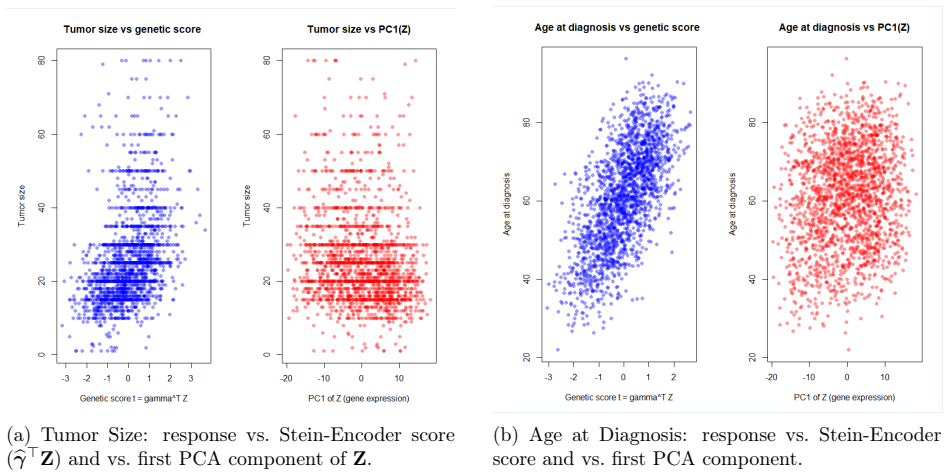
By leveraging Stein's method and residualization techniques, the Stein-Encoder constructs an interpretable single index that summarizes relevant biological heterogeneity while flexibly incorporating clinical factors and can be used to improve downstream prediction. Theoretical guarantees are established for identification, consistency and efficiency improvement. Applied to the METABRIC cohort, the Stein-Encoder outperforms unsupervised benchmarks in predictive accuracy and achieves structural disentanglement by revealing that tumor size is driven primarily by mitotic networks whereas prognostic indices rely on a distinct proliferation-versus-immune axis.
What carries the argument
Stein identity applied after residualization on clinical covariates, which produces the supervised single-index encoder.
If this is right
- The single index improves predictive accuracy over unsupervised benchmarks on the METABRIC data.
- The method supplies theoretical guarantees of identification, consistency, and efficiency improvement.
- Structural disentanglement reveals distinct biological mechanisms for tumor size versus prognostic indices.
- The resulting index supports a range of downstream precision-medicine tasks that require compressed multi-modal inputs.
Where Pith is reading between the lines
- The same residualization-plus-Stein construction could be tested on other cohorts to check whether the mitotic-versus-immune separation generalizes.
- The encoder might be combined with survival models to produce time-to-event summaries that retain the same interpretability property.
- If the single index proves stable across data splits, it could serve as a low-dimensional surrogate for high-dimensional genomic inputs in clinical-trial design.
Load-bearing premise
That Stein identities can isolate the genetic signal driving clinical outcomes conditional on nuisance covariates in high-dimensional genomic data.
What would settle it
Re-application of the Stein-Encoder to the METABRIC cohort yields no gain in downstream prediction accuracy or fails to recover the reported separation between mitotic and immune axes in an independent validation set.
Figures

read the original abstract
In multi-modal biomedical research, integrating high-dimensional genomic data with clinical baselines is essential for precision medicine. However, standard deep neural network approaches often entangle these modalities, obscuring the specific predictive impact of genetic features and leading to possibly suboptimal predictive performance. Motivated by the landmark METABRIC cohort primary breast tumors study, we propose the Stein-Encoder, a white-box supervised framework designed to isolate the genetic signal driving clinical outcomes conditional on nuisance covariates. By leveraging Stein's method and residualization techniques, our approach constructs an interpretable single index that summarizes relevant biological heterogeneity while flexibly incorporating clinical factors and can be used to improve downstream prediction. We establish theoretical guarantees for identification, consistency and efficiency improvement. Applied to the METABRIC cohort, the Stein-Encoder outperforms unsupervised benchmarks in predictive accuracy. Crucially, it achieves structural disentanglement by revealing response-specific biological mechanisms: we find that tumor size is driven primarily by mitotic networks, whereas prognostic indices rely on a distinct proliferation-versus-immune axis. This work contributes a unified, computationally efficient framework that bridges statistical rigor with the representational power of neural networks, enabling interpretable, task-specific and efficient compression of multi-modal health data for a wide range of precision medicine applications, beyond biomarker discovery.
Editorial analysis
A structured set of objections, weighed in public.
Referee Report
Summary. The manuscript proposes the Stein-Encoder, a white-box supervised framework that applies Stein identities together with residualization to isolate the genetic component driving clinical outcomes conditional on nuisance covariates. It constructs an interpretable single-index summary of biological heterogeneity, claims theoretical guarantees of identification, consistency and efficiency gains, and reports superior predictive accuracy over unsupervised benchmarks on the METABRIC cohort while revealing response-specific mechanisms (mitotic networks for tumor size; proliferation-versus-immune axis for prognostic indices).
Significance. A method that delivers both statistical identification guarantees and interpretable single-index compression of multi-modal genomic-clinical data would be valuable for precision-medicine applications. The combination of Stein’s method with neural-network flexibility is conceptually attractive, yet the high-dimensional regime (p ≫ n) makes the claimed guarantees sensitive to unverified regularity conditions on the score function.
major comments (3)
- [Theoretical guarantees (abstract and method description)] The central identification and consistency claims rest on the conditional Stein identity E[score(X)·f(X)|Z]=0 after residualization. No section verifies that the score function exists and can be estimated at a sufficient rate when the genomic dimension greatly exceeds sample size, which is load-bearing for the stated theoretical guarantees.
- [Efficiency improvement result] The efficiency-improvement claim via residualization assumes that all dependence on clinical nuisance covariates is removed without introducing bias. The manuscript does not supply a rate or explicit condition under which this holds in the p ≫ n setting of METABRIC-scale data.
- [METABRIC application and results] The empirical superiority on METABRIC is reported without error bars, data-exclusion rules, or verification that the high-dimensional score estimator converges; these omissions prevent assessment of whether the outperformance is robust or an artifact of the particular implementation.
minor comments (2)
- [Abstract] The abstract refers to “structural disentanglement” but does not define a quantitative metric or validation procedure for this property.
- [Method section] Notation for the single-index encoder and the residualization operator should be introduced with explicit definitions before the theoretical statements.
Simulated Author's Rebuttal
Thank you for the opportunity to respond to the referee's comments. We appreciate the detailed feedback and will revise the manuscript accordingly to address the concerns raised regarding theoretical guarantees and empirical validation.
read point-by-point responses
-
Referee: [Theoretical guarantees (abstract and method description)] The central identification and consistency claims rest on the conditional Stein identity E[score(X)·f(X)|Z]=0 after residualization. No section verifies that the score function exists and can be estimated at a sufficient rate when the genomic dimension greatly exceeds sample size, which is load-bearing for the stated theoretical guarantees.
Authors: We agree that explicit verification of the score function's existence and estimation rate in the p ≫ n regime is important for the theoretical claims. The manuscript assumes standard regularity conditions from Stein's method literature, but to strengthen the paper, we will add a dedicated subsection in the Methods that discusses these conditions, including references to high-dimensional nonparametric estimation techniques that achieve the required rates under sparsity. We will also clarify that the guarantees are conditional on these assumptions being met. revision: yes
-
Referee: [Efficiency improvement result] The efficiency-improvement claim via residualization assumes that all dependence on clinical nuisance covariates is removed without introducing bias. The manuscript does not supply a rate or explicit condition under which this holds in the p ≫ n setting of METABRIC-scale data.
Authors: The efficiency improvement is derived under the assumption that the residualization fully removes the covariate dependence, which follows from the conditional Stein identity. We will revise the theoretical section to include an explicit rate condition based on the convergence of the score estimator and the residualization operator. This will specify the conditions under which the efficiency gain holds in high dimensions. revision: yes
-
Referee: [METABRIC application and results] The empirical superiority on METABRIC is reported without error bars, data-exclusion rules, or verification that the high-dimensional score estimator converges; these omissions prevent assessment of whether the outperformance is robust or an artifact of the particular implementation.
Authors: We acknowledge the need for more rigorous reporting of the empirical results. In the revised manuscript, we will include error bars from bootstrap resampling, detail the data exclusion criteria and preprocessing steps, and provide evidence of score estimator convergence through cross-validation metrics and sensitivity analyses. This will allow readers to better assess the robustness of the findings. revision: yes
Circularity Check
No significant circularity detected
full rationale
The abstract and context present the Stein-Encoder as constructed via Stein identities and residualization, with claimed theoretical guarantees for identification, consistency, and efficiency. No equations, self-citations, or fitted quantities are exhibited that reduce any prediction or identification result to the inputs by construction. Stein's method is invoked as an external tool rather than derived from the paper's own data or prior self-citations. The application to METABRIC is presented as empirical validation rather than a load-bearing step that forces the theoretical claims. The derivation chain therefore remains self-contained against external benchmarks.
Axiom & Free-Parameter Ledger
Reference graph
Works this paper leans on
-
[1]
Multimodal machine learning: A survey and taxonomy.IEEE transactions on pattern analysis and machine intelligence, 41(2): 423–443, 2018
Tadas Baltrušaitis, Chaitanya Ahuja, and Louis-Philippe Morency. Multimodal machine learning: A survey and taxonomy.IEEE transactions on pattern analysis and machine intelligence, 41(2): 423–443, 2018. 20 Victor Chernozhukov, Denis Chetverikov, Mert Demirer, Esther Duflo, Christian Hansen, Whit- ney Newey, and James Robins. Double/debiased machine learnin...
2018
-
[2]
Auto-Encoding Variational Bayes
Dunning, Doug Speed, Andy G Lynch, Shamith Samarajiwa, Yinyin Yuan, et al. The genomic and transcriptomic architecture of 2,000 breast tumours reveals novel subgroups.Nature, 486 (7403):346–352, 2012. Marcus H Galea, Roger W Blamey, Christopher E Elston, and Ian O Ellis. The nottingham prog- nostic index in primary breast cancer.Breast cancer research and...
work page internal anchor Pith review Pith/arXiv arXiv 2012
-
[3]
Subtype- dependent relationship between young age at diagnosis and breast cancer survival.Journal of Clinical Oncology, 34(27):3308–3314, 2016
Edge, Richard L Theriault, Douglas W Blayney, Joyce C Niland, Eric P Winer, et al. Subtype- dependent relationship between young age at diagnosis and breast cancer survival.Journal of Clinical Oncology, 34(27):3308–3314, 2016. Bernard Pereira, Suet-Feung Chin, Oscar M Rueda, Hans-Kristian Moen Vollan, Elena Provenzano, Helen A Bardwell, Michelle Pugh, Lin...
2016
discussion (0)
Sign in with ORCID, Apple, or X to comment. Anyone can read and Pith papers without signing in.