Langshaw: Declarative Interaction Protocols Based on Sayso and Conflict
Pith reviewed 2026-06-30 01:36 UTC · model grok-4.3
The pith
Langshaw specifies multiagent protocols declaratively using sayso for attribute priority and nono/nogo for conflicts.
A machine-rendered reading of the paper's core claim, the machinery that carries it, and where it could break.
Core claim
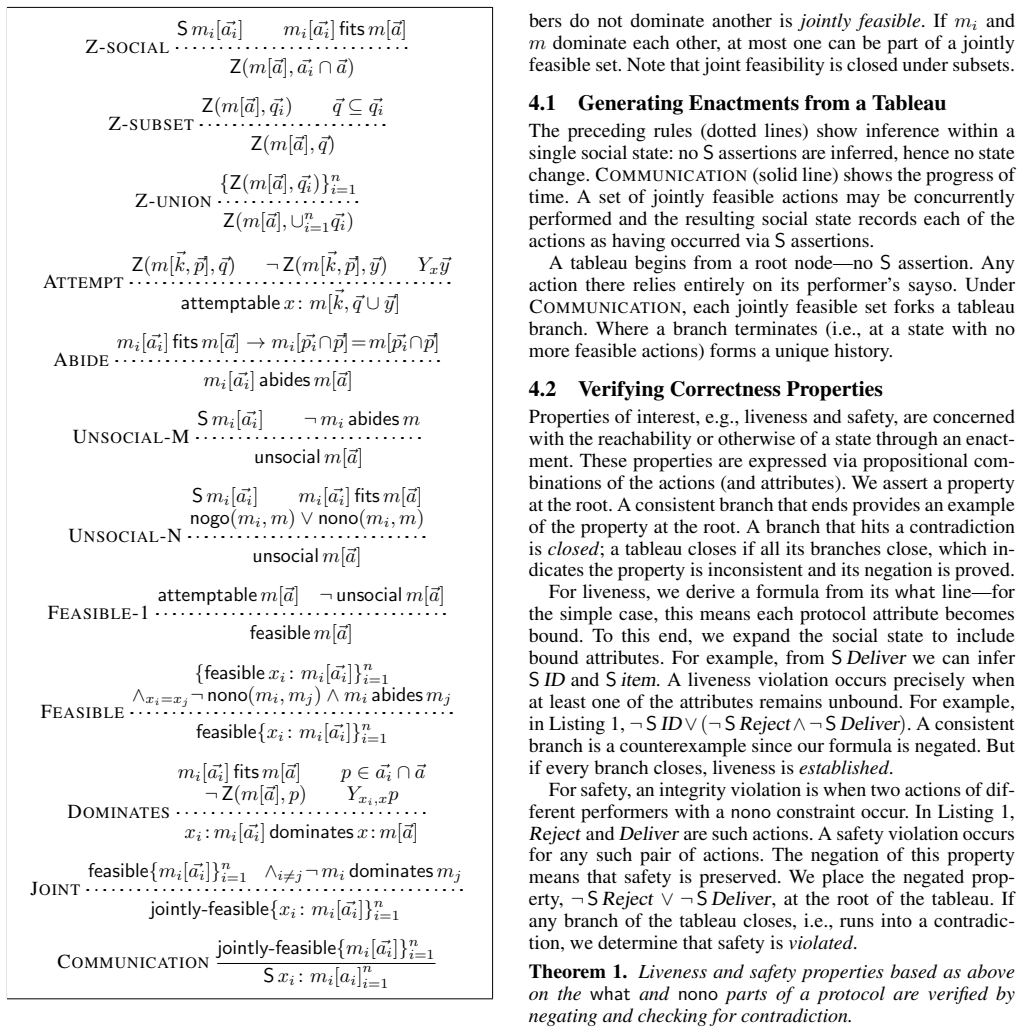
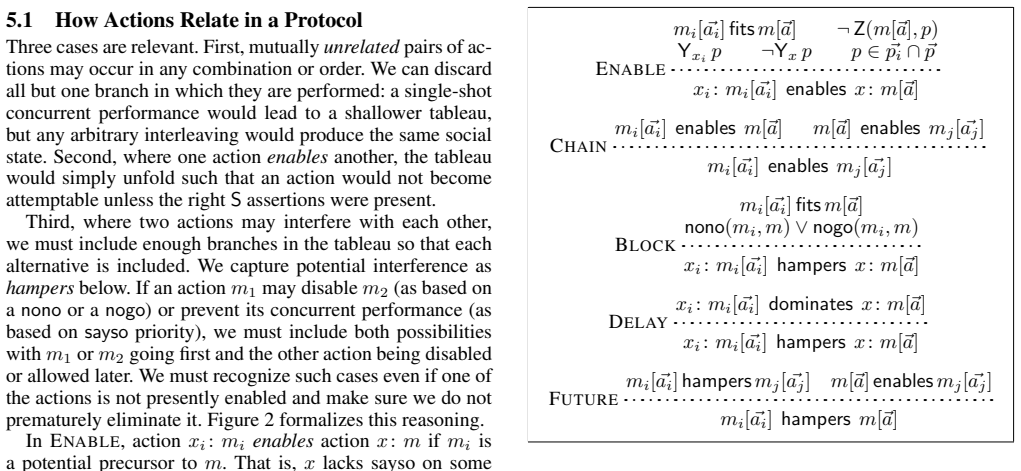
Langshaw is a declarative protocol language based on sayso, a construct that captures who has priority over setting each attribute, and nono and nogo, two constructs to capture conflicts between actions. Langshaw combines flexibility with an information model to express meaning. We give a formal semantics for Langshaw, procedures for determining the safety and liveness of a protocol, and a method to generate a message-oriented protocol suitable for flexible asynchronous enactment.
What carries the argument
sayso for capturing priority over attribute setting, combined with nono and nogo for capturing conflicts between actions, plus an associated information model
If this is right
- Designers can specify protocols that permit flexible enactments without losing clarity of meaning.
- Safety and liveness of specified protocols can be verified through given procedures.
- A coordination-embedded message protocol can be generated from the declarative specification for asynchronous use.
Where Pith is reading between the lines
- The constructs might reduce ambiguity in protocol design for open systems compared to traditional approaches.
- Applying the generation method could lead to more reliable implementations in distributed agent platforms.
- Future work could explore automating the translation to other protocol formats.
Load-bearing premise
The sayso, nono, and nogo constructs, together with the information model, are sufficient to capture protocol meanings and conflicts without introducing new forms of over-constraint or ambiguity in practice.
What would settle it
An example protocol in which the Langshaw constructs fail to prevent over-constraint or produce ambiguous meanings during actual enactment.
Figures
read the original abstract
Current languages for specifying multiagent protocols either over-constrain protocol enactments or complicate capturing their meanings. We propose Langshaw, a declarative protocol language based on (1) sayso, a new construct that captures who has priority over setting each attribute, and (2) nono and nogo, two constructs to capture conflicts between actions. Langshaw combines flexibility with an information model to express meaning. We give a formal semantics for Langshaw, procedures for determining the safety and liveness of a protocol, and a method to generate a message-oriented protocol (embedding needed coordination) suitable for flexible asynchronous enactment.
Editorial analysis
A structured set of objections, weighed in public.
Referee Report
Summary. The paper introduces Langshaw, a declarative language for multiagent interaction protocols. It defines sayso to capture priority over setting attributes, along with nono and nogo constructs to express conflicts between actions. The language is paired with an information model for meaning, a formal semantics, decision procedures for protocol safety and liveness, and a generation method that produces a message-oriented protocol embedding the necessary coordination for flexible asynchronous enactment.
Significance. If the claimed formal semantics, safety/liveness procedures, and generation method are sound and the constructs prove sufficient in practice, Langshaw would address a recognized gap between overly rigid protocol languages and those that lose semantic clarity. The combination of declarative conflict handling with automated analysis and asynchronous protocol synthesis could be useful for multiagent systems design.
minor comments (1)
- The abstract asserts the existence of formal semantics and decision procedures, but the provided text does not include the actual definitions, theorems, or examples needed to verify that the sayso/nono/nogo constructs support the safety and liveness claims without introducing ambiguity.
Simulated Author's Rebuttal
We thank the referee for the positive summary of Langshaw and for recognizing its potential to bridge rigid and semantically unclear protocol languages. No major comments were listed in the report, so we have no specific points to address point-by-point. We remain available to provide additional details on the formal semantics, safety/liveness procedures, or generation method if requested.
Circularity Check
No circularity in derivation chain
full rationale
The paper introduces new constructs (sayso, nono, nogo) with an information model, then supplies independent formal semantics, safety/liveness decision procedures, and a generation method for asynchronous protocols. No self-definitional equations, fitted inputs renamed as predictions, or load-bearing self-citations appear in the abstract or description; the claims rest on the novel definitions rather than reducing to prior inputs by construction. The derivation is self-contained against external benchmarks.
Axiom & Free-Parameter Ledger
Reference graph
Works this paper leans on
-
[1]
John L. Austin. How to Do Things with Words . Clarendon Press, Oxford, 1962
1962
-
[2]
A priori conformance verification for guaranteeing interoperability in open environments
Matteo Baldoni, Cristina Baroglio, Alberto Martelli, and Viviana Patti. A priori conformance verification for guaranteeing interoperability in open environments. In Proceedings of the 4th International Conference on Service-Oriented Computing (ICSOC) , LNCS, pages 339--351. Springer, December 2006
2006
-
[3]
Engineering commitment-based business protocols with the 2CL methodology
Matteo Baldoni, Cristina Baroglio, Elisa Marengo, Viviana Patti, and Federico Capuzzimati. Engineering commitment-based business protocols with the 2CL methodology. Journal of Autonomous Agents and Multi-Agent Systems (JAAMAS) , 28(4):519--557, July 2014
2014
-
[4]
Accountability in multi-agent organizations: From conceptual design to agent programming
Matteo Baldoni, Cristina Baroglio, Roberto Micalizio, and Stefano Tedeschi. Accountability in multi-agent organizations: From conceptual design to agent programming. Journal of Autonomous Agents and Multi-Agent Systems (JAAMAS) , 37(1):7, June 2023
2023
-
[5]
Developing Multi-Agent Systems with JADE
Fabio Bellifemine, Giovanni Caire, and Dominic Greenwood. Developing Multi-Agent Systems with JADE . Wiley, Chichester, UK, 2007
2007
-
[6]
The first twenty years of agent-based software development with JADE
Federico Bergenti, Giovanni Caire, Stefania Monica, and Agostino Poggi. The first twenty years of agent-based software development with JADE . Journal of Autonomous Agents and Multi-Agent Systems (JAAMAS) , 34(2):36, 2020
2020
-
[7]
Bordini, Jomi Fred H \" u bner, Alessandro Ricci, and Andrea Santi
Olivier Boissier, Rafael H. Bordini, Jomi Fred H \" u bner, Alessandro Ricci, and Andrea Santi. Multi-agent oriented programming with JaCaMo . Science of Computer Programming , 78(6):747--761, June 2013
2013
-
[8]
Agents on the Web ( Dagstuhl seminar 23081)
Olivier Boissier, Andrei Ciortea, Andreas Harth, Alessandro Ricci, and Danai Vachtsevanou. Agents on the Web ( Dagstuhl seminar 23081). Dagstuhl Reports , 13(2):71--162, 2023
2023
-
[9]
New methods to color vertices of a graph
Daniel Br \'e laz. New methods to color vertices of a graph. Communications of the ACM (CACM) , 22(4):251--256, April 1979
1979
-
[10]
Linda in context
Nicholas Carriero and David Gelernter. Linda in context. Communications of the ACM (CACM) , 32(4):444--458, April 1989
1989
-
[11]
Experiencing AUML in the GAIA methodology
Luca Cernuzzi and Franco Zambonelli. Experiencing AUML in the GAIA methodology. In Proceedings of the 6th International Conference on Enterprise Information Systems (ICEIS) , pages 283--288, Porto, Portugal, April 2004. Science and Technology Publications, Lda
2004
-
[12]
Chopra and Munindar P
Amit K. Chopra and Munindar P. Singh. Custard: Computing norm states over information stores. In Proceedings of the 15th International Conference on Autonomous Agents and MultiAgent Systems (AAMAS) , pages 1096--1105, Singapore, May 2016. IFAAMAS
2016
-
[13]
Christie V , Amit K
Samuel H. Christie V , Amit K. Chopra, and Munindar P. Singh. Hercule: Representing and reasoning about norms as a foundation for declarative contracts over blockchain. IEEE Internet Computing (IC) , 25(4):67--75, July 2021
2021
-
[14]
Christie V , Munindar P
Samuel H. Christie V , Munindar P. Singh, and Amit K. Chopra. Kiko: Programming agents to enact interaction protocols. In Proceedings of the 22nd International Conference on Autonomous Agents and MultiAgent Systems (AAMAS) , pages 1154--1163, London, May 2023. IFAAMAS
2023
-
[15]
Mallya, Amit K
Nirmit Desai, Ashok U. Mallya, Amit K. Chopra, and Munindar P. Singh. OWL-P : A methodology for business process modeling and enactment. In Proceedings of the AAMAS Workshop on Agent Oriented Information Systems (AOIS) , Utrecht, The Netherlands, July 2005
2005
-
[16]
Decentralizing MAS monitoring with DecAMon
Angelo Ferrando, Davide Ancona, and Viviana Mascardi. Decentralizing MAS monitoring with DecAMon . In Proceedings of the 16th International Conference on Autonomous Agents and MultiAgent Systems (AAMAS) , pages 239--248, S\ a o Paulo, May 2017. IFAAMAS
2017
-
[17]
On enactability of agent interaction protocols: Towards a unified approach
Angelo Ferrando, Michael Winikoff, Stephen Cranefield, Frank Dignum, and Viviana Mascardi. On enactability of agent interaction protocols: Towards a unified approach. In Proceedings of the 7th International Workshop on Engineering Multi-Agent Systems (EMAS) , volume 12058 of Lecture Notes in Computer Science , pages 43--64, Montr \'e al, May 2019. Springer
2019
-
[18]
Introduction
Melvin Fitting. Introduction. In Marcello D'Agostino, Dov M. Gabbay, Reiner H \"a hnle, and Joachim Posegga, editors, Handbook of Tableau Methods , chapter 1, pages 1--43. Kluwer, 1999
1999
-
[19]
Mallya and Munindar P
Ashok U. Mallya and Munindar P. Singh. An algebra for commitment protocols. Journal of Autonomous Agents and Multi-Agent Systems (JAAMAS) , 14(2):143--163, April 2007
2007
-
[20]
Asynchronous distributed termination---parallel and symmetric solutions with echo algorithms
Friedemann Mattern. Asynchronous distributed termination---parallel and symmetric solutions with echo algorithms. Algorithmica , 5(3):325--340, June 1990
1990
-
[21]
Reijers, Stefanie Rinderle-Ma, Andreas Solti, Michael Rosemann, Stefan Schulte, Munindar P
Jan Mendling, Ingo Weber, Wil van der Aalst, Jan vom Brocke, Cristina Cabanillas, Florian Daniel, S ren Debois, Claudio Di Ciccio, Marlon Dumas, Schahram Dustdar, Avigdor Gal, Luciano Garc \' i a-Ba \ n uelos, Guido Governatori, Richard Hull, Marcello La Rosa, Henrik Leopold, Frank Leymann, Jan Recker, Manfred Reichert, Hajo A. Reijers, Stefanie Rinderle-...
2018
-
[22]
Prometheus: A practical agent-oriented methodology
Lin Padgham and Michael Winikoff. Prometheus: A practical agent-oriented methodology. In Brian Henderson-Sellers and Paolo Giorgini, editors, Agent-Oriented Methodologies , chapter 5, pages 107--135. Idea Group, Hershey, Pennsylvania, 2005
2005
-
[23]
Specifying protocols for multi-agent systems interaction
Stefan Poslad. Specifying protocols for multi-agent systems interaction. ACM Transactions on Autonomous and Adaptive Systems (TAAS) , 2(4):15:1--15:24, 2007
2007
-
[24]
Environment programming in CArtAgO
Alessandro Ricci, Michele Piunti, Mirko Viroli, and Andrea Omicini. Environment programming in CArtAgO . In Rafael H. Bordini, Mehdi Dastani, J \" u rgen Dix, and Amal El Fallah Seghrouchni, editors, Multi-Agent Programming, Languages, Tools and Applications , chapter 8, pages 259--288. Springer, Dordrecht, Netherlands, 2009
2009
-
[25]
Bordini, and Jomi Fred H \" u bner
Alessandro Ricci, Andrei Ciortea, Simon Mayer, Olivier Boissier, Rafael H. Bordini, and Jomi Fred H \" u bner. Engineering scalable distributed environments and organizations for MAS . In Proceedings of the 18th International Conference on Autonomous Agents and MultiAgent Systems (AAMAS) , pages 790--798, Montr \'e al, May 2019. IFAAMAS
2019
-
[26]
Collier, and Gregory M
Colm Rooney, Rem W. Collier, and Gregory M. P. O'Hare. VIPER : A visual protocol editor. In Proceedings of the 6th International Conference on Coordination Models and Languages COORDINATION , volume 2949 of Lecture Notes in Computer Science , pages 279--293, Pisa, February 2004. Springer
2004
-
[27]
David Sadek, Philippe Bretier, and Franck Panaget
M. David Sadek, Philippe Bretier, and Franck Panaget. ARTIMIS : Natural dialogue meets rational agency. In Proceedings of the 15th International Joint Conference on Artificial Intelligence (IJCAI) , pages 1030--1035, Nagoya, Japan, August 1997. Morgan Kaufmann
1997
-
[28]
Singh and Amit K
Munindar P. Singh and Amit K. Chopra. Clouseau: Generating communication protocols from commitments. In Proceedings of the 34th Conference on Artificial Intelligence (AAAI) , pages 7244--7252, New York, February 2020. AAAI Press
2020
-
[29]
Singh and Samuel H
Munindar P. Singh and Samuel H. Christie V . Tango: Declarative semantics for multiagent communication protocols. In Proceedings of the 30th International Joint Conference on Artificial Intelligence (IJCAI) , pages 391--397, Online, August 2021. IJCAI
2021
-
[30]
Munindar P. Singh. Synthesizing distributed constrained events from transactional workflow specifications. In Proceedings of the 12th International Conference on Data Engineering (ICDE) , pages 616--623, New Orleans, February 1996. IEEE
1996
-
[31]
Munindar P. Singh. Write asynchronous, run synchronous. IEEE Internet Computing (IC) , 3(2):4--5, March 1999. Instance of the column Being Interactive
1999
-
[32]
Munindar P. Singh. A social semantics for agent communication languages. In Proceedings of the 1999 IJCAI Workshop on Agent Communication Languages , number 1916 in Lecture Notes in Artificial Intelligence, pages 31--45, Berlin, 2000. Springer
1999
-
[33]
Munindar P. Singh. Information-driven interaction-oriented programming: BSPL , the Blindingly Simple Protocol Language . In Proceedings of the 10th International Conference on Autonomous Agents and MultiAgent Systems (AAMAS) , pages 491--498, Taipei, May 2011. IFAAMAS
2011
-
[34]
Munindar P. Singh. LoST : Local State Transfer --- An architectural style for the distributed enactment of business protocols. In Proceedings of the 9th IEEE International Conference on Web Services (ICWS) , pages 57--64, Washington, DC, July 2011. IEEE Computer Society
2011
-
[35]
Munindar P. Singh. Semantics and verification of information-based protocols. In Proceedings of the 11th International Conference on Autonomous Agents and MultiAgent Systems (AAMAS) , pages 1149--1156, Valencia, Spain, June 2012. IFAAMAS
2012
-
[36]
Signifiers as a first-class abstraction in hypermedia multi-agent systems
Danai Vachtsevanou, Andrei Ciortea, Simon Mayer, and J \' e r \' e my Lem \' e e. Signifiers as a first-class abstraction in hypermedia multi-agent systems. In Proceedings of the 22nd International Conference on Autonomous Agents and MultiAgent Systems (AAMAS) , pages 1200--1208, London, May 2023. IFAAMAS
2023
-
[37]
Moreira, Michael J
Renata Vieira, \' A lvaro F. Moreira, Michael J. Wooldridge, and Rafael H. Bordini. On the formal semantics of speech-act based communication in an agent-oriented programming language. Journal of Artificial Intelligence Research (JAIR) , 29:221--267, June 2007
2007
-
[38]
A formal model for situated multi-agent systems
Danny Weyns and Tom Holvoet. A formal model for situated multi-agent systems. Fundamenta Informaticae , 63(2-3):125--158, 2004
2004
-
[39]
Environment as a first class abstraction in multiagent systems
Danny Weyns, Andrea Omicini, and James Odell. Environment as a first class abstraction in multiagent systems. Journal of Autonomous Agents and Multi-Agent Systems (JAAMAS) , 14(1):5--30, February 2007
2007
-
[40]
A new Hierarchical Agent Protocol Notation
Michael Winikoff, Nitin Yadav, and Lin Padgham. A new Hierarchical Agent Protocol Notation . Journal of Autonomous Agents and Multi-Agent Systems (JAAMAS) , 32(1):59--133, January 2018
2018
-
[41]
Implementing commitment-based interactions
Michael Winikoff. Implementing commitment-based interactions. In Proceedings of the 6th International Joint Conference on Autonomous Agents and MultiAgent Systems (AAMAS) , pages 868--875, Honolulu, May 2007. IFAAMAS
2007
discussion (0)
Sign in with ORCID, Apple, or X to comment. Anyone can read and Pith papers without signing in.