Room for Error: Large-Scale Simulation of Over-the-Air Acoustic Attacks
Pith reviewed 2026-06-29 03:43 UTC · model grok-4.3
The pith
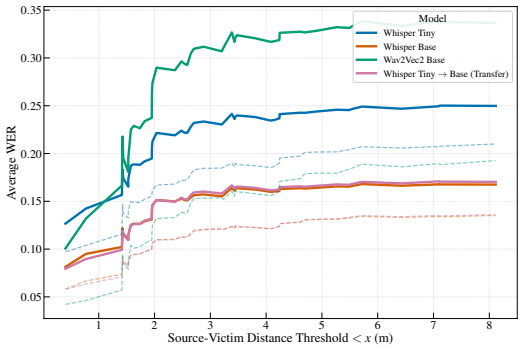
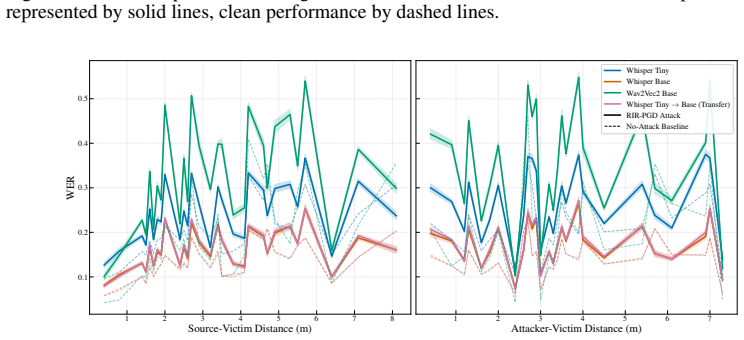
Incorporating acoustic geometry and factors into simulations increases measured word error rates from attacks on speech models by up to 94.5%.
A machine-rendered reading of the paper's core claim, the machinery that carries it, and where it could break.
Core claim
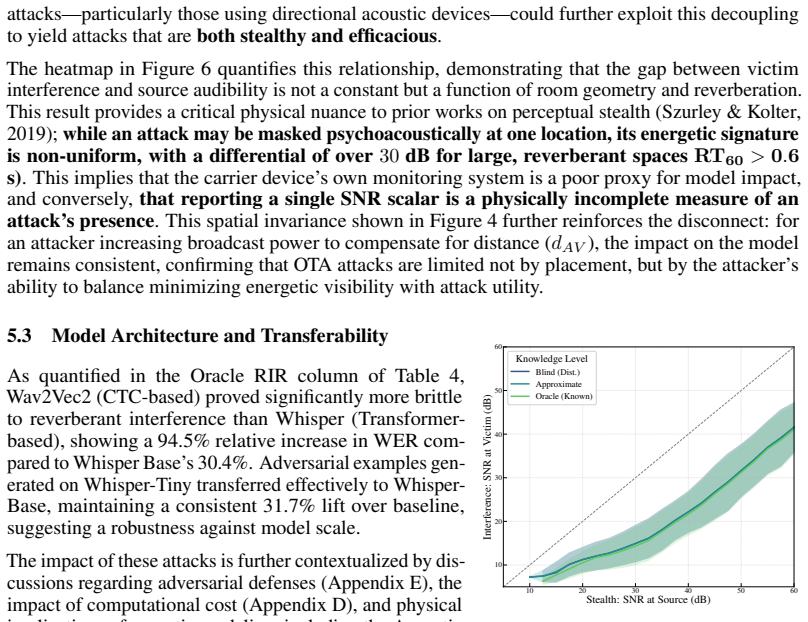
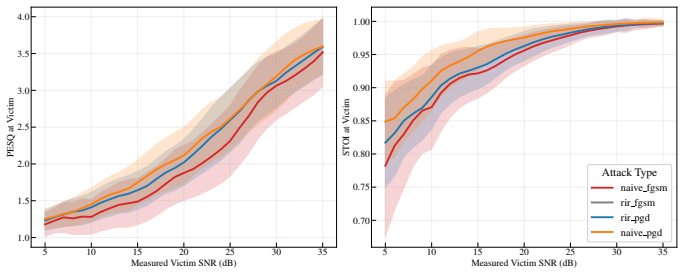
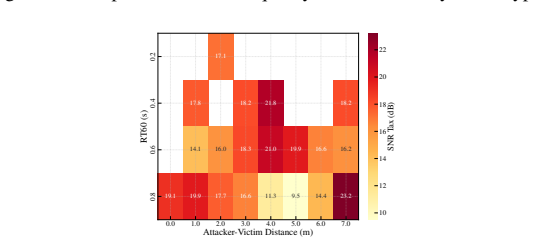
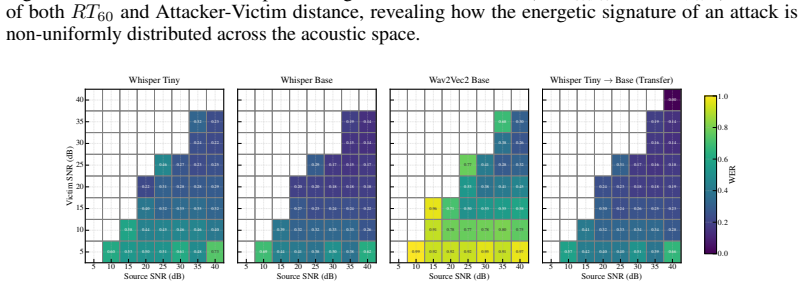
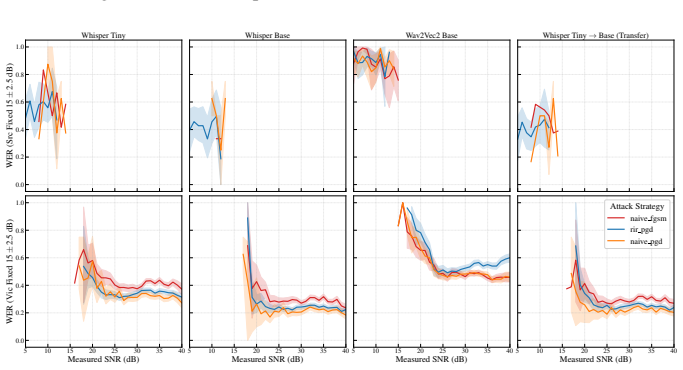
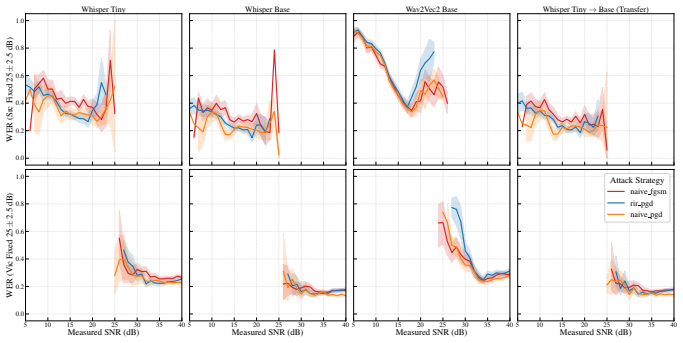
By testing over 8 million adversarial evaluations with a novel high-throughput reality simulation framework, the paper shows that acoustic awareness yields relative Word Error Rate increases of up to 94.5% under Whisper and wav2vec. The framework models geometry and other acoustic factors on detectability and efficacy. It further introduces and operationalizes a Dual-Form Signal to Noise Ratio to decouple source stealth from victim attack efficacy, addressing a key limitation in prior work and enabling repeatable research that includes rather than abstracts the acoustic environment.
What carries the argument
The high-throughput reality simulation framework that models geometry and acoustic factors on detectability and attack efficacy, together with the Dual-Form Signal to Noise Ratio that separates stealth from efficacy.
If this is right
- Acoustic awareness in attack generation produces substantially larger word error rate increases on models such as Whisper and wav2vec.
- The Dual-Form Signal to Noise Ratio allows separate measurement of source stealth and attack effectiveness.
- Over 8 million evaluations become feasible, enabling systematic exploration of physical acoustic attacks.
- Current abstractions that ignore the acoustic environment underestimate attack impact and limit risk assessment.
- The approach supports repeatable, verifiable studies that treat the acoustic environment as central rather than optional.
Where Pith is reading between the lines
- If the modeled acoustic effects prove reliable, purely digital attack benchmarks will need systematic physical correction factors.
- Voice system designers could run the framework in reverse to identify input conditions that reduce vulnerability to acoustically aware attacks.
- The same simulation method might be applied to other audio tasks such as speaker verification or environmental sound classification to check for similar underestimation.
- Security standards for voice interfaces could require acoustic-aware testing as a baseline rather than an optional extension.
Load-bearing premise
The simulation framework accurately captures how geometry and other acoustic factors affect both detectability and attack success.
What would settle it
Running the same adversarial examples in actual over-the-air physical tests and checking whether the simulated word error rate increases of up to 94.5% match the measured real-world increases.
Figures

read the original abstract
While voice control is rapidly becoming a ubiquitous vector of human-AI communication, the risks facing these systems remain poorly understood. This is, in part, a product of the difficulties in scaling strictly digital adversarial workflows to the physical world. These scale barriers have led the community to abstract away key acoustic factors relating to detectability and the influence of geometry on acoustics. These methodological and metrological shortcomings undermine our understanding of risk. We illuminate these issues through real-world testing, conceptual discussions, and a novel, high-throughput reality simulation framework. By testing over 8 million adversarial evaluations, we demonstrate that acoustic awareness yields relative Word Error Rate increases of up to 94.5\% under Whisper and wav2vec. We employ this framework to explore a formalize and operationalize a Dual-Form Signal to Noise Ratio to decouple source stealth from victim attack efficacy, resolving a crucial limitation in current works. This lays the groundwork for repeatable, verifiable research that embraces, rather than abstracts, the acoustic environment.
Editorial analysis
A structured set of objections, weighed in public.
Referee Report
Summary. The paper introduces a high-throughput reality simulation framework for over-the-air acoustic attacks on ASR systems. It reports results from over 8 million adversarial evaluations demonstrating that acoustic awareness (including room geometry and propagation effects) produces relative Word Error Rate increases of up to 94.5% on Whisper and wav2vec. The work also defines and operationalizes a Dual-Form SNR metric to separate source stealth from victim attack efficacy, supported by real-world testing and conceptual analysis.
Significance. If the simulator's fidelity to physical acoustics is established, the scale of the evaluation campaign and the Dual-Form SNR construction would provide a valuable, repeatable methodology for studying physical adversarial audio attacks beyond purely digital abstractions. The explicit handling of geometry and detectability addresses a recognized gap in the literature.
major comments (2)
- [Abstract / Simulation Framework description] The central claims (94.5% relative WER increase from 8M evaluations and the utility of Dual-Form SNR) rest on the unvalidated assertion that the simulation framework accurately reproduces the influence of room geometry, reflections, and propagation on attack efficacy and detectability. No quantitative validation (e.g., simulated vs. measured impulse responses, WER correlation with physical recordings, or error bounds) is reported in the abstract or visible text.
- [Abstract] The abstract states that results derive from 'real-world testing' in addition to simulation, yet no section supplies the corresponding validation metrics or direct comparison between simulated and physical microphone data that would ground the large-scale numbers.
minor comments (1)
- [Abstract] Clarify the exact definition and derivation of Dual-Form SNR; the abstract presents it as resolving a limitation but does not show the construction.
Simulated Author's Rebuttal
We thank the referee for highlighting the need for explicit quantitative validation of the simulation framework. We agree that the current presentation does not sufficiently ground the large-scale results and will revise the manuscript accordingly.
read point-by-point responses
-
Referee: [Abstract / Simulation Framework description] The central claims (94.5% relative WER increase from 8M evaluations and the utility of Dual-Form SNR) rest on the unvalidated assertion that the simulation framework accurately reproduces the influence of room geometry, reflections, and propagation on attack efficacy and detectability. No quantitative validation (e.g., simulated vs. measured impulse responses, WER correlation with physical recordings, or error bounds) is reported in the abstract or visible text.
Authors: We acknowledge that no quantitative validation metrics appear in the abstract or the sections describing the framework. The manuscript relies on standard acoustic propagation models without reporting direct comparisons to physical measurements. We will add a dedicated validation subsection that includes simulated versus measured impulse responses, WER correlations from paired physical recordings, and error bounds on attack efficacy. These additions will be referenced from the abstract. revision: yes
-
Referee: [Abstract] The abstract states that results derive from 'real-world testing' in addition to simulation, yet no section supplies the corresponding validation metrics or direct comparison between simulated and physical microphone data that would ground the large-scale numbers.
Authors: The phrase 'real-world testing' in the abstract refers to limited empirical checks that informed model parameters, but we agree these are not accompanied by the quantitative metrics or direct simulated-versus-physical comparisons needed to support the scale of the evaluation campaign. We will revise the abstract for precision and insert the quantitative validation results described above to provide the required grounding. revision: yes
Circularity Check
No circularity detected in derivation chain
full rationale
The abstract and visible text introduce a simulation framework and Dual-Form SNR as novel tools without any quoted equations, self-citations, or derivations that reduce by construction to fitted inputs or prior self-referential claims. The 8M evaluations and 94.5% WER result are presented as outputs of the framework rather than tautological re-statements of its parameters. No load-bearing uniqueness theorems or ansatzes smuggled via citation appear. This is the common case of a self-contained empirical simulation study.
discussion (0)
Sign in with ORCID, Apple, or X to comment. Anyone can read and Pith papers without signing in.