CHEM: Estimating and Understanding Hallucinations in Deep Learning for Image Processing
Pith reviewed 2026-05-21 17:34 UTC · model grok-4.3
The pith
CHEM identifies hallucination-prone regions in deep learning image reconstructions using wavelet and shearlet features plus conformal quantile regression.
A machine-rendered reading of the paper's core claim, the machinery that carries it, and where it could break.
Core claim
The paper establishes that the Conformal Hallucination Estimation Metric (CHEM) localizes hallucination-prone regions at the level of image features by means of wavelet and shearlet representations and assesses hallucination levels via conformalized quantile regression in a distribution-free manner. A theoretical analysis characterizes CHEM's sensitivity to hallucinated artifacts and its connection to mean squared error. Adopting an approximation-theory viewpoint, the work explains why U-shaped networks are prone to hallucination-prone predictions.
What carries the argument
The Conformal Hallucination Estimation Metric (CHEM), which combines wavelet and shearlet representations for feature localization with conformalized quantile regression for distribution-free hallucination assessment.
If this is right
- CHEM can highlight specific regions within a model's output image that are most likely to contain hallucinations.
- The method supplies a distribution-free score for comparing hallucination tendencies across different reconstruction architectures.
- Approximation theory analysis indicates that U-shaped networks inherently favor predictions containing hallucinations in reconstruction settings.
- The framework applies to both astronomical image deconvolution on datasets such as CANDELS and natural-image super-resolution on datasets such as DIV2K.
Where Pith is reading between the lines
- CHEM could be inserted into training loops to penalize hallucination-prone regions and encourage more reliable architectures.
- The same wavelet-shearlet plus conformal pipeline might transfer to other inverse imaging problems such as denoising or inpainting.
- Linking CHEM scores to downstream task performance could yield practical uncertainty maps for scientific image analysis pipelines.
Load-bearing premise
Hallucinated artifacts remain distinguishable from true signal features once projected into wavelet and shearlet bases, allowing conformal quantile regression to isolate them without being confounded by model biases or dataset artifacts.
What would settle it
In experiments on images with synthetically inserted known hallucinations, CHEM fails to assign high scores to the modified regions or its scores do not correlate with the size of the introduced artifacts.
Figures






read the original abstract
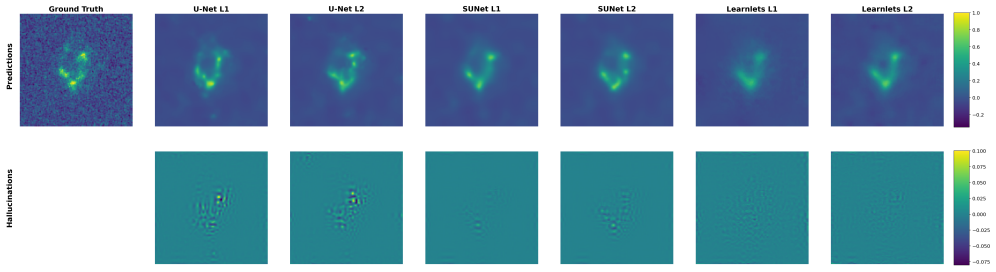
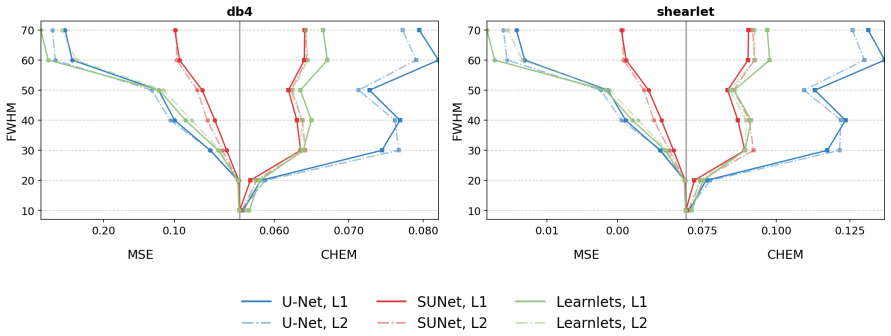
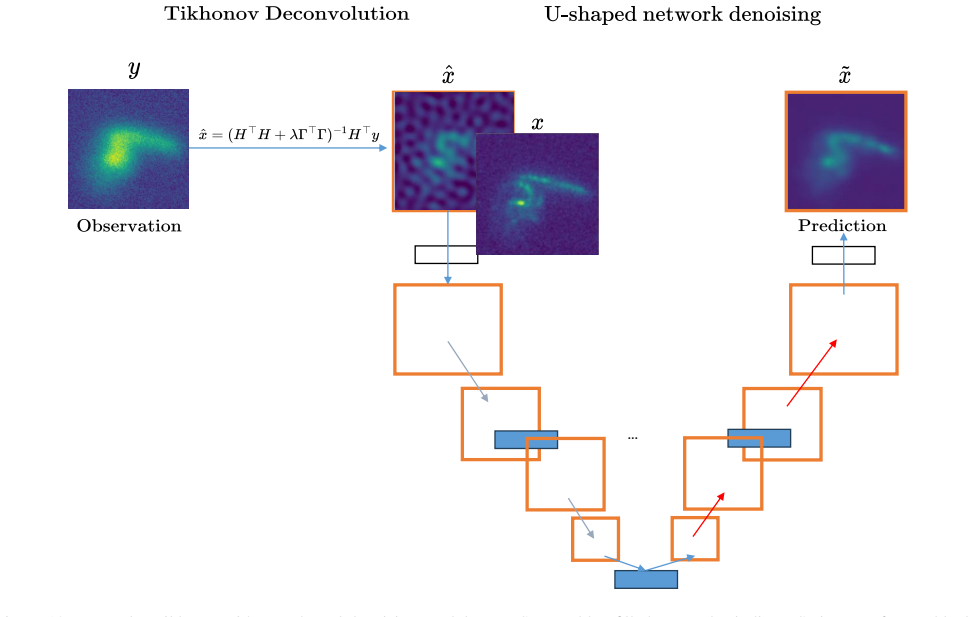
Deep learning-based methods have recently achieved significant success in image reconstruction problems. However, challenges have emerged, as these methods may generate unrealistic artifacts or hallucinations, which can interfere with analysis in safety-critical scenarios. This paper introduces a framework for quantifying and characterizing hallucinated artifacts in image reconstruction models. The proposed method, termed the Conformal Hallucination Estimation Metric (CHEM), enables the identification of hallucination-prone regions in model predictions. It leverages wavelet and shearlet representations to localize such regions at the level of image features, and uses conformalized quantile regression to assess hallucination levels in a distribution-free manner. A theoretical analysis is provided, characterizing the sensitivity of CHEM to hallucinated artifacts and its relationship to the mean squared error. Building on these insights and adopting a viewpoint grounded in approximation theory, we investigate why U-shaped networks, widely used architectures for image reconstruction, tend to hallucination-prone predictions. We assess the effectiveness of the proposed approach on astronomical image deconvolution using the CANDELS dataset with architectures such as U-Net, SwinUNet, and Learnlets, and on natural image super-resolution using the DIV2K dataset with models such as DRUNet, Unfolded DRS, RAM, and DPS.
Editorial analysis
A structured set of objections, weighed in public.
Referee Report
Summary. The paper introduces the Conformal Hallucination Estimation Metric (CHEM) for quantifying and localizing hallucinations in deep learning models for image reconstruction. CHEM combines wavelet and shearlet representations to identify hallucination-prone regions at the feature level with conformalized quantile regression to provide distribution-free hallucination level assessment. It includes a theoretical analysis characterizing CHEM's sensitivity to hallucinations and its relation to mean squared error, plus an approximation-theory explanation for why U-shaped networks tend to produce hallucination-prone outputs. The approach is evaluated on astronomical image deconvolution using the CANDELS dataset with U-Net, SwinUNet, and Learnlets, and on natural image super-resolution using DIV2K with DRUNet, Unfolded DRS, RAM, and DPS.
Significance. If the central claims hold, CHEM offers a principled, distribution-free tool for detecting and understanding hallucinations in image processing models, which is valuable for safety-critical domains such as astronomy. The combination of standard multiscale bases with conformal quantile regression provides a concrete way to localize issues without strong parametric assumptions, and the theoretical links to MSE and approximation theory supply useful insight into architectural tendencies. The dual-domain evaluation (astronomical and natural images) strengthens the empirical grounding.
major comments (3)
- [Theoretical analysis] The abstract states a theoretical analysis relating CHEM to mean squared error and an approximation-theory explanation for U-Net hallucinations, but without the full derivations or explicit error bounds it is impossible to verify whether the central claims hold.
- [Method and sensitivity analysis] The central claim requires that hallucinated artifacts produce reliably separable signatures in wavelet and shearlet coefficients so that conformal quantile regression can isolate them; the sensitivity analysis links CHEM to MSE but does not derive or empirically test a separation margin against ground-truth artifacts.
- [Experiments] Post-hoc dataset choices on CANDELS appear in the experimental setup; this undermines the cross-dataset robustness claim for hallucination identification.
minor comments (2)
- [§3] Clarify the precise definition of the conformal quantile regression thresholds and how they are computed from the calibration set.
- [Discussion] Add a short discussion of computational overhead for the wavelet/shearlet transforms and conformal step relative to baseline inference.
Simulated Author's Rebuttal
We thank the referee for their constructive and detailed feedback on our manuscript. We address each major comment below, providing clarifications and indicating planned revisions where appropriate to strengthen the presentation of our results.
read point-by-point responses
-
Referee: [Theoretical analysis] The abstract states a theoretical analysis relating CHEM to mean squared error and an approximation-theory explanation for U-Net hallucinations, but without the full derivations or explicit error bounds it is impossible to verify whether the central claims hold.
Authors: We thank the referee for highlighting this point. The relation between CHEM and MSE is derived in Section 4 using the properties of conformal quantile regression applied to the multiscale coefficients, and the approximation-theory argument for U-shaped networks is developed from the perspective of how such architectures approximate high-frequency components. To make verification straightforward, we will insert the key derivation steps and explicit error bounds into the main text of the revised manuscript (with full proofs remaining in the appendix). revision: yes
-
Referee: [Method and sensitivity analysis] The central claim requires that hallucinated artifacts produce reliably separable signatures in wavelet and shearlet coefficients so that conformal quantile regression can isolate them; the sensitivity analysis links CHEM to MSE but does not derive or empirically test a separation margin against ground-truth artifacts.
Authors: The referee correctly notes that separability in the coefficient domain is central to the method. The existing sensitivity analysis shows how CHEM increases under perturbations that mimic hallucinations and connects this increase to MSE. We will strengthen the revision by adding both a theoretical derivation of a separation margin in the wavelet/shearlet domain and an empirical evaluation on synthetic ground-truth artifacts with controlled hallucination locations. revision: yes
-
Referee: [Experiments] Post-hoc dataset choices on CANDELS appear in the experimental setup; this undermines the cross-dataset robustness claim for hallucination identification.
Authors: We respectfully disagree with the characterization of post-hoc selection. The CANDELS dataset was selected a priori as a standard benchmark for astronomical deconvolution tasks, with the full experimental protocol (including model architectures, training procedures, and evaluation metrics) fixed before any results were obtained. The dual evaluation on CANDELS and DIV2K was designed from the outset to demonstrate applicability across domains. To improve clarity, we will expand the experimental section with an explicit statement of the pre-specified dataset rationale and protocol. revision: partial
Circularity Check
No significant circularity in CHEM derivation chain
full rationale
The paper defines CHEM by combining standard wavelet and shearlet bases for feature localization with conformalized quantile regression for distribution-free hallucination assessment. The theoretical sensitivity analysis relates CHEM to MSE as a characterization rather than deriving the metric itself from fitted parameters or self-referential inputs. Empirical evaluations on CANDELS and DIV2K datasets with multiple architectures provide external validation. No load-bearing steps reduce predictions to inputs by construction, and no self-citation chains or ansatzes are invoked to force uniqueness. The derivation remains self-contained against the stated benchmarks.
Axiom & Free-Parameter Ledger
axioms (2)
- domain assumption Hallucinated artifacts are sufficiently localized and distinguishable in wavelet and shearlet representations.
- standard math Conformalized quantile regression yields valid coverage for hallucination scores without distributional assumptions.
Forward citations
Cited by 1 Pith paper
-
On Hallucinations in Inverse Problems: Fundamental Limits and Provable Assessment Methods
Hallucinations in inverse problem reconstructions are fundamental to ill-posedness, with necessary and sufficient conditions plus computable bounds depending only on the forward model.
Reference graph
Works this paper leans on
-
[1]
Deep learning-based galaxy image deconvolution.Frontiers in Astronomy and Space Sciences, 9, 2022
Utsav Akhaury, Jean-Luc Starck, Pascale Jablonka, Fr ´ed´eric Courbin, and Kevin Michalewicz. Deep learning-based galaxy image deconvolution.Frontiers in Astronomy and Space Sciences, 9, 2022. Publisher: Frontiers
work page 2022
-
[2]
U. Akhaury, P. Jablonka, J.-L. Starck, and F. Courbin. Ground-based image deconvolution with Swin Transformer UNet.Astronomy & Astrophysics, 688:A6, 2024
work page 2024
-
[3]
Anastasios N Angelopoulos, Amit Pal Kohli, Stephen Bates, Michael Jordan, Jitendra Malik, Thayer Alshaabi, Srigokul Upadhyayula, and Yaniv Romano. Image-to-image regres- sion with distribution-free uncertainty quantification and ap- plications in imaging. InInternational Conference on Ma- chine Learning, pages 717–730. PMLR, 2022
work page 2022
-
[4]
Harrison H Barrett and Kyle J Myers.Foundations of Image Science. John Wiley & Sons, 2013
work page 2013
-
[5]
Peter L Bartlett, Nick Harvey, Christopher Liaw, and Abbas Mehrabian. Nearly-tight VC-dimension and pseudodimen- sion bounds for piecewise linear neural networks.Journal of Machine Learning Research, 20(63):1–17, 2019
work page 2019
-
[6]
Omer Belhasin, Yaniv Romano, Daniel Freedman, Ehud Rivlin, and Michael Elad. Principal Uncertainty Quantifi- cation with Spatial Correlation for Image Restoration Prob- lems, 2024. arXiv:2305.10124 [cs]
-
[7]
Chinmay Belthangady and Loic A. Royer. Applications, promises, and pitfalls of deep learning for fluorescence im- age reconstruction.Nature Methods, 16(12):1215–1225, 2019
work page 2019
-
[8]
Sayantan Bhadra, Varun A. Kelkar, Frank J. Brooks, and Mark A. Anastasio. On hallucinations in tomographic im- age reconstruction.IEEE Transactions on Medical Imaging, 40(11):3249–3260, 2021
work page 2021
-
[9]
Swin-Unet: Unet-like pure transformer for medical image segmentation
Hu Cao, Yueyue Wang, Joy Chen, Dongsheng Jiang, Xi- aopeng Zhang, Qi Tian, and Manning Wang. Swin-Unet: Unet-like pure transformer for medical image segmentation. InComputer Vision – ECCV 2022 Workshops, pages 205– 218, 2023
work page 2022
-
[10]
TransUNet: Transformers Make Strong Encoders for Medical Image Segmentation
Jieneng Chen, Yongyi Lu, Qihang Yu, Xiangde Luo, Ehsan Adeli, Yan Wang, Le Lu, Alan L. Yuille, and Yuyin Zhou. TransUNet: Transformers make strong encoders for medical image segmentation, 2021. arXiv:2102.04306 [cs]
work page internal anchor Pith review Pith/arXiv arXiv 2021
-
[11]
Encoder-decoder with atrous separable convolution for semantic image segmentation
Liang-Chieh Chen, Yukun Zhu, George Papandreou, Florian Schroff, and Hartwig Adam. Encoder-decoder with atrous separable convolution for semantic image segmentation. In Proceedings of the European conference on computer vision (ECCV), pages 801–818, 2018
work page 2018
-
[12]
Regev Cohen, Idan Kligvasser, Ehud Rivlin, and Daniel Freedman. Looks too good to be true: An information- theoretic analysis of hallucinations in generative restoration models.Advances in Neural Information Processing Sys- tems, 37:22596–22623, 2024
work page 2024
-
[13]
On the relationship between self-attention and convo- lutional layers
Jean Baptiste Cordonnier, Andreas Loukas, and Martin Jaggi. On the relationship between self-attention and convo- lutional layers. In8th International Conference on Learning Representations, ICLR 2020, 2020
work page 2020
-
[14]
Society for Industrial and Applied Mathematics, 1992
Ingrid Daubechies.Ten Lectures on Wavelets. Society for Industrial and Applied Mathematics, 1992
work page 1992
-
[15]
Philip J Davis.Interpolation and approximation. Courier Corporation, 1975
work page 1975
-
[16]
SUNet: Swin transformer UNet for image denoising
Chi-Mao Fan, Tsung-Jung Liu, and Kuan-Hsien Liu. SUNet: Swin transformer UNet for image denoising. In2022 IEEE International Symposium on Circuits and Systems (ISCAS), pages 2333–2337. IEEE, 2022
work page 2022
-
[17]
Gottschling, Vegard Antun, Anders C
Nina M. Gottschling, Vegard Antun, Anders C. Hansen, and Ben Adcock. The troublesome kernel: On hallucinations, no free lunches, and the accuracy-stability tradeoff in inverse problems.SIAM Review, 67(1):73–104, 2025. Publisher: Society for Industrial and Applied Mathematics. 9
work page 2025
-
[18]
Norman A. Grogin, Dale D. Kocevski, S. M. Faber, Henry C. Ferguson, Anton M. Koekemoer, Adam G. Riess, Viviana Acquaviva, David M. Alexander, Omar Almaini, Matthew L. N. Ashby, Marco Barden, Eric F. Bell, Fr ´ed´eric Bour- naud, Thomas M. Brown, Karina I. Caputi, Stefano Caser- tano, Paolo Cassata, Marco Castellano, Peter Challis, Ranga- Ram Chary, Edmond...
work page 2011
-
[19]
Ingo G ¨uhring, Gitta Kutyniok, and Philipp Petersen. Error bounds for approximations with deep relu neural networks inw s,p norms.Analysis and Applications, 18(05):803–859, 2020
work page 2020
-
[20]
Kanghui Guo, Gitta Kutyniok, and Demetrio Labate. Sparse multidimensional representations using anisotropic dilation and shear operators.Wavelets and Splines, 14:189–201, 2006
work page 2006
-
[21]
Iryna Gurevych, Michael Kohler, and G ¨ozde G¨ul S ¸ahin. On the rate of convergence of a classifier based on a transformer encoder.IEEE Transactions on Information Theory, 68(12): 8139–8155, 2022
work page 2022
-
[22]
Yoseob Han and Jong Chul Ye. Framing U-Net via deep con- volutional framelets: Application to sparse-view CT.IEEE Transactions on Medical Imaging, 37(6):1418–1429, 2018
work page 2018
-
[23]
Yunpeng Huang, Jingwei Xu, Junyu Lai, Zixu Jiang, Taolue Chen, Zenan Li, Yuan Yao, Xiaoxing Ma, Lijuan Yang, Hao Chen, Shupeng Li, and Penghao Zhao. Advancing trans- former architecture in long-context large language models: A comprehensive survey, 2024. arXiv:2311.12351 [cs]
-
[24]
Fabian Isensee, Paul F. Jaeger, Simon A. A. Kohl, Jens Petersen, and Klaus H. Maier-Hein. nnU-Net: a self- configuring method for deep learning-based biomedical im- age segmentation.Nature Methods, 18(2):203–211, 2021
work page 2021
-
[25]
Andrew Jesson, Nicolas Beltran-Velez, Quentin Chu, Sweta Karlekar, Jannik Kossen, Yarin Gal, John P Cunningham, and David Blei. Estimating the hallucination rate of genera- tive AI.Advances in Neural Information Processing Systems, 37:31154–31201, 2024
work page 2024
-
[26]
Survey of hallucination in natural language generation.ACM Computing Surveys, 55(12):1–38, 2023
Ziwei Ji, Nayeon Lee, Rita Frieske, Tiezheng Yu, Dan Su, Yan Xu, Etsuko Ishii, Ye Jin Bang, Andrea Madotto, and Pascale Fung. Survey of hallucination in natural language generation.ACM Computing Surveys, 55(12):1–38, 2023
work page 2023
-
[27]
Anton M. Koekemoer, S. M. Faber, Henry C. Ferguson, Nor- man A. Grogin, Dale D. Kocevski, David C. Koo, Kamson Lai, Jennifer M. Lotz, Ray A. Lucas, Elizabeth J. McGrath, Sara Ogaz, Abhijith Rajan, Adam G. Riess, Steve A. Rodney, Louis Strolger, Stefano Casertano, Marco Castellano, Tomas Dahlen, Mark Dickinson, Timothy Dolch, Adriano Fontana, Mauro Giavali...
work page internal anchor Pith review Pith/arXiv arXiv 2011
-
[28]
Explaining image classifiers with multiscale directional image representation
Stefan Kolek, Robert Windesheim, Hector Andrade-Loarca, Gitta Kutyniok, and Ron Levie. Explaining image classifiers with multiscale directional image representation. InPro- ceedings of the IEEE/CVF Conference on Computer Vision and Pattern Recognition, pages 18600–18609, 2023. 10
work page 2023
-
[29]
Rajeev Ranjan Kumar, S Vishnu Shankar, Ronit Jaiswal, Mrinmoy Ray, Neeraj Budhlakoti, and KN Singh. Advances in deep learning for medical image analysis: A comprehen- sive investigation.Journal of Statistical Theory and Practice, 19(1):9, 2025
work page 2025
-
[30]
Conformal prediction masks: Visualiz- ing uncertainty in medical imaging
Gilad Kutiel, Regev Cohen, Michael Elad, Daniel Freedman, and Ehud Rivlin. Conformal prediction masks: Visualiz- ing uncertainty in medical imaging. InTrustworthy Machine Learning for Healthcare, pages 163–176, 2023
work page 2023
-
[31]
Springer Science & Business Media, 2012
Gitta Kutyniok and Demetrio Labate.Shearlets: Multiscale analysis for multivariate data. Springer Science & Business Media, 2012
work page 2012
-
[32]
Gitta Kutyniok, Wang-Q Lim, and Rafael Reisenhofer. Shearlab 3D: Faithful digital shearlet transforms based on compactly supported shearlets.ACM Transactions on Math- ematical Software (TOMS), 42(1):1–42, 2016
work page 2016
-
[33]
Hubert Leterme, Jalal Fadili, and J-L Starck. Distribution- free uncertainty quantification for inverse problems: Appli- cation to weak lensing mass mapping.Astronomy & Astro- physics, 694:A267, 2025
work page 2025
-
[34]
Jianfei Li, Han Feng, and Xiaosheng Zhuang. Convolutional neural networks for spherical signal processing via area- regular spherical haar tight framelets.IEEE Transactions on Neural Networks and Learning Systems, 35(4):4400–4410, 2022
work page 2022
-
[35]
Jianfei Li, Han Feng, and Ding-Xuan Zhou. Approximation analysis of CNNs from a feature extraction view.Analysis and Applications, 22(03):635–654, 2024
work page 2024
-
[36]
A survey on hallucination in large vision-language models,
Hanchao Liu, Wenyuan Xue, Yifei Chen, Dapeng Chen, Xiu- tian Zhao, Ke Wang, Liping Hou, Rongjun Li, and Wei Peng. A survey on hallucination in large vision-language models,
-
[37]
arXiv:2402.00253 [cs]
work page internal anchor Pith review Pith/arXiv arXiv
-
[38]
Multi-level wavelet-CNN for image restoration
Pengju Liu, Hongzhi Zhang, Kai Zhang, Liang Lin, and Wangmeng Zuo. Multi-level wavelet-CNN for image restoration. InProceedings of the IEEE conference on com- puter vision and pattern recognition workshops, pages 773– 782, 2018
work page 2018
-
[39]
Swin transformer: Hierarchical vision transformer using shifted windows
Ze Liu, Yutong Lin, Yue Cao, Han Hu, Yixuan Wei, Zheng Zhang, Stephen Lin, and Baining Guo. Swin transformer: Hierarchical vision transformer using shifted windows. In 2021 IEEE/CVF International Conference on Computer Vi- sion (ICCV), pages 9992–10002, 2021
work page 2021
-
[40]
U-Mamba: Enhancing long-range dependency for biomedical image segmentation,
Jun Ma, Feifei Li, and Bo Wang. U-Mamba: Enhancing long-range dependency for biomedical image segmentation,
-
[41]
arXiv:2401.04722 [eess]
work page internal anchor Pith review Pith/arXiv arXiv
-
[42]
St ´ephane Mallat.A Wavelet Tour of Signal Processing. El- sevier, 1999
work page 1999
-
[43]
A review of deep learn- ing techniques for speech processing.Information Fusion, 99:101869, 2023
Ambuj Mehrish, Navonil Majumder, Rishabh Bharadwaj, Rada Mihalcea, and Soujanya Poria. A review of deep learn- ing techniques for speech processing.Information Fusion, 99:101869, 2023
work page 2023
-
[44]
Song Mei. U-Nets as belief propagation: Efficient classi- fication, denoising, and diffusion in generative hierarchical models, 2024. arXiv:2404.18444 [cs]
-
[45]
Hrushikesh Narhar Mhaskar and Nahmwoo Hahm. Neural networks for functional approximation and system identifi- cation.Neural Computation, 9(1):143–159, 1997
work page 1997
-
[46]
Matthew J. Muckley, Bruno Riemenschneider, Alireza Radmanesh, Sunwoo Kim, Geunu Jeong, Jingyu Ko, Yohan Jun, Hyungseob Shin, Dosik Hwang, Mahmoud Mostapha, Simon Arberet, Dominik Nickel, Zaccharie Ramzi, Philippe Ciuciu, Jean-Luc Starck, Jonas Teuwen, Dimitrios Karkalousos, Chaoping Zhang, Anuroop Sriram, Zhengnan Huang, Nafissa Yakubova, Yvonne W. Lui, a...
work page 2020
-
[47]
Attention U-Net: Learning Where to Look for the Pancreas
Ozan Oktay, Jo Schlemper, Loic Le Folgoc, Matthew Lee, Mattias Heinrich, Kazunari Misawa, Kensaku Mori, Steven McDonagh, Nils Y . Hammerla, Bernhard Kainz, Ben Glocker, and Daniel Rueckert. Attention U-Net: Learning where to look for the pancreas, 2018. arXiv:1804.03999 [cs]
work page internal anchor Pith review Pith/arXiv arXiv 2018
-
[48]
Xuebin Qin, Zichen Zhang, Chenyang Huang, Masood De- hghan, Osmar R Zaiane, and Martin Jagersand. U2-Net: Go- ing deeper with nested U-structure for salient object detec- tion.Pattern recognition, 106:107404, 2020
work page 2020
-
[49]
Wavelets in the deep learning era.Journal of Mathematical Imaging and Vision, 65(1):240–251, 2023
Zaccharie Ramzi, Kevin Michalewicz, Jean-Luc Starck, Thomas Moreau, and Philippe Ciuciu. Wavelets in the deep learning era.Journal of Mathematical Imaging and Vision, 65(1):240–251, 2023
work page 2023
-
[50]
Conformalized quantile regression.Advances in Neural In- formation Processing Systems, 32, 2019
Yaniv Romano, Evan Patterson, and Emmanuel Candes. Conformalized quantile regression.Advances in Neural In- formation Processing Systems, 32, 2019
work page 2019
-
[51]
U- Net: Convolutional networks for biomedical image segmen- tation
Olaf Ronneberger, Philipp Fischer, and Thomas Brox. U- Net: Convolutional networks for biomedical image segmen- tation. InInternational Conference on Medical Image Com- puting and Computer-Assisted Intervention, pages 234–241. Springer, 2015
work page 2015
-
[52]
Pranab Sahoo, Prabhash Meharia, Akash Ghosh, Sriparna Saha, Vinija Jain, and Aman Chadha. A comprehensive sur- vey of hallucination in large language, image, video and au- dio foundation models, 2024. arXiv:2405.09589 [cs]
-
[53]
Angelopoulos, Stephen Bates, Yaniv Romano, and Phillip Isola
Swami Sankaranarayanan, Anastasios N. Angelopoulos, Stephen Bates, Yaniv Romano, and Phillip Isola. Seman- tic uncertainty intervals for disentangled latent spaces, 2022. arXiv:2207.10074 [cs]
-
[54]
SIAM Journal on Numerical Analysis, 6(2):161–183, 1969
Martin H Schultz.L ∞-multivariate approximation theory. SIAM Journal on Numerical Analysis, 6(2):161–183, 1969
work page 1969
-
[55]
Zuowei Shen, Haizhao Yang, and Shijun Zhang. Optimal approximation rate of ReLU networks in terms of width and depth.Journal de Math ´ematiques Pures et Appliqu´ees, 157: 101–135, 2022
work page 2022
-
[56]
J.-L. Starck and F. Murtagh.Astronomical Image and Data Analysis. Springer, 2006
work page 2006
-
[57]
Florent Sureau, Alexis Lechat, and J-L Starck. Deep learning for a space-variant deconvolution in galaxy surveys.Astron- omy & Astrophysics, 641:A67, 2020
work page 2020
-
[58]
A mathematical explanation of UNet.Mathe- matical Foundations of Computing, 8(5):874–889, 2025
Xue-Cheng TAI, Hao LIU, Raymond H CHAN, and Lingfeng LI. A mathematical explanation of UNet.Mathe- matical Foundations of Computing, 8(5):874–889, 2025
work page 2025
-
[59]
Conformal risk control for semantic uncertainty quantifica- tion in computed tomography
Jacopo Teneggi, J Webster Stayman, and Jeremias Sulam. Conformal risk control for semantic uncertainty quantifica- tion in computed tomography. InInternational Conference on Medical Image Computing and Computer-Assisted Inter- vention, pages 45–55, 2025. 11
work page 2025
-
[60]
Hallucination index: An im- age quality metric for generative reconstruction models
Matthew Tivnan, Siyeop Yoon, Zhennong Chen, Xiang Li, Dufan Wu, and Quanzheng Li. Hallucination index: An im- age quality metric for generative reconstruction models. In International Conference on Medical Image Computing and Computer-Assisted Intervention, pages 449–458. Springer, 2024
work page 2024
-
[61]
Christopher Williams, Fabian Falck, George Deligiannidis, Chris C Holmes, Arnaud Doucet, and Saifuddin Syed. A unified framework for U-Net design and analysis.Advances in Neural Information Processing Systems, 36:27745–27782, 2023
work page 2023
-
[62]
Yunfei Yang. On the optimal approximation of Sobolev and Besov functions using deep ReLU neural networks.Applied and Computational Harmonic Analysis, page 101797, 2025
work page 2025
-
[63]
Yue Zhang, Yafu Li, Leyang Cui, Deng Cai, Lemao Liu, Tingchen Fu, Xinting Huang, Enbo Zhao, Yu Zhang, Yulong Chen, Longyue Wang, Anh Tuan Luu, Wei Bi, Freda Shi, and Shuming Shi. Siren’s song in the ai ocean: A survey on hallucination in large language models.Computational Linguistics, pages 1–46, 2025
work page 2025
-
[64]
Zhengxin Zhang, Qingjie Liu, and Yunhong Wang. Road extraction by deep residual U-Net.IEEE Geoscience and Remote Sensing Letters, 15(5):749–753, 2018
work page 2018
-
[65]
Unet++: A nested U-Net architecture for medical image segmentation
Zongwei Zhou, Md Mahfuzur Rahman Siddiquee, Nima Tajbakhsh, and Jianming Liang. Unet++: A nested U-Net architecture for medical image segmentation. InInterna- tional Workshop on Deep Learning in Medical Image Anal- ysis, pages 3–11, 2018. Appendix The appendix provides additional explanations regarding the experimental setup and the theoretical results. I...
work page 2018
-
[66]
The learning rate is adjusted using a two-stage scheduling strategy that combines a linear warm-up and cosine anneal- ing. During the first three epochs, the learning rate grad- ually increases from zero to the initial value of2×10 −4 (warm-up phase). Subsequently, a cosine annealing sched- uler progressively reduces the learning rate to a minimum value o...
work page 2022
-
[67]
However,Krep- resent the overall number of parameters in U-shaped net- works
If this tensor has more thanKchannels, the convolu- tion layer to produce this tensor has at leastKconvolu- tion kernels which have2Kparameters. However,Krep- resent the overall number of parameters in U-shaped net- works. This presents a contradiction, suggesting that the output dimension of each layer does not exceedmax{t, K}. Consequently, the fully co...
discussion (0)
Sign in with ORCID, Apple, or X to comment. Anyone can read and Pith papers without signing in.