Sharp Low-Degree Thresholds for Planted-vs-Planted Testing
Pith reviewed 2026-06-28 07:23 UTC · model grok-4.3
The pith
Low-degree tests achieve the same sharp threshold for distinguishing planted communities as for recovering them.
A machine-rendered reading of the paper's core claim, the machinery that carries it, and where it could break.
Core claim
We establish the first sharp thresholds for low-degree polynomial tests in planted-vs-planted settings. Matching upper and lower bounds are proved for counting communities in the planted submatrix and planted dense subgraph models, and the testing threshold coincides exactly with the known low-degree recovery threshold. A new framework based on latent-variable expansion plus pruning of non-signal contributions is used to obtain these results.
What carries the argument
Latent-variable expansion from low-degree recovery, extended by methods that identify and prune non-signal contributions to isolate the planted-vs-planted signal.
If this is right
- The low-degree testing threshold for planted-vs-planted community counting equals the recovery threshold in both models.
- Weak testing between two planted models exhibits a smooth transition instead of a sharp threshold.
- Low-degree methods achieve the information-theoretic threshold for the distinction task.
- The same sharp threshold holds simultaneously for planted submatrix and planted dense subgraph instances.
Where Pith is reading between the lines
- The coincidence suggests that, at the low-degree level, distinguishing which planted model generated the data is no easier than recovering the communities themselves.
- The pruning technique may extend to other planted-vs-planted tasks such as planted clique or sparse PCA.
- If the framework applies more broadly, sharp low-degree thresholds could be derived for additional distinction problems without separate analysis.
- Algorithmic implementations could stop at the recovery threshold when the goal is only to identify the generating model.
Load-bearing premise
The latent-variable expansion plus pruning steps correctly capture every relevant signal term for distinguishing the two planted models without missing or discarding signal.
What would settle it
An explicit low-degree polynomial whose performance threshold in the planted submatrix model differs from the known recovery threshold would falsify the claimed coincidence.
Figures
read the original abstract
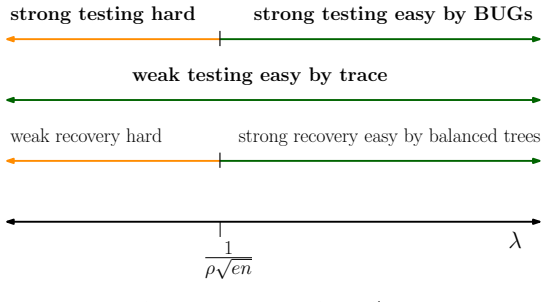
We establish the first sharp thresholds for low-degree polynomial tests in planted-vs-planted settings, where the goal is to determine with vanishing error which of two structured planted mechanisms generated the observed data. We prove matching low-degree upper and lower bounds for counting communities in the planted submatrix and planted dense subgraph models. The resulting testing threshold coincides, down to the sharp constant, with the known low-degree recovery threshold. In contrast, the task of weak testing, where the goal is to outperform random guessing, does not have a sharp threshold but rather a smooth transition, which we identify. To prove our results, we develop a framework for planted-vs-planted testing that builds on a latent-variable expansion originating in low-degree recovery and employs new methods to identify and prune non-signal contributions.
Editorial analysis
A structured set of objections, weighed in public.
Referee Report
Summary. The paper claims to establish the first sharp thresholds for low-degree polynomial tests in planted-vs-planted settings. It proves matching upper and lower bounds for distinguishing which of two planted mechanisms (in the planted submatrix and planted dense subgraph models for counting communities) generated the data, with the resulting threshold coinciding exactly with the known low-degree recovery threshold. It further shows that weak testing (outperforming random guessing) exhibits a smooth transition rather than a sharp threshold. The proofs rely on a new framework extending latent-variable expansions from low-degree recovery, incorporating methods to identify and prune non-signal contributions.
Significance. If the central claims hold, the work is significant for providing the first sharp constants in a planted-vs-planted testing regime, extending low-degree analysis beyond single-alternative recovery or detection. The exact match to the recovery threshold is a notable structural finding with potential implications for computational-statistical gaps in community detection and related inference problems. The pruning technique in the expansion framework represents a technical contribution that may generalize.
major comments (2)
- [Framework and lower-bound proof (around the definition of the pruned polynomial and expansion)] The lower bound (and thus the claimed exact coincidence with the recovery threshold) rests on the pruning step in the latent-variable expansion correctly retaining all relevant signal terms from both planted models while eliminating cross-terms. The manuscript should include an explicit lemma or calculation (in the framework section) verifying that no non-signal contributions from the second latent structure survive at the critical constant; without this, the matching sharp constant is not secured.
- [Section developing the planted-vs-planted framework] The adaptation of the latent-variable expansion to the planted-vs-planted distinction requires a clear accounting of how the new pruning methods interact with the two latent structures simultaneously. If any cross-term between the two planted mechanisms is retained (or a signal term pruned) at the threshold value identified in prior recovery work, the lower bound would not match the upper bound.
minor comments (2)
- [Abstract] Clarify the precise relationship between 'counting communities' in the abstract and the planted submatrix/planted dense subgraph models used in the theorems.
- [Framework section] Notation for the low-degree polynomials and the pruning threshold could be made more self-contained, with a short recap of the originating latent-variable expansion for readers.
Simulated Author's Rebuttal
We thank the referee for the detailed and constructive report. The comments focus on the explicitness of the pruning argument in the planted-vs-planted framework; we address each point below and will strengthen the presentation accordingly.
read point-by-point responses
-
Referee: [Framework and lower-bound proof (around the definition of the pruned polynomial and expansion)] The lower bound (and thus the claimed exact coincidence with the recovery threshold) rests on the pruning step in the latent-variable expansion correctly retaining all relevant signal terms from both planted models while eliminating cross-terms. The manuscript should include an explicit lemma or calculation (in the framework section) verifying that no non-signal contributions from the second latent structure survive at the critical constant; without this, the matching sharp constant is not secured.
Authors: We agree that an explicit statement would improve readability. The current proof (Section 3 and Appendix A) already shows via direct moment expansion that all cross-terms between the two latent structures vanish at the recovery threshold constant; the pruning operator is defined precisely to retain only intra-model signal contributions whose norms match the known single-alternative recovery threshold. To address the request, we will insert a new lemma (Lemma 3.4) in the framework section that isolates this verification as a self-contained calculation. revision: yes
-
Referee: [Section developing the planted-vs-planted framework] The adaptation of the latent-variable expansion to the planted-vs-planted distinction requires a clear accounting of how the new pruning methods interact with the two latent structures simultaneously. If any cross-term between the two planted mechanisms is retained (or a signal term pruned) at the threshold value identified in prior recovery work, the lower bound would not match the upper bound.
Authors: The framework section (Section 3) defines the joint pruning operator that acts separately on each latent structure while discarding all bilinear cross-terms; the norm calculations in the lower-bound proof (Theorem 4.1) confirm that the retained terms exactly reproduce the recovery threshold and that no cross-term survives with positive norm at that constant. We will add a short paragraph immediately after the definition of the pruned polynomial that explicitly tabulates the interaction of the pruning map with each of the two structures, thereby making the accounting fully transparent without altering the argument. revision: yes
Circularity Check
No circularity: new framework extends prior expansion with independent pruning methods
full rationale
The derivation develops a planted-vs-planted framework that builds on a latent-variable expansion from prior low-degree recovery work and adds new pruning techniques for non-signal terms. The matching upper/lower bounds and threshold coincidence are derived outputs, not inputs by construction. No self-definitional reductions, fitted parameters renamed as predictions, or load-bearing self-citations that collapse the central claim appear in the abstract or described chain. The prior expansion is treated as external input whose validity is independent of this paper's results.
Axiom & Free-Parameter Ledger
axioms (1)
- domain assumption Planted submatrix and planted dense subgraph models follow standard random graph distributions with hidden structure parameters.
Reference graph
Works this paper leans on
-
[1]
2014 , publisher=
Analysis of boolean functions , author=. 2014 , publisher=
2014
-
[2]
IEEE Transactions on Information Theory , year=
Planted Bipartite Graph Detection , author=. IEEE Transactions on Information Theory , year=
-
[3]
Proceedings of the 57th Annual ACM Symposium on Theory of Computing , pages=
Sharp phase transitions in estimation with low-degree polynomials , author=. Proceedings of the 57th Annual ACM Symposium on Theory of Computing , pages=
-
[4]
arXiv preprint arXiv:2505.17360 , year=
The quasi-polynomial low-degree conjecture is false , author=. arXiv preprint arXiv:2505.17360 , year=
-
[5]
ITCS 2023, January 10-13, 2023, MIT, Cambridge, Massachusetts, USA , pages=
Is it easier to count communities than find them? , author=. ITCS 2023, January 10-13, 2023, MIT, Cambridge, Massachusetts, USA , pages=. 2023 , organization=
2023
-
[6]
, title =
Moon, John W. , title =. 1970 , publisher =
1970
-
[7]
The Annals of Statistics , volume=
Computational barriers to estimation from low-degree polynomials , author=. The Annals of Statistics , volume=. 2022 , publisher=
2022
-
[8]
SIAM Journal on Computing , volume=
Constant time generation of rooted trees , author=. SIAM Journal on Computing , volume=. 1980 , publisher=
1980
-
[9]
arXiv preprint arXiv:2509.09353 , year=
Low-degree lower bounds via almost orthonormal bases , author=. arXiv preprint arXiv:2509.09353 , year=
-
[10]
Random Structures & Algorithms , volume=
Testing for high-dimensional geometry in random graphs , author=. Random Structures & Algorithms , volume=. 2016 , publisher=
2016
-
[11]
, title =
Butucea, Cristina and Ingster, Yuri I. , title =. Bernoulli , year =
-
[12]
Advances in Neural Information Processing Systems , volume=
Minimax localization of structural information in large noisy matrices , author=. Advances in Neural Information Processing Systems , volume=
-
[13]
ESAIM: Probability and Statistics , volume=
Sharp variable selection of a sparse submatrix in a high-dimensional noisy matrix , author=. ESAIM: Probability and Statistics , volume=. 2015 , publisher=
2015
-
[14]
Computational complexity of statistics: New insights from low-degree polynomials
Computational Complexity of Statistics: New Insights from Low-Degree Polynomials , author=. arXiv preprint arXiv:2506.10748 , year=
-
[15]
1939 , publisher=
Orthogonal polynomials , author=. 1939 , publisher=
1939
-
[16]
Bandeira, Afonso S and El Alaoui, Ahmed and Hopkins, Samuel and Schramm, Tselil and Wein, Alexander S and Zadik, Ilias , journal=. The
-
[17]
Conference on Learning Theory , pages=
Statistical and computational phase transitions in group testing , author=. Conference on Learning Theory , pages=. 2022 , organization=
2022
-
[18]
Physical Review Letters , volume=
Inference and phase transitions in the detection of modules in sparse networks , author=. Physical Review Letters , volume=. 2011 , publisher=
2011
-
[19]
Physical Review E--Statistical, Nonlinear, and Soft Matter Physics , volume=
Asymptotic analysis of the stochastic block model for modular networks and its algorithmic applications , author=. Physical Review E--Statistical, Nonlinear, and Soft Matter Physics , volume=. 2011 , publisher=
2011
-
[20]
Communications on Pure and Applied Mathematics , volume=
Proof of the achievability conjectures for the general stochastic block model , author=. Communications on Pure and Applied Mathematics , volume=. 2018 , publisher=
2018
-
[21]
2017 IEEE 58th Annual Symposium on Foundations of Computer Science (FOCS) , pages=
Efficient bayesian estimation from few samples: community detection and related problems , author=. 2017 IEEE 58th Annual Symposium on Foundations of Computer Science (FOCS) , pages=. 2017 , organization=
2017
-
[22]
Conference on Learning Theory , pages=
Spectral planting and the hardness of refuting cuts, colorability, and communities in random graphs , author=. Conference on Learning Theory , pages=. 2021 , organization=
2021
-
[23]
arXiv preprint arXiv:2502.15024 , year=
Low degree conjecture implies sharp computational thresholds in stochastic block model , author=. arXiv preprint arXiv:2502.15024 , year=
-
[24]
Random Structures & Algorithms , volume=
Finding a large hidden clique in a random graph , author=. Random Structures & Algorithms , volume=. 1998 , publisher=
1998
-
[25]
Smooth trade-off for tensor
Kothari, Pravesh K and Xu, Jeff , booktitle=. Smooth trade-off for tensor. 2026 , organization=
2026
-
[26]
Lecture Notes , year=
Statistical physics methods in optimization and machine learning , author=. Lecture Notes , year=
-
[27]
ISAAC Congress (International Society for Analysis, its Applications and Computation) , pages=
Notes on computational hardness of hypothesis testing: Predictions using the low-degree likelihood ratio , author=. ISAAC Congress (International Society for Analysis, its Applications and Computation) , pages=. 2019 , organization=
2019
-
[28]
Stochastic block models with many communities and the
Chin, Byron and Mossel, Elchanan and Sohn, Youngtak and Wein, Alexander S , journal=. Stochastic block models with many communities and the
-
[29]
The Thirty Eighth Annual Conference on Learning Theory , pages=
Stochastic block models with many communities and the Kesten--Stigum bound , author=. The Thirty Eighth Annual Conference on Learning Theory , pages=. 2025 , organization=
2025
-
[30]
Phase Transition for Stochastic Block Model with more than
Carpentier, Alexandra and Giraud, Christophe and Verzelen, Nicolas , journal=. Phase Transition for Stochastic Block Model with more than
-
[31]
The Thirty Sixth Annual Conference on Learning Theory , pages=
Is planted coloring easier than planted clique? , author=. The Thirty Sixth Annual Conference on Learning Theory , pages=. 2023 , organization=
2023
-
[32]
Proceedings of the 56th Annual ACM Symposium on Theory of Computing , pages=
On the fourier coefficients of high-dimensional random geometric graphs , author=. Proceedings of the 56th Annual ACM Symposium on Theory of Computing , pages=
-
[33]
The Annals of Statistics , volume=
Testing network correlation efficiently via counting trees , author=. The Annals of Statistics , volume=. 2024 , publisher=
2024
-
[34]
Journal of the ACM (JACM) , volume=
Color-coding , author=. Journal of the ACM (JACM) , volume=. 1995 , publisher=
1995
-
[35]
Community Detection in Random Networks
Community detection in random networks , author=. arXiv preprint arXiv:1302.7099 , year=
work page internal anchor Pith review Pith/arXiv arXiv
-
[36]
2015 , journal=
Community detection in sparse random networks , author=. 2015 , journal=
2015
-
[37]
Journal of Machine Learning Research , volume=
Statistical-computational tradeoffs in planted problems and submatrix localization with a growing number of clusters and submatrices , author=. Journal of Machine Learning Research , volume=
-
[38]
Conference on Learning Theory , pages=
Computational lower bounds for community detection on random graphs , author=. Conference on Learning Theory , pages=. 2015 , organization=
2015
-
[39]
Detecting high log-densities: an
Bhaskara, Aditya and Charikar, Moses and Chlamtac, Eden and Feige, Uriel and Vijayaraghavan, Aravindan , booktitle=. Detecting high log-densities: an
-
[40]
Journal of Optimization Theory and Applications , volume=
Guaranteed recovery of planted cliques and dense subgraphs by convex relaxation , author=. Journal of Optimization Theory and Applications , volume=. 2015 , publisher=
2015
-
[41]
Journal of Statistical Physics , volume=
Finding one community in a sparse graph , author=. Journal of Statistical Physics , volume=. 2015 , publisher=
2015
-
[42]
The Annals of Statistics , pages=
Computational barriers in minimax submatrix detection , author=. The Annals of Statistics , pages=. 2015 , publisher=
2015
-
[43]
Conference On Learning Theory , pages=
Reducibility and computational lower bounds for problems with planted sparse structure , author=. Conference On Learning Theory , pages=. 2018 , organization=
2018
-
[44]
arXiv preprint arXiv:2502.04861 , year=
Optimal Low degree hardness for Broadcasting on Trees , author=. arXiv preprint arXiv:2502.04861 , year=
-
[45]
arXiv preprint arXiv:2502.09832 , year=
Algorithmic contiguity from low-degree conjecture and applications in correlated random graphs , author=. arXiv preprint arXiv:2502.09832 , year=
-
[46]
Algorithmic Contiguity from Low-Degree Heuristic
Li, Zhangsong , journal=. Algorithmic Contiguity from Low-Degree Heuristic
-
[47]
Journal of Machine Learning Research , volume=
Submatrix localization via message passing , author=. Journal of Machine Learning Research , volume=
discussion (0)
Sign in with ORCID, Apple, or X to comment. Anyone can read and Pith papers without signing in.