On couplings for kinetic Langevin diffusions
Pith reviewed 2026-06-28 21:15 UTC · model grok-4.3
The pith
For the kinetic Langevin equation with quadratic potential, no Markovian coupling captures the asymptotic decay rate of total variation distance between solutions from different initial conditions.
A machine-rendered reading of the paper's core claim, the machinery that carries it, and where it could break.
Core claim
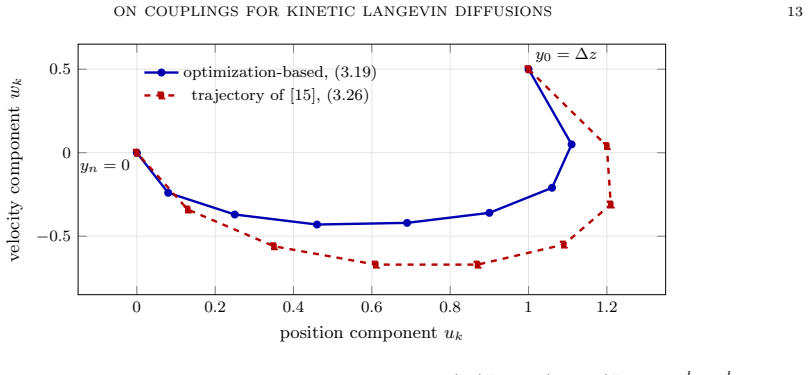
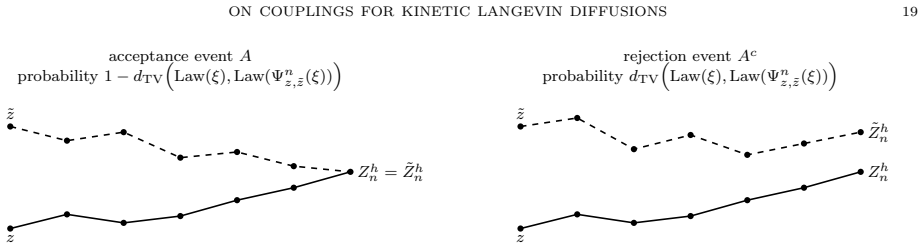
For the kinetic Langevin diffusion with quadratic potential, no Markovian coupling (continuous or discrete) captures the asymptotic decay rate of the TV distance between two solutions with different initial values; the canonical iterated one-shot coupling saturates this lower bound. The recent sharp TV bounds admit a natural interpretation through an explicit non-Markovian coupling built from an optimal coalescence trajectory characterized by a classical minimum-energy control problem. For the OBABO splitting scheme this approach removes the Hessian-Lipschitz, step-size, and final-time assumptions required in prior work.
What carries the argument
The explicit non-Markovian coupling constructed from an optimal coalescence trajectory that solves a classical minimum-energy control problem, which matches the sharp TV contraction rates.
If this is right
- The iterated one-shot coupling saturates the lower bound on asymptotic TV decay among all Markovian couplings.
- The non-Markovian control-based coupling recovers the sharp TV bounds and explains their origin.
- For the OBABO splitting discretization the same coupling construction removes the need for Hessian-Lipschitz, step-size, and final-time restrictions.
- Hypoelliptic noise structure makes the link between couplings and TV bounds strictly more subtle than in the elliptic setting.
Where Pith is reading between the lines
- Similar gaps between Markovian and non-Markovian couplings may appear for non-quadratic potentials, though the explicit control problem would change.
- The minimum-energy trajectory viewpoint could be used to design practical simulation schemes that deliberately follow near-optimal coalescence paths.
- The result suggests that convergence proofs for other hypoelliptic processes may also require non-Markovian arguments once sharp rates are sought.
Load-bearing premise
The potential must be exactly quadratic so that closed-form calculations and exact contraction formulas remain available.
What would settle it
Exhibiting any Markovian coupling (continuous or discrete) for the quadratic-potential kinetic Langevin equation whose TV contraction rate is strictly faster than that of the iterated one-shot coupling.
Figures


read the original abstract
For the kinetic Langevin diffusion and its splitting discretizations, the hypoelliptic noise structure makes the relationship between couplings and total variation (TV) bounds more subtle than in the elliptic case. We establish that, for the kinetic Langevin equation with quadratic potential, no Markovian coupling (continuous or discrete) captures the asymptotic decay rate of the TV distance between two solutions with different initial values; the canonical iterated one-shot (or sticky) coupling, for which we derive an exact contraction formula, saturates this lower bound. On the constructive side, we show that the recent sharp TV bounds obtained by Chak and Monmarch\'e admit a natural interpretation through an explicit non-Markovian coupling, built from an optimal coalescence trajectory characterized by a classical minimum-energy control problem. For the OBABO splitting scheme, this approach additionally eliminates the Hessian-Lipschitz, step-size, and final-time assumptions in the work of Chak and Monmarch\'e.
Editorial analysis
A structured set of objections, weighed in public.
Referee Report
Summary. The paper studies couplings for the kinetic Langevin diffusion and its splitting discretizations. For the quadratic-potential case it proves that no Markovian coupling (continuous or discrete) attains the asymptotic total-variation decay rate, derives an exact contraction formula for the iterated sticky coupling that saturates this lower bound, and constructs an explicit non-Markovian coupling from an optimal-control coalescence trajectory that realizes the sharp Chak–Monmarché bounds. The same approach applied to the OBABO scheme removes the Hessian-Lipschitz, step-size, and final-time assumptions present in prior work.
Significance. If the derivations hold, the work supplies a precise demarcation between Markovian and non-Markovian couplings for hypoelliptic processes, together with closed-form contraction rates and an optimal-control interpretation of existing sharp bounds. The exact formulas for the quadratic case and the removal of extraneous assumptions in the discrete setting constitute concrete technical advances for the analysis of kinetic Langevin dynamics.
minor comments (3)
- [§3] §3 (lower-bound argument): the explicit solution formulas for the quadratic case are used throughout; a short remark clarifying which steps rely on the quadratic structure versus which steps are structural would help readers assess possible extensions.
- [§4] The control problem in §4 is introduced via the minimum-energy trajectory; an explicit equation number for the resulting value function would improve cross-referencing with the TV bound statement.
- [OBABO section] The OBABO section states that three assumptions from Chak–Monmarché are removed; a one-sentence pointer to the precise statements of those assumptions in the earlier paper would make the improvement immediately verifiable.
Simulated Author's Rebuttal
We thank the referee for their positive and accurate summary of the manuscript, as well as for the recommendation of minor revision. The report correctly identifies the key contributions regarding the demarcation between Markovian and non-Markovian couplings, the exact contraction formulas, and the removal of assumptions for the OBABO scheme.
Circularity Check
No significant circularity identified
full rationale
The paper's central claims rest on explicit closed-form calculations for the quadratic-potential kinetic Langevin diffusion, including a new lower bound showing that no Markovian coupling (continuous or discrete) can achieve the sharp TV decay rate, an exact contraction formula for the iterated sticky coupling that saturates this bound, and an explicit non-Markovian coupling constructed from an optimal-control coalescence trajectory that recovers the Chak–Monmarché bounds. These derivations rely on the hypoelliptic generator's explicit solutions under quadratic assumptions and do not reduce any load-bearing step to a fitted parameter, self-definition, or a self-citation chain; the citation to Chak–Monmarché supplies an external benchmark that the paper then reinterprets rather than presupposing. The OBABO extension similarly removes prior assumptions while preserving the same explicit structure. No step matches the enumerated circularity patterns.
Axiom & Free-Parameter Ledger
axioms (2)
- standard math Standard existence, uniqueness, and regularity results for solutions of hypoelliptic SDEs with quadratic potential.
- domain assumption Existence of an optimal coalescence trajectory characterized by a classical minimum-energy control problem.
Reference graph
Works this paper leans on
-
[1]
Data-driven minimum-energy controls for linear systems
G. Baggio, V. Katewa, and F. Pasqualetti. “Data-driven minimum-energy controls for linear systems”. In: IEEE Control Syst. Lett. 3.3 (2019), pp. 589–594 (cit. on p. 14)
2019
-
[2]
Coupling the Kolmogorov diffusion: maximality and efficiency consid- erations
S. Banerjee and W. S. Kendall. “Coupling the Kolmogorov diffusion: maximality and efficiency consid- erations”. In: Adv. in Appl. Probab. 48.A (2016), pp. 15–35 (cit. on pp. 2, 4, 21, 26)
2016
-
[3]
Estimates of the proximity of Gaussian measures
S. S. Barsov and V. V. Ul’yanov. “Estimates of the proximity of Gaussian measures”. English. In: Sov. Math., Dokl. 34 (1987), pp. 462–466 (cit. on p. 5)
1987
-
[4]
Coupling constructions for hypoelliptic diffusions: two examples
G. Ben Arous, M. Cranston, and W. S. Kendall. “Coupling constructions for hypoelliptic diffusions: two examples”. In: Stochastic analysis (Ithaca, NY, 1993) . Vol. 57. Proc. Sympos. Pure Math. Amer. Math. Soc., Providence, RI, 1995, pp. 193–212 (cit. on p. 2)
1993
-
[5]
Couplings for Andersen dynamics
N. Bou-Rabee and A. Eberle. “Couplings for Andersen dynamics”. In: Ann. Inst. Henri Poincar´ e Probab. Stat. 58.2 (2022), pp. 916–944 (cit. on p. 2)
2022
-
[6]
Mixing time guarantees for unadjusted Hamiltonian Monte Carlo
N. Bou-Rabee and A. Eberle. “Mixing time guarantees for unadjusted Hamiltonian Monte Carlo”. In: Bernoulli 29.1 (2023), pp. 75–104 (cit. on pp. 4, 10)
2023
-
[7]
Two-scale coupling for preconditioned Hamiltonian Monte Carlo in infinite dimensions
N. Bou-Rabee and A. Eberle. “Two-scale coupling for preconditioned Hamiltonian Monte Carlo in infinite dimensions”. In: Stoch. Partial Differ. Equ. Anal. Comput. 9.1 (2021), pp. 207–242 (cit. on p. 31)
2021
-
[8]
Coupling and convergence for Hamiltonian Monte Carlo
N. Bou-Rabee, A. Eberle, and R. Zimmer. “Coupling and convergence for Hamiltonian Monte Carlo”. In: Ann. Appl. Probab. 30.3 (2020), pp. 1209–1250 (cit. on pp. 4, 31)
2020
-
[9]
N. Bou-Rabee, S. Mitra, and A. Wibisono. Tail-Sensitive KL and R´ enyi Convergence of Unadjusted Hamiltonian Monte Carlo via One-Shot Couplings . 2026. arXiv: 2601.09019 [stat.ML] (cit. on p. 16)
-
[10]
Mixing of Metropolis-adjusted Markov chains via couplings: the high acceptance regime
N. Bou-Rabee and S. Oberd¨ orster. “Mixing of Metropolis-adjusted Markov chains via couplings: the high acceptance regime”. In: Electron. J. Probab. 29 (2024), Paper No. 89, 27 (cit. on p. 13)
2024
-
[11]
Convergence of unadjusted Hamiltonian Monte Carlo for mean-field models
N. Bou-Rabee and K. Schuh. “Convergence of unadjusted Hamiltonian Monte Carlo for mean-field models”. In: Electron. J. Probab. 28 (2023), Paper No. 91, 40 (cit. on p. 4)
2023
-
[12]
An elementary analysis of a procedure for sampling points in a convex body
R. Bubley, M. Dyer, and M. Jerrum. “An elementary analysis of a procedure for sampling points in a convex body”. In: Random Structures Algorithms 12.3 (1998), pp. 213–235 (cit. on pp. 4, 31)
1998
- [13]
-
[14]
On explicit L2-convergence rate estimate for underdamped Langevin dynamics
Y. Cao, J. Lu, and L. Wang. “On explicit L2-convergence rate estimate for underdamped Langevin dynamics”. In: Arch. Ration. Mech. Anal. 247 (2023), Paper No. 90 (cit. on p. 1)
2023
-
[15]
Reflection coupling for unadjusted generalized Hamiltonian Monte Carlo in the nonconvex stochastic gradient case
M. Chak and P. Monmarch´ e. “Reflection coupling for unadjusted generalized Hamiltonian Monte Carlo in the nonconvex stochastic gradient case”. In: IMA Journal of Numerical Analysis (June 2025), draf045. eprint: https : / / academic . oup . com / imajna / advance - article - pdf / doi / 10 . 1093 / imanum/draf045/63552073/draf045.pdf (cit. on pp. 1–4, 6, ...
2025
-
[16]
Underdamped Langevin MCMC: A non-asymptotic analysis
X. Cheng, N. S. Chatterji, P. L. Bartlett, and M. I. Jordan. “Underdamped Langevin MCMC: A non-asymptotic analysis”. In: Conference on learning theory. PMLR. 2018, pp. 300–323 (cit. on p. 4)
2018
- [17]
-
[18]
Coupling for some partial differential equations driven by white noise
G. Da Prato, A. Debussche, and L. Tubaro. “Coupling for some partial differential equations driven by white noise”. In: Stochastic Process. Appl. 115.8 (2005), pp. 1384–1407 (cit. on p. 2)
2005
-
[19]
Theoretical guarantees for approximate sampling from smooth and log-concave den- sities
A. S. Dalalyan. “Theoretical guarantees for approximate sampling from smooth and log-concave den- sities”. In: J. R. Stat. Soc. Ser. B. Stat. Methodol. 79.3 (2017), pp. 651–676 (cit. on p. 4)
2017
-
[20]
On sampling from a log-concave density using kinetic Langevin diffusions
A. S. Dalalyan and L. Riou-Durand. “On sampling from a log-concave density using kinetic Langevin diffusions”. In: Bernoulli 26.3 (2020), pp. 1956–1988 (cit. on p. 4). 52 REFERENCES
2020
-
[21]
S. Darshan, A. Eberle, and G. Stoltz. Sticky coupling as a control variate for sensitivity analysis . 2024. arXiv: 2409.15500 [math.PR] (cit. on p. 4)
-
[22]
Discrete sticky couplings of functional autoregressive processes
A. Durmus, A. Eberle, A. Enfroy, A. Guillin, and P. Monmarch´ e. “Discrete sticky couplings of functional autoregressive processes”. In: Ann. Appl. Probab. 34.6 (2024), pp. 5032–5075 (cit. on p. 4)
2024
-
[23]
High-dimensional Bayesian inference via the unadjusted Langevin algo- rithm
A. Durmus and ´E. Moulines. “High-dimensional Bayesian inference via the unadjusted Langevin algo- rithm”. In: Bernoulli 25.4A (2019), pp. 2854–2882 (cit. on pp. 2, 4, 30, 31, 33, 34, 37)
2019
-
[24]
Nonasymptotic convergence analysis for the unadjusted Langevin algo- rithm
A. Durmus and ´E. Moulines. “Nonasymptotic convergence analysis for the unadjusted Langevin algo- rithm”. In: Ann. Appl. Probab. 27.3 (2017), pp. 1551–1587 (cit. on p. 4)
2017
-
[25]
Reflection couplings and contraction rates for diffusions
A. Eberle. “Reflection couplings and contraction rates for diffusions”. In: Probab. Theory Related Fields 166.3-4 (2016), pp. 851–886 (cit. on pp. 2, 21)
2016
-
[26]
Couplings and quantitative contraction rates for Langevin dynamics
A. Eberle, A. Guillin, and R. Zimmer. “Couplings and quantitative contraction rates for Langevin dynamics”. In: Ann. Probab. 47.4 (2019), pp. 1982–2010 (cit. on pp. 2, 4, 21)
2019
-
[27]
Non-reversible lifts of reversible diffusion processes and relaxation times
A. Eberle and F. L¨ orler. “Non-reversible lifts of reversible diffusion processes and relaxation times”. In: Probab. Theory Related Fields (2024) (cit. on p. 1)
2024
-
[28]
Quantitative contraction rates for Markov chains on general state spaces
A. Eberle and M. B. Majka. “Quantitative contraction rates for Markov chains on general state spaces”. In: Electron. J. Probab. 24 (2019), Paper No. 26, 36 (cit. on p. 4)
2019
-
[29]
HMC and underdamped Langevin united in the unadjusted convex smooth case
N. Gouraud, P. Le Bris, A. Majka, and P. Monmarch´ e. “HMC and underdamped Langevin united in the unadjusted convex smooth case”. In: SIAM/ASA J. Uncertain. Quantif. 13.1 (2025), pp. 278–303 (cit. on p. 4)
2025
-
[30]
Unbiased Markov chain Monte Carlo methods with couplings
P. E. Jacob, J. O’Leary, and Y. F. Atchad´ e. “Unbiased Markov chain Monte Carlo methods with couplings”. In: J. R. Stat. Soc. Ser. B. Stat. Methodol. 82.3 (2020), pp. 543–600 (cit. on p. 30)
2020
-
[31]
Curvature, concentration and error estimates for Markov chain Monte Carlo
A. Joulin and Y. Ollivier. “Curvature, concentration and error estimates for Markov chain Monte Carlo”. In: Ann. Probab. 38.6 (2010), pp. 2418–2442 (cit. on p. 2)
2010
-
[32]
T. Kailath. Linear systems. Prentice Hall Information and System Sciences Series. Prentice-Hall, Inc., Englewood Cliffs, NJ, 1980, pp. xxi+682 (cit. on p. 14)
1980
-
[33]
Convergence in total variation for the kinetic Langevin algorithm
J. Lehec. “Convergence in total variation for the kinetic Langevin algorithm”. In: Math. Stat. Learn. 8.1-2 (2025), pp. 71–104 (cit. on p. 4)
2025
-
[34]
Contraction and convergence rates for discretized kinetic Langevin dynamics
B. J. Leimkuhler, D. Paulin, and P. A. Whalley. “Contraction and convergence rates for discretized kinetic Langevin dynamics”. In: SIAM J. Numer. Anal. 62.3 (2024), pp. 1226–1258 (cit. on p. 4)
2024
-
[35]
Lindvall
T. Lindvall. Lectures on the coupling method. Corrected reprint of the 1992 original. Dover Publications, Inc., Mineola, NY, 2002, pp. xiv+257 (cit. on pp. 5, 20)
1992
-
[36]
Coupling of multidimensional diffusions by reflection
T. Lindvall and L. C. G. Rogers. “Coupling of multidimensional diffusions by reflection”. In: Ann. Probab. 14.3 (1986), pp. 860–872 (cit. on pp. 2, 4)
1986
-
[37]
Is there an analog of Nesterov acceleration for gradient-based MCMC?
Y.-A. Ma, N. S. Chatterji, X. Cheng, N. Flammarion, P. L. Bartlett, and M. I. Jordan. “Is there an analog of Nesterov acceleration for gradient-based MCMC?” In: Bernoulli 27.3 (2021), pp. 1942–1992 (cit. on p. 4)
2021
-
[38]
Quantitative bounds for Markov chain convergence: Wasserstein and total variation distances
N. Madras and D. Sezer. “Quantitative bounds for Markov chain convergence: Wasserstein and total variation distances”. In: Bernoulli 16.3 (2010), pp. 882–908 (cit. on p. 9)
2010
-
[39]
Ergodicity for SDEs and approximations: locally Lipschitz vec- tor fields and degenerate noise
J. Mattingly, A. Stuart, and D. Higham. “Ergodicity for SDEs and approximations: locally Lipschitz vec- tor fields and degenerate noise”. In: Stochastic Processes and their Applications 101.2 (2002), pp. 185– 232 (cit. on p. 1)
2002
-
[40]
An entropic approach for Hamiltonian Monte Carlo: the idealized case
P. Monmarch´ e. “An entropic approach for Hamiltonian Monte Carlo: the idealized case”. In:Ann. Appl. Probab. 34.2 (2024), pp. 2243–2293 (cit. on pp. 4, 8, 17)
2024
-
[41]
High-dimensional MCMC with a standard splitting scheme for the underdamped Langevin diffusion
P. Monmarch´ e. “High-dimensional MCMC with a standard splitting scheme for the underdamped Langevin diffusion.” In: Electron. J. Stat. 15.2 (2021), pp. 4117–4166 (cit. on p. 4)
2021
-
[42]
One-shot coupling for certain stochastic recursive sequences
G. O. Roberts and J. S. Rosenthal. “One-shot coupling for certain stochastic recursive sequences”. In: Stochastic Process. Appl. 99.2 (2002), pp. 195–208 (cit. on p. 4). REFERENCES 53
2002
-
[43]
Faithful couplings of Markov chains: now equals forever
J. S. Rosenthal. “Faithful couplings of Markov chains: now equals forever”. In: Adv. in Appl. Math. 18.3 (1997), pp. 372–381 (cit. on p. 22)
1997
-
[44]
K. Schuh and P. A. Whalley. Convergence of kinetic Langevin samplers for non-convex potentials. 2025. arXiv: 2405.09992 [math.PR] (cit. on pp. 4, 9)
-
[45]
Stochastic Hamiltonian systems: exponential convergence to the invariant measure, and discretization by the implicit Euler scheme
D. Talay. “Stochastic Hamiltonian systems: exponential convergence to the invariant measure, and discretization by the implicit Euler scheme”. In: Markov Process. Related Fields 8.2 (2002), pp. 163– 198 (cit. on p. 1)
2002
-
[46]
Expansion of the global error for numerical schemes solving stochastic dif- ferential equations
D. Talay and L. Tubaro. “Expansion of the global error for numerical schemes solving stochastic dif- ferential equations”. In: Stochastic Anal. Appl. 8.4 (1990), pp. 483–509 (cit. on p. 4)
1990
-
[47]
C. Villani. Optimal transport: old and new. Vol. 338. Grundlehren der mathematischen Wissenschaften. Springer-Verlag, Berlin, 2009, pp. xxii+973 (cit. on p. 2)
2009
discussion (0)
Sign in with ORCID, Apple, or X to comment. Anyone can read and Pith papers without signing in.