Population synthesis of active galactic nuclei based on the radiation-regulated unification model
Pith reviewed 2026-05-19 22:37 UTC · model grok-4.3
The pith
Simulations of active galactic nuclei using a radiation-regulated model match the cosmic X-ray background with a 40 percent Compton-thick fraction.
A machine-rendered reading of the paper's core claim, the machinery that carries it, and where it could break.
Core claim
Using simulation-based inference with RefleX ray-tracing on a population drawn from intrinsic active black hole mass and Eddington ratio functions, the radiation-regulated unification model yields an intrinsic Compton-thick fraction of 40±3 percent. A simple prescription for the evolution of the active supermassive black hole fraction allows the synthetic population to reproduce the cosmic X-ray background along with differential number counts and local absorption statistics.
What carries the argument
The radiation-regulated unification model for circumnuclear geometry and emission spectra, implemented via RefleX ray-tracing simulations to generate self-consistent X-ray properties for the synthetic AGN population.
If this is right
- The intrinsic Compton-thick fraction of AGNs is 40±3 percent.
- A minimal evolutionary model for the active fraction of supermassive black holes is enough to match the cosmic X-ray background.
- The size and density of the dusty torus can be constrained to fit multiple observed absorption properties simultaneously.
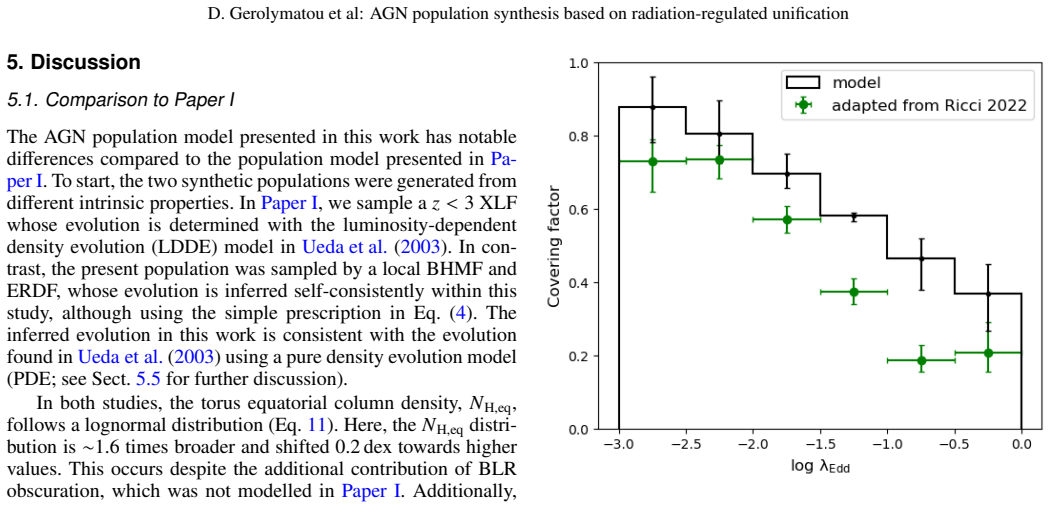
- The model predicts the number of obscured versus unobscured AGNs as a function of Eddington ratio.
Where Pith is reading between the lines
- If the radiation-regulated geometry holds, similar simulation methods could be applied to model AGN populations at higher redshifts using the same torus parameters.
- Future surveys might use these constraints to better estimate the contribution of AGNs to the overall energy density in the universe.
- Testing the model against multi-wavelength data could reveal whether the assumed Eddington-ratio dependent spectra are consistent across bands.
Load-bearing premise
The radiation-regulated unification model accurately captures the geometry and X-ray emission of the material around active black holes, allowing the simulations to match real absorption observations after parameter adjustment.
What would settle it
A direct count of Compton-thick AGNs in a flux-limited local sample that yields a fraction far from 40 percent would indicate the model does not correctly reproduce the absorption properties.
Figures




read the original abstract
X-ray surveys of active galactic nuclei (AGNs) provide direct constraints on the properties of individual AGNs, such as their emission, obscuration, and accretion rate. Previous AGN population synthesis models have not addressed such properties self-consistently. Here, we use a simulation-based inference (SBI) approach to constrain the geometrical and physical properties of the AGN population. We perform numerical simulations with our ray-tracing code, RefleX, which allows the self-consistent modelling of the X-ray emission of AGNs with flexible circumnuclear and source geometries. We create our synthetic population by sampling the intrinsic active black hole mass function (BHMF) and Eddington ratio distribution function (ERDF) of local AGNs, and we construct a geometry based on the radiation-regulated model, along with Eddington-ratio-dependent emission spectra. Using the RefleX-simulated emission of the AGN population, we aim to simultaneously reproduce the cosmic X-ray background (CXB), differential AGN number counts, and several observed absorption properties of local AGNs, such as the fraction of $N_\mathrm{H}$ in bins of log($N_\mathrm{H}$), the Compton-thick fraction as a function of limiting flux, and the number of obscured and unobscured AGNs as a function of Eddington ratio. With this approach, we test the consistency of the radiation-regulated model with a very comprehensive set of X-ray observables, while constraining the size and density of the dusty torus and the evolution of the local AGN population. We derive an intrinsic Compton-thick fraction of $40\pm3$%, and find that a simple evolutionary prescription controlling the active fraction of supermassive black holes is sufficient for our synthetic population to reproduce the CXB.
Editorial analysis
A structured set of objections, weighed in public.
Referee Report
Summary. The manuscript presents a population synthesis model for active galactic nuclei based on the radiation-regulated unification model. It employs ray-tracing simulations with the RefleX code and simulation-based inference to construct a synthetic population from local black hole mass and Eddington ratio distribution functions, incorporates Eddington-ratio-dependent spectra and torus geometry, and applies a simple evolutionary prescription for the active fraction of supermassive black holes. The model is shown to simultaneously reproduce the cosmic X-ray background, differential AGN number counts, NH column density fractions, the Compton-thick fraction as a function of flux, and the obscured fraction versus Eddington ratio, yielding an intrinsic Compton-thick fraction of 40±3%.
Significance. If the central results hold, this work advances AGN population synthesis by providing a self-consistent link between circumnuclear geometry, X-ray emission, and demographic evolution that matches a broad suite of independent X-ray observables. The use of flexible RefleX simulations combined with SBI for parameter constraints is a methodological strength that allows quantitative testing of the radiation-regulated model against the CXB and local absorption statistics.
major comments (2)
- [Section 3.2] Section 3.2 (Synthetic population construction): The model samples the local AGN BHMF and ERDF and applies evolution only to the active fraction. Since the CXB receives substantial contributions from z ≳ 1–3 where the ERDF shape and luminosity function evolve (downsizing), holding intrinsic distributions fixed while varying only the active fraction to match CXB intensity may allow a fit without verifying that the same torus geometry and CT fraction hold under redshift-dependent distributions. This assumption is load-bearing for the reported 40±3% intrinsic CT fraction.
- [Abstract and Section 5] Abstract and Section 5 (Results): Torus size, density, and evolutionary prescription parameters are adjusted via SBI to reproduce the CXB and absorption data. The quoted 40±3% Compton-thick fraction therefore depends on these fitted quantities rather than emerging as an independent prediction from the radiation-regulated model; the manuscript should quantify the sensitivity of this fraction to the choice of priors and the degree to which it is data-driven versus model-assumption-driven.
minor comments (2)
- [Figure captions] Figure captions would benefit from additional detail distinguishing model curves from observational data points and error bars.
- [Methods] Notation for log(NH) bins and obscured/unobscured classifications should be defined once in the methods and used consistently.
Simulated Author's Rebuttal
We thank the referee for their constructive and detailed report. The comments highlight important aspects of our modeling assumptions and the interpretation of the derived Compton-thick fraction. We address each point below and have revised the manuscript accordingly where possible.
read point-by-point responses
-
Referee: [Section 3.2] Section 3.2 (Synthetic population construction): The model samples the local AGN BHMF and ERDF and applies evolution only to the active fraction. Since the CXB receives substantial contributions from z ≳ 1–3 where the ERDF shape and luminosity function evolve (downsizing), holding intrinsic distributions fixed while varying only the active fraction to match CXB intensity may allow a fit without verifying that the same torus geometry and CT fraction hold under redshift-dependent distributions. This assumption is load-bearing for the reported 40±3% intrinsic CT fraction.
Authors: We acknowledge that fixing the shapes of the local BHMF and ERDF while evolving only the active fraction represents a simplification, given the known downsizing and redshift evolution of the AGN luminosity function. The radiation-regulated model itself links torus geometry and obscuration directly to the instantaneous Eddington ratio, which is sampled from the ERDF at each step; thus the CT fraction emerges from the distribution of Eddington ratios rather than from a single fixed value. The simultaneous reproduction of the CXB (an integral over cosmic history) together with local absorption statistics provides an indirect consistency check on this assumption. In the revised manuscript we have expanded Section 3.2 with an explicit discussion of this limitation, including a qualitative estimate of how a redshift-dependent ERDF broadening would affect the integrated CT fraction, and we flag this as a target for future work that incorporates evolving distribution functions. revision: partial
-
Referee: [Abstract and Section 5] Abstract and Section 5 (Results): Torus size, density, and evolutionary prescription parameters are adjusted via SBI to reproduce the CXB and absorption data. The quoted 40±3% Compton-thick fraction therefore depends on these fitted quantities rather than emerging as an independent prediction from the radiation-regulated model; the manuscript should quantify the sensitivity of this fraction to the choice of priors and the degree to which it is data-driven versus model-assumption-driven.
Authors: The referee correctly notes that the reported 40±3% intrinsic CT fraction is obtained after SBI optimization of the torus parameters. To quantify the relative roles of data and assumptions, we have added a dedicated sensitivity analysis in the revised Section 5. This includes (i) posterior predictive checks for the CT fraction under the fiducial priors, (ii) re-runs with broadened and shifted priors on torus size and density, and (iii) a comparison against a model in which the CT fraction is fixed a priori. The results show that the CT fraction remains within 37–43% across the explored prior ranges, indicating that the value is primarily constrained by the combination of CXB intensity and local NH distributions rather than by prior choice alone. We have updated the abstract and Section 5 to reflect this analysis. revision: yes
Circularity Check
No significant circularity: model parameters constrained by external observables via SBI
full rationale
The paper samples observed local BHMF and ERDF, builds geometry from the radiation-regulated unification model, generates RefleX spectra, and uses simulation-based inference to adjust torus size, density, and a simple active-fraction evolution parameter so that the synthetic population simultaneously matches the CXB intensity and spectrum, differential number counts, and multiple absorption statistics (NH distributions, CT fraction vs. flux, obscured fraction vs. Eddington ratio). The reported 40±3% intrinsic CT fraction is the value realized by the best-fit geometry; it is not inserted by definition nor obtained by renaming a fitted input. No equation reduces to itself, no self-citation chain is load-bearing for the central claim, and the derivation remains self-contained against the listed external data sets.
Axiom & Free-Parameter Ledger
free parameters (2)
- torus size and density
- evolutionary prescription parameters
axioms (2)
- domain assumption The radiation-regulated unification model correctly describes AGN circumnuclear geometry and Eddington-ratio-dependent emission spectra.
- domain assumption Sampling from the local active black-hole mass function and Eddington-ratio distribution function yields the intrinsic AGN population.
Reference graph
Works this paper leans on
-
[1]
The Accretion History of AGNs. I. Supermassive Black Hole Population Synthesis Model. , keywords =. doi:10.3847/1538-4357/aafb77 , archivePrefix =. 1810.02298 , primaryClass =
work page internal anchor Pith review Pith/arXiv arXiv doi:10.3847/1538-4357/aafb77
-
[2]
The close environments of accreting massive black holes are shaped by radiative feedback
The close environments of accreting massive black holes are shaped by radiative feedback. , keywords =. doi:10.1038/nature23906 , archivePrefix =. 1709.09651 , primaryClass =
work page internal anchor Pith review Pith/arXiv arXiv doi:10.1038/nature23906
-
[3]
RefleX: X-ray absorption and reflection in active galactic nuclei for arbitrary geometries
RefleX: X-ray absorption and reflection in active galactic nuclei for arbitrary geometries. , keywords =. doi:10.1051/0004-6361/201629623 , archivePrefix =. 1906.08824 , primaryClass =
work page internal anchor Pith review Pith/arXiv arXiv doi:10.1051/0004-6361/201629623 1906
-
[4]
Cosmological Evolution of the Hard X-Ray Active Galactic Nucleus Luminosity Function and the Origin of the Hard X-Ray Background. , keywords =. doi:10.1086/378940 , archivePrefix =. astro-ph/0308140 , primaryClass =
work page internal anchor Pith review Pith/arXiv arXiv doi:10.1086/378940
-
[5]
Unified models for active galactic nuclei and quasars. , keywords =. doi:10.1146/annurev.aa.31.090193.002353 , adsurl =
-
[6]
The relative frequency of broad-lined and narrow-lined active galactic nuclei : implications for unified schemes. , keywords =. doi:10.1093/mnras/252.4.586 , adsurl =
-
[7]
X-ray simulations of polar gas in accreting supermassive black holes. , keywords =. doi:10.1093/mnras/stab3178 , archivePrefix =. 2111.00065 , primaryClass =
-
[8]
The 70 Month Swift-BAT All-Sky Hard X-Ray Survey
The 70 Month Swift-BAT All-sky Hard X-Ray Survey. , keywords =. doi:10.1088/0067-0049/207/2/19 , archivePrefix =. 1212.3336 , primaryClass =
work page internal anchor Pith review Pith/arXiv arXiv doi:10.1088/0067-0049/207/2/19
-
[9]
BAT AGN Spectroscopic Survey. V. X-Ray Properties of the Swift/BAT 70-month AGN Catalog. , keywords =. doi:10.3847/1538-4365/aa96ad , archivePrefix =. 1709.03989 , primaryClass =
work page internal anchor Pith review Pith/arXiv arXiv doi:10.3847/1538-4365/aa96ad
-
[10]
Toward the Standard Population Synthesis Model of the X-Ray Background: Evolution of X-Ray Luminosity and Absorption Functions of Active Galactic Nuclei Including Compton-thick Populations. , keywords =. doi:10.1088/0004-637X/786/2/104 , archivePrefix =. 1402.1836 , primaryClass =
work page internal anchor Pith review Pith/arXiv arXiv doi:10.1088/0004-637x/786/2/104
-
[11]
The evolution of the X-ray luminosity functions of unabsorbed and absorbed AGNs out to z~5
The evolution of the X-ray luminosity functions of unabsorbed and absorbed AGNs out to z 5. , keywords =. doi:10.1093/mnras/stv1062 , archivePrefix =. 1503.01120 , primaryClass =
work page internal anchor Pith review Pith/arXiv arXiv doi:10.1093/mnras/stv1062
-
[12]
Reflection in Seyfert Galaxies and the Unified Model of AGN
Reflection in Seyfert galaxies and the unified model of AGN. , keywords =. doi:10.1051/0004-6361/201016409 , archivePrefix =. 1104.3676 , primaryClass =
work page internal anchor Pith review Pith/arXiv arXiv doi:10.1051/0004-6361/201016409
-
[13]
NuSTAR view of heavily absorbed AGN: The R-N _ H correlation. , keywords =. doi:10.1051/0004-6361/202140379 , archivePrefix =. 2107.10917 , primaryClass =
-
[14]
The Chandra COSMOS Legacy Survey: Energy Spectrum of the Cosmic X-Ray Background and Constraints on Undetected Populations. , keywords =. doi:10.3847/1538-4357/aa5ea4 , archivePrefix =. 1702.01660 , primaryClass =
work page internal anchor Pith review Pith/arXiv arXiv doi:10.3847/1538-4357/aa5ea4
-
[15]
INTEGRAL observations of the cosmic X-ray background in the 5-100 keV range via occultation by the Earth. , keywords =. doi:10.1051/0004-6361:20066230 , archivePrefix =. astro-ph/0608250 , primaryClass =
work page internal anchor Pith review Pith/arXiv arXiv doi:10.1051/0004-6361:20066230
-
[16]
The spectrum of the cosmic X-ray background observed by RTXE/PCA
The spectrum of the cosmic X-ray background observed by RTXE/PCA. , keywords =. doi:10.1051/0004-6361:20031386 , archivePrefix =. astro-ph/0306569 , primaryClass =
work page internal anchor Pith review Pith/arXiv arXiv doi:10.1051/0004-6361:20031386
-
[17]
Cosmic X-ray background and Earth albedo Spectra with Swift/BAT
Cosmic X-Ray Background and Earth Albedo Spectra with Swift BAT. , keywords =. doi:10.1086/592595 , archivePrefix =. 0808.3377 , primaryClass =
work page internal anchor Pith review Pith/arXiv arXiv doi:10.1086/592595
-
[18]
A new measurement of the cosmic X-ray background. , keywords =. doi:10.1051/0004-6361:200811197 , adsurl =
-
[19]
Three years Swift-BAT Survey of AGN: reconciling theory and observations?
Three-year Swift-BAT Survey of Active Galactic Nuclei: Reconciling Theory and Observations?. , keywords =. doi:10.1088/0004-637X/728/1/58 , archivePrefix =. 1012.0302 , primaryClass =
work page internal anchor Pith review Pith/arXiv arXiv doi:10.1088/0004-637x/728/1/58
-
[20]
Handbook of X-ray and Gamma-ray Astrophysics , year = 2022, eid =
Surveys of the Cosmic X-Ray Background. Handbook of X-ray and Gamma-ray Astrophysics , year = 2022, eid =. doi:10.1007/978-981-16-4544-0_130-1 , adsurl =
-
[21]
Constraining the fraction of Compton-thick AGN in the Universe by modelling the diffuse X-ray background spectrum. , keywords =. doi:10.1051/0004-6361/201219387 , archivePrefix =. 1209.5398 , primaryClass =
work page internal anchor Pith review Pith/arXiv arXiv doi:10.1051/0004-6361/201219387
-
[22]
The Space Density of Compton Thick AGN and the X-ray Background
The Space Density of Compton-Thick Active Galactic Nucleus and the X-Ray Background. , keywords =. doi:10.1088/0004-637X/696/1/110 , archivePrefix =. 0902.0608 , primaryClass =
work page internal anchor Pith review Pith/arXiv arXiv doi:10.1088/0004-637x/696/1/110
-
[23]
A deep INTEGRAL hard X-ray survey of the 3C 273/Coma region
A deep INTEGRAL hard X-ray survey of the 3C 273/Coma region. , keywords =. doi:10.1051/0004-6361:200809450 , archivePrefix =. 0805.0537 , primaryClass =
work page internal anchor Pith review Pith/arXiv arXiv doi:10.1051/0004-6361:200809450
-
[24]
Astronomy and Astrophysics , author =
Supermassive black holes at high redshift are expected to be obscured by their massive host galaxies' interstellar medium. , keywords =. doi:10.1051/0004-6361/202243708 , archivePrefix =. 2206.03508 , primaryClass =
-
[25]
Solar System Abundances and Condensation Temperatures of the Elements. , keywords =. doi:10.1086/375492 , adsurl =
-
[26]
The Demography of Massive Dark Objects in Galaxy Centres
The Demography of Massive Dark Objects in Galaxy Centers. , keywords =. doi:10.1086/300353 , archivePrefix =. astro-ph/9708072 , primaryClass =
work page internal anchor Pith review Pith/arXiv arXiv doi:10.1086/300353
-
[27]
A Relationship Between Nuclear Black Hole Mass and Galaxy Velocity Dispersion
A Relationship between Nuclear Black Hole Mass and Galaxy Velocity Dispersion. , keywords =. doi:10.1086/312840 , archivePrefix =. astro-ph/0006289 , primaryClass =
work page internal anchor Pith review Pith/arXiv arXiv doi:10.1086/312840
-
[28]
Coevolution (Or Not) of Supermassive Black Holes and Host Galaxies
Coevolution (Or Not) of Supermassive Black Holes and Host Galaxies. , keywords =. doi:10.1146/annurev-astro-082708-101811 , archivePrefix =. 1304.7762 , primaryClass =
work page internal anchor Pith review Pith/arXiv arXiv doi:10.1146/annurev-astro-082708-101811
-
[29]
Obscured Active Galactic Nuclei
Obscured Active Galactic Nuclei. , keywords =. doi:10.1146/annurev-astro-081817-051803 , archivePrefix =. 1806.04680 , primaryClass =
work page internal anchor Pith review Pith/arXiv arXiv doi:10.1146/annurev-astro-081817-051803
-
[30]
Cosmic X-ray surveys of distant active galaxies. The demographics, physics, and ecology of growing supermassive black holes. , keywords =. doi:10.1007/s00159-014-0081-z , archivePrefix =. 1501.01982 , primaryClass =
work page internal anchor Pith review Pith/arXiv arXiv doi:10.1007/s00159-014-0081-z
-
[31]
BAT AGN Spectroscopic Survey. I. Spectral Measurements, Derived Quantities, and AGN Demographics. , keywords =. doi:10.3847/1538-4357/aa8ec9 , archivePrefix =. 1707.08123 , primaryClass =
work page internal anchor Pith review Pith/arXiv arXiv doi:10.3847/1538-4357/aa8ec9
-
[32]
Determination of the X-ray reflection emissivity profile of 1H 0707-495. , keywords =. doi:10.1111/j.1365-2966.2011.18458.x , archivePrefix =. 1102.0433 , primaryClass =
-
[33]
BAT AGN Spectroscopic Survey - XII. The relation between coronal properties of active galactic nuclei and the Eddington ratio. , keywords =. doi:10.1093/mnras/sty1879 , archivePrefix =. 1809.04076 , primaryClass =
work page internal anchor Pith review Pith/arXiv arXiv doi:10.1093/mnras/sty1879
-
[34]
Alvaro Tejero-Cantero and Jan Boelts and Michael Deistler and Jan-Matthis Lueckmann and Conor Durkan and Pedro J. Gonçalves and David S. Greenberg and Jakob H. Macke , title =. 2020 , publisher =. doi:10.21105/joss.02505 , url =
-
[35]
Automatic Posterior Transformation for Likelihood-Free Inference
Automatic Posterior Transformation for Likelihood-Free Inference. arXiv e-prints , keywords =. doi:10.48550/arXiv.1905.07488 , archivePrefix =. 1905.07488 , primaryClass =
work page internal anchor Pith review Pith/arXiv arXiv doi:10.48550/arxiv.1905.07488 1905
-
[36]
Astronomical Data Analysis Software and Systems V , year = 1996, editor =
XSPEC: The First Ten Years. Astronomical Data Analysis Software and Systems V , year = 1996, editor =
work page 1996
-
[37]
Mildly obscured active galaxies and the cosmic X-ray background
Mildly obscured active galaxies and the cosmic X-ray background. , keywords =. doi:10.1051/0004-6361/201527868 , archivePrefix =. 1603.06426 , primaryClass =
work page internal anchor Pith review Pith/arXiv arXiv doi:10.1051/0004-6361/201527868
-
[38]
Reflection geometries in absorbed and unabsorbed AGN
Reflection geometries in absorbed and unabsorbed AGN. , keywords =. doi:10.1051/0004-6361/201935052 , archivePrefix =. 1907.02523 , primaryClass =
work page internal anchor Pith review Pith/arXiv arXiv doi:10.1051/0004-6361/201935052 1907
-
[39]
Molecular Gas Disk Structures around AGNs
Molecular Gas Disk Structures Around Active Galactic Nuclei. , keywords =. doi:10.1088/0004-637X/702/1/63 , archivePrefix =. 0906.5444 , primaryClass =
work page internal anchor Pith review Pith/arXiv arXiv doi:10.1088/0004-637x/702/1/63
-
[40]
A Two-Phase Model for the X-Ray Emission from Seyfert Galaxies. , keywords =. doi:10.1086/186171 , adsurl =
-
[41]
The contribution of the obscuring torus to the X-ray spectrum of Seyfert galaxies: a test for the unification model. , keywords =. doi:10.1093/mnras/267.3.743 , archivePrefix =. astro-ph/9401044 , primaryClass =
work page internal anchor Pith review Pith/arXiv arXiv doi:10.1093/mnras/267.3.743
-
[42]
Calibration of X-ray absorption in our Galaxy
Calibration of X-ray absorption in our Galaxy. , keywords =. doi:10.1093/mnras/stt175 , archivePrefix =. 1303.0843 , primaryClass =
work page internal anchor Pith review Pith/arXiv arXiv doi:10.1093/mnras/stt175
-
[43]
BASS XXXVII: The Role of Radiative Feedback in the Growth and Obscuration Properties of Nearby Supermassive Black Holes. , keywords =. doi:10.3847/1538-4357/ac8e67 , archivePrefix =. 2209.00014 , primaryClass =
-
[44]
Insights on the Dusty Torus and Neutral Torus from Optical and X-Ray Obscuration in a Complete Volume Limited Hard X-Ray AGN Sample. , keywords =. doi:10.1088/0004-637X/806/1/127 , archivePrefix =. 1505.00536 , primaryClass =
work page internal anchor Pith review Pith/arXiv arXiv doi:10.1088/0004-637x/806/1/127
-
[45]
AGN Dusty Tori. II. Observational Implications of Clumpiness. , keywords =. doi:10.1086/590483 , archivePrefix =. 0806.0512 , primaryClass =
work page internal anchor Pith review Pith/arXiv arXiv doi:10.1086/590483
-
[46]
Nuclear obscuration in active galactic nuclei
Nuclear obscuration in active galactic nuclei. Nature Astronomy , keywords =. doi:10.1038/s41550-017-0232-z , archivePrefix =. 1709.00019 , primaryClass =
work page internal anchor Pith review Pith/arXiv arXiv doi:10.1038/s41550-017-0232-z
-
[47]
X-rays across the galaxy population - II. The distribution of AGN accretion rates as a function of stellar mass and redshift. , keywords =. doi:10.1093/mnras/stx2700 , archivePrefix =. 1705.01132 , primaryClass =
work page internal anchor Pith review Pith/arXiv arXiv doi:10.1093/mnras/stx2700
-
[48]
Observational constraints on the specific accretion-rate distribution of X-ray selected AGN
Observational constraints on the specific accretion-rate distribution of X-ray-selected AGNs. , keywords =. doi:10.1093/mnras/stx1602 , archivePrefix =. 1705.01133 , primaryClass =
work page internal anchor Pith review Pith/arXiv arXiv doi:10.1093/mnras/stx1602
-
[49]
Scattering by Interstellar Dust Grains. II. X-Rays. , keywords =. doi:10.1086/379123 , archivePrefix =. astro-ph/0308251 , primaryClass =
work page internal anchor Pith review Pith/arXiv arXiv doi:10.1086/379123
-
[50]
Ray-tracing Simulations and Spectral Models of X-Ray Radiation in Dusty Media. , keywords =. doi:10.3847/1538-4357/acb5a6 , archivePrefix =. 2301.10268 , primaryClass =
-
[51]
X-ray reflection from cold matter in the nuclei of active galaxies. , keywords =. doi:10.1038/344132a0 , adsurl =
-
[52]
The relation between optical extinction and hydrogen column density in the Galaxy. , keywords =. doi:10.1111/j.1365-2966.2009.15598.x , archivePrefix =. 0903.2057 , primaryClass =
-
[53]
Compton-thick Accretion in the local Universe
Compton-thick Accretion in the Local Universe. , keywords =. doi:10.1088/2041-8205/815/1/L13 , archivePrefix =. 1603.04852 , primaryClass =
work page internal anchor Pith review Pith/arXiv arXiv doi:10.1088/2041-8205/815/1/l13 2041
-
[54]
The NuSTAR Serendipitous Survey: The 40-month Catalog and the Properties of the Distant High-energy X-Ray Source Population. , keywords =. doi:10.3847/1538-4357/836/1/99 , archivePrefix =. 1612.06389 , primaryClass =
work page internal anchor Pith review Pith/arXiv arXiv doi:10.3847/1538-4357/836/1/99
-
[55]
The NuSTAR Serendipitous Survey: Hunting for The Most Extreme Obscured AGN at >10 keV
The NuSTAR Serendipitous Survey: Hunting for the Most Extreme Obscured AGN at >10 keV. , keywords =. doi:10.3847/1538-4357/aa8176 , archivePrefix =. 1707.06651 , primaryClass =
work page internal anchor Pith review Pith/arXiv arXiv doi:10.3847/1538-4357/aa8176
-
[56]
BASS. XXX. Distribution Functions of DR2 Eddington Ratios, Black Hole Masses, and X-Ray Luminosities. , keywords =. doi:10.3847/1538-4365/ac5b64 , archivePrefix =. 2201.05603 , primaryClass =
-
[57]
INTEGRAL/IBIS 7-year All-Sky Hard X-Ray Survey. II. Catalog of sources. , keywords =. doi:10.1051/0004-6361/201014935 , archivePrefix =. 1006.4437 , primaryClass =
work page internal anchor Pith review Pith/arXiv arXiv doi:10.1051/0004-6361/201014935
-
[58]
The NuSTAR Extragalactic Surveys: The Number Counts of Active Galactic Nuclei and the Resolved Fraction of the Cosmic X-Ray Background. , keywords =. doi:10.3847/0004-637X/831/2/185 , archivePrefix =. 1511.04183 , primaryClass =
work page internal anchor Pith review Pith/arXiv arXiv doi:10.3847/0004-637x/831/2/185
-
[59]
The effect of radiation pressure on dusty absorbing gas around active galactic nuclei. , keywords =. doi:10.1111/j.1745-3933.2008.00430.x , archivePrefix =. 0712.0277 , primaryClass =
-
[60]
On the Estimation of Confidence Intervals for Binomial Population Proportions in Astronomy: The Simplicity and Superiority of the Bayesian Approach. , keywords =. doi:10.1071/AS10046 , archivePrefix =. 1012.0566 , primaryClass =
work page internal anchor Pith review Pith/arXiv arXiv doi:10.1071/as10046
-
[61]
The Swift/BAT AGN Spectroscopic Survey (BASS) -- VI. The Gamma_X - L/L_Edd relation
BAT AGN Spectroscopic Survey (BASS) - VI. The _ X -L/L _ Edd relation. , keywords =. doi:10.1093/mnras/stx1117 , archivePrefix =. 1705.01550 , primaryClass =
work page internal anchor Pith review Pith/arXiv arXiv doi:10.1093/mnras/stx1117
-
[62]
The Relationship Between Luminosity and Broad-Line Region Size in Active Galactic Nuclei
The Relationship between Luminosity and Broad-Line Region Size in Active Galactic Nuclei. , keywords =. doi:10.1086/431275 , archivePrefix =. astro-ph/0504484 , primaryClass =
work page internal anchor Pith review Pith/arXiv arXiv doi:10.1086/431275
-
[63]
The Fe K Compton shoulder in accreting supermassive black holes. , keywords =. doi:10.1093/mnras/stae1781 , archivePrefix =. 2407.18312 , primaryClass =
-
[64]
The Evolution of Swift/BAT blazars and the origin of the MeV background
The Evolution of Swift/BAT Blazars and the Origin of the MeV Background. , keywords =. doi:10.1088/0004-637X/699/1/603 , archivePrefix =. 0905.0472 , primaryClass =
work page internal anchor Pith review Pith/arXiv arXiv doi:10.1088/0004-637x/699/1/603
-
[65]
Universal bolometric corrections for active galactic nuclei over seven luminosity decades. , keywords =. doi:10.1051/0004-6361/201936817 , archivePrefix =. 2001.09984 , primaryClass =
-
[66]
The NuSTAR Local AGN N _ H Distribution Survey (NuLANDS). I. Toward a Truly Representative Column Density Distribution in the Local Universe. , keywords =. doi:10.3847/1538-4357/ad8236 , archivePrefix =. 2410.07339 , primaryClass =
-
[67]
Accretion-driven evolution of black holes: Eddington ratios, duty cycles and active galaxy fractions. , keywords =. doi:10.1093/mnras/sts026 , archivePrefix =. 1111.3574 , primaryClass =
work page internal anchor Pith review Pith/arXiv arXiv doi:10.1093/mnras/sts026
-
[68]
Survey definition and measurements of the X-ray number counts
The Extragalactic Serendipitous Swift Survey (ExSeSS) - I. Survey definition and measurements of the X-ray number counts. , keywords =. doi:10.1093/mnras/stac3703 , archivePrefix =. 2212.07464 , primaryClass =
-
[69]
2018, arXiv e-prints, arXiv:1804.06788
Validating Bayesian Inference Algorithms with Simulation-Based Calibration. arXiv e-prints , keywords =. doi:10.48550/arXiv.1804.06788 , archivePrefix =. 1804.06788 , primaryClass =
-
[70]
The Low-luminosity End of the Radius-Luminosity Relationship for Active Galactic Nuclei. , keywords =. doi:10.1088/0004-637X/767/2/149 , archivePrefix =. 1303.1742 , primaryClass =
work page internal anchor Pith review Pith/arXiv arXiv doi:10.1088/0004-637x/767/2/149
-
[71]
A new method for determining the sensitivity of X-ray imaging observations and the X-ray number counts. , keywords =. doi:10.1111/j.1365-2966.2008.13423.x , archivePrefix =. 0805.4417 , primaryClass =
-
[72]
High precision X-ray logN-logS distributions: implications for the obscured AGN population
High precision X-ray log N - log S distributions: implications for the obscured AGN population. , keywords =. doi:10.1051/0004-6361:200810004 , archivePrefix =. 0809.1939 , primaryClass =
work page internal anchor Pith review Pith/arXiv arXiv doi:10.1051/0004-6361:200810004 1939
-
[73]
Dusty Structure Around Type-I Active Galactic Nuclei: Clumpy Torus Narrow-line Region and Near-nucleus Hot Dust. , keywords =. doi:10.1088/0004-637X/705/1/298 , archivePrefix =. 0907.1654 , primaryClass =
work page internal anchor Pith review Pith/arXiv arXiv doi:10.1088/0004-637x/705/1/298
-
[74]
Covering Factor of the Dust-Driven Broad-Line Region Clouds. Universe , keywords =. doi:10.3390/universe10010029 , archivePrefix =. 2312.11724 , primaryClass =
-
[75]
Obscuration-dependent evolution of Active Galactic Nuclei
Obscuration-dependent Evolution of Active Galactic Nuclei. , keywords =. doi:10.1088/0004-637X/802/2/89 , archivePrefix =. 1501.02805 , primaryClass =
work page internal anchor Pith review Pith/arXiv arXiv doi:10.1088/0004-637x/802/2/89
-
[76]
Self-consistent population synthesis of active galactic nuclei from observational constraints in the X-rays , DOI= "10.1051/0004-6361/202553878", url= "https://doi.org/10.1051/0004-6361/202553878", journal =
-
[77]
The iron line and high energy bump as X-ray signatures of cold matter in Seyfert 1 galaxies. , keywords =
-
[78]
Physics of Active Galactic Nuclei at all Scales , year = 2006, editor =
The Broad-Line Region in Active Galactic Nuclei. Physics of Active Galactic Nuclei at all Scales , year = 2006, editor =. doi:10.1007/3-540-34621-X_3 , adsurl =
-
[79]
A two-component broad emission line model
The environment of active galactic nuclei - I. A two-component broad emission line model. , keywords =. doi:10.1093/mnras/232.3.539 , adsurl =
-
[80]
Iron Kalpha line intensity from accretion discs around rotating black holes. , keywords =. doi:10.1093/mnras/282.4.L53 , adsurl =
discussion (0)
Sign in with ORCID, Apple, or X to comment. Anyone can read and Pith papers without signing in.