The role of major mergers in triggering super-Eddington accretion
Pith reviewed 2026-06-28 08:56 UTC · model grok-4.3
The pith
Major mergers at z~11 do not trigger sustained super-Eddington black hole accretion when feedback operates.
A machine-rendered reading of the paper's core claim, the machinery that carries it, and where it could break.
Core claim
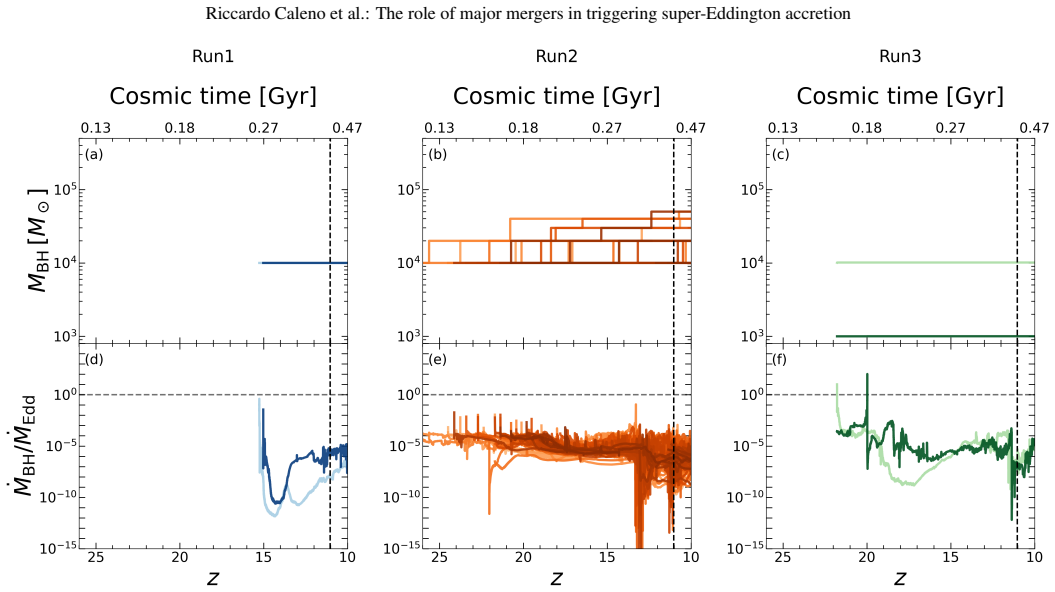
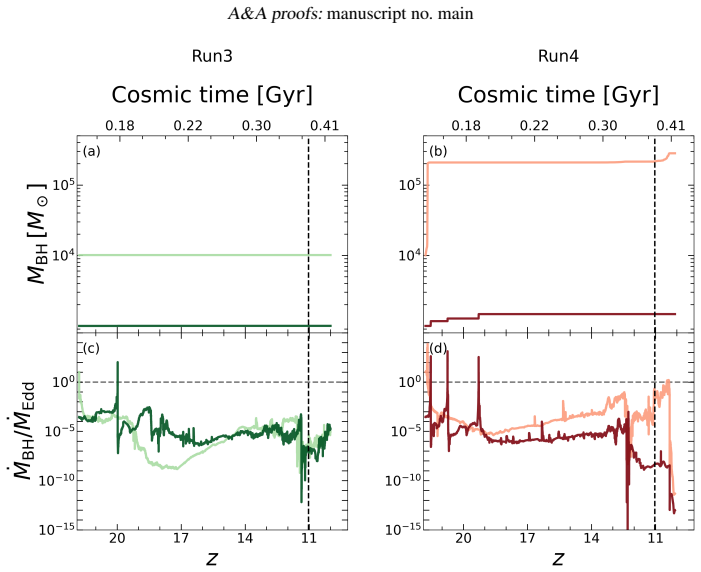
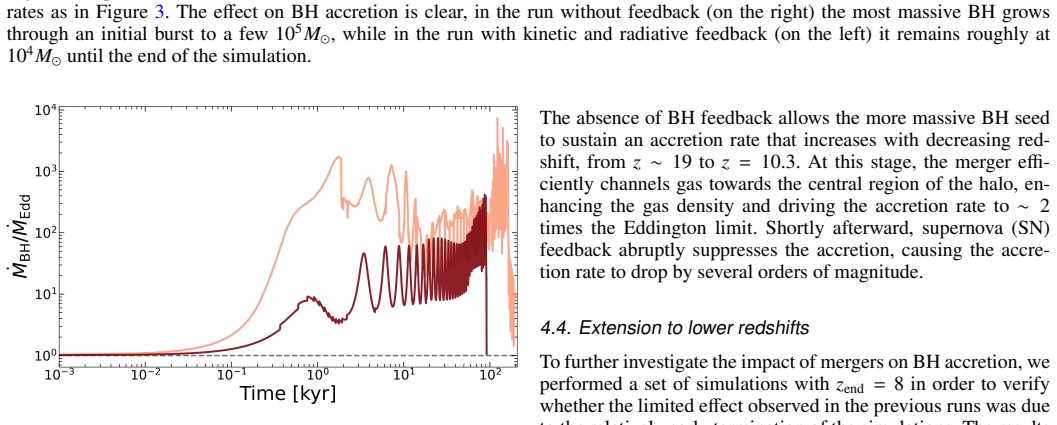
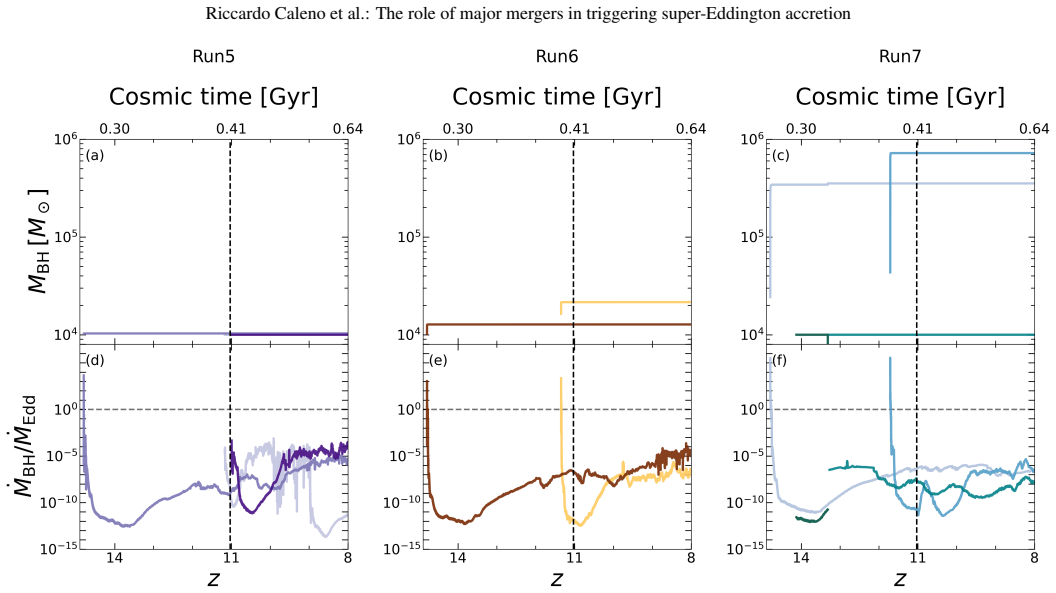
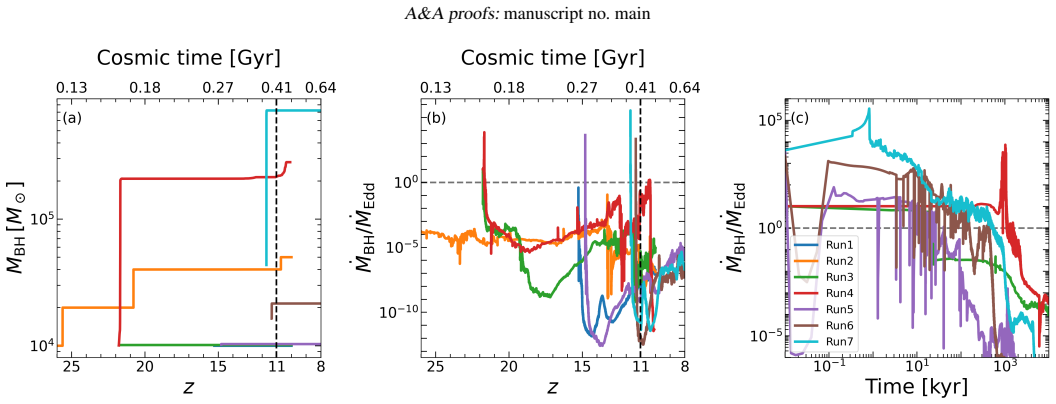
In these simulations the merger drives gas inflows toward the centers yet produces no substantial enhancement of the black hole accretion rate. Sustained super-Eddington episodes occur only immediately after black hole seeding or when all feedback is disabled. Kinetic feedback is the primary channel that limits black hole growth across the explored accretion regimes.
What carries the argument
Cosmological zoom-in simulations with black hole seeding and combined radiative plus kinetic feedback prescriptions applied across ADAF, sub-Eddington, and super-Eddington regimes.
If this is right
- Feedback suppresses gas accretion efficiently enough to prevent substantial black hole growth in these halos.
- Post-merger super-Eddington accretion requires feedback to be absent.
- Kinetic feedback dominates regulation of growth over radiative channels.
- The only notable super-Eddington episodes happen right after seeding rather than during the merger.
Where Pith is reading between the lines
- Mechanisms other than major mergers are likely required to explain the rapid early black hole growth inferred from JWST data.
- Results underscore that accurate feedback modeling is essential for predicting black hole populations in the first galaxies.
- Running equivalent simulations for higher-mass halos or different redshifts could reveal whether mergers matter more in other regimes.
Load-bearing premise
The chosen black hole seeding and feedback prescriptions correctly capture the main physical processes that control gas supply to the black holes in these low-mass halos near redshift 11.
What would settle it
A simulation with the same initial conditions but an alternative feedback implementation that produces sustained super-Eddington accretion after the merger completes.
Figures

read the original abstract
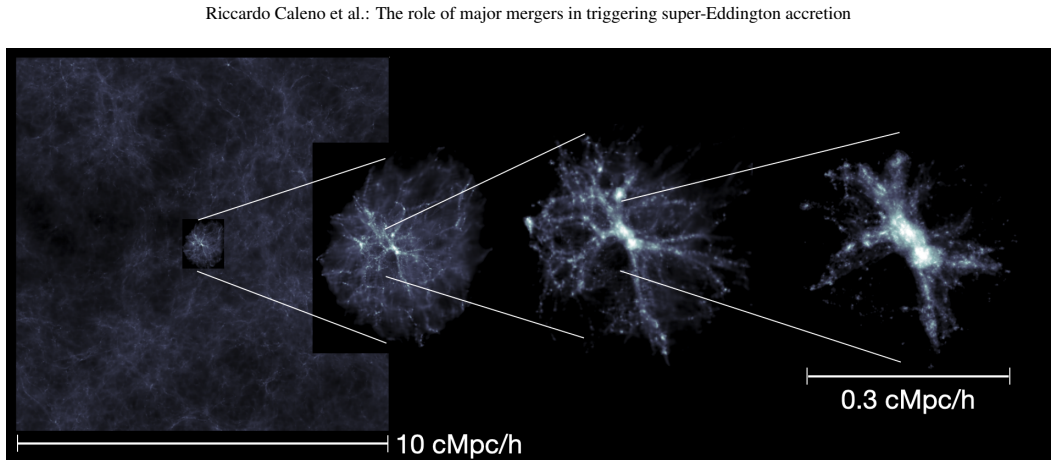
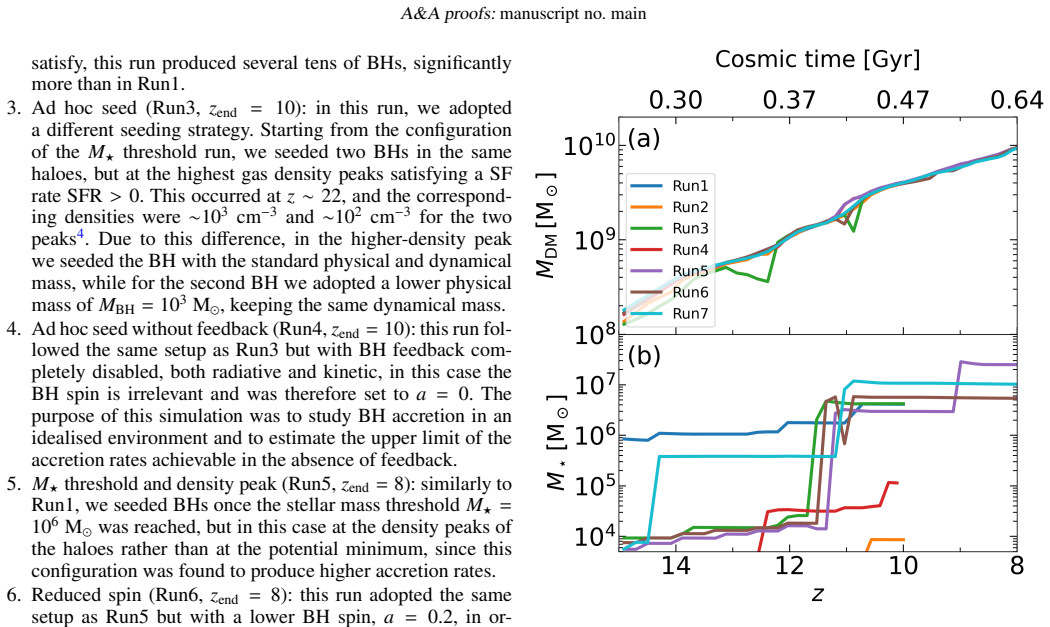
JWST observations have opened a new era in the exploration of the high-redshift Universe, revealing black holes (BHs) with masses of several million solar masses already at $z>8$, challenging our understanding of their growth mechanisms. In this context, super-Eddington (SE) accretion has emerged as a promising solution and has been widely adopted in both numerical simulations and semi-analytical models. In this work, we investigate whether a major merger between two relatively low-mass halos ($M_{\rm halo}\sim10^9\,\mathrm{M_\odot}$) at high redshift can trigger episodes of sustained SE accretion, with particular focus on the role of BH feedback. We employ state-of-the-art, high-resolution cosmological zoom-in simulations of a major merger at $z\sim11$. We explore different prescriptions for BH seeding and feedback, including physically motivated radiative and kinetic models (winds and jets) across the three main accretion regimes: advection-dominated accretion flows (ADAF), radiatively efficient sub-Eddington accretion, and SE accretion. For the relatively low-mass halos studied here, our feedback prescription efficiently suppresses gas accretion, preventing substantial BH growth. We find that, although the merger drives gas inflows towards the central regions, this is not sufficient to trigger sustained SE accretion. Post-merger SE accretion episodes are observed only when BH feedback is entirely switched off. Amongst the feedback channels considered, kinetic feedback is the primary mechanism regulating BH growth. Moreover, the only significant SE accretion episodes occur immediately after BH seeding, while the merger itself does not produce a substantial enhancement of the accretion rate.
Editorial analysis
A structured set of objections, weighed in public.
Referee Report
Summary. The manuscript investigates whether major mergers between low-mass halos (~10^9 M_sun) at z~11 can trigger sustained super-Eddington (SE) accretion onto black holes using high-resolution cosmological zoom-in simulations. The authors explore different BH seeding and feedback prescriptions, including radiative and kinetic models across ADAF, sub-Eddington, and SE regimes. They conclude that BH feedback efficiently suppresses gas accretion, preventing substantial BH growth, and that the merger-driven inflows are not sufficient to trigger sustained SE accretion. SE episodes occur only when feedback is entirely switched off, with kinetic feedback as the primary regulator, and significant SE accretion mainly immediately after BH seeding.
Significance. If the results hold, this work would suggest that major mergers do not play a significant role in triggering the SE accretion required to explain the massive BHs observed at high redshift by JWST. The systematic exploration of multiple feedback channels and accretion regimes provides a useful benchmark for sub-grid physics in simulations of early BH growth. The finding that feedback suppresses accretion in these low-mass systems highlights the sensitivity of high-z BH evolution to modeling choices.
major comments (3)
- [Abstract and Results] Abstract and Results: The central claim that the merger does not produce a substantial enhancement of the accretion rate and that post-merger SE episodes occur only when feedback is off lacks accompanying quantitative accretion-rate histories or time-resolved plots demonstrating the lack of enhancement during the merger phase. Without these, the support for the claim cannot be fully assessed.
- [Methods (feedback prescriptions)] Methods (feedback prescriptions): The conclusion relies on the specific choices for radiative and kinetic feedback efficiencies in the SE regime. No section quantifies the sensitivity of the results to plausible variations in these parameters (e.g., wind coupling or jet efficiency) for 10^9 M_sun halos at z~11, which is a load-bearing assumption given the limited observational constraints at these redshifts.
- [Simulation setup] Simulation setup: No resolution tests, convergence checks, or comparisons with lower-resolution runs are reported, which is essential for validating the gas inflow and accretion dynamics in zoom-in simulations of this type.
minor comments (2)
- [Notation] Ensure consistent use of M_halo and M_{\rm halo} throughout the text.
- [Figures] Figure captions should explicitly state the feedback configuration for each panel to aid interpretation.
Simulated Author's Rebuttal
We thank the referee for their careful and constructive review. Their comments highlight areas where the presentation can be strengthened, and we address each point below.
read point-by-point responses
-
Referee: [Abstract and Results] Abstract and Results: The central claim that the merger does not produce a substantial enhancement of the accretion rate and that post-merger SE episodes occur only when feedback is off lacks accompanying quantitative accretion-rate histories or time-resolved plots demonstrating the lack of enhancement during the merger phase. Without these, the support for the claim cannot be fully assessed.
Authors: The manuscript already presents time-resolved accretion-rate histories in Section 3 (Figure 3), with the merger epoch explicitly marked and separate curves for each feedback prescription. These show no sustained post-merger enhancement when feedback is active. To address the concern directly, we will add an inset or supplementary panel quantifying the pre- versus post-merger accretion-rate ratio (averaged over 10 Myr windows) and will update the abstract to reference these figures explicitly. revision: yes
-
Referee: [Methods (feedback prescriptions)] Methods (feedback prescriptions): The conclusion relies on the specific choices for radiative and kinetic feedback efficiencies in the SE regime. No section quantifies the sensitivity of the results to plausible variations in these parameters (e.g., wind coupling or jet efficiency) for 10^9 M_sun halos at z~11, which is a load-bearing assumption given the limited observational constraints at these redshifts.
Authors: The efficiencies adopted are standard values drawn from the high-redshift simulation literature (cited in the Methods). We acknowledge that a systematic sensitivity study would be desirable. We will add a dedicated paragraph discussing the impact of plausible variations (within a factor of two) and note that the qualitative result—kinetic feedback as the dominant suppressor—remains unchanged. A full parameter exploration lies beyond the scope of the present work but is flagged as important future work. revision: partial
-
Referee: [Simulation setup] Simulation setup: No resolution tests, convergence checks, or comparisons with lower-resolution runs are reported, which is essential for validating the gas inflow and accretion dynamics in zoom-in simulations of this type.
Authors: The adopted gas mass resolution (~10^4 M_⊙) is among the highest used for z~11 zoom-ins. Dedicated convergence tests for this exact merger were not performed owing to computational cost. We will insert a new Methods paragraph that (i) states the resolution explicitly, (ii) notes consistency with our prior lower-resolution runs on analogous systems, and (iii) cites convergence studies from related high-z zoom-in literature to support the adopted resolution. revision: yes
Circularity Check
No circularity: simulation outcomes follow from sub-grid prescriptions without reduction to fitted inputs or self-citations
full rationale
The paper reports results from cosmological zoom-in simulations exploring BH seeding and feedback across ADAF/sub-Eddington/SE regimes. The central finding—that mergers do not trigger sustained SE accretion except when feedback is switched off—emerges directly from the simulation runs under the stated models. No equations or claims reduce a prediction to a parameter fitted from the target result itself, nor does any load-bearing step rely on a self-citation chain that is unverified or self-referential by construction. Model dependence on feedback efficiency is acknowledged as an assumption but does not constitute circularity per the defined patterns.
Axiom & Free-Parameter Ledger
Reference graph
Works this paper leans on
-
[1]
Extremely red galaxies at z=5-9 with MIRI and NIRSpec: dusty galaxies or obscured AGNs?. arXiv e-prints , keywords =. doi:10.48550/arXiv.2305.14418 , archivePrefix =. 2305.14418 , primaryClass =
-
[2]
JWST/NIRSpec First Census of Broad-Line AGNs at z=4-7: Detection of 10 Faint AGNs with M\_BH -0.5ex 10\^6-10\^7 M\_sun and Their Host Galaxy Properties. arXiv e-prints , keywords =. doi:10.48550/arXiv.2303.11946 , archivePrefix =. 2303.11946 , primaryClass =
-
[3]
Hidden Little Monsters: Spectroscopic Identification of Low-Mass, Broad-Line AGN at z>5 with CEERS. arXiv e-prints , keywords =. doi:10.48550/arXiv.2302.00012 , archivePrefix =. 2302.00012 , primaryClass =
-
[4]
A CEERS Discovery of an Accreting Supermassive Black Hole 570 Myr after the Big Bang: Identifying a Progenitor of Massive z > 6 Quasars. arXiv e-prints , keywords =. doi:10.48550/arXiv.2303.08918 , archivePrefix =. 2303.08918 , primaryClass =
-
[5]
NGDEEP Epoch 1: The Faint End of the Luminosity Function at z 9-12 from Ultradeep JWST Imaging. , keywords =. doi:10.3847/2041-8213/acf365 , archivePrefix =. 2306.06244 , primaryClass =
-
[6]
UNCOVER: Candidate Red Active Galactic Nuclei at 3<z<7 with JWST and ALMA. arXiv e-prints , keywords =. doi:10.48550/arXiv.2306.07320 , archivePrefix =. 2306.07320 , primaryClass =
-
[7]
A small and vigorous black hole in the early Universe. , keywords =. doi:10.1038/s41586-024-07052-5 , archivePrefix =. 2305.12492 , primaryClass =
-
[8]
A Candidate for the Least-massive Black Hole in the First 1.1 Billion Years of the Universe. , keywords =. doi:10.3847/2041-8213/aca9d3 , archivePrefix =. 2209.07325 , primaryClass =
-
[9]
Morphologies of Galaxies at z 9 Uncovered by JWST/NIRCam Imaging: Cosmic Size Evolution and an Identification of an Extremely Compact Bright Galaxy at z 12. , keywords =. doi:10.3847/1538-4357/acd44a , archivePrefix =. 2208.13582 , primaryClass =
-
[10]
A massive black hole in a low-metallicity AGN at z 5.55 revealed by JWST/NIRSpec IFS. arXiv e-prints , keywords =. doi:10.48550/arXiv.2302.06647 , archivePrefix =. 2302.06647 , primaryClass =
-
[11]
CEERS Key Paper. VI. JWST/MIRI Uncovers a Large Population of Obscured AGN at High Redshifts. , keywords =. doi:10.3847/2041-8213/acd639 , archivePrefix =. 2303.11736 , primaryClass =
-
[12]
2024, A&A, 691, A145, doi: 10.1051/0004-6361/202347640
JADES: The diverse population of infant black holes at 4 < z < 11: Merging, tiny, poor, but mighty. , keywords =. doi:10.1051/0004-6361/202347640 , archivePrefix =. 2308.01230 , primaryClass =
-
[13]
MUSIC: MUlti-Scale Initial Conditions
-
[14]
Aghanim, N. and Akrami, Y. and Ashdown, M. and Aumont, J. and Baccigalupi, C. and Ballardini, M. and Banday, A. J. and Barreiro, R. B. and Bartolo, N. and Basak, S. and Battye, R. and Benabed, K. and Bernard, J.-P. and Bersanelli, M. and Bielewicz, P. and Bock, J. J. and Bond, J. R. and Borrill, J. and Bouchet, F. R. and Boulanger, F. and Bucher, M. and B...
-
[15]
Young and turbulent: the early life of massive galaxy progenitors , volume=
Fiacconi, Davide and Mayer, Lucio and Madau, Piero and Lupi, Alessandro and Dotti, Massimo and Haardt, Francesco , year=. Young and turbulent: the early life of massive galaxy progenitors , volume=. Monthly Notices of the Royal Astronomical Society , publisher=. doi:10.1093/mnras/stx335 , number=
-
[16]
AHF: Amiga's Halo Finder. , keywords =. doi:10.1088/0067-0049/182/2/608 , archivePrefix =. 0904.3662 , primaryClass =
work page internal anchor Pith review Pith/arXiv arXiv doi:10.1088/0067-0049/182/2/608
-
[17]
Sustained super-Eddington accretion in high-redshift quasars. , keywords =. doi:10.1051/0004-6361/202348788 , archivePrefix =. 2312.08422 , primaryClass =
-
[18]
Size matters: are we witnessing super-Eddington accretion in high-redshift black holes from JWST?. , keywords =. doi:10.1051/0004-6361/202451249 , archivePrefix =. 2406.17847 , primaryClass =
-
[19]
GIZMO: A New Class of Accurate, Mesh-Free Hydrodynamic Simulation Methods
A new class of accurate, mesh-free hydrodynamic simulation methods. , keywords =. doi:10.1093/mnras/stv195 , archivePrefix =. 1409.7395 , primaryClass =
work page internal anchor Pith review Pith/arXiv arXiv doi:10.1093/mnras/stv195
-
[20]
The cosmological simulation code GADGET-2. , keywords =. doi:10.1111/j.1365-2966.2005.09655.x , archivePrefix =. astro-ph/0505010 , primaryClass =
-
[21]
Super-Eddington accretion in high-redshift quasar hosts: Black-hole driven outflows, galaxy quenching, and the nature of little red dots. arXiv e-prints , keywords =. doi:10.48550/arXiv.2505.05556 , archivePrefix =. 2505.05556 , primaryClass =
-
[22]
The [C II]-SFR correlation in dwarf galaxies across cosmic time. , keywords =. doi:10.1093/mnras/staa048 , archivePrefix =. 1905.00431 , primaryClass =
-
[23]
On the low ortho-to-para H _ 2 ratio in star-forming filaments. , keywords =. doi:10.1051/0004-6361/202142145 , archivePrefix =. 2109.02655 , primaryClass =
-
[24]
KROME: Chemistry package for astrophysical simulations
-
[25]
A Simple Law of Star Formation
A Simple Law of Star Formation. , keywords =. doi:10.1088/2041-8205/759/2/L27 , archivePrefix =. 1208.3758 , primaryClass =
work page internal anchor Pith review Pith/arXiv arXiv doi:10.1088/2041-8205/759/2/l27 2041
-
[26]
Monthly Notices of the Royal Astronomical Society , volume =
Lupi, Alessandro , title =. Monthly Notices of the Royal Astronomical Society , volume =. 2019 , month =. doi:10.1093/mnras/stz100 , url =
-
[27]
2001, MNRAS, 322, 231, doi: 10.1046/j.1365-8711.2001.04022.x
On the variation of the initial mass function. , keywords =. doi:10.1046/j.1365-8711.2001.04022.x , archivePrefix =. astro-ph/0009005 , primaryClass =
-
[28]
Evidence for heavy-seed origin of early supermassive black holes from a z 10 X-ray quasar. Nature Astronomy , keywords =. doi:10.1038/s41550-023-02111-9 , archivePrefix =. 2305.15458 , primaryClass =
-
[29]
Relations between Central Black Hole Mass and Total Galaxy Stellar Mass in the Local Universe. , keywords =. doi:10.1088/0004-637X/813/2/82 , archivePrefix =. 1508.06274 , primaryClass =
work page internal anchor Pith review Pith/arXiv arXiv doi:10.1088/0004-637x/813/2/82
-
[30]
Masses of quasars. , keywords =. doi:10.1093/mnras/200.1.115 , adsurl =
-
[31]
The low-end of the black hole mass function at cosmic dawn. , keywords =. doi:10.1093/mnras/stac062 , archivePrefix =. 2201.02630 , primaryClass =
-
[32]
Seeking the growth of the first black hole seeds with JWST. , keywords =. doi:10.1093/mnras/stac3768 , archivePrefix =. 2211.01389 , primaryClass =
-
[33]
Exploring the nature of UV-bright z 10 galaxies detected by JWST: star formation, black hole accretion, or a non-universal IMF?. , keywords =. doi:10.1093/mnras/stae651 , archivePrefix =. 2305.04944 , primaryClass =
-
[34]
Episodic super-Eddington accretion as a clue to Overmassive Black Holes in the early Universe. arXiv e-prints , keywords =. doi:10.48550/arXiv.2412.14248 , archivePrefix =. 2412.14248 , primaryClass =
-
[35]
Super-critical accretion of medium-weight seed black holes in gaseous proto-galactic nuclei. , keywords =. doi:10.1093/mnras/stac3608 , archivePrefix =. 2204.10330 , primaryClass =
-
[36]
Super-Eddington accretion in protogalactic cores
Super-Eddington accretion in protogalactic cores. , keywords =. doi:10.1051/0004-6361/202557006 , archivePrefix =. 2508.21114 , primaryClass =
work page internal anchor Pith review Pith/arXiv arXiv doi:10.1051/0004-6361/202557006
-
[37]
How the super-Eddington regime regulates black hole growth in high-redshift galaxies. , keywords =. doi:10.1051/0004-6361/202243170 , archivePrefix =. 2201.08766 , primaryClass =
-
[38]
Slim Accretion Disks. , keywords =. doi:10.1086/166683 , adsurl =
-
[39]
Slim disks around Kerr black holes revisited
Slim Disks Around Kerr Black Holes Revisited. , keywords =. doi:10.1088/0067-0049/183/2/171 , archivePrefix =. 0906.0355 , primaryClass =
work page internal anchor Pith review Pith/arXiv arXiv doi:10.1088/0067-0049/183/2/171
-
[40]
The effects of super-Eddington accretion and feedback on the growth of early supermassive black holes and galaxies. , keywords =. doi:10.1093/mnras/staf146 , archivePrefix =. 2410.09450 , primaryClass =
-
[41]
A hybrid active galactic nucleus feedback model with spinning black holes, winds and jets. , keywords =. doi:10.1093/mnras/stag324 , archivePrefix =. 2509.05179 , primaryClass =
-
[42]
Recipes for Jet Feedback and Spin Evolution of Black Holes with Strongly Magnetized Super-Eddington Accretion Disks. , keywords =. doi:10.3847/2041-8213/aceda5 , archivePrefix =. 2307.04621 , primaryClass =
-
[43]
Super-Critical Growth of Massive Black Holes from Stellar-Mass Seeds
Super-critical Growth of Massive Black Holes from Stellar-mass Seeds. , keywords =. doi:10.1088/2041-8205/784/2/L38 , archivePrefix =. 1402.6995 , primaryClass =
work page internal anchor Pith review Pith/arXiv arXiv doi:10.1088/2041-8205/784/2/l38 2041
-
[44]
Magnetic Flux of Progenitor Stars Sets Gamma-ray Burst Luminosity and Variability
Magnetic flux of progenitor stars sets gamma-ray burst luminosity and variability. , keywords =. doi:10.1093/mnras/stu2229 , archivePrefix =. 1409.4414 , primaryClass =
work page internal anchor Pith review Pith/arXiv arXiv doi:10.1093/mnras/stu2229
-
[45]
Energy flows in thick accretion disks and their consequences for black hole feedback
Energy flows in thick accretion discs and their consequences for black hole feedback. , keywords =. doi:10.1093/mnras/stv2854 , archivePrefix =. 1510.08845 , primaryClass =
work page internal anchor Pith review Pith/arXiv arXiv doi:10.1093/mnras/stv2854
-
[46]
Magnetically Arrested Disk: An Energetically Efficient Accretion Flow
Magnetically Arrested Disk: an Energetically Efficient Accretion Flow. , keywords =. doi:10.1093/pasj/55.6.L69 , archivePrefix =. astro-ph/0305029 , primaryClass =
work page internal anchor Pith review Pith/arXiv arXiv doi:10.1093/pasj/55.6.l69
-
[47]
Three-dimensional simulations of supercritical black hole accretion discs - luminosities, photon trapping and variability. , keywords =. doi:10.1093/mnras/stv2941 , archivePrefix =. 1509.03168 , primaryClass =
work page internal anchor Pith review Pith/arXiv arXiv doi:10.1093/mnras/stv2941
-
[48]
A novel subgrid model for super-Eddington accretion of spinning black holes in galaxy-scale simulations. , keywords =. doi:10.1093/mnras/stag003 , archivePrefix =. 2504.19281 , primaryClass =
-
[49]
Growing massive black holes through super-critical accretion of stellar-mass seeds
Growing massive black holes through supercritical accretion of stellar-mass seeds. , keywords =. doi:10.1093/mnras/stv2877 , archivePrefix =. 1512.02651 , primaryClass =
work page internal anchor Pith review Pith/arXiv arXiv doi:10.1093/mnras/stv2877
-
[50]
Rapid emergence of overmassive black holes in the early Universe. arXiv e-prints , keywords =. doi:10.48550/arXiv.2601.04955 , archivePrefix =. 2601.04955 , primaryClass =
-
[51]
arXiv e-prints , keywords =
Growth of Light Seed Black Holes in the Early Universe. arXiv e-prints , keywords =
-
[52]
arXiv e-prints , keywords =
The importance of super-Eddington black hole accretion for the emergence of massive quiescent galaxies at high redshift. arXiv e-prints , keywords =
-
[53]
Super-Eddington Accretion and Feedback from the First Massive Seed Black Holes
Super-Eddington accretion and feedback from the first massive seed black holes. , keywords =. doi:10.1093/mnras/stz1045 , archivePrefix =. 1811.04953 , primaryClass =
work page internal anchor Pith review Pith/arXiv arXiv doi:10.1093/mnras/stz1045
-
[54]
Enhanced star formation in z 6 quasar companions. , keywords =. doi:10.1093/mnras/stac978 , archivePrefix =. 2204.03658 , primaryClass =
-
[55]
, year = 1916, month = nov, volume =
On the radiative equilibrium of the stars. , year = 1916, month = nov, volume =. doi:10.1093/mnras/77.1.16 , adsurl =
-
[56]
Turbulent cold flows gave birth to the first quasars. , keywords =. doi:10.1038/s41586-022-04813-y , archivePrefix =. 2207.05093 , primaryClass =
-
[57]
Forming massive seed black holes in high-redshift quasar host progenitors. , keywords =. doi:10.1093/mnras/stab692 , archivePrefix =. 2102.05051 , primaryClass =
-
[58]
The formation of direct collapse black holes under the influence of streaming velocities
The formation of direct collapse black holes under the influence of streaming velocities. , keywords =. doi:10.1093/mnras/stx1915 , archivePrefix =. 1705.02347 , primaryClass =
work page internal anchor Pith review Pith/arXiv arXiv doi:10.1093/mnras/stx1915
-
[59]
Systematic broad-band X-ray study of super-Eddington accretion on to supermassive black holes - I. X-ray continuum. , keywords =. doi:10.1093/mnras/stac3590 , archivePrefix =. 2212.06183 , primaryClass =
-
[60]
Supermassive Black Holes with High Accretion Rates in Active Galactic Nuclei. IX. 10 New Observations of Reverberation Mapping and Shortened H Lags. , keywords =. doi:10.3847/1538-4357/aaae6b , archivePrefix =. 1802.03022 , primaryClass =
work page internal anchor Pith review Pith/arXiv arXiv doi:10.3847/1538-4357/aaae6b
-
[61]
An Ultraluminous X-ray Source Powered by An Accreting Neutron Star
An ultraluminous X-ray source powered by an accreting neutron star. , keywords =. doi:10.1038/nature13791 , archivePrefix =. 1410.3590 , primaryClass =
work page internal anchor Pith review Pith/arXiv arXiv doi:10.1038/nature13791
-
[62]
The nature of SS433 and the ultraluminous X-ray sources. , keywords =. doi:10.1111/j.1365-2966.2006.10469.x , archivePrefix =. astro-ph/0604497 , primaryClass =
-
[63]
Foundations of Black Hole Accretion Disk Theory
Foundations of Black Hole Accretion Disk Theory. Living Reviews in Relativity , keywords =. doi:10.12942/lrr-2013-1 , archivePrefix =. 1104.5499 , primaryClass =
work page internal anchor Pith review Pith/arXiv arXiv doi:10.12942/lrr-2013-1 2013
-
[64]
Weakness of X-rays and variability in high-redshift active galactic nuclei with super-Eddington accretion. , keywords =. doi:10.1093/pasj/psaf050 , archivePrefix =. 2412.03653 , primaryClass =
-
[65]
2024, ApJL, 976, L24, doi: 10.3847/2041-8213/ad90e1
X-Ray Weak Active Galactic Nuclei from Super-Eddington Accretion onto Infant Black Holes. , keywords =. doi:10.3847/2041-8213/ad90e1 , archivePrefix =. 2410.00417 , primaryClass =
-
[66]
Planck 2015 results. XIII. Cosmological parameters. , keywords =. doi:10.1051/0004-6361/201525830 , archivePrefix =. 1502.01589 , primaryClass =
work page internal anchor Pith review Pith/arXiv arXiv doi:10.1051/0004-6361/201525830 2015
-
[67]
Monthly Notices of the Royal Astronomical Society , volume =
Jets in magnetically arrested hot accretion flows: geometry, power, and black hole spin-down. , keywords =. doi:10.1093/mnras/stac285 , archivePrefix =. 2108.12380 , primaryClass =
-
[68]
Analytic properties of force-free jets in the Kerr spacetime- I
Analytic Properties of Force-free Jets in the Kerr Spacetime - I. , keywords =. doi:10.1088/0004-637X/812/1/57 , archivePrefix =. 1504.04864 , primaryClass =
work page internal anchor Pith review Pith/arXiv arXiv doi:10.1088/0004-637x/812/1/57
-
[69]
arXiv e-prints , keywords =
Black Hole Feedback, Galaxy Quenching and Outflows at Cosmic Dawn: Analysis of the SEEDZ Simulations. arXiv e-prints , keywords =
-
[70]
Hyper-Eddington accretion flows onto massive black holes
Hyper-Eddington accretion flows on to massive black holes. , keywords =. doi:10.1093/mnras/stw836 , archivePrefix =. 1511.02116 , primaryClass =
work page internal anchor Pith review Pith/arXiv arXiv doi:10.1093/mnras/stw836
-
[71]
The formation of the first quasars: the black hole seeds, accretion, and feedback models. , keywords =. doi:10.1093/mnras/stac1556 , archivePrefix =. 2012.01458 , primaryClass =
-
[72]
Chaotic cold accretion onto black holes
Chaotic cold accretion on to black holes. , keywords =. doi:10.1093/mnras/stt692 , archivePrefix =. 1301.3130 , primaryClass =
work page internal anchor Pith review Pith/arXiv arXiv doi:10.1093/mnras/stt692
-
[73]
Massive Black Holes as Population III Remnants
Massive Black Holes as Population III Remnants. , keywords =. doi:10.1086/319848 , archivePrefix =. astro-ph/0101223 , primaryClass =
work page internal anchor Pith review Pith/arXiv arXiv doi:10.1086/319848
-
[74]
Can Supermassive Black Holes Form in Metal-Enriched High-Redshift Protogalaxies ?
Can Supermassive Black Holes Form in Metal-enriched High-Redshift Protogalaxies?. , keywords =. doi:10.1086/591636 , archivePrefix =. 0804.3141 , primaryClass =
work page internal anchor Pith review Pith/arXiv arXiv doi:10.1086/591636
-
[75]
High-redshift formation and evolution of central massive objects - II. The census of BH seeds. , keywords =. doi:10.1111/j.1365-2966.2012.20406.x , archivePrefix =. 1201.3761 , primaryClass =
-
[76]
Pathways to massive black holes and compact star clusters in pre-galactic dark matter haloes with virial temperatures > -0.5ex 10000K. , keywords =. doi:10.1111/j.1365-2966.2009.14579.x , archivePrefix =. 0810.2802 , primaryClass =
-
[77]
Rapidly Accreting Supergiant Protostars: Embryos of Supermassive Black Holes?
Rapidly Accreting Supergiant Protostars: Embryos of Supermassive Black Holes?. , keywords =. doi:10.1088/0004-637X/756/1/93 , archivePrefix =. 1203.2613 , primaryClass =
work page internal anchor Pith review Pith/arXiv arXiv doi:10.1088/0004-637x/756/1/93
-
[78]
Cosmological Simulations of Early Black Hole Formation: Halo Mergers, Tidal Disruption, and the Conditions for Direct Collapse. , keywords =. doi:10.3847/0004-637X/832/2/134 , archivePrefix =. 1603.08923 , primaryClass =
work page internal anchor Pith review Pith/arXiv arXiv doi:10.3847/0004-637x/832/2/134
-
[79]
Direct Formation of Supermassive Black Holes in Metal-enriched Gas at the Heart of High-redshift Galaxy Mergers. , keywords =. doi:10.1088/0004-637X/810/1/51 , archivePrefix =. 1411.5683 , primaryClass =
work page internal anchor Pith review Pith/arXiv arXiv doi:10.1088/0004-637x/810/1/51
-
[80]
2025, MNRAS, 539, 2561, doi: 10.1093/mnras/staf598
Formation of supermassive stars and dense star clusters in metal-poor clouds exposed to strong FUV radiation. , keywords =. doi:10.1093/mnras/staf598 , archivePrefix =. 2412.14900 , primaryClass =
discussion (0)
Sign in with ORCID, Apple, or X to comment. Anyone can read and Pith papers without signing in.