Super-Kamiokande Strongly Constrains Leptophilic Dark Matter Capture in the Sun
Pith reviewed 2026-05-23 04:35 UTC · model grok-4.3
The pith
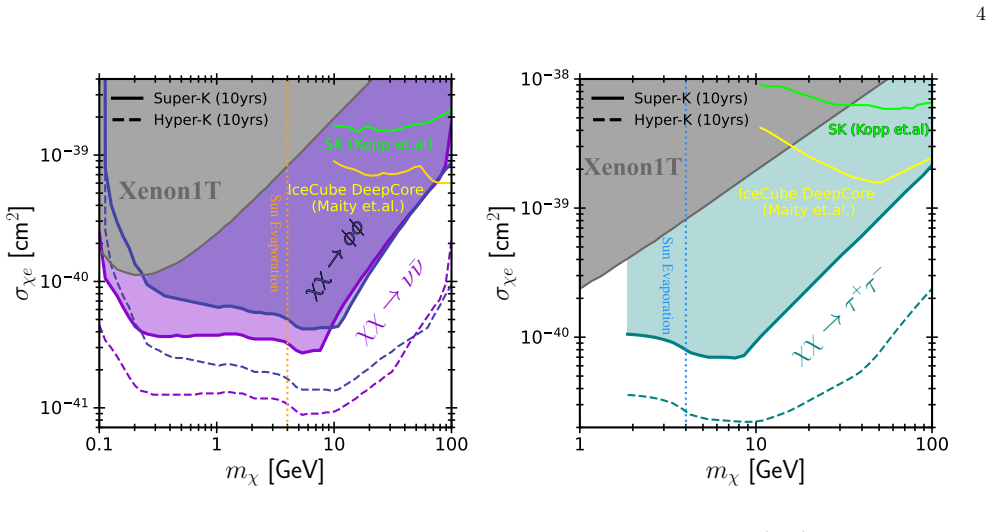
Super-Kamiokande data from the Sun constrains dark matter-electron scattering cross sections to ~4×10^{-41} cm² for masses below 100 GeV.
A machine-rendered reading of the paper's core claim, the machinery that carries it, and where it could break.
Core claim
Using 10 years of Super-Kamiokande observations, we set constraints on the dark-matter/electron scattering cross-section that exceed terrestrial direct detection searches by more than an order of magnitude for dark matter masses below 100 GeV, and reach cross-sections as low as ∼4×10^{-41}cm^{-2}.
What carries the argument
Solar capture of leptophilic dark matter via scattering on free electrons, followed by annihilation into leptonic final states that yield a detectable neutrino flux.
If this is right
- For dark matter masses below 100 GeV the solar neutrino channel excludes scattering cross sections more than ten times smaller than current direct detection reach.
- Cross sections down to approximately 4×10^{-41} cm^{-2} are ruled out for leptophilic models that annihilate to leptons.
- The Sun serves as an effective target for leptophilic dark matter that would otherwise be hard to detect in underground experiments.
Where Pith is reading between the lines
- Non-observation of solar neutrinos can exclude regions of leptophilic parameter space that remain open to laboratory searches.
- The same capture-and-annihilation logic could be applied to other neutrino telescopes to extend the mass and cross-section coverage.
- If leptophilic dark matter exists near the reported limit, next-generation neutrino detectors should see a corresponding solar signal.
Load-bearing premise
Leptophilic dark matter captured in the Sun must annihilate into leptonic states that produce a detectable neutrino flux.
What would settle it
A confirmed neutrino excess from the Sun whose spectrum and rate match the expected signal from dark matter annihilation at a scattering cross section above 4×10^{-41} cm² for a mass below 100 GeV.
Figures



read the original abstract
The Sun can efficiently capture leptophilic dark matter that scatters with free electrons. If this dark matter subsequently annihilates into leptonic states, it can produce a detectable neutrino flux. Using 10 years of Super-Kamiokande observations, we set constraints on the dark-matter/electron scattering cross-section that exceed terrestrial direct detection searches by more than an order of magnitude for dark matter masses below 100 GeV, and reach cross-sections as low as $\sim$4$\times$10$^{-41}$cm$^{-2}$.
Editorial analysis
A structured set of objections, weighed in public.
Referee Report
Summary. The manuscript claims that 10 years of Super-Kamiokande data can be used to set upper limits on the DM-electron scattering cross section for leptophilic dark matter captured in the Sun. Under the assumption that the captured DM annihilates into leptonic final states that produce a detectable neutrino flux, the resulting limits are stronger than those from terrestrial direct-detection experiments by more than an order of magnitude for DM masses below 100 GeV and reach cross sections as low as ∼4×10^{-41} cm^{-2}.
Significance. If the analysis holds, the result illustrates the complementary power of solar-capture neutrino searches for leptophilic DM models, extending sensitivity below the reach of current direct-detection experiments in the sub-100 GeV range. The conditional framing of the annihilation channel is stated explicitly in the abstract.
minor comments (2)
- The abstract supplies the final numerical limit but contains no description of the analysis pipeline, background model, capture-rate formalism, or systematic uncertainties; while the full manuscript presumably contains these details, the abstract should at minimum indicate the key methodological ingredients so that the quoted bound can be evaluated at a glance.
- The central claim is explicitly conditional on leptophilic DM annihilating into leptonic states that yield neutrinos; this condition is stated upfront rather than hidden, so the reported cross-section limits apply only under that scenario.
Simulated Author's Rebuttal
We thank the referee for their positive summary of the manuscript and for recommending minor revision. The report does not list any specific major comments.
Circularity Check
No significant circularity; data-driven limits under explicit condition
full rationale
The paper reports upper limits on the DM-electron scattering cross section derived from 10 years of Super-Kamiokande neutrino observations. The central result is conditional on leptophilic DM capture followed by annihilation into leptonic states that produce a detectable neutrino flux; this condition is stated explicitly in the abstract rather than derived internally. No equations, parameters, or results are shown to reduce by construction to fitted inputs, self-citations, or prior ansatze from the same authors. The derivation chain consists of standard capture-rate calculations and observational flux limits, which remain independent of the reported cross-section bounds.
Axiom & Free-Parameter Ledger
Forward citations
Cited by 4 Pith papers
-
Impact of Evaporation Barriers on Solar-Captured Dark Matter Distribution and Evaporation Mass
Orbit-space calculation shows that a smooth in-medium attraction barrier suppresses evaporation of solar-captured dark matter by reshaping near-threshold phase space and lowering the evaporation mass.
-
Monochromatic neutrinos from scotogenic dark matter
A modified scotogenic model makes the lightest pseudo-Dirac singlet a dark matter candidate that annihilates mostly to neutrino pairs near threshold, reproducing the relic abundance while satisfying direct detection a...
-
INTEGRAL, eROSITA and Voyager Constraints on Light Bosonic Dark Matter: ALPs, Dark Photons, Scalars, $B-L$ and $L_{i}-L_{j}$ Vectors
This work sets new upper limits on decay lifetimes and couplings for axion-like particles, dark photons, scalars, and B-L or L_i-L_j vector bosons using 511 keV line, X-ray continuum, and cosmic-ray flux observations.
-
Monochromatic neutrinos from scotogenic dark matter
A variation of the scotogenic model makes the lightest pseudo-Dirac fermion singlet a dark matter candidate that annihilates with 90% branching ratio into neutrino pairs near threshold, yielding the observed relic abu...
Reference graph
Works this paper leans on
-
[1]
Particle Dark Matter: Evidence, Candidates and Constraints
G. Bertone, D. Hooper, and J. Silk, Phys. Rept. 405, 279 (2005), arXiv:hep-ph/0404175
work page internal anchor Pith review Pith/arXiv arXiv 2005
-
[2]
G. Bertone and D. Hooper, Rev. Mod. Phys. 90, 045002 (2018), arXiv:1605.04909 [astro-ph.CO]
work page internal anchor Pith review Pith/arXiv arXiv 2018
-
[3]
M. Cirelli, A. Strumia, and J. Zupan, (2024), arXiv:2406.01705 [hep-ph]
work page internal anchor Pith review Pith/arXiv arXiv 2024
-
[4]
Y. Kahn and T. Lin, Rept. Prog. Phys. 85, 066901 (2022), arXiv:2108.03239 [hep-ph]. 11
- [5]
-
[6]
TASI lectures on dark matter models and direct detection
T. Lin, PoS 333, 009 (2019), arXiv:1904.07915 [hep-ph]
work page internal anchor Pith review Pith/arXiv arXiv 2019
- [7]
-
[8]
R. Essig et al. , in Snowmass 2021 (2022) arXiv:2203.08297 [hep-ph]
-
[9]
Aprileet al.(XENON), The XENONnT dark mat- ter experiment, Eur
E. Aprile et al. (XENON), Eur. Phys. J. C 84, 784 (2024), arXiv:2402.10446 [physics.ins-det]
-
[10]
J. Aalbers et al. (LZ), Commun. Phys. 7, 292 (2024), arXiv:2406.02441 [hep-ex]
- [11]
-
[12]
Detecting Dark Matter with Imploding Pulsars in the Galactic Center
J. Bramante and T. Linden, Phys. Rev. Lett. 113, 191301 (2014), arXiv:1405.1031 [astro-ph.HE]
work page internal anchor Pith review Pith/arXiv arXiv 2014
-
[13]
Dark Kinetic Heating of Neutron Stars and An Infrared Window On WIMPs, SIMPs, and Pure Higgsinos
M. Baryakhtar, J. Bramante, S. W. Li, T. Linden, and N. Raj, Phys. Rev. Lett. 119, 131801 (2017), arXiv:1704.01577 [hep-ph]
work page internal anchor Pith review Pith/arXiv arXiv 2017
-
[14]
P. J. Fox and E. Poppitz, Phys. Rev. D 79, 083528 (2009), arXiv:0811.0399 [hep-ph]
work page internal anchor Pith review Pith/arXiv arXiv 2009
-
[15]
Gamma-ray and radio tests of the e+e- excess from DM annihilations
G. Bertone, M. Cirelli, A. Strumia, and M. Taoso, JCAP 03, 009 (2009), arXiv:0811.3744 [astro-ph]
work page internal anchor Pith review Pith/arXiv arXiv 2009
-
[16]
I. John and T. Linden, Phys. Rev. D 108, 103022 (2023), arXiv:2304.07317 [hep-ph]
-
[17]
I. John and T. Linden, JCAP 12, 007 (2021), arXiv:2107.10261 [astro-ph.HE]
- [18]
- [19]
-
[20]
Decaying Dark Matter can explain the electron/positron excesses
E. Nardi, F. Sannino, and A. Strumia, JCAP 01, 043 (2009), arXiv:0811.4153 [hep-ph]
work page internal anchor Pith review Pith/arXiv arXiv 2009
- [21]
-
[22]
A. Berlin and D. Hooper, Phys. Rev. D 110, 075018 (2024), arXiv:2407.04768 [hep-ph]
-
[23]
K.-W. Ng, K. A. Olive, and M. Srednicki, Phys. Lett. B 188, 138 (1987)
work page 1987
-
[24]
B. Chauhan, M. H. Reno, C. Rott, and I. Sarcevic, JCAP 01, 030 (2024), arXiv:2308.16134 [hep-ph]
- [25]
-
[26]
Dark matter in the Sun: scattering off electrons vs nucleons
R. Garani and S. Palomares-Ruiz, JCAP 05, 007 (2017), arXiv:1702.02768 [hep-ph]
work page internal anchor Pith review Pith/arXiv arXiv 2017
- [27]
-
[28]
A. Albert et al. (HAWC), Phys. Rev. Lett. 131, 051201 (2023), arXiv:2212.00815 [astro-ph.HE]
-
[29]
M. U. Nisa, J. F. Beacom, S. Y. BenZvi, R. K. Leane, T. Linden, K. C. Y. Ng, A. H. G. Peter, and B. Zhou, (2019), arXiv:1903.06349 [astro-ph.HE]
work page internal anchor Pith review Pith/arXiv arXiv 2019
-
[30]
A. Albert et al. (HAWC), Phys. Rev. D 98, 123012 (2018), arXiv:1808.05624 [hep-ph]
work page internal anchor Pith review Pith/arXiv arXiv 2018
-
[31]
R. Abbasi et al. (IceCube), Phys. Rev. D 105, 062004 (2022), arXiv:2111.09970 [astro-ph.HE]
-
[32]
R. K. Leane, K. C. Y. Ng, and J. F. Beacom, Phys. Rev. D 95, 123016 (2017), arXiv:1703.04629 [astro-ph.HE]
work page internal anchor Pith review Pith/arXiv arXiv 2017
- [33]
-
[34]
N. F. Bell and K. Petraki, JCAP 04, 003 (2011), arXiv:1102.2958 [hep-ph]
work page internal anchor Pith review Pith/arXiv arXiv 2011
- [35]
-
[36]
N. F. Bell, A. J. Brennan, and T. D. Jacques, JCAP 10, 045 (2012), arXiv:1206.2977 [hep-ph]
work page internal anchor Pith review Pith/arXiv arXiv 2012
-
[37]
C. Niblaeus, A. Beniwal, and J. Edsjo, JCAP 11, 011 (2019), arXiv:1903.11363 [astro-ph.HE]
-
[38]
Neutrinos from cosmic ray interactions in the Sun
J. Edsjo, J. Elevant, R. Enberg, and C. Niblaeus, JCAP 06, 033 (2017), arXiv:1704.02892 [astro-ph.HE]
work page internal anchor Pith review Pith/arXiv arXiv 2017
- [39]
-
[40]
M. G. Aartsen et al. (IceCube), JCAP 04, 022 (2016), arXiv:1601.00653 [hep-ph]
work page internal anchor Pith review Pith/arXiv arXiv 2016
-
[41]
J. L. Feng, J. Smolinsky, and P. Tanedo, Phys. Rev. D 93, 115036 (2016), [Erratum: Phys.Rev.D 96, 099903 (2017)], arXiv:1602.01465 [hep-ph]
work page internal anchor Pith review Pith/arXiv arXiv 2016
-
[42]
WIMP Annihilation and Cooling of Neutron Stars
C. Kouvaris, Phys. Rev. D 77, 023006 (2008), arXiv:0708.2362 [astro-ph]
work page internal anchor Pith review Pith/arXiv arXiv 2008
-
[43]
Probing Light Dark Matter via Evaporation from the Sun
C. Kouvaris, Phys. Rev. D 92, 075001 (2015), arXiv:1506.04316 [hep-ph]
work page internal anchor Pith review Pith/arXiv arXiv 2015
-
[44]
The Spectrum of Darkonium in the Sun
C. Kouvaris, K. Langæble, and N. G. Nielsen, JCAP 10, 012 (2016), arXiv:1607.00374 [hep-ph]
work page internal anchor Pith review Pith/arXiv arXiv 2016
-
[45]
Thermalization time scales for WIMP capture by the Sun in effective theories
A. Widmark, JCAP 05, 046 (2017), arXiv:1703.06878 [hep-ph]
work page internal anchor Pith review Pith/arXiv arXiv 2017
-
[46]
WIMP capture by the Sun in the effective theory of dark matter self-interactions
R. Catena and A. Widmark, JCAP 12, 016 (2016), arXiv:1609.04825 [astro-ph.CO]
work page internal anchor Pith review Pith/arXiv arXiv 2016
-
[47]
Does Solar Physics Provide Constraints to Weakly Interacting Massive Particles?
A. Bottino, G. Fiorentini, N. Fornengo, B. Ricci, S. Scopel, and F. L. Villante, Phys. Rev. D 66, 053005 (2002), arXiv:hep-ph/0206211
work page internal anchor Pith review Pith/arXiv arXiv 2002
-
[48]
A novel way of constraining WIMPs annihilations in the Sun: MeV neutrinos
N. Bernal, J. Mart´ ın-Albo, and S. Palomares-Ruiz, JCAP 08, 011 (2013), arXiv:1208.0834 [hep-ph]
work page internal anchor Pith review Pith/arXiv arXiv 2013
- [49]
- [50]
- [51]
- [52]
-
[53]
C. Ilie and C. Levy, Phys. Rev. D 104, 083033 (2021), arXiv:2105.09765 [astro-ph.CO]
-
[54]
C. Ilie, Astrophys. J. 970, 159 (2024), arXiv:2402.07713 [astro-ph.CO]
- [55]
-
[56]
D. Krishna, R. Sherpa, A. K. Saha, T. N. Maity, R. Laha, and N. Raj, (2025), arXiv:2503.07713 [hep-ph]
- [57]
- [58]
- [59]
-
[60]
PPPC 4 DM ID: A Poor Particle Physicist Cookbook for Dark Matter Indirect Detection
M. Cirelli, G. Corcella, A. Hektor, G. Hutsi, M. Kadastik, P. Panci, M. Raidal, F. Sala, and A. Strumia, JCAP 03, 051 (2011), [Erratum: JCAP 10, E01 (2012)], arXiv:1012.4515 [hep-ph]
work page internal anchor Pith review Pith/arXiv arXiv 2011
-
[61]
PPPC 4 DM$\nu$: A Poor Particle Physicist Cookbook for Neutrinos from DM annihilations in the Sun
P. Baratella, M. Cirelli, A. Hektor, J. Pata, M. Piibeleht, and A. Strumia, JCAP 03, 053 (2014), arXiv:1312.6408 [hep-ph]. 12
work page internal anchor Pith review Pith/arXiv arXiv 2014
-
[62]
C. Rott, J. Siegal-Gaskins, and J. F. Beacom, Phys. Rev. D 88, 055005 (2013), arXiv:1208.0827 [astro-ph.HE]
work page internal anchor Pith review Pith/arXiv arXiv 2013
- [63]
- [64]
- [65]
-
[66]
J. Kopp, V. Niro, T. Schwetz, and J. Zupan, Phys. Rev. D 80, 083502 (2009), arXiv:0907.3159 [hep-ph]
work page internal anchor Pith review Pith/arXiv arXiv 2009
-
[67]
Shiozawa (Super-Kamiokande), Nucl
M. Shiozawa (Super-Kamiokande), Nucl. Instrum. Meth. A 433, 240 (1999)
work page 1999
-
[68]
E. Drakopoulou, G. A. Cowan, M. D. Needham, S. Playfer, and M. Taani, JINST 13, P04009 (2018), arXiv:1710.05668 [physics.ins-det]
work page internal anchor Pith review Pith/arXiv arXiv 2018
- [69]
-
[70]
M. Jiang et al. (Super-Kamiokande), PTEP 2019, 053F01 (2019), arXiv:1901.03230 [hep-ex]
-
[71]
E. Richard et al. (Super-Kamiokande), Phys. Rev. D 94, 052001 (2016), arXiv:1510.08127 [hep-ex]
work page internal anchor Pith review Pith/arXiv arXiv 2016
-
[72]
E. Konishi, Y. Minorikawa, V. I. Galkin, M. Ishiwata, I. Nakamura, N. Takahashi, M. Kato, and A. Misaki, (2010), arXiv:1007.3812 [hep-ex]
work page internal anchor Pith review Pith/arXiv arXiv 2010
-
[73]
E. Konishi, Y. Minorikawa, V. I. Galkin, M. Ishiwata, I. Nakamura, N. Takahashi, M. Kato, and A. Misaki (2011) arXiv:1108.1064 [hep-ex]
work page internal anchor Pith review Pith/arXiv arXiv 2011
-
[74]
V. I. Galkin, A. M. Anokhina, E. Konishi, and A. Misaki, (2008), arXiv:0808.0824 [hep-ex]
work page internal anchor Pith review Pith/arXiv arXiv 2008
-
[75]
S. Robles and S. A. Meighen-Berger, (2024), arXiv:2411.04435 [hep-ph]
-
[76]
B. Zhou and J. F. Beacom, Phys. Rev. D 109, 103003 (2024), arXiv:2311.05675 [hep-ph]
-
[77]
K. C. Y. Ng, J. F. Beacom, A. H. G. Peter, and C. Rott, Phys. Rev. D 96, 103006 (2017), arXiv:1703.10280 [astro-ph.HE]
work page internal anchor Pith review Pith/arXiv arXiv 2017
-
[78]
C. O’Hare, “Direct detection plots,” https://github.com/cajohare/DirectDetectionPlots (2024)
work page 2024
-
[79]
R. Garani and S. Palomares-Ruiz, JCAP 05, 042 (2022), arXiv:2104.12757 [hep-ph]
- [80]
discussion (0)
Sign in with ORCID, Apple, or X to comment. Anyone can read and Pith papers without signing in.