REVIEW 2 major objections 8 minor 40 references
Reviewed by Pith at T0; open to challenge.
T0 means a machine referee read the full paper against a public rubric. The mark states how deep the mechanical check went, never who wrote it. the ladder, T0–T4 →
T0 review · glm-5.2
AI hiring freezes mask slow erosion of organizational capability
2026-07-05 01:27 UTC pith:HLS6NPC5
load-bearing objection A useful synthesis with an unresolved tension at its core the 2 major comments →
Short-Term Gain, Long-Term Fragility: AI Labor Substitution and the Erosion of Sustainable Capability
The pith
A machine-rendered reading of the paper's core claim, the machinery that carries it, and where it could break.
Core claim
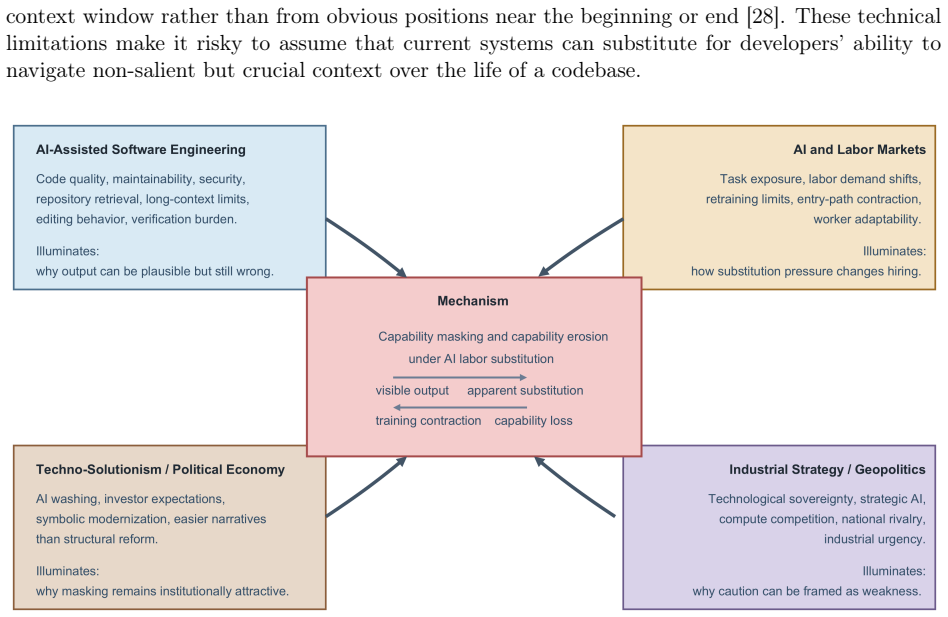
The paper identifies and formalizes a five-step mechanism: (1) AI produces visible, plausible output that appears to substitute for human work; (2) managers and policymakers infer from that output that underlying capability has been replaced; (3) organizations respond with hiring restraint, leaner staffing, and deeper dependence on external platforms; (4) hidden costs accumulate through verification burdens, loss of tacit knowledge, and contraction of the apprenticeship pipeline; (5) these firm-level decisions scale into broader fragility — weaker organizational resilience, narrower entry paths into professions, and more concentrated power. The key conceptual move is distinguishing between '
What carries the argument
The central mechanism is 'capability masking and capability erosion.' Masking is the perceptual and accounting-level error: visible AI output creates the appearance that organizational capability has been replaced. Erosion is the slower structural consequence: the human systems that actually sustain capability — tacit knowledge, apprenticeship pipelines, institutional memory, peer review — weaken over time. The paper also frames this as a layered debt accumulation: technical debt (short-term expedients in artifacts), capability debt (weakening human skill and review capacity), and institutional debt (deferred investment in governance and social systems).
Load-bearing premise
The paper's load-bearing premise is that the five-step mechanism is actually occurring at meaningful scale in real organizations — specifically, that firms are reducing human staffing based on the appearance of AI capability substitution, and that this is causing measurable erosion of tacit knowledge and apprenticeship pipelines. The paper is a conceptual synthesis rather than an empirical study, and the causal chain from 'AI output looks plausible' to 'organizations reduce'
What would settle it
The mechanism would be substantially weakened if firms using AI for labor substitution were simultaneously maintaining or expanding their apprenticeship and training pipelines, or if follow-up empirical studies found that organizations adopting AI aggressively showed no degradation in institutional memory, tacit knowledge transfer, or recovery capacity over multi-year horizons. It would also be challenged if AI-generated code quality improved to the point where verification burdens dropped to negligible levels and junior developer hiring rebounded.
Editorial analysis
A structured set of objections, weighed in public.
Referee Report
Summary. This manuscript proposes a conceptual mechanism —
Significance. The paper identifies a cross-domain mechanism — capability masking and capability erosion — that connects AI-assisted coding evidence, labor-market research, political economy, and industrial strategy into a single causal account. The contribution is integrative rather than empirical, and the paper is commendably honest about this scope (§2). It draws on a diverse, external evidence base (peer-reviewed studies, the METR RCT, BLS statistics, Senate testimony, OECD analysis) without circular self-citation. The five-step mechanism in §4 is clearly stated and falsifiable in principle: if firms that reduce staffing based on AI adoption do not subsequently experience capability erosion, the mechanism would be weakened. The debt framing (technical, capability, institutional) is a useful organizing device. The policy recommendations in §10, while somewhat generic, are proportionate to the argument.
major comments (2)
- §4, five-step mechanism, steps 1–2: The central load-bearing claim is that AI output creates a 'persuasive appearance' of capability substitution (step 1), which managers then act on (step 2). However, the paper's own evidence base argues against this persuasiveness for direct users. The METR study (ref 5, discussed in §5) shows experienced developers were 19% slower with AI and accepted fewer than 44% of generations. Refs 1–2 show code quality is uneven in correctness, maintainability, and security. The paper itself states 'human verification remains essential' (§4). This creates an internal tension: if AI output is visibly flawed to practitioners, who is actually being 'masked'? The paper gestures at this in §4 ('optimistic interpretation of AI output, and the political and financial convenience of accepting visible productivity as proof of real substitution'), but this passage实际上支持 an
- §4, five-step mechanism, steps 1–2: The central load-bearing claim is that AI output creates a 'persuasive appearance' of capability substitution (step 1), which managers then act on (step 2). However, the paper's own evidence base argues against this persuasiveness for direct users. The METR study (ref 5, discussed in §5) shows experienced developers were 19% slower with AI and accepted fewer than 44% of generations. Refs 1–2 show code quality is uneven in correctness, maintainability, and security. The paper itself states 'human verification remains essential' (§4). This creates an internal tension: if AI output is visibly flawed to practitioners, who is actually being 'masked'? The paper gestures at this in §4 ('optimistic interpretation of AI output, and the political and financial convenience of accepting visible productivity as proof of real substitution'), but this passage实际上支持 an
minor comments (8)
- §1: The paper cites corporate statements about layoffs and AI authorship rates (refs 16–19) as evidence that 'AI is already being used as part of the managerial justification for workforce reduction.' The causal link between AI adoption and specific layoffs is not established by these statements, and the paper acknowledges this ('These examples do not prove a uniform one-to-one replacement'). This is fine, but the framing could be tightened to avoid implying stronger causation than the evidence supports.
- §7: The evidence for apprenticeship pipeline contraction relies on a single CIO article (ref 7) and labor-market research on AI-exposed tasks (refs 8–9) that does not isolate junior software roles. The paper acknowledges this ('These findings do not isolate junior software roles on their own'), but the claim that 'this risk is no longer hypothetical' (§7) overstates what the cited evidence shows. Consider softening to 'this risk is becoming visible in early indicators.'
- §6: The GitHub Copilot study (ref 31) is described as 'vendor-produced' and the paper appropriately cautions against treating it as neutral. The DORA report (ref 29) is also vendor-produced (Google). The paper treats DORA more favorably without the same caveat. Consider applying the same disclosure consistently.
- Figures 1–7 are referenced but not visible in the reviewed manuscript text. Ensure that figures are legible, properly captioned, and that Figure 1 (the causal chain) clearly labels all five steps of the mechanism.
- §8: The discussion of data limitations (refs 33–35, Epoch AI and model collapse) is interesting but tangential to the core mechanism. Consider whether this material strengthens the argument or distracts from it. If retained, connect it more explicitly to the mechanism — e.g., how uncertainty about model maturity affects step 2 (managerial inference).
- §9: The discussion of platform concentration (refs 36–40) is wide-ranging and somewhat disconnected from the core capability-erosion argument. The link between concentration and capability erosion could be made more explicit.
- The paper uses epigraph-like sentences at the start of each section (e.g., 'When institutions mistake visible output for durable capability, speed becomes a solvent of memory.'). These are stylistically distinctive but may read as editorializing for a research audience. Consider whether they match the target venue's conventions.
- References: Several sources are from 2026 (refs 15, 19, 20–22, 26, 30, 32). Ensure all citations are publicly accessible and properly archived, as some appear to be very recent news or government sources that may not be stable.
Simulated Author's Rebuttal
The referee raises a sharp internal-tension objection: if the paper's own evidence shows AI output is visibly flawed to practitioners, then who is actually being 'masked'? We agree the manuscript needs to make the masking target more precise and will revise accordingly. The referee's comment appears truncated, but the core challenge is clear and substantive.
read point-by-point responses
-
Referee: §4, steps 1–2: The central load-bearing claim is that AI output creates a 'persuasive appearance' of capability substitution (step 1), which managers then act on (step 2). However, the paper's own evidence base argues against this persuasiveness for direct users. The METR study shows experienced developers were 19% slower with AI and accepted fewer than 44% of generations. Refs 1–2 show code quality is uneven. The paper itself states 'human verification remains essential.' This creates an internal tension: if AI output is visibly flawed to practitioners, who is actually being 'masked'?
Authors: The referee identifies a genuine gap in the manuscript's argumentation, and we agree it must be addressed. The core issue is that the paper does not sufficiently distinguish between two audiences for AI output: practitioners who directly use the tools and decision-makers who are one or more organizational layers removed from the code. The masking mechanism does not require that experienced developers are fooled. It requires that managers, executives, and policymakers — who see aggregate metrics, cost savings, dashboards, and narratives rather than individual code generations — interpret visible output as evidence that capability has been replaced. The METR study actually strengthens this argument rather than weakening it: it shows that the people closest to the work are not persuaded, while the people making staffing decisions (e.g., the corporate examples in §1 — Microsoft, Amazon, Salesforce, Anthropic) are nonetheless acting as though substitution has occurred. This is precisely the asymmetry the mechanism describes. However, the referee is correct that the manuscript does not make this distinction explicit enough. The passage in §4 about 'optimistic interpretation of AI output, and the political and financial convenience of accepting visible productivity as proof of real substitution' gestures at the answer but does not develop it. We will revise §4 (steps 1–2) to clarify that the masking target is primarily organizational decision-makers rather than direct practitioners, and to make explicit that the paper's own evidence about practitioner skepticism is not a counterargument to the mechanism but a component of it: the very gap between practitioner awareness and managerial action is what makes the masking possible. We will also add a brief discussion noting that the revision: no
Circularity Check
No circularity: conceptual synthesis built entirely from external evidence with no self-citation or fitted-parameter predictions
full rationale
The paper is explicitly a conceptual synthesis (§2: 'This paper is a conceptual synthesis rather than a new empirical study') that integrates external evidence from four literatures. None of the 40 references are self-citations by the author (Wolfgang Rohde / AiSuNe Foundation). The five-step mechanism in §4 is a qualitative causal chain, not a mathematical derivation, so there are no equations that could reduce to inputs by construction. No parameters are fitted to data and then presented as predictions. No uniqueness theorem or prior ansatz from the same authors is invoked. The paper's definitions of 'masking' and 'erosion' are standard conceptual definitions, not circular (masking is defined as the perceptual phenomenon of overreading AI output; erosion is defined as the structural consequence of acting on that misreading — they are distinct concepts, not defined in terms of each other). The debt-framing (technical/capability/institutional debt) is explicitly presented as analogy, not as a new derivation. The argument's load-bearing evidence comes from independent external sources: METR's RCT (ref 5), NBER/Fed working papers (refs 8-9), BLS statistics (ref 22), GAO reports (ref 32), Nature (ref 34), and peer-reviewed software-engineering studies (refs 1-4). The paper is self-contained against external benchmarks and exhibits no circular reasoning.
Axiom & Free-Parameter Ledger
axioms (5)
- domain assumption AI-generated output creates a 'persuasive appearance' that organizational capability has been replaced, sufficient to influence managerial decisions about hiring and staffing.
- domain assumption The human systems that sustain capability — tacit knowledge transfer, apprenticeship pipelines, institutional memory — are slow to build and difficult to restore once eroded.
- domain assumption The mechanism extends by analogy from software development to other apprenticeship-based domains.
- domain assumption Current AI development paths may not mature enough to deliver the reliability assumed by full substitution narratives.
- standard math Short-termism in corporate governance causes underinvestment in workforce training and innovation.
invented entities (3)
-
Capability masking
no independent evidence
-
Capability debt
no independent evidence
-
Institutional debt
no independent evidence
read the original abstract
What looks like acceleration can be a quiet transfer of burden from the present to the future. Attempts to replace human labor with AI systems are often presented as rational responses to technological progress, but that view is often structurally short-sighted. Across software development and adjacent knowledge industries, AI is increasingly attractive because it appears to reduce labor costs, speed output, and improve short-term metrics. Yet those gains may be achieved by drawing down human capabilities that are slow to build and difficult to restore. This paper develops a mechanism of capability masking and capability erosion under AI labor substitution. AI-generated output can create the appearance that organizational capability has been replaced, even when dependence on skilled human labor remains. That appearance can support hiring restraint while slower costs accumulate in the background. Evidence from AI-assisted coding shows that generated output still requires substantial human verification and remains uneven in correctness, maintainability, and security. Repository-level studies also suggest limits in handling broader codebase context. More broadly, labor-market, political-economy, and industrial-strategy evidence suggests that substitution pressures are being driven by managerial cost incentives and national competition while increasing risks of concentration and platform control. The result is a system that may look more efficient in the short term while becoming more fragile over time.
Figures



Reference graph
Works this paper leans on
-
[1]
(2023).Evaluating the code quality of AI-assisted code generation tools
Yetiştiren, B., et al. (2023).Evaluating the code quality of AI-assisted code generation tools. arXiv.https://arxiv.org/abs/2304.10778
-
[2]
(2023).Security weaknesses of Copilot-generated code in GitHub projects: An empirical study
Fu, Y., et al. (2023).Security weaknesses of Copilot-generated code in GitHub projects: An empirical study. arXiv.https://arxiv.org/abs/2310.02059
-
[3]
(2023).RepoCoder: Repository-level code completion through iterative retrieval and generation
RepoCoder. (2023).RepoCoder: Repository-level code completion through iterative retrieval and generation. arXiv.https://arxiv.org/abs/2303.12570 16
-
[4]
RepoBench: Benchmarking Repository-Level Code Auto-Completion Systems
RepoBench. (2023).RepoBench: Benchmarking repository-level code auto-completion systems. arXiv.https://arxiv.org/abs/2306.03091
work page internal anchor Pith review Pith/arXiv arXiv 2023
-
[5]
METR. (2025, July 10).Measuring the impact of early-2025 AI on experienced open-source developer productivity.https://metr.org/blog/2025-07-10-early-2025-ai-experienced -os-dev-study/
work page 2025
-
[6]
(2024, October 3).Introducing canvas.https://openai.com/index/introducing-c anvas/
OpenAI. (2024, October 3).Introducing canvas.https://openai.com/index/introducing-c anvas/
work page 2024
-
[7]
CIO. (2025, September 23). Demand for junior developers softens as AI takes over.https: //www.cio.com/article/4062024/demand-for-junior-developers-softens-as-ai-takes -over.html
-
[8]
Hampole, M., Papanikolaou, D., Schmidt, L. D. W., & Seegmiller, B. (2025).Artificial intelli- gence and the labor market(NBER Working Paper 33509).https://www.nber.org/papers/w3 3509
work page 2025
-
[9]
(2025).How retrainable are AI-exposed workers? Federal Reserve Bank of New York Staff Reports, No
Hyman, B., Lahey, B., Ni, K., & Pilossoph, L. (2025).How retrainable are AI-exposed workers? Federal Reserve Bank of New York Staff Reports, No. 1165.https://www.newyorkfed.org/r esearch/staff_reports/sr1165
work page 2025
-
[10]
Selwyn, N. (2025).The ethics of AI or techno-solutionism?.Journal of Education Policy.https: //www.tandfonline.com/doi/abs/10.1080/01425692.2025.2502808
-
[11]
Thomson Reuters. (2024, March 26).AI washing and SEC enforcement.https://www.thomso nreuters.com/en-us/posts/investigation-fraud-and-risk/ai-washing-enforcement/
work page 2024
-
[12]
PwC. (2024).Global investor survey 2024.https://www.pwc.com/th/en/press-room/pres s-release/2024/press-release-26-12-24-en.html
work page 2024
-
[13]
OECD. (2025).Competition in artificial intelligence infrastructure.https://www.oecd.org/e n/publications/competition-in-artificial-intelligence-infrastructure_623d1874-e n.html
work page 2025
-
[14]
Ishkhanyan, A. (2025). The sovereignty-internationalism paradox in AI governance: Digital federalism and global algorithmic control.Discover Artificial Intelligence, 5, Article 123.https: //link.springer.com/article/10.1007/s44163-025-00374-x
-
[15]
Papyshev, G., & Chan, K. J. D. (2026). AI regulatory strategies for digital sovereignty: The role of geopolitics and technological disparities.Electronic Markets, 36, Article 8.h tt p s: //doi.org/10.1007/s12525-025-00870-z
-
[16]
CNBC. (2025a, May 13).Microsoft laying off about 6,000 people, or 3% of its workforce.https: //www.cnbc.com/2025/05/13/microsoft-is-cutting-3percent-of-workers-across-the-s oftware-company.html
work page 2025
-
[17]
(2025, June 17).Message from CEO Andy Jassy: Some thoughts on Generative AI
Amazon. (2025, June 17).Message from CEO Andy Jassy: Some thoughts on Generative AI. About Amazon.https://www.aboutamazon.com/news/company-news/amazon-ceo-andy-jas sy-on-generative-ai/
work page 2025
-
[18]
CNBC. (2025c, June 26).AI is doing up to 50% of the work at Salesforce, CEO Marc Benioff says.https://www.cnbc.com/2025/06/26/ai-salesforce-benioff.html
work page 2025
-
[19]
Fortune. (2026, January 29).Top engineers at Anthropic, OpenAI say AI now writes 100% of their code, with big implications for the future of software development jobs.https://fortune. com/2026/01/29/100-percent-of-code-at-anthropic-and-openai-is-now-ai-written-b oris-cherny-roon/ 17
work page 2026
-
[20]
U.S. Senate Commerce Committee. (2026, March 3).Less Hype, More Help: AI That Improves Safety, Productivity, and Care.https://www.commerce.senate.gov/2026/3/less-hype-mor e-help-ai-that-improves-safety-productivity-and-care
work page 2026
-
[21]
Less Hype, More Help: AI That Improves Safety, Productivity, and Care
Siemens. (2026, March 3).Testimony before the U.S. Senate Commerce Subcommittee hearing “Less Hype, More Help: AI That Improves Safety, Productivity, and Care”.https://www.comm erce.senate.gov/services/files/C9ACEB55-01EB-4F71-8E06-E6015C4C3886
work page 2026
-
[22]
(2026, March 6).The Employment Situation - February 2026
BLS. (2026, March 6).The Employment Situation - February 2026. U.S. Bureau of Labor Statistics.https://www.bls.gov/news.release/archives/empsit_03062026.htm
work page 2026
-
[23]
Terry, S.J.(2023).The macro impact of short-termism.Econometrica, 91(5), 1881-1912.https: //doi.org/10.3982/ECTA15420
-
[24]
Green, F., Felstead, A., Gallie, D., Inanc, H., & Jewson, N. (2016). The declining volume of workers’ training in Britain.British Journal of Industrial Relations, 54(2), 422-448.https: //doi.org/10.1111/bjir.12130
-
[25]
Raisch, S., & Krakowski, S. (2021). Artificial intelligence and management: The automation- augmentation paradox.Academy of Management Review, 46(1), 192-210.https://doi.org/ 10.5465/amr.2018.0072
-
[26]
Manning, S. J., & Aguirre, T. (2026).How adaptable are American workers to AI-induced job displacement?(NBER Working Paper 34705).https://www.nber.org/papers/w34705
work page 2026
-
[27]
Brookings. (2025, May 16).AI labor displacement and the limits of worker retraining.https: //www.brookings.edu/articles/ai-labor-displacement-and-the-limits-of-worker-ret raining/
work page 2025
-
[28]
F., Lin, K., Hewitt, J., Paranjape, A., Bevilacqua, M., Petroni, F., & Liang, P
Liu, N. F., Lin, K., Hewitt, J., Paranjape, A., Bevilacqua, M., Petroni, F., & Liang, P. (2024). Lost in the middle: How language models use long contexts.Transactions of the Association for Computational Linguistics, 12, 157-173.https://direct.mit.edu/tacl/article/doi/10.1 162/tacl_a_00638/119630/Lost-in-the-Middle-How-Language-Models-Use-Long
work page 2024
-
[29]
(2025).State of AI-assisted software development.https://dora.dev/dora-r eport-2025
Google DORA. (2025).State of AI-assisted software development.https://dora.dev/dora-r eport-2025
work page 2025
-
[30]
Sonar. (2026a, January 8). Sonar data reveals critical verification gap in AI coding.https: //www.sonarsource.com/company/press-releases/sonar-data-reveals-critical-verif ication-gap-in-ai-coding/
-
[31]
(2024, November 18).Does GitHub Copilot improve code quality? Here’s what the data says
GitHub. (2024, November 18).Does GitHub Copilot improve code quality? Here’s what the data says. The GitHub Blog.https://github.blog/news-insights/research/does-github-cop ilot-improve-code-quality-heres-what-the-data-says/
work page 2024
-
[32]
GAO. (2025).Information technology: Agencies need to plan for modernizing critical decades-old legacy systems(GAO-25-107795).https://files.gao.gov/reports/GAO-25-107795/index. html
work page 2025
-
[33]
Villalobos, P., Ho, A., Sevilla, J., Besiroglu, T., Heim, L., & Hobbhahn, M. (2024).Will we run out of data? Limits of LLM scaling based on human-generated data.Epoch AI.https: //epoch.ai/blog/will-we-run-out-of-data-limits-of-llm-scaling-based-on-human-g enerated-data
work page 2024
-
[34]
Shumailov, I., Shumaylov, Z., Zhao, Y., Gal, Y., Papernot, N., & Anderson, R. (2024).AI models collapse when trained on recursively generated data.Nature, 631, 755-759.h t t p s : //www.nature.com/articles/s41586-024-07566-y 18
work page 2024
-
[35]
Kang, F., Ardalani, N., Kuchnik, M., Emad, Y., Elhoushi, M., Sengupta, S., Li, S.-W., Raghaven- dra, R., Jia, R., & Wu, C.-J. (2025).Demystifying synthetic data in LLM pre-training: A sys- tematic study of scaling laws, benefits, and pitfalls. InProceedings of the 2025 Conference on Empirical Methods in Natural Language Processing(pp. 10739-10758). Associ...
work page 2025
-
[36]
(2025).The 2025 Foundation Model Transparency Index
Wan, A., Klyman, K., Kapoor, S., Maslej, N., Longpre, S., Xiong, B., Liang, P., & Bommasani, R. (2025).The 2025 Foundation Model Transparency Index. Stanford Center for Research on Foundation Models.https://crfm.stanford.edu/fmti/December-2025/paper.pdf
work page 2025
-
[37]
Reuters. (2025, January 31). Taiwan bans government agencies from using DeepSeek, citing security concerns.Taipei Times.https://www.taipeitimes.com/News/taiwan/archives/202 5/01/31/2003831128
work page 2025
-
[38]
CNBC. (2025, May 16).Musk’s xAI says Grok’s ’white genocide’ posts resulted from change that violated ’core values’.https://www.cnbc.com/2025/05/15/musks-xai-grok-white-genocid e-posts-violated-core-values.html
work page 2025
-
[39]
(2025, January 21).Microsoft and OpenAI evolve partnership to drive the next phase of AI
Microsoft. (2025, January 21).Microsoft and OpenAI evolve partnership to drive the next phase of AI. The Official Microsoft Blog.https://blogs.microsoft.com/blog/2025/01/21/micros oft-and-openai-evolve-partnership-to-drive-the-next-phase-of-ai/
work page 2025
-
[40]
Reuters. (2025, September 22).Nvidia to invest up to $100 billion in OpenAI, linking two artificial intelligence titans. Investing.com.https://www.investing.com/news/stock-marke t-news/nvidia-to-invest-100-billion-in-openai-4249616 19
work page 2025
discussion (0)
Sign in with ORCID, Apple, or X to comment. Anyone can read and Pith papers without signing in.