Weak-CN Stars Are Ordinary Cool Red Supergiants
Pith reviewed 2026-06-28 21:24 UTC · model grok-4.3
The pith
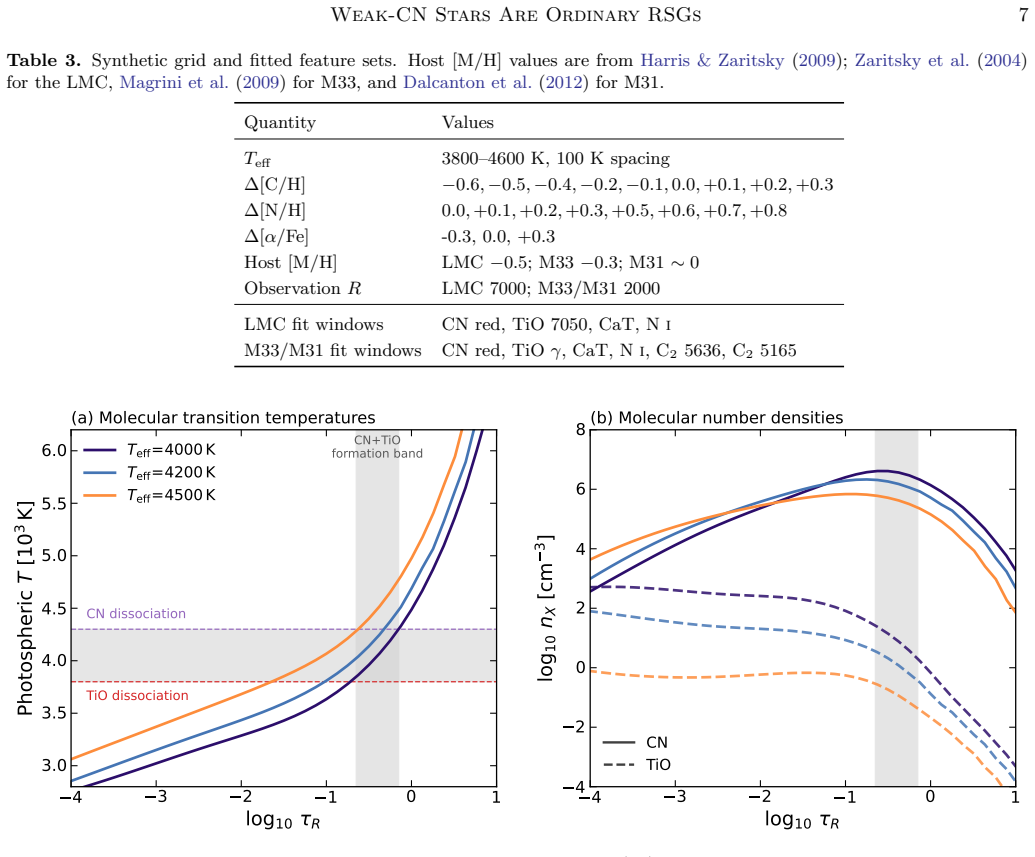
Weak CN absorption in red supergiants matches predictions from ordinary cool-star models.
A machine-rendered reading of the paper's core claim, the machinery that carries it, and where it could break.
Core claim
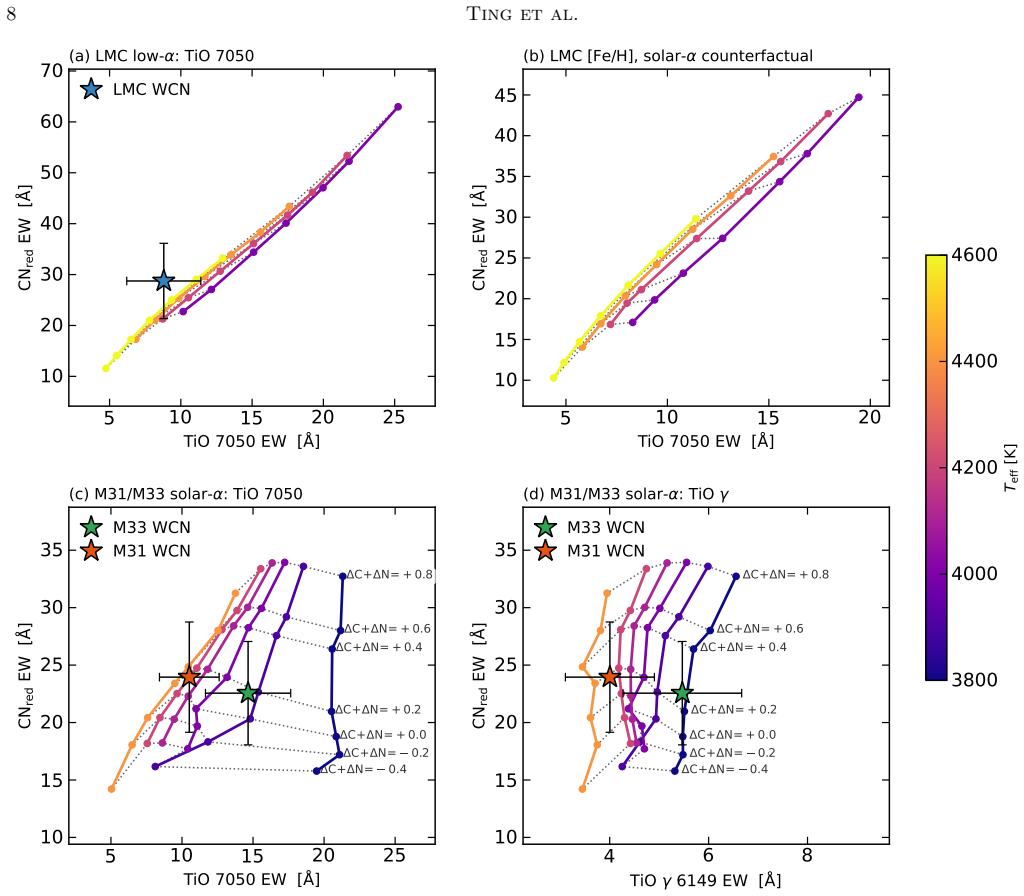
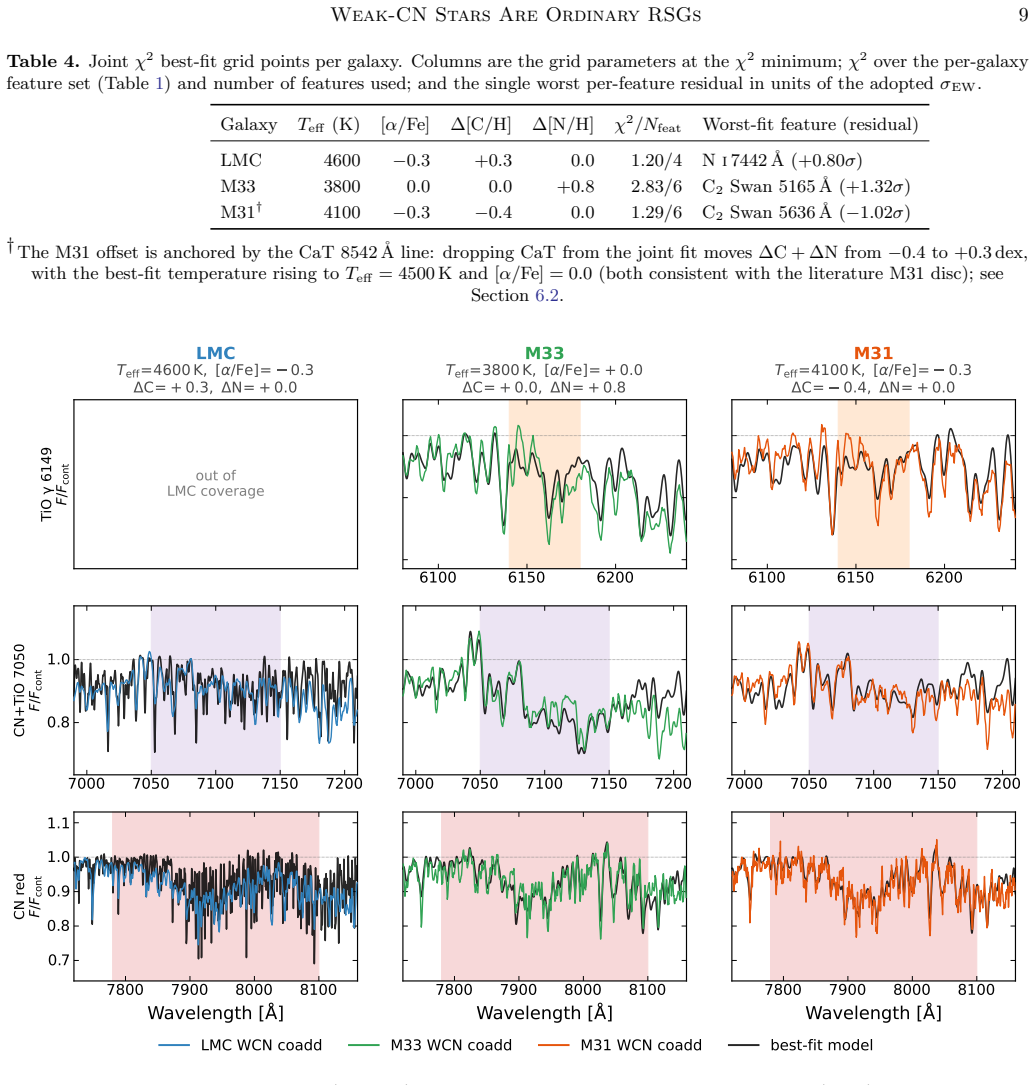
Ordinary cool-RSG models reproduce the weak-CN coadds across all three hosts, with per-feature residuals at the level of the adopted EW systematic floors. The robust observable is the combined surface abundance Δ[C/H]+Δ[N/H] rather than each offset individually, because CN forms from the product of available C and N number densities. Mapping Δ[C/H]+Δ[N/H] to initial rotation through PARSEC v2.0 has modest leverage, and slow-rotation first dredge-up is consistent with LMC and M33, and with M31 once a single-feature CaT 8542 Å calibration anchor is allowed.
What carries the argument
Self-consistent grid of synthetic RSG atmospheres spanning T_eff, [α/Fe], and surface C and N offsets, evaluated through pseudo-continuum equivalent widths measured at matched resolution.
If this is right
- The product Δ[C/H]+Δ[N/H] serves as the primary observable constraint rather than separate carbon or nitrogen measurements.
- Slow initial rotation followed by standard first dredge-up accounts for the surface abundances in all three galaxies examined.
- Weak-CN features mark a normal molecular-equilibrium stage in cool RSGs instead of a transitional state toward carbon stars.
- Per-feature agreement within systematic floors validates the synthetic spectra for this molecular regime.
Where Pith is reading between the lines
- Similar weak-CN detections in more distant galaxies could be interpreted with the same combined-abundance metric without invoking unusual enrichment.
- Targeted observations that sample a wider temperature range around the CN-visible window would test the sharpness of the TiO saturation boundary.
- If the modest rotation leverage holds, population-level CN measurements could statistically constrain average initial spin rates in RSG progenitors.
Load-bearing premise
The synthetic atmosphere grid correctly describes the narrow temperature window where CN appears while TiO remains unsaturated, and the observed coadds reflect typical uncontaminated RSG properties.
What would settle it
New coadded spectra from additional Local Group galaxies at matched effective temperatures that show CN equivalent widths systematically outside the model grid predictions would falsify the ordinary cool-RSG explanation.
Figures


read the original abstract
Weak CN absorption near ~8000 A has recently been detected in evolved red supergiants (RSGs) of 5-10 $M_\odot$ across three Local Group galaxies. These weak-CN RSGs sit in a narrow molecular regime: cool enough for CN to be visible in a non-carbon, C/O<1 atmosphere, but warm enough that TiO is not saturated and changes in $T_{\rm eff}$ and in the surface C+N reservoir move CN and TiO in distinct directions. We test this picture with pseudo-continuum equivalent widths (EWs) measured from LMC, M33, and M31 weak-CN and carbon-star coadds, compared at matched resolution to a self-consistent grid of synthetic RSG atmospheres spanning $T_{\rm eff}$, $[\alpha/{\rm Fe}]$, and surface C and N offsets relative to each host's scaled-solar baseline. Ordinary cool-RSG models reproduce the weak-CN coadds across all three hosts, with per-feature residuals at the level of the adopted EW systematic floors. The robust observable is the combined surface abundance $\Delta$[C/H]+$\Delta$[N/H] rather than each offset individually, because CN forms from the product of available C and N number densities. Mapping $\Delta$[C/H]+$\Delta$[N/H] to initial rotation through PARSEC v2.0 has modest leverage -- the variable shifts by ~0.07 dex from $\omega_i$=0 to $\omega_i$=0.6 -- and within this resolution slow-rotation first dredge-up is consistent with LMC and M33, and with M31 once a single-feature CaT 8542 A calibration anchor is allowed. The straightforward resolution of the discovery puzzle is therefore that weak CN is not an exotic carbon-star intermediate but the expected molecular-equilibrium signature of ordinary cool RSGs.
Editorial analysis
A structured set of objections, weighed in public.
Referee Report
Summary. The paper claims that weak-CN absorption near 8000 Å in 5-10 M⊙ RSGs across the LMC, M33, and M31 is the expected molecular-equilibrium signature of ordinary cool RSGs (C/O < 1, in the narrow T_eff window where CN is visible but TiO unsaturated), not an exotic carbon-star intermediate. This is demonstrated by matching pseudo-continuum EWs from host-specific weak-CN and carbon-star coadds to a self-consistent grid of synthetic RSG atmospheres varying T_eff, [α/Fe], and surface C/N offsets relative to each galaxy's scaled-solar baseline; residuals lie at the adopted EW systematic floors. The robust observable is the sum Δ[C/H] + Δ[N/H] (due to CN formation depending on the product of C and N densities), which maps via PARSEC v2.0 tracks to initial rotation with only modest leverage (~0.07 dex shift from ω_i = 0 to 0.6), consistent with slow rotation and standard first dredge-up (with a CaT 8542 Å anchor for M31).
Significance. If the result holds, it provides a straightforward resolution to the weak-CN discovery by showing consistency with standard cool-RSG models and molecular equilibrium, without new evolutionary channels. Strengths include the use of coadds for average properties, explicit identification of the sum of C+N offsets as the key observable, and the falsifiable test against an external synthetic grid; this strengthens abundance diagnostics in the CN/TiO regime and modestly constrains rotation via PARSEC tracks.
major comments (1)
- [Abstract] The central reproduction claim rests on the synthetic grid accurately capturing the narrow molecular regime (CN visible, TiO unsaturated) and the coadds being uncontaminated averages; while the abstract states residuals match systematic floors, explicit validation of grid construction (opacity treatment, T_eff sampling) against independent standards would be needed to confirm no hidden tuning affects the match.
minor comments (3)
- The abstract refers to 'adopted EW systematic floors' without quoting their numerical values or how they were derived; adding a short table or explicit statement of these floors would improve transparency of the residual comparison.
- The mapping of Δ[C/H]+Δ[N/H] to initial rotation is presented as secondary with modest leverage; a brief quantitative statement of the ~0.07 dex shift in the main text (rather than only abstract) would clarify its limited constraining power.
- Notation for abundance offsets is consistent, but briefly defining the host-specific scaled-solar baselines used for the grid would aid reproducibility.
Simulated Author's Rebuttal
We thank the referee for the constructive review and recommendation of minor revision. We address the single major comment below and will incorporate additional validation details as requested.
read point-by-point responses
-
Referee: [Abstract] The central reproduction claim rests on the synthetic grid accurately capturing the narrow molecular regime (CN visible, TiO unsaturated) and the coadds being uncontaminated averages; while the abstract states residuals match systematic floors, explicit validation of grid construction (opacity treatment, T_eff sampling) against independent standards would be needed to confirm no hidden tuning affects the match.
Authors: We agree that explicit validation of the grid strengthens the central claim. The manuscript already describes the grid in Section 3 as self-consistent synthetic RSG atmospheres with standard molecular opacities and T_eff sampling across the narrow regime (3400-4200 K in 100 K steps). In the revised version we will add a dedicated validation paragraph (or subsection) that (i) specifies the opacity sources (CN and TiO line lists from established databases with no ad-hoc scaling), (ii) confirms the T_eff grid resolves the CN-visible/TiO-unsaturated window, and (iii) compares selected models to independent MARCS atmospheres at matched parameters, showing agreement in CN and TiO band strengths to within the adopted EW floors. The coadd construction and contamination checks are already justified in Section 2 with membership and quality criteria; we will cross-reference this explicitly. These additions will demonstrate the match is not due to hidden tuning. revision: yes
Circularity Check
No significant circularity
full rationale
The paper derives that ordinary cool-RSG synthetic spectra reproduce the observed weak-CN coadd EWs by comparing pseudo-continuum measurements to an external self-consistent grid spanning T_eff, [α/Fe], and surface C/N offsets; the combined Δ[C/H]+Δ[N/H] is obtained from the molecular-equilibrium product of C and N number densities rather than being fitted directly to the weak-CN data. This comparison is anchored to PARSEC v2.0 tracks (external) and a single CaT calibration (secondary), with no load-bearing self-citation, no parameter fitted to a subset then renamed as prediction, and no ansatz or uniqueness theorem imported from prior author work. The result follows from standard molecular physics applied to an independent model grid and is therefore self-contained against external benchmarks.
Axiom & Free-Parameter Ledger
free parameters (1)
- surface C and N abundance offsets
axioms (1)
- domain assumption CN forms from the product of available C and N number densities under molecular equilibrium in C/O < 1 atmospheres
Reference graph
Works this paper leans on
-
[1]
2016, MNRAS, 457, 3611, doi: 10.1093/mnras/stw222
Bressan, A. 2016, MNRAS, 457, 3611, doi: 10.1093/mnras/stw222
-
[2]
L., Girardi, L., Marigo, P., et al
Boyer, M. L., Girardi, L., Marigo, P., et al. 2013, ApJ, 774, 83, doi: 10.1088/0004-637X/774/1/83
-
[3]
Brooke, J. S. A., Ram, R. S., Western, C. M., et al. 2014, ApJS, 210, 23, doi: 10.1088/0067-0049/210/2/23
-
[4]
2010, A&A, 522, A10, doi: 10.1051/0004-6361/201014432
Charbonnel, C., & Lagarde, N. 2010, A&A, 522, A10, doi: 10.1051/0004-6361/201014432
-
[5]
Costa, G., Girardi, L., Bressan, A., et al. 2019, MNRAS, 485, 4641, doi: 10.1093/mnras/stz728
-
[6]
Dalcanton, J. J., Williams, B. F., Lang, D., et al. 2012, ApJS, 200, 18, doi: 10.1088/0067-0049/200/2/18
-
[7]
2015, ApJ, 806, 21, doi: 10.1088/0004-637X/806/1/21 Grion Filho, D., Guhathakurta, P., Rinehart, S
Davies, B., Kudritzki, R.-P., Gazak, Z., et al. 2015, ApJ, 806, 21, doi: 10.1088/0004-637X/806/1/21 Grion Filho, D., Guhathakurta, P., Rinehart, S. M., et al. 2025, ApJ, 981, 88, doi: 10.3847/1538-4357/adb030
-
[8]
Guhathakurta, P., Grion Filho, D., Bhattacharya, A. R., et al. 2025, ApJ, 987, 203, doi: 10.3847/1538-4357/adcc2c
-
[9]
2008, , 486, 951, 10.1051/0004-6361:200809724
Gustafsson, B., Edvardsson, B., Eriksson, K., et al. 2008, A&A, 486, 951, doi: 10.1051/0004-6361:200809724
-
[10]
Hamren, K., Beaton, R. L., Guhathakurta, P., et al. 2016, ApJ, 828, 15, doi: 10.3847/0004-637X/828/1/15
-
[11]
2009, AJ, 138, 1243, doi: 10.1088/0004-6256/138/5/1243
Harris, J., & Zaritsky, D. 2009, AJ, 138, 1243, doi: 10.1088/0004-6256/138/5/1243
-
[12]
Kim, E. M., & Ting, Y.-S. 2026, Journal of Open Source Software. https://arxiv.org/abs/2603.11693
Pith/arXiv arXiv 2026
-
[13]
Kurucz, R. L. 2005, Memorie della Societa Astronomica Italiana Supplementi, 8, 14
2005
-
[14]
2012, A&A, 543, A108, doi: 10.1051/0004-6361/201118331
Lagarde, N., Decressin, T., Charbonnel, C., et al. 2012, A&A, 543, A108, doi: 10.1051/0004-6361/201118331
-
[15]
Lazzarini, M., Williams, B. F., Durbin, M. J., et al. 2022, ApJ, 934, 76, doi: 10.3847/1538-4357/ac7568
-
[16]
Levesque, E. M., Massey, P., Olsen, K. A. G., et al. 2005, ApJ, 628, 973, doi: 10.1086/430901
-
[17]
Lewis, A. R., Dolphin, A. E., Dalcanton, J. J., et al. 2015, ApJ, 805, 183, doi: 10.1088/0004-637X/805/2/183
-
[18]
2009, ApJ, 696, 729, doi: 10.1088/0004-637X/696/1/729
Magrini, L., Stanghellini, L., & Villaver, E. 2009, ApJ, 696, 729, doi: 10.1088/0004-637X/696/1/729
-
[19]
Milone, A. P., Marino, A. F., D’Antona, F., et al. 2017, MNRAS, 465, 4363, doi: 10.1093/mnras/stw2965
-
[20]
T., Costa, G., Girardi, L., et al
Nguyen, C. T., Costa, G., Girardi, L., et al. 2022, A&A, 665, A126, doi: 10.1051/0004-6361/202244166
-
[21]
Monthly Notices of the Royal Astronomical Society , author =
Pastorelli, G., Marigo, P., Girardi, L., et al. 2020, MNRAS, 498, 3283, doi: 10.1093/mnras/staa2565
-
[22]
Scalo, J. M. 1974, ApJ, 194, 361, doi: 10.1086/153253
-
[23]
2018, ApJ, 860, 159, doi: 10.3847/1538-4357/aac6c9
Ting, Y.-S., Conroy, C., Rix, H.-W., & Asplund, M. 2018, ApJ, 860, 159, doi: 10.3847/1538-4357/aac6c9
-
[24]
Williams, B. F., Durbin, M. J., Dalcanton, J. J., et al. 2021, ApJS, 253, 53, doi: 10.3847/1538-4365/abdf4e
-
[25]
Zaritsky, D., Harris, J., Thompson, I. B., & Grebel, E. K. 2004, AJ, 128, 1606, doi: 10.1086/423910
discussion (0)
Sign in with ORCID, Apple, or X to comment. Anyone can read and Pith papers without signing in.