Hybrid Diffusion Transformer for Instruction-Guided Audio Editing via Rectified Flow
Pith reviewed 2026-06-26 15:49 UTC · model grok-4.3
The pith
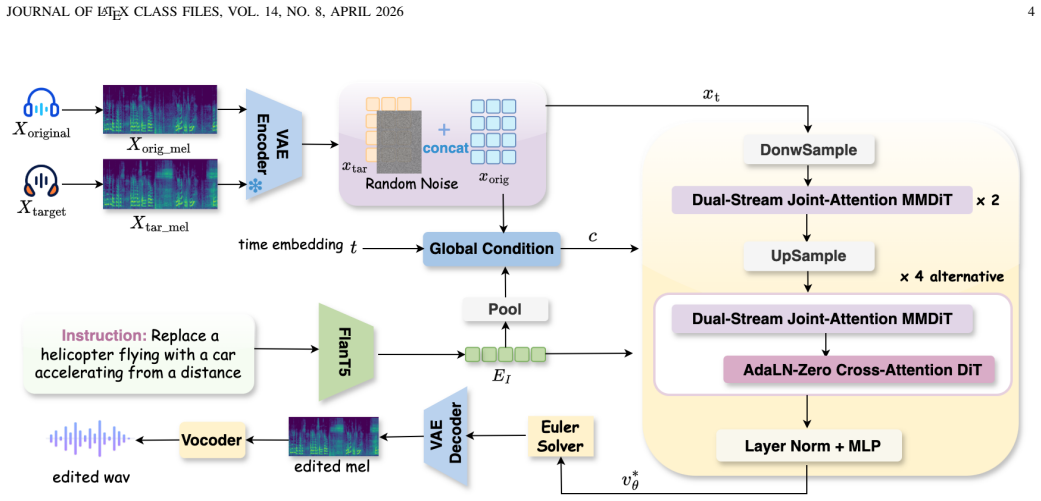
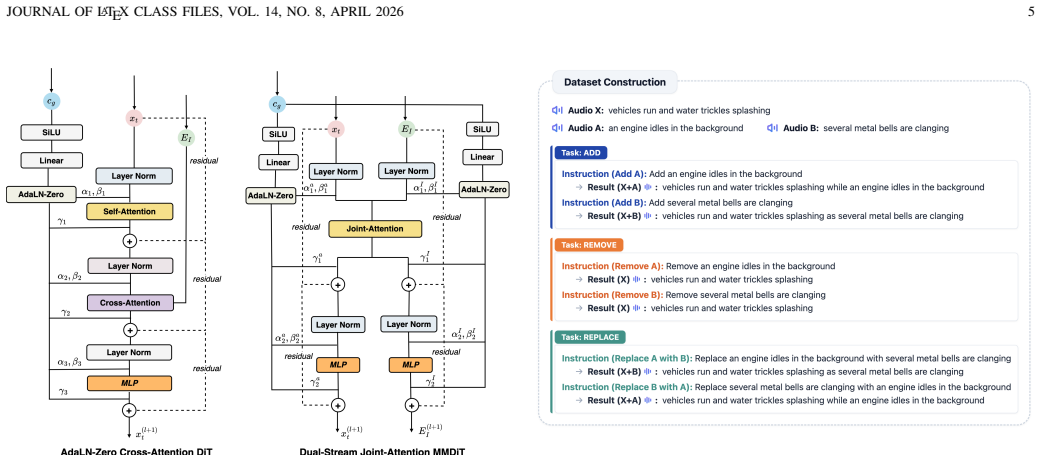
A hybrid two-stage diffusion transformer performs joint attention at low resolution then alternating joint and cross attention at high resolution to enable efficient instruction-guided audio editing via rectified flow.
A machine-rendered reading of the paper's core claim, the machinery that carries it, and where it could break.
Core claim
The hybrid two-stage diffusion transformer architecture performs joint attention over audio and text tokens to establish coarse semantic alignment at the low-resolution stage, then switches to alternating joint-attention and cross-attention blocks to refine editing details at the high-resolution stage, enabling efficient and accurate instruction-guided audio editing when trained with rectified flow matching.
What carries the argument
The hybrid two-stage attention schedule that applies full joint attention only at low resolution before alternating joint and cross attention at high resolution.
If this is right
- Notable performance gains occur on challenging tasks with overlapping audio events and complex instructions.
- Editing efficiency improves substantially while using a compact model.
- Long-range semantic alignment improves relative to convolutional U-Net backbones.
- Quadratic complexity is reduced relative to architectures that apply joint attention in every block.
Where Pith is reading between the lines
- The same coarse-to-fine attention pattern could be tested in text-to-audio generation or music continuation tasks to see whether it yields similar efficiency gains.
- Dynamic switching criteria based on instruction length or audio duration might further reduce average compute without retraining.
- The rectified-flow training could be combined with the hybrid backbone in other multimodal domains such as video editing to check transferability.
Load-bearing premise
That switching from full joint attention at low resolution to alternating joint- and cross-attention at high resolution sufficiently mitigates quadratic complexity while preserving or improving semantic alignment and editing accuracy.
What would settle it
A controlled experiment on standard audio editing benchmarks that measures both editing accuracy (e.g., instruction following and content preservation) and wall-clock inference time, showing the hybrid model underperforms a full joint-attention baseline or a U-Net baseline at matched compute.
Figures
read the original abstract
Audio editing aims to modify specific content in an existing audio clip according to a natural language instruction while preserving the remaining acoustic content. Despite the remarkable progress of diffusion models, existing training-based editing methods mainly rely on the local inductive biases and cross-attention interaction in convolutional U-Net backbones, which often hinder long-range semantic alignment and precise understanding and localization of instructions. In contrast, diffusion transformers provide stronger global modeling and multimodal fusion, but existing editing architectures usually adopt a simple stack of MMDiT and DiT blocks. Applying joint attention over concatenated audio and text tokens in all blocks results in quadratic complexity with respect to token length. To balance editing performance and efficiency, we propose a hybrid two-stage diffusion transformer architecture for instruction-guided audio editing based on rectified flow matching. It performs joint attention over audio and text tokens to establish coarse semantic alignment at low-resolution stage, then switches to alternating joint-attention and cross-attention blocks to refine editing details at high-resolution stage. This coarse-to-fine strategy enables efficient and accurate instruction-guided audio editing. Experiments show that the proposed framework achieves notable performance gains on challenging editing tasks involving overlapping audio events and complex instructions, while substantially improving editing efficiency with a compact model.
Editorial analysis
A structured set of objections, weighed in public.
Referee Report
Summary. The manuscript proposes a hybrid two-stage diffusion transformer architecture for instruction-guided audio editing based on rectified flow matching. The architecture uses joint attention over audio and text tokens at low resolution for coarse semantic alignment, followed by alternating joint-attention and cross-attention blocks at high resolution for detail refinement. This is intended to address the quadratic complexity of full joint attention in diffusion transformers while improving long-range semantic alignment compared to U-Net backbones. The paper claims that this approach achieves notable performance gains on tasks with overlapping audio events and complex instructions, and substantially improves editing efficiency with a compact model.
Significance. The hybrid attention strategy addresses a practical challenge in scaling diffusion transformers for audio editing tasks. If the experimental claims hold, it could contribute to more efficient multimodal audio generation and editing models. However, the lack of any reported metrics or comparisons makes it difficult to gauge the actual significance or novelty relative to existing MMDiT and DiT approaches.
major comments (1)
- Abstract: The abstract states that 'Experiments show that the proposed framework achieves notable performance gains on challenging editing tasks involving overlapping audio events and complex instructions, while substantially improving editing efficiency with a compact model.' However, no quantitative metrics, baseline comparisons, error bars, dataset details, or experimental setup are provided anywhere in the manuscript. This absence is load-bearing for the central claim of performance and efficiency improvements.
Simulated Author's Rebuttal
We thank the referee for highlighting the critical issue with the abstract's claims. We agree that the absence of supporting experimental evidence undermines the central claims and will revise the manuscript accordingly.
read point-by-point responses
-
Referee: Abstract: The abstract states that 'Experiments show that the proposed framework achieves notable performance gains on challenging editing tasks involving overlapping audio events and complex instructions, while substantially improving editing efficiency with a compact model.' However, no quantitative metrics, baseline comparisons, error bars, dataset details, or experimental setup are provided anywhere in the manuscript. This absence is load-bearing for the central claim of performance and efficiency improvements.
Authors: We fully agree with this assessment. The submitted manuscript draft is missing the experimental section, which was an error in preparation. In the revised version we will add a full Experiments section including: dataset descriptions and splits, baseline implementations (U-Net, standard MMDiT, DiT variants), quantitative metrics (e.g., FAD, CLAP similarity, editing precision), efficiency numbers (FLOPs, latency, model size), error bars from repeated runs, and detailed experimental setup. The abstract will be updated to reference these results rather than assert them without evidence. revision: yes
Circularity Check
No significant circularity
full rationale
The paper proposes a hybrid two-stage diffusion transformer architecture (joint attention at low resolution, alternating joint/cross at high resolution) for instruction-guided audio editing, grounded in rectified flow matching. All central claims rest on experimental validation of performance and efficiency gains versus baselines. No equations, parameter-fitting steps presented as predictions, self-definitional reductions, or load-bearing self-citations appear in the abstract or architecture description. The derivation chain is architectural and empirical rather than mathematical, with no steps that reduce to inputs by construction.
Axiom & Free-Parameter Ledger
Reference graph
Works this paper leans on
-
[1]
Denoising diffusion probabilistic models,
J. Ho, A. Jain, and P. Abbeel, “Denoising diffusion probabilistic models,” Advances in neural information processing systems, vol. 33, pp. 6840– 6851, 2020
2020
-
[2]
Audioldm: text-to-audio generation with latent diffusion models,
H. Liu, Z. Chen, Y . Yuan, X. Mei, X. Liu, D. Mandic, W. Wang, and M. D. Plumbley, “Audioldm: text-to-audio generation with latent diffusion models,” inProceedings of the 40th International Conference on Machine Learning, 2023, pp. 21 450–21 474
2023
-
[3]
Audioldm 2: Learning holistic audio generation with self-supervised pretraining,
H. Liu, Y . Yuan, X. Liu, X. Mei, Q. Kong, Q. Tian, Y . Wang, W. Wang, Y . Wang, and M. D. Plumbley, “Audioldm 2: Learning holistic audio generation with self-supervised pretraining,”IEEE/ACM Transactions on Audio, Speech, and Language Processing, vol. 32, pp. 2871–2883, 2024
2024
-
[4]
Make-an-audio: Text-to-audio generation with prompt- enhanced diffusion models,
R. Huang, J. Huang, D. Yang, Y . Ren, L. Liu, M. Li, Z. Ye, J. Liu, X. Yin, and Z. Zhao, “Make-an-audio: Text-to-audio generation with prompt- enhanced diffusion models,” inInternational Conference on Machine Learning. PMLR, 2023, pp. 13 916–13 932
2023
-
[5]
Make-an-audio 2: Temporal-enhanced text-to- audio generation,
J. Huang, Y . Ren, R. Huang, D. Yang, Z. Ye, C. Zhang, J. Liu, X. Yin, Z. Ma, and Z. Zhao, “Make-an-audio 2: Temporal-enhanced text-to- audio generation,”arXiv preprint arXiv:2305.18474, 2023
arXiv 2023
-
[6]
Text-to-audio gen- eration using instruction guided latent diffusion model,
D. Ghosal, N. Majumder, A. Mehrish, and S. Poria, “Text-to-audio gen- eration using instruction guided latent diffusion model,” inProceedings of the 31st ACM International Conference on Multimedia, 2023, pp. 3590–3598
2023
-
[7]
Tango 2: Aligning diffusion-based text-to-audio generations through direct preference optimization,
N. Majumder, C.-Y . Hung, D. Ghosal, W.-N. Hsu, R. Mihalcea, and S. Poria, “Tango 2: Aligning diffusion-based text-to-audio generations through direct preference optimization,” inProceedings of the 32nd ACM International Conference on Multimedia, 2024, pp. 564–572
2024
-
[8]
Flow matching for generative modeling,
Y . Lipman, R. T. Chen, H. Ben-Hamu, M. Nickel, and M. Le, “Flow matching for generative modeling,”arXiv preprint arXiv:2210.02747, 2022
Pith/arXiv arXiv 2022
-
[9]
Flow straight and fast: Learning to generate and transfer data with rectified flow,
X. Liu, C. Gong, and Q. Liu, “Flow straight and fast: Learning to generate and transfer data with rectified flow,”arXiv preprint arXiv:2209.03003, 2022
Pith/arXiv arXiv 2022
-
[10]
C.-Y . Hung, N. Majumder, Z. Kong, A. Mehrish, A. A. Bagherzadeh, C. Li, R. Valle, B. Catanzaro, and S. Poria, “Tangoflux: Super fast and faithful text to audio generation with flow matching and clap-ranked preference optimization,”arXiv preprint arXiv:2412.21037, 2024
arXiv 2024
-
[11]
Audit: Audio editing by following instructions with latent diffusion models,
Y . Wang, Z. Ju, X. Tan, L. He, Z. Wu, J. Bianet al., “Audit: Audio editing by following instructions with latent diffusion models,”Advances in Neural Information Processing Systems, vol. 36, pp. 71 340–71 357, 2023
2023
-
[12]
Zero-shot unsupervised and text-based audio editing using ddpm inversion,
H. Manor and T. Michaeli, “Zero-shot unsupervised and text-based audio editing using ddpm inversion,” inProceedings of the 41st International Conference on Machine Learning, 2024, pp. 34 603–34 629
2024
-
[13]
Audioeditor: A training-free diffusion-based audio editing framework,
Y . Jia, Y . Chen, J. Zhao, S. Zhao, W. Zeng, Y . Chen, and Y . Qin, “Audioeditor: A training-free diffusion-based audio editing framework,” inICASSP 2025-2025 IEEE International Conference on Acoustics, Speech and Signal Processing (ICASSP). IEEE, 2025, pp. 1–5
2025
-
[14]
Prompt-guided precise audio editing with diffusion models,
M. Xu, C. Li, D. Zhang, D. Su, W. Liang, and D. Yu, “Prompt-guided precise audio editing with diffusion models,” inProceedings of the 41st International Conference on Machine Learning, 2024, pp. 55 126– 55 143
2024
-
[15]
Audio editing with non-rigid text prompts,
F. Paissan, L. Della Libera, Z. Wang, M. Ravanelli, P. Smaragdis, C. Subakanet al., “Audio editing with non-rigid text prompts,” in Proceedings of INTERSPEECH 2024, 2024
2024
-
[16]
Rfm-editing: Rectified flow matching for text-guided audio editing,
L. Gao, Y . Yuan, Y . Chen, Y . Cheng, Z. Li, J. Wen, S. Zhang, and W. Wang, “Rfm-editing: Rectified flow matching for text-guided audio editing,”arXiv preprint arXiv:2509.14003, 2025
Pith/arXiv arXiv 2025
-
[17]
Mmedit: A unified framework for multi-type audio editing via audio language model,
Y . Tao, X. Xu, W. Wu, S. Wang, M. Wu, and C. Zhang, “Mmedit: A unified framework for multi-type audio editing via audio language model,”arXiv preprint arXiv:2512.20339, 2025
arXiv 2025
-
[18]
Audio controlnet for fine-grained audio generation and editing,
H. Zhu, Y . Xiao, X. Li, Z. Ma, J. Yu, B. Zhang, M. Yang, and X. Chen, “Audio controlnet for fine-grained audio generation and editing,”arXiv preprint arXiv:2602.04680, 2026
arXiv 2026
-
[19]
Scaling rectified flow transformers for high-resolution image synthesis,
P. Esser, S. Kulal, A. Blattmann, R. Entezari, J. M ¨uller, H. Saini, Y . Levi, D. Lorenz, A. Sauer, F. Boeselet al., “Scaling rectified flow transformers for high-resolution image synthesis,” inForty-first international conference on machine learning, 2024
2024
-
[20]
B. F. Labs, “Flux,” https://github.com/black-forest-labs/flux, 2024
2024
-
[21]
Flux.1 kontext: Flow matching for in-context image generation and editing in latent space,
B. F. Labs, S. Batifol, A. Blattmann, F. Boesel, S. Consul, C. Diagne, T. Dockhorn, J. English, Z. English, P. Esser, S. Kulal, K. Lacey, Y . Levi, C. Li, D. Lorenz, J. M ¨uller, D. Podell, R. Rombach, H. Saini, A. Sauer, and L. Smith, “Flux.1 kontext: Flow matching for in-context image generation and editing in latent space,” 2025. [Online]. Available: h...
Pith/arXiv arXiv 2025
-
[22]
A unified approach to short-time fourier analysis and synthesis,
J. B. Allen and L. R. Rabiner, “A unified approach to short-time fourier analysis and synthesis,”Proceedings of the IEEE, vol. 65, no. 11, pp. 1558–1564, 2005
2005
-
[23]
The phase vocoder: A tutorial,
M. Dolson, “The phase vocoder: A tutorial,”Computer Music Journal, vol. 10, no. 4, pp. 14–27, 1986
1986
-
[24]
Improved phase vocoder time-scale modi- fication of audio,
J. Laroche and M. Dolson, “Improved phase vocoder time-scale modi- fication of audio,”IEEE Transactions on Speech and Audio processing, vol. 7, no. 3, pp. 323–332, 2002
2002
-
[25]
Signal estimation from modified short-time fourier transform,
D. Griffin and J. Lim, “Signal estimation from modified short-time fourier transform,”IEEE Transactions on acoustics, speech, and signal processing, vol. 32, no. 2, pp. 236–243, 1984
1984
-
[26]
Audio inpainting,
A. Adler, V . Emiya, M. G. Jafari, M. Elad, R. Gribonval, and M. D. Plumbley, “Audio inpainting,”IEEE Transactions on Audio, Speech, and Language Processing, vol. 20, no. 3, pp. 922–932, 2011
2011
-
[27]
Spectral modeling synthesis: A sound analy- sis/synthesis system based on a deterministic plus stochastic decompo- sition,
X. Serra and J. Smith, “Spectral modeling synthesis: A sound analy- sis/synthesis system based on a deterministic plus stochastic decompo- sition,”Computer Music Journal, vol. 14, no. 4, pp. 12–24, 1990
1990
-
[28]
Pitch-synchronous waveform pro- cessing techniques for text-to-speech synthesis using diphones,
E. Moulines and F. Charpentier, “Pitch-synchronous waveform pro- cessing techniques for text-to-speech synthesis using diphones,”Speech communication, vol. 9, no. 5-6, pp. 453–467, 1990
1990
-
[29]
U-net: Convolutional networks for biomedical image segmentation,
O. Ronneberger, P. Fischer, and T. Brox, “U-net: Convolutional networks for biomedical image segmentation,” inInternational Conference on Medical image computing and computer-assisted intervention. Springer, 2015, pp. 234–241
2015
-
[30]
Scalable diffusion models with transformers,
W. Peebles and S. Xie, “Scalable diffusion models with transformers,” inProceedings of the IEEE/CVF international conference on computer vision, 2023, pp. 4195–4205. JOURNAL OF LATEX CLASS FILES, VOL. 14, NO. 8, APRIL 2026 10
2023
-
[31]
Dif- fwave: A versatile diffusion model for audio synthesis,
Z. Kong, W. Ping, J. Huang, K. Zhao, and B. Catanzaro, “Dif- fwave: A versatile diffusion model for audio synthesis,”arXiv preprint arXiv:2009.09761, 2020
Pith/arXiv arXiv 2009
-
[32]
Diffsound: Discrete diffusion model for text-to-sound generation,
D. Yang, J. Yu, H. Wang, W. Wang, C. Weng, Y . Zou, and D. Yu, “Diffsound: Discrete diffusion model for text-to-sound generation,” IEEE/ACM Transactions on Audio, Speech, and Language Processing, vol. 31, pp. 1720–1733, 2023
2023
-
[33]
High- resolution image synthesis with latent diffusion models,
R. Rombach, A. Blattmann, D. Lorenz, P. Esser, and B. Ommer, “High- resolution image synthesis with latent diffusion models,” inProceedings of the IEEE/CVF conference on computer vision and pattern recognition, 2022, pp. 10 684–10 695
2022
-
[34]
Auto-encoding variational bayes,
D. P. Kingma and M. Welling, “Auto-encoding variational bayes,”arXiv preprint arXiv:1312.6114, 2013
Pith/arXiv arXiv 2013
-
[35]
Classifier-free diffusion guidance,
J. Ho and T. Salimans, “Classifier-free diffusion guidance,”arXiv preprint arXiv:2207.12598, 2022
Pith/arXiv arXiv 2022
-
[36]
Score-based generative modeling through stochastic differ- ential equations,
Y . Song, J. Sohl-Dickstein, D. P. Kingma, A. Kumar, S. Ermon, and B. Poole, “Score-based generative modeling through stochastic differ- ential equations,” inInternational Conference on Learning Representa- tions, 2021
2021
-
[37]
Denoising diffusion implicit models,
J. Song, C. Meng, and S. Ermon, “Denoising diffusion implicit models,” inInternational Conference on Learning Representations, 2021
2021
-
[38]
Consistency models,
Y . Song, P. Dhariwal, M. Chen, and I. Sutskever, “Consistency models,” 2023
2023
-
[39]
Meanaudio: Fast and faithful text-to-audio generation with mean flows,
X. Li, J. Liu, Y . Liang, Z. Niu, W. Chen, and X. Chen, “Meanaudio: Fast and faithful text-to-audio generation with mean flows,”arXiv preprint arXiv:2508.06098, 2025
arXiv 2025
-
[40]
Null- text inversion for editing real images using guided diffusion models,
R. Mokady, A. Hertz, K. Aberman, Y . Pritch, and D. Cohen-Or, “Null- text inversion for editing real images using guided diffusion models,” inProceedings of the IEEE/CVF conference on computer vision and pattern recognition, 2023, pp. 6038–6047
2023
-
[41]
An edit friendly ddpm noise space: Inversion and manipulations,
I. Huberman-Spiegelglas, V . Kulikov, and T. Michaeli, “An edit friendly ddpm noise space: Inversion and manipulations,” inProceedings of the IEEE/CVF Conference on Computer Vision and Pattern Recognition, 2024, pp. 12 469–12 478
2024
-
[42]
Auffusion: Leveraging the power of diffusion and large language models for text-to-audio generation,
J. Xue, Y . Deng, Y . Gao, and Y . Li, “Auffusion: Leveraging the power of diffusion and large language models for text-to-audio generation,” IEEE/ACM Transactions on Audio, Speech, and Language Processing, 2024
2024
-
[43]
Prompt-to-prompt image editing with cross-attention control,
A. Hertz, R. Mokady, J. Tenenbaum, K. Aberman, Y . Pritch, and D. Cohen-or, “Prompt-to-prompt image editing with cross-attention control,” inThe Eleventh International Conference on Learning Rep- resentations
-
[44]
Audiomorphix: Training-free audio editing with diffusion probabilistic models,
J. Liang, Y . Chen, Y . Yuan, D. Jia, X. Zhuang, Z. Chen, Y . Wang, and Y . Wang, “Audiomorphix: Training-free audio editing with diffusion probabilistic models,”arXiv preprint arXiv:2505.16076, 2025
arXiv 2025
-
[45]
Semanticaudio: Audio generation and editing in semantic space,
Z. Dai, G. Zhang, H. He, X. Li, J. Li, C. Wu, Y . Guo, and Q. Kong, “Semanticaudio: Audio generation and editing in semantic space,”arXiv preprint arXiv:2601.21402, 2026
arXiv 2026
-
[46]
Flowedit: Inversion-free text-based editing using pre-trained flow mod- els,
V . Kulikov, M. Kleiner, I. Huberman-Spiegelglas, and T. Michaeli, “Flowedit: Inversion-free text-based editing using pre-trained flow mod- els,” inProceedings of the IEEE/CVF International Conference on Computer Vision, 2025, pp. 19 721–19 730
2025
-
[47]
Wavcraft: Audio editing and generation with natural language prompts
J. Liang, H. Zhang, H. Liu, Y . Cao, Q. Kong, X. Liu, W. Wang, M. Plumbley, H. Phan, and E. Benetos, “Wavcraft: Audio editing and generation with natural language prompts.” ICLR 2024 Workshop on LLM Agents, 2024
2024
-
[48]
Audio-agent: Leveraging llms for audio generation, editing and composition,
Z. Wang, C.-K. Tang, and Y .-W. Tai, “Audio-agent: Leveraging llms for audio generation, editing and composition,”arXiv preprint arXiv:2410.03335, 2024
arXiv 2024
-
[49]
Diffusion-based diverse audio captioning with retrieval-guided langevin dynamics,
Y . Zhu, A. Men, and L. Xiao, “Diffusion-based diverse audio captioning with retrieval-guided langevin dynamics,”Information Fusion, vol. 114, p. 102643, 2025
2025
-
[50]
Zero-shot diverse audio captioning with diffusion models,
Y . Zhu, Y . Zhang, L. Xiao, W. Wang, and A. Men, “Zero-shot diverse audio captioning with diffusion models,”Knowledge-Based Systems, p. 115205, 2025
2025
-
[51]
Guiding audio editing with audio language model,
Z. Lan, Y . Hao, and M. Zhao, “Guiding audio editing with audio language model,”arXiv preprint arXiv:2509.21625, 2025
arXiv 2025
-
[52]
S. Ghosh, Z. Kong, S. Kumar, S. Sakshi, J. Kim, W. Ping, R. Valle, D. Manocha, and B. Catanzaro, “Audio flamingo 2: An audio-language model with long-audio understanding and expert reasoning abilities,” arXiv preprint arXiv:2503.03983, 2025
arXiv 2025
-
[53]
Y . Chu, J. Xu, Q. Yang, H. Wei, X. Wei, Z. Guo, Y . Leng, Y . Lv, J. He, J. Linet al., “Qwen2-audio technical report,”arXiv preprint arXiv:2407.10759, 2024
Pith/arXiv arXiv 2024
-
[54]
Scaling instruction-finetuned language models,
H. W. Chung, L. Hou, S. Longpre, B. Zoph, Y . Tay, W. Fedus, Y . Li, X. Wang, M. Dehghani, S. Brahmaet al., “Scaling instruction-finetuned language models,”Journal of Machine Learning Research, vol. 25, no. 70, pp. 1–53, 2024
2024
-
[55]
∆-DiT: A training-free acceleration method tailored for diffusion transformers,
P. Chen, M. Shen, P. Ye, J. Cao, C. Tu, C.-S. Bouganis, Y . Zhao, and T. Chen, “∆-DiT: A training-free acceleration method tailored for diffusion transformers,”arXiv preprint arXiv:2406.01125, 2024
arXiv 2024
-
[56]
Bigvgan: A universal neural vocoder with large-scale training,
S.-g. Lee, W. Ping, B. Ginsburg, B. Catanzaro, and S. Yoon, “Bigvgan: A universal neural vocoder with large-scale training,”arXiv preprint arXiv:2206.04658, 2022
arXiv 2022
-
[57]
AudioCaps: Generating Captions for Audios in The Wild,
C. D. Kim, B. Kim, H. Lee, and G. Kim, “AudioCaps: Generating Captions for Audios in The Wild,” inNAACL-HLT, 2019
2019
-
[58]
Audio set: An ontology and human- labeled dataset for audio events,
J. F. Gemmeke, D. P. Ellis, D. Freedman, A. Jansen, W. Lawrence, R. C. Moore, M. Plakal, and M. Ritter, “Audio set: An ontology and human- labeled dataset for audio events,” in2017 IEEE international conference on acoustics, speech and signal processing (ICASSP). IEEE, 2017, pp. 776–780
2017
-
[59]
Audiosetcaps: An enriched audio-caption dataset using automated generation pipeline with large audio and language models,
J. Bai, H. Liu, M. Wang, D. Shi, W. Wang, M. D. Plumbley, W.-S. Gan, and J. Chen, “Audiosetcaps: An enriched audio-caption dataset using automated generation pipeline with large audio and language models,” IEEE Transactions on Audio, Speech and Language Processing, 2025
2025
-
[60]
Clap learning audio concepts from natural language supervision,
B. Elizalde, S. Deshmukh, M. Al Ismail, and H. Wang, “Clap learning audio concepts from natural language supervision,” inICASSP 2023- 2023 IEEE International Conference on Acoustics, Speech and Signal Processing (ICASSP). IEEE, 2023, pp. 1–5
2023
-
[61]
Panns: Large-scale pretrained audio neural networks for audio pattern recognition,
Q. Kong, Y . Cao, T. Iqbal, Y . Wang, W. Wang, and M. D. Plumbley, “Panns: Large-scale pretrained audio neural networks for audio pattern recognition,”IEEE/ACM Transactions on Audio, Speech, and Language Processing, vol. 28, pp. 2880–2894, 2020
2020
-
[62]
Cnn architectures for large-scale audio classification,
S. Hershey, S. Chaudhuri, D. P. Ellis, J. F. Gemmeke, A. Jansen, R. C. Moore, M. Plakal, D. Platt, R. A. Saurous, B. Seyboldet al., “Cnn architectures for large-scale audio classification,” in2017 ieee international conference on acoustics, speech and signal processing (icassp). IEEE, 2017, pp. 131–135
2017
-
[63]
Decoupled weight decay regularization,
I. Loshchilov and F. Hutter, “Decoupled weight decay regularization,” arXiv preprint arXiv:1711.05101, 2017
Pith/arXiv arXiv 2017
discussion (0)
Sign in with ORCID, Apple, or X to comment. Anyone can read and Pith papers without signing in.