REVIEW 4 major objections 9 minor 16 references
Matching only CFG-composed velocities lets positive and negative branch errors cancel, and under privileged negative conditioning this becomes antagonistic and guidance-scale fragile; supervising the positive prediction and the CFG directio
Reviewed by Pith at T0; open to challenge. T0 means a machine referee read the full paper against a public rubric. the ladder, T0–T4 →
T0 review · grok-4.5
2026-07-31 06:31 UTC pith:IOFVLRXG
load-bearing objection Clean algebraic observation plus a practical fix for CFG-aware OPD when teacher negatives carry privileged context; causal story is a bit confounded but the engineering result holds up. the 4 major comments →
Rethinking Classifier-Free Guidance in On-Policy Diffusion Distillation
The pith
A machine-rendered reading of the paper's core claim, the machinery that carries it, and where it could break.
Core claim
CFG-composed on-policy distillation is under-identified at the branch level. Under shared negative conditioning the ambiguity is benign and both branch errors fall together; under privileged negative conditioning naive guided matching induces Negative Branch Asymmetry—antagonistic dynamics that cut positive-branch error while raising negative-branch error—producing excess sensitivity to inference guidance scale. Positive–Direction Matching removes that compensation freedom by separately constraining the positive prediction and the CFG conditional direction.
What carries the argument
Positive–Direction Matching (PDM): the pointwise loss ||e+||² + λ||e+ − e−||², which matches the positive branch and the CFG conditional direction d = v+ − v− so that zero loss forces both branch errors to zero and blocks cross-branch cancellation in the guided objective.
Load-bearing premise
The claim that privileged information in the teacher’s negative branch is what turns branch ambiguity into antagonistic error dynamics rests on a two-setting contrast that also changes base model, task, and training setup, not on a single controlled toggle of that privilege alone.
What would settle it
Hold architecture, task, and training fixed and only toggle whether the teacher’s negative branch retains privileged inputs the student lacks; if naive CFG matching then shows joint error reduction without privilege and antagonistic positive-down/negative-up dynamics with privilege—while PDM does not—the NBA causal story stands; if the antagonism appears or disappears independently of that toggle, it fails.
If this is right
- When a teacher’s native CFG path keeps privileged control or reference signals on the negative branch, matching only guided velocities is an unreliable OPD objective.
- Branch-aware losses (PDM, and IBM as foil) should keep student behavior closer to the teacher across inference guidance scales, not only at the training scale.
- Dense-to-sparse video control (pose, depth, scribble) can transfer dense teacher knowledge more reliably with PDM than with naive guided matching, SFT, or off-policy matching.
- Supervising only an early slice of the student trajectory can cut video OPD cost while preserving the gains of branch-aware matching.
Where Pith is reading between the lines
- Any distillation setup that retains separate CFG branches but gives the teacher extra negative-branch context—reference images, dense controls, multi-modal negatives—is a candidate NBA regime, not only the paper’s two cases.
- Methods that bake CFG into a single student head avoid branch ambiguity by construction, but lose the ability to retune guidance at inference; PDM is the complementary path for branch-retaining students.
- A clean next experiment is a same-backbone ablation that only adds or strips privileged negative inputs, to separate conditioning asymmetry from model-family confounds.
Editorial analysis
A structured set of objections, weighed in public.
Referee Report
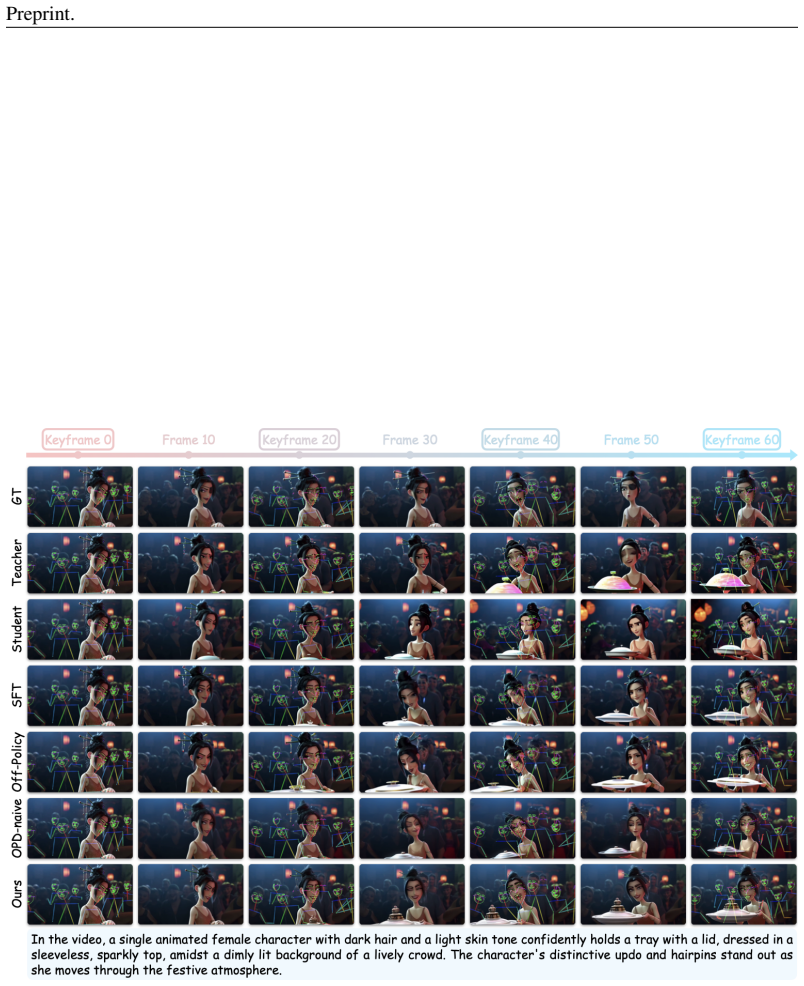
Summary. The paper studies how classifier-free guidance (CFG) should be handled in on-policy diffusion distillation (OPD) when teacher and student each retain separate positive/negative branches. It first observes that matching only the CFG-composed velocity, L_naive ∝ ‖γe+ + (1−γ)e−‖², is under-identified at the branch level: nonzero branch errors can cancel (Eqs. 4–7). It then argues, through two contrasting image-domain case studies (text rendering on SD3.5 with shared null-text negatives; reference-conditioned style distillation on FLUX.2 with privileged reference latents in the teacher's negative branch), that this ambiguity is benign under shared negative conditioning but induces "Negative Branch Asymmetry" (NBA) — antagonistic branch-error dynamics where ‖e+‖ decreases while ‖e−‖ increases — under privileged negative conditioning. The proposed remedy, Positive–Direction Matching (PDM), supervises ‖e+‖² + λ‖e+ − e−‖² before composition, eliminating the compensation freedom. On a dense-to-sparse video control benchmark (Wan2.1-VACE-1.3B, 600 difficulty-stratified test clips, pose/depth/scribble), PDM and the IBM foil outperform naive OPD, SFT, and off-policy matching at the training scale (Table 2) and are far more robust to inference guidance-scale shifts (Table 3).
Significance. If the results hold, the paper makes a useful and timely contribution to a rapidly growing OPD literature that has so far either collapsed CFG into a single student prediction or only studied shared negative conditioning. The branch-ambiguity observation (Eqs. 5–7) is simple but correct and, to my knowledge, not previously isolated in the OPD context. The diagnostic framing — excess guidance-scale degradation relative to the teacher or a branch-aware student, rather than an absolute drop at γ=1, as the signature of NBA — is a falsifiable prediction and is tested as such (Table 1 vs. Table 3). The practical contribution is well supported: a 600-clip, difficulty-stratified video benchmark with control re-extraction metrics (MPJPE/PCK, affine-invariant depth SI-RMSE, tolerant scribble F1, FID/FVD), matched-budget baselines, and a guidance sweep (Table 3) in which naive OPD collapses at γ=1 (FVD 507.7) while PDM stays flat. The supervision-horizon ablation (Table 5) showing K=8-of-50 suffices at ~6× lower cost is independently useful. PDM is essentially parameter-light (λ ablated in Table 4) and trivially implementable.
major comments (4)
- [§3.1, §4.1 (Finding); App. 7.1.1–7.1.2] The load-bearing causal claim of the 'Finding' in §4.1.3 — that privileged negative conditioning (Eq. 14) is what turns branch ambiguity into NBA — rests on a single cross-setting contrast that confounds the conditioning variable with nearly everything else: base model (SD3.5-Medium vs FLUX.2-klein-4B), task (OCR rendering vs style transfer), γ_train (4.5 vs 2), LoRA rank (32 vs 64), data scale (19.6K vs 24 demonstrations), and training budget (1000 vs 2000 steps; §4.1.1, App. 7.1.1–7.1.2). If FLUX.2's editing-interface negative branch, its scheduler, or the 24-example LoRA regime independently produce antagonistic branch dynamics, the attribution in §3.1 is misdiagnosed even though PDM remains practically useful. A controlled toggle is feasible within the paper's own setups and would settle this: e.g., in the reference-conditioned setting, run the identical training with the teacher's n
- [§4.1.2, Fig. 2] The positive-only ablation (ℓ+ = ‖e+‖², Fig. 2 bottom) already exhibits antagonistic branch-error dynamics under privileged conditioning, even though it contains no composed objective and hence no compensation freedom of the form in Eq. 6–7. This suggests the harm may flow from conditioning asymmetry plus shared-parameter drift (positive updates actively degrading the negative branch) rather than from the under-identification of the composed loss per se — a different mechanism than the one the paper names. The manuscript should address this directly: e.g., report whether naive matching's negative-branch growth exceeds the positive-only trajectory (it appears similar in Fig. 2), and clarify what the composed objective adds beyond the drift already present under positive-only training. This matters because it determines whether PDM works by 'removing compensation freedom' (the paper's stor
- [§4.1.3, Fig. 3; App. 7.1.2] The claim in §4.1.3 that naive matching causes 'excess degradation relative to both the teacher and PDM' in the reference-conditioned setting is supported only qualitatively: Fig. 3 shows 2 held-out prompts, App. 7.1.2 describes 12 test prompts evaluated 'qualitatively by inspecting', with no metric at any guidance scale. By contrast, the shared-conditioning side of the contrast is quantitative (Table 1, 1,018 prompts, OCR reward across γ). The asymmetry weakens the central two-regime claim: one side of the contrast has a rigorous guidance-sweep measurement and the other has cherry-pickable images. Please add a quantitative guidance-scale sweep for the reference-conditioned case — e.g., a style-consistency score (CLIP/DINO similarity to the reference style) and a prompt-alignment score across γ ∈ {1, 1.5, 2, 2.5} on more than 12 prompts — or clearly delimit the reference-conditioned stud
- [§4.3.1, Table 4; cf. Table 3] Table 4 complicates the PDM narrative: PDM(λ=0) — i.e., positive-only matching, which Fig. 2 identifies as antagonistic under privileged conditioning — achieves the best overall MPJPE (4.24) and competitive PCK in the pose-only video ablation, and λ=1 improves over λ=0 only marginally on most control metrics (4.27 vs 4.24 MPJPE, 82.12 vs 81.80 PCK@0.1). The guidance-robustness benefit of direction matching is clear in Table 3, but the matched-scale benefit over positive-only is within noise-looking margins, and no γ-sweep is reported for λ=0. Since positive-only is also the natural ablation of PDM's first term, the paper should (a) include a guidance-scale sweep for λ=0 in Table 3 or Fig. 4, and (b) report variance or repeated-seed results sufficient to establish that λ=1's matched-scale gains are real. Otherwise the evidence supports 'branch-aware direction matching buys robustness' mor
minor comments (9)
- [§2.2, Eq. (3)] Eq. (3) and elsewhere use a rendered-glyph notation (ev, evT, evS) for the CFG-composed velocity that reads as a typo for v; a distinct symbol (e.g., ṽ or v_cfg, as in Fig. 1) would avoid confusion.
- [App. 7.1.1–7.1.2] λ differs across experiments without comment: λ=2 for text-rendering (App. 7.1.1), λ=1 for reference-conditioned and video (App. 7.1.2, §4.2.1). Given Table 4 shows sensitivity to λ, please state how each value was selected.
- [App. 7.1.2] In the reference-conditioned setup the 'teacher' adapter is itself updated by EMA of the student (decay 0.9999, App. 7.1.2), so the teacher drifts during training; this is atypical for distillation and could interact with the measured branch-error trajectories in Fig. 2. Please justify and, if possible, report a frozen-teacher variant.
- [Fig. 2] Fig. 2 branch-error curves appear to be single runs (seed 42, App. 7.1.1). Since NBA is defined by the sign pattern of these trajectories, error bars or multi-seed replication would strengthen the paper's central diagnostic.
- [Table 2] Table 2 bolding is inconsistent with the text's claim that PDM gives 'the most consistent' improvements: for pose, IBM has better Key MPJPE (2.88 vs 2.83 — fine) but also better FID (13.26 vs 13.52); for depth, naive OPD's FVD (72.20) is far worse than SFT (58.13), which deserves comment since it is naive OPD's worst matched-scale result.
- [§3.3; App. 7.1.1] Typos: 'smaller K xreduces training cost' (§3.3); 'the target strings to be rendered is given' (App. 7.1.1); 'transition-mean space' (App. 7.1.1) is undefined.
- [§3.2, Eq. (11)] IBM's weights γ² and (γ−1)² in Eq. (11) are introduced as retaining 'the per-branch weights of the expanded naive objective'; it would help to show the one-line expansion making this explicit, and to note that IBM's weighting is therefore tied to γ_train while PDM's λ is not — a potentially important practical difference.
- [§4.1.3] The reference-conditioned evaluation uses only 12 held-out prompts and qualitative inspection (App. 7.1.2); please state this limitation in the main text near Fig. 3 rather than only in the appendix.
- [§5.1] Related work would benefit from citing guidance-aware distillation analyses beyond the few-step literature (e.g., CFG-distillation or guidance-interval training works), to position the branch-retaining setting more precisely.
Circularity Check
No significant circularity: algebraic under-identification, empirical NBA diagnosis, and designed PDM objective are independent of each other and of external benchmarks.
full rationale
The paper’s load-bearing chain does not reduce outputs to inputs by construction. (1) Under-identification of naive CFG-composed OPD (Eq. 5–7) is elementary linear algebra on branch errors e+, e−; it does not smuggle in the later empirical claim. (2) Negative Branch Asymmetry is defined as an observed optimization trajectory (antagonistic ||e+||↓ / ||e−||↑ under privileged negative conditioning) and diagnosed on held-out prompts and control-reextraction metrics (OCR, MPJPE/PCK, SI-RMSE, scribble F1, FID/FVD)—not a fitted quantity renamed as a prediction. (3) PDM (ℓ_PDM = ||e+||² + λ||e+ − e−||²) is an intentionally identifiable loss whose zero set forces e+=e−=0; that is objective design, not a self-definitional derivation of a claimed natural law. (4) Citations to concurrent OPD work supply setting and baselines; none is a uniqueness theorem or ansatz that forces the central Finding. Confounds in the shared-vs-privileged contrast affect causal attribution (correctness), not circularity. Score 0; steps empty.
Axiom & Free-Parameter Ledger
free parameters (4)
- PDM direction weight λ =
1 (default); 2 in text-rendering appendix
- OPD supervision horizon K =
8 of 50 steps (main video)
- Training guidance scale γ_train =
4.5 (text-rendering), 2 (reference), 5 (video)
- IBM branch weights γ² and (γ−1)² =
determined by γ_train
axioms (5)
- domain assumption CFG denoising velocity is the linear mix ẽ = γv+ + (1−γ)v− with separately evaluated positive/negative branches.
- domain assumption Diffusion OPD reduces (up to timestep weight w(t)) to matching teacher and student velocity predictions on student-visited states.
- domain assumption Each model’s native CFG schema may retain auxiliary inputs (reference/control) on the negative branch even when text is null.
- ad hoc to paper Excess guidance-scale degradation relative to the teacher or a branch-aware student is the diagnostic signature of NBA, not any absolute drop at γ=1.
- ad hoc to paper Early-trajectory supervision (first K states) is sufficient for dense-to-sparse video OPD performance.
invented entities (3)
-
Negative Branch Asymmetry (NBA)
no independent evidence
-
Positive–Direction Matching (PDM)
independent evidence
-
Independent Branch Matching (IBM)
independent evidence
read the original abstract
On-policy distillation (OPD) adapts diffusion models by querying a teacher along trajectories generated by the current student, but how it should behave under classifier-free guidance (CFG), a default component of modern diffusion systems, remains poorly understood. Existing OPD methods naturally extend velocity matching to the CFG-composed prediction, directly matching teacher and student guided velocities. We show that this objective is under-identified at the branch level: positive- and negative-branch errors can compensate in the guided prediction. Through two contrasting cases, we find that naive matching remains effective under shared negative conditioning, where both branch errors decrease jointly. When the model's native CFG schema retains privileged information in the teacher's negative branch that is unavailable to the student, however, this joint reduction breaks down and the composed objective induces antagonistic branch-error dynamics, reducing the positive-branch error while increasing the negative-branch error. We term this failure mode Negative Branch Asymmetry (NBA). To address NBA, we introduce Positive--Direction Matching (PDM), a branch-aware OPD objective that separately constrains the positive prediction and the CFG conditional direction. We apply PDM to dense-to-sparse video control, where naive guided matching is highly sensitive to inference guidance scales, while branch-aware supervision enables more robust and effective knowledge transfer.
Figures




Reference graph
Works this paper leans on
-
[1]
On-policy distillation of language models: Learning from self- generated mistakes
Rishabh Agarwal, Nino Vieillard, Yongchao Zhou, Piotr Stanczyk, Sabela Ramos Garea, Matthieu Geist, and Olivier Bachem. On-policy distillation of language models: Learning from self- generated mistakes. InInternational Conference on Learning Representations, volume 2024, pp. 21246–21263,
2024
-
[3]
Flow-opd: On-policy distillation for flow matching models.arXiv preprint arXiv:2605.08063,
Zhen Fang, Wenxuan Huang, Yu Zeng, Yiming Zhao, Shuang Chen, Kaituo Feng, Yunlong Lin, Lin Chen, Zehui Chen, Shaosheng Cao, et al. Flow-opd: On-policy distillation for flow matching models.arXiv preprint arXiv:2605.08063,
-
[7]
Consistency trajectory models: Learning proba- bility flow ode trajectory of diffusion
Dongjun Kim, Chieh-Hsin Lai, WeiHsiang Liao, Naoki Murata, Yuhta Takida, Toshimitsu Uesaka, Yutong He, Yuki Mitsufuji, and Stefano Ermon. Consistency trajectory models: Learning proba- bility flow ode trajectory of diffusion. InInternational Conference on Learning Representations, volume 2024, pp. 44493–44525,
2024
-
[8]
Quanhao Li, Junqiu Yu, Kaixun Jiang, Yujie Wei, Zhen Xing, Pandeng Li, Ruihang Chu, Shiwei Zhang, Yu Liu, and Zuxuan Wu. Diffusionopd: A unified perspective of on-policy distillation in diffusion models.arXiv preprint arXiv:2605.15055, 2026b. Simian Luo, Yiqin Tan, Longbo Huang, Jian Li, and Hang Zhao. Latent consistency models: Synthe- sizing high-resolu...
-
[11]
Haozhe Wang, Weijia Feng, Jinpeng Yu, Che Liu, Ping Nie, Fangzhen Lin, Jiaming Liu, Ruihua Huang, Jimmy Lin, Wenhu Chen, et al. Search beyond what can be taught: Evolving the knowl- edge boundary in agentic visual generation.arXiv preprint arXiv:2607.05382, 2026a. Haozhe Wang, Cong Wei, Weiming Ren, Jiaming Liu, Fangzhen Lin, and Wenhu Chen. Rational- Rew...
-
[12]
Qiyong Zhong, Mao Zheng, Mingyang Song, Xin Lin, Jie Sun, Houcheng Jiang, Xiang Wang, and Junfeng Fang. Sod: Step-wise on-policy distillation for small language model agents.arXiv preprint arXiv:2605.07725,
-
[13]
Danceopd: On-policy generative field distillation.arXiv preprint arXiv:2606.27377,
Wei Zhou, Xiongwei Zhu, Zelin Xu, Bo Dong, Lixue Gong, Yongyuan Liang, Meng Chu, Leigang Qu, Lingdong Kong, Wei Liu, et al. Danceopd: On-policy generative field distillation.arXiv preprint arXiv:2606.27377,
-
[14]
7 APPENDIX 7.1 ADDITIONALEXPERIMENTALDETAILS 7.1.1 TEXTRENDERINGDISTILLATION Models.The base model is Stable Diffusion 3.5-Medium (Esser et al., 2024)
13 Preprint. 7 APPENDIX 7.1 ADDITIONALEXPERIMENTALDETAILS 7.1.1 TEXTRENDERINGDISTILLATION Models.The base model is Stable Diffusion 3.5-Medium (Esser et al., 2024). Both the teacher and the student are LoRA adapters (Hu et al.,
2024
-
[15]
A score of1means the rendered text is read back exactly;0means no characters match
and score ROCR = 1− Lev(ˆs, s) max(|ˆs|,|s|) ∈[0,1],(16) whereLev(ˆs, s)is the Levenshtein (edit) distance between the two strings—the minimum number of single-character insertions, deletions, or substitutions to turnˆsintos—and| · |denotes string length. A score of1means the rendered text is read back exactly;0means no characters match. Evaluation.Unless...
2026
-
[16]
Inference and qualitative evaluation.At inference, we discard the teacher adapter and reference image; the student receives only the held-out text prompt
We use bfloat16 mixed precision for the trainable model and V AE, gradient checkpointing, and DeepSpeed ZeRO-2. Inference and qualitative evaluation.At inference, we discard the teacher adapter and reference image; the student receives only the held-out text prompt. We generate512×512images with 40 denoising steps and evaluate guidance scalesγ∈ {1,1.5,2,2...
2025
-
[2020]
Progressive distillation for fast sampling of diffusion models.arXiv preprint arXiv:2202.00512,
Tim Salimans and Jonathan Ho. Progressive distillation for fast sampling of diffusion models.arXiv preprint arXiv:2202.00512,
-
[2022]
Yubo Huang, Hailong Guo, Fangtai Wu, Weiqiang Wang, Shifeng Zhang, Shijie Huang, Qijun Gan, Lin Liu, Sirui Zhao, Enhong Chen, et al. Live avatar: Streaming real-time audio-driven avatar generation with infinite length.arXiv preprint arXiv:2512.04677,
-
[2023]
Wan: Open and advanced large-scale video generative models.arXiv preprint arXiv:2503.20314,
Team Wan, Ang Wang, Baole Ai, Bin Wen, Chaojie Mao, Chen-Wei Xie, Di Chen, Feiwu Yu, Haiming Zhao, Jianxiao Yang, et al. Wan: Open and advanced large-scale video generative models.arXiv preprint arXiv:2503.20314,
-
[2024]
Paddleocr 3.0 technical report.arXiv preprint arXiv:2507.05595,
Cheng Cui, Ting Sun, Manhui Lin, Tingquan Gao, Yubo Zhang, Jiaxuan Liu, Xueqing Wang, Zelun Zhang, Changda Zhou, Hongen Liu, et al. Paddleocr 3.0 technical report.arXiv preprint arXiv:2507.05595,
-
[2025]
Dengyang Jiang, Xin Jin, Dongyang Liu, Zanyi Wang, Mingzhe Zheng, Ruoyi Du, Xiangpeng Yang, Qilong Wu, Zhen Li, Peng Gao, et al. D-opsd: On-policy self-distillation for continuously tuning step-distilled diffusion models.arXiv preprint arXiv:2605.05204,
-
[2026]
Classifier-free diffusion guidance.arXiv preprint arXiv:2207.12598,
Jonathan Ho and Tim Salimans. Classifier-free diffusion guidance.arXiv preprint arXiv:2207.12598,
discussion (0)
Sign in with ORCID, Apple, or X to comment. Anyone can read and Pith papers without signing in.