A fast spectral-multigrid Poisson solver in non-Cartesian geometries
Pith reviewed 2026-06-26 22:57 UTC · model grok-4.3
The pith
Spectral decomposition plus multigrid solves the Poisson equation to second order in spherical and cylindrical geometries.
A machine-rendered reading of the paper's core claim, the machinery that carries it, and where it could break.
Core claim
The central claim is that azimuthal Fourier decomposition reduces the 3D Poisson equation to a set of 2D Helmholtz problems that can be solved by a geometrically consistent multigrid algorithm preserving second-order accuracy on both uniform and non-uniform (logarithmic) radial grids, with vacuum boundaries handled via a screening-mass approach, yielding an efficient, scalable solver for astrophysical self-gravity.
What carries the argument
azimuthal Fourier decomposition combined with a geometrically consistent multigrid algorithm applied mode-by-mode to the resulting Helmholtz equations
If this is right
- Second-order convergence holds for both spherical and cylindrical geometries on uniform and stretched grids.
- The Poisson solve remains subdominant to the magnetohydrodynamic update even at 4096 cores.
- Vacuum boundaries and inner cavities are treated accurately without artificial reflections.
- The solver supports large-scale simulations of star formation, accretion disks, and gravitational instabilities.
Where Pith is reading between the lines
- The faster convergence of higher Fourier modes could be exploited to truncate or adaptively refine the mode set for additional speed.
- Integration with adaptive mesh refinement would allow the same accuracy on even larger dynamic ranges.
- The same decomposition-plus-multigrid structure might apply to other elliptic operators or coordinate systems beyond the two tested here.
Load-bearing premise
The geometrically consistent multigrid algorithm preserves second-order accuracy on both uniform and non-uniform logarithmic grids when applied to the Helmholtz equations that result from the azimuthal Fourier decomposition.
What would settle it
A convergence test on a logarithmic radial grid with an analytic vacuum-boundary solution in which the measured error fails to decrease quadratically with grid spacing would disprove the accuracy claim.
Figures





read the original abstract
Accurate and efficient computation of self-gravity is essential in astrophysical fluid dynamics, particularly in spherical and cylindrical geometries where large radial dynamic ranges and non-axisymmetric structures arise. Poisson solvers in such settings must simultaneously achieve high accuracy, scalability, and flexibility across a wide range of grid configurations and physical regimes. We present a robust and scalable Poisson solver for three-dimensional non-Cartesian geometries, supporting both spherical and cylindrical coordinates with either uniform or logarithmic radial discretizations. The method employs azimuthal Fourier decomposition to transform the 3D Poisson equation into a set of independent 2D Helmholtz equations. These are solved using a geometrically consistent multigrid algorithm that preserves second-order accuracy on both uniform and non-uniform grids. Vacuum boundary conditions are implemented through a screening-mass approach, enabling accurate solutions in domains with open boundaries, inner cavities, and strongly non-axisymmetric mass distributions. Owing to the differing convergence rates of Fourier modes -- where higher-order modes converge more rapidly -- the solver allows efficient mode-by-mode treatment. The combination of spectral decomposition and multigrid acceleration provides an efficient and flexible computational framework. The solver is implemented in the PLUTO code and validated against both analytical solutions and dynamical test problems in spherical and cylindrical geometries. Results demonstrate second-order convergence and excellent agreement with reference solutions. Weak-scaling tests up to 4096 cores show strong parallel performance, with the Poisson solve remaining subdominant to magnetohydrodynamic update cost. This makes the method well suited for large-scale simulations of star formation, accretion disks, and gravitational instabilities.
Editorial analysis
A structured set of objections, weighed in public.
Referee Report
Summary. The manuscript presents a Poisson solver for 3D spherical and cylindrical geometries that decomposes the problem azimuthally via Fourier transforms into independent 2D Helmholtz equations, solved by a geometrically consistent multigrid algorithm on uniform or logarithmic radial grids. Vacuum boundaries are handled with a screening-mass method. The solver is implemented in PLUTO, with claims of second-order convergence, agreement with analytical and dynamical reference solutions, and good weak scaling to 4096 cores where the Poisson step remains subdominant to MHD updates.
Significance. If the second-order accuracy holds on logarithmic grids, the method would offer a scalable, flexible tool for self-gravity in astrophysical codes handling large radial dynamic ranges and non-axisymmetric structures, directly addressing needs in star formation and accretion-disk simulations.
major comments (2)
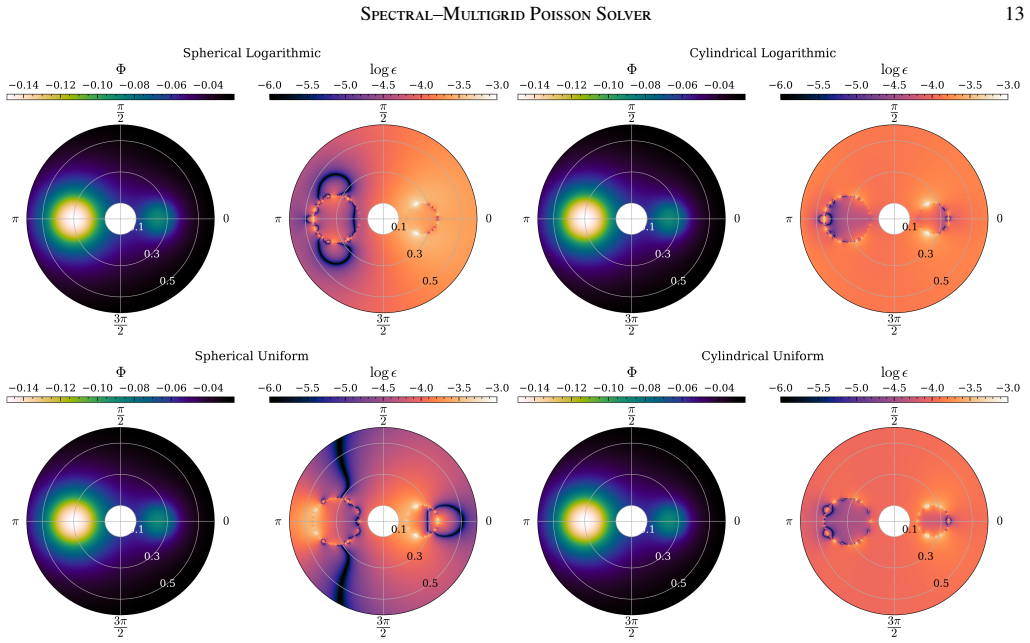
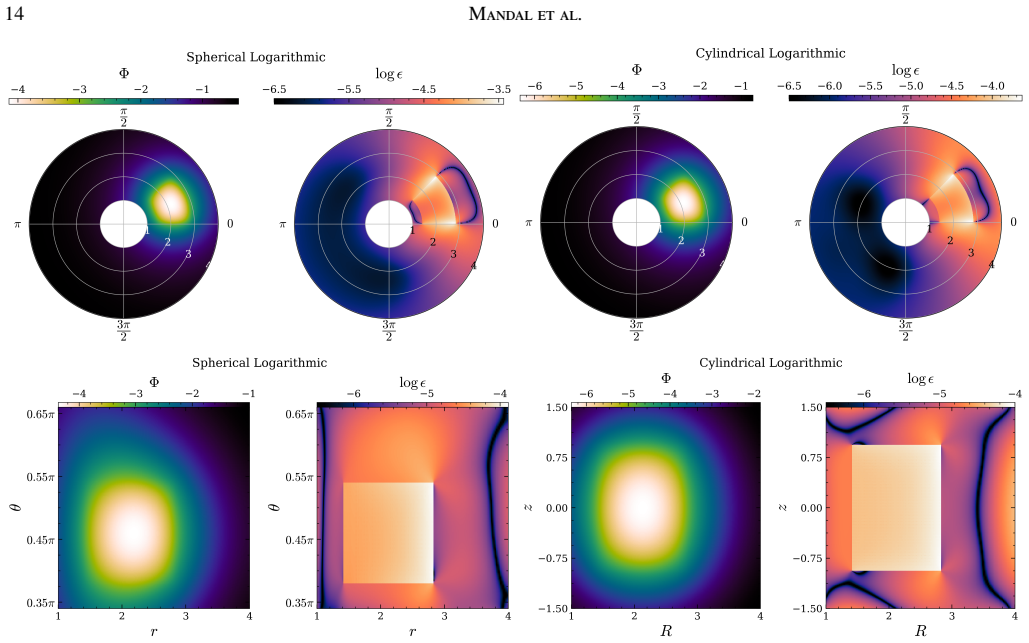
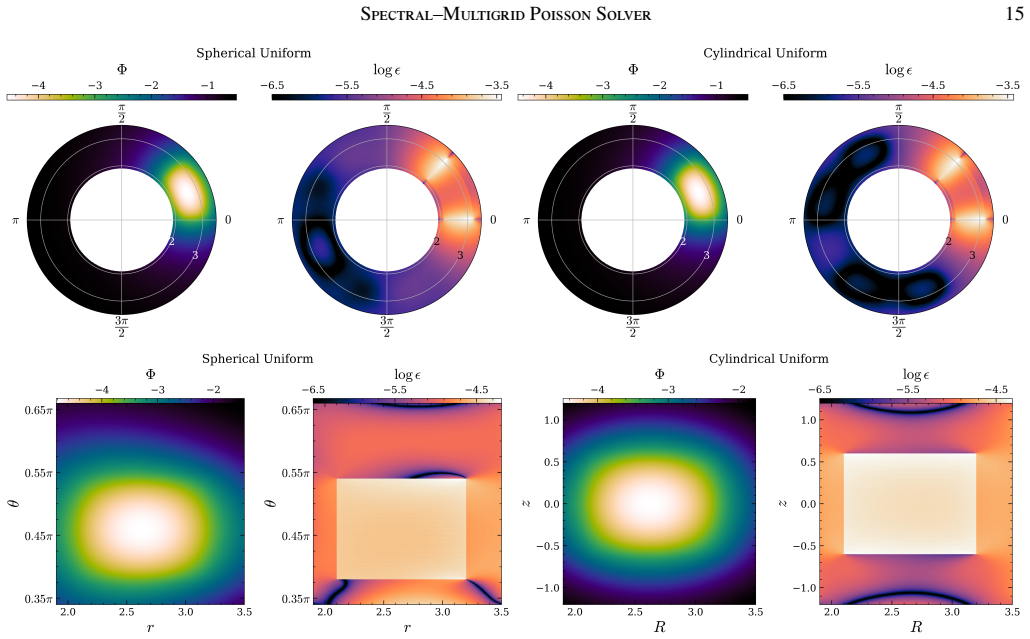
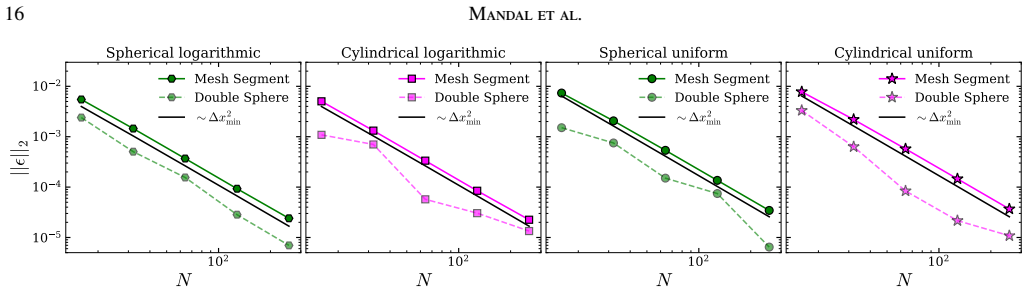
- [Abstract / validation sections] Abstract and validation sections: the central claim of second-order convergence on both uniform and logarithmic grids is stated but unsupported by any quantitative error tables, convergence plots, or discretization analysis in the provided text. This absence prevents verification that the multigrid transfers preserve the underlying finite-volume order for the variable-coefficient Helmholtz operator after Fourier decomposition.
- [Multigrid algorithm / weakest assumption] Geometrically consistent multigrid description: the assertion that the algorithm remains second-order accurate on logarithmic radial meshes (where cell volumes scale as r^2) requires an isolated test on a single azimuthal Fourier mode with an exact Helmholtz solution; without it, any mismatch between prolongation/restriction and the discrete divergence form could drop global accuracy below two, directly undermining the headline result.
Simulated Author's Rebuttal
We thank the referee for the careful reading and constructive comments. We address each major comment below.
read point-by-point responses
-
Referee: [Abstract / validation sections] Abstract and validation sections: the central claim of second-order convergence on both uniform and logarithmic grids is stated but unsupported by any quantitative error tables, convergence plots, or discretization analysis in the provided text. This absence prevents verification that the multigrid transfers preserve the underlying finite-volume order for the variable-coefficient Helmholtz operator after Fourier decomposition.
Authors: We agree that the manuscript text as provided to the referee does not contain the requested quantitative tables, plots or discretization analysis. We will add explicit L2 and L-infinity error tables, convergence plots for both uniform and logarithmic radial grids, and a short section confirming that the multigrid restriction/prolongation operators preserve the second-order accuracy of the underlying finite-volume discretization of the Fourier-decomposed Helmholtz operator. revision: yes
-
Referee: [Multigrid algorithm / weakest assumption] Geometrically consistent multigrid description: the assertion that the algorithm remains second-order accurate on logarithmic radial meshes (where cell volumes scale as r^2) requires an isolated test on a single azimuthal Fourier mode with an exact Helmholtz solution; without it, any mismatch between prolongation/restriction and the discrete divergence form could drop global accuracy below two, directly undermining the headline result.
Authors: We agree that an isolated single-mode test would provide the strongest verification. We will insert a dedicated subsection containing an exact Helmholtz solution on a logarithmic radial grid for a single azimuthal Fourier mode, together with measured convergence rates that confirm the multigrid transfers remain consistent with the discrete divergence form and preserve global second-order accuracy. revision: yes
Circularity Check
No circularity; standard Fourier + multigrid construction with external analytical validation
full rationale
The derivation chain consists of azimuthal Fourier decomposition reducing the 3D Poisson equation to independent 2D Helmholtz problems, followed by a geometrically consistent multigrid solver on the resulting variable-coefficient operators. These steps are assembled from well-known components (Fourier transform, finite-volume discretization, multigrid transfers) without any self-referential definitions, fitted parameters renamed as predictions, or load-bearing self-citations. Convergence order is established by direct comparison to analytical solutions and reference codes rather than by construction from the inputs themselves. The paper therefore remains self-contained against external benchmarks.
Axiom & Free-Parameter Ledger
axioms (2)
- standard math Azimuthal Fourier decomposition reduces the 3D Poisson equation to a set of independent 2D Helmholtz equations
- domain assumption Geometrically consistent multigrid preserves second-order accuracy on uniform and logarithmic radial discretizations
Reference graph
Works this paper leans on
-
[1]
A Self-gravity Module for the PLUTO Code. , keywords =. doi:10.3847/1538-4365/aced0a , archivePrefix =. 2306.05332 , primaryClass =
-
[2]
and Teukolsky, Saul A
Press, William H. and Teukolsky, Saul A. and Vetterling, William T. and Flannery, Brian P. , title =. 1992 , isbn =
1992
-
[3]
2000 , isbn =
Trottenberg, Ulrich and Oosterlee, Cornelius and Schuller, Anton , title =. 2000 , isbn =
2000
-
[4]
and Henson, Van Emden and McCormick, Steve F
Briggs, William L. and Henson, Van Emden and McCormick, Steve F. , year =. A Multigrid Tutorial, Second Edition , ISBN =. doi:10.1137/1.9780898719505 , publisher =
-
[5]
A simple multigrid scheme for solving the Poisson equation with arbitrary domain boundaries
A simple multigrid scheme for solving the Poisson equation with arbitrary domain boundaries. Journal of Computational Physics , keywords =. doi:10.1016/j.jcp.2011.02.044 , archivePrefix =. 1104.1703 , primaryClass =
work page internal anchor Pith review Pith/arXiv arXiv doi:10.1016/j.jcp.2011.02.044 2011
-
[6]
A Direct Multigrid Poisson Solver for Oct-Tree Adaptive Meshes
A Direct Multigrid Poisson Solver for Oct-Tree Adaptive Meshes. ApJS , keywords =. doi:10.1086/526425 , archivePrefix =. 0710.4397 , primaryClass =
work page internal anchor Pith review Pith/arXiv arXiv doi:10.1086/526425
-
[7]
Self-gravitational Force Calculation of Second-order Accuracy Using the Multigrid Method on Nested Grids. ApJS , keywords =. doi:10.3847/1538-4365/ab66ba , archivePrefix =. 2001.02327 , primaryClass =
-
[8]
Self-gravitational adaptive mesh magnetohydrodynamics with the NIRVANA code. A&A , keywords =. doi:10.1051/0004-6361:20042451 , adsurl =
-
[9]
PLUTO: a Numerical Code for Computational Astrophysics
PLUTO: A Numerical Code for Computational Astrophysics. ApJS , keywords =. doi:10.1086/513316 , archivePrefix =. astro-ph/0701854 , primaryClass =
work page internal anchor Pith review Pith/arXiv arXiv doi:10.1086/513316
-
[10]
The PLUTO Code for Adaptive Mesh Computations in Astrophysical Fluid Dynamics
The PLUTO Code for Adaptive Mesh Computations in Astrophysical Fluid Dynamics. ApJS , keywords =. doi:10.1088/0067-0049/198/1/7 , archivePrefix =. 1110.0740 , primaryClass =
work page internal anchor Pith review Pith/arXiv arXiv doi:10.1088/0067-0049/198/1/7
-
[11]
Y., V¨ ais¨ anen, P., Whitelock, P
E pur si muove: Galilean-invariant cosmological hydrodynamical simulations on a moving mesh. MNRAS , keywords =. doi:10.1111/j.1365-2966.2009.15715.x , archivePrefix =. 0901.4107 , primaryClass =
-
[12]
The cosmological simulation code GADGET-2. MNRAS , keywords =. doi:10.1111/j.1365-2966.2005.09655.x , archivePrefix =. astro-ph/0505010 , primaryClass =
-
[13]
Beyond N-body: 3D cosmological gas dynamics. MNRAS , keywords =. doi:10.1093/mnras/235.3.911 , adsurl =
-
[14]
Fragmentation in a rotating protostar: a comparison of two three-dimensional computer codes. ApJ , keywords =. doi:10.1086/157497 , adsurl =
-
[15]
Multiple Fragmentation in Collapsing Protostars. MNRAS , keywords =. doi:10.1093/mnras/264.4.798 , adsurl =
-
[16]
The Jeans Condition: A New Constraint on Spatial Resolution in Simulations of Isothermal Self-gravitational Hydrodynamics. ApJL , keywords =. doi:10.1086/310975 , adsurl =
-
[17]
Self-gravitational Hydrodynamics with Three-dimensional Adaptive Mesh Refinement: Methodology and Applications to Molecular Cloud Collapse and Fragmentation. ApJ , keywords =. doi:10.1086/305329 , adsurl =
-
[18]
A second-order accurate Super TimeStepping formulation for anisotropic thermal conduction. MNRAS , keywords =. doi:10.1111/j.1365-2966.2012.20744.x , adsurl =
-
[19]
Scalable explicit implementation of anisotropic diffusion with Runge-Kutta-Legendre super-time stepping. MNRAS , keywords =. doi:10.1093/mnras/stx2176 , archivePrefix =. 1702.05487 , primaryClass =
work page internal anchor Pith review Pith/arXiv arXiv doi:10.1093/mnras/stx2176
-
[20]
Journal of Computational Physics , year = 2014, month = jan, volume =
A stabilized Runge-Kutta-Legendre method for explicit super-time-stepping of parabolic and mixed equations. Journal of Computational Physics , year = 2014, month = jan, volume =. doi:10.1016/j.jcp.2013.08.021 , adsurl =
-
[21]
CASTRO: A New Compressible Astrophysical Solver. I. Hydrodynamics and Self-gravity. ApJ , keywords =. doi:10.1088/0004-637X/715/2/1221 , archivePrefix =. 1005.0114 , primaryClass =
work page internal anchor Pith review Pith/arXiv arXiv doi:10.1088/0004-637x/715/2/1221
-
[22]
Asymptotic Methods for Integrals , ISBN =
Temme, Nico M , year =. Asymptotic Methods for Integrals , ISBN =. doi:10.1142/9195 , journal =
-
[23]
Computing and Visualization in Science , publisher =
Cell-centred multigrid revisited , volume =. Computing and Visualization in Science , publisher =. 2004 , month = oct, pages =. doi:10.1007/s00791-004-0137-0 , number =
-
[24]
Galactic Dynamics: Second Edition , ISBN =
Binney, James and Tremaine, Scott , year =. Galactic Dynamics: Second Edition , ISBN =. doi:10.2307/j.ctvc778ff , publisher =
-
[25]
arXiv e-prints , keywords =
Mathematical Vindications of the ``Jeans Swindle''. arXiv e-prints , keywords =
-
[26]
Why does the Jeans Swindle work?
Why does the jeans swindle work?. MNRAS , keywords =. doi:10.1093/mnrasl/sls051 , archivePrefix =. 1210.3363 , primaryClass =
work page internal anchor Pith review Pith/arXiv arXiv doi:10.1093/mnrasl/sls051
-
[27]
Conservation of Gravitational Energy , volume =
Hanawa, Tomoyuki , year =. Conservation of Gravitational Energy , volume =. Journal of Physics: Conference Series , publisher =. doi:10.1088/1742-6596/1225/1/012015 , number =
-
[28]
White Dwarf Mergers on Adaptive Meshes. I. Methodology and Code Verification. ApJ , keywords =. doi:10.3847/0004-637X/819/2/94 , archivePrefix =. 1512.06099 , primaryClass =
work page internal anchor Pith review Pith/arXiv arXiv doi:10.3847/0004-637x/819/2/94
-
[29]
An Extension of the Athena++ Framework for Fully Conservative Self-gravitating Hydrodynamics. ApJS , keywords =. doi:10.3847/1538-4365/abcfbd , archivePrefix =. 2012.01340 , primaryClass =
-
[30]
A New Way to Conserve Total Energy for Eulerian Hydrodynamic Simulations with Self-Gravity
A new way to conserve total energy for Eulerian hydrodynamic simulations with self-gravity. NewA , keywords =. doi:10.1016/j.newast.2012.08.002 , archivePrefix =. 1208.1795 , primaryClass =
work page internal anchor Pith review Pith/arXiv arXiv doi:10.1016/j.newast.2012.08.002 2012
-
[31]
FLASH: An Adaptive Mesh Hydrodynamics Code for Modeling Astrophysical Thermonuclear Flashes. ApJS , keywords =. doi:10.1086/317361 , adsurl =
-
[32]
Computer Physics Communications , year = 1995, month = aug, volume =
A piecewise parabolic method for cosmological hydrodynamics. Computer Physics Communications , year = 1995, month = aug, volume =. doi:10.1016/0010-4655(94)00191-4 , adsurl =
-
[33]
A&A , keywords =
On the capabilities and limits of smoothed particle hydrodynamics. A&A , keywords =
-
[34]
Resolution requirements for simulating gravitational fragmentation using SPH
Resolution requirements for simulating gravitational fragmentation using SPH. A&A , keywords =. doi:10.1051/0004-6361:20054100 , archivePrefix =. astro-ph/0512247 , primaryClass =
work page internal anchor Pith review Pith/arXiv arXiv doi:10.1051/0004-6361:20054100
-
[35]
GANDALF - Graphical Astrophysics code for N-body Dynamics And Lagrangian Fluids
GANDALF - Graphical Astrophysics code for N-body Dynamics And Lagrangian Fluids. MNRAS , keywords =. doi:10.1093/mnras/stx2405 , archivePrefix =. 1709.04488 , primaryClass =
work page internal anchor Pith review Pith/arXiv arXiv doi:10.1093/mnras/stx2405
-
[36]
TREESPH: A Unification of SPH with the Hierarchical Tree Method. ApJS , keywords =. doi:10.1086/191344 , adsurl =
-
[37]
GADGET: A code for collisionless and gasdynamical cosmological simulations
GADGET: a code for collisionless and gasdynamical cosmological simulations. NewA , keywords =. doi:10.1016/S1384-1076(01)00042-2 , archivePrefix =. astro-ph/0003162 , primaryClass =
work page internal anchor Pith review Pith/arXiv arXiv doi:10.1016/s1384-1076(01)00042-2
-
[38]
Gasoline: An adaptable implementation of TreeSPH
Gasoline: a flexible, parallel implementation of TreeSPH. NewA , keywords =. doi:10.1016/j.newast.2003.08.004 , archivePrefix =. astro-ph/0303521 , primaryClass =
work page internal anchor Pith review Pith/arXiv arXiv doi:10.1016/j.newast.2003.08.004 2003
-
[39]
GIZMO: A New Class of Accurate, Mesh-Free Hydrodynamic Simulation Methods
A new class of accurate, mesh-free hydrodynamic simulation methods. MNRAS , keywords =. doi:10.1093/mnras/stv195 , archivePrefix =. 1409.7395 , primaryClass =
work page internal anchor Pith review Pith/arXiv arXiv doi:10.1093/mnras/stv195
-
[40]
A new calculation on rotating protostar collapse. ApJ , keywords =. doi:10.1086/158185 , adsurl =
-
[41]
Protostellar Hydrodynamics: Constructing and Testing a Spatially and Temporally Second-Order--accurate Method. I. Spherical Coordinates. ApJS , keywords =. doi:10.1086/191739 , adsurl =
-
[42]
Resolution requirements for smoothed particle hydrodynamics calculations with self-gravity. MNRAS , keywords =. doi:10.1093/mnras/288.4.1060 , adsurl =
-
[43]
Journal of Computational and Applied Mathematics , keywords =
Star formation with 3-D adaptive mesh refinement: the collapse and fragmentation of molecular clouds. Journal of Computational and Applied Mathematics , keywords =
-
[44]
Accelerating self-gravitating hydrodynamics simulations with adaptive force updates. MNRAS , keywords =. doi:10.1093/mnras/stab2208 , archivePrefix =. 2010.13792 , primaryClass =
-
[45]
A Production Mechanism for Clusters of Dense Cores. ApJ , keywords =. doi:10.1086/303982 , adsurl =
-
[46]
Impact of relativistic jets on the star formation rate: a turbulence-regulated framework. MNRAS , keywords =. doi:10.1093/mnras/stab2822 , archivePrefix =. 2109.13654 , primaryClass =
-
[47]
Density, Velocity, and Magnetic Field Structure in Turbulent Molecular Cloud Models
Density, Velocity, and Magnetic Field Structure in Turbulent Molecular Cloud Models. ApJ , keywords =. doi:10.1086/318290 , archivePrefix =. astro-ph/0008454 , primaryClass =
work page internal anchor Pith review Pith/arXiv arXiv doi:10.1086/318290
-
[48]
Malicious User Experience Design Research for Cybersecurity
Theory of Star Formation. ARA&A , keywords =. doi:10.1146/annurev.astro.45.051806.110602 , archivePrefix =. 0707.3514 , primaryClass =
work page internal anchor Pith review Pith/arXiv arXiv doi:10.1146/annurev.astro.45.051806.110602
-
[49]
Dimension as a Key to the Neutrino Mechanism of Core-Collapse Supernova Explosions
Dimension as a Key to the Neutrino Mechanism of Core-collapse Supernova Explosions. ApJ , keywords =. doi:10.1088/0004-637X/720/1/694 , archivePrefix =. 1006.3792 , primaryClass =
work page internal anchor Pith review Pith/arXiv arXiv doi:10.1088/0004-637x/720/1/694
-
[50]
Giant planet formation by gravitational instability. Science , keywords =. doi:10.1126/science.276.5320.1836 , adsurl =
-
[51]
ARA&A , year = 1998, month = jan, volume =
Simulations of Structure Formation in the Universe. ARA&A , year = 1998, month = jan, volume =. doi:10.1146/annurev.astro.36.1.599 , adsurl =
-
[52]
Galaxy Formation and Evolution , ISBN =
Mo, Houjun and van den Bosch, Frank and White, Simon , year =. Galaxy Formation and Evolution , ISBN =. doi:10.1017/cbo9780511807244 , publisher =
-
[53]
2005, MNRAS, 364, L18, doi: 10.1111/j.1745-3933.2005.00096.x
Investigating fragmentation conditions in self-gravitating accretion discs. MNRAS , keywords =. doi:10.1111/j.1745-3933.2005.00105.x , archivePrefix =. astro-ph/0509413 , primaryClass =
-
[54]
An Improved Multipole Approximation for Self-gravity and Its Importance for Core-collapse Supernova Simulations. ApJ , keywords =. doi:10.1088/0004-637X/778/2/181 , archivePrefix =. 1307.3135 , primaryClass =
work page internal anchor Pith review Pith/arXiv arXiv doi:10.1088/0004-637x/778/2/181
-
[55]
Multi-level adaptive solutions to boundary-value problems , volume =
Brandt, Achi , year =. Multi-level adaptive solutions to boundary-value problems , volume =. Mathematics of Computation , publisher =. doi:10.1090/s0025-5718-1977-0431719-x , number =
-
[56]
Charles R. Harris and K. Jarrod Millman and St. Array programming with. 2020 , month = sep, journal =. doi:10.1038/s41586-020-2649-2 , publisher =
-
[57]
2007, Computing in Science & Engineering, 9, 90, doi: 10.1109/MCSE.2007.55
Hunter, John D. , year =. Matplotlib: A 2D Graphics Environment , volume =. Computing in Science & Engineering , publisher =. doi:10.1109/mcse.2007.55 , number =
-
[58]
The Journal of Open Source Software , keywords =
CMasher: Scientific colormaps for making accessible, informative and 'cmashing' plots. The Journal of Open Source Software , keywords =. doi:10.21105/joss.02004 , archivePrefix =. 2003.01069 , primaryClass =
-
[59]
Equilibrium Sequences and Gravitational Instability of Rotating Isothermal Rings
Equilibrium Sequences and Gravitational Instability of Rotating Isothermal Rings. , keywords =. doi:10.3847/0004-637X/829/1/45 , archivePrefix =. 1607.03570 , primaryClass =
work page internal anchor Pith review Pith/arXiv arXiv doi:10.3847/0004-637x/829/1/45
-
[60]
A Fast Poisson Solver of Second-order Accuracy for Isolated Systems in Three-dimensional Cartesian and Cylindrical Coordinates. , keywords =. doi:10.3847/1538-4365/ab09e9 , archivePrefix =. 1902.08369 , primaryClass =
-
[61]
A Fast, Second-order Accurate Poisson Solver in Spherical Polar Coordinates. , keywords =. doi:10.3847/1538-4365/adec68 , archivePrefix =. 2507.06784 , primaryClass =
-
[62]
A Versatile Method for Obtaining Structures of Rapidly Rotating Stars. , keywords =. doi:10.1086/191121 , adsurl =
-
[63]
Astronomische Nachrichten , keywords =
Toward an efficient second-order method for computing the surface gravitational potential on spherical-polar meshes. Astronomische Nachrichten , keywords =. doi:10.1002/asna.20240056 , archivePrefix =. 2407.11648 , primaryClass =
-
[64]
An efficient spectral Poisson solver for the nirvana-III code: the shearing-box case with vertical vacuum boundary conditions. arXiv e-prints , keywords =. doi:10.48550/arXiv.2510.10070 , archivePrefix =. 2510.10070 , primaryClass =
-
[65]
Self-gravity in curved mesh elements
Self-gravity in curved mesh elements. Celestial Mechanics and Dynamical Astronomy , keywords =. doi:10.1007/s10569-014-9535-x , archivePrefix =. 1401.2758 , primaryClass =
work page internal anchor Pith review Pith/arXiv arXiv doi:10.1007/s10569-014-9535-x
-
[66]
The solution of poisson’s equation for isolated source distributions , volume =
James, R.A , year =. The solution of poisson’s equation for isolated source distributions , volume =. Journal of Computational Physics , publisher =. doi:10.1016/0021-9991(77)90013-4 , number =
-
[67]
A Compact Cylindrical Green's Function Expansion for the Solution of Potential Problems. , keywords =. doi:10.1086/308062 , adsurl =
-
[68]
GROMMET: an N-body code for high-resolution simulations of individual galaxies. , keywords =. doi:10.1111/j.1365-2966.2007.12344.x , archivePrefix =. astro-ph/0703406 , primaryClass =
-
[69]
and Johnson, Charles R
Horn, Roger A. and Johnson, Charles R. , title=. 1985 , doi=
1985
-
[70]
and Orszag, Steven A
Bender, Carl M. and Orszag, Steven A. , title =. 1999 , doi=
1999
-
[71]
, title =
Young, David M. , title =. 1971 , doi=
1971
-
[72]
, title =
Varga, Richard S. , title =. 2009 , doi=
2009
-
[73]
Strikwerda, John C. , year =. Finite Difference Schemes and Partial Differential Equations, Second Edition , ISBN =. doi:10.1137/1.9780898717938 , publisher =
-
[74]
Iterative methods for solving partial difference equations of elliptic type , volume =
Young, David , year =. Iterative methods for solving partial difference equations of elliptic type , volume =. Transactions of the American Mathematical Society , publisher =. doi:10.1090/s0002-9947-1954-0059635-7 , number =
-
[75]
II ---Full Nonlinear Numerical Simulations---
Fragmentation of Isothermal Sheet-Like Clouds. II ---Full Nonlinear Numerical Simulations---. Progress of Theoretical Physics , year = 1987, month = dec, volume =. doi:10.1143/PTP.78.1273 , adsurl =
-
[76]
Dynamics of Protoplanetary Disks
Dynamics of Protoplanetary Disks. , keywords =. doi:10.1146/annurev-astro-081710-102521 , archivePrefix =. 1011.1496 , primaryClass =
work page internal anchor Pith review Pith/arXiv arXiv doi:10.1146/annurev-astro-081710-102521
-
[77]
Star formation in molecular clouds: observation and theory. , keywords =. doi:10.1146/annurev.aa.25.090187.000323 , adsurl =
-
[78]
MHD Simulations of Global Accretion Disks with Vertical Magnetic Fields
Magnetohydrodynamic Simulations of Global Accretion Disks with Vertical Magnetic Fields. , keywords =. doi:10.1088/0004-637X/784/2/121 , archivePrefix =. 1309.6916 , primaryClass =
work page internal anchor Pith review Pith/arXiv arXiv doi:10.1088/0004-637x/784/2/121
-
[79]
Global Magnetohydrodynamical Simulations of Accretion Tori
Global Magnetohydrodynamical Simulations of Accretion Tori. , keywords =. doi:10.1086/308180 , archivePrefix =. astro-ph/9907385 , primaryClass =
work page internal anchor Pith review Pith/arXiv arXiv doi:10.1086/308180
-
[80]
1988 , doi =
Computer Simulation Using Particles , publisher =. 1988 , doi =
1988
discussion (0)
Sign in with ORCID, Apple, or X to comment. Anyone can read and Pith papers without signing in.