A Posteriori Error Analysis for Decoupled Neural Approximations of Fully Coupled FBSDEs with Control Mismatch
Pith reviewed 2026-06-30 02:02 UTC · model grok-4.3
The pith
Decoupled neural approximations of fully coupled FBSDEs admit computable a posteriori error bounds depending only on terminal defect, pathwise residual, and control mismatch.
A machine-rendered reading of the paper's core claim, the machinery that carries it, and where it could break.
Core claim
By introducing an auxiliary control process into the forward coefficients of fully coupled FBSDEs, the authors obtain a continuous-time stability estimate under perturbations of the drift, diffusion, generator, terminal condition, and auxiliary control. Transferring this to the discrete adapted trajectory of the neural approximation produces computable a posteriori error bounds that depend on the terminal defect, the pathwise residual, and the control mismatch. When the auxiliary control coincides with the backward neural output, the mismatch term disappears and the bound takes the standard two-term form.
What carries the argument
The auxiliary control process inserted into the forward SDE coefficients, which decouples it from the neural backward component and introduces a quantifiable mismatch term in the error bound.
If this is right
- The error bounds depend only on quantities that can be computed from the neural approximation itself.
- When the auxiliary control is identified with the backward approximation, the mismatch term vanishes and the bound reduces to the standard two-term form.
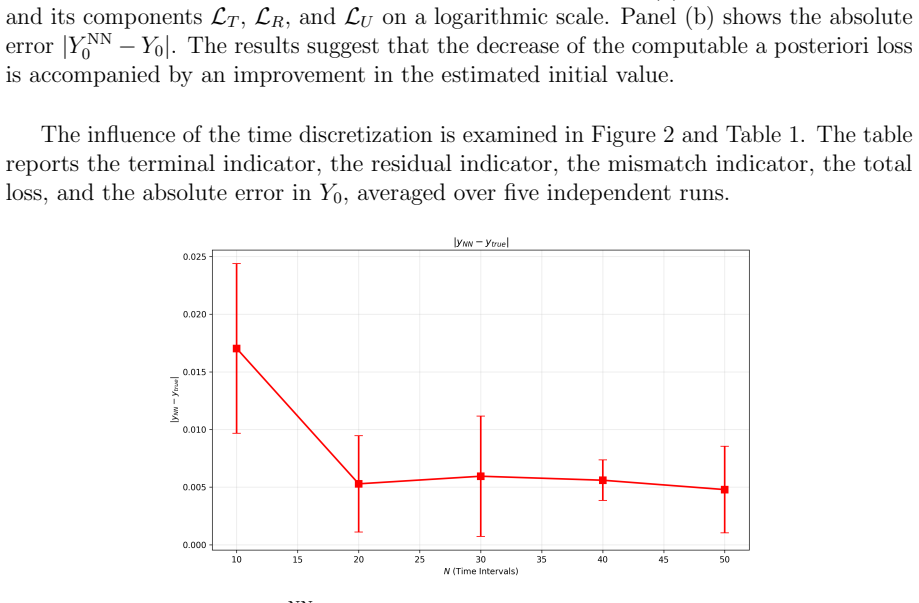
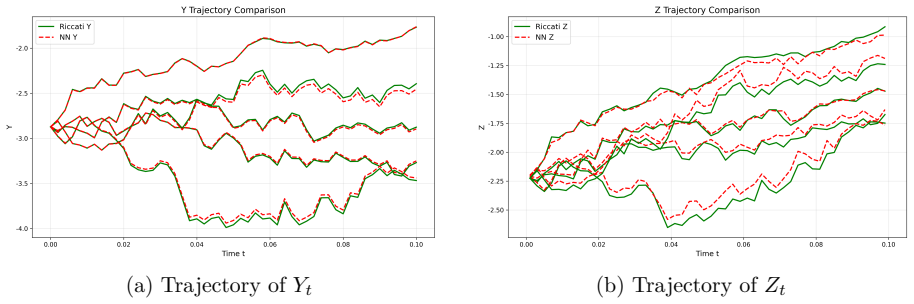
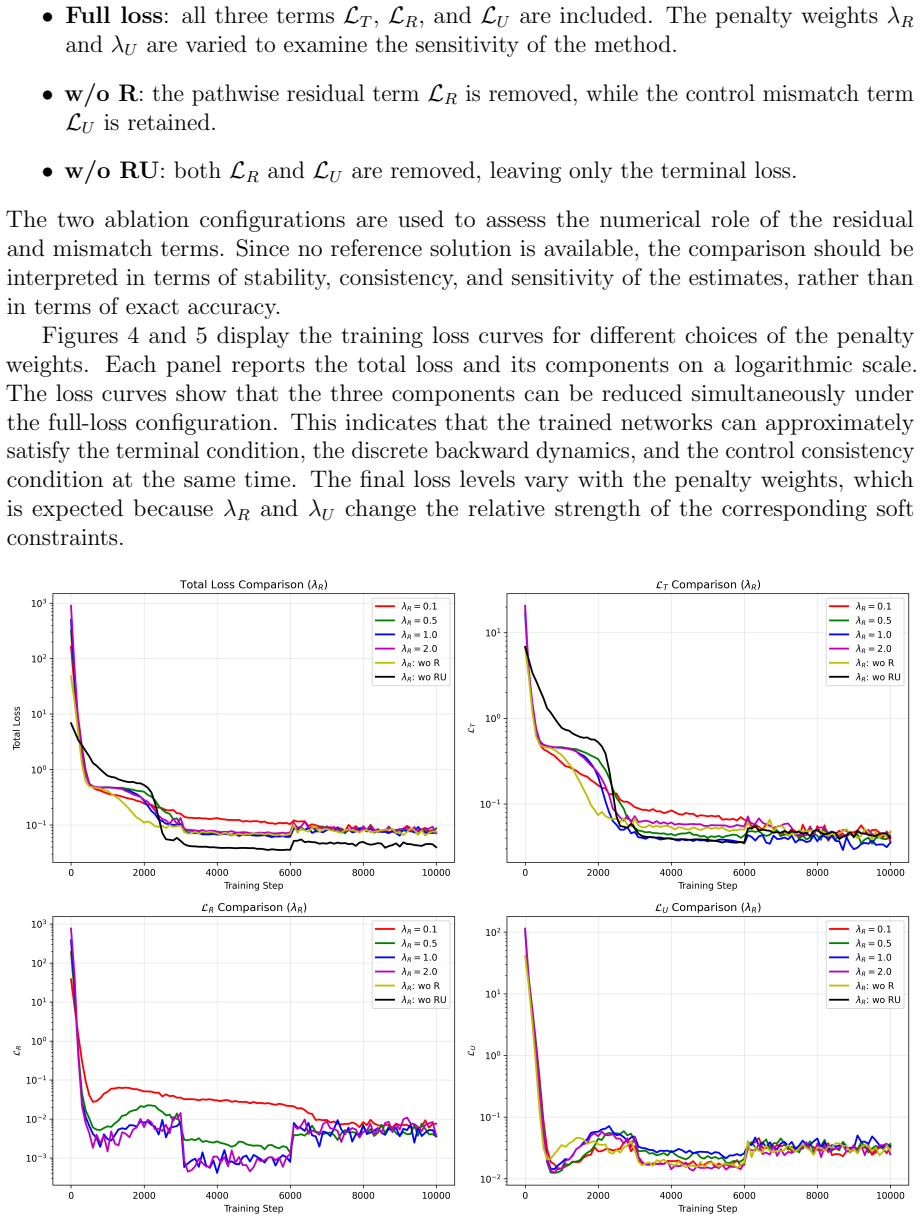
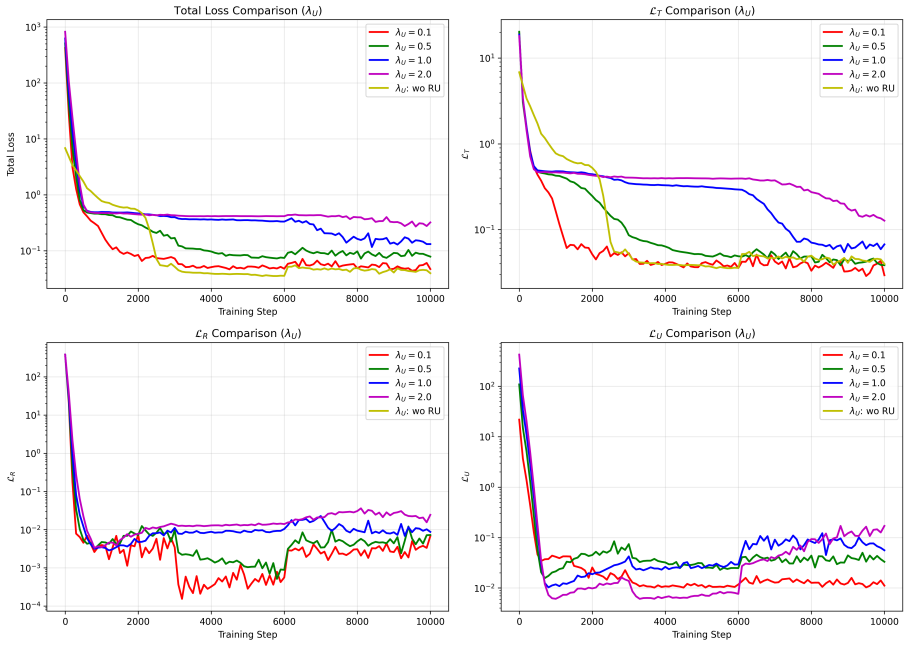
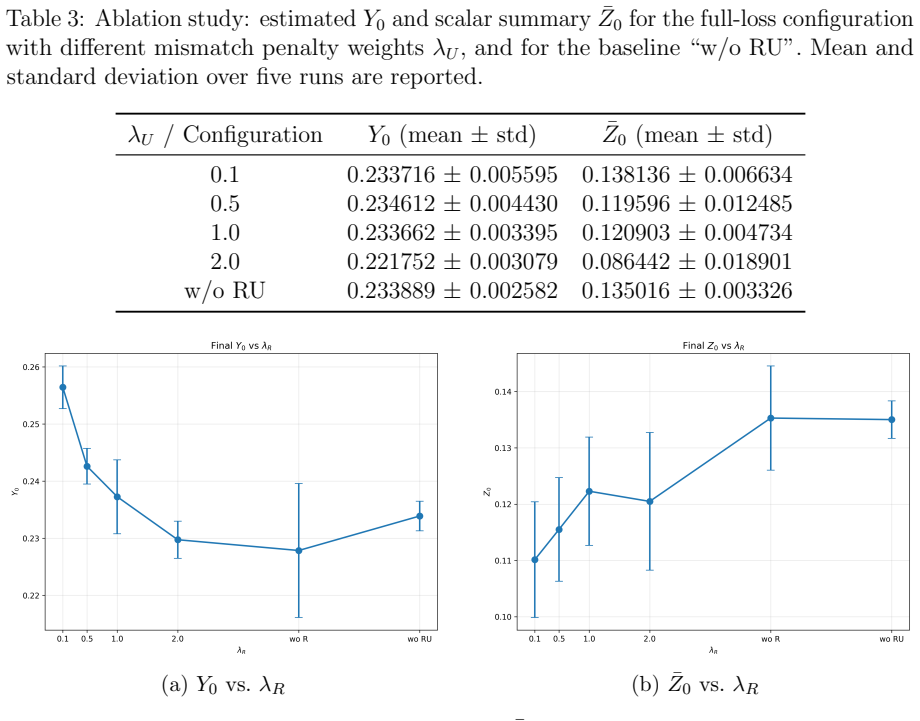
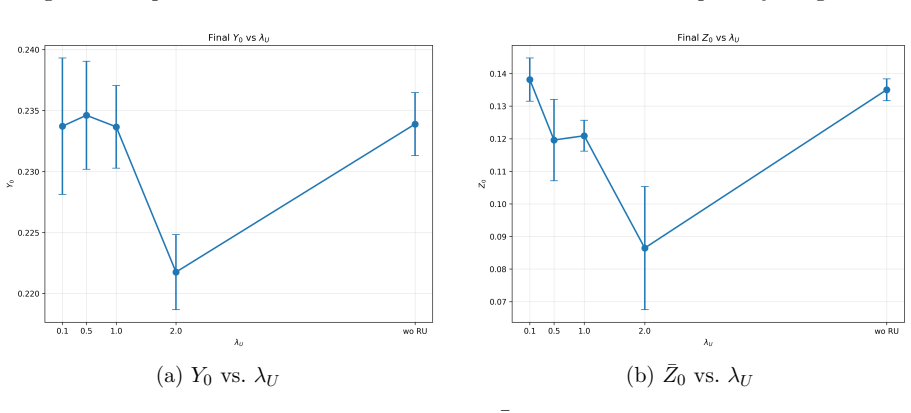
- Numerical experiments on a linear-quadratic FBSDE with explicit solution and a multidimensional Burgers-type FBSDE without reference solution illustrate the diagnostic role of the indicators and the contribution of the mismatch penalty.
- The analysis applies directly to the idealized discrete adapted trajectory before Monte Carlo sampling.
Where Pith is reading between the lines
- The same decoupling device and mismatch accounting could be used in other numerical schemes for FBSDEs that separate the forward and backward solves.
- Training procedures could be designed to penalize control mismatch explicitly, potentially tightening both the approximation error and the a posteriori bound.
- The stability estimate may be useful for studying how changes in network depth or optimizer affect the size of the mismatch term in high-dimensional problems.
Load-bearing premise
A continuous-time stability estimate for fully coupled FBSDEs holds under perturbations of the drift, diffusion, generator, terminal condition, and auxiliary control input, and this estimate transfers to the discrete-time setting used by the neural approximation.
What would settle it
Compute the actual error against the known explicit solution in the linear-quadratic FBSDE example and check whether the derived bound upper-bounds this error for positive values of the control mismatch.
Figures

read the original abstract
This paper develops an a posteriori error analysis framework for decoupled neural approximations of fully coupled forward--backward stochastic differential equations (FBSDEs). It provides an a posteriori error-analysis for the idealized discrete adapted trajectory. The main feature of the proposed formulation is the use of an auxiliary control process in the forward coefficients, which may differ from the backward component approximated by the neural network. This decoupling is useful in practical deep learning implementations, but it creates a control mismatch that must be included in the error analysis. We first establish a continuous-time stability estimate for fully coupled FBSDEs under perturbations of the drift, diffusion, generator, terminal condition, and auxiliary control input. We then transfer this estimate to the discrete-time setting and derive computable a posteriori error bounds depending only on the terminal defect, the pathwise residual, and the control mismatch. When the auxiliary control is identified with the backward approximation, the mismatch term vanishes and the bound reduces to the standard two-term form. Numerical experiments on a linear--quadratic FBSDE with an explicit reference solution and a multidimensional Burgers-type FBSDE without a reference solution illustrate the diagnostic role of the proposed indicators and the contribution of the mismatch penalty to the consistency and reproducibility of the numerical approximations.
Editorial analysis
A structured set of objections, weighed in public.
Referee Report
Summary. The paper develops an a posteriori error analysis framework for decoupled neural approximations of fully coupled FBSDEs. It introduces an auxiliary control process (allowed to differ from the neural backward approximation) in the forward equation to enable practical decoupling. A continuous-time stability estimate is first proved for fully coupled FBSDEs under perturbations to drift, diffusion, generator, terminal condition, and the auxiliary control input. This estimate is then transferred to the discrete adapted trajectories arising in neural schemes, yielding computable a posteriori bounds controlled solely by the terminal defect, pathwise residual, and control mismatch. When the auxiliary control coincides with the backward approximation the mismatch term vanishes and the bound reduces to the standard two-term form. Numerical experiments on an LQ FBSDE (with explicit solution) and a multidimensional Burgers-type FBSDE (without reference) are used to illustrate the diagnostic value of the indicators.
Significance. If the continuous-time stability estimate holds under the stated perturbations and transfers to the discrete setting without unabsorbed remainder terms, the result would be a useful contribution to numerical methods for FBSDEs. It directly addresses a common practical device (decoupling via auxiliary control) by incorporating the resulting mismatch into the error bound, thereby improving the reliability and reproducibility of neural approximations. The explicit reduction to the mismatch-free case provides a consistency check, and the computable nature of the three indicators offers diagnostic tools that can guide training. The framework is particularly relevant for high-dimensional or fully coupled problems where reference solutions are unavailable.
major comments (2)
- The continuous-time stability estimate (the step that accounts for auxiliary control perturbations in addition to drift/diffusion/generator/terminal perturbations) is load-bearing for the central claim. The manuscript must explicitly state all regularity and smallness assumptions required on the FBSDE coefficients and on the size of the control mismatch; if the estimate relies on implicit smallness conditions not stated in the abstract, the applicability to general neural approximations is restricted.
- Transfer of the stability estimate to the discrete-time setting (the step that produces the claimed computable bounds). The transfer must demonstrate that all discretization artifacts (quadrature errors, Itô-Taylor remainders, or adapted-projection discrepancies) are absorbed into the three indicators (terminal defect, pathwise residual, control mismatch) without introducing additional non-computable terms; any gap here would invalidate the a-posteriori character of the bounds.
minor comments (2)
- Numerical experiments section: quantitative values for the three indicators, their observed magnitudes, and their correlation with actual approximation errors (where a reference solution exists) should be reported to substantiate the diagnostic role claimed in the abstract.
- Notation: the precise definitions of 'pathwise residual' and 'terminal defect' in the discrete adapted setting should be stated with explicit formulas so that readers can verify computability directly from the neural-network output.
Simulated Author's Rebuttal
We thank the referee for the detailed and constructive report. The two major comments concern the explicitness of assumptions in the continuous-time stability result and the rigor of the transfer to discrete trajectories. We address both below and will revise the manuscript accordingly.
read point-by-point responses
-
Referee: The continuous-time stability estimate (the step that accounts for auxiliary control perturbations in addition to drift/diffusion/generator/terminal perturbations) is load-bearing for the central claim. The manuscript must explicitly state all regularity and smallness assumptions required on the FBSDE coefficients and on the size of the control mismatch; if the estimate relies on implicit smallness conditions not stated in the abstract, the applicability to general neural approximations is restricted.
Authors: We agree that the assumptions must be stated explicitly rather than left implicit. In the revised version we will insert a new subsection (Section 2.3) that collects all regularity hypotheses (uniform Lipschitz constants, linear growth, uniform ellipticity) together with the precise smallness condition on the control mismatch that appears in the proof of the stability estimate (Theorem 2.4). These conditions are already satisfied by the coefficients and neural approximations used in the numerical examples; the revision will make the domain of applicability transparent without narrowing it. revision: yes
-
Referee: Transfer of the stability estimate to the discrete-time setting (the step that produces the claimed computable bounds). The transfer must demonstrate that all discretization artifacts (quadrature errors, Itô-Taylor remainders, or adapted-projection discrepancies) are absorbed into the three indicators (terminal defect, pathwise residual, control mismatch) without introducing additional non-computable terms; any gap here would invalidate the a-posteriori character of the bounds.
Authors: The transfer is performed in Section 4 by viewing the discrete adapted processes as exact solutions of a perturbed FBSDE whose perturbations are exactly the terminal defect, the pathwise residual (which already includes all quadrature and projection discrepancies by construction), and the control mismatch. No additional remainder terms arise because the stability estimate is applied directly to these perturbed processes. We will add a short clarifying paragraph after Theorem 4.2 that explicitly identifies each discretization artifact inside the pathwise residual, confirming that the resulting bound remains fully computable from the neural-network outputs. revision: yes
Circularity Check
No significant circularity; derivation is self-contained
full rationale
The paper first proves a continuous-time stability estimate for fully coupled FBSDEs that accounts for perturbations in drift, diffusion, generator, terminal condition, and auxiliary control input. It then transfers this estimate to the discrete adapted trajectories arising from the neural scheme and obtains explicit a posteriori bounds controlled solely by the terminal defect, pathwise residual, and control mismatch. No step reduces a claimed result to its own inputs by definition, renames a fitted quantity as a prediction, or relies on a load-bearing self-citation whose validity is presupposed. The reduction to the standard two-term bound when mismatch vanishes is a direct algebraic consequence of the derived estimate rather than a circular redefinition. The central claim therefore rests on an independent stability argument rather than on any of the enumerated circularity patterns.
Axiom & Free-Parameter Ledger
axioms (1)
- domain assumption Continuous-time stability estimate holds for fully coupled FBSDEs under perturbations of drift, diffusion, generator, terminal condition, and auxiliary control
Reference graph
Works this paper leans on
-
[1]
Probability Theory and Related Fields , volume=
Solution of forward-backward stochastic differential equations , author=. Probability Theory and Related Fields , volume=
-
[2]
Systems and Control Letters , volume =
Pardoux, \'Etienne and Peng, Shige , title =. Systems and Control Letters , volume =
-
[3]
SIAM Journal on Control and Optimization , volume =
Peng, Shige and Wu, Zhen , title =. SIAM Journal on Control and Optimization , volume =
-
[4]
Probability theory and related fields , volume=
Solving forward-backward stochastic differential equations explicitly—a four step scheme , author=. Probability theory and related fields , volume=. 1994 , publisher=
1994
-
[5]
Ma, Jin and Yong, Jiongmin , title =
-
[6]
Bellman , title =
Richard E. Bellman , title =
-
[7]
Finance and Stochastics , volume =
Bouchard, Bruno and Ekeland, Ivar and Touzi, Nizar , title =. Finance and Stochastics , volume =. 2004 , doi =
2004
-
[8]
Stochastic Analysis with Financial Applications , series =
Cruzeiro, Ana Bela and Shamarova, Evelina , title =. Stochastic Analysis with Financial Applications , series =. 2011 , publisher =
2011
-
[9]
Classical solution to a multidimensional stochastic Burgers equation via forward-backward SDEs
Ohashi, Alberto and Shamarova, Evelina , title =. arXiv:1602.06268 , year =
work page internal anchor Pith review Pith/arXiv arXiv
-
[10]
Multidimensional Stochastic Burgers Equation , journal =
Brze\'. Multidimensional Stochastic Burgers Equation , journal =. 2014 , doi =. https://doi.org/10.1137/120866117 , abstract =
-
[11]
IMA Journal of Numerical Analysis , volume =
Reisinger, Christoph and Stockinger, Wolfgang and Zhang, Yufei , title =. IMA Journal of Numerical Analysis , volume =. 2024 , doi =
2024
-
[12]
Methodology and Computing in Applied Probability , volume =
Germain, Maximilien and Mikael, Joseph and Warin, Xavier , title =. Methodology and Computing in Applied Probability , volume =. 2022 , doi =
2022
-
[13]
Stochastic Processes and their Applications , volume =
Bouchard, Bruno and Touzi, Nizar , title =. Stochastic Processes and their Applications , volume =
-
[14]
Stochastic Processes and their Applications , volume =
Gobet, Emmanuel and Labart, C\'eline , title =. Stochastic Processes and their Applications , volume =
-
[15]
Proceedings of the National Academy of Sciences , volume =
Han, Jiequn and Jentzen, Arnulf and E, Weinan , title =. Proceedings of the National Academy of Sciences , volume =
-
[16]
, title =
Raissi, Maziar and Perdikaris, Paris and Karniadakis, George E. , title =. Journal of Computational Physics , volume =
-
[17]
Communications in Mathematics and Statistics , volume =
E, Weinan and Han, Jiequn and Jentzen, Arnulf , title =. Communications in Mathematics and Statistics , volume =
-
[18]
Probability, Uncertainty and Quantitative Risk , volume =
Han, Jiequn and Long, Jihao , title =. Probability, Uncertainty and Quantitative Risk , volume =
-
[19]
Gnoatto, Alessandro and Oberpriller, Katharina and Picarelli, Athena , title =. arXiv:2501.09727 , year =
-
[20]
SIAM Journal on Financial Mathematics , year =
Gao, Chengfan and Chen, Sheng and Zhu, Zimu and Wang, Zhaojun , title =. SIAM Journal on Financial Mathematics , year =
-
[21]
Journal of Scientific Computing , volume=
Multistep Schemes for Forward Backward Stochastic Differential Equations with Jumps , author=. Journal of Scientific Computing , volume=
-
[22]
Least-Squares Monte Carlo for Backward SDEs
Bender, Christian and Steiner, Jessica. Least-Squares Monte Carlo for Backward SDEs. Numerical Methods in Finance. 2012
2012
- [23]
-
[24]
Stochastic Processes and Their Applications , volume=
Problem of eigenvalues of stochastic Hamiltonian systems with boundary conditions , author=. Stochastic Processes and Their Applications , volume=
-
[25]
Fully Coupled Forward-Backward Stochastic Differential Equations and Applications to Optimal Control , author=
-
[26]
1999 , publisher=
Stochastic Controls-Hamiltonian System and HJB Equations , author=. 1999 , publisher=
1999
-
[27]
Journal of Mathematical Analysis and Applications , volume=
Conjugate convex functions in optimal stochastic control , author=. Journal of Mathematical Analysis and Applications , volume=
-
[28]
Siam Review , volume=
An Introductory Approach to Duality in Optimal Stochastic Control , author=. Siam Review , volume=
-
[29]
Haussmann, U. G. General necessary conditions for optimal control of stochastic systems. Stochastic Systems: Modeling, Identification and Optimization, II. 1976. doi:10.1007/BFb0120743
-
[30]
Mathematics of Control, Signals and Systems , author =
Approximation by superpositions of a sigmoidal function , volume =. Mathematics of Control, Signals and Systems , author =. 1989 , pages =. doi:10.1007/BF02551274 , number =
-
[31]
Neural Networks , volume=
Approximation capabilities of multilayer feedforward networks , author=. Neural Networks , volume=
-
[32]
31st Conference on Neural Information Processing Systems (NIPS 2017) , year=
The marginal value of adaptive gradient methods in machine learning , author=. 31st Conference on Neural Information Processing Systems (NIPS 2017) , year=
2017
-
[33]
, title =
Kushner, Harold J. , title =. SIAM Journal on Control , volume =. 1972 , doi =
1972
-
[34]
Siam Journal on Control and Optimization , volume=
A general stochastic maximum principle for optimal control problems , author=. Siam Journal on Control and Optimization , volume=
-
[35]
NIPS Workshop on Deep Reinforcement Learning , year=
Deep Learning Approximation for Stochastic Control Problems , author=. NIPS Workshop on Deep Reinforcement Learning , year=
-
[36]
Annals of Applied Probability , volume =
Numerical simulation of quadratic BSDEs , author=. Annals of Applied Probability , volume =
-
[37]
Annals of Applied Probability , volume =
Time Discretization and Markovian Iteration for Coupled FBSDEs , author=. Annals of Applied Probability , volume =
-
[38]
Three Algorithms for Solving High-Dimensional Fully Coupled FBSDEs Through Deep Learning , year=
Ji, Shaolin and Peng, Shige and Peng, Ying and Zhang, Xichuan , journal=. Three Algorithms for Solving High-Dimensional Fully Coupled FBSDEs Through Deep Learning , year=
-
[39]
Journal of Scientific Computing , year=
Ji, Shaolin and Peng, Shige and Peng, Ying and Zhang, Xichuan , title=. Journal of Scientific Computing , year=. doi:10.1007/s10915-022-01979-5 , url=
-
[40]
Hur\'. Deep Neural Networks Algorithms for Stochastic Control Problems on Finite Horizon: Convergence Analysis , journal =. 2021 , doi =. https://doi.org/10.1137/20M1316640 , abstract =
-
[41]
Mathematics of Computation , volume =
Gobet, Emmanuel and Turkedjiev, Plamen , title =. Mathematics of Computation , volume =. 2016 , doi =
2016
-
[42]
Annals of Applied Probability , volume =
Gobet, Emmanuel and Lemor, Jean-Philippe and Warin, Xavier , title =. Annals of Applied Probability , volume =
-
[43]
Methodology and Computing in Applied Probability , year=
Deep Neural Networks Algorithms for Stochastic Control Problems on Finite Horizon: Numerical Applications , author=. Methodology and Computing in Applied Probability , year=
-
[44]
29th Annual Conference on Learning Theory , pages =
benefits of depth in neural networks , author =. 29th Annual Conference on Learning Theory , pages =. 2016 , editor =
2016
-
[45]
Error bounds for approximations with deep relu networks
Dmitry Yarotsky , keywords =. Error bounds for approximations with deep ReLU networks , journal =. 2017 , issn =. doi:https://doi.org/10.1016/j.neunet.2017.07.002 , url =
-
[46]
Multilayer feedforward networks with a nonpolynomial activation function can approximate any function , volume =. Neural Networks , author =. 1993 , pages =. doi:10.1016/S0893-6080(05)80131-5 , abstract =
-
[47]
Analysis and Applications , volume =
Jiao, Yuling and Lai, Yanming and Lo, Yisu and Wang, Yang and Yang, Yunfei , title =. Analysis and Applications , volume =. 2024 , doi =. https://doi.org/10.1142/S021953052350015X , abstract =
-
[48]
Nonlinear Expectations and Stochastic Calculus under Uncertainty-with Robust CLT and G-Brownian Motion , author=
-
[49]
SIAM Journal on Control and Optimization , volume=
Relationship between backward stochastic differential equations and stochastic controls: a linear-quadratic approach , author=. SIAM Journal on Control and Optimization , volume=
-
[50]
El Karoui, Nicole and Peng, Shige and Quenez, Marie Claire , title =. Mathematical Finance , volume =. doi:https://doi.org/10.1111/1467-9965.00022 , url =. https://onlinelibrary.wiley.com/doi/pdf/10.1111/1467-9965.00022 , abstract =
-
[51]
Numerical Methods in Finance , editor =
El Karoui, Nicole and Quenez, Marie Claire , title =. Numerical Methods in Finance , editor =. 1997 , doi =
1997
-
[52]
, title =
Duffie, Darrell and Epstein, Larry G. , title =. Econometrica , volume =
-
[53]
SIAM Journal on Control and Optimization , year=
Linear-quadratic control of backward stochastic differential equations , author=. SIAM Journal on Control and Optimization , year=
-
[54]
Journal of Financial Markets , year=
Optimal control of execution costs , author=. Journal of Financial Markets , year=
-
[55]
Optimal Liquidity Trading
Gur Huberman and Werner Stanzl. Optimal Liquidity Trading. Review of Finance. 2005
2005
-
[56]
Mathematical Control and Related Fields , volume=
Constrained BSDEs, viscosity solutions of variational inequalities and their applications , author=. Mathematical Control and Related Fields , volume=
-
[57]
Probability theory and related fields , volume=
Monotonic limit theorem of BSDE and nonlinear decomposition theorem of Doob–Meyer\'s type , author=. Probability theory and related fields , volume=
-
[58]
Stochastics and Stochastic Reports , volume =
Probabilistic interpretation for systems of quasilinear parabolic partial differential equations , author=. Stochastics and Stochastic Reports , volume =
discussion (0)
Sign in with ORCID, Apple, or X to comment. Anyone can read and Pith papers without signing in.