Isoperimetric relations between Dirichlet and Neumann eigenvalues
Pith reviewed 2026-05-25 17:20 UTC · model grok-4.3
The pith
The number of Neumann eigenvalues no greater than the first Dirichlet eigenvalue is controlled by a domain's isoperimetric ratio.
A machine-rendered reading of the paper's core claim, the machinery that carries it, and where it could break.
Core claim
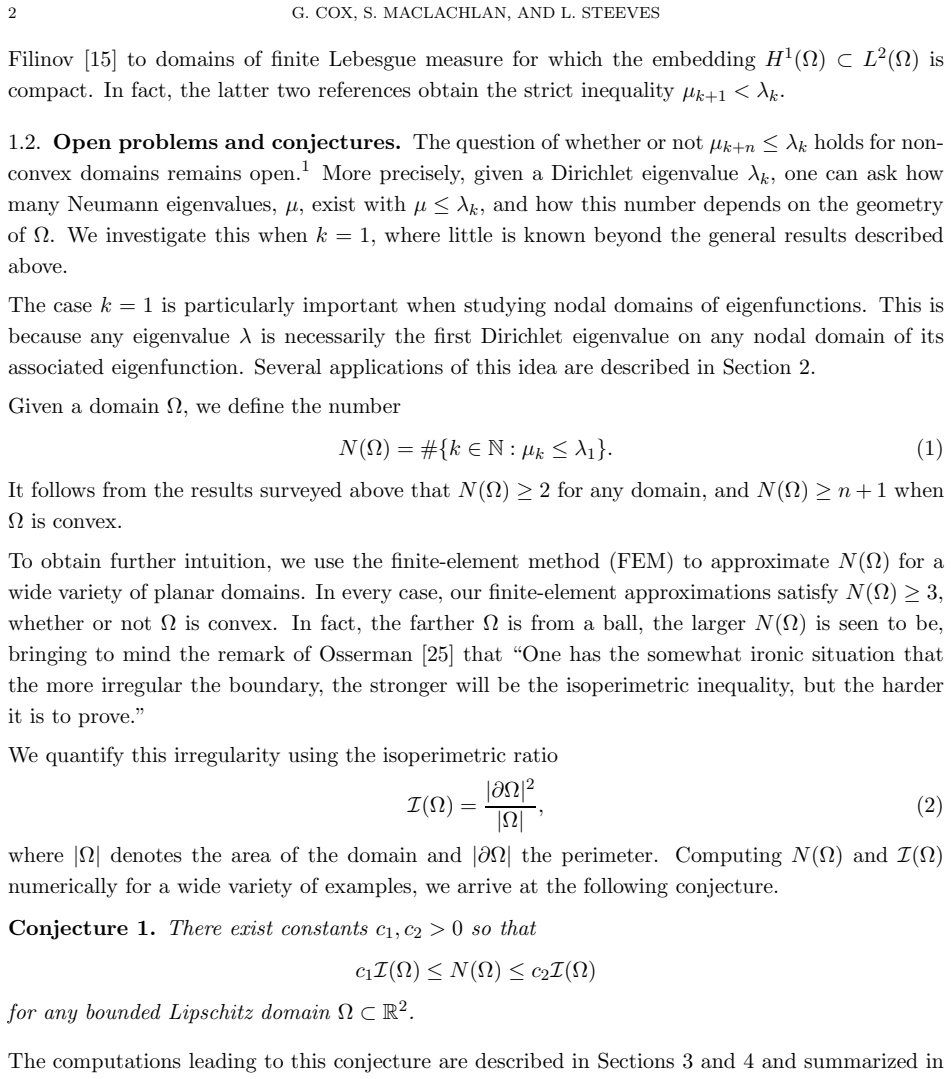
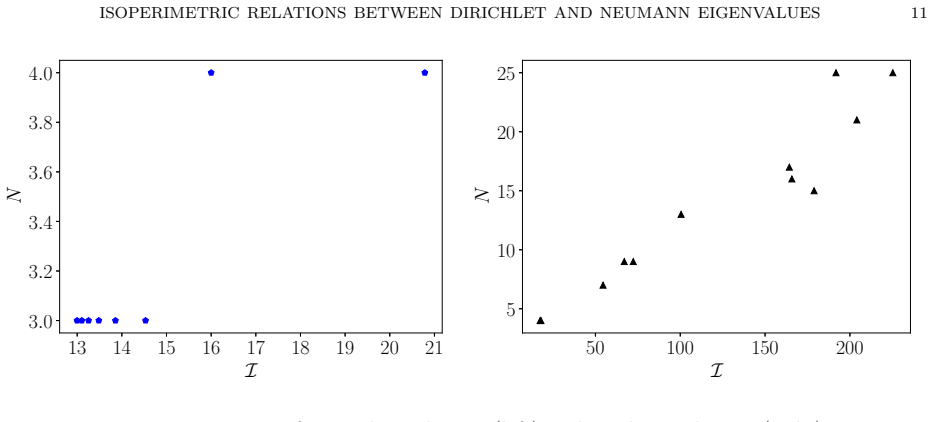
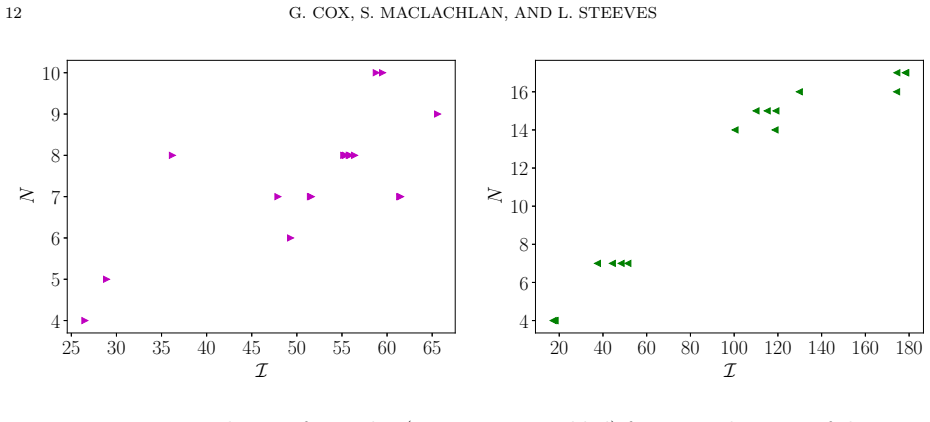
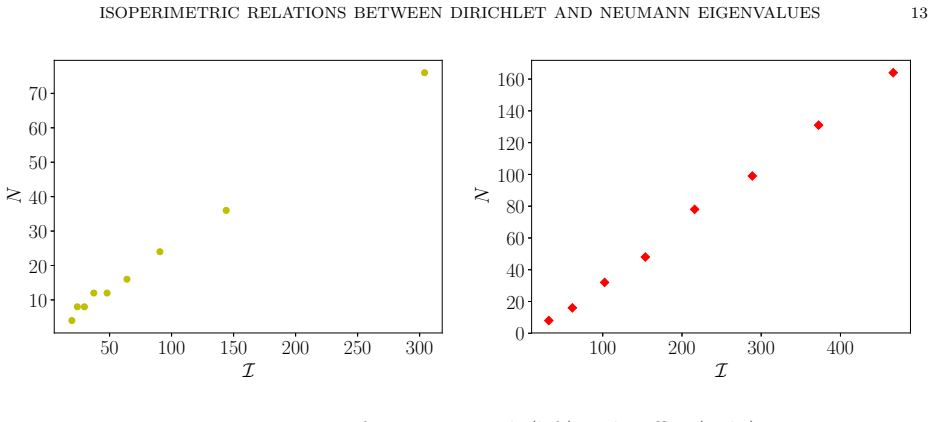
The authors conjecture that the number of Neumann eigenvalues less than or equal to the first Dirichlet eigenvalue is controlled by the isoperimetric ratio of the domain.
What carries the argument
The isoperimetric ratio of the domain, which quantifies how far the boundary length deviates from the circle of the same area and thereby governs the eigenvalue count in question.
If this is right
- The nodal deficiency of certain eigenfunctions is bounded in terms of the isoperimetric ratio.
- New relations appear between the Dirichlet and Neumann spectra that go beyond classical comparison inequalities.
- The conjecture supplies a concrete route toward estimating the Hausdorff measure of nodal sets.
Where Pith is reading between the lines
- Verification on domains with corners or holes would test whether the same ratio governs the count.
- The relation may yield practical estimates of eigenvalue multiplicity without full numerical diagonalization of the Laplacian.
Load-bearing premise
The pattern observed in the tested domains and eigenvalue regimes extends to a general relation that holds for every possible domain.
What would settle it
A single explicit domain whose isoperimetric ratio and Neumann eigenvalue count up to the first Dirichlet eigenvalue violate the conjectured control.
Figures




read the original abstract
Inequalities between the Dirichlet and Neumann eigenvalues of the Laplacian have received much attention in the literature, but open problems abound. Here, we study the number of Neumann eigenvalues no greater than the first Dirichlet eigenvalue. Based on a combination of analytical and numerical results, we conjecture that this number is controlled by the isoperimetric ratio of the domain. This has applications to the nodal deficiency of eigenfunctions and is closely related to a long-standing conjecture of Yau on the Hausdorff measure of nodal sets.
Editorial analysis
A structured set of objections, weighed in public.
Referee Report
Summary. The manuscript examines inequalities relating Dirichlet and Neumann eigenvalues of the Laplacian on planar domains. It defines N(Ω) as the number of Neumann eigenvalues ≤ the first Dirichlet eigenvalue and, via a combination of analytical bounds on special domains and numerical computations on a range of shapes, conjectures that N(Ω) is controlled by the isoperimetric ratio of Ω. The conjecture is positioned as having consequences for nodal deficiency and Yau’s nodal-set conjecture.
Significance. If the conjecture is correct it would supply a new isoperimetric constraint on the low-lying spectrum and thereby link two classical problems in spectral geometry. The paper’s explicit combination of rigorous bounds for model domains with reproducible numerical tests is a positive feature that makes the conjecture falsifiable and invites further analytic work.
major comments (2)
- [Numerical experiments section] Numerical experiments section: the reported computations are performed on a collection of domains whose isoperimetric ratios vary, yet no table or figure isolates families of domains that share the same isoperimetric ratio while differing in other geometric invariants (genus, presence of narrow necks, higher moments of the boundary). Without such controls it remains possible that N(Ω) depends on additional geometric data, which directly undermines the claim that the count is a function of the isoperimetric ratio alone.
- [Analytical results section] Analytical results section: the partial bounds are derived only for disks, annuli and stadiums; the manuscript does not indicate how these special-case estimates could be combined or extended to rule out counter-examples with the same isoperimetric ratio but different N(Ω), leaving the general conjecture without a clear path from the proven cases.
minor comments (2)
- [Introduction] The precise mathematical statement of the conjecture (whether N(Ω) equals a specific function of the isoperimetric ratio or is merely bounded by one) should be written as a numbered display equation for clarity.
- [Numerical experiments section] Figure captions should state the discretization method and the number of mesh points used for each eigenvalue computation so that the numerical evidence can be reproduced independently.
Simulated Author's Rebuttal
We thank the referee for the careful reading and constructive feedback. The comments highlight important points for strengthening the presentation of our conjecture. We respond to each major comment below.
read point-by-point responses
-
Referee: Numerical experiments section: the reported computations are performed on a collection of domains whose isoperimetric ratios vary, yet no table or figure isolates families of domains that share the same isoperimetric ratio while differing in other geometric invariants (genus, presence of narrow necks, higher moments of the boundary). Without such controls it remains possible that N(Ω) depends on additional geometric data, which directly undermines the claim that the count is a function of the isoperimetric ratio alone.
Authors: We agree that isolating the dependence on the isoperimetric ratio requires additional controls. Our existing computations vary multiple geometric features across a range of ratios, but to directly test independence from other invariants we will add a new figure and accompanying discussion in the revised numerical section. This will include families of domains (e.g., stadiums and perturbed annuli) with fixed isoperimetric ratio but differing neck widths or boundary moments, confirming that N(Ω) is unchanged within numerical tolerance. revision: yes
-
Referee: Analytical results section: the partial bounds are derived only for disks, annuli and stadiums; the manuscript does not indicate how these special-case estimates could be combined or extended to rule out counter-examples with the same isoperimetric ratio but different N(Ω), leaving the general conjecture without a clear path from the proven cases.
Authors: The analytic bounds are deliberately restricted to domains that attain or approach the extremal isoperimetric ratios, where the conjecture can be verified rigorously. Because the statement remains a conjecture, these cases are not claimed to yield a general proof or a systematic method for excluding counter-examples at fixed ratio. The manuscript presents the conjecture as supported by the combination of these bounds with the numerical survey; extending the analytic results to a full proof is left as future work. revision: no
Circularity Check
No circularity; central claim framed as conjecture from analysis and numerics
full rationale
The paper explicitly presents its main result as a conjecture ('we conjecture that this number is controlled by the isoperimetric ratio of the domain') supported by 'a combination of analytical and numerical results' rather than any derivation or first-principles proof that could reduce to inputs by construction. No self-citations, fitted parameters renamed as predictions, or ansatzes are invoked in a load-bearing way for the central statement. The relation to Yau's conjecture is noted as context, not as a self-referential justification. This is the normal case of an honest conjecture paper with no circularity in its (non-)derivation chain.
Axiom & Free-Parameter Ledger
Reference graph
Works this paper leans on
-
[1]
Martin S. Alnæs, Jan Blechta, Johan Hake, August Johansso n, Benjamin Kehlet, Anders Logg, Chris Richardson, Johannes Ring, Marie E. Rognes, and Garth N. Wells, The fenics project version 1.5 , Archive of Numerical Software 3 (2015), no. 100
work page 2015
- [2]
-
[3]
Mark S. Ashbaugh and Rafael D. Benguria, Universal bounds for the low eigenvalues of Neumann Laplaci ans in n dimensions, SIAM J. Math. Anal. 24 (1993), no. 3, 557–570. MR 1215424
work page 1993
-
[4]
Patricio Aviles, Symmetry theorems related to Pompeiu’s problem , Amer. J. Math. 108 (1986), no. 5, 1023–1036. MR 859768
work page 1986
-
[5]
Rafael Benguria, Michael Levitin, and Leonid Parnovski, Fourier transform, null variety, and Laplacian ’s eigen- values, J. Funct. Anal. 257 (2009), no. 7, 2088–2123. MR 2548031 14 G. COX, S. MACLACHLAN, AND L. STEEVES
work page 2009
-
[6]
Pierre B´ erard and Daniel Meyer, In´ egalit´ es isop´ erim´ etriques et applications, Ann. Sci. ´Ecole Norm. Sup. (4) 15 (1982), no. 3, 513–541. MR 690651
work page 1982
-
[7]
Gregory Berkolaiko, Graham Cox, and Jeremy L. Marzuola, Nodal deficiency, spectral flow, and the Dirichlet-to- Neumann map , Letters in Mathematical Physics 109 (2019), no. 7, 1611–1623
work page 2019
-
[8]
Braess, Finite elements , Cambridge University Press, Cambridge, 2001, Second Edit ion
D. Braess, Finite elements , Cambridge University Press, Cambridge, 2001, Second Edit ion
work page 2001
-
[9]
S.C. Brenner and L.R. Scott, The mathematical theory of finite element methods , Texts in Applied Mathematics, vol. 15, Springer-Verlag, New York, 1994. MR MR1278258 (95f :65001)
work page 1994
-
[10]
Jochen Br¨ uning, ¨Uber Knoten von Eigenfunktionen des Laplace-Beltrami-Ope rators, Math. Z. 158 (1978), no. 1, 15–21. MR 0478247
work page 1978
-
[11]
Bruno Colbois, Ahmad El Soufi, and Alexandre Girouard, Isoperimetric control of the Steklov spectrum , J. Funct. Anal. 261 (2011), no. 5, 1384–1399. MR 2807105
work page 2011
-
[12]
R. Courant and D. Hilbert, Methods of mathematical physics. Vol. I , Interscience Publishers, Inc., New York, N.Y., 1953. MR 0065391 (16,426a)
work page 1953
-
[13]
Graham Cox, Christopher K.R.T. Jones, and Jeremy L. Marz uola, Manifold decompositions and indices of Schr¨ odinger operators, Indiana Univ. Math. J. 66 (2017), 1573–1602
work page 2017
-
[14]
Harold Donnelly and Charles Fefferman, Nodal sets of eigenfunctions on Riemannian manifolds , Invent. Math. 93 (1988), no. 1, 161–183. MR 943927
work page 1988
-
[15]
Filinov, On an inequality between Dirichlet and Neumann eigenvalues for the Laplace operator , St
N. Filinov, On an inequality between Dirichlet and Neumann eigenvalues for the Laplace operator , St. Petersburg Math. J. 16 (2004), no. 2, 413–416
work page 2004
-
[16]
Leonid Friedlander, Some inequalities between Dirichlet and Neumann eigenvalu es, Arch. Rational Mech. Anal. 116 (1991), no. 2, 153–160. MR 1143438 (93h:35146)
work page 1991
-
[17]
Bernard Helffer and Mikael Persson Sundqvist, On nodal domains in Euclidean balls , Proc. Amer. Math. Soc. 144 (2016), no. 11, 4777–4791. MR 3544529
work page 2016
-
[18]
Vicente Hernandez, Jose E. Roman, and Vicente Vidal, SLEPc: A scalable and flexible toolkit for the solution of eigenvalue problems , ACM Trans. Math. Software 31 (2005), no. 3, 351–362
work page 2005
- [19]
-
[20]
Howard A. Levine and Hans F. Weinberger, Inequalities between Dirichlet and Neumann eigenvalues , Arch. Rational Mech. Anal. 94 (1986), no. 3, 193–208. MR 846060
work page 1986
-
[21]
Partial Differential Equations 2 (1977), no
Hans Lewy, On the minimum number of domains in which the nodal lines of sp herical harmonics divide the sphere, Comm. Partial Differential Equations 2 (1977), no. 12, 1233–1244. MR 0477199 (57 #16740)
work page 1977
-
[22]
Alexander Logunov, Nodal sets of Laplace eigenfunctions: polynomial upper est imates of the Hausdorff measure , Ann. of Math. (2) 187 (2018), no. 1, 221–239. MR 3739231
work page 2018
-
[23]
, Nodal sets of Laplace eigenfunctions: proof of Nadirashvil i’s conjecture and of the lower bound in Yau’s conjecture, Ann. of Math. (2) 187 (2018), no. 1, 241–262. MR 3739232
work page 2018
-
[24]
Lee Lorch and Peter Szego, Bounds and monotonicities for the zeros of derivatives of ul traspherical Bessel func- tions, SIAM J. Math. Anal. 25 (1994), no. 2, 549–554. MR 1266576
work page 1994
-
[25]
Robert Osserman, The isoperimetric inequality, Bull. Amer. Math. Soc. 84 (1978), no. 6, 1182–1238. MR 0500557
work page 1978
-
[26]
L. E. Payne, Inequalities for eigenvalues of membranes and plates , J. Rational Mech. Anal. 4 (1955), 517–529. MR 0070834
work page 1955
- [27]
-
[28]
P´ olya,Remarks on the foregoing paper , J
G. P´ olya,Remarks on the foregoing paper , J. Math. Physics 31 (1952), 55–57. MR 0047237
work page 1952
-
[29]
Yousef Saad, Numerical methods for large eigenvalue problems , Classics in Applied Mathematics, vol. 66, Society for Industrial and Applied Mathematics (SIAM), Philadelph ia, PA, 2011, Revised edition of the 1992 original [ 1177405]. MR 3396212
work page 2011
-
[30]
thesis, Georg-August-Universit¨ at G¨ ottingen, 1925
Antonie Stern, Bemerkungen ¨ uber asymptotisches Verhalten von Eigenwerten und eigenfunktionen , Ph.D. thesis, Georg-August-Universit¨ at G¨ ottingen, 1925. ISOPERIMETRIC RELATIONS BETWEEN DIRICHLET AND NEUMANN EIG ENV ALUES 15
work page 1925
-
[31]
G. N. Watson, A treatise on the theory of Bessel functions , Cambridge Mathematical Library, Cambridge Uni- versity Press, Cambridge, 1995, Reprint of the second (1944 ) edition. MR 1349110 E-mail address : gcox@mun.ca E-mail address : smaclachlan@mun.ca E-mail address : luke.steeves@mun.ca Department of Mathematics and Statistics, Memorial Univer sity of...
work page 1995
discussion (0)
Sign in with ORCID, Apple, or X to comment. Anyone can read and Pith papers without signing in.