Closed-Form and Constant-Time New-Source Selection for Fault-Tolerant Broadcasting in Dense Gaussian Networks
Pith reviewed 2026-06-26 19:33 UTC · model grok-4.3
The pith
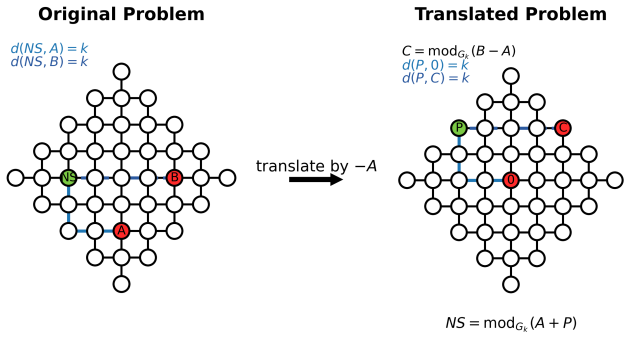
The shifted direct selector finds a point P at distance k from both 0 and the modular difference C of two faults by checking at most 144 algebraic cases over nine quotient-lattice shifts.
A machine-rendered reading of the paper's core claim, the machinery that carries it, and where it could break.
Core claim
Given faulty nodes A and B, translate the problem to C = mod_{G_k}(B-A). The shifted direct selector finds P satisfying d(P,0)=d(P,C)=k by evaluating at most 9 imes16=144 shifted sign cases; non-parallel systems are solved via Cramer's rule and parallel systems via interval-endpoint selection. Validation shows zero count mismatches over 26,623 tested nodes, 500,000 valid outputs over 500,000 sampled fault pairs, and 40,000 successful re-rooted broadcasts, together with a 5.92 imes speedup over boundary search at k=200 that remains stable as k grows.
What carries the argument
The shifted direct selector, which reduces source selection to an algebraic search for an equidistant boundary point P in the Gaussian quotient lattice and resolves it by a fixed collection of nine lattice shifts each containing sixteen signed linear systems.
If this is right
- The number of valid new sources is obtained in closed form by a fixed union of side-pair intervals without scanning the network or its boundary.
- New-source selection completes in O(1) time bounded by 144 algebraic operations and therefore independent of network diameter k.
- Re-rooting the broadcast at the selected source succeeds in every sampled case while delivering a measured 5.92 imes speedup that does not degrade with larger k.
- The algebraic procedure eliminates the need for boundary search and makes the entire fault-recovery step size-independent.
Where Pith is reading between the lines
- The same fixed-shift algebraic pattern could be adapted to locate sources at prescribed distances from more than two faults by intersecting additional boundary sets.
- Constant-time selection removes a scaling bottleneck that would otherwise appear in very large Gaussian networks under frequent faults.
- The method's independence from network size suggests it may transfer to other Cayley graphs whose quotient lattices admit a similar finite covering by shifts.
Load-bearing premise
The nine quotient-lattice shifts together with their sixteen signed systems per shift are sufficient to cover every possible pair of faults without omission or overlap that would miss a valid source or return an incorrect distance.
What would settle it
A single tested fault pair for which the selector returns a point P whose distance to 0 or to C is not equal to k, or whose reported count of valid sources differs from an exhaustive enumeration of the intersection set.
Figures

read the original abstract
Fault-tolerant broadcasting in dense Gaussian networks is recovered by re-rooting the broadcast at a new source at maximum graph distance from the faulty nodes. This paper extends the re-rooting framework by replacing its boundary-search source-selection step with a quotient-lattice-aware algebraic construction. The first contribution is a constant-time counting method for valid new sources, formulated as an intersection of two diameter-$k$ boundary sets in the Gaussian quotient. The exact count is obtained by a fixed union of side-pair intervals over nine quotient-lattice copies, giving a closed-form procedure without scanning the network or boundary. The second contribution is a shifted direct selector for two arbitrary faulty nodes. Given faulty nodes $A$ and $B$, the problem is translated to $C=\operatorname{mod}_{G_k}(B-A)$, and the selector finds $P$ satisfying $d(P,0)=d(P,C)=k$. For each of nine quotient-lattice shifts, sixteen signed linear systems are checked. Nonparallel systems are solved via Cramer's rule; parallel systems are handled by interval-endpoint selection. At most $9\times16=144$ shifted sign cases are evaluated, giving $O(1)$ selection under the word-RAM model. Validation reports zero count mismatches over $26{,}623$ tested nodes, $500{,}000$ valid outputs over $500{,}000$ sampled fault pairs, and $40{,}000$ successful re-rooted broadcast trials. The shifted selector achieves a $5.92\times$ speedup over boundary search at $k=200$, remaining stable as $k$ increases. These results make new-source selection algebraic, bounded, and independent of network size.
Editorial analysis
A structured set of objections, weighed in public.
Referee Report
Summary. The paper claims that new-source selection for fault-tolerant broadcasting in dense Gaussian networks can be performed in constant time via an algebraic construction on the Gaussian quotient lattice. Given faults A and B, it reduces the problem to C = mod_{G_k}(B-A) and finds P with d(P,0)=d(P,C)=k by enumerating at most 9 quotient-lattice shifts each with 16 signed linear systems (solved by Cramer's rule or interval endpoints), yielding a closed-form count via union of side-pair intervals and an O(1) selector under word-RAM; extensive sampling (26,623 nodes, 500,000 fault pairs, 40,000 trials) reports zero mismatches and a 5.92× speedup at k=200.
Significance. If the 9-shift/16-system enumeration is exhaustive, the result supplies a parameter-free, network-size-independent algebraic procedure for both counting and selecting valid re-rooting sources, replacing boundary search with bounded arithmetic. The reported validation volume and zero-error outcome on sampled pairs constitute a strong empirical check; combined with the closed-form interval-union count, this would constitute a concrete advance in practical fault-tolerant broadcasting for Gaussian networks.
major comments (1)
- [Shifted direct selector] Shifted direct selector section: the manuscript presents the 9 quotient-lattice shifts and 16 signed systems per shift as sufficient to solve d(P,0)=d(P,C)=k for every C, but supplies no derivation showing that these cases exhaust the solution set of the two diameter-k equations over the quotient (no proof that every valid P is captured by one of the 144 cases and that no extraneous solutions are generated). The constant-time claim rests on this completeness; only the procedure plus zero mismatches on 500,000 sampled pairs is given.
Simulated Author's Rebuttal
We thank the referee for the careful review and for highlighting the need for a formal derivation of completeness in the shifted direct selector. We address the single major comment below and will revise the manuscript accordingly.
read point-by-point responses
-
Referee: Shifted direct selector section: the manuscript presents the 9 quotient-lattice shifts and 16 signed systems per shift as sufficient to solve d(P,0)=d(P,C)=k for every C, but supplies no derivation showing that these cases exhaust the solution set of the two diameter-k equations over the quotient (no proof that every valid P is captured by one of the 144 cases and that no extraneous solutions are generated). The constant-time claim rests on this completeness; only the procedure plus zero mismatches on 500,000 sampled pairs is given.
Authors: We agree with the referee that the manuscript does not supply an explicit derivation proving that the nine quotient-lattice shifts together with the sixteen signed linear systems per shift exhaust all solutions to the pair of diameter-k equations and generate no extraneous points. The current text presents the algebraic construction and relies on the empirical result of zero mismatches across 500,000 sampled pairs. To make the constant-time claim rigorous, the revised manuscript will add a dedicated subsection that derives completeness. The derivation proceeds by (i) fixing an arbitrary C in the quotient and considering the possible locations of the two circles of radius k centered at 0 and at C, (ii) showing that the nine representative shifts of the fundamental domain cover every possible intersection geometry, and (iii) verifying that each of the sixteen sign combinations corresponds to a unique orthant or boundary case within a shifted copy, with parallel cases handled by interval endpoints. We will also prove that any extraneous candidate is rejected by the distance checks. This case analysis will be self-contained and independent of network size. revision: yes
Circularity Check
No circularity; algebraic enumeration is a direct constructive procedure
full rationale
The paper defines the shifted direct selector explicitly as a fixed enumeration over nine quotient-lattice shifts and sixteen signed linear systems per shift, solved by Cramer's rule or interval endpoints. This procedure is presented as a self-contained algebraic algorithm on the Gaussian quotient that directly computes a P satisfying the two diameter-k equations; the bound of 144 cases yields O(1) time by construction without reference to fitted parameters, prior self-citations as load-bearing premises, or any renaming of empirical patterns. Validation counts on sampled pairs are external checks, not inputs that define the method. No step in the given derivation chain reduces to its own outputs by definition or forces the result via self-referential assumptions.
Axiom & Free-Parameter Ledger
axioms (1)
- domain assumption Gaussian networks are faithfully modeled by the integer lattice with quotient G_k whose diameter-k boundary sets admit the stated interval-union counting formula.
Reference graph
Works this paper leans on
-
[1]
The topology of Gaussian and Eisenstein–Jacobi interconnec- tion networks,
M. Flahive and B. Bose, “The topology of Gaussian and Eisenstein–Jacobi interconnec- tion networks,”IEEE Transactions on Parallel and Distributed Systems, vol. 21, no. 8, pp. 1132–1142, 2010
2010
-
[2]
Dense Gaussian networks: Suitable topologies for on-chip multiprocessors,
C. Mart´ ınez, E. Vallejo, R. Beivide, C. Izu, and M. Moret´ o, “Dense Gaussian networks: Suitable topologies for on-chip multiprocessors,”International Journal of Parallel Pro- gramming, vol. 34, no. 3, pp. 193–211, 2006
2006
-
[3]
Gaussian interconnection networks,
R. Beivide, C. Mart´ ınez, and E. Vallejo, “Gaussian interconnection networks,” inProc. Spanish Parallelism Conference, 2005
2005
-
[4]
On the perfectt- dominating set problem in circulant graphs and codes over Gaussian integers,
C. Mart´ ınez, R. Beivide, J. Guti´ errez, and E. M. Gabidulin, “On the perfectt- dominating set problem in circulant graphs and codes over Gaussian integers,” inProc. IEEE International Symposium on Information Theory (ISIT), 2005, pp. 254–258
2005
-
[5]
Hierarchical topologies for large-scale two-level networks,
E. Vallejo, C. Mart´ ınez, and R. Beivide, “Hierarchical topologies for large-scale two-level networks,”Journal of Parallel and Distributed Computing, vol. 68, no. 4, pp. 461–476, 2008
2008
-
[6]
Grama, A
A. Grama, A. Gupta, G. Karypis, and V. Kumar,Introduction to Parallel Computing, 2nd ed. Pearson, 2003
2003
-
[7]
Duato, S
J. Duato, S. Yalamanchili, and L. Ni,Interconnection Networks: An Engineering Ap- proach. Morgan Kaufmann, 2002
2002
-
[8]
W. J. Dally and B. Towles,Principles and Practices of Interconnection Networks. Mor- gan Kaufmann, 2004
2004
-
[9]
A survey on fault-tolerant communication in network-on-chip architectures,
D. Kliazovich, F. Granelli, and D. Miorandi, “A survey on fault-tolerant communication in network-on-chip architectures,”Computer Networks, vol. 54, no. 14, pp. 2434–2452, 2010
2010
-
[10]
Pasricha and N
S. Pasricha and N. Dutt,On-Chip Communication Architectures: System-on-Chip In- terconnect. Morgan Kaufmann, 2008
2008
-
[11]
Flich and D
J. Flich and D. Bertozzi,Designing Network-on-Chip Architectures in the Nanoscale Era. CRC Press, 2010
2010
-
[12]
A distributed algorithm for constructing independent spanning trees in parallel systems,
J. Wu and H. Huang, “A distributed algorithm for constructing independent spanning trees in parallel systems,”IEEE Transactions on Parallel and Distributed Systems, vol. 10, no. 4, pp. 377–381, 1999
1999
-
[13]
Topological properties of hypercubes,
Y. Saad and M. H. Schultz, “Topological properties of hypercubes,”IEEE Transactions on Computers, vol. 37, no. 7, pp. 867–872, 1988
1988
-
[14]
Re-rooting-based fault-tolerant broad- casting in dense Gaussian networks,
B. Albader, M. R. Al-Mulla, and G. Hassan, “Re-rooting-based fault-tolerant broad- casting in dense Gaussian networks,”IEEE Access, 2026. 23
2026
-
[15]
Development of routing algorithms in networks-on-chip based on two-dimensional optimal circulant topologies,
A. Y. Romanov, E. V. Lezhnev, A. Y. Glukhikh, and A. A. Amerikanov, “Development of routing algorithms in networks-on-chip based on two-dimensional optimal circulant topologies,”Heliyon, vol. 6, no. 1, Art. no. e03172, 2020
2020
-
[16]
Routing algorithms in opti- mal degree four circulant networks based on relative addressing: Comparative analysis for networks-on-chip,
E. A. Monakhova, O. G. Monakhov, and A. Y. Romanov, “Routing algorithms in opti- mal degree four circulant networks based on relative addressing: Comparative analysis for networks-on-chip,”IEEE Transactions on Network Science and Engineering, vol. 10, no. 1, pp. 413–425, 2023
2023
-
[17]
Gaussian-based optical networks- on-chip: Performance analysis and optimization,
T. Song, Y. Xie, Y. Ye, Y. Du, B. Liu, and Y. Liu, “Gaussian-based optical networks- on-chip: Performance analysis and optimization,”Nano Communication Networks, vol. 24, Art. no. 100286, 2020. 24
2020
discussion (0)
Sign in with ORCID, Apple, or X to comment. Anyone can read and Pith papers without signing in.