Integrating Mechanistic and Data-Driven Models for Neurological Disorders through Differentiable Programming
Pith reviewed 2026-06-28 01:42 UTC · model grok-4.3
The pith
Hybrid models integrating differential equations and deep learning outperform standalone approaches in modeling neurological disorders.
A machine-rendered reading of the paper's core claim, the machinery that carries it, and where it could break.
Core claim
Hybrid models that integrate governing differential equation based formulations and deep learning outperform standalone mechanistic or purely data driven approaches in characterizing the evolution of neurological disorders, with proposed configurations improving diagnosis accuracy, predicting disease progression, and informing treatment strategies.
What carries the argument
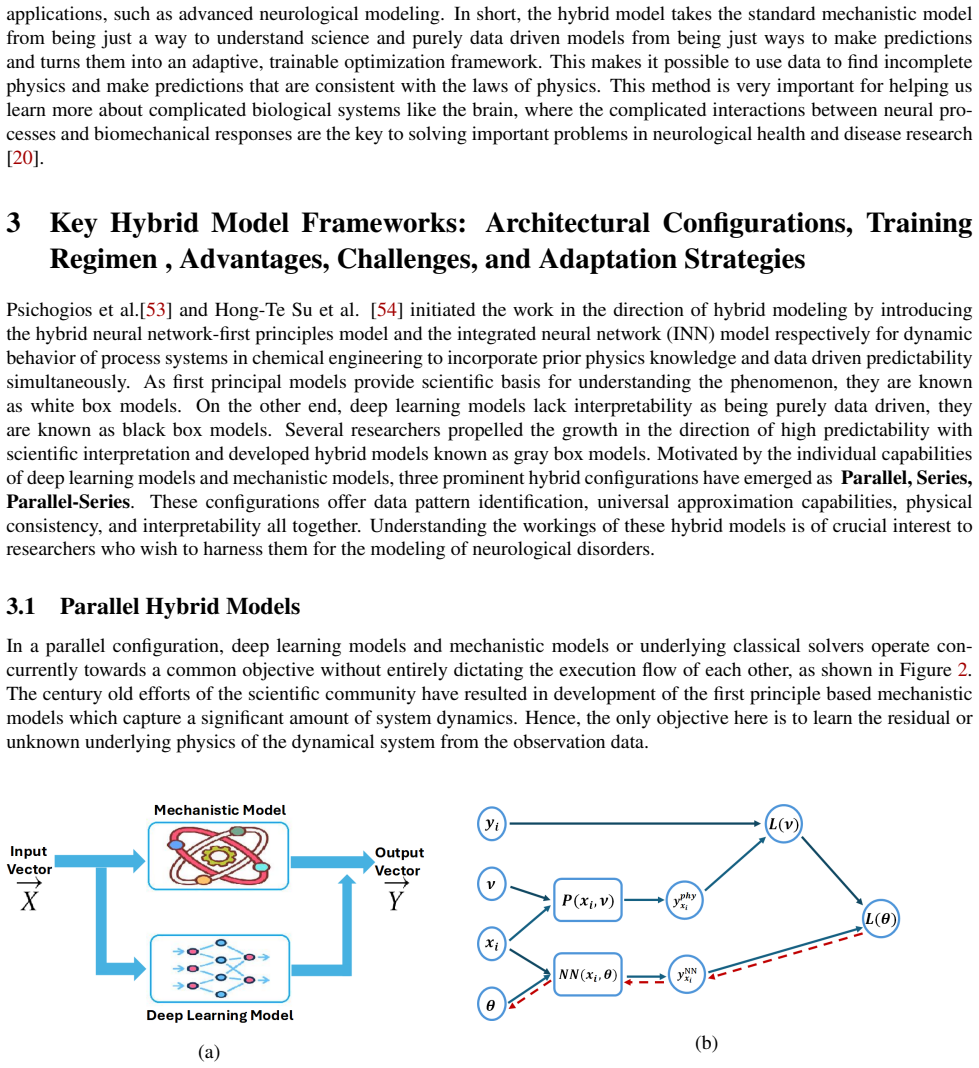
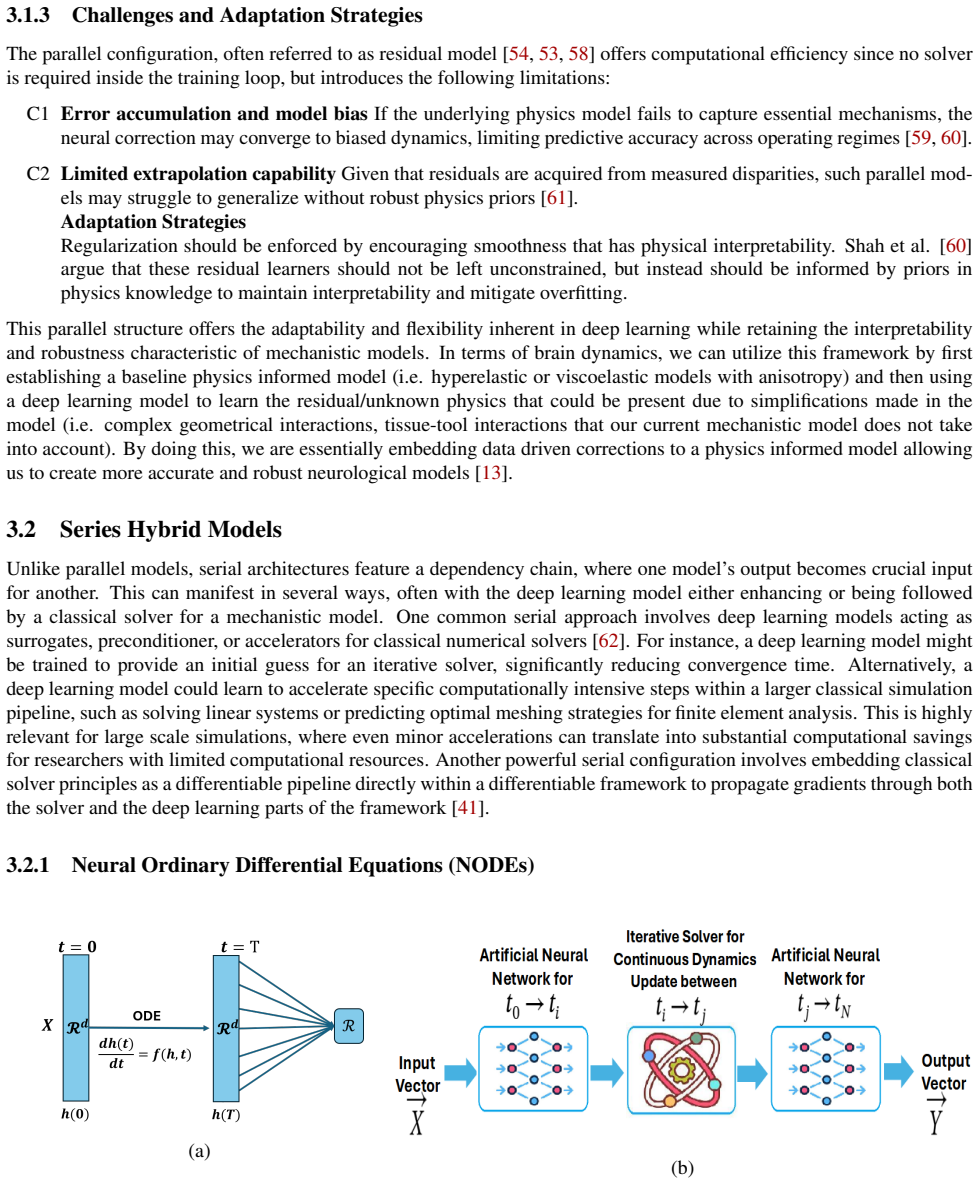
Hybrid architectures (parallel, series, parallel-series) that combine deep learning with physics-based solvers through approaches like residual modeling for missing physics, Neural Ordinary Differential Equations for continuous time dynamics, and neural approximations to accelerate solvers.
If this is right
- Enhanced diagnosis accuracy for neurological conditions such as brain tumors, Alzheimer's disease, and stroke.
- Better prediction of disease progression over time.
- More informed treatment strategies based on personalized modeling.
- Overcoming computational expense and simplification issues in mechanistic models.
- Addressing data requirements and generalization problems in pure data-driven methods.
Where Pith is reading between the lines
- Such hybrid methods could be tested on other dynamical systems in biology, like immune response modeling.
- Development of user-friendly software libraries for these differentiable programming hybrids would accelerate adoption.
- Clinical validation studies comparing hybrid predictions against long-term patient data would be needed to confirm benefits.
Load-bearing premise
That the hybrid configurations can be practically implemented and validated across neurological disorders without major data or integration barriers.
What would settle it
An empirical test on a dataset for Alzheimer's progression where the hybrid model fails to show measurable improvements in prediction accuracy or computational speed over the best existing pure approaches.
Figures





read the original abstract
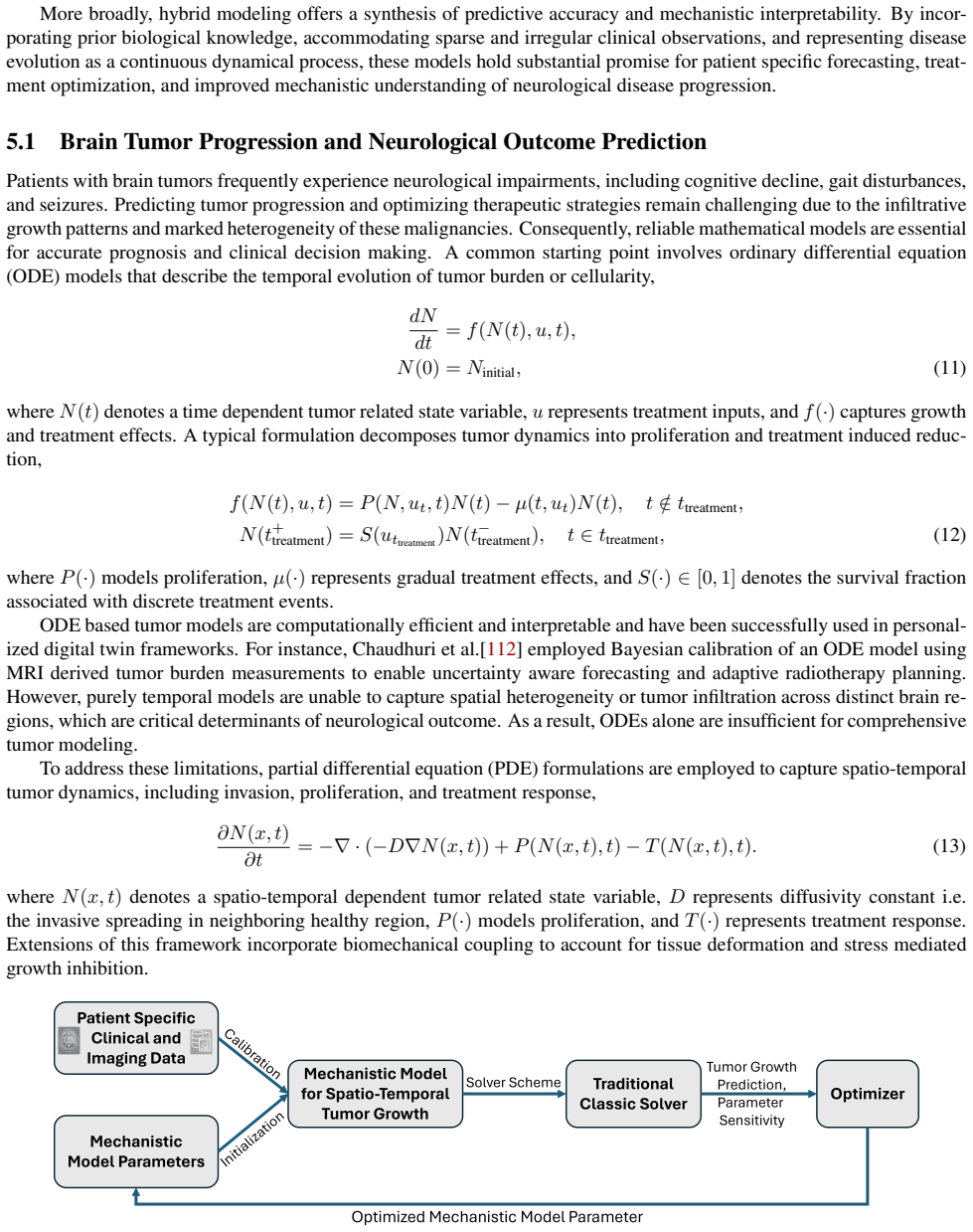
Advances in computational modeling, neuroimaging, and artificial intelligence are revolutionizing the modeling of neurological disorders for improved diagnostics, prognosis, and treatment planning. Mechanistic models provide valuable scientific insight into the disorders, but in practice they are often simplified with assumptions or computationally expensive and slow to solve. However, while purely data driven approaches provide speed and scalability, they require large, high quality data to train and generally suffer from interpretability and generalization issues. This perspective paper presents a structured overview of hybrid modeling strategies, which combine deep learning models with physics based solvers, and are categorized into parallel, series, and parallel-series architectures. Three main approaches that have been emphasized are residual modeling for missing or incomplete physics, Neural Ordinary Differential Equations (NODEs) for continuous time dynamics approximation, and solver in the loop that accelerates traditional solvers with neural approximations. These hybrid models integrate the governing differential equation based formulations and deep learning to characterize the evolution of neurological disorders, and promise advanced personalized neurological modeling. In addition, the study explores and proposes different hybrid configurations to improve diagnosis accuracy, predict disease progression, and inform treatment strategies across a range of neurological disorders. These capabilities outperform standalone mechanistic or purely data driven approaches, making hybrid modeling a powerful tool, especially in applications involving modeling the progression and treatment responses in neurological conditions such as brain tumors, Alzheimer's disease, and stroke.
Editorial analysis
A structured set of objections, weighed in public.
Referee Report
Summary. This perspective paper overviews hybrid modeling strategies that combine physics-based differential equation solvers with deep learning for neurological disorders. It categorizes architectures as parallel, series, and parallel-series; emphasizes residual modeling, Neural ODEs, and solver-in-the-loop techniques; and proposes configurations for brain tumors, Alzheimer's disease, and stroke. The central claim is that these hybrids integrate mechanistic and data-driven elements to outperform standalone mechanistic or purely data-driven approaches in diagnosis accuracy, progression prediction, and treatment planning.
Significance. A well-supported overview of hybrid architectures could usefully synthesize existing ideas for the neurology modeling community and highlight differentiable programming as an integration tool. However, because the manuscript supplies no derivations, implementations, benchmarks, or validation results, the asserted performance gains remain conceptual and the practical significance cannot yet be assessed.
major comments (2)
- [Abstract] Abstract: the statement that the proposed hybrid configurations 'outperform standalone mechanistic or purely data driven approaches' is presented as established fact, yet the manuscript contains no quantitative comparisons, error metrics, datasets, or validation studies to support this load-bearing claim.
- [Proposed hybrid configurations] Discussion of hybrid configurations for brain tumors, Alzheimer's, and stroke: the text proposes specific architectures but supplies no implementation details, solver integration code, or even schematic equations demonstrating how the governing DEs are coupled to the neural components, leaving the feasibility of the claimed integration unverified.
minor comments (2)
- The manuscript would benefit from explicit citations to prior hybrid modeling work in other domains (e.g., physics-informed neural networks or Neural ODE applications in systems biology) to situate the proposed neurological configurations.
- Terminology such as 'solver in the loop' and 'parallel-series architectures' is introduced without a dedicated definitions subsection or diagram, which may reduce accessibility for readers outside the immediate subfield.
Simulated Author's Rebuttal
We thank the referee for the detailed review of our perspective paper. We agree that the manuscript is conceptual in nature and does not contain new empirical validations or implementations. Below we address the major comments directly, with revisions planned where appropriate to better reflect the perspective format.
read point-by-point responses
-
Referee: [Abstract] Abstract: the statement that the proposed hybrid configurations 'outperform standalone mechanistic or purely data driven approaches' is presented as established fact, yet the manuscript contains no quantitative comparisons, error metrics, datasets, or validation studies to support this load-bearing claim.
Authors: We agree the abstract wording overstates the claim as established fact. As this is a perspective paper synthesizing existing hybrid modeling ideas rather than reporting new experiments, we will revise the abstract to indicate that the proposed configurations 'have the potential to outperform' standalone approaches by combining mechanistic insight with data-driven flexibility, consistent with the cited literature on residual learning and Neural ODEs. revision: yes
-
Referee: [Proposed hybrid configurations] Discussion of hybrid configurations for brain tumors, Alzheimer's, and stroke: the text proposes specific architectures but supplies no implementation details, solver integration code, or even schematic equations demonstrating how the governing DEs are coupled to the neural components, leaving the feasibility of the claimed integration unverified.
Authors: We acknowledge that the perspective format does not include code or full implementations. To improve clarity on feasibility, we will add schematic equations in the revised manuscript illustrating the coupling of governing differential equations with neural components (e.g., residual terms or Neural ODE formulations) for the brain tumor, Alzheimer's, and stroke configurations. revision: partial
Circularity Check
No circularity: purely descriptive perspective paper with no derivations or equations
full rationale
The paper is explicitly a perspective/overview piece that describes hybrid architectures (parallel/series/parallel-series), residual modeling, NODEs, and solver-in-the-loop concepts at a high level and proposes configurations for disorders such as brain tumors and Alzheimer's. No equations, derivations, fitted parameters, or quantitative results are presented anywhere in the text, so there is no derivation chain that could reduce to self-definition, fitted inputs, or self-citation. The outperformance statement is a forward-looking claim without any supporting math or data reduction steps.
Axiom & Free-Parameter Ledger
Reference graph
Works this paper leans on
-
[1]
Exploring human brain mechanics by combining experiments, modeling, and simula- tion
Silvia Budday. “Exploring human brain mechanics by combining experiments, modeling, and simula- tion”. In:Brain Multiphysics5 (2023), p. 100076.URL:https://www.sciencedirect.com/s cience/article/pii/S266652202300014X
2023
-
[2]
Fifty Shades of Brain: A Review on the Mechanical Testing and Modeling of Brain Tissue
Silvia Budday et al. “Fifty Shades of Brain: A Review on the Mechanical Testing and Modeling of Brain Tissue”. In:Archives of Computational Methods in Engineering27 (2020), 1187–1230
2020
-
[3]
Human Brain Disorders: A Review
Naz Falaq and Siddique Yasir Hasan. “Human Brain Disorders: A Review”. In:The Open Biology Journal8 (2020).URL:https://www.openbiologyjournal.com/abs/10.2174/18741 96702008010006
-
[4]
A review of brain injury at multiple time scales and its clinicopathological correlation through in silico modeling
Abhilash Awasthi et al. “A review of brain injury at multiple time scales and its clinicopathological correlation through in silico modeling”. In:Brain Multiphysics6 (2024), p. 100090
2024
-
[5]
June 2019.ISBN: 978-1-4939-9810-4
Corina Drapaca and Sivabal Sivaloganathan.Mathematical Modelling and Biomechanics of the Brain. June 2019.ISBN: 978-1-4939-9810-4
2019
-
[6]
Biomechanical modelling and computer aided simulation of deep brain retrac- tion in neurosurgery
Abhilash Awasthi et al. “Biomechanical modelling and computer aided simulation of deep brain retrac- tion in neurosurgery”. In:Computer methods and programs in biomedicine197 (2020), p. 105688
2020
-
[7]
Modeling chemical processes using prior knowledge and neural networks
Michael L. Thompson and Mark A. Kramer. “Modeling chemical processes using prior knowledge and neural networks”. In:AIChE Journal40.8 (1994), pp. 1328–1340.URL:https://aiche.online library.wiley.com/doi/abs/10.1002/aic.690400806
-
[8]
Combining Semi-Physical and Neural Network Modeling: An Example ofIts Usefulness
U. Forssell and P. Lindskog. “Combining Semi-Physical and Neural Network Modeling: An Example ofIts Usefulness”. In:IFAC Proceedings Volumes30.11 (1997). IFAC Symposium on System Identifi- cation (SYSID’97), Kitakyushu, Fukuoka, Japan, 8-11 July 1997, pp. 767–770.ISSN: 1474-6670.URL: https://www.sciencedirect.com/science/article/pii/S1474667017429387
1997
-
[9]
Differentiable modelling to unify machine learning and physical models for geosciences
Chaopeng Shen et al. “Differentiable modelling to unify machine learning and physical models for geosciences”. In:Nature Reviews Earth & Environment4 (2023)
2023
-
[10]
NeuralSim: Augmenting Differentiable Simulators with Neural Networks
Eric Heiden et al. “NeuralSim: Augmenting Differentiable Simulators with Neural Networks”. In:2021 IEEE International Conference on Robotics and Automation (ICRA). 2021, pp. 9474–9481
2021
-
[11]
Artificial Intelligence and Disease Modeling: Focus on Neurological Disorders
Benjamin Ribba et al. “Artificial Intelligence and Disease Modeling: Focus on Neurological Disorders”. In:Clinical Pharmacology & Therapeutics115.6 (2024), pp. 1208–1211.URL:https://ascpt.o nlinelibrary.wiley.com/doi/abs/10.1002/cpt.3253
-
[12]
Solving Forward and Inverse Problems with Differentiable Physics and Deep Learning
Philipp Marcel Holl. “Solving Forward and Inverse Problems with Differentiable Physics and Deep Learning”. PhD thesis. Technische Universit¨at M¨unchen, 2024.URL:https://mediatum.ub.tu m.de/doc/1739592/1739592.pdf
arXiv 2024
-
[13]
Maziar Raissi, Paris Perdikaris, and George Em Karniadakis. “Physics-informed neural networks: A deep learning framework for solving forward and inverse problems involving nonlinear partial differen- tial equations”. In:Journal of Computational Physics378 (2019), pp. 686–707.URL:https://doi .org/10.1016/j.jcp.2018.10.045
-
[14]
Mohammad Sarabian, Hessam Babaee, and Kaveh Laksari.Physics-informed neural networks for im- proving cerebral hemodynamics predictions. 2021. arXiv:2108.11498.URL:https://arxiv.o rg/abs/2108.11498. 20
arXiv 2021
-
[15]
Parameter Estimation in Brain Dynamics Models from Resting-State fMRI Data using Physics-Informed Neural Networks
Roberto C. Sotero, Jose M. Sanchez-Bornot, and Iman Shaharabi-Farahani. “Parameter Estimation in Brain Dynamics Models from Resting-State fMRI Data using Physics-Informed Neural Networks”. In:2024 8th International Conference on Biomedical Engineering and Applications (ICBEA). 2024, pp. 73–79
2024
-
[16]
Roberto Carlos Sotero and Jose Sanchez-Bornot. “Estimating the Excitatory-Inhibitory Balance from Electrocorticography Data using Physics-Informed Neural Networks”. In: New York, NY , USA: Asso- ciation for Computing Machinery, 2025, 113–118.ISBN: 9798400717536.URL:https://doi.org /10.1145/3700666.3700701
-
[17]
Thuerey et al.Physics-based Deep Learning
N. Thuerey et al.Physics-based Deep Learning. 2025. arXiv:2109.05237.URL:https://arxi v.org/abs/2109.05237
arXiv 2025
-
[18]
A review and perspective on hybrid modeling methodologies
Artur M. Schweidtmann, Dongda Zhang, and Moritz von Stosch. “A review and perspective on hybrid modeling methodologies”. In:Digital Chemical Engineering10 (2024), p. 100136.ISSN: 2772-5081. URL:https://www.sciencedirect.com/science/article/pii/S2772508123000 546
2024
-
[19]
Amig ´o.Differentiable programming and its applications to dynamical systems
Adri ´an Hern´andez and Jos´e M. Amig ´o.Differentiable programming and its applications to dynamical systems. 2020. arXiv:1912.08168.URL:https://arxiv.org/abs/1912.08168
arXiv 2020
-
[20]
Facundo Sapienza et al.Differentiable Programming for Differential Equations: A Review. 2024. arXiv: 2406.09699.URL:https://arxiv.org/abs/2406.09699
arXiv 2024
-
[21]
Bharath Ramsundar, Dilip Krishnamurthy, and Venkatasubramanian Viswanathan.Differentiable Physics: A Position Piece. 2021. arXiv:2109.07573.URL:https://arxiv.org/abs/2109.07573
arXiv 2021
-
[22]
Generative Models of Brain Dynamics
Mahta Ramezanian-Panahi et al. “Generative Models of Brain Dynamics”. In:Frontiers in Artificial Intelligence5 (2022).ISSN: 2624-8212.URL:https://www.frontiersin.org/journals/a rtificial-intelligence/articles/10.3389/frai.2022.807406
-
[23]
N. Bhutani, G. P. Rangaiah, and A. K. Ray. “First-Principles, Data-Based, and Hybrid Modeling and Optimization of an Industrial Hydrocracking Unit”. In:Industrial & Engineering Chemistry Research 45.23 (2006), pp. 7807–7816.URL:https://doi.org/10.1021/ie060247q
-
[24]
Hybrid model of a physics-based model and machine learning for real-time estimation of unmeasurable parts: Mapping from measurable to unmeasurable variables
Tatsuya Kaneko et al. “Hybrid model of a physics-based model and machine learning for real-time estimation of unmeasurable parts: Mapping from measurable to unmeasurable variables”. In:Ocean Engineering261 (2022), p. 112123.ISSN: 0029-8018.URL:https://www.sciencedirect.co m/science/article/pii/S0029801822014342
2022
-
[25]
2022.URL: https://openreview.net/forum?id=famc03Gg231
Philipp Holl, Nils Thuerey, and Vladlen Koltun.Physical Gradients for Deep Learning. 2022.URL: https://openreview.net/forum?id=famc03Gg231
2022
-
[26]
Integrating physics-based modeling with machine learning: A survey
Jared Willard et al. “Integrating physics-based modeling with machine learning: A survey”. In:arXiv preprint arXiv:2003.049191.1 (2020), pp. 1–34.URL:https://arxiv.org/abs/2003.0491 9v4
arXiv 2003
-
[27]
Society for Industrial and Applied Mathematics, 2011
Uwe Naumann.The Art of Differentiating Computer Programs. Society for Industrial and Applied Mathematics, 2011. eprint:https://epubs.siam.org/doi/pdf/10.1137/1.978161197 2078.URL:https://epubs.siam.org/doi/abs/10.1137/1.9781611972078
-
[28]
Mathieu Blondel and Vincent Roulet.The Elements of Differentiable Programming. 2025. arXiv:240 3.14606.URL:https://arxiv.org/abs/2403.14606
arXiv 2025
-
[29]
Automatic Differentiation in Machine Learning: a Survey
Atilim Gunes Baydin et al. “Automatic Differentiation in Machine Learning: a Survey”. In:Journal of Machine Learning Research18.153 (2018), pp. 1–43.URL:http://jmlr.org/papers/v 18/17-468.html
2018
-
[30]
Andreas Griewank and Andrea Walther.Evaluating Derivatives. Second. Society for Industrial and Applied Mathematics, 2008. eprint:https://epubs.siam.org/doi/pdf/10.1137/1. 9780898717761.URL:https://epubs.siam.org/doi/abs/10.1137/1.978089871 7761
work page doi:10.1137/1 2008
-
[31]
Stanford University, 2024.URL:https://purl.stanford.edu/pw437cb2999
Rastko Ciric.Differentiable Programming for Mapping the Function of the Human Brain. Stanford University, 2024.URL:https://purl.stanford.edu/pw437cb2999. 21
2024
-
[32]
Understanding the Mechanical Properties of Pituitary Adenomas for Optimized Surgery
Umesh Gautam et al. “Understanding the Mechanical Properties of Pituitary Adenomas for Optimized Surgery”. In:Journal of Biomedical Materials Research Part A113.6 (2025), e37940
2025
-
[33]
Biomechanical Characterization of Epileptic Brain for Surgical Planning of In- tractable Epilepsy
Umesh Gautam et al. “Biomechanical Characterization of Epileptic Brain for Surgical Planning of In- tractable Epilepsy”. In:Journal of Biomedical Materials Research Part A114.1 (2026), e70017
2026
-
[34]
Mechanical characterization and standardization of silicon scalp and dura surrogates for neurosurgical simulation
Ramandeep Singh et al. “Mechanical characterization and standardization of silicon scalp and dura surrogates for neurosurgical simulation”. In:World Neurosurgery169 (2023), e197–e205
2023
-
[35]
Material parameter identification for brain tissue using open-source platforms-GIBBON and FEBio
Abhilash Awasthi, Umesh Gautam, and Sitikantha Roy. “Material parameter identification for brain tissue using open-source platforms-GIBBON and FEBio”. In:Recent Advances in Applied Mechanics: Proceedings of Virtual Seminar on Applied Mechanics (VSAM 2021). Springer. 2022, pp. 495–502
2021
-
[36]
MatNLI: An open-source MATLAB-based solver for the non-linear inversion in elastography
Abhilash Awasthi et al. “MatNLI: An open-source MATLAB-based solver for the non-linear inversion in elastography”. In:Advances in Engineering Software181 (2023), p. 103476
2023
-
[37]
A Comparison of Gradient-Based Optimization Techniques in Magnetic Res- onance Elastography
Abhilash Awasthi et al. “A Comparison of Gradient-Based Optimization Techniques in Magnetic Res- onance Elastography”. In:Asian Conference on Mechanics of Functional Materials and Structures. Springer. 2022, pp. 371–381
2022
-
[38]
Tikhonov and Vasily Y
Andrey N. Tikhonov and Vasily Y . Arsenin.Solutions of Ill-Posed Problems. Wiley, 1977
1977
-
[39]
Diego Renner and Georgios Kissas.Accelerated Patient-Specific Calibration via Differentiable Hemo- dynamics Simulations. 2024. arXiv:2412.14572.URL:https://arxiv.org/abs/2412. 14572
arXiv 2024
-
[40]
Inverse identification of region-specific hyperelastic material parameters for hu- man brain tissue
Jan Hinrichsen et al. “Inverse identification of region-specific hyperelastic material parameters for hu- man brain tissue”. In:Biomechanics and Modeling in Mechanobiology22.5 (2023), pp. 1729–1749. URL:https://doi.org/10.1007/s10237-023-01739-w
-
[41]
Rhys Newbury et al.A Review of Differentiable Simulators. 2024. arXiv:2407.05560.URL:https ://arxiv.org/abs/2407.05560
arXiv 2024
-
[42]
Ado Farsi, Nacime Bouziani, and David A Ham.Missing Physics Discovery through Fully Differen- tiable Finite Element-Based Machine Learning. 2025. arXiv:2507.15787.URL:https://arxiv .org/abs/2507.15787
arXiv 2025
-
[43]
Automatic Differentiation and Applications
Hans-Christoph Fischer. “Automatic Differentiation and Applications”. In:Scientific Computing with Automatic Result Verification. Ed. by E. Adams and U. Kulisch. V ol. 189. Mathematics in Science and Engineering. Elsevier, 1993, pp. 105–142.URL:https://www.sciencedirect.com/scienc e/article/pii/S0076539208628441
1993
-
[44]
Yu-Hsueh Fang et al.A Step-by-step Introduction to the Implementation of Automatic Differentiation
-
[45]
arXiv:2402.16020 [cs.LG].URL:https://arxiv.org/abs/2402.16020
-
[46]
Learning representations by back- propagating errors
David E. Rumelhart, Geoffrey E. Hinton, and Ronald J. Williams. “Learning representations by back- propagating errors”. In:Nature323.6088 (1986), pp. 533–536.URL:https://www.nature.com /articles/323533a0
1986
-
[47]
John Wiley & Sons, 1994
Paul John Werbos.The roots of backpropagation: from ordered derivatives to neural networks and political forecasting. John Wiley & Sons, 1994
1994
-
[48]
A comparison of the continuous and discrete adjoint approach extended based on the standard lattice Boltzmann method in flow field inverse optimization problems
Mohamad Hamed Hekmat and Masoud Mirzaei. “A comparison of the continuous and discrete adjoint approach extended based on the standard lattice Boltzmann method in flow field inverse optimization problems”. In:Acta Mechanica227.4 (2016), pp. 1025–1050.URL:https : / / doi . org / 10 . 1007/s00707-015-1509-x
2016
-
[49]
Multi-Directional Dynamic Model for Traumatic Brain Injury Detection
Kaveh Laksari et al. “Multi-Directional Dynamic Model for Traumatic Brain Injury Detection”. In: Journal of Neurotrauma37.7 (2020). PMID: 31856650, pp. 982–993.URL:https : / / doi . org /10.1089/neu.2018.6340
-
[50]
Finite Element Algorithms for Computational Biomechanics of the Brain
Adam Wittek, Grand Roman Joldes, and Karol Miller. “Finite Element Algorithms for Computational Biomechanics of the Brain”. In: ed. by Karol Miller. Cham: Springer International Publishing, 2019, pp. 243–272.URL:https://doi.org/10.1007/978-3-030-04996-6_10. 22
-
[51]
The mechanical behaviour of brain tissue: Large strain response and constitutive modelling
M. Hrapko et al. “The mechanical behaviour of brain tissue: Large strain response and constitutive modelling”. In:Biorheology43.5 (2006), pp. 623–636.URL:https : / / doi . org / 10 . 1177 / 0006355X2006043005004
2006
-
[52]
Constitutive Modeling of Brain Tissue: Current Perspectives
Rijk de Rooij and Ellen Kuhl. “Constitutive Modeling of Brain Tissue: Current Perspectives”. In:Ap- plied Mechanics Reviews68.1 (Jan. 2016), p. 010801.ISSN: 0003-6900.URL:https://doi.org /10.1115/1.4032436
-
[53]
Christopher Rackauckas et al.Universal Differential Equations for Scientific Machine Learning. 2021. arXiv:2001.04385.URL:https://arxiv.org/abs/2001.04385
Pith/arXiv arXiv 2021
-
[54]
A hybrid neural network-first principles approach to process modeling
Dimitris C. Psichogios and Lyle H. Ungar. “A hybrid neural network-first principles approach to process modeling”. In:AIChE Journal38.10 (1992), pp. 1499–1511.URL:https://aiche.onlinelibr ary.wiley.com/doi/abs/10.1002/aic.690381003
-
[55]
Integrating Neural Networks with First Principles Models for Dynamic Modeling
Hong-Te Su et al. “Integrating Neural Networks with First Principles Models for Dynamic Modeling”. In:IFAC Proceedings Volumes25.5 (1992). 3rd IFAC Symposium on Dynamics and Control of Chemi- cal Reactors, Distillation Columns and Batch Processes (DYCORD+ ’92), Maryland, USA, 26-29 April, pp. 327–332.ISSN: 1474-6670.URL:https://www.sciencedirect.com/scien...
1992
-
[56]
Universal Differential Equations Applied to Bioprocesses
Jyler Menard. “Universal Differential Equations Applied to Bioprocesses”. PhD thesis. 2023.URL: https://uwaterloo.ca/computational-mathematics/sites/default/files/u ploads/documents/menard_jyler_0.pdf
2023
-
[57]
Universal Differential Equations as a Common Modeling Language for Neuroscience
Ahmed ElGazzar and Marcel van Gerven. “Universal Differential Equations as a Common Modeling Language for Neuroscience”. In:arXiv preprint arXiv:2403.14510(2024).URL:https://arxiv.o rg/abs/2403.14510
arXiv 2024
-
[58]
Current state and open problems in universal dif- ferential equations for systems biology
Maren Philipps, Nina Schmid, and Jan Hasenauer. “Current state and open problems in universal dif- ferential equations for systems biology”. In:npj Systems Biology and Applications11.1 (2025), p. 101. URL:https://doi.org/10.1038/s41540-025-00550-w
-
[59]
Combining first principles modelling and artificial neural networks: a general framework
R. Oliveira. “Combining first principles modelling and artificial neural networks: a general framework”. eng. In:Computers & chemical engineering28.5 (2004), pp. 755–766.ISSN: 0098-1354
2004
-
[60]
Incorporating Unmodeled Dynamics Into First-Principles Models Through Machine Learning
Ward Quaghebeur, Ingmar Nopens, and Bernard De Baets. “Incorporating Unmodeled Dynamics Into First-Principles Models Through Machine Learning”. In:IEEE Access9 (2021), pp. 22014–22022
2021
-
[61]
Hybrid modeling of first-principles and machine learning: A step-by-step tutorial review for practical implementation
Parth Shah et al. “Hybrid modeling of first-principles and machine learning: A step-by-step tutorial review for practical implementation”. In:Computers & Chemical Engineering194 (2025), p. 108926. ISSN: 0098-1354.URL:https : / / www . sciencedirect . com / science / article / pii /S0098135424003442
2025
-
[62]
Integration of machine learning and first principles models
Lokesh Rajulapati et al. “Integration of machine learning and first principles models”. In:AIChE Jour- nal68.6 (2022), e17715.URL:https://aiche.onlinelibrary.wiley.com/doi/abs /10.1002/aic.17715
-
[63]
AI-enhanced iterative solvers for accelerating the solution of large-scale parametrized systems
Stefanos Nikolopoulos et al. “AI-enhanced iterative solvers for accelerating the solution of large-scale parametrized systems”. In:International Journal for Numerical Methods in Engineering125.2 (2024), e7372. eprint:https://onlinelibrary.wiley.com/doi/pdf/10.1002/nme.7372. URL:https://onlinelibrary.wiley.com/doi/abs/10.1002/nme.7372
-
[64]
Neural Ordinary Differential Equations
Ricky T. Q. Chen et al. “Neural Ordinary Differential Equations”. In:Advances in Neural Information Processing Systems. Ed. by S. Bengio et al. V ol. 31. Curran Associates, Inc., 2018.URL:https : //proceedings.neurips.cc/paper_files/paper/2018/file/69386f6bb1dfed 68692a24c8686939b9-Paper.pdf
2018
-
[65]
YongKyung Oh et al.Comprehensive Review of Neural Differential Equations for Time Series Analysis
-
[66]
arXiv:2502.09885.URL:https://arxiv.org/abs/2502.09885
-
[67]
Deep Implicit Layers - Neural ODEs, Deep Equili- birum Models, and Beyond
Zico Kolter, David Duvenaud, and Matt Johnson. “Deep Implicit Layers - Neural ODEs, Deep Equili- birum Models, and Beyond”. NeurIPS 2020 tutorial.URL:https://implicit-layers-tutor ial.org/. 23
2020
-
[68]
Belinda Tzen and Maxim Raginsky.Neural Stochastic Differential Equations: Deep Latent Gaussian Models in the Diffusion Limit. 2019. arXiv:1905 . 09883.URL:https : / / arxiv . org / abs /1905.09883
arXiv 2019
-
[69]
Augmented Neural ODEs
Emilien Dupont, Arnaud Doucet, and Yee Whye Teh. “Augmented Neural ODEs”. In:Advances in Neural Information Processing Systems32 (2019). Ed. by H. Wallach et al.URL:https://proce edings.neurips.cc/paper_files/paper/2019/file/21be9a4bd4f81549a9d1d 241981cec3c-Paper.pdf
2019
-
[70]
Neural Controlled Differential Equations for Irregular Time Series
Patrick Kidger et al. “Neural Controlled Differential Equations for Irregular Time Series”. In:Advances in Neural Information Processing Systems33 (2020). Ed. by H. Larochelle et al., pp. 6696–6707.URL: https://proceedings.neurips.cc/paper_files/paper/2020/file/4a5876b 450b45371f6cfe5047ac8cd45-Paper.pdf
2020
-
[71]
Lagrangian Neural Networks
Miles Cranmer et al. “Lagrangian Neural Networks”. In:ICLR 2020 Workshop on Integration of Deep Neural Models and Differential Equations. 2019.URL:https://openreview.net/forum?id =iE8tFa4Nq
2020
-
[72]
Hamiltonian Neural Networks
Samuel Greydanus, Misko Dzamba, and Jason Yosinski. “Hamiltonian Neural Networks”. In:Advances in Neural Information Processing Systems32 (2019). Ed. by H. Wallach et al.URL:https://pro ceedings.neurips.cc/paper_files/paper/2019/file/26cd8ecadce0d4efd6cc 8a8725cbd1f8-Paper.pdf
2019
-
[73]
Generalized Framework for Liquid Neural Network upon Sequential and Non-Sequential Tasks
Prakash Kumar Karn, Iman Ardekani, and Waleed H. Abdulla. “Generalized Framework for Liquid Neural Network upon Sequential and Non-Sequential Tasks”. In:Mathematics12.16 (2024).ISSN: 2227-7390.URL:https://www.mdpi.com/2227-7390/12/16/2525
2024
-
[74]
On Second Order Behaviour in Augmented Neural ODEs
Alexander Norcliffe et al. “On Second Order Behaviour in Augmented Neural ODEs”. In:Advances in Neural Information Processing Systems33 (2020). Ed. by H. Larochelle et al., pp. 5911–5921.URL: https://proceedings.neurips.cc/paper_files/paper/2020/file/418db2ea 5d227a9ea8db8e5357ca2084-Paper.pdf
2020
-
[75]
Neural differential equations for learning to program neural nets through continuous learning rules
Kazuki Irie, Francesco Faccio, and J ¨urgen Schmidhuber. “Neural differential equations for learning to program neural nets through continuous learning rules”. In:Advances in Neural Information Processing Systems35 (2022), pp. 38614–38628.URL:https://papers.nips.cc/paper_files/pape r/2022/file/fc09b26b85ab3abb2832bd555a2e4215-Paper-Conference.pdf
2022
-
[76]
nmODE: neural memory ordinary differential equation
Zhang Yi. “nmODE: neural memory ordinary differential equation”. In:Artificial Intelligence Review 56.12 (2023), pp. 14403–14438
2023
-
[77]
Jonas Degrave et al.A Differentiable Physics Engine for Deep Learning in Robotics. 2018. arXiv: 1611.01652.URL:https://arxiv.org/abs/1611.01652
Pith/arXiv arXiv 2018
-
[78]
Differentiable Physics Simulation
Junbang Liang and Ming C. Lin. “Differentiable Physics Simulation”. In:ICLR 2020 Workshop on Integration of Deep Neural Models and Differential Equations. 2019.URL:https://openreview .net/forum?id=p-SG2KFY2
2020
-
[79]
Learning to Control PDEs with Differentiable Physics
Philipp Holl, Nils Thuerey, and Vladlen Koltun. “Learning to Control PDEs with Differentiable Physics”. In:International Conference on Learning Representations. 2020.URL:https://openreview.ne t/forum?id=HyeSin4FPB
2020
-
[80]
Scalable Differentiable Physics for Learning and Control
Yi-Ling Qiao et al. “Scalable Differentiable Physics for Learning and Control”. In:Proceedings of the 37th International Conference on Machine Learning. Ed. by Hal Daum´e III and Aarti Singh. V ol. 119. Proceedings of Machine Learning Research. PMLR, 2020, pp. 7847–7856.URL:https://procee dings.mlr.press/v119/qiao20a.html
2020
discussion (0)
Sign in with ORCID, Apple, or X to comment. Anyone can read and Pith papers without signing in.