Extended pseudo-spectral physics-informed neural networks for phase-field models
Pith reviewed 2026-06-25 21:36 UTC · model grok-4.3
The pith
An extended pseudo-spectral physics-informed neural network recovers both bulk chemical potential and gradient coefficients in phase-field models from transient snapshot data.
A machine-rendered reading of the paper's core claim, the machinery that carries it, and where it could break.
Core claim
The ESPINN framework enables simultaneous recovery of the bulk chemical potential and unknown gradient coefficients in phase-field models directly from transient snapshot data, yielding accurate and statistically stable reconstructions on the one-dimensional Cahn-Hilliard equation in the noiseless regime and robust results when noise is present and additional snapshots are used.
What carries the argument
The extended pseudo-spectral physics-informed neural network (ESPINN), which augments physics-informed neural networks with pseudo-spectral methods to identify both the bulk free-energy density and interfacial gradient terms while satisfying the governing evolution equation.
If this is right
- Substantial constitutive information can be extracted from even a single pair of snapshots when measurement noise is absent.
- Reconstruction accuracy decreases smoothly as noise level rises.
- Adding more snapshot pairs reduces run-to-run variance in noisy settings.
- The approach supplies a data-efficient route to learning free-energy structure in continuum models of phase separation.
Where Pith is reading between the lines
- The same architecture could be tested on two- or three-dimensional phase-field simulations to check whether spatial dimensionality affects recovery quality.
- If successful on experimental imaging sequences, the method would allow parameter inference without assuming a specific functional form for the bulk energy in advance.
- Coupling the network output to uncertainty estimates would indicate how many snapshots are needed for reliable recovery at a given noise level.
Load-bearing premise
The observed transient snapshot data must be produced exactly by a Cahn-Hilliard-type phase-field model whose only unknowns are the bulk chemical potential and gradient coefficients that the network is asked to recover.
What would settle it
Apply the trained network to synthetic snapshot data generated from a known Cahn-Hilliard model with a standard quartic bulk potential and constant gradient coefficient; the recovered functions must match the known forms within numerical tolerance.
Figures



read the original abstract
Phase-field models play a central role in the continuum description of phase separation, in which the bulk free-energy density and the interfacial thickness parameter determine pattern formation and microstructural evolution. In practice, these constitutive quantities are rarely known a priori and must be inferred from limited dynamical observations. In this work, an extended pseudo-spectral physics-informed neural network (ESPINN) framework is developed for the inverse identification of phase-field models from transient snapshot data. It enables the simultaneous recovery of both the bulk chemical potential and unknown gradient coefficients. Numerical experiments on the one-dimensional Cahn-Hilliard equation demonstrate accurate and statistically stable reconstruction in the noiseless regime, with substantial constitutive information recoverable from even a single snapshot pair. In the presence of noise, reconstruction accuracy degrades gracefully, and increasing the number of snapshots improves robustness by reducing variance across runs. These results establish ESPINN as a data-efficient and physically consistent approach for learning free-energy structure in continuum models of phase separation.
Editorial analysis
A structured set of objections, weighed in public.
Referee Report
Summary. The manuscript develops an extended pseudo-spectral physics-informed neural network (ESPINN) framework for the inverse identification of phase-field models from transient snapshot data. It enables simultaneous recovery of the bulk chemical potential and unknown gradient coefficients. Numerical experiments on the one-dimensional Cahn-Hilliard equation demonstrate accurate and statistically stable reconstruction in the noiseless regime, with substantial constitutive information recoverable from even a single snapshot pair; reconstruction accuracy degrades gracefully with noise, and additional snapshots improve robustness.
Significance. If the central claims hold, the work offers a data-efficient and physically consistent method for inferring constitutive relations in continuum phase-field models, addressing a practical need in materials modeling where free-energy parameters are rarely known a priori. The pseudo-spectral extension to PINNs is a targeted contribution that could improve scalability for inverse problems in this domain.
minor comments (3)
- [Abstract] Abstract: the claims of 'accurate and statistically stable reconstruction' and 'graceful' noise degradation would benefit from a brief mention of the quantitative error metrics (e.g., relative L2 errors) and network architecture details used to support them.
- The manuscript should clarify the precise form of the pseudo-spectral extension (e.g., how Fourier modes are incorporated into the loss or network architecture) to allow readers to reproduce the claimed efficiency gains.
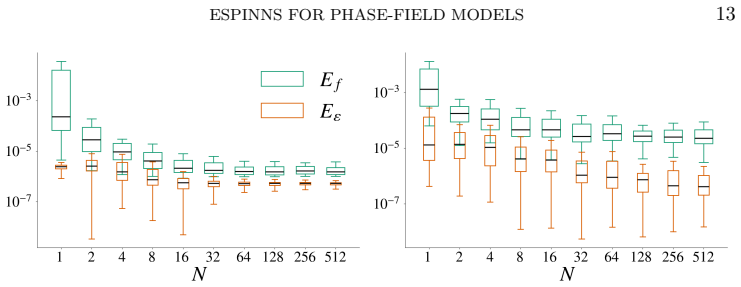
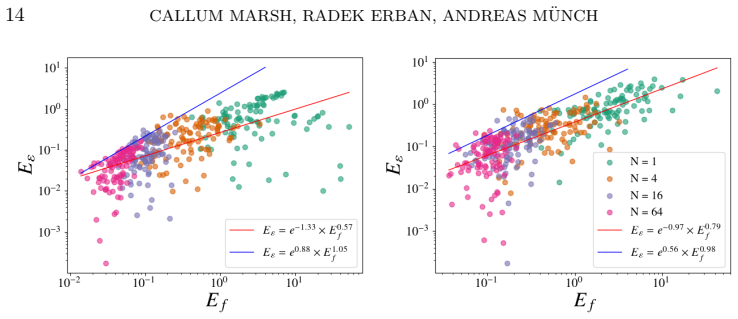
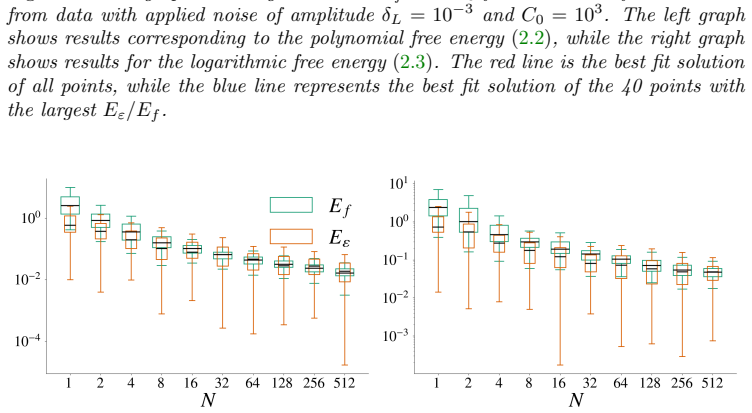
- Figure captions and axis labels should explicitly state the number of snapshots, noise levels, and number of independent runs used to compute the reported statistics.
Simulated Author's Rebuttal
We thank the referee for their positive summary, recognition of the work's significance for data-efficient inference of phase-field constitutive relations, and recommendation of minor revision. No major comments were raised in the report.
Circularity Check
No significant circularity identified
full rationale
The paper develops an ESPINN framework for inverse identification of phase-field model parameters (bulk chemical potential and gradient coefficients) from transient snapshot data. The load-bearing premise—that observed data is generated exactly by a Cahn-Hilliard model whose unknowns are precisely those quantities—is stated explicitly in the abstract and is the standard well-posedness condition for any inverse modeling task; it does not reduce the claimed recoveries to tautologies or fitted inputs renamed as predictions. No self-citations, uniqueness theorems, or ansatzes are invoked in the provided material to justify the method. The numerical experiments on 1D Cahn-Hilliard data are presented as external validation, with graceful degradation under noise, confirming the derivation chain remains independent of its own outputs.
Axiom & Free-Parameter Ledger
axioms (1)
- domain assumption Observed data are generated by the Cahn-Hilliard equation with unknown bulk chemical potential and gradient coefficients.
Reference graph
Works this paper leans on
-
[1]
Nature Chemistry , pages=
Determinants that enable disordered protein assembly into discrete condensed phases , author=. Nature Chemistry , pages=
-
[2]
Protein Science , volume=
Improved coarse-grained model for studying sequence dependent phase separation of disordered proteins , author=. Protein Science , volume=
-
[3]
Methods in Enzymology , volume=
Using a sequence-specific coarse-grained model for studying protein liquid--liquid phase separation , author=. Methods in Enzymology , volume=. 2021 , publisher=
2021
-
[4]
Journal of Chemical Physics , volume=
Model for disordered proteins with strongly sequence-dependent liquid phase behavior , author=. Journal of Chemical Physics , volume=
-
[5]
and Kedersha, N
Sanders, D. and Kedersha, N. and Lee, D. and Strom, A. and Drake, V. and Riback, J. and Bracha, D. and Eeftens, J. and Iwanicki, A. and Wang, A. and Wei, M. and Whitney, G. and Lyons, S. and Anderson, P. and Jacobs, W. and Ivanov, P. and Brangwynne, C. , journal=. Competing protein-
-
[6]
Journal of Chemical Physics , volume=
Accelerated simulation method for charge regulation effects , author=. Journal of Chemical Physics , volume=
-
[7]
Journal of Chemical Physics , volume=
Counterion-controlled phase equilibria in a charge-regulated polymer solution , author=. Journal of Chemical Physics , volume=
-
[8]
and Frydel, D
Bakhshandeh, A. and Frydel, D. and Levin, Y. , journal=. Reactive
-
[9]
European Physical Journal E , volume=
Induced phase transformation in ionizable colloidal nanoparticles , author=. European Physical Journal E , volume=
-
[10]
Journal of Physical Chemistry B , volume=
Asymmetric Periodic Boundary Conditions for All-Atom Molecular Dynamics and Coarse-Grained Simulations of Nucleic Acids , author=. Journal of Physical Chemistry B , volume=
-
[11]
and Hilliard, J
Cahn, J. and Hilliard, J. , journal=. Free energy of a nonuniform system
-
[12]
2015 , publisher=
Molecular dynamics , author=. 2015 , publisher=
2015
-
[13]
, journal=
Speck, T. , journal=. Collective behavior of active
-
[14]
and Menzel, A
Speck, T. and Menzel, A. and Bialk. Dynamical mean-field theory and weakly non-linear analysis for the phase separation of active. Journal of chemical physics , volume=
-
[15]
and Bialk
Speck, T. and Bialk. Effective. Physical Review Letters , volume=
-
[16]
and Togashi, Y
Rolls, E. and Togashi, Y. and Erban, R. , journal=. Varying the resolution of the
-
[17]
and Rana, S
Gangmei, G. and Rana, S. and Rolfe, B. and Mitra, K. and Bhattacharyya, S. , journal=. Learning coupled
-
[18]
SIAM Journal on Life Sciences , volume=
Neural networks for learning macroscopic chemotactic sensitivity from microscopic models , author=. SIAM Journal on Life Sciences , volume=
-
[19]
1988 , publisher=
The theory of polymer dynamics , author=. 1988 , publisher=
1988
-
[20]
2020 , publisher =
Stochastic Modelling of Reaction--Diffusion Processes , author=. 2020 , publisher =
2020
-
[21]
Handbook of
Chapter 4. Handbook of. 2008 , month = jan, volume =
2008
-
[22]
Communications on Applied Mathematics and Computation , volume=
Discovering phase field models from image data with the pseudo-spectral physics informed neural networks , author=. Communications on Applied Mathematics and Computation , volume=
-
[23]
Physica D: Nonlinear Phenomena , volume=
Individual based and mean-field modeling of direct aggregation , author=. Physica D: Nonlinear Phenomena , volume=
-
[24]
2020 , eprint=
Fourier Features Let Networks Learn High Frequency Functions in Low Dimensional Domains , author=. 2020 , eprint=
2020
-
[25]
Computer Methods in Applied Mechanics and Engineering , year =
Wang, Sifan and Wang, Hanwen and Perdikaris, Paris , title =. Computer Methods in Applied Mechanics and Engineering , year =
-
[26]
2023 , eprint=
An Expert's Guide to Training Physics-informed Neural Networks , author=. 2023 , eprint=
2023
-
[27]
and Higham, Desmond J
Higham, Catherine F. and Higham, Desmond J. , title =. SIAM Review , year =
-
[28]
2019 , eprint=
On the Spectral Bias of Neural Networks , author=. 2019 , eprint=
2019
-
[29]
Communications in Computational Physics , year =
Zhi-Qin John Xu, Zhi-Qin John Xu and Yaoyu Zhang, Yaoyu Zhang and Tao Luo, Tao Luo and Yanyang Xiao, Yanyang Xiao and Zheng Ma, Zheng Ma , title =. Communications in Computational Physics , year =
-
[30]
2020 , eprint=
Frequency Bias in Neural Networks for Input of Non-Uniform Density , author=. 2020 , eprint=
2020
-
[31]
Proceedings of the 2008 International Conference on Modeling, Simulation and Visualization Methods, MSV 2008 , year =
Hawick, Ken and Playne, Daniel , title =. Proceedings of the 2008 International Conference on Modeling, Simulation and Visualization Methods, MSV 2008 , year =
2008
-
[32]
Perspective:
De Las Heras, Daniel and Zimmermann, Toni and Samm. Perspective:. Journal of Physics: Condensed Matter , year =
-
[33]
Eidnes, S. Pseudo-. Journal of Computational Physics , year =
-
[34]
Computational and Applied Mathematics , year =
Glasner, Karl , title =. Computational and Applied Mathematics , year =
-
[35]
and Martin, S
Hu, C. and Martin, S. and Dingreville, R. , title =. Computer Methods in Applied Mechanics and Engineering , year =
-
[36]
, title =
Mao, Zirui and Demkowicz, Michael J. , title =. Journal of Materials Research , year =
-
[37]
Applied Energy , year =
Wu, Bin and Zhang, Buyi and Deng, Changyu and Lu, Wei , title =. Applied Energy , year =
-
[38]
and Bazant, Martin Z
Zhao, Hongbo and Braatz, Richard D. and Bazant, Martin Z. , title =. Journal of Computational Physics , year =
-
[39]
and Braatz, Richard D
Zhao, Hongbo and Storey, Brian D. and Braatz, Richard D. and Bazant, Martin Z. , title =. Physical Review Letters , year =
-
[40]
Acta Metallurgica , year =
Cahn, John W , title =. Acta Metallurgica , year =
-
[41]
and Eckmann, Christian R
Brangwynne, Clifford P. and Eckmann, Christian R. and Courson, David S. and Rybarska, Agata and Hoege, Carsten and Gharakhani, J. Germline. Science , year =
-
[42]
Macromolecules , year =
Ohta, Takao and Kawasaki, Kyozi , title =. Macromolecules , year =
-
[43]
Macromolecules , year =
Kawasaki, Kyoji and Ohta, Takao and Kohrogui, Mitsuharu , title =. Macromolecules , year =
-
[44]
Overbeek, J. Th G. and Voorn, M. J. , title =. Journal of Cellular and Comparative Physiology , year =
-
[45]
, title =
Huggins, Maurice L. , title =. Journal of Chemical Physics , year =
-
[46]
, title =
Flory, Paul J. , title =. Journal of Chemical Physics , year =
-
[47]
Spencer, P. J. , title =. Calphad , year =
-
[48]
Acta Metallurgica , year =
Hillert, M , title =. Acta Metallurgica , year =
-
[49]
1928 , author =
The. 1928 , author =
1928
-
[50]
Liu, Jimmy V. and. Optimized. Macromolecules , year =
-
[51]
Sequence-
Lin, Yi-Hsuan and. Sequence-. Physical Review Letters , year =
-
[52]
and Perdikaris, P
Raissi, M. and Perdikaris, P. and Karniadakis, G. E. , title =. Journal of Computational Physics , year =
-
[53]
Computational Materials Science , year =
An, Jiaqi and Ran, Yanlong and Lin, Jiaping and Zhang, Liangshun , title =. Computational Materials Science , year =
-
[54]
and Walker, Pierre J
Inguva, Pavan K. and Walker, Pierre J. and Yew, Hon Wa and Zhu, Kezheng and Haslam, Andrew J. and Matar, Omar K. , title =. Soft Matter , year =
-
[55]
Misleading Results on the Use of Artificial Neural Networks for Correlating and Predicting Properties of Fluids
Fa. Misleading Results on the Use of Artificial Neural Networks for Correlating and Predicting Properties of Fluids. Journal of Molecular Liquids , year =
-
[56]
Equation of
Veit, Max and Jain, Sandeep Kumar and Bonakala, Satyanarayana and Rudra, Indranil and Hohl, Detlef and Cs. Equation of. Journal of Chemical Theory and Computation , year =
-
[57]
Generating a
Zhu, Kezheng and M. Generating a. The Journal of Physical Chemistry B , year =
-
[58]
Progress in Polymer Science , volume =
Juan Rodríguez-Hernández , title =. Progress in Polymer Science , volume =. 2015 , note =
2015
-
[59]
Smart Composite Coatings and Membranes , publisher =
8 - Smart multiphase polymer coatings for the protection of materials , editor =. Smart Composite Coatings and Membranes , publisher =. 2016 , series =
2016
-
[60]
Ultramicroscopy , volume =
Phase separation in equiatomic. Ultramicroscopy , volume =. 2013 , note =
2013
-
[61]
, date =
Fratzl, Peter and Penrose, Oliver and Lebowitz, Joel L. , date =. 1999 , journal =
1999
-
[62]
Using metadynamics to explore complex free-energy landscapes , volume =
Bussi, Giovanni and Laio, Alessandro , date =. Using metadynamics to explore complex free-energy landscapes , volume =. Nature Reviews Physics , number =
-
[63]
1999 , issn =
Replica-exchange molecular dynamics method for protein folding , journal =. 1999 , issn =
1999
-
[64]
Journal of Chemical Physics , volume =
Darve, Eric and Rodríguez-Gómez, David and Pohorille, Andrew , title =. Journal of Chemical Physics , volume =. 2008 , month =
2008
-
[65]
2022 , issn =
Accelerating phase-field predictions via recurrent neural networks learning the microstructure evolution in latent space , journal =. 2022 , issn =
2022
-
[66]
Computer Methods in Applied Mechanics and Engineering , volume=
Respecting causality for training physics-informed neural networks , author=. Computer Methods in Applied Mechanics and Engineering , volume=. 2024 , publisher=
2024
-
[67]
Deep Learning , author=
-
[68]
Physics-informed neural networks (
Cai, Shengze and Mao, Zhiping and Wang, Zhicheng and Yin, Minglang and Karniadakis, George Em , journal=. Physics-informed neural networks (. 2021 , publisher=
2021
-
[69]
Journal of Scientific Computing , volume=
Scientific machine learning through physics--informed neural networks: Where we are and what’s next , author=. Journal of Scientific Computing , volume=
-
[70]
International Conference on Machine Learning , pages=
Rathore, Pratik and Lei, Weimu and Frangella, Zachary and Lu, Lu and Udell, Madeleine , title=. International Conference on Machine Learning , pages=. 2024 , organization=
2024
-
[71]
2017 , note=
Adam: A Method for Stochastic Optimization , author=. 2017 , note=
2017
-
[72]
Mathematical programming , volume=
On the limited memory BFGS method for large scale optimization , author=. Mathematical programming , volume=. 1989 , publisher=
1989
discussion (0)
Sign in with ORCID, Apple, or X to comment. Anyone can read and Pith papers without signing in.