A Fractional-Memory Physics-Informed Neural Network with Fast History Compression for Tempered Fractional Coupled Phase-Field Systems
Pith reviewed 2026-06-26 11:34 UTC · model grok-4.3
The pith
A neural network embeds tempered fractional memory directly into its representation to solve coupled phase-field models with nonlocal transport.
A machine-rendered reading of the paper's core claim, the machinery that carries it, and where it could break.
Core claim
The central claim is that embedding tempered fractional memory into the neural representation via latent memory-source functions and the tempered fractional integral operator, together with graded-mesh sum-of-exponentials compression, produces accurate coupled phase and concentration fields, reliable interface diagnostics, and consistent parameter estimates for tempered fractional corrosion phase-field models in one and two dimensions.
What carries the argument
FM-tfPINN architecture that places tempered fractional memory inside the neural representation through latent memory-source functions and a tempered fractional integral operator, evaluated via fast shifted residuals on graded temporal meshes with sum-of-exponentials compression.
If this is right
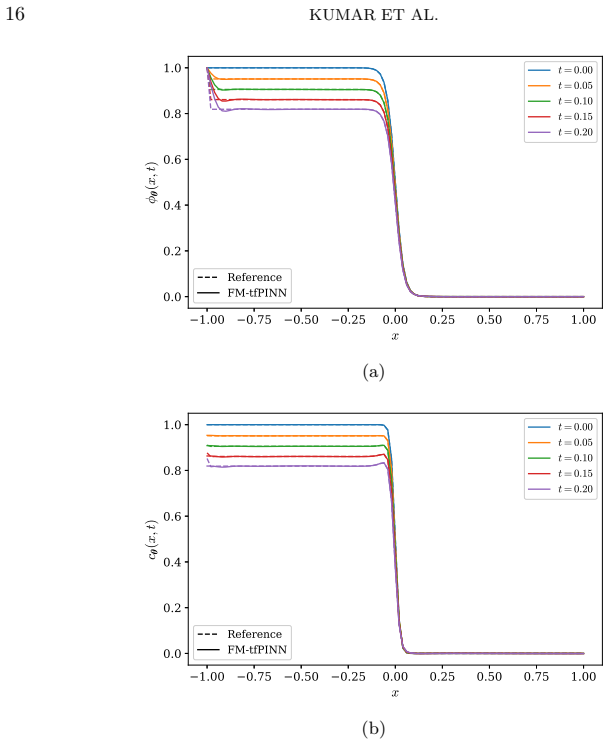
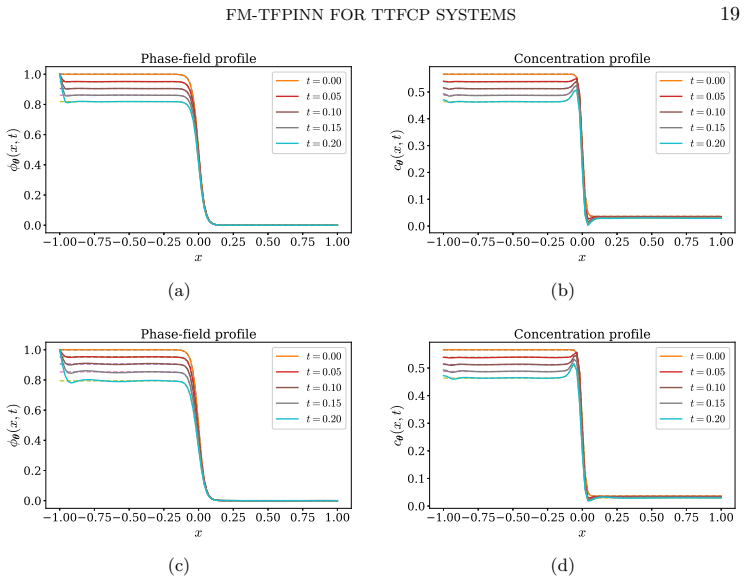
- The coupled phase and concentration fields are recovered accurately in one-dimensional corrosion-front propagation and two-dimensional pitting corrosion.
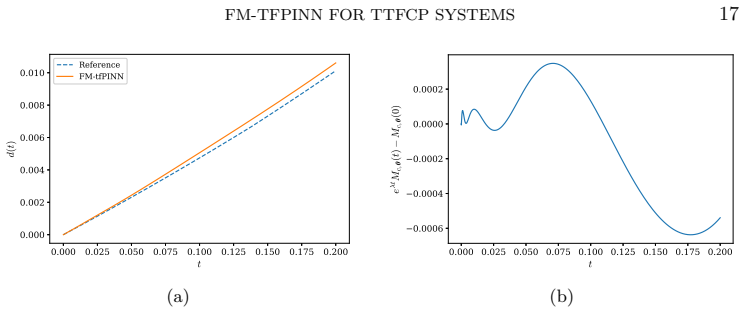
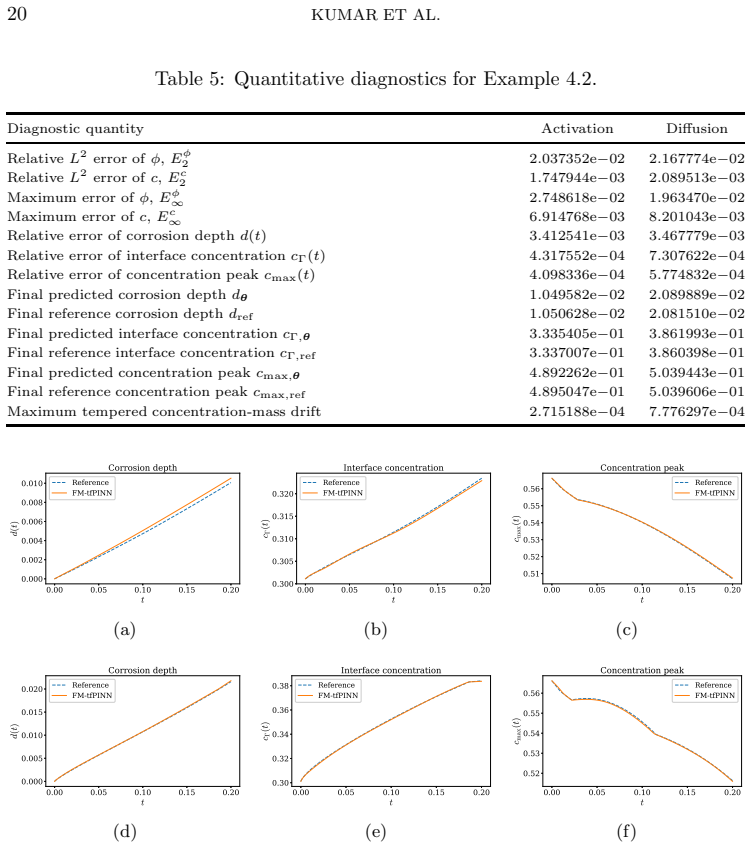
- Physically relevant interface diagnostics such as front position and velocity are predicted robustly.
- Unknown physical parameters such as mobility are estimated reliably from limited observations.
- The approach supports both forward prediction and inverse identification within a single physics-informed loss.
Where Pith is reading between the lines
- The same latent-memory embedding could be tested on other tempered fractional systems that lack moving interfaces but share long-memory transport.
- Graded meshes plus exponential compression may allow extension to three-dimensional or long-time simulations where standard history storage becomes prohibitive.
- The interface-aware collocation strategy might transfer to other diffuse-interface problems that combine fractional time operators with evolving fronts.
Load-bearing premise
The fast shifted residual formulation based on graded temporal meshes and sum-of-exponentials history compression accurately approximates the tempered fractional operators near evolving diffuse interfaces without introducing uncontrolled errors that affect the coupled multiphysics solution.
What would settle it
Running the method on a manufactured exact solution of a tempered fractional phase-field equation and observing whether the recovered interface position or mobility parameter deviates by more than a few percent from the known truth under the same observation density used in the paper's examples.
Figures
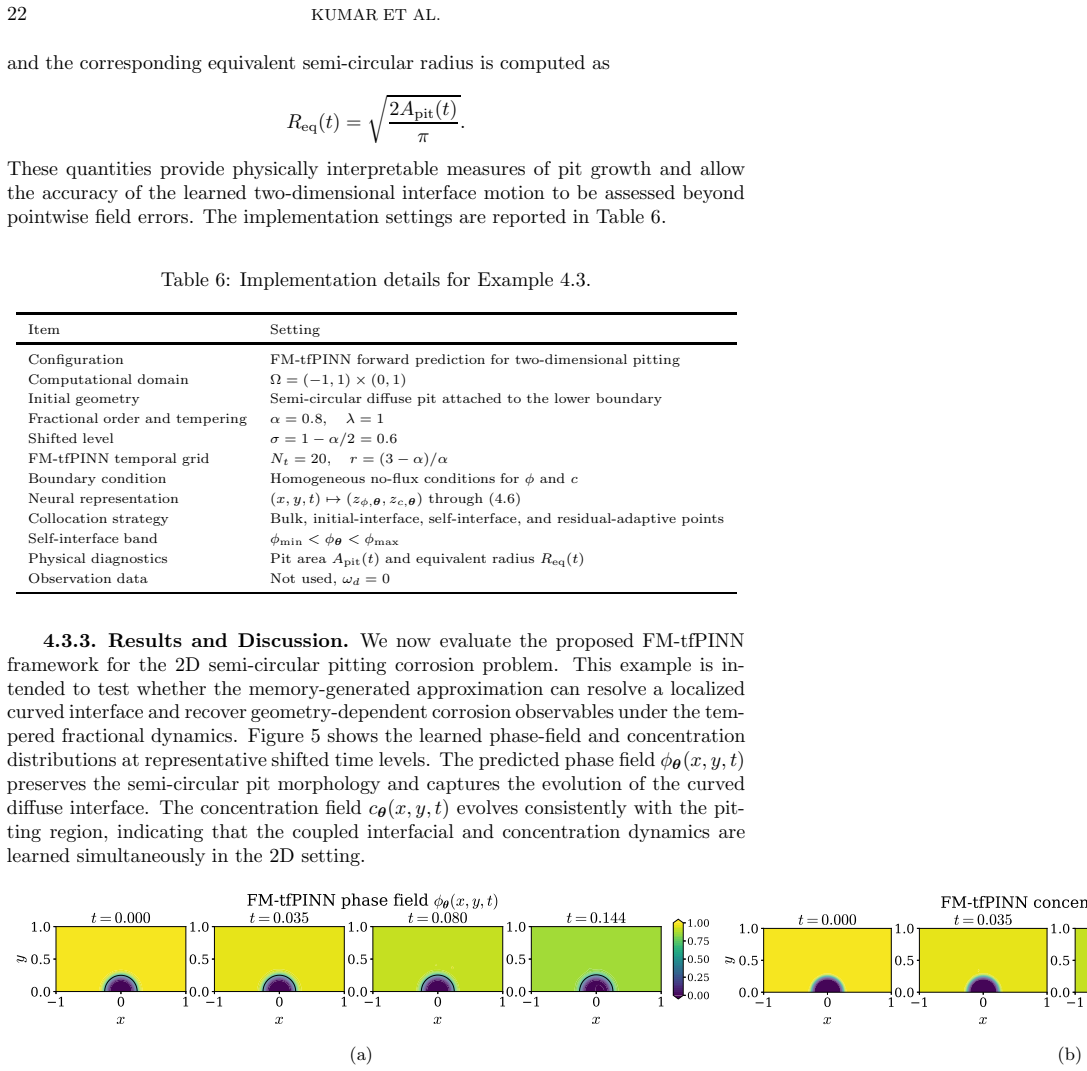
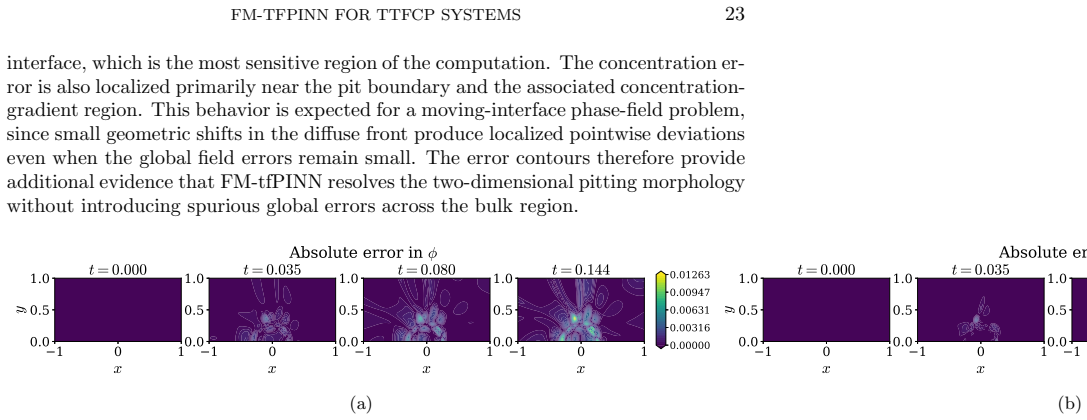
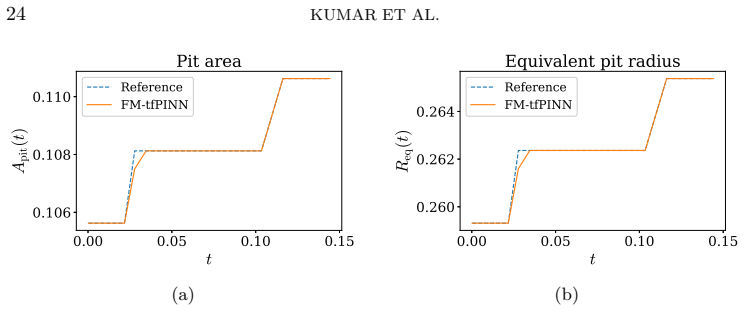
read the original abstract
Tempered time-fractional coupled phase-field (tTFCP) systems are used to model interfacial phenomena involving memory-dependent transport and relaxation mechanisms. Numerical solutions to these systems are challenging due to the simultaneous presence of nonlocal temporal operators, weak initial singularities, moving diffuse interfaces, and strongly coupled multiphysics dynamics. In this work, we introduce FM-tfPINN (fractional-memory physics-informed neural network), which is used for forward simulation and inverse parameter identification in tempered fractional coupled phase-field systems. Unlike conventional fractional PINNs, which enforce memory effects solely through residual constraints, our framework incorporates tempered fractional memory directly into the neural representation via latent memory-source functions and a tempered fractional integral operator. We develop a fast shifted residual formulation based on graded temporal meshes and sum-of-exponentials (SOE) history compression to efficiently evaluate the tempered fractional operators. This framework combines interface-aware and residual-adaptive collocation strategies, improving resolution near evolving diffuse interfaces. A unified, physics-informed loss formulation allows for the forward prediction and inverse recovery of unknown physical parameters from sparse observations. We assess the proposed method on a class of tempered fractional corrosion phase-field models, including one-dimensional corrosion-front propagation, activation- and diffusion-controlled regimes, two-dimensional pitting corrosion, and inverse mobility identification problems. The numerical results demonstrate the accurate recovery of coupled phase and concentration fields, the robust prediction of physically relevant interface diagnostics, and the reliable estimation of parameters from limited data.
Editorial analysis
A structured set of objections, weighed in public.
Referee Report
Summary. The manuscript introduces FM-tfPINN, a physics-informed neural network that embeds tempered fractional memory via latent source functions and a tempered fractional integral operator. It employs a fast shifted residual formulation on graded meshes with sum-of-exponentials (SOE) compression to evaluate the nonlocal operators, combined with interface-aware collocation. The method is applied to forward simulation and inverse parameter recovery for tempered fractional corrosion phase-field models in 1D and 2D, with claims of accurate field recovery, interface diagnostics, and parameter estimation from sparse data.
Significance. If the numerical accuracy claims hold under controlled operator errors, the work would offer a practical route to incorporating long-memory tempered fractional effects into PINN-based multiphysics solvers without prohibitive history storage, which is relevant for corrosion and interfacial transport models. The direct embedding of memory into the network representation and the unified loss for forward/inverse tasks are constructive ideas.
major comments (3)
- [§5] §5 (Numerical Experiments), first paragraph and Tables 1–3: the reported L2 errors and interface-position diagnostics are presented without a separate verification isolating the SOE truncation remainder from the PINN optimization error. Because the phase and concentration equations are nonlinearly coupled through the interface, an a-priori or numerical bound on the local SOE error uniform near the diffuse front is needed to support the claim that the observed accuracy is due to the method rather than test-case specifics.
- [§3.2] §3.2 (Fast Shifted Residual Formulation), Eq. (3.8)–(3.10): the SOE compression is introduced with a fixed tolerance, yet no analysis or numerical check is given showing that the compression error remains controlled when the graded mesh is adapted to an evolving interface whose width is comparable to the mesh grading parameter. This directly affects the weakest assumption identified in the stress test.
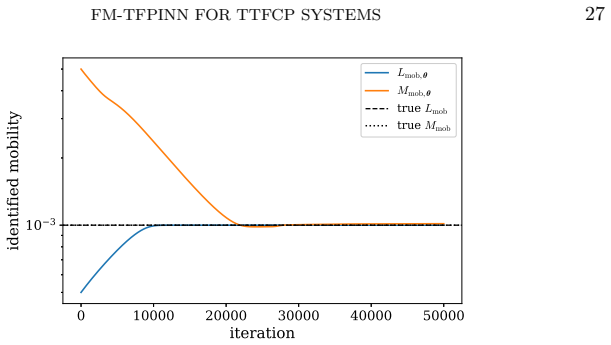
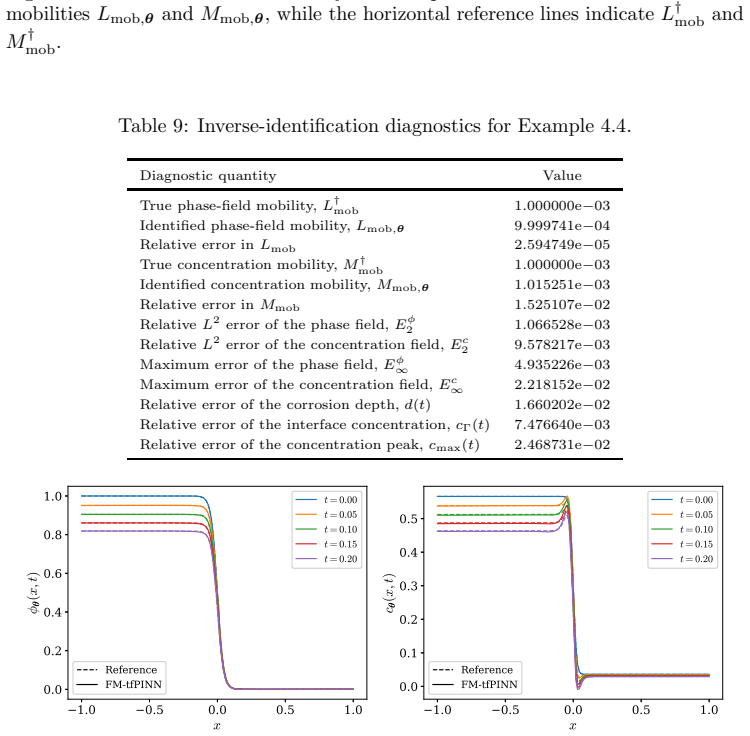
- [§4.3] §4.3 (Inverse Problem), Figure 8 and associated text: parameter recovery is shown for mobility, but the loss formulation does not include an explicit term penalizing or monitoring the residual of the tempered fractional operator itself; therefore the reported parameter accuracy cannot be unambiguously attributed to faithful operator approximation.
minor comments (2)
- The abstract states “accurate recovery” and “reliable estimation” without quoting any quantitative error norms or baseline comparisons; these should be added to the abstract once the numerical section is revised.
- [§2] Notation for the tempered fractional integral operator and the latent memory-source functions is introduced in §2 but reused with slight variations in §3; a single consistent definition table would improve readability.
Simulated Author's Rebuttal
We thank the referee for the constructive and detailed comments. We address each major comment point by point below.
read point-by-point responses
-
Referee: §5 (Numerical Experiments), first paragraph and Tables 1–3: the reported L2 errors and interface-position diagnostics are presented without a separate verification isolating the SOE truncation remainder from the PINN optimization error. Because the phase and concentration equations are nonlinearly coupled through the interface, an a-priori or numerical bound on the local SOE error uniform near the diffuse front is needed to support the claim that the observed accuracy is due to the method rather than test-case specifics.
Authors: We agree that the reported errors combine multiple sources and that an explicit isolation of the SOE truncation contribution would strengthen the validation, especially given the nonlinear coupling. In the revision we will add a dedicated numerical study in §5 that holds the network fixed and varies only the SOE tolerance, thereby providing a numerical bound on the local SOE error near the diffuse front. revision: yes
-
Referee: §3.2 (Fast Shifted Residual Formulation), Eq. (3.8)–(3.10): the SOE compression is introduced with a fixed tolerance, yet no analysis or numerical check is given showing that the compression error remains controlled when the graded mesh is adapted to an evolving interface whose width is comparable to the mesh grading parameter. This directly affects the weakest assumption identified in the stress test.
Authors: The current manuscript introduces SOE compression with a fixed tolerance but does not supply the requested analysis or numerical check for the case of an evolving interface on a graded mesh. We will add such verification experiments in the revised §3.2 (or §5) to confirm that the compression error stays controlled under these conditions. revision: yes
-
Referee: §4.3 (Inverse Problem), Figure 8 and associated text: parameter recovery is shown for mobility, but the loss formulation does not include an explicit term penalizing or monitoring the residual of the tempered fractional operator itself; therefore the reported parameter accuracy cannot be unambiguously attributed to faithful operator approximation.
Authors: The unified loss is constructed from the residuals of the full coupled system, which contain the tempered fractional operators; minimizing the loss therefore enforces operator accuracy. To address the referee’s concern directly, we will revise the loss description in §4.3 to make the operator-residual terms explicit and will add corresponding monitoring diagnostics to the revised Figure 8. revision: yes
Circularity Check
No significant circularity; new method construction evaluated on independent test problems
full rationale
The paper introduces FM-tfPINN as a novel architecture incorporating latent memory-source functions and a tempered fractional integral operator, paired with a graded-mesh SOE residual formulation. These elements are presented as a new construction rather than derived from prior fitted quantities or self-citations. Numerical results on corrosion phase-field models (1D front propagation, 2D pitting, inverse identification) are reported as empirical demonstrations on test cases, with no quoted reduction showing that interface diagnostics or parameter estimates equal inputs by construction. The framework remains self-contained against external benchmarks.
Axiom & Free-Parameter Ledger
Reference graph
Works this paper leans on
-
[1]
Abadi et al
M. Abadi et al. , TensorFlow: A system for large-scale machine learning , in Proc. 12th USENIX Symp. Operating Systems Design and Implementation ( OSDI 16), USENIX As- sociation, 2016, pp. 265–283
2016
-
[2]
T. Q. Ansari, Z. Xiao, S. Hu, Y. Li, J.-L. Luo, and S.-Q. Shi , Phase-field model of pitting corrosion kinetics in metallic materials , npj Comput. Mater., 4 (2018), 38
2018
-
[3]
Arnold, M
A. Arnold, M. Ehrhardt, and I. Sofronov , Discrete transparent boundary conditions for the Schr¨ odinger equation: Fast calculation, approximati on, and stability , Comm. Math. Sci., 1(3) (2003), pp. 501–556
2003
-
[4]
Baeumer and M
B. Baeumer and M. M. Meerschaert , Tempered stable L´ evy motion and transient super- diffusion , J. Comput. Appl. Math., 233 (2010), pp. 2438–2448
2010
-
[5]
A. G. Baydin, B. A. Pearlmutter, A. A. Radul, and J. M. Siskind , Automatic differentia- tion in machine learning: a survey , J. Mach. Learn. Res., 18 (2018), Paper 153, pp. 1–43
2018
-
[6]
W. J. Boettinger, J. A. W arren, C. Beckermann, and A. Karma , Phase-field simulation of solidification , Annu. Rev. Mater. Res., 32 (2002), pp. 163–194
2002
-
[7]
Caginalp, An analysis of a phase field model of a free boundary , Arch
G. Caginalp, An analysis of a phase field model of a free boundary , Arch. Ration. Mech. Anal., 92 (1986), pp. 205–245
1986
-
[8]
W. Cai, X. Li, and L. Liu , A phase shift deep neural network for high frequency approxi mation and wave problems , SIAM J. Sci. Comput., 42 (2020), pp. A3285–A3312
2020
-
[9]
Caputo , Linear models of dissipation whose Q is almost frequency independent–II , Geo- phys
M. Caputo , Linear models of dissipation whose Q is almost frequency independent–II , Geo- phys. J. R. Astron. Soc., 13 (1967), pp. 529–539
1967
-
[10]
Chen , Phase-field models for microstructure evolution , Annu
L.-Q. Chen , Phase-field models for microstructure evolution , Annu. Rev. Mater. Res., 32 (2002), pp. 113–140
2002
-
[11]
N. Chen, S. Lucarini, R. Ma, A. Chen, and C. Cui , PF-PINNs: Physics-informed neu- ral networks for solving coupled Allen–Cahn and Cahn–Hilli ard phase field equations , J. Comput. Phys., 529 (2025), 113843
2025
-
[12]
H. K. Dwivedi, Rajeev, and S. Zeng , Nonuniform tempered Alikhanov scheme for fractional Allen–Cahn equations with discrete maximum principle , J. Sci. Comput., 107 (2026), 17
2026
-
[13]
H. K. Dwivedi, M. Ehrhardt, and Rajeev , Alikhanov-XfPINNs: Adaptive Physics-Informed Learning for Nonlinear Fractional PDEs on Nonuniform Meshe s, arXiv:2605.01305 (2026)
work page internal anchor Pith review Pith/arXiv arXiv 2026
-
[14]
Jiang, J
S. Jiang, J. Zhang, Q. Zhang, and Z. Zhang , Fast evaluation of the Caputo fractional derivative and its applications to fractional diffusion equ ations, Commun. Comput. Phys., 21 (2017), pp. 650–678
2017
-
[15]
B. Jin, R. Lazarov, and Z. Zhou , An analysis of the L1 scheme for the subdiffusion equation with nonsmooth data , IMA J. Numer. Anal., 36 (2016), pp. 197–221
2016
-
[16]
G. E. Karniadakis, I. G. Kevrekidis, L. Lu, P. Perdikaris, S. W ang, and L. Yang, Physics- informed machine learning , Nat. Rev. Phys., 3 (2021), pp. 422–440
2021
-
[17]
A. A. Kilbas, H. M. Srivastava, and J. J. Trujillo , Theory and Applications of Fractional Differential Equations , North-Holland Math. Stud. 204, Elsevier, Amsterdam, 2006
2006
-
[18]
D. P. Kingma and J. Ba , Adam: A method for stochastic optimization , in Proc. International Conference on Learning Representations (ICLR), 2015
2015
-
[19]
H. Liu, A. Cheng, H. W ang, and J. Zhao , Time-fractional Allen–Cahn and Cahn–Hilliard phase-field models and their numerical investigation , Comput. Math. Appl., 76 (2018), pp. 1876–1892
2018
-
[20]
W. Mai, S. Soghrati, and R. G. Buchheit , A phase field model for simulating the pitting corrosion, Corros. Sci., 110 (2016), pp. 157–166
2016
-
[21]
McLean , Regularity of solutions to a time-fractional diffusion equa tion, ANZIAM J., 52 (2010), pp
W. McLean , Regularity of solutions to a time-fractional diffusion equa tion, ANZIAM J., 52 (2010), pp. 123–138
2010
-
[22]
M. M. Meerschaert, Y. Zhang, and B. Baeumer , Tempered anomalous diffusion in hetero- geneous systems , Geophys. Res. Lett., 35 (2008), L17403
2008
-
[23]
Metzler and J
R. Metzler and J. Klafter , The random walk’s guide to anomalous diffusion: A fractional dynamics approach, Phys. Rep., 339 (2000), pp. 1–77
2000
-
[24]
G. Pang, L. Lu, and G. E. Karniadakis , fPINNs: Fractional physics-informed neural net- works, SIAM J. Sci. Comput., 41 (2019), pp. A2603–A2626
2019
-
[25]
Paszke, S
A. Paszke, S. Gross, S. Chintala, G. Chanan, E. Yang, Z. DeVito, Z. Lin, A. Desmaison, L. Antiga, and A. Lerer , Automatic differentiation in PyTorch , in NIPS 2017 W orkshop on Automatic Differentiation, 2017
2017
-
[26]
Podlubny , Fractional Differential Equations , Math
I. Podlubny , Fractional Differential Equations , Math. Sci. Eng. 198, Academic Press, San Diego, CA, 1999
1999
-
[27]
Provatas and K
N. Provatas and K. Elder , Phase-Field Methods in Materials Science and Engineering , Wiley-VCH, W einheim, 2010. 30 KUMAR ET AL
2010
-
[28]
Raissi, P
M. Raissi, P. Perdikaris, and G. E. Karniadakis , Physics-informed neural networks: A deep learning framework for solving forward and inverse problem s involving nonlinear partial differential equations , J. Comput. Phys., 378 (2019), pp. 686–707
2019
-
[29]
H. Ren, X. Meng, R. Liu, J. Hou, and Y. Yu , A class of improved fractional physics informed neural networks , Neurocomputing, 562 (2023), 126890
2023
-
[30]
Sabzikar, M
F. Sabzikar, M. M. Meerschaert, and J. Chen , Tempered fractional calculus, J. Comput. Phys., 293 (2015), pp. 14–28
2015
-
[31]
J. Shi, X. Liu, and X. Yang , Data-driven solutions and parameter estimation of the high - dimensional time-fractional reaction-diffusion equation s using an improved fPINN method , Nonlinear Dyn., 113 (2025), pp. 9577–9604
2025
-
[32]
Stynes, E
M. Stynes, E. O’Riordan, and J. L. Gracia , Error analysis of a finite difference method on graded meshes for a time-fractional diffusion equation , SIAM J. Numer. Anal., 55 (2017), pp. 1057–1079
2017
-
[33]
T. Tang, H. Yu, and T. Zhou , On energy dissipation theory and numerical stability for time-fractional phase-field equations , SIAM J. Sci. Comput., 41 (2019), pp. A3757–A3778
2019
discussion (0)
Sign in with ORCID, Apple, or X to comment. Anyone can read and Pith papers without signing in.